I. INTRODUCTION
Excessive free radicals in the body may cause the natural antioxidants produced by the body to be unable to reduce the danger of these free radicals, resulting in cell damages. Therefore, the intake of antioxidants from outside the body that can prevent, overcome and even repair the damage is required. Nowadays, there has been increasing interest in the use of marine natural compounds replacing chemicals either for treatment of specific diseases (Anis M., et al., 2018; Boopathy, N. S., & Kathiresan, K., 2013; Syaharuddin et al., 2018; Sun, Z., et al., 2018) or daily antioxidant intake. There are various resources of natural antioxidants, including the phenolic compounds of the red algae (Eucheuma cottonii) and brown algae (Sargassum sp.).
South Sulawesi is one of province in Indonesia which has a great potential as a Eucheuma cottonii seaweed producer. The total production of Eucheuma Cottoni in Indonesia reaches 3,082,113 tons which is about 50% of the world's seaweed product. The red algae (Eucheuma cottonii) and brown algae (Sargassum sp.) are also known to contain phenolic compounds that can act as antioxidants (Denny, 2013; Ermina P., et al., 2018). According to Irianti, et al. (2007), polyphenol compounds can be considered as the most important antioxidant component in plants. The antioxidant mechanism of polyphenol compounds is due to the presence of hydroxyl groups which are capable of binding to free radicals, thus forming more stable compounds.
Based on the polarity consideration of the hydroxyl groups, extraction of polyphenol compounds using polar solvents will be more effective than non-polar solvents (Nontji A, 2007). In addition, extraction methods can also affect the value of antioxidant activity. The study by Ermina P. et al., (2018) demonstrated that the n-hexane extract of Eucheuma cottonii which was extracted by maceration equipped by sonication method had antioxidant activity with IC50 of 119.208 g/mL while extract using conventional maceration method had higher value of antioxidant activity with IC50 of 77,62 g/mL. The extraction of polyphenol compounds from brown algae was also carried out by Indriawati (2015) using ethanol: water (50:50) with the temperature of 40oC by liquid-liquid extraction method, showing the antioxidant activity with IC50 value of 1770 mg/L (Indriawati, 2015). Based on these studies, the extraction of phenolic compounds from red algae (Eucheuma cottonii) and brown algae (Sargassum sp.) using the method of maceration by digestion using ethanol: water (50:50) as solvents at 40oC. The antioxidant activity assay was carried out by DPPH method.12 The purpose of this study was to obtain the extract of polyphenolic compounds from red algae (Eucheuma cottonii) and brown algae (Sargassum sp.) which has antioxidant activity.
II. EXPERIMENTAL
a) Collection and identification of samples
Samples of red algae Euchema cottoni and brown algae Sargassum sp. were collected from a cultivation area in Takalar Regency, South Sulawesi,
Indonesia thus identified the taxonomic positions in the Biology Department, Faculty of Mathematics and Natural Sciences, Hasanuddin University, Makassar, Indonesia. Fresh samples were washed using distilled water and cleaned form salt residue by soaking them in warm water. Washing and soaking were done 3 times. Fresh samples were immediately extracted after the sampling preparation process. While dried algae were obtained after vacuum drying at C in the Laboratory of Biofarmaka, Faculty of Pharmacy, Hasanuddin University.
b) Extraction Process
The fresh and dried samples of Eucheuma cottonii and Sargassum sp. were blended into a fine powder with a grinder (Sico®) then were weighed (Sartorius®) to 60 g each, and soaked in mixture of ethanol: water (50:50) as a solvent. The maceration method at a temperature of 40°C equipped with constant stirring speed of 800 rpm. After 8 hr., the resulting liquid extract was then centrifuged at 4000 rpm for 5 minutes. The supernatant was evaporated using a rotary evaporator. The liquid extract obtained was then evaporated at dark shade in room temperature. During the evaporation process, ethanol is added to the extract until a thickened extract is obtained.
c) Separation of Compounds Based on Solubility
The obtained extract of dried Euchema cottonii was dissolved with 20 ml ethanol and then inserted in separation funnel. 20 ml of n-hexane was added and the mixture was homogenized and allowed to stand for 5 minutes. The n-hexane fraction was taken and then the ethanol fraction is added with 20 ml of ethyl acetate, homogenized and allowed to stand for 5 minutes and then the ethyl acetate fraction was separated from the ethanol fraction. Hexane fraction, ethyl acetate fraction and ethanol fraction were obtained as the final results.
Sargassum sp. extract was dissolved in 50 ml of ethanol and 50 ml of hexane was added and the mixture was shaken for 10 minutes and allowed to stand for 5 minutes. The upper layer was taken and evaporated. 50 ml of ethyl acetate was added to the lower layer and the mixture was shaken for 10 minutes and allowed to stand for 5 minutes. The upper layer was taken and evaporated. 50 ml of water was added to the bottom layer and the mixture was shaken for 10 minutes and allowed to stand for 5 minutes. The top and bottom layers were separated and evaporated at room temperature.
d) Identification of Polyphenol Compounds with the Folin-Ciocalteu Method
The dried fractions were analyzed for their polyphenol content using Folin-Ciocalteu reagents. Each of the fractions was taken sufficiently and dissolved in suitable solvent and then inserted in the test tube. The fractions were added with 7.5% Folin-
Ciocalteu reagent and 1% NaOH sufficiently and then homogenized. The change of color to blue indicated the presence of polyphenol compounds in the extract.
e) Identification Using Thin Layer Chromatography
The fractions obtained from liquid-liquid extraction were added into vials separately and dissolved with adequate ethanol and then spotted on TLC plates that had been activated by heating at 110oC for 1 hour. TLC plates were developed using a mixture of methanol: Chloroform (3:1) as eluent. The spots were observed using UV lamps 254 and 366 nm.
f) Determination of Total Phenolic Content
The gallic acid solution was made by dissolving 10 mg of gallic acid in water in a 10 ml-volumetric flask (stock solution of 1000 ppm). For Eucheuma cottonii, the standard solution of gallic acid was prepared in the concentration of 0.5; 1.5; 3; 5; and 7 ppm by pipetting: 2.5 l; 7.5 l; 15 l; 25 l; 35 l of stock solution respectively and for Sargassum sp. the standard solution of gallic acid was prepared in the concentration of 0.15, 0.5, 1.5, 3, 5, and 7 ppm by pipetting 7.5 l, 25 l, 75 l, 150 l, 250 l and 350 l of stock solution respectively. Each of the standard solution was added into 5 ml-volumetric flask followed by 2.5 ml of folin reagent and the mixture was homogenized. 2 ml of 1% NaOH was added to the mixture and diluted to the mark with water. The absorbances were measured with UV-Vis spectrophotometer.
The sample measurement procedure was performed by preparing a stock solution of 10,000 ppm, each of which 50 mg of ethanol fraction and ethyl acetate fraction were dissolved in 5 ml of ethanol. 3 dilution series were prepared by pipetting 500 l of stock solution followed by 2.5 ml of 7.5% Folin-Ciocalteau reagent and 2 ml of 1% NaOH. The mixture was allowed to stand for 30 minutes and the absorbances were measured at maximum wavelength using UV-Vis spectrophotometer.
g) Antioxidant Activity Assay Using DPPH Method
Each 30 mg of the Eucheuma cottonii fractions was dissolved with ethanol in a 10 ml-volumetric flask (concentration of 3000 ppm), then a stock solution was prepared by pipetting 160 l of the solution into a 5 ml-volumetric flask and diluted to mark with ethanol p.a. (concentration of 100 ppm). 1; 1.5; 2; 2.5; and 3 ml of stock solutions were pipetted respectively, followed by 1 ml of DPPH stock solution (160 ppm) and diluted to mark with ethanol p.a. The mixtures were allowed to stand for 15 minutes at room temperature, then the absorbances were measured using UV-Vis spectrophotometer at the wavelength of 516 nm.
For Sargassum sp., 20 mg of the ethyl acetate fraction and ethanol fraction containing polyphenol compound were dissolved with ethanol in a 10 ml-volumetric flask, stock solution was prepared by pipetting 0.05 ml of the solution into a 5 ml-volumetric flask and diluted to mark with ethanol to obtain the concentrations of 20, 40, 60, 80, and 100 ppm and 1 ml of DPPH was added to each concentration and the mixtures were allowed to stand protected from light for 30 minutes. The absorbances were measured at 517 nm.
h) Experimental Analysis
One-way analysis of variance (ANOVA) was used to compare the antioxidant activity of E. cottonii and Sargassum sp. extracts, as well as the absorbance value of spectrophotometry results. The SPSS program (version 20.0; SPSS Inc., Chicago, IL, USA) was performed to further analyze the data. All p-values less than 0.05 were considered statistically significant.
III. RESULTS AND DISCUSSION
In this study, the extraction of polyphenolic compounds from red algae Eucheuma cottonii and brown algae Sargassum sp. was carried out using the method of maceration by digestion with low temperature heating (40°C) at 800 rpm for 8 hours. This method was chosen because it had several advantages such as faster extraction time and stirring and slight warming could prevent the thickening of the solvent and precipitation of the extracted compound. The solvents used in the extraction were ethanol: Water (50:50). Previous study by Indriawati (2015) showed that the use of ethanol: Water (50:50) as solvents could provide the highest phenolic content compared to other concentrations. The solvent mixture was used because it is a polar compound which is capable of extracting polar polyphenol compounds.
The results of the extraction of Eucheuma cottonii and Sargassum sp. are shown in table 1. The results showed that the yield for dried samples was higher compared to fresh samples. The difference was probably caused by lesser water content in the dried samples than the fresh samples thus affecting the extraction process.
| Sample | Sample Weight (g) | Extract weight (g) | Yield (% w/w) |
| Eucheuma cottonii dried sample | 60 | 1,9 | 3,17 |
| Eucheuma cottonii | 60 | 0,453 | 0,76 |
| fresh sample | |||
| Sargassum sp. dried sample | 60 | 9,1319 | 15,21 |
| Sargassumsp.fresh sample | 60 | 0,2616 | 0,44 |
| fresh sample | |||
| Sargassum sp. dried sample | 60 | 9,1319 | 15,21 |
| Sargassumsp.fresh sample | 60 | 0,2616 | 0,44 |
The qualitative identification of ethyl acetate fraction and ethanol fraction using Folin-ciocalteu method obtained a blue solution. The change of color was caused by the reduction of the phosphopolythdate phosphotungstate by the polyphenolic compounds present in Folin Cioucalteu and forminga blue-colored molybdenum. These results indicated that the ethyl acetate fraction and ethanol fraction of Eucheuma cottonii contain polyphenol compounds while for the hexane fraction there was no change of color which indicated the absence of polyphenol compounds. Positive results were obtained on ethyl acetate fraction and ethanol fraction of the Sargassum sp. samples. While negative results were observed on the hexane fraction. This difference was due to the hexane solvent being nonpolar, hence polyphenol compounds might not be present in the hexane fraction.
| Sample | Fraction | Rf value |
| Dried Eucheuma cottonii | Ethyl acetate | 0,61 |
| Ethanol | 0,55 | |
| Fresh Eucheuma cottonii | Ethyl acetate | 0,71 |
| Ethanol | 0,55 | |
| Dried Sargassum sp. | Ethyl acetate | 0,73 |
| Ethanol | 0,68 | |
| Fresh Sargassum sp. | Ethyl acetate | 0,71 |
| Ethanol | 0,65 | |
| Gallic acid | - | 0,68 |
The qualitative test by TLC method used silica gel GF 254 as the stationary phase, the mobile phase was a mixture of methanol: Chloroform (1:1) with gallic acid as the standard solution. It could be concluded from the Rf value that the ethyl acetate fraction of both samples might have the same compound with the standard solution.
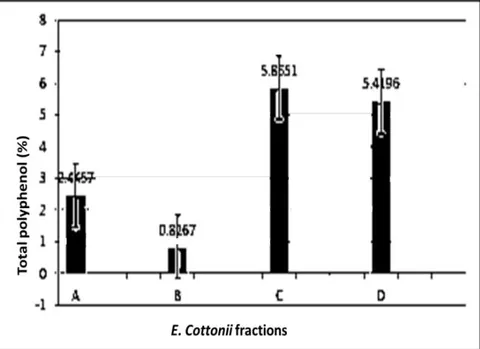
Total polyphenol content of ethyl acetate fraction and ethanol fraction of Eucheuma cottonii were 0.24% and 0.08% respectively, while for the fresh sample the total polyphenol content of ethyl acetate fraction and ethanol fraction were 0.59% and 0.54% respectively. The measurements showed that the highest polyphenol content was found in the ethyl acetate fraction of the fresh sample of Eucheuma cottonii and the lowest content was observed in ethanol fraction of dried sample. For Sargassum sp., the highest polyphenol content was obtained on ethyl acetate fraction of fresh sample with the value of 0.34% and the lowest content was obtained in ethanol fraction of dried sample with the value of 0.01%.
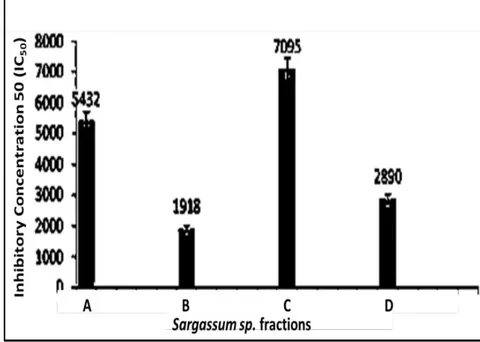
The antioxidant activity assay was performed using DPPH method. This method was chosen because it is a simple, fast and does not require many reagents. Moreover, the results of DPPH measurements show the general antioxidant activity of the sample and does not based on the type of radical inhibited (Juniarti, 2009). Antioxidant activity was measured using UV-Vis spectrophotometer and the percentage of DPPH radical binding will be used to calculate IC50 value. Determination of IC50 value aimed to determine the antioxidant activity of the fraction. IC50 shows the concentration of extracts that can provide DPPH damping by 50%. The smaller the value of IC50, the greater the antioxidant activity.
| Sample | AAI | Classification | |
| Ethanol fraction Dried sample | 52.36 ppm | 0.611 | (high antioxidant activity) AAI (moderate antioxidant activity) |
| Ethyl acetate fraction Dried sample | 400.867 ppm | 0.079 | (very low antioxidant activity) AAI (very low antioxidant activity) |
| Ethanol fraction Fresh sample | 113.24 ppm | 0.283 | (low antioxidant activity) AAI (low antioxidant activity) |
| Ethyl acetate sample Fresh sample | 255.27 ppm | 0.125 | (moderate antioxidant activity) AAI (low antioxidant activity) |
| Vitamin C | 4.102 ppm | 7.801 | (very high antioxidant activity) AAI (very high antioxidant activity) |
| Sample | IC50 | AAI | Classification |
| Ethanol fraction Dried sample | 1.918 ppm | 0.016 | IC50(very low antioxidant activity) AAI (very low antioxidant activity) |
| Ethyl acetate fraction Dried sample | 5.432 ppm | 0.005 | IC50(very low antioxidant activity) AAI (very low antioxidant activity) |
| Ethanol fraction Fresh sample | 2.890 ppm | 0.011 | IC50(very low antioxidant activity) AAI (very low antioxidant activity) |
| Ethyl acetate sample Fresh sample | 7.095 ppm | 0.004 | IC50(very low antioxidant activity) AAI (very low antioxidant activity) |
| Vitamin C | 4.102 ppm | 7.801 | IC50(very high antioxidant activity) AAI (very high antioxidant activity) |
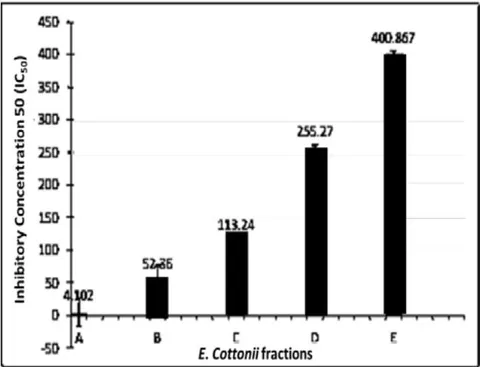
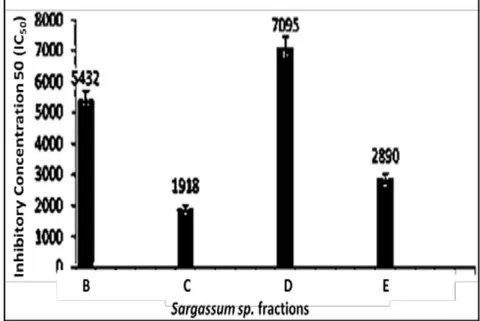
The results of the antioxidant activity assay showed the highest IC50 value for ethanol fraction of dried Eucheuma cottonii and ethyl acetate fraction of fresh Sargassum sp. Meanwhile, the lowest IC50 values was obtained from methyl acetate fraction of dried Eucheuma cottonii and Sargasum sp. The low antioxidant activity might result from improper separation processes, as well as other factors that may affect.
IV. CONCLUSION
Based on this study it can be concluded that the dried sample of red algae (Eucheuma cottoni) and brown algae (Sargassum sp.) had a higher yield percentage than fresh samples. The highest total polyphenol content was obtained from ethyl acetate fraction of fresh Eucheuma cottonii with the value of 0,59%, while the ethanol fraction of dried sample had the lowest polyphenol content of 0,08%. For Sargassum sp., the highest polyphenol content was obtained from ethyl acetate fraction of fresh sample with the value of 0,34% and the lowest was obtained from the ethanol fraction of dried sample with the value of 0,01%. The ethanol fraction of dried Eucheuma cottonii had better antioxidant activity than other fraction with IC50 value of 52,36 ppm (classified as high antioxidant activity) and AAI value of 0,611. While the ethyl acetate fraction of the dried sample had the lowest antioxidant activity compared to other fractions with IC50 value of 400.867 (very weak antioxidant activity) and AAI value of 0.079. For Sargassum sp., the antioxidant activity of all fractions was very weak.
ACKNOWLEDGEMENT
We thank all staff of Faculty of Pharmacy, Hasanuddin University and the Centre for Research and Laboratory Biofarmaka for providing all the facilities.
Footnotes
ml of stock solution was pipetted and inserted into a 5 ml-volumetric flask and diluted to mark with ethanol p.a (32 ppm), then homogenized and allowed to stand for a few minutes. The absorbance was then measured with spectrophotometer at the wavelength of 516 nm. (p.2) ↩
mg of DPPH was dissolved in 50 ml of ethanol p.a in a volumetric flask (160 ppm). (p.2) ↩