

I. INTRODUCTION
Against Explosions and any other shock waves the structure should have a capacity of protecting people. In some facilities like plants there are a lot of people working in the area where the usage of an explosive gas is used should be defend against blasts. To maintain the protection against these actions the wall should be constructed much thicken enough with normal strength- ranged reinforced concrete. The lateral stress caused by blasts and earthquake Fiber Reinforced concrete (FRC) which is a solution know for its high energy absorption capacity and high tensile strength. The difference between concrete and Fiber Reinforcement concrete (FRC) has high tensile strength and toughness. In FRC the fiber is the main substance to improve the properties of Material.
On the opposite addition of fiber in concrete mixer causes decrease workability and increase viscosity and Yield Stress, due to poor yield strength FRC with high fiber content has described as a fiber ball effect while the mixing process and negative reinforced concrete performance. Therefore, as to achieve the maximum mechanical performance without Practicable issue, Slurry Fiber Concrete was introduced. For FRC the fiber content should be equally fair between mechanical properties and workability.
The reinforcing fibers for improving the cement Material properties have different roles or performance depending on their condition length to diameter ratio, materials or different shapes. The materials, reinforced fiber can be classified into metallic and polymeric fibers. The Metallic fiber mainly used in steel fiber increases the toughness of the Mixture. The Metallic fiber includes a high elastic modulus and high tensile strength i.e., it gives an increasing tensile strength and elastic modulus while it is taken out from the cement mixer. As the Metallic fiber has high tensile strength than cement cast, the failure practice of fiber is pulling out of the fibers, so there are different types of geometrics of the Metallic fibers such as hooks, bents and different cross sections. In other way, Polymeric fibers like polypropylene, polyethylene, nylon fibers etc., Comparatively have less tensile strength and elastic modulus than metallic fiber. So, the polymeric fiber can't advance the mechanical properties of the Mixture as compared to the Metallic fiber. Because of the good cement mechanical properties in fresh state, it has higher chance of increasing mechanical properties of mixture. Specifically, polymeric fiber has high length to diameter ratio with in diameter, and because of the flexibility of the shape it doesn't decrease the Practicability of the Mixture than metallic fiber. The combination of different types of attain synthetic effect which are known as Hybrid fiber or cocktailed fiber. Substances like Banthia et al and Markovic et al give a resulted much better in mechanical properties of FRC with two fibers with different materials and Peng et al resulted two different polymeric fibers with different length to diameter ratios and melting point for much better work of reducing spalling damage of high-performance concrete mixture. This has made us to see the improvement of the of the wanted properties of FRC with combined fibers or hybrid fibers with low fiber content to achieve the much better Workability. Therefore, mixing of different kinds of fibers has used as a solution of low workability by low fiber content with equivalent performance.
However, many research has Reported combination of fiber for increasing the Mechanical properties. More importantly the issue of securing the quality of fiber diffusion and relatively decreased Workability, it's has been made harder to use FRC on field using ready mixed concrete system which includes plant mixing, causes trouble in truck delivery and placing along the pump. The goal is to provide a protectable concrete against Explosions and Blasts, which is obtained the required act and agreeable practicable by combining the Fibers. Therefore, it is decided to place in both fresh concrete placing and in the protection of broken things. This experiment was conducted in field for a Real Plan Construction. The result of the research is to make a high performance fiber reinforced concrete properties which has an agreeable protecting performance and workability.
II. LITERATURE REVIEW
The types of methods available in prediction of Blast Effect on Structural Building are: - Empirical Methods, Semi Empirical Methods and Numerical Method. Empirical Method are basically parallel with experimental data. Most of the way are limited by the limit of the basic experimental database. The certain Empirical Equations lowered as the blast events have been become to greater extent near fields. Semi Empirical Methods are based upon easy made models of physical phenomena. The attempt is to model the fundamental essential physical processes in an easy manner. These methods are reliable on through data and case study. Numerical Methods are based on mathematical equations that explains the fundamental laws of physics commanding a problem. These laws containing mass, momentum and energy. In addition, the physical behaviour of materials is explained by essential relationship. These are very well known as Computational Fluid Dynamics (CFD) Models.
III. METHODOLOGY
a) Details of Blast Protection Wall Panel
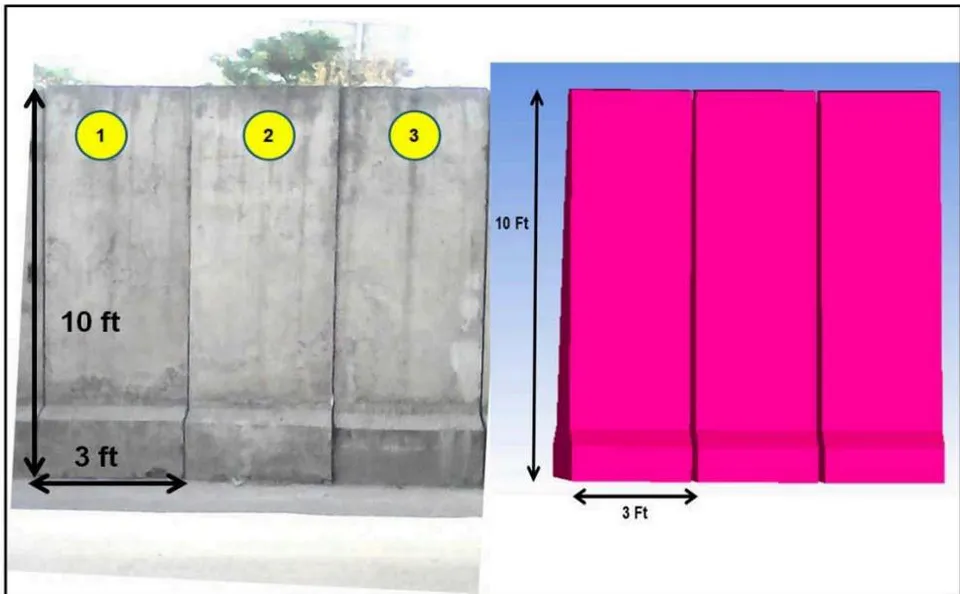
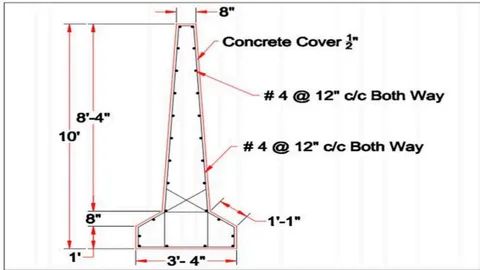
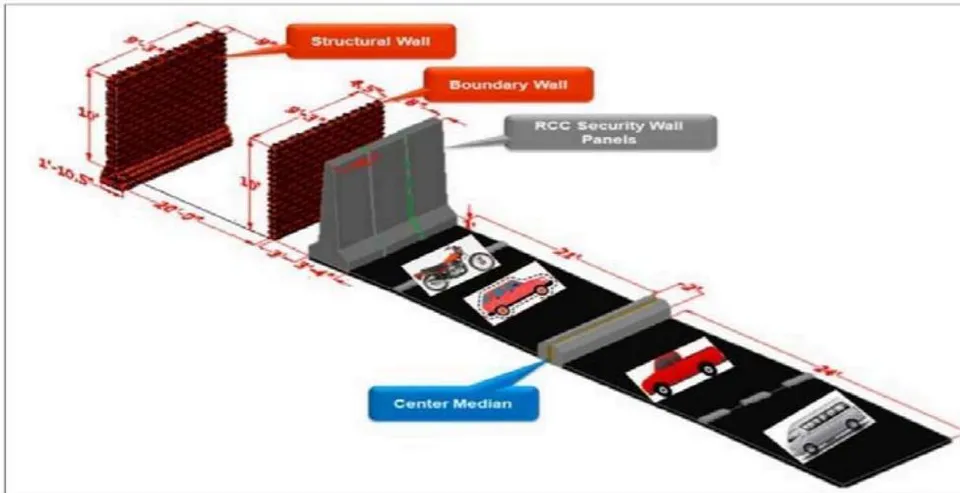
RCC wall panel reduces the blast damage effect. RCC wall panels are placed in front of the boundary side by side which makes a large barrier of wall in front of the structure. The RCC wall panel is of size 10 ft in height, 3 ft in width, 8 inch in thick and 3 ft 4 inch thick from bottom of the panel.
b) Material Properties
Materials: Brick, Concrete, Mortar, TNT, Air and Mechanical Properties of RCC are not available as it is hard to model concrete and steel that requires a lot of Knowledge. However, the researchers worked on it and by several experiments has given them a result in modified properties and have been proposed to be use in reinforcing bars in concrete. Here are the different Properties used Materials.
c) Techniques used for Strengthening of Structure against Blasts
A lot of research had been made to improve the strength of the Existing Structure. The Structure Members Fail due to large dynamic load occurs. Different improvement techniques have made and used to strengthen the structure against the Blast Loading. The following are some of technique are being used to backfit the existing structure for Strengthening the structure against the blasts and to improve the overall uprightness of the Structure.
1. Aramid fibre reinforced plastics (AFRP)
2. Fibre reinforced polymers (FRP)
3. Ultra-high performance fibre reinforced concrete
4. Glass fiber reinforced polymers
5. Carbon fiber reinforced polymers
6. Polyurethane elastomers
7. Steel jacketing
8. Strain hardening cementations composites
9. Steel plates
10. Glass curtain walls
11. FRP composites
12. Use of GFRP
13. Use of steel jackets and strips
d) Failures in Existing Plan
1. The Base of the RCC wall panel is not Fixed
2. Intermediate space between RCC wall Panels
- RCC wall Panels not designed for Blast Loading e) The Technique used to Strengthening the Existing Structure against Blasts

The Steel Strips Technique is used to increase the resistance strength of the pre-existing structure against blasts. It's east for the installation and more effective and economic in compared to the other backfit Techniques. A Probabilistic Risk Assessment (PAR) has made to check or predict the risk of an explosive charge weight and its placement.
| Ser | Location | TNT (Kilograms) |
| 1 | U.S. Consulate Karachi | 70 |
| 2 | U.S. Consulate Karachi | 100 |
| 3 | Parachinar, Pakistan | 50 |
| 4 | Charbagh, Swat Valley, KPK | 60 |
| 5 | Police Checkpoint Peshawar | 80 |
| 6 | Orakzai Agency, FATA | 95 |
| 7 | Khyber Bazaar, Peshawar | 30 |
| 8 | Timergara, Lower Dir | 75 |
| 9 | Lakki Marwat District, KPK | 79 |
| 10 | Khyber Agency, FATA | 56 |
| 11 | Ghalanai, Mohmand Agency, FATA | 50 |
IV. ANALYSIS OF FIELD APPLICATION
a) Field Conditions for Site and Mixture
The Experiment was held at a chemical plant which manufactures Cosmetics. For the manufacturing of the Cosmetic high-pressured gas should be introduced which is cautious and we should allocate a special area for this process and it should be protected from any kind of sudden explosions or blasts. The main structure is made of reinforced concrete structure. In this research, the outer wall of the protected area was covered with High-performance fibre-reinforced
Cementitious composites (HPFRCC). The applied amount of HPFRCC was about for 3 m depth of the protective wall. The concrete mixture was delivered by the truck with agitator (stirrer) was placed using the ready mixed concrete system mixing at the plant and to placed by the pump. The Target concrete mixture has target compressive strength at 28 days of 25 MPa, and 150 mm of target Slump. Apart from the laboratory test, the field applied concrete has a coarse aggregate of size of 25 mm. To develop workability, combined fiber of SF to PF of 1:1 was replaced by 1% of entire volume of the mixture.
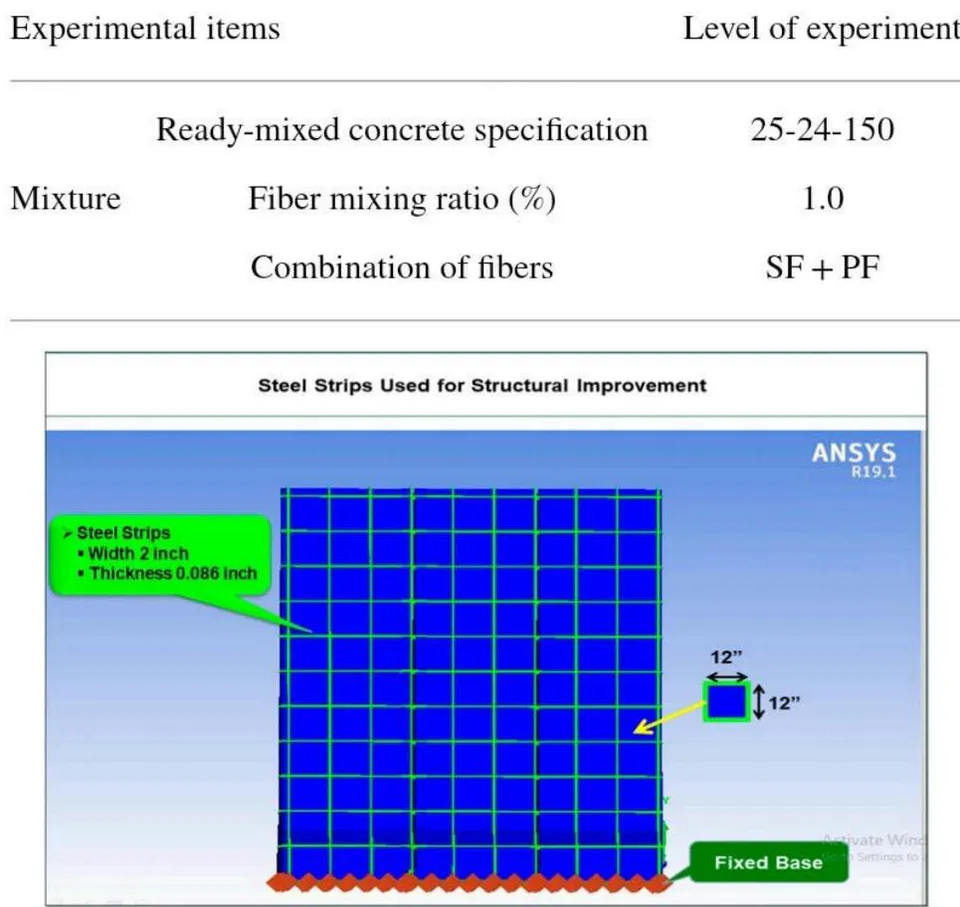
The concrete was mixed with a method called Central Mix Method in the ready mixed concrete plant. As the plant doesn't have the framework of fiber in addition thus the fiber was introduced manually from the provided entrance of the premeasured quantity. The time taken for mixing of HPFRCC was around 1-2 minutes instead of 30-40 seconds of regular concrete to give required workability and diffusion of Fiber. Different methods of delivery and placing of concrete are done with the agitator (stirrer) truck and pump truck.
b) Test Method
To check the properties of the mixture for the real field Work, Slump and Slump flow test for Practicable, air condition and compressive strength for mechanical properties are Noted down. The testing samples were taken from the and agitator (stirrer) truck arrived at the site. Each and every test was conducted following ASTM C143, C1611, C231 and C39 methods for Slump, Slump Flow, Air Condition and Compressive Strength. The Compressive Strength is conducted at 28 days age.
V. RESULT OF FIELD APPLICATIONS
The primary thing is that the slump and Slump flow results are taken.
| Division | Slump (mm) | Slump flow (mm) | Air contents (%) | Compression strength (MPa) | ||
| 7 days | 28 days | |||||
| First agitator truck arrived in site | Before pumping | 130 | 225/220 | 4.0 | 20.9 | 30.9 |
| After pumping | 170 | 240/300 | 3.6 | 23.8 | 32.7 | |
| Third agitator truck arrived in site | Before pumping | 135 | 230/240 | 3.8 | 21.8 | 31.0 |
| After pumping | 160 | 310/280 | 3.5 | 24.2 | 33.1 | |
The fluidity of the concrete mixture was raised after the pumping. In general workability of concrete is decreased in slump or flow after the pumping. In this research however the fiber reinforced concrete is throughout the fiber in concrete mixer was adjusted by the pressure of the pumping and it provided the improved fluidity of the fiber reinforced concrete mixture. In spite of increases fluidity of the mixture, air content of concrete was decreased. It is similar trend of already reported results of studies. However, in general, the properties of fresh-state fiber-reinforced concrete mixture were acceptable to use field construction, and there was no problem on placing process of the wall.
The field-processed HPFRCC's mechanical properties were evaluated with compressive strength. All concrete samples showed over 30 MPa and it absolutely was above the target compressive strength of 25 MPa. For the concrete mixture obtained after the pumping, slightly increased compressive strength was observed. It should be stated that decreased air content and well-oriented fiber can contribute to the improved compressive strength. For more detail, although it's a necessity to review the relation between pumping and performance of HPFRCC, during this research, the goal of the experiment was evaluating field applicability of HPFRCC, thus it is not discussed during this paper.
VI. CONCLUSION
Safe design of RCC wall is done by either increasing the thickness of wall or by increasing the share of steel. Just in case where there's restriction of space, such the wall thickness has been restricted it's desirable to increase the share of steel because it winds up in safer design from ductility point of view but should accommodate the minimum percentage of steel. This might cause cost effectiveness of RCC wall. It has been found that for a 200mm thick RCC wall, minimum percentage of steel required to resist blast loading is 0.75%. For a 250mm thick RCC wall, percentage of steel required to resist blast loading is 0.40%. For a 300mm, thick RCC wall percentage of steel required to resist blast loading is 0.25%.
In this research with a goal of applying HPFRCC on field conditions, the workability, mechanical properties, and protecting performance of combined fiber-reinforced concrete mixtures were evaluated, and field application was conducted with a ready-mixed concrete system. Per a series of experiment, some conclusions are obtained as follows:
By using combined fibers of SF and PF, fresh-state properties of HPFRCC were improved rather than the case with the unfavorable result with one fiber and showed better performances than the averaged value of each single-type fiber-reinforced mixture.
For mechanical properties of compressive, flexural, and tensile strengths, the mixture with combined fiber showed improved values rather than any single-type fiber-reinforced mixtures.
Regarding the protection performance against flying debris, the HPFRCC panel reinforced by combined fiber showed the foremost desirable performance of protecting the high-velocity projectile.
The combined HPFRCC showed improved mechanical and protective performances with favorable workability. Supported by these improved features of combined fiber reinforcement, field application of combined HPFRCC was successful under the ready-mixed concrete system including agitators, delivering, and placing.