





1. Introduction
Adolescent motherhood is a major public health concern, particularly in low‑ and middle‑income countries where early childbearing remains common. In Kenya, many girls aged 15–19 years especially in rural and peri‑urban areas like Kajiado, face significant psychosocial, economic, and developmental challenges that increase their vulnerability to mental health disorders. Depressive and anxiety disorders are especially prevalent among adolescent mothers, yet they often go undetected and untreated. Research shows that limited social support, interrupted schooling, poverty, stigma, intimate partner violence, and the physiological demands of early pregnancy heighten the risk of these conditions, which frequently cooccur and contribute to poor maternity and child outcomes (Kirkbride, et al., 2024). Despite growing attention to perinatal mental health, evidence on the prevalence and comorbidity of depression and anxiety among adolescent mothers in Kenya remains limited, underscoring the need for localized data to inform effective interventions.
This study examines the prevalence and co‑occurrence of depressive and anxiety disorders among adolescent mothers in Kajiado County, Kenya. By generating empirical data specific to this population, the research aims to illuminate the scope of mental health needs, identify patterns of comorbidity, and contribute to the development of culturally responsive, adolescent‑centered interventions. Strengthening the evidence base in this area is critical for improving maternal well‑being, enhancing child developmental outcomes, and advancing broader public health priorities within Kenya.
1.1. Background to study
Global evidence consistently shows that depressive and anxiety disorders are highly prevalent among adolescents and adolescent mothers (Al-Abri, Edge, & Armitage, 2023). A study has shown that depression ranks as the foremost mental health concern among childbearing women (Pokharel, et al., 2023). Within low-and middle-income countries, between 20 and 25% of women encounter depression during pregnancy or soon after delivery (Fonagy, et al., 2024). Anxiety disorders also appear frequently in postpartum and post‑partum‑extended periods, with prevalence estimates ranging widely from as low as 3.7% to as high as 37% beyond the first postpartum year, reflecting substantial variability across global studies (Hunter, Chiew, McDonald, & Adhikari, 2024).
Tedla et al. (2026) in a systematic review reported a pooled depression prevalence of 40.06% among adolescents experiencing teenage pregnancy and early motherhood, highlighting the substantial psychological burden faced by this group. Comparable findings have emerged across multiple global contexts: Deng et al. (2021) documented a 48% prevalence of moderate to severe depressive symptoms among adolescent mothers in community health centers, while Tembo, Portsmouth, and Burns (2023) found a similar rate of 43.6% in their cross‑sectional study. In sub‑Saharan Africa, Seakamela et al., (2023) reported a 42.8% prevalence among pregnant and parenting young mothers in rural South Africa, and Tele et al. (2022) observed a 43.1% prevalence among pregnant adolescents in Kenya. Studies from Nigeria further underscore the severity of the issue, with Okereke, Ezeh, and Onwukwe (2022) identifying a 52% depression rate linked to socioeconomic hardship, stigma, and disrupted education. Iruo and Juliana (2025) reporting a 46% prevalence associated with unstable housing, partner conflict, and limited access to mental health services.
Additional evidence from Malawi shows one of the highest rates, with Kachingwe et al. (2022) finding that 55% of adolescent mothers experienced clinically significant depressive symptoms. Dennis et al. (2024) reported a 41% depression rate among adolescent mothers in the southeastern United States, and Asante et al. (2024) documented a 48% prevalence in northern Ghana. Collectively, these studies reveal a consistent global pattern of elevated depression rates among adolescent mothers, typically ranging between 40% and 55% driven by intersecting social, economic, and relational vulnerabilities that transcend geographic boundaries.
Regarding prevalence of anxiety disorders among adolescent mothers, Tembo and colleagues (2023) found that 31.9% of the 395 adolescent mothers in their study screened positive for generalized anxiety disorder, reflecting a substantial burden that mirrors trends across multiple global settings. Comparable findings have been reported in Nigeria, where Iruo and Juliana (2025) documented a 39% prevalence of anxiety among teenage mothers, linking these outcomes to limited family support and intimate partner violence, while Lesinskiene, Andruskevic, and Butvilaite (2025) and Adebayo et al. (2022) similarly identified a 37% anxiety prevalence among adolescent mothers. Broader evidence reinforces these patterns: a systematic review and meta‑analysis by Wang et al. (2023) estimated anxiety prevalence at 36% among adolescent mothers, and Karimi, Lee, Patel, and Choi (2023) reported that 32.8% of postpartum mothers in a Canadian multicenter study met diagnostic criteria for clinically significant anxiety. Additional findings from rural Australia showed a 34% prevalence of generalized anxiety disorder among adolescent mothers (Coates & de Vries, 2022). Although slightly lower, Park and Lim (2025) observed a 29.6% anxiety prevalence among teenage mothers in a longitudinal analysis of Korean youth, indicating that while prevalence varies across contexts, adolescent mothers consistently experience elevated rates of anxiety driven by intersecting social, relational, and structural vulnerabilities.
Furthermore, a growing body of evidence shows that anxiety and depression frequently co‑occur among adolescent mothers, with anxiety serving as a strong predictor of depressive symptoms across diverse settings (Famutimi, Okafor, & Chukwuere, 2026). For example, Karimi, Lee, Patel, and Choi (2023) demonstrated in a Canadian cohort that adolescents experiencing anxiety were significantly more likely to exhibit depressive symptoms. This pattern is reinforced by meta‑analytic findings from Mugisha, Bwire, and Tumwesigye (2024), who reported that adolescent mothers with anxiety were twice as likely to develop depression compared to their non‑anxious counterparts. Additional studies echo this strong association: Park and Lim (2025) found that anxiety symptoms substantially increased the likelihood of depressive disorder among adolescent mothers, while Coates and de Vries (2022) similarly documented a robust co‑occurrence of anxiety and depression in their study population. Collectively, these findings highlight the intertwined nature of anxiety and depression among adolescent mothers, emphasizing the need for integrated screening and intervention approaches (Ferrara, et al., 2024).
1.2. Methods
This study represents a focused extract from a quasi‑experimental doctoral dissertation evaluating the effectiveness of Acceptance and Commitment Therapy (ACT) in reducing depressive and anxiety symptoms among adolescent mothers in Kajiado County, Kenya. For publication purposes, this derivative study functions as a stand‑alone empirical investigation examining the prevalence and comorbidity of depressive and anxiety disorders within this population. The research was conducted in Kajiado County, a southern Rift Valley region and one of Kenya’s 47 counties, purposively selected due to its population of approximately 1,117,840 residents, 50.1% of whom are women, and its documented high proportion of adolescent mothers (Munene, 2020).
The study targeted adolescent mothers aged 12–21 years residing in Kajiado North and Kajiado West sub‑counties. Of the 170 individuals screened, seven did not complete the questionnaire and were excluded, yielding a final sample of 163 participants and a response rate of 95.9%. Data collection employed self‑administered instruments, including a researcher‑developed sociodemographic questionnaire, the Patient Health Questionnaire‑9 (PHQ‑9) for assessing depressive symptom severity, and the Generalized Anxiety Disorder‑7 (GAD‑7) for evaluating anxiety symptoms. The sociodemographic questionnaire was used to collect key participant characteristics, including age, number of children, motherhood experience, parenting stress, and educational background. The PHQ‑9 demonstrates strong psychometric properties, with sensitivity and specificity values of 88% for major depressive disorder and Cronbach’s alpha coefficients ranging from .86 to .89 (Badr et al., 2016).
The GAD‑7 is anchored in the core transdiagnostic feature of generalized anxiety disorder; excessive worry and has consistently demonstrated strong reliability and validity across psychiatric and general population samples. Rutter and Brown (2017) identified an optimal cutoff score of ≥10, yielding a sensitivity of 89% and specificity of 82% for GAD, though sensitivity and specificity shift predictably with different cutoff points. Subsequent evaluations in heterogeneous clinical samples found good internal consistency and convergent validity but noted reduced specificity and higher false‑positive rates for certain anxiety disorders, with the ≥10 cutoff showing only partial support. Overall, the GAD‑7 demonstrates solid psychometric performance, though cutoff selection should be tailored to the clinical context to optimize diagnostic accuracy (Hinz, et al., 2017).
Data was analyzed using SPSS version 31.0, with statistical significance set at p < .05 at the 95% confidence level. Ethical considerations were rigorously upheld, including confidentiality, informed consent, beneficence, non‑maleficence, and voluntary participation. Approvals were obtained from Daystar University’s School of Psychology, the Daystar University Institutional Scientific and Ethical Review Committee (DU‑ISERC), the National Commission for Science, Technology, and Innovation (NACOSTI), and all participating institutions. Participants received clear explanations of the study’s purpose, assurances of anonymity, and appropriate consent or assent procedures. The study further adhered to core psychological ethical principles by safeguarding identifying information, preventing bias, and ensuring participants’ freedom to withdraw without penalty.
1.3. Results
| Variable | Frequency | Percent |
|---|---|---|
| Respondent’s depressive symptoms | ||
| Non-clinical depression | 86 | 52.8% |
| Clinical depression | 75 | 46% |
| Missing data | 2 | 1.2% |
| Total | 163 | 100% |
| Respondent’s anxiety symptoms | ||
| Non-clinical anxiety | 102 | 62.6% |
| Clinical anxiety | 58 | 35.6% |
| Missing data | 3 | 1.8 |
| Total | 163 | 100% |
The prevalence of depressive symptoms among adolescent mothers showed an almost equal distribution between non‑clinical and clinical ranges. At baseline, 52.8% of respondents fell within the non‑clinical category, whereas 46% met criteria for clinical depression, indicating a substantial burden of depressive symptomatology in this population. Anxiety symptoms were also common, with 62.6% classified as non‑clinical and 35.6% meeting clinical thresholds; missing data accounted for 1.8% responses. Although clinical anxiety was slightly less prevalent than clinical depression, more than one‑third of participants experienced clinically significant anxiety, reflecting considerable emotional distress. Taken together, these findings demonstrate high levels of depressive and anxiety symptoms among adolescent mothers in Kajiado County and underscore the need for systematic screening, early identification, and integrated mental health support for this vulnerable group.
| Variables | Anxiety symptoms | Total | Chi-square test | Mantel-Haenzel Common odds ratio estimate | |||
|---|---|---|---|---|---|---|---|
| Non-clinical | Clinical | ꭕ2 | df | Sig. | |||
| Non-clinical depression | 73(71.6) | 13(22.4) | 86(53.8) | 35.938 | 1 | .001 | µ = 8.714 Sig. = .001 Lower – 4.107 Upper – 18.489 |
| Clinical depression | 29(28.4) | 45(77.6) | 74(46.3) | ||||
Table 2 reports the Mantel–Haenszel Common Odds Ratio assessing the association between depressive and anxiety symptoms among adolescent mothers in Kajiado County. This model evaluates whether the relationship between the two conditions is consistent across strata and provides an adjusted estimate of association while accounting for potential confounding. The cross‑tabulation indicates marked comorbidity: 71.6% of respondents with non‑clinical depression reported non‑clinical anxiety, whereas 77.6% of those with clinical depression exhibited clinical anxiety. The chi‑square test (ꭕ² = 35.938, df = 1, p = .001) confirms a significant association, and the Mantel–Haenszel estimate (OR = 8.714, 95% CI: 4.107–18.489, p = .001) shows that adolescent mothers with clinical depression have more than eightfold higher odds of experiencing clinical anxiety. Overall, the analysis demonstrates a strong and statistically significant link between depressive and anxiety symptoms, underscoring the need for integrated mental health screening and intervention for this population.
Table 3. Tests of Conditional Independence
| Chi-Squared | Df | Asymptotic Significance (2-sided) | |
|---|---|---|---|
| Cochran’s | 35.938 | 1 | .000 |
| Mantel-Haenszel | 33.775 | 1 | .000 |
Under the conditional independence assumption, Cochran’s statistic is asymptotically distributed as a 1 df chi-squared distribution, only if the number of strata is fixed, while the Mantel-Haenszel statistic is always asymptotically distributed as a 1 df chi-squared distribution. Note that the continuity correction is removed from the Mantel-Haenszel statistic when the sum of the differences between the observed and the expected is 0.
The test of conditional independence evaluates whether the association between depressive and anxiety symptoms remains statistically significant after accounting for stratification or potential confounding. In comorbidity research, this approach is essential for determining whether the co‑occurrence of two disorders reflects a genuine relationship rather than subgroup effects or underlying factors. Using Cochran’s and Mantel–Haenszel statistics, the analysis provides a rigorous assessment of whether depressive and anxiety symptoms persistently co‑occur across strata, directly addressing the objective of the study. As shown in Table 3, both tests yielded statistically significant results: Cochran’s test produced a chi‑square value of 35.938 (df = 1, p = .000), and the Mantel–Haenszel test produced a chi‑square value of 33.775 (df = 1, p = .000), indicating that depression and anxiety are not independent conditions. These findings corroborate the Mantel–Haenszel Common Odds Ratio results, confirming that the comorbidity between depressive and anxiety disorders is robust and occurs at levels far beyond chance.
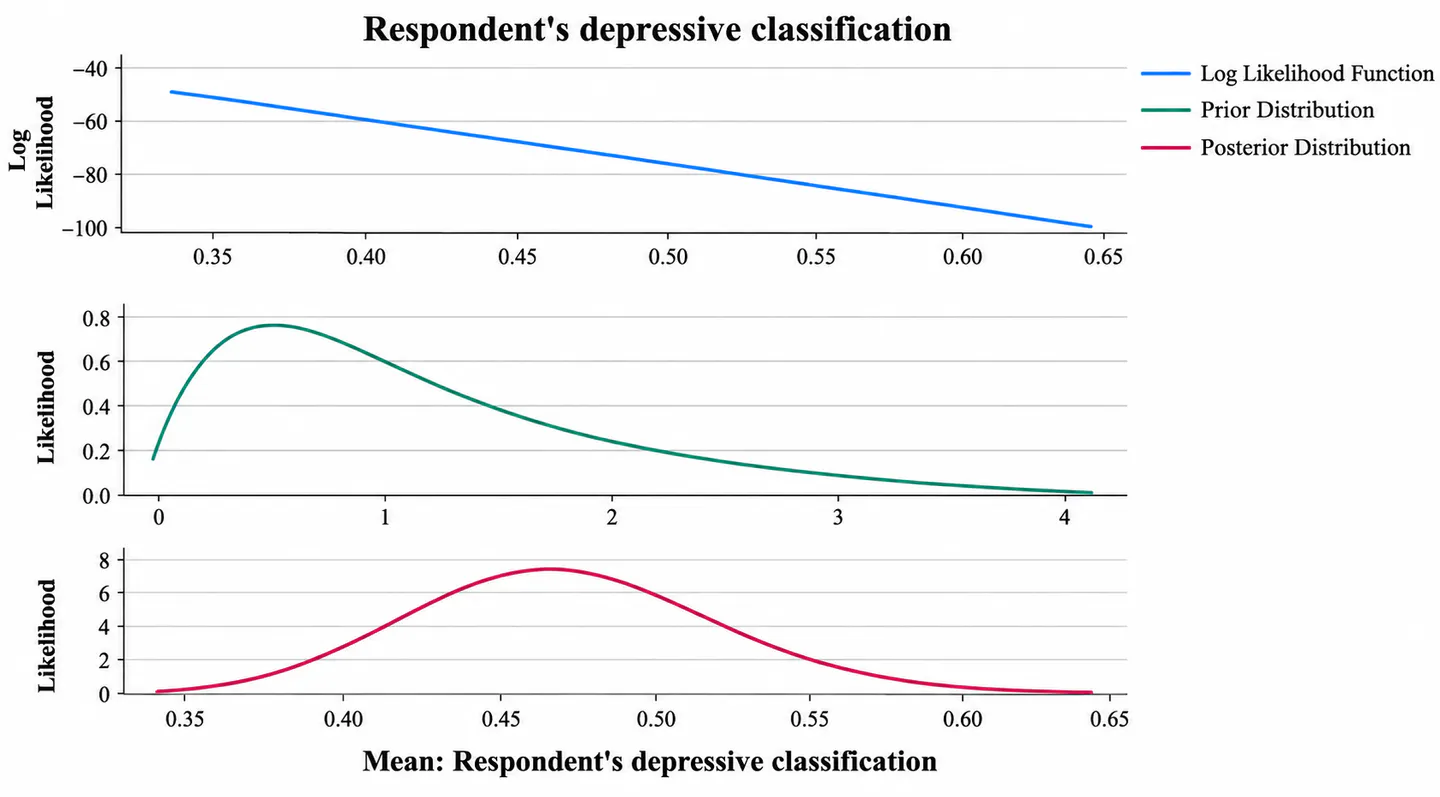
The figure depicts three sequential plots representing the Bayesian inference process for respondents’ depressive classification, integrating the log‑likelihood function, prior distribution, and posterior distribution.
The top panel displays the log‑likelihood function (blue line), which declines steadily as the depressive classification parameter increases from approximately 0.35 to 0.65. This pattern indicates that higher classification values correspond to lower likelihoods under the observed data, suggesting that the most plausible depressive intensity lies toward the lower end of the range. The middle panel shows the prior distribution (teal line), modeled as a Gamma (2, 2) prior, which peaks near 1 and tapers gradually, reflecting a moderate prior expectation of low‑to‑moderate depressive symptom intensity. The bottom panel presents the posterior distribution (maroon line), a smooth, bell‑shaped curve centered around a mean of approximately 0.47, consistent with the posterior mean reported in Table 8. Its narrow spread indicates low variance and high precision, demonstrating strong data support for the estimated depressive classification rate.
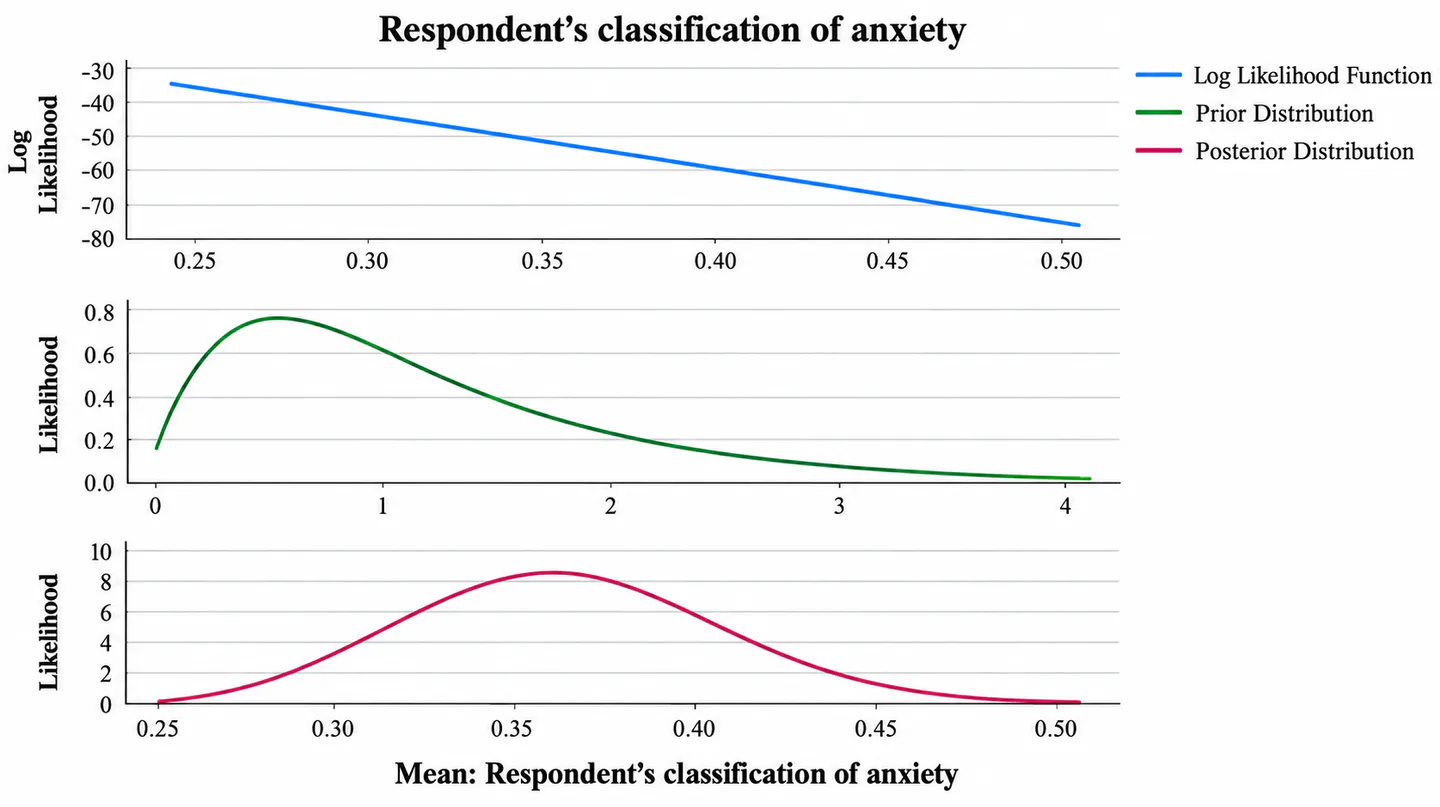
The figure presents three sequential plots that visualize the Bayesian inference process for respondents’ anxiety classification, integrating the log‑likelihood function, prior distribution, and posterior distribution.
The top panel displays the log‑likelihood function (blue line), which declines steadily as the anxiety classification parameter increases from approximately 0.25 to 0.50. This downward trend indicates that higher classification values correspond to lower likelihoods under the observed data, suggesting that the most plausible intensity of anxiety symptoms lies toward the lower end of the range. The middle panel shows the prior distribution (teal line), modeled using a Gamma (2, 2) prior, which peaks near 0.8 around x = 0.5 and gradually tapers toward zero, reflecting a moderate prior expectation of low‑to‑moderate anxiety intensity. The bottom panel presents the posterior distribution (maroon line), a smooth, bell‑shaped curve centered around a mean of approximately 0.37, consistent with the posterior mean reported in Table 4.8. Its narrow spread indicates low variance and high precision, demonstrating strong data support for the estimated anxiety classification rate.
1.4. Discussion
The present study identified a 46% prevalence of clinical depression among adolescent mothers, indicating that nearly half of the participants were experiencing clinically significant depressive symptoms. This finding is consistent with empirical evidence published between 2021 and 2026, which places depression prevalence among adolescent mothers between 40% and 55%, with the notable exception of an unusually high rate of 70% reported in Cameroon (Nicolet et al., 2021). Collectively, these studies demonstrate that adolescent mothers face disproportionately high mental health burdens compared to their non‑parenting peers. Tedla et al. (2026), in a systematic review and meta‑analysis, reported a pooled prevalence of 40.06% among adolescents experiencing teenage pregnancy and early motherhood, while Deng et al. (2021) documented a 48% prevalence of moderate to severe depressive symptoms among adolescent mothers receiving care in community health centers. Similarly, Tembo, Portsmouth, and Burns (2023) found a prevalence of 43.6% in a cross‑sectional study of adolescent mothers, mirroring patterns observed in comparable research on early motherhood.
Similarly, evidence from sub‑Saharan Africa reflects comparable patterns. In rural South Africa, Seakamela et al. (2023) reported a 42.8% prevalence of depression among pregnant and parenting young mothers, while Tele et al. (2022) found a 43.1% prevalence among pregnant adolescents in Kenya. Studies from Nigeria further underscore the severity of the burden, with Okereke, Ezeh, and Onwukwe (2022) identifying a 52% depression rate among adolescent mothers, attributing these elevated levels to socioeconomic hardship, stigma, and disrupted educational trajectories.
Iruo and Juliana (2025) reported a 46% prevalence of depression among teenage mothers in Nigeria, attributing these elevated rates to unstable housing, partner conflict, and limited access to mental health services. In Malawi, Kachingwe et al. (2022) found that 55% of adolescent mothers experienced clinically significant depressive symptoms. Dennis et al. (2024) documented a 41% prevalence of depression during the first postpartum year among adolescent mothers in the southeastern United States. Likewise, a cross‑sectional study in northern Ghana reported that 48% of adolescent mothers screened positive for depression (Asante et al., 2024).
Taken together, these findings reveal a consistent pattern across diverse cultural and socioeconomic contexts: adolescent mothers exhibit markedly elevated vulnerability to depressive disorders, underscoring the need for targeted mental health interventions and supportive policy frameworks. A prevalence exceeding fifty percent positions adolescent mothers as a high‑risk clinical population requiring specialized assessment, early intervention, and coordinated systemic support. Such elevated rates place this group within a severe vulnerability category, reinforcing the need for clinicians to conceptualize adolescent pregnancy as a significant mental health risk rather than a normative developmental transition. These results further highlight the importance of early, developmentally appropriate screening for depressive symptoms during both the prenatal and postpartum periods.
Additionally, 35.6% of respondents in the present study reported clinical anxiety, indicating substantial emotional distress within this population. Recent literature shows comparable patterns, with anxiety prevalence among adolescent mothers typically ranging between 31% and 38%, closely aligning with the rate observed here. Tembo et al. (2023) and Pan et al. (2025) found that 31.9% of 395 adolescent mothers screened positive for generalized anxiety disorder, while a study in Nigeria reported a 39% prevalence, with lack of family support and intimate partner violence significantly associated with adverse outcomes (Iruo & Juliana, 2025). Similarly, Adebayo et al. (2022) documented a 37% anxiety prevalence among adolescent mothers in Nigeria. Collectively, these findings reinforce the conclusion that adolescent mothers face heightened vulnerability to anxiety disorders across diverse contexts.
Findings from a systematic review and meta-analysis of treatment rates for mental disorders among adolescent mothers showed a prevalence of anxiety at 36% (Wang, et al., 2023). A similar multicenter study in Canada to investigate the rates of anxiety disorders among postpartum mothers reported that 32.8% of the study population met the diagnostic criteria for clinically significant anxiety (Karimi, Lee, Patel, & Choi, 2023). Likewise, a cross-sectional study in rural Australia reported a 34% prevalence of generalized anxiety disorder among the study population (Coates & de Vries, 2022). However, a longitudinal analysis of Korean youth in 2025 reported a slightly lower prevalence compared to the average ranges of 31% and 38%, where the same study showed a prevalence of anxiety among teenage mothers at 29.6% (Park & Lim, 2025).
Collectively, these findings reveal a consistent pattern of elevated anxiety across diverse cultural and socioeconomic contexts, reinforcing the conclusion that adolescent mothers experience substantial emotional distress. The stability of these prevalence rates underscores the need for targeted mental health interventions, early screening, and supportive services tailored specifically to adolescent parents. In this regard, the high anxiety prevalence observed in the present study signals a critical research priority within clinical and developmental psychology. The results highlight a highly vulnerable population whose mental health risks are shaped by developmental immaturity, socioeconomic adversity, and the demands of early parenting. These intersecting pressures call for deeper empirical investigation and the development of more nuanced, contextually grounded theoretical models.
Furthermore, this study employed the chi‑square test, the Mantel–Haenszel model, and the test of conditional independence to determine whether the association between depressive and anxiety symptoms remained significant after accounting for potential confounding. The analysis revealed a strong and statistically significant relationship between the two conditions (ꭕ² = 35.938, p = .001), indicating substantial comorbidity within this population. This finding aligns with broader empirical evidence; for example, a Canadian study reported that anxiety markedly increased the likelihood of depressive symptoms among adolescent mothers (Karimi, Lee, Patel, & Choi, 2023). Similarly, a meta‑analysis by Mugisha, Bwire, and Tumwesigye (2024) found a high correlation between anxiety and depression, with pooled results showing that adolescent mothers with anxiety symptoms were twice as likely to experience depression. Additional studies, including Park and Lim (2025) and Coates and de Vries (2022), likewise documented significant co‑occurrence of anxiety and depression, underscoring the intertwined nature of these disorders among adolescent mothers.
A strong and significant co‑occurrence of anxiety and depression among adolescent mothers carries important implications for psychological science, as it underscores the mutually reinforcing nature of these disorders during a uniquely vulnerable developmental period (Acoba, 2024). When these conditions present simultaneously as they frequently do in teenage mothers, they create a compounded clinical burden that is more impairing than either disorder alone, intensifying emotional distress, cognitive disruption, and functional impairment. This pattern suggests that adolescent mothers are navigating an overlapping psychopathological profile shaped by developmental immaturity, socioeconomic adversity, limited social support, and the demands of early caregiving (Barber, Zainal, & Newman, 2023; Abdul-Rahim, et al., 2024). For psychological research, these findings highlight the need for integrated theoretical models that account for the interaction of anxiety and depression within the context of adolescent neurodevelopment and parenting stress, as well as multidimensional assessment tools capable of detecting blended symptom presentations (Martinez & Choudhury, 2026). The intertwined nature of these disorders also calls for combined intervention strategies that simultaneously address anxious arousal, depressive affect, trauma histories, and contextual stressors, while raising critical longitudinal questions about how dual‑diagnosis patterns influence maternal functioning, attachment quality, and child developmental outcomes over time.
1.5. Conclusion
Overall, the study shows that adolescent mothers experience consistently high rates of depression and anxiety, with the present findings aligning closely with global evidence and confirming this group as a clinically vulnerable population. The strong comorbidity between the two disorders further indicates a compounded mental health burden that intensifies functional impairment and emotional distress. Based on this evidence, it is recommended that health systems implement routine, age‑appropriate screening for depression and anxiety during both prenatal and postpartum care; expand access to adolescent‑friendly mental health services; develop integrated interventions that simultaneously address co‑occurring disorders; strengthen social support structures including family‑based and community‑based programs; and invest in policies that reduce socioeconomic hardship and educational disruption among adolescent mothers.



