

I. INTRODUCTION
In Sub-Saharan Africa, work on mycotoxins covering field cases, acute exposures and chronic effects related to dietary intake is reviewed. Mycotoxins have been implicated in the etiology of diseases like kwashiorkor, marasmic kwashiorkor, hepatocellular carcinoma in humans, encephalopathy and other acute diseases in animals. Mycotoxins are poisonous chemical compounds produced by certain fungi. There are many such compounds, but only a few of them are regularly found in food and animal feedstuffs such as grains and seeds. Nevertheless, those that do occur in food have great significance in the health of humans and livestock. Since they are produced by fungi, mycotoxins are associated with diseased or moldy crops, although the visible mold contamination can be superficial. The effects of some food-borne mycotoxins are acute, symptoms of severe illness appearing very quickly. Other mycotoxins occurring in food have longer term chronic or cumulative effects on health, including the induction of cancers and immune deficiency. Information about food-borne mycotoxins is far from complete, but enough is known to identify them as a serious problem in many parts of the world, causing significant economic losses. The economic and health hazards of mycotoxin contamination in crops and food products present a huge challenge, especially in Sub-Saharan Africa, where there is limited data to ascertain the degree of harm caused by these toxins. Tackling this problem needs a multi-factorial approach. A workable strategy would be the systematic development of centers of research expertise, and building research capacities aimed at establishing a database on mycotoxins found in different grains and seeds at each given time and health-related risks caused by mycotoxins. Growing the interest of the African scientific community towards increasing the research output in the region is imperative. To this end, building an automated system on mycotoxicology is a good starting point. This will enable a better collation of data which will aid decision making. This research work will also aid the access and acknowledgment of mycotoxins reports of agricultural products in Sub-Saharan Africa. To aid policy makers in having an overview of mycotoxin reports of agricultural products in Sub-Saharan Africa. This research work will be relevant to research officers especially those in the area of mycotoxins and related research topics to have quick access to referencing data and to make comparisons as desired for better results. It will as well aid interaction between research scientists and farmers for updates. This will enable governments to make adequate policies that will help to improve and secure human and animal health.
II. METHODOLOGY
a) Materials
This study adopts a case study of some FIIRO scientists in Food, Biotechnology and CEFT departments. Verbal interview was conducted randomly to ascertain some facts about Mycotoxins. The following material were involved: Paper, pen, computer system, flash, and printer.
b) Methods
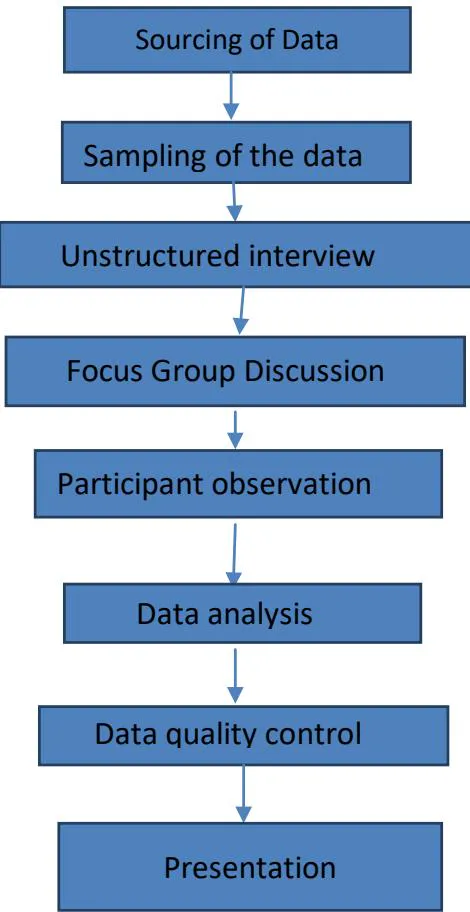
The analytical services used in testing for mycotoxins and the methods used are presented in tables and figure below. This gave us the insight in the designing and development of the database. The system will be able to display the services carried out and also the methods used for each agricultural product. Figure 1 shows the flow of the method used.
| Services | Method |
| Mold Culture and Identifications. | ➢ Microbiological Culturing; Microscopic or biochemical identification test. |
| Chemical Analysis | ➢ Enzyme linked Immunosorbent (ELISA).➢ Tin layer Chromatography (TLC).➢ High Performance Liquid Chromatography (HPLC).➢ Gas Chromatography /Mass Spectroscopy. |
| Country | Food | Year(s) | Sample source | AF types | N | +ves (%) | Range (ppb) | Mean (ppb) | Ref |
| Nigeria | Maize | 2001 | Preharvested | AFB1 | 103 | 18 | 3-130 | 22 | 16 |
| Dry roasted groundnuts | (2005) | Retail | Total | 106 | 64 | 5-165 | 25.5 | 17 | |
| Ghana | Kenkey (fermented maize) | (2000) | Processing sites | Total | 15 | 53 | 2-662 | 176 | 18 |
| 1996 | Processing sites | Total | 12 | 100 | 0.7-313 | 135.4 | 19 | ||
| Kenkey (cooked fermented maize) | 1996 | Processing sites | Total | 16 | 94 | 0.7-313 | 50.9 | 19 | |
| Botswana | Groundnut | 2001 | Retail Outlets | Total | 120 | 78 | 12-329 | 118 | 20 |
An unstructured interview was conducted with fifteen (15) respondents in the Federal Institute of Industrial Research Oshodi, Lagos as presented in table 3. The socio-economic characteristics of the respondents and the opinions of Mycotoxins were gathered.
| Department | Number | Percentage (%) |
| Biotechnology | 60 | 40 |
| Food Technology | 40 | 26.7 |
| CFET | 50 | 33.3 |
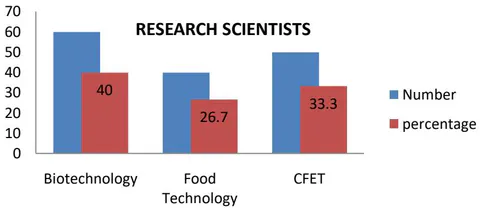
From Table 3, fifteen scientists responded, 6 from department of Biotechnology, 4 from Food technology department and 5 from CEFT department with 40, 26.7 and 33.3% respectively. The socio-economic characteristics of these respondents were gathered based on UN standard, which formed Table 2.
| VARIABLES | CATEGORIES | NUMBER | PERCENTAGE (%) |
| Age | 15-25 | 0 | 0 |
| 25-34 | 50 | 33.3 | |
| 34-45 | 30 | 20 | |
| 45-54 | 60 | 40 | |
| 54-64 | 10 | 6.7 | |
| 65 Above | 0 | 0 | |
| Sex | Male | 70 | 46.7 |
| Female | 80 | 53.3 | |
| Education Level | B.Sc | 20 | 13.3 |
| M.Sc | 60 | 40 | |
| Ph.D | 70 | 46.7 | |
| Marital status | Married | 90 | 60 |
| Single | 50 | 33.3 | |
| Divorce | 0 | 0 | |
| Widow/widower | 10 | 6.7 |
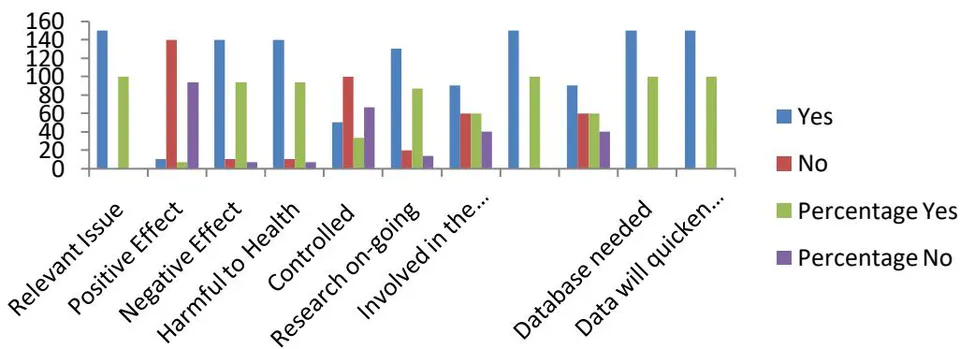
The issue of Mycotoxins in agricultural products is very vital in food and biotech industry. These caused health hazards in humans and animals. The opinions of these scientists in Table 5, formed our decision in designing an automated database system
| Variables | Yes | No | Percentage Yes | Percentage No |
| Relevant Issue | 150 | 0 | 100 | 0 |
| Positive Effect | 10 | 140 | 6.7 | 93.3 |
| Negative Effect | 140 | 10 | 93.3 | 6.7 |
| Harmful to Health | 140 | 10 | 93.3 | 6.7 |
| Controlled | 50 | 100 | 33.3 | 66.7 |
| Research on-going | 130 | 20 | 86.7 | 13.3 |
| Involved in the research | 90 | 60 | 60 | 40 |
| Need referencing data | 150 | 0 | 100 | 0 |
| Internet as data source | 90 | 60 | 60 | 40 |
| Database needed | 150 | 0 | 100 | 0 |
| Data will quicken the solution | 150 | 0 | 100 | 0 |
Mycotoxins Automated Database System (MADAS)
A database has been developed for users to show the Mycotoxins statistical reports of agricultural products that are registered and available here in Sub-Saharan Africa.
The languages used are Microsoft.Net framework, C# at front end and SQL/my SQL
◆ Searching the database In order to search the database, the following instructions must be followed:
The database is available on the website of the Federal institute of Industrial Research oshodi, (FIIRO), Lagos.
http://www.mycotoxin.gov.ng.ie/biotech/crops/mycotoxinscertification/mycotoxinsdatabase/ To Navigating the program: - Launch the Application
- from the investigation grid view, Click on Export to excel or pdf to print
Add new Service/Investigation: - Launch the Application
- Click Add New- "To open the service/investigation dialog box
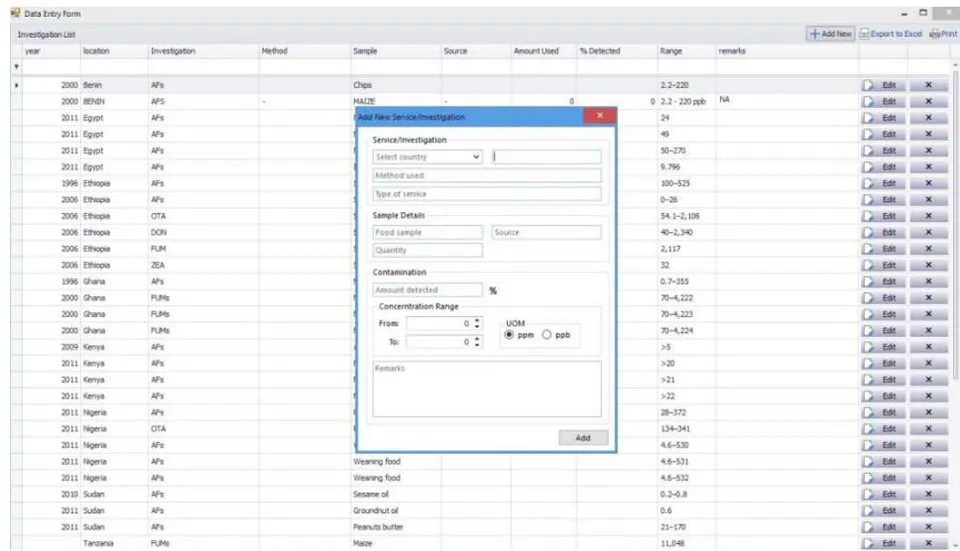
Make necessary inputs - Click the Add button, when done
Confirm the new entry on the grid view list
| Year | location | Investigation | Method | Sample | Source | Amount Used | % Detected | Range | remarks | ||
| 2000 | Benin | APs | Chips | 2.2-220 | Edit | × | |||||
| 2000 | Bhzhhi | APS | - | MALZE | - | 0 | 0 | 2.2 - 220 ppb | NA | Edit | × |
| 2011 | Egypt | APs | Nuts and seeds | 24 | Edit | × | |||||
| 2011 | Egypt | APs | Medicinal plants | 49 | Edit | × | |||||
| 2011 | Egypt | APs | Milk | 50-270 | Edit | × | |||||
| 2011 | Egypt | APs | Infant milk formula | 9.796 | Edit | × | |||||
| 1996 | Ethiopia | APs | Shiro and ground red p... | 100-525 | Edit | × | |||||
| 2006 | Ethiopia | APs | Sorghum, barley, teff... | 0-26 | Edit | × | |||||
| 2006 | Ethiopia | OTA | Sorghum, barley and... | 54.1-2.106 | Edit | × | |||||
| 2006 | Ethiopia | DON | Sorghum | 40-2,340 | Edit | × | |||||
| 2006 | Ethiopia | FLMs | Sorghum | 2,117 | Edit | × | |||||
| 2006 | Ethiopia | ZEA | Sorghum | 32 | Edit | × | |||||
| 1996 | Ghana | APs | Maize | 0.7-355 | Edit | × | |||||
| 2000 | Ghana | FLMs | Maize | 70-4,222 | Edit | × | |||||
| 2000 | Ghana | FLMs | Maize | 70-4,223 | Edit | × | |||||
| 2000 | Ghana | FLMs | Maize | 70-4,224 | Edit | × | |||||
| 2009 | Kenya | APs | Animal feed and milk | >5 | Edit | × | |||||
| 2011 | Kariya | APs | Maize | >20 | Edit | × | |||||
| 2011 | Kenya | APs | Maize | >21 | Edit | × | |||||
| 2011 | Kenya | APs | Maize | >22 | Edit | × | |||||
| 2011 | Nigeria | APs | Rice | 28-372 | Edit | × | |||||
| 2011 | Nigeria | OTA | Rice | 134-341 | Edit | × | |||||
| 2011 | Nigeria | APs | Weaning food | 4.6-530 | Edit | × | |||||
| 2011 | Nigeria | APs | Weaning food | 4.6-531 | Edit | × | |||||
| 2011 | Nigeria | APs | Weaning food | 4.6-532 | Edit | × | |||||
| 2010 | Sudan | APs | Sesame oil | 0.2-0.8 | Edit | × | |||||
| 2011 | Sudan | APs | Groundnut oil | 0.6 | Edit | × | |||||
| 2011 | Sudan | APs | Peanuts butter | 21-170 | Edit | × | |||||
| Tanzania | FLMs | Maize | 11,048 | Edit | × |
IV. BENEFITS
The automated database system provides the client significant time and cost savings, improved its ability to analyze data, and aided decisions in the issue of mycotoxins in crops.
As a result, the solution offered the following benefits:
Robust data collection, management, and analysis methods
A secure and protected data environment
Reduction in errors caused by insufficient or inconsistent data
Data storage to facilitate regulatory compliance
Data storage practices that offer scalability and reduced testing rework
Improved maintainability, standardization, control, predictability, and traceability of data
Enhanced decision-making capabilities in choosing better variety of crop seed and better quality end products
Better audit and control procedures
Lower costs due to automation of labor intensive tasks and elimination of redundant work
Overall cost reduction due to streamlining of the traditional way of data sourcing.
Reduced time-to-conclude analysis of mycotoxins in agricultural products
V. CONCLUSION
The presence of mycotoxins in grains and other staple foods and feedstuffs has serious implications for human and animal health. Many countries have enacted regulations stipulating maximum amounts of mycotoxins permissible in food and feedstuffs. Most developed countries will not permit the import of commodities containing amounts of mycotoxins above specified limits. Mycotoxins therefore have implications for trade between nations. Prevention of fungal invasion of commodities is by far the most effective method of avoiding mycotoxin problems. The role Information Technology cannot be over emphasized in this matter. For accuracy in monitoring and management of mycotoxins and its related diseases, a pool of data must be in place. Therefore, the automated database system will be of great help which will lead to a sustainable development.
VI. RECOMMENDATION
The Mycotoxins association should organise training programme to create awareness of the automated database system to Sub-Saharan Africa.
Government should fund the research of mycotoxin, for this is a necessity for life security. Since this involves crops and feedstuff, the lives of animals and humans need to be assured. This is also major case when we talk of sustainability development.
The ICT centers should be made available for research officers and the farmers to ensure communication and proper interaction via the database.