I. INTRODUCTION
The Islamic economic system was known to have introduced principles that endeavored to respecting the environment through land management, water The impact of technology in today's Muslim's life has been tremendous in different Muslim's nations. Muslims were known to be the inventors of various innovations that led to the creation of many cities across the history. In today's Muslims societies, there are numerous Islamic Smart cities introduced and developed to cater to the Muslims need across the globe, Malaysia and Indonesia where seems to be leading in the design and development of the Islamic Smart cities. However, it is important to understand how different is the Islamic Smart city, and what made it Islamic as well as the origin of Islamic cities. This paper has endeavored to shade light on these issues by looking at the past, current and future developments of Islamic Smart cities and how Important it is in the current technology revolution 4.0. The original idea of Islamic smart city has been supported by the precise Shari'ah rules and regulations which were designated to actualize the healthy life style of the Muslims communities and emphases on green living society with strict care to the environment and other inhabitant within and surrounding the Muslims communities.
The Islamic economic system was known to have introduced principles that endeavored to respecting the environment through land management, water supply and air protection for sustainable living, and this has contributed to the effective ecological care and development of Muslims nations across the history. Prophet Muhammad peace be upon him has enacted a principle for land acquisition in the Islamic society and this principle was based on land development and investment, "whoever developed a land he owns it" this prophetic tradition has contributed to the land development and also the land acquisition process which was constituted on sustainable development. Land development is an integral part of an Islamic Smart city development, the principles of land acquisition in Islam is a part of the Islamic Smart city principles which is a merger of other Islamic principles on environmental care, principles for improving the quality of natural resources as well as the principles related to Islamic design and green planning which incorporated with the modern technology support, this has resulted in the introduction of the concept of Islamic Smart city development in today's Muslims societies.
II. THE CONCEPT OF SMART CITY
A Smart city is a harmonious city in which information and communications technology (ICT)-driven technology enhances municipal services in order to improve the quality of life for citizens was first proposed by IBM in order to depict a harmonious city in which information and communications technology (ICT)-driven technology enhances municipal services in order to improve the quality of life for citizens (Chang, 2021). Smart city are Intelligent cities consider as harmonious places where data-driven services are set out to benefit interactions of people and their environment. That is, cities that are considered to be "smart" are harmonious places where everyone generated and share data with people and their surroundings (Bibri, 2021). Smart cities may connect their infrastructure with other sectors and areas of life based on data collection and analysis, and they can use new technologies to discover answers to problems, which makes things even more exciting (Hashem et al., 2016).
A significant role has been played by smart cities in the development of several aspects of human existence, affecting sectors such as education, health and many more (Ahad et al., 2020). The amount of data being collected and stored is expanding at rate where many human activities are tied to generating, processing and analyzing data, particularly in the case of businesses which requires instant report (Van Doorn & Badger, 2020). The ability to recognize and extract important information from huge volumes of transactional data can be highly beneficial in a variety of ways when it comes to human activities, typically those activities that depend on the online application (Ajah & Nweke, 2019). The analysis of transactional data of day-to-day human affairs can also aid in the early warning of potentially hazardous weather conditions to the general public, which can help to save lives (Porter & Heppelmann, 2015).
It wasn't that long ago that the phenomenon of "ethos" in technology was established to distinguished among those technologies that are defined by people against those technologies that defined people (Brett, 2009). The concept of ethical behaviour in technology has been introduced historically to realize that technology does not only define itself by the wide range of hardware, software and data it generates and networks it connects, but also by the way people place value on adopting a variety of new technologies at an increasingly rapid rate (Wang et al., 2020). Therefore, Islamic values should be included as a core component of any smart city design. When combined, these values will provide the opportunity to gain significant insights into the usage of vast amounts of technology, which is becoming increasingly widespread. Particularly when compared to human activity, several features of smart cities are characterised by their unstructured nature (Martucci et al., 2017). Every one of these considerations when taken into account when designing the Smart City concept will yield a better interactions of devices. The concept of values in smart city associated with Islam include themes as diverse as internet networks from Islamic perspective, city services, and infrastructure, among other things. There has been a plethora of criteria developed for their most well-known criterion classification.
In order to add value and increase engagement, the smart city makes advantage of developing technology, such as integrations of various wireless technology, while simultaneously increasing the overall quality of life. However, the application of Islamic values in the smart city is still in its infancy. When it comes to improving the quality of smart city services, Islamic values is a relatively new tool that has immense potential to do so. Among the many sources of large amounts of tool being generated today by a multitude of sources are smart services and components such as social networking sites, global positioning systems, sensors and cameras, commercial transactions, and video games to name a few (Raj & Kumar, 2017). In recent years, research into smart cities has grown at an exponential rate, and efficient components and processing facilities have posed a serious challenge to the traditional intelligent environment. The huge amounts of information produced by sensor equipment may be used to extract a substantial amount of useful information from the data (Hashem et al., 2016). The successful functioning of many enterprises and service industries, including the smart city application, is dependent on the analysis and exploitation of large amounts of data. Large processing and storage facilities are required to process the streams of information created in a smart city setting, which is one of the many benefits and problems associated with the implementation of Islamic values in a smart city. It is possible to acquire access to this benefit through the use of cloud computing services and the Internet of Things (IoT) technologies, both of which are now accessible on the market (Botta et al., 2016).
An improved ability of smart cities to instil Islamic values in their citizens is proven in the following case study, which shows how digital gadgets employed in conjunction with smart city infrastructure improve the ability of a smart city to instil Islamic principles in its residents. A positive development is that it encourages the flow of information about Islamic beliefs among city dwellers, which is a good thing. Large amounts of unstructured data generated by integrated devices in smart cities can be rearranged in a similar way with the assistance of intelligent technology (Chen et al., 2019). In order for information to be created and processed, a large number of servers must be present in order for the computer infrastructure to function. There will be no issues with this infrastructure because it is designed to manage enormous amounts of data without experiencing any difficulties. All of these bits of information are utilised to build a specific service or application, and they are propagated throughout a variety of services throughout the development and deployment process. In order to reap the greatest possible benefits from smart cities, it is imperative that Islamic principles be included into computer methodologies for data processing. Due to the fact that each component of data in smart cities can be applied to many various elements of human engagement, the greatest possible advantage can be obtained from each component (Perera et al., 2017).
Every day, new smart city concepts are being adopted by an increasing number of governments in order to improve the living conditions of their citizens, and Islamic values are not being used to achieve this goal. It is possible that the technology of the smart city, which is based on large-scale data collection and analysis, will have a substantial impact on virtually all aspects of human activities in the future. The adoption of fundamental smart Islamic values features, such as realising the primary characteristics of a smart interaction of human-to-human as well as machine-to-human, is necessary in order to meet the learning principles and requirements of smart city applications. It is possible to achieve long-term viability and resilience of human activities engagement through the incorporation of critical components of Islamic values into smart city planning and implementation. Other advantages include an improvement in the overall quality of life, the careful use of natural resources, and the construction of sound infrastructures, among others. To do this, five important criteria are necessary namely.
III. THE TECHNOLOGY OF ISLAMIC SMART CITY
Smart cities, in terms of technology, distinguish themselves by the extensive application of various electronic technologies and technological tools such as sensors and sensor networks, among other things, in order to reach an extremely high degree of efficiency (James et al., 2021). A smart city is comprised of a diverse range of components. This research examines the interaction of the following components: "Smart Facilities," "Smart Devices," "Smart Governance," "Smart Data," and "Smart People" in order to develop mechanisms for smart cities that incorporate Islamic approaches into their design (see Figure 1). The combination of these components has an impact on whether or not the Islamic smart city concept is adopted.
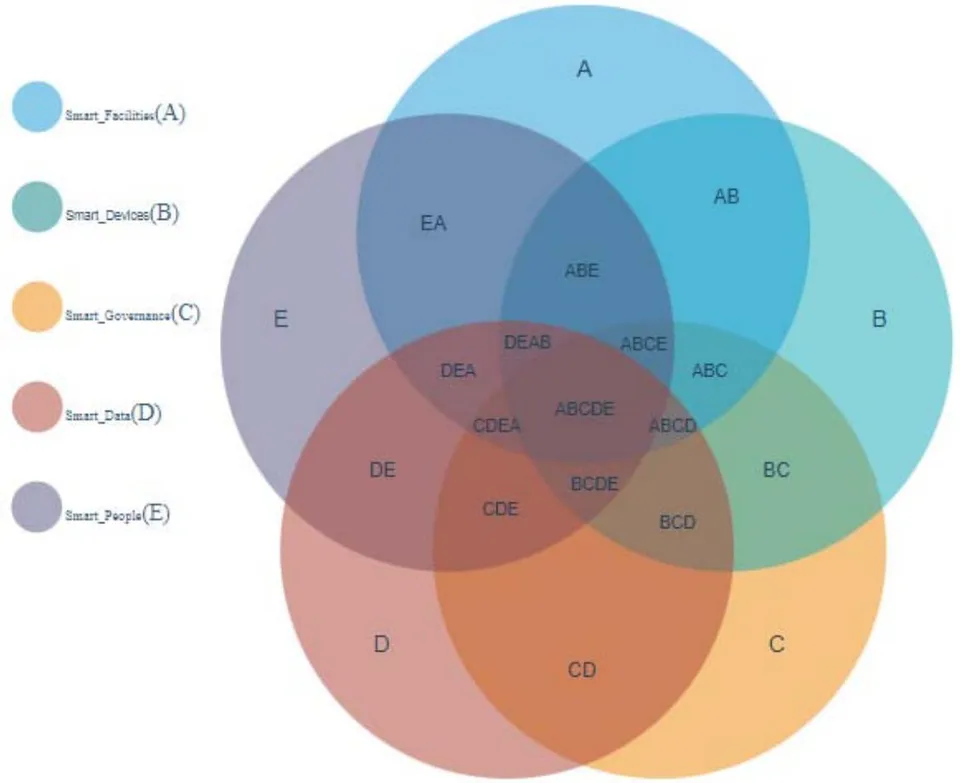
The proposed components of Smart Cities that would integrate Islamic approach form the key point of (ABCDE) from the figure 1 above, which is a combination of infrastructures, devices, governance, data, and people. When dealing with a single component, however, there is a conceptual interaction between it and its neighbour that is distinct from the other's. This refers to the establishment of an Islamic approach in each of the components that interact with one another. The information gathered from each component is used to manage smart facilities more effectively and efficiently. The smart facility is positioned as the highest level of conceptualization in this paper, which is justified. In a similar vein, facilities in cities or
smart facilities are associated with more complex infrastructure and technologies, but they also have the resources to manage those infrastructure and technologies. For this reason, smart devices come first, followed by smart facilities, because smart devices are the tools that will assist in the operation of the facilities.
A situation will be created in which a decision will be required in order to put the smart devices into proper operation for the purpose of managing the smart facilities. When doing so, governance is required, and protocols should be defined in order to maintain an orderly and efficient operational environment. The concept proposes smart governance as a result, in order to establish and provide high-quality services to those who require them. When considering a scenario in which a smart building facility has evolved with the net effect of systems control that can be managed for entire buildings or for entire building areas, smart facilities, smart devices, and smart governance interaction could be envisioned.
In the course of operating smart facilities, smart devices, and smart governance, data is generated, which is also a component of the smart city and is referred to as intelligent data. The collection of interactivity among smart devices within Smart facilities in a smart city results in the generation of a large amount of data, which is used to improve the quality of life. When it comes to smart governance of smart city growth and security and how information is interpreted and stored is critical. Smart cities can take advantage of this by utilising smart data to improve efficiencies while also enhancing sustainability, fostering economic development, and improving quality of life factors for those who live and work in the city. Smart people band together to form intelligent communities. As a result, the number of people who are involved in smart cities has increased. Communities are made up of people who have a common interest and who collaborate with the government and other institutional organisations to promote the use of smart cities in order to improve the quality of daily life as a result of various deteriorations in daily activities. Furthermore, if a smart city strategy is not planned with people involved in its implementation in mind, it may result in the creation of new areas.
If we take into account the impact of the Islamic approach to each of the smart city components: "Smart Facilities", "Smart Devices", "Smart Governance", "Smart Data" and "Smart People" described above, it becomes possible for us to try to understand the concept of Islamic smart city.
IV. CONCLUSION
The term "Islamic city" refers to a city that was created in accordance with the Quran's and prophetic traditions' teachings, as well as general Islamic ideals that promoted healthy living, environmental stewardship, and sustainable development. There are significant distinctions between Islamic and Muslim cities. Muslims city is merely a city where Muslims dwell; it does not have to adhere to any of the Islamic city's specific norms and regulations. The Islamic Smart city can then be defined as a city that adheres to Islamic city ideals while adopting a modern perspective on Smart city equipment based on current technological advancements. Numerous studies noted that numerous towns were built inside an Islamdom to demonstrate that Islamic civilization is not only about developing a belief system, but also about developing fully functioning Islamic communities and cities based on religious regulations and divine laws. As a result, Islam has come to be considered as an urban religion. To comprehend the origins of the Islamic metropolis, we must look back at the Prophet Muhammad's life, peace be upon him. The Prophet Muhammad was an urbanite, as evidenced by his migration to Medina; the call for a weekly congregational prayer "Jumu'ah" in the mosque was an indication of urbanisation; Islam is a city-based religion, sharing similar qualities of sophistication and urbanity with Judaism and Christianity. According to Muslim geographers, one of the characteristics of Islamic cities is that they must have a Friday mosque and most have a market nearby. Additionally, a public bath should be available for Muslims to prepare for congregational prayers. The Islamic smart city's structural design and concept should begin with the design of a Masjid in the heart of the city; this concept was derived from the prophet Muhammad's initial plan upon his arrival in Madinah.