
Freddy Mgiba
I. INTRODUCTION
The fourth industrial revolution (4IR) has given rise to studies in many areas such as Digital marketing (Chukurna, and Konak, 2018), Marketing education (Matt, Hess, and Benlian, 2015), and has shaped a new era (Philbeck, and Davis, 2018). However, the preeminence of the Fourth Industrial Revolution (4IR) discourse is not only an issue for academics; it is also a major imperative for people who manage businesses (see Toma, and Tohanean, 2018; Delfmann, Ten Hompel, Kersten, Schmidt, and Stölzle, 2018). The 4IR has been described in different ways by different authors (examples: Industry internet of things, Breaux, R, 2018; Industrial revolution 4.0, Kuruczleki, Pelle, Laczi, and Fekete, (2016); Artificial Intelligence, Sam, 2018; and Digital age, Lee, Yun, Pyka., Won, Kodama, Schiuma, Park, Jeon, Park, Jung, Yan, Lee, and Zhao, 2018). It has been hailed as a paradigm that ushers in many gains such as: delivery of breakthroughs in many business fields (Lieu, 2017), reduction of logistics costs (Chukurna, and Konak, 2018-1), improved productivity (Mehta, 2018-8) and connectivity (Chukurna, and Konak, 2018), blurring of lines between the physical, digital, and biological spheres (Schwab, 2016). For example, applying Artificial Intelligence (AI) to Sales and Marketing (S-M) could create profitability and efficiencies (Mehta, 2018-8). Mehta (2018) estimates that the 4IR will create profits and efficiencies of between 2 and 7 Trillion dollars over the next On 20 years. On the negative side, there is a high risk of the automation of jobs (Frey, and Osborne, 2013), the reduction of low-cost labors, and the reduction of competitive advantages of nations and firms that depend on low-cost labor (Rickmann, 2014; Sommer, 2015). Robots could replace up to 800 million jobs by 2030 (Charalambos, Tsekeris, 2019). Further, the 4IR has also (and still does) brought about threatened maintenance of employment levels (Kuruczleki, et al., 2016); creation of unemployment for skilled white-collar highly educated employees (Mehta, 2018), increased man-machine conflicts (Mehta, 2018-8), and disruption of some industries (Monahan, 2017; Ferrari, 2017). The 4IR carries within it some seeds for both positive and negative disruptive changes, which in turn necessitate the reconfiguration of business. Although scholars and practitioners have shown a growing interest in understanding and analyzing the 4IR, a dearth of theoretical conceptualizations that incorporates the S-M functions remains.
II. PROBLEM AND PURPOSE STATEMENT
The 4IR has brought into sharp focus a need for improvement to productivity and competitiveness for organizations (Mrugalski, Witczak, and Korbicz, 2008). Studies on the 4IR have, however, mainly concentrated on the operational (Kagermann, 2015; Sipsas, Alexopoulos, Xanthakis, and Chryssolouris, 2016), and the technical aspects of the business (Bordeleau, Mosconi, and De Santa-Eulalia, 2018). This era, however, also affects the S-M divisions as the following examples illustrate. Digitalization has led to Social media marketing measures, which are a necessity to reach more customers effectively, reliably, and efficiently (Chary, 2014). The 4IR affects customer expectations, impacts and changes consumer engagements and behavior (Schwab, 2016), and delivers tools to build better relationships with customers (Sam, 2018-7). Further, the 4IR has ushered in the diffusion and adoption of technology (Arnett, Wittmann, 2014), which continues to break barriers between functional divisions (Bloem, et al., 2014), and has created a business environment that calls for a collaborative innovative approach in dealing with customers (Schwabb, 2016). Clearly, the 4IR is much more than just a technology change (Xu, David, and Kim, 2018). This article closes the gap between the operational emphasis of the 4IR and requirements of the S-M implications by drawing from existing literature on the 4IR environment, identifying and integrating the common elements in 4IR literature, and extending their implications to include the S-M functions (Meredith, 1993). The issues under consideration in this article are how the 4IR has created; The need to upskill and reskill the Sales-Marketing (S-M) personnel, The possible merger of the S-M divisions in organizations, and, The speedy response times to customer requests. The rationale for the choice follows.
Firstly, literature shows that the creation and conveyance of value to customers has been a central mission for both Marketing (e.g Kotler, et al., 2012) and the Sales functions (Grove et al, 2018; Rackham, and De Vincentis, 1999). Close cooperation between these functions creates the potential for synergy and effectiveness (Malse, 2016; Kelemen-Eerdos, and Molnar, 2019). However, they continue to operate as separate silos (Gupta, and Ogden, 2009; Grier, and Deshpande, 2001), and as independent divisions whose relationship is often conflictual (Homburg, and Jensen, 1997; Nauta, De Dreu, and Van der Vaart, 2002). Presently, the coordination of these functional divisions is a source of dysfunctionality and turbulence (Malse, 2016; Kelemen-Erdos, and Molnar, 2019). The 4IR environment seems to call for a new approach to the configuration of these divisions, an issue that has not been addressed.
Secondly, the 4IR environment is characterized by digitization and connectivity (Scwabb, 2016), and complex business environment (Carvalho, Chaima, Carza, 2018), a combination of which has created skills gap challenges and possible job displacements (Frey, and Osborne, 2013; Kuruczleki, et al., 2015). This environment calls for the development of new skills and competencies for employees (Kuruczleki, et al., 2016). There seems to be a need for both reskilling and upskilling of employees in order to meet the challenges that the 4IR poses. Lastly, quick and accurate response time to customer requests (aggravated by the 4IR as will be shown below) is one of the major functions of both the Sales and the Marketing divisions. The 4IR is an era of rapid advances in digital technology (Syam, and Sharma, 2018). The dynamic nature of the Digital technology (Chukurna, and Konak, 2018), and the availability of substitute products (Schwabb, 2016) give rise to the need for even faster and accurate response to customer requirements (Mehta, 2018). Extant literature does not seem to address this requirement in the light of the 4IR.
The preceding gaps motivated this article to develop a conceptual framework that integrates S-M merger, upskilling and reskilling of S-M personnel and response time to customer requirements. The article aims to be what Roberts, Snowden, and Petticrew (2006) refer to as a Paradigm shifter in terms of the integration of the Sales and Marketing functions in theoretical discussions around the 4IR and its implications for these divisions. The goal of this article was to understand and to conceptualize competitiveness using the Sales and Marketing divisions in the era of the 4IR. This was achieved by separating different concepts extracted from the literature on the 4IR, finding linkages between them, and conceptualizing how they relate to each other (Creswell, 2009; Dadzie, Runeson, Ding, and Bondinuba 2018). The process included describing and characterizing how current literature deals with the impacts of the 4IR environment, isolating and operationalize major themes relevant to the S-M functions under the 4IR, proposing relationships between these themes, and suggesting a way forward for the functioning of the S-M divisions. The variables of interest for the study are 4IR environment (4IRE), Reskilling and Upskilling of the Sales and Marketing (RAU), Merger of Sales and Marketing (MSM), and Response time (RT) to customer requirements. The study proposes a network of relationships between these variables and argues that the new network has the potential to improve organizational competitiveness. To the best of the author's knowledge, no other author has developed a conceptual model that combines all these variables. This article, therefore, contributes to knowledge by strengthening the literature on the 4IR as it pertains to the S-M divisions, which in turn opens up new avenues for future empirical research to either affirm or refute the proposals given hereunder. It will also deepen managers' understanding of how to sustain and proactively build firm-level competitiveness by keeping up with and taking advantage of the new developments of the 4IR. The framework can be useful in situations in which individuals have to make decisions on whether to transition or to keep their present positions in the light of the new business requirements. The layout of this paper is as follows. Methodology, literature review, proposals, research framework, implications and limitations of the study.
III. METHODOLOGY
A review of the content of published journal articles, with the aim of systematically integrating their findings on the 4IR, the S-M functions, productivity and efficiencies in a scientific way formed the bases of this study. Camargo and Camargo (2019) state that synthesizing information from different articles helps develop a more scientific knowledge base. Systematic literature review (see Kekale, Weerd-Nederhof, Cervai, and Borelli, 2009; Tranfield, Denyer, and Smart, 2003) was a method of choice for this study. The researcher identified, evaluated, and synthesized the existing body of completed and researchable works produced by researchers, scholars, and practitioners (ChituOkoli, and Kira Schabram, 2010). There was, however, a bias toward those articles from scholarly journals as these are the most valid sources in literature review (Rowley, and Slack, 2004). Known advantages of Systematic literature review are that: it is a transparent, reproducible criterion, applies objective criteria to the inclusion or rejection of articles (Denyer, and Tranfield, 2009; Tranfield, et al., 2003; Bordeleau, Mosconi, and De Santa-Eulalia, 2018), and that it helps overcome or minimizes researcher bias (Roehrich, Lewis, and George, 2014; Chen Liu, 2017). To further overcome and limit possibilities of research bias (Tranfield et al., 2003), cross-referencing between researchers was undertaken (Roehrich, Lewis, and George, 2014). A combination of search terms with truncations (as recommended by lgwe, Charlton, Probst, Kent, Netzel, 2019) led to the key descriptors for the study which are the 4IR, Sales and Marketing divisions, Upskilling and Reskilling of personnel, Response time to customer requirements, and Divisional mergers. Exclusion and inclusion criteria for articles reviewed was another major consideration in line with scholarly recommendation (see Denyer, and Tranfield 2009; Roehrich, Lewis, and George, 2014). The exclusion criteria for articles are as follows. Unavailable related papers, those whose abstracts did not relate to the major constructs (4IR and to the S-M functions), and duplicated articles did not form part of this article. The evaluation of the articles consisted of reading the studies through the technique of content analysis as recommended by Camargo and Camargo (2019). This led to the summarization of the major issues in a concept matrix. The integration, synthesis of the relationships between the identified themes are followed by a string of propositions and a conceptual framework.
IV. A REVIEW OF THE PROFESSIONAL AND ACADEMIC LITERATURE
Headings for the literature review are the 4IR business environment, the 4IR and the possible merging of the S-M divisions, the 4IR's implications for the upskilling and Reskilling of S-M personnel, and the 4IR implications for response times to customer requirements.
a) The 4IR business environment
The first industrial revolution (1IR) began around 1760 in the UK (Mehta, 2019). It entailed the transition from manual labor to mechanized work by utilizing water and steam (Schwab, 2016-5; Liu, 2017-3), and the introduction of assembly lines and division of labor (Liu, 2017-3). The second industrial revolution (2IR) was based on the advent of Combustion engines (Lee, 2018 et al), began in the latter end of the 19th century (from the 1920s to the 1970s) in the US (Mehta, 2018; Schwab, 2016), and brought about the mass production of goods and services, the growth of steel and oil industries, and electrification (Schwab, 2016; Liu, 2017). The third industrial revolution (3IR) started around the 1950s with the introduction of semiconductors, IT, personal computers, the internet, and automated production (Liu, 2017), and the transition from analog to digital technology (Schwab, 2016). The 4IR developed from the horizontal expansion of information technology (Lee, Yun, Pyka, Won, Kodama, Schiuma, Park, Jeon, Park, Jung, Yan, Lee, and Zhao, 2018), was based on the technology and infrastructure developed in the 3IR but used them in entirely new ways which made technology to be embedded in business (Liu, 2017). Schabb (2016) confirms that it was born out of the technological breakthroughs in areas such as mobile connectivity, artificial intelligence, the internet of things, robotics, 3D printing, biotechnology, genetic engineering, nanotechnology, and advanced materials. The 4IR is an era of increased automation and interconnectivity (Cavarlho, et al, 2018; Kagermann, 2015; Schwab, 2016), digitalized production and service offering (Carvalho, et al 2018; Sipsas, Alexopoulos, Xanthakis, Chryssolouris, 2016), and as an era in which decision-making shifts from human to machines (Syam, and Sharma, 2018). There is a high level of business complexity (Carvalho, Chaima, Cazarinia, Gerolamo, 2018), and the proliferation of mobile marketing devices (Hofacker, Ruyter, Lurie, Machanda, 2016; Shankar, and Balasubramanian, 2009). The big drivers of the 4IR are mobile computing, cloud computing, and big data (Roblek, Mesko, & Krapez, 2016).
The 4IR has revolutionized business (Rickmann, 2014, in Sommer, 2015), reduced production costs (Peters, 2017; Schwabb, 2016), increased speed and accuracy in workplaces (Mehta, 2018), and blurred the lines between the physical, digital, and biological spheres (Ferrari, 2017). It has created a bigger need for improved productivity (Liu, 2017), and for collaboration amongst divisions (Sipsas, Alexopoulos, Xanthakis, Chtryssolouris, 2016; Liu, 2017). All of these, necessitate the rethinking of organizational structure and design strategies in order to improve productivity and competitiveness (Liu, 2017). Of most interest for the present study are those aspects of the 4IR that continually influence the Sales and Marketing functions in organizations.
For instance, the 4IR is characterized by new products and services offering (Schwab, 2016), finished product with built-in components of software, the changing mode of interaction of buyers and sellers (Forrest, and Hoanca, 2015), and by the changing relationships between consumers and producers (Wynstra, Spring, and Schoenherr, 2015; Roblek, and Mesko, 2016). Marketing and Sales activities can be implemented using digital and communication technology (Chukurna, and Konak, 2018-1; Schwab, 2016). Breaux (2018) highlights that the S-M of the future will be more about satisfying predictive demands rather than reactive ones. The tools available in the 4IR can be utilized to build better relationships with customers (Sam, 2018), marketing intelligence (Sam, 2018-7), customer relationship management (Roblek, and Mesko, 2016), promotion of goods and customers targeting (Schwab, 2016). This, in turn, highlights the requirements for an even quicker response to customer requirements by organizations under the 4IR. Gleaning from the above review, it follows that the 4IR is an era characterized by increased digitalization and connectivity, automation, organizational complexity, and an era with a greater need for productivity. It is further characterized by the development of new products and services at a faster rate, changed mode of interactions with customers, and as an environment that requires collaboration amongst employees. These characteristics necessitate a call for possible mergers of functional divisions.
b) The 4IR and the
The rules of doing business are continually being challenged (Buzzel, 1985), and organizations are required to develop the S-M strategies to stay competitive (Mrugalski, and Wyrwicka, 2008). The information-intensive economies ushered in by the 4IR further emphasize the need for organizational realignment (Bloem, Van Doom, Duivesteis, and Excoffier, 2014). For instance, the Internet of things has brought about an even greater interdependence between functional divisions (Bloem, et al, 2014), and a need for a collaborative innovative approach to S-M (Schwab, 2016). Sales and Marketing are the most crucial teams in organizations as they generate revenues (Srinivas, and Suresh, 2014; Muzundor, and Fontanella, 2006), and they both have common end group goals of increasing customer acquisition and retention (Rackham, & DeVincentis, 1998), and of profitability maximization (Smith, Srinath, and Chatterjee, 2006; Muzundor, and Fontanella, 2006). They each include several activities that connect with the other to support value creation and customer-relationship management (Moncrief, and Marshall, 2005), and each produces a positive effects on the other in the commercialization of new products (Ruzic, and Benazi, 2018; Ingram, Laforge, Scwepker, and Williams, 2008; Crawford, and Dibenedetto, 2011). Customers often see them as a single function, which is not differentiable from the other (Cespedes, 1993; Webster, 1997; Yandle, and Blythe, 2000, Meunier-Fitzhugh, and Piercy, 2007). A considerable part of the information and knowledge S-M personnel need to perform their roles is held by the others within these two divisions (Krasnikov, Jayachandran, & Kumar, 2009; Gonzalez, Claro, and
Palmatier, 2014), and the utilization of this internal information often leads to improved performance for both divisions (Gonzalez et al., 2014; Steward, Walker, Hutt, & Kumar, 2010). For example, a salesperson's visit to introduce a new product is more effective when it is coordinated with marketing's launch of an associate advertisement campaign (Rouzies, and Hulland, 2014). It is reasonable, therefore, to assert that in this new environment (4IR environment), the business requirements necessitate a closer collaboration between these two functions (Bolander, Satornino, Hughes, and Ferris, 2015; Gonzalez, et al., 2014; Steward et al., 2010; Malshe, & Sohi, 2009) for better performance (Hughes, Le Bon, and Malshe 2012; Guenzi, and Troilo, 2007), for better customer relationship management (Moncrief, and Marshall, 2005), and to offer integrated solutions to problems (Sujan, 1999; Tuli, Kohli, and Bharadwaj, 2007). The 4IR places a premium on the capacity for teamwork and collective thought (Penprase, 2018). Van Deursen and Van Dijk (2014) posit that the workplace of tomorrow will be more collaborative (Van Deursen, and Van Diijk, 2014). However, presently, there are barriers between these (S-M) partners (Bloem, et al., 2014; Glazer, 1991).
In light of the above, and the fact that the new business environment is an Information-Intensive one, there seems to be a requirement for a considerable reformation in the relationships between the S-M divisions as suggested by earlier on by Glazier (1991). Actually, digitalized and automated economies are already blurring the boundaries between functional areas (Hirschli, 2018), and creating boundary-less organizations (Arthur, 2014, Arthur, and Rousseau, 1996; Hirschli, 2018). In order to survive in the 4IR, there has to be the merging of expertise and resources (Penprase, 2018), as the merger is likely to reduce transactional costs due to a new communication spirit and greater coherence of action (Chen, Chen, Yen, 2007). An ideal revolutionary change suggested in this article is a complete merger of the S-M functions, which is likely to produce a variety of insights, views, and opinions (Keleme-Erdos, and Molnar, 2019). In fact, the distinction between these functions is already fading, as they increasingly tend to be integrated (Keszey, Biemans, 2015; Keszely, and Katona, 2017; Kelemen-Erdos, and Molnar, 2019). Drawing from the above review, it can be stated that the S-M divisions: are interdependent divisions, have similar goals and are not differentiable from each other (from outside of the organization), have a huge potential for synergies when they collaborate well, and digital technology is already blurring their boundaries. Close cooperation between them will yield many economic rewards such as pooling of expertise and resources, lowering of transactional costs, offering integrated solutions to customers, improved performance, and better customer relationships. It seems reasonable to propose a complete merger between these functional divisions.
c) The 4IR's implications for the upskilling reskilling of the S-M personnel
Digital technology and Mobile marketing are reshaping the entire marketing mix (Jobber, 2009), and increasingly becoming important marketing trends (Chaffey, & Smith, 2012). The Marketing technology industry grew by 40% between 2016 and 2017, and S-M is increasingly becoming data-driven functions (Stephen, 2017). Stephen (2017) further states that the Sales and marketing functions look more like IT than their former selves. Customer engagements and expectations continually alter (Schwab, 2016), and no one can expect his/her skills to stay significant throughout this era of unpredictable changes (Yang, 2019). Technological disruption (which characterizes the 4IR) carries with it the risk of skills mismatch (ILO, 2010), the creation of turmoil, and the actual displacement for employees (Bajpai, and Biberman, 2019).
The Digitalization process is disruptive and continues to reshape the kind of skills asked by the digital labor market. According to Bajpai and Biberman (2019), skills initiatives are a classic response to industries facing disruptions and displacements. There is, therefore, a need to augment existing skills with new or significantly enhanced knowledge or skills to enable individuals to continue and succeed in the same profession or field of work or to move on to new positions. It follows, therefore, that greater investment in training to help the S-M personnel to gain new knowledge and skills to perform new jobs with long-term career opportunities makes sense in the 4IR era (Ecless, and Serafein, 2017), as people need to be equipped to stay ahead of technological changes (Van Deursen, and Van Dijk, 2014). The new challenge to organizations is in developing future-ready S-M employees by upskilling and reskilling them to be more customer and market-focused, more agile, and adaptive to changes (Stephen, 2017). Further, Mokyr (2015) and Penprase (2018) both state that lifelong learning will mitigate the negative consequences of the changes. As an illustration, the employability of the elderly workforce (OECD, 2015a), and their competence in automated and repetitive jobs will depend on their readiness to reskill (Pedron, 2018). Many scholars agree that under the 4IR, new ways of work (example: Anusha, 2018; Pedron, 2018; Brynjolfsson, and MaCfee, 2014), and new S-M employee profiles (Anusha, 2018), with higher educational levels will continue to emerge (Hirschli, 2018). The S-M workforce of tomorrow will need to both update and to gain new skills and knowledge set (Hirschli, 2018; Pedron, 2018).
The above review reveals the following: technological changes and development bring about disruptions, skills mismatch, displacements, changing customer expectations, and engagements. These necessitate skills initiatives for future-ready employees.
d) The 4IR's implications for response times to customer requirements
The 4IR has led to high product variety (Filho, Velososaes, 2013), to the reduction of barriers of entry to business (Iraki, 2018-6; Filho, and Velososaes, 2013), and to the development of highly competitive markets characterized by impatient customers (Lodree, Jang, and Klein, 2004). Excellent customer service ((Brettel Klein, Friederichsen, 2016), and customer experience management holds immense potential for differentiation (Bolton, Gustafsson McColl-Kennedy, Sirianni, Tse, 2014). There is also a greater need for a reduction of lead times (Filho, Velososaes, 2013), and for a real-time response to customers' requirements (Roblek, and Mesko, 2016; Filho, and Velososaes, 2013; Kagermann, Helbig, Hellinger, Wahlster; 2013). This would, in turn, lead to a timeous and accurate response to customer requirements (Carvalho, Chaima, Cazarinia, Gerolamo, 2018). Gleaning from this subheading, the 4IR appears to be characterized as an environment in which: there is a general reduction in barriers of entry to industries, product variety is increasing, organizations are faced with impatient customers and more competitive markets, and there is a call for reduction in lead times and speedy and accurate response to customer requirements. Drawing from the above review of literature, the following Concept matrix (Figure 1) isolates the constructs of interest, and characterize them as per the summaries above, with the view of stating the list of proposals emanating there from.
Figure 1: Concept matrix, their characterization, and examples of authors
| Construct | Characterization | Examples of sources used |
| The 4IR business environment | An era characterized by increased digitalization and connectivity, automation, organizational complexity, and an era with a greater need for productivity. It further characterized by the development of new products and services at a faster rate, changed the mode of interactions with customers, and as an environment that requires collaboration amongst employees | Carvalho, Chaima, Cazarinia, Gerolamo, 2018; Forrest, and Hoanca, 2015; Chukurna, and Konak, 2018-1; Schwab, 2016; Roblek, and Mesko, 2016 |
| S-M merger | S-M divisions: are interdependent divisions, which: have similar goals, are not differentiable from each other, have a huge potential for synergies when well-collaborated, whose boundaries are blurred by digital technology and close cooperation between them will yield many economic rewards such as pooling of expertise and resources, lowering of transactional costs, offering integrated solutions to customers, improved performance, and better customer relationships. Need for realignment | Bloem, Van Doom, Duivesteis, and Excoffier, 2014; Bloem, et al, 2014 Moncrief, & Marshall, 2005; Cespedes, 1993; Webster, 1997; Yandle, & Blythe, 2000;Meunier-Fitzhugh, and Piercy, 2007; Bolander, Satornino, Hughes, & Ferris, 2015; Gonzalez, et al., 2014; Steward et al., 2010; Malshe, & Sohi, 2009; Van Deursen, and Van Dijk, 2014 |
| Upskilling and Reskilling of the S-M personnel | Technological changes and development bring about disruptions, skills mismatch, displacements of employees, changing customer expectations and engagements. These necessitate skills initiatives for future-ready employees with new and enhanced knowledge and skills and higher education levels. | Strew, and Serafein, 2017; Hirshli, 2018; Pedron, 2018; Strew, and Serafein, 2018; Anusha, 2018; Srinivas, and Suresh, 2014. |
| Response time | A general reduction in barriers of entry to industries, Increased product variety, Customers becoming more impatient, More competitive markets, and a call for a reduction in lead times and speedy and accurate response to customer requirements | Filho, Velososaes, 2013; Roblek, & Mesko, 2016; Kagermann, Helbig, Hellinger, Carvalho, Chaima, Cazarinia, Gerolamo, 2013, Lodree, Jang, and Klein, 2004 |
Proposals
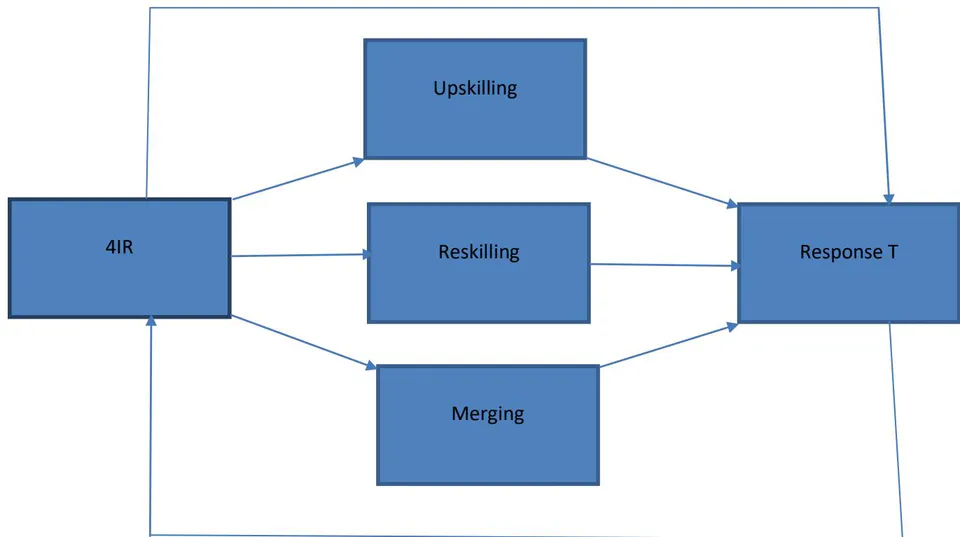
In the 4IR environment, merged S-M divisions will give competitive advantages over separate S-M divisions;
The 4IR has a direct positive impact on the reskilling requirement for the S-M personnel;
The 4IR has a direct positive impact on the upskilling requirement of the S-M personnel.
A merger of the S-M functions, upskilling and Reskilling of the S-M functions will improve the response time to customer requirements;
The 4IR has a direct positive effect on response times expectations on both suppliers and consumers.
Quick response times will further give a positive influence on the competitive advantage in the 4IR.
The proposals given above are represented by a Conceptual model given below in Figure 2 below.
V. ACADEMIC, PRACTICAL IMPLICATIONS AND LIMITATIONS OF THE STUDY
Studies on the 4IR are still emerging and are characterized by their technological approach nature and their social implications. The aim of the present study was to clarify the effects of the 4IR on the S-M divisions in view of the changing nature of technology and of the customer profile based on the findings of a systematic literature review. Some of the important conclusions are that, there is need for the destruction of the barriers between the S-M functions. The 4IR environment is already blurring their divisions. These recommendations are in line with what literature recommends in other circumstances (example: Pedron, 2018; Hirschli, 2018, Anusha, 2018). Also, the dynamic nature of the external environment of organizations necessitates both upskilling and reskilling of the S-M personnel. This call is supported by literature (see Penprase, 2018; Stephen, 2017; Bajpai and Biberman, 2019; Van Deursen, and Van Dijk, 2014). The paper goes on to suggest that response times to customer requirements are a function of the combined effect of merging the S-M, upskilling, and reskilling of S-M personnel. Many authors have shown that individually these have a direct positive impact (see Kelemen-Erdos, and NMolnar, 2019; Penprase, 2018; Hirschli, 2018). What is new is the suggestion that their combined effect are more than what can be expected when they are seen in isolation. It must also be stated that this paper was only based on literature review and has not been subjected to an empirical testing. Given the qualitative nature of this study, the propositions might not be applicable to all industries and thus not generalizable. Future research may focus on using Quantitative methods to empirically test the propositions suggested by this article. Further, scholars may study any additional components of the 4IR that impact the Sales and the Marketing functions in organizations in addition to what has been covered. Also, given the dynamic nature of the 4IR business environment, other contextual conditions are likely to emerge. Therefore, the conceptual framework might need to be adapted. Lastly, testing this study within new contexts such as services will be helpful.