
I. INTRODUCTION
One of the consequences under the scrutiny of researchers is cognitive dysfunction in drug addiction. Abnormal brain function in people with addiction predisposes them to make decisions with disastrous consequences for their health and well-being, and the well-being of their families and communities [1]. Many authors point out that there is an extensive literature supporting the hypothesis that long-term drug exposure leads to certain cognitive impairments [2,3,4,5]. Among drug users, the prevalence of cognitive impairment ranges from 30 to [6].
Areas of the brain and processes underlying addiction overlap significantly with areas involved in basic cognitive functions . Anatomically, there is an important overlap between learning and memory neural substrates and addictions. Some of the areas that show overlap include the cerebral cortex, hippocampus, amygdala, and striatum, all of which are components of the mesolimbic dopaminergic system [8]. Cognitive dysfunctions are closely associated with a strong pathological craving for the drug, with its ideational and affective components being especially pronounced. The intensity of changes in the ideational component is confirmed, along with impairments in the cognitive sphere, impaired nosognosias in most patients in the post-withdrawal period [9]. A similar reflection was found in the article by Copersino M. L. and Wiers R. W. that cognitive impairment affects addictive behavior [10,11].
Yaltonsky V.M. "The combination of legal and illegal surfactants is manifested by high neurotoxicity, which is considered as one of the main causes of neurodegenerative disorders in chemical addictions and is accompanied by neurocognitive deficits" [12].
Many authors come to the conclusion that it is the cannabinoid group that is the main source of cognitive dysfunctions in combined abuse with tramadol , which depend on the age of onset, duration, amount, and frequency of abuse . Tursunkhojaeva L.A., and Rustamova J.T. in a comparative assessment of memory functions in patients with opium-hashish poly-drug addiction and opium mono-addiction, we concluded that all amnestic processes are disturbed during poly-drug addiction .
Cognitive impairment is a predictor of poor treatment outcome . Cognitive dysfunction also harms treatment processes such as motivation for treatment, willingness to change, readiness for treatment, and the rehabilitation period . The preservation of cognitive functions in drug addicts can reduce the risk of relapse and improve the effectiveness of rehabilitation . Predictors of low treatment success and a high likelihood of relapse are memory impairments, a low level of abstraction, low psychomotor speed and impaired visual-spatial synthesis, impaired inhibition processes, and working memory . The patient's cognitive ability is a predictor of quality of treatment outcome, which can be a useful screening tool for alerting potential problems that may arise during treatment . Repeated drug use in the face of negative consequences indicates dysfunction of the cognitive mechanisms underlying decision-making. The deficit in decision making is most likely due to both premorbid factors and effects caused by psychoactive substances, which in the long term is associated with a high risk of relapse .
Purpose: A neuropsychological study of cognitive functions in patients with combined dependence on hashish and tramadol.
II. MATERIALS AND RESEARCH METHODS
Following the goal of the study, 129 male patients were selected who underwent inpatient treatment for drug addiction in the Republican Narcological Center from 2015 to 2019. All patients are male. The patients were divided into 3 groups: group 1 (main group) - 41% of patients (n=53) with combined abuse of hashish and tramadol. For comparison, patients with opium and hashish monar addiction who were not complicated by dependence on other types of psychoactive substances were selected. 2- group (control group) -34% of patients (n=44) with dependence on opioids, abuse tramadol without a doctor's prescription to achieve euphoria, who did not use other opioids before taking tramadol. Group 3 (control group) - 24.8% of patients (n=32) with dependence on cannabinoids.
A neuropsychological study was carried out using two approaches: 1. a cognitive screening tool to distinguish between patients in the main and control groups. For the study of memory: a method of memorizing 10 words according to AR Luria, [30,31] words that are not related to each other, neutral in logic and emotional color. A set of words is presented 5 times so that the patient can fully remember them and can reproduce them in any sequence.
- A battery of tests to determine the relationship between disease and cognitive dysfunction - Montreal Cognitive Assessment Scale (MoCA test) [32,33]. The MoCA test is sensitive to subtle cognitive impairments in a variety of populations and has a wide range of applications, including dependence on psychoactive substances , in contrast to MMSE (Mini-mental state examination (MMSE) MF Folstein, PR Folstein (1975), the MOSA test is more sensitive to early detection of cognitive decline. The MOCA test helps to assess: executive functions, optical-spatial activity, memory, attention, speech, conceptual thinking, counting, and orientation. The sensitivity is 90%, the specificity of the method is 87%. The maximum score is 30; the cut-off point is 25/26 points . Time for the test is approximately 10 minutes. When concluding, they were not based only on rating scales, we took into account the anamnestic information collected from the patient, as well as, if possible and the consent of the patient and his close relatives, mental status, and our observations.
The data revealed during the study were subjected to statistical processing on a Pentium-IV personal computer using the Microsoft Office Excel-2016 software package, using the built-in statistical processing functions. The level of reliability P < 0.05 was taken as statistically significant changes. All patients had informed consent for examination.
III. RESULTS AND DISCUSSION
The age of the surveyed ranged from 20 to 45 years. The average age is years. The average age of patients at the time of examination in group 1 was years (median 31.5; minimum age - 20 years, maximum age 45 years), in group 2 - years (median 29.5; minimum age 20 years, maximum age 45 years), in group 3 - (median 32.5; minimum age 22 years, maximum age 44 years).
The result of the study of the level of education, presented in Figure 1, did not reveal statistically significant intergroup differences (P 1-2, P 1-3 > 0.05).
Among the patients of the studied groups, cognitive impairments of varying severity were revealed.
The results of the study of memory by the method of memorizing 10 words showed that after the first series, which indicates the volume of auditory short-term memory, a large proportion of patients with combined addiction remembered only 2-4 words: 67.9% of patients in group 1, 11.3% patients in group 2 (P1-2 <0.001) and 53.1% of patients in group 3 (P 1-3 > 0.05), in contrast, were able to reproduce 5-7 words in patients with tramadol dependence (32% of patients 1- group, 88.6% of patients in group 2 (P 1-2 <0.001) and 46.8% of patients in group 3 (P 1-3 > 0.05).
When examining subjects without memory impairments, by the third repetition they reproduce, correctly, up to 9 or 10 words. Substance-dependent patients gave the following results (Table 1).
| Word count | group(n=53) | group(n=44) | group(n=32) | |||||
| abc. | % | abc. | % | abc. | % | |||
| 2-4 | 6 | 11,3 | 0 | 0 | 3 | 9,3 | <0,05 | >0,05 |
| 5-7 | 31 | 58,4 | 6 | 13,6 | 13 | 40,6 | <0,001 | <0,01 |
| 8-10 | 16 | 30,1 | 38 | 86,3 | 16 | 50 | <0,001 | >0,05 |
| Total | 53 | 100 | 44 | 100 | 32 | 100 | ||
The indicators of the volume of auditory long-term memory, taken after one hour, determined that the vast majority of patients with tramadol dependence could reproduce 8-10 words (18.8% of patients in group 1, 81.8% of patients in group 2 (P1-2 <0.001) and
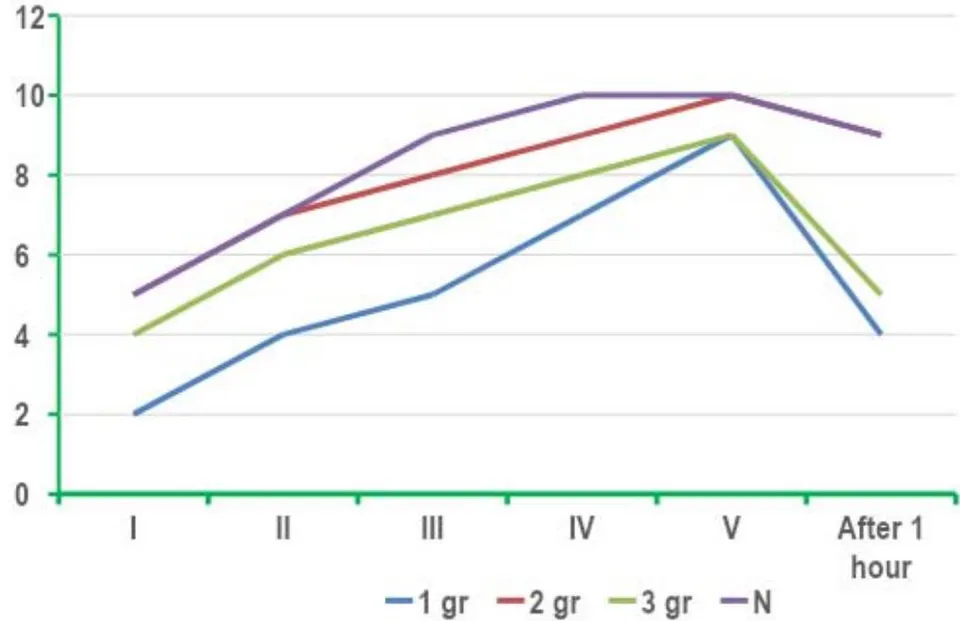
Normally, the learning curve is steadily increasing. The curve of patients in groups 1 and 3 reflects violations of all mnemonic processes - fixation, retention and reproduction. Their curve with a sharp downward slope indicates a weakening of active attention. Although the curves of patients in groups 1 and 3 are the same, the number of words in the initial and subsequent reproductions is lower with combined dependence on hashish and tramadol than with mono use of hashish. And also patients in group 1 often reproduced words in random order with the aim of not specifically highlighting previously unmentioned words. Having made a mistake, they continued to repeat it in the next tests.
Screening of cognitive function with the MOSA test also revealed intergroup differences. The average score on the MOSA test was higher among patients in group 2 - 24.5±1.15 (P1-2 <0.01), for patients in group 1 it was 21.4±2.42 and in patients in group 3 - 22.81±1, 09 (P 1-3 > 0.05). Table 2 shows the indicators of each domain of the MOCA scale in the subjects.
| Indicators | 1 Group(n=53) | 2Group(n=44) | 3 Group(n=32) | |||||
| abc. | % | abc. | abc. | % | abc. | |||
| Draw a broken line: | ||||||||
| wrong | 18 | 34,0 | 1 | 2,3 | 6 | 18,8 | <0,001 | >0,05 |
| right | 35 | 66,0 | 43 | 97,7 | 26 | 81,3 | <0,001 | >0,05 |
| Optical-spatial activity (cube): | ||||||||
| wrong | 25 | 47,2 | 14 | 31,8 | 12 | 37,5 | >0,05 | >0,05 |
| right | 28 | 52,8 | 30 | 68,2 | 20 | 62,5 | >0,05 | >0,05 |
| Optical-spatial activity (hours): | ||||||||
| Контур: | ||||||||
| wrong | 3 | 5,7 | 0 | 0 | 2 | 6,3 | >0,05 | >0,05 |
| right | 50 | 94,3 | 44 | 100 | 30 | 93,8 | >0,05 | >0,05 |
| Numbers: | ||||||||
| wrong | 15 | 28,3 | 4 | 9,1 | 6 | 18,8 | <0,001 | >0,05 |
| right | 38 | 71,7 | 40 | 90,9 | 26 | 81,3 | <0,01 | >0,05 |
| Arrows | ||||||||
| wrong | 20 | 37,7 | 9 | 20,5 | 10 | 31,3 | >0,05 | >0,05 |
| right | 33 | 62,3 | 35 | 79,5 | 22 | 68,8 | >0,05 | >0,05 |
| Naming: | ||||||||
| Llion | ||||||||
| wrong | 0 | 0 | 0 | 0 | 0 | 0 | ||
| right | 53 | 100 | 44 | 100 | 32 | 100 | ||
| Rhinoceros | ||||||||
| wrong | 16 | 30,2 | 16 | 36,4 | 16 | 50,0 | >0,05 | >0,05 |
| right | 37 | 69,8 | 28 | 63,6 | 16 | 50,0 | >0,05 | >0,05 |
| Camel | ||||||||
| wrong | 5 | 9,4 | 4 | 9,1 | 3 | 9,4 | >0,05 | >0,05 |
| right | 48 | 90,6 | 40 | 90,9 | 29 | 90,6 | >0,05 | >0,05 |
| Attention: | ||||||||
| Direct account | ||||||||
| wrong | 21 | 39,6 | 16 | 36,4 | 12 | 37,5 | >0,05 | >0,05 |
| right | 32 | 60,4 | 28 | 63,6 | 20 | 62,5 | >0,05 | >0,05 |
| Reverse count | ||||||||
| wrong | 7 | 13,2 | 8 | 18,2 | 6 | 18,7 | >0,05 | >0,05 |
| right | 46 | 86,8 | 36 | 81,8 | 26 | 81,2 | >0,05 | >0,05 |
| Reaction (clap on the letter A) | ||||||||
| wrong | 11 | 20,8 | 8 | 18,2 | 7 | 21,9 | >0,05 | >0,05 |
| right | 42 | 79,2 | 36 | 81,8 | 25 | 78,2 | >0,05 | >0,05 |
| Serial account | ||||||||
| 1 score | 3 | 5,7 | 0 | 0 | 0 | 0 | >0,05 | >0,05 |
| 2 score | 31 | 58,5 | 20 | 45,5 | 18 | 56,2 | >0,05 | >0,05 |
| 3 score | 19 | 35,8 | 24 | 54,5 | 14 | 43,7 | >0,05 | >0,05 |
| Repeating a sentence I | ||||||||
| wrong | 42 | 81,1 | 31 | 70,5 | 23 | 71,8 | >0,05 | >0,05 |
| right | 11 | 18,9 | 13 | 29,5 | 9 | 28,1 | >0,05 | >0,05 |
| Repeating a sentence II | ||||||||
| wrong | 35 | 66 | 25 | 56,8 | 20 | 62,5 | >0,05 | >0,05 |
| right | 18 | 34,0 | 19 | 43,2 | 12 | 37,5 | >0,05 | >0,05 |
| Fluency of speech: | ||||||||
| wrong | 23 | 44,4 | 14 | 31,8 | 11 | 34,4 | >0,05 | >0,05 |
| right | 30 | 56,6 | 30 | 68,2 | 21 | 65,6 | >0,05 | >0,05 |
| Abstract thinking: | ||||||||
| 1 score | 24 | 45,3 | 19 | 43,2 | 14 | 43,8 | >0,05 | >0,05 |
| 2 score | 29 | 54,7 | 25 | 56,8 | 18 | 56,3 | >0,05 | >0,05 |
| Delayed playback: | ||||||||
| 1 score | 5 | 9,4 | 0 | 0 | 0 | 0 | <0,05 | >0,05 |
| 2 score | 15 | 28,3 | 0 | 0 | 3 | 9,4 | <0,001 | <0,05 |
| 3 score | 25 | 47,2 | 7 | 15,9 | 11 | 34,4 | <0,001 | >0,05 |
| 4 score | 8 | 15,1 | 20 | 45,5 | 18 | 56,3 | <0,001 | <0,001 |
| 5 score | 0 | 0 | 17 | 38,6 | 0 | 0 | <0,001 | |
| Orientation: | ||||||||
| 4 score | 2 | 3,8 | 0 | 0 | 0 | 0 | >0.05 | >0.05 |
| 5 score | 28 | 52,8 | 20 | 45,5 | 15 | 46,9 | >0.05 | >0.05 |
| 6 score | 23 | 43,4 | 24 | 54,5 | 17 | 53,1 | >0.05 | >0.05 |
Among all patients with addiction to psychoactive substances, more violations were revealed in such parameters as executive skills - drawing a broken line: correct performance was 66% in group 1, 97.7% in group 2 (P1-2 <0.001), 3-group 81.3% (P1-3 >0.05). Any mistake, if corrected by the patient on his own, was counted. When assessing optical-spatial activity (cube): intergroup differences were not revealed (P1-2; P1-3 >0.05); Optical-spatial activity (hours): when drawing the correct contour and the arrangement of arrows, intergroup differences were not revealed (P1-2; P1-3 >0.05); the correct arrangement of numbers - patients in group 1 - 71.7%, group 2 - 90, 9% (P1-2 <0.01), 3 groups 81.3% (P1-3 >0.05). Delayed reproduction (score is assigned 1 point for each named word without any prompts): 1 point was received only by patients of group 1, 9.4% (P1-2; P1-3 <0.05); 2 points - patients in group 1 - 28.3%, group 2 did not receive (P1-2 <0.001), group 3 - 9.4% (P1-3 >0.05); 3 points - patients of group 1 - 47.2%, group 2 - 15.9% (P1-2 <0.001), group 3 - 34.4% (P1-3 >0.05) 4 points - patients 1 - group 15.1%, group 2 45.5% (P1-2 <0.001), group 3 56.3% (P1-3 <0.001); 5 points - only patients in group 2 38.6% (P1-2 <0.001). In the remaining domains, such as naming, attention, repetition of sentences in two approaches, fluency, abstract thinking and orientation, no statistically intergroup differences were found (P1-2; P1-3> 0.05). But draws attention, all patients of the study groups, 100% correctly named the animal "lion", while the naming of the animal "rhino" had difficulties in patients of group 3 (group 1 - 69.8% answered correctly, group 2 63.6%, group 3 - 50.0% (P1-2; P1-3> 0.05) All patients in the study of attention had difficulties in direct counting, the proportion of correct answers was low (group 1 - 60.4%; Group 2 - 63.6%; Group 3 -62.5% (P1-2; P1-3> 0.05) compared to the reverse count (Group 1 -86.8%; Group 2 -81.8%; Group 3-81.2% (P1-2; P1-3> 0.05)).
Conclusion: Screening of cognitive functions in patients with the combined use of hashish and tramadol showed that there is a negative synergistic effect on cognitive function. The cannabinoid group is the main cognitive dysfunction when combined with tramadol - with combined use and mono use of hashish, violations of all mnemonic processes occur: fixation, retention, and reproduction, but with deeper disorders in poly addiction.
Screening of the cognitive function of patients with poly addiction is one of the main prognostic signs and gives an idea to the clinician for a further algorithm of actions, directions for improving the specialized treatment of addiction and preventing the relapse of the disease.