
I. INTRODUCTION
Blood transfusion transfers of blood and its components such as red blood cells, platelets, and plasma from donor to the recipient (WHO, 2011). The donation of the blood saves the lives of millions of people universally, and it is essential to the helpfulness of the health system by supporting current transfusions worldwide (WHO, GDB, 2011). The following tests were mandatory performed in Sudan, at all blood centers at all levels following WHO, international organizations and regulatory bodies for blood safety: Hepatitis B surface antigen (HBsAg), anti-HIV1, HIV2, and an approved test for anti-HCV. All three tests have to be negative. (Roger Y. Dodd, 2001). All reactive results of blood donor's samples for infectious transmitted disease were should be retested in duplicate by the same assay. (WHO, 2012). All confirmed contaminated blood components units by TTI through repeatedly testing samples were not used for therapeutic applications and should normally be destroyed unless useful for non-therapeutic purposes or investigations. All blood donors have reactive testing results should be evaluated by a confirmatory tests and there should be a mechanism to inform blood donors the positive testing results. (WHO, Geneva, 2013). It is recommended that national testing algorithms for TTI shall be developed and used to enable consistent resolution of discordant indeterminate or unconfirmed results. (Jain C., et al, 2011). In some African countries, in addition to TTI markers other serological tests were performed, for instance, anti-HBC testing may be performed on whole blood donations to further reduce the risk of exposure of recipients to HBV by contaminated blood or blood components to supply of safe blood products for transfusion, it's compulsory to introduce an advanced technology like a nucleic acid test (NAT) because of excellent clinical sensitivity and good specificity to detect infected blood components as it identified pathogens prior in the 'window period' than enzymes immune assay (Gerard C.,. et al, 1995). Even though, it has some margin in blood components with a lesser range of viremia, which can even free quantifiable by NAT (WHO, Geneva, 2012). Even with this margin, the grouping of both enzymes immune assay and NAT has notably condensed the hazard of pathogen spread during transfusion (11). Also, many scientific research data showed that the comparison between p24 antigen detection or conventional serological testing, it is estimated that the use of NAT reduces the detection time from 22 to 11 days for HIV; from 70 to 10 days for HCV, and from 60 to 30 days for HBV infection (H.Sheikholeslami., et al, 2010). Additional testing for other agents or markers such as anti-HTLV I, II, anti-T.cruzil, or West Nile virus (WNV) may be taking into account the epidemiological situation in any given region or country or the frequency of donating blood (H.W.Reesink, 2000). In addition to testing TTI markers serologically, Nucleic Acid Testing (NAT) testing of blood donations for the virus genomes has been introduced in some countries to increase the chance of identifying infected blood donors. Testing for the presence of nucleic acid may be performed for viruses such as HCV, HBV, HIV, HTLV, and WNV and or Parvovirus B19, and the application of this technology may be extended to other transmissible microbes (M.M.E Nageh., et al, 1994). Nucleic Acid Testing (NAT) require a sophisticated laboratory environment, special equipment, and specially trained laboratory personnel. To supply of safe blood products for transfusion, it's compulsory to introduce an advanced technology like a
nucleic acid test (NAT) because of excellent clinical sensitivity and good specificity to detect infected blood components as it identified pathogens prior in the 'window period' than enzymes immune assay to supply of safe blood product for transfusion, it's compulsory to introduce an advanced technology like a nucleic acid test (NAT) because of excellent clinical sensitivity and good specificity to detect infected blood components as it identified pathogens prior in the 'window period' than enzymes immune assay (WHO, GDB,2011).Even though, it has some margin in blood components with a lesser range of viremia, which can even free quantifiable by NAT. Even with this margin, the grouping of both enzymes immune assay and NAT has notably condensed the hazard of pathogen spread during transfusion (WHO, Geneva, 2002).Even though, it has some margin in blood components with a lesser range of viremia, which can even free quantifiable by NAT(WHO, Geneva,2012). Even with this margin, the grouping of both enzymes immune assay and NAT reduced the hazard of pathogen spread through blood (Widman FK, 1985). Mainly because of an extraordinary risk of false-positive testing results due to contamination when NATs were performed to donor samples, therefore very stringent handling and logistics are mandatory. (WHO, 2008-2015). In contrast to testing of individual blood donor specimen's serologically for TTI markers, NAT testing can be performed following assembling various samples in mini-pools. (WHO, Geneva, 2014). However, this requires thoroughly validated laboratory systems including samples labeling, a validated strategy and pooling process, a validated algorithm to resolve pool results to individual donors. Hence, specific logistics systems shall be established at all laboratory and blood transfusion services process to collect suitably label samples. (WHO, Geneva, 2011). Contiguously tracing blood samples through the whole process from blood donation, through pooling samples, testing, and release of the testing results may present a particularly demanding challenge. A system should exist in the country or region for approval of laboratory testing systems, such as accredited laboratory or council. (WHO. GDB, 1998 - 1999).The blood transfusion department contains clinical methods and guidelines for blood screening before transfusion. If the screening procedure and other regulations are not followed well, there is a possibility to carry the risk of spreading blood transfusion contagious pathogens like HIV, HBV, HCV, Bacteria (syphilis), and others (WHO Geneva, 2012). Also, there is a of chance of transfusion - related infection in each unit of blood even if the procedure is followed well (WHO, 2002). Therefore, the risk of blood transfusion - transmitted infection today is minimized than constantly, the delivery of safe blood products stays behind inquiry to infection with accepted and until now to be predictable human pathogens (WHO, June 2011).
II. MAIN TEXT
In the present study were incorporated 500 blood donors. All the donors have been screened with a medical consultant before donation, who attended as voluntary and replacement in blood transfusion centers in all states from January 2014 to December 2015.
III. SAMPLE COLLECTION
Five milliliters (5ml) of venous blood were collected from each donor after taking history and clinical examination using plain vacationer tubes during donated blood. All samples were allowed to clot formation and then were centrifuged at 3000 rpm for 10 minutes. All serum samples were separated into sterile 2ml cry vial containers and stored at until used. All serum samples were shipped and transported from the states to the national blood directorate in the Khartoum within the acceptable period, and temperature using cool boxes containing ice bags, temperature - controlled in each cool box using thermostats.
IV. SEROLOGY
All donors samples were screened by ELISA kits from fortress diagnostic Unit 2C Antrim technology park, Antrim BT41 IQS (United Kingdom): the least most negligible (cut off) was considered as per company guidelines for reporting positive and negative outcomes. Actual positive and negative samples were used subjectively as an outside run in each screening for our laboratory intention. The donated blood was discarded if the serum sample was positive for any infectivity. The statistical analysis was done using Microsoft ware office excel 2007.
V. RESULTS
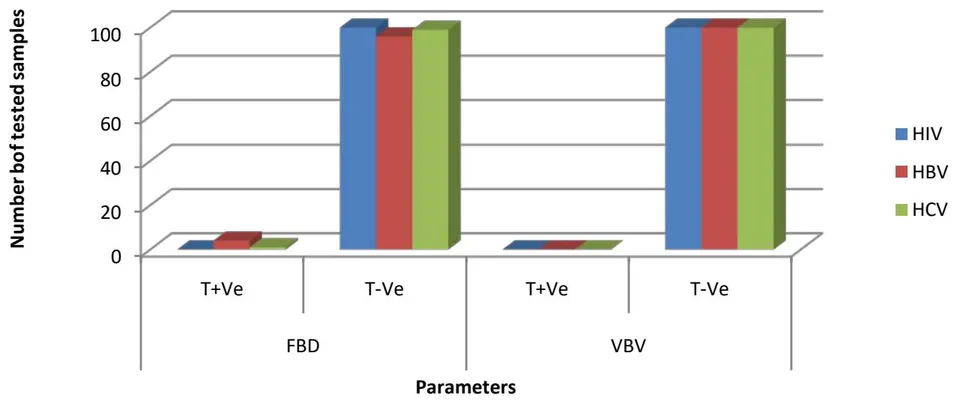
Two hundred samples were collected from blood donors for TTI markers (HIV, HBV, and HCV) testing. One hundred samples were collected from family replacement blood donors and another one hundred samples were collected from voluntary blood donors. All models were tested for HIV, HBV, and HCV using the ELISA technique. 4 models have positive results for HBV and one model had positive effects for HCV from the FBD group, in contrast all models from VBD were negative for TTI markers as presented in fig 1.
VI. DISCUSSION
Overall average laboratory testing principle in the blood transfusion services in Sudan was found to be The world health organization (WHO) recommends that all donated blood be screened for HIV1&11, HBV, HCV, and syphilis (WHO, 2009). The lowest incidence and prevalence of transfusion-transmissible infections is generally found among regular voluntary non-remunerated donors rather than first-time or occasional donors and family replacement blood donors (WHO, GDB reports, 2001-2002). The tested results of samples from family replacement blood donors (FRBD) show that there are seropositive for HBV was found in family replacement blood donors while in contrast the number of representatives from voluntary blood donors (VBD) was found free of viral transfusion transmissible inactions such as HIV, HBV and HCV. The obtained results by this study was in high agreement With results done in the African countries, and the results shows that the prevalence of hepatitis B among blood donors in WHO African Region countries were and the prevalence of hepatitis C among blood donors in Cameroon , in Tanzania and Africa (DR Neelam, June 2006). HIV causes significant health problems in sub-Saharan Africa where the prevalence of HIV among blood donors ranges between similarly: the prevalence of HCV was in Cameron, in Tanzania (WHO, 2013). And high in Egypt (Martin, H and Jeffery's, 2011). Hepatitis B prevalence was and Hepatitis C, among blood donors in Egypt (Egypt, 2016).
VII. CONCLUSION
Comparison of seroprevalence of (TTI) between family replacement and voluntary blood donors shows that there are of family replacement blood donors has positive HBV results, which increase the risk of transfusion of infected blood in contrast all voluntary blood donors show that the testing result for (TTI) markers are negative which that the blood supply through voluntary blood donors is safest than family replacement blood donation system. The seroprevalence rate was low in voluntary blood donors compared to family replacement blood donors because regularly voluntary blood donors are safe and recommended by WHO.
VIII. LIMITATION OF THE STUDY
In this study, rapid and ELISA techniques were used to diagnose the infection. Although it has a specific accuracy, it is currently used to diagnose diseases. Also no previous studies data in Sudan were used for comparison.
List of abbreviations
Not applicable
Declarations
Ethical approval and consent to participant
Approval of conducting this study was obtained from the National public health laboratory, Khartoum, Sudan. Written consent was taken from each member of the study.
Consent for publication
Not applicable.
Availability of data and materials
The datasets generated during and/or analyzed in this study are not publicly available due to the National public health laboratory, Khartoum, Sudan, ethical policy to protect participant confidentiality.
Competing interest
The authors declare that they have no competing interests.
Funding
No funding was obtained for this study
Authors contributions
ACKNOWLEDGMENT
We acknowledge the support provided by technical staff from blood banks and centers in all states. Also, to all my collages in national blood transfusion center and coagulation reference laboratory—national public health laboratory. Results of tested quality parameters the samples collected from these units.