




I. INTRODUCTION
As reported in the media, the care of hospitals and health centers in Brazil has become increasingly precarious. Said precariousness is due to the excessive workload, unhealthy conditions, and lack of PPE's; this affects the psychological of the nurses, which can cause depression or Burnout syndrome, among other problems. All of this culminates in affecting patient care and the effectiveness of screening and monitoring. That said, the efficiency of care at health centers and similar places has become an increasingly relevant social problem in Brazil. Increasingly, patients in public hospitals feel uncomfortable to perform examinations or for simple temperature monitoring; also, we cannot ignore the nurse's health. Based on these facts, was developed the research project SOFIA - Optical System of Operation and Medical Analysis; Which aims to optimize the acquisition of conventional clinical examinations in the queues of hospitals and other similar places. The initial idea is the creation of an electronic system capable of acquiring the temperature in a non-invasive way, ensuring a considerable optimization of the medical service. The thermographic sensor would measure the patient's temperature and, through programmed speech and voice communication, the robot would make a record for the patient; the professional would receive the sent data.
II. DEVELOPMENT
The first phase of the project's development aims to provide Brazilian hospitals and health centers with an electronic device capable of quickly and non-invasively screening patients, acquiring the results of conventional clinical examinations such as body temperature. The development of the project will take place in several stages. In its first stage, the system would be able to capture a person's temperature through the forehead with the thermographic sensor obtaining this data through a program on the microcomputer. This step, in turn, is already partially completed; a calibration was performed but aimed at to do a more detailed one focused on human applications. The new calibration process started, and; a small-scale prototype too. In the prototype, an ultrasonic sensor and a voice recognition sensor would use together. The robot would use programmed speeches to interact with the patient. The idea would be to make the device able to detect the distance of the patient through the ultrasonic system and the programmed speeches. The robot would interact with the person asking for his data; In turn, the voice recognition device would capture everything the patient says and then set up their profile with the results of the screening; The doctor at the end of the process would receive these profiles via wifi. It is to add new sensors to perform other types of tests, in particular, the glucose test. The device would use the infrared to capture the level of sugar in the blood, so it would not be necessary to pierce the finger as is the conventional examination. The advantage of being done this way is that it is non-invasive; it would make people do it more often since many do not like the conventional way. This step would be developed based on the thesis "Glucose monitoring system in a continuous and non-invasive way to the human body based on spectroscopy and photoplethysmography methods" (Santos, Samuel, 2017). The aim is also to be able to use the thermographic image to perform the breast cancer exam; in this way, it would be non-invasive.
a) The micro-computer
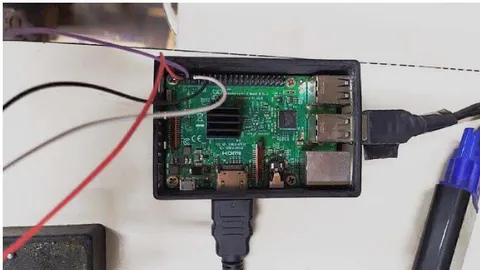
The Raspberry pi 3 B plus (Figure 1), produced by the Raspberry Pi Foundation, is a micro-computer that uses the Broadcom BCM2837B0 processor, which is very versatile and intuitive. The microcomputer acquires the sensor data, sending this information to the professional. This development board selected for its high processing capacity and the ease of implementation of other sensors.
b) The thermographic sensor
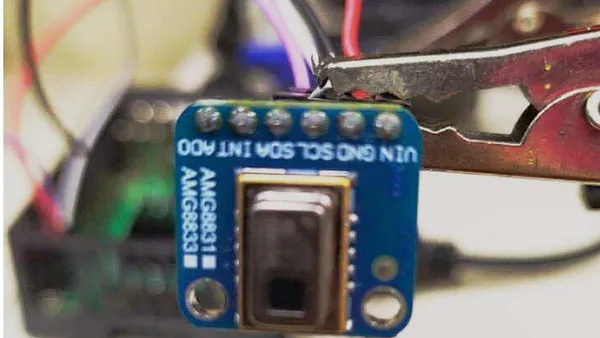
The temperature sensor chosen was the AMG8833 (Figure 2); Panasonic Industries produced the device; however, the plate printed by Adafruit Industries, the same as a thermographic device, ends up capturing the temperature in the form of an image.
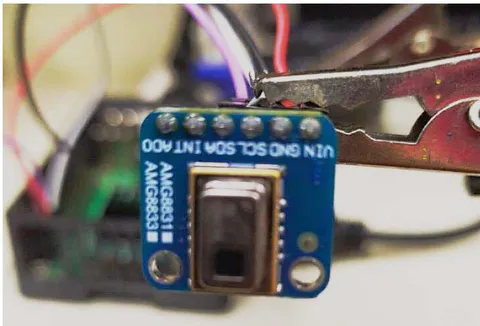
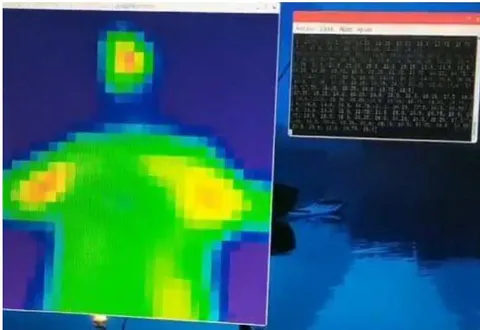
The AMG8833 has an accuracy of but can circumvent through calibration. It also uses the I2C interface, which facilitates the connection with the microcomputer. The minimum temperature for use would be and the maximum ; it is also sensitive to humidity, operating at 15% to 85% R.H. Outside this range, it can end up deteriorating. The capture of the sensor can see it in Figure 3, where it shows the operation.
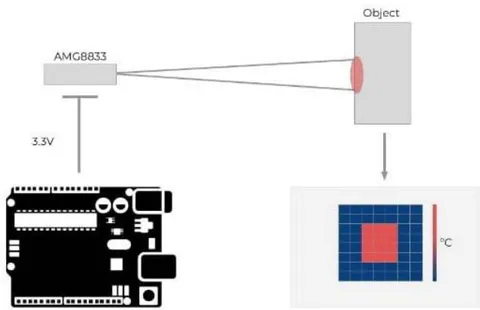
It's worth point out that the acquisition distance also influences the reading, being that it measures up to 7m, however in practice, to measure a person, the maximum is + -30cm. The device itself works as a matrix; that is, if you capture the image of a specific point that is capable of measuring the human body, such as the forehead and the armpit when averaging that matrix, you find the temperature in common. That said, it was necessary to perform a calibration to make sure that the average is indeed correct. For this, were used a Peltier plate, a bench power supply, a multimeter, and a thermocouple. With the source, it was possible to control the temperature of the Peltier plate; the thermocouple would be the base temperature sensor. In this way, were recorded in an excel spreadsheet the values that the thermocouple and the sensor captured. Also, were noted the day temperature, humidity, current, and voltage, as seen in Figure 4; However, this was only for academic purposes; Since what matters in the graph is the thermocouple and sensor data.
Figure 4: Spreadsheet with sensor calibration values
| TEMP | MOISTURE | ||
| 26°C | 68% | ||
| CURRENT | VOLTAGE | THERMOCOUPLE | SENSOR |
| 0 | 0 | 28 | 2,4 |
| 0,05 | 0,2 | 29 | 31 |
| 0,1 | 0,4 | 29 | 23,567 |
| 0,15 | 0,5 | 30 | 3,85 |
| 0,2 | 0,8 | 31 | 24,733 |
| 0,25 | 0,8 | 33 | 26,367 |
| 0,3 | 1,2 | 34 | 27,3 |
| 0,35 | 1,3 | 36 | 29,9 |
| 0,4 | 1,5 | 38 | 31,5 |
| 0,45 | 1,7 | 40 | 32,433 |
| 0,5 | 2 | 43 | 34,717 |
| 0,55 | 2,2 | 46 | 35,7 |
After writing down the data, was created the graph and then get the equation to correct the errors.
The thermocouple was X, and the sensor was Y, as can be seen in Figure 5
THERMOCOUPLE X SENSOR
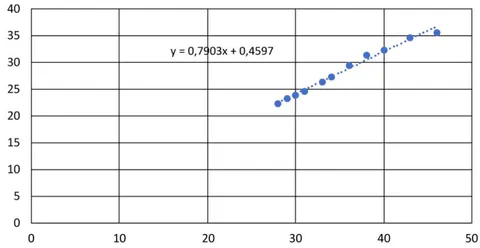
In the sensor program to correct the errors of the amg8833, was placed the equation(1).
However, it was an initial test; to correct all errors will be done a more detailed one. To not invade the patient's personal space, the equipment will have characteristics that can provide this requirement; and will be designed with materials that cannot damage the
(1) skin or cause any allergy or any other unforeseen to the patient.
c) Set Sensor-Microprocessor
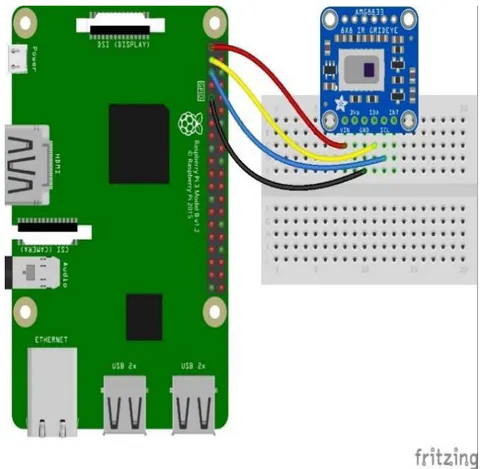
The connection sensor-microprocessor is an I2C connection, as shown in Figure 6, so the red wire connects the raspberry's 3V3 pin to the VIN pin of the sensor; yellow connects the two SDAs; blue connects the two SCLs; and finally, black connects the two GNDs.
The basic program, available on the Adafruit Industries website (Rembor, Kattini, 2019), was posteriorly downloaded. Is not calibrated the initial code, than was necessary a calibration. After these processes, was placed in the program, the equation(1). With a thermographic sensor, it is possible to capture the body structure at the temperature, as in Figure 7. The idea would be to use it to detect other problems, being possible even to detect breast cancer.
However, the resolution of the sensor used is inferior to others; Is not yet discarded the possibility of getting such an exam. Despite the current work on calibration more detailed; Is building an attractive interface that would send the data to the active professional; A patient's record, with name, blood type, current temperature. All this information, through voice, would be computed; This would be very attractive for children, especially those with down syndrome or autism.
d) Distance sensor
To obtain the right distance for an ideal temperature reading will be used as an ultrasonic sensor, the model HC-SR04 (Figure 8); The sensor works with distances from two centimeters to four meters.
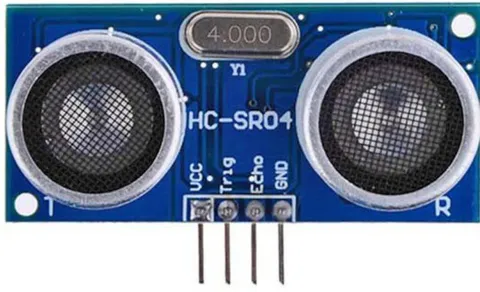
The idea is to use prepared speeches where it will tell if the patient should move away or get closer, to leave him where the sensor can measure the temperature correctly.
e) Prototype
As stated earlier, the intention is to create a small-scale prototype; the idea is to create a totem robot. The project already has a prototype design (Figure 9).

The design was made especially for this project; the robot's face would consist of a small LCD screen that connects to the raspberry, the sensor would be in the lower right corner.
III. RESULTS AND DISCUSSIONS
Currently is partially completed the calibration process for the AMG-8833 thermographic sensor. The device already works with the initial calibration; however, to achieve greater precision and superior quality in temperature acquisitions, a more detailed calibration will be performed. The project presented at technological exhibitions and the result of the temperature measurements with the initial calibration is entirely satisfactory. To analyze the approval of the project will be carried out a popular survey. Will interviewed health professionals to obtain an approval index about the possible effectiveness of the prototype in the field, possible implementation in health establishments in Brazil, and widespread approval regarding the willingness to undergo robot analysis.
IV. CONCLUSIONS AND FUTURE WORKS
The project has many health benefits; As mentioned before, it could decrease the nurse's workload, thus reducing cases of exhaustion that lead to depression or burnout syndrome, in addition to improving care, making it faster and not invasive. There are still some issues, more accurate calibration, and the prototype test in the field. Despite this, it already shows great potential; Since, with the initial calibration, it was already able to measure people's temperature correctly. It is estimated to create an interactive interface in conjunction with the programmed speeches; this would facilitate the user's interaction with the robot. After the exchange, as previously mentioned, the active professional would receive the obtained data professional. It is intended in the future to add other sensors to expand the range of exams. In principle would be created a sensor to measure glucose based on infrared, as it would be non-invasive without the need to pierce the finger. The idea for the construction of this device is based on the "Glucose monitoring system in a continuous and non-invasive way to the human body based on spectroscopy and photoplethysmography methods" (Santos, Samuel, 2017). Also, the possibility of obtaining another thermographic sensor more powerful, it is being studied. Still, of low cost, the idea will be to use it to perform the examination of breast cancer in a non-invasive way.


