
I. INTRODUCTION
The collapse of the nine-story Rana Plaza building in Savar, Dhaka, on April 24, 2013, remains one of the most catastrophic industrial accidents globally. Housing five garment factories, a bank branch, and various shops, the building's failure resulted in 1,136 deaths and over 2,500 injuries (MoLE, 2016). The incident spotlighted serious gaps in industrial safety compliance, urban planning, and emergency preparedness in Bangladesh. In response, a multitude of actors, including government bodies, NGOs, international organizations, and private sector representatives, mobilized to assist victims.
Among these efforts, the establishment of the Rana Plaza Coordination Cell (RPCC) by the Ministry of Labour and Employment was a pivotal institutional innovation. The RPCC was tasked with ensuring coordination among stakeholders, managing databases of victims, and facilitating compensation and rehabilitation. This paper explores how the RPCC responded to challenges of coordination, information management, and victim reintegration in the aftermath of the disaster.
II. LITERATURE REVIEW
A wide range of literature has addressed the Rana Plaza disaster, yet much of it has focused narrowly on compliance issues or criticized government actions from a distance, leaving a gap in understanding institutional innovations like the Rana Plaza Coordination Cell (RPCC). For instance, Mostafiz, Fahmida, and Akter (2016) examined the post-tragedy roles of the government and the Bangladesh Garment Manufacturers and Exporters Association (BGMEA) but focused primarily on improving workplace compliance rather than evaluating systemic rehabilitation efforts. Similarly, Islam (2015) concentrated on disability inclusion and identified a lack of state mechanisms for addressing survivors with long-term injuries, yet did not investigate coordination mechanisms like the RPCC that emerged to confront such gaps.
Ashfaquzzaman (2017) applied a postcolonial lens to analyze crisis communication during the disaster but lacked engagement with the logistics of institutional recovery. Quadir et al. (2019) assessed quality of life among survivors but did not include RPCC stakeholders in their data collection, leaving out a vital component in the rehabilitation chain. Fitch et al. (2015) focused on psychosocial impacts and PTSD among survivors but again did not connect these outcomes to institutional rehabilitation frameworks.
These gaps highlight a broader issue in the disaster literature: the tendency to analyze post-disaster contexts through either a critical policy lens or victim-centric narrative, without bridging the two through institutional analysis. This paper aims to bridge that divide by focusing on RPCC's organizational role in coordinating relief, managing data, and facilitating recovery. The literature on disaster governance, such as Comfort (1999), emphasizes that integrated information systems and coordination mechanisms are crucial for effective response. The adaptive governance framework (Folke et al., 2005) supports this notion, suggesting that in complex, uncertain situations like industrial disasters, flexible, stakeholder-inclusive structures are essential. RPCC's role aligns with this perspective by functioning as a dynamic, evolving body that responded to real-time challenges.
Moreover, disaster sociology scholars such as Tierney (2007) argue that elite and institutional actors often retreat from direct accountability, leaving civil society to fill the gap. This aligns with findings from this study that show limited involvement by BGMEA in initial relief efforts. In contrast, the RPCC's establishment served as a case of what Sylves (2008) terms Integrated Emergency Management Systems (IEMS), where multiple actors coordinate under a unified strategy.
Incorporating theories from public administration, such as Ansell and Gash's (2008) collaborative governance model, the RPCC's multi-stakeholder decision-making process illustrates how institutional innovation can emerge even in a governance landscape marked by fragmentation and mistrust. At the same time, critiques from Weberian bureaucratic theory (Weber, 1947) caution against ad hoc solutions that bypass formal authority, raising important questions about the sustainability of such interventions.
This paper contributes to the literature by documenting a hybrid model of state-led and community-supported disaster response that offers replicable lessons for future industrial crises. It aligns with calls in the broader development and governance literature for embedded, context-sensitive institutional arrangements that balance rapid response with accountability and long-term recovery planning.
III. RESEARCH GAP
While various studies critique or analyze specific aspects of the Rana Plaza disaster, few have documented the systemic coordination mechanisms employed by the RPCC. Existing literature rarely includes data directly collected from RPCC officials or beneficiaries, focusing instead on peripheral stakeholders. This paper addresses this lacuna by examining RPCC's operations using primary and secondary sources.
IV. OBJECTIVES
The Paper Aims to:
Assess the RPCC's role in post-disaster rehabilitation coordination.
Identify challenges faced during victim identification, data management, and service delivery.
Evaluate the impact of RPCC interventions on compensation, reintegration, and psychological recovery.
V. METHODOLOGY
- A mixed-methods approach was adopted. Primary data were collected via:
- Surveys of 45 victims using purposive sampling.
- Three FGDs with stakeholders, including union leaders, government officials, and NGO workers.
- Fifteen key informant interviews with RPCC members, medical professionals, and representatives from BGMEA and Rana Plaza Claims Administration (RPCA).
Secondary data included RPCC meeting minutes, NGO reports, government documents, and media archives. Data were analyzed thematically and triangulated across sources.
VI. BACKGROUND OF THE RPCC
Bangladesh has established robust systems for responding to natural disasters. However, the Rana Plaza collapse revealed a vacuum in institutional mechanisms for managing industrial disasters. Spontaneous rescue efforts by civilians exposed the absence of trained personnel, coordination, and equipment. Relief distribution was inconsistent and unregulated. Rana Plaza Coordination Cell (RPCC) was created in response to these systemic deficiencies. It aimed to:
- Coordinate rehabilitation services among stakeholders.
- Create a central database for victims.
- Provide timely information and resources to affected families.
Beneficiaries included injured workers, families of deceased and missing persons, and those indirectly impacted (e.g., adjacent residents and rescue workers).
VII. FINDINGS AND ANALYSIS
a) Emergency Relief and Medical Support
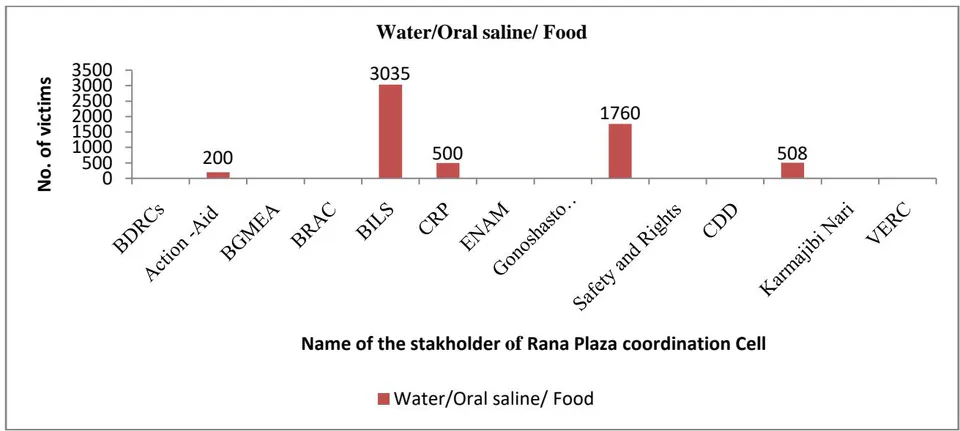
The initial phase of emergency relief following the Rana Plaza collapse was marked by a highly fragmented response. Numerous NGOs, civil society groups, and individual citizens rushed to assist, but in the absence of central coordination, efforts often overlapped or missed critical needs. As Figure 2 illustrates, food, water, and oral saline were distributed by diverse sources, many of whom were acting independently. According to ActionAid (2013), of the surveyed victims identified food as their most immediate requirement. In-depth interviews revealed that water, rather than oxygen or other medical interventions, was the first demand of those trapped under debris—a reflection of both the nature of the entrapment and the oversight in conventional emergency planning.
While such spontaneous aid is consistent with the emergent norm theory (Turner & Killian, 1987), which posits that during crises, new social norms quickly develop to facilitate prosocial behavior, the absence of structured oversight led to inefficiencies. For example, multiple victims received duplicate aid while others were left out entirely. The RPCC, although officially inaugurated on 7 November 2013 after the primary rescue operation, retroactively documented these early contributions to recognize and channel service providers' continued involvement under government coordination.
The role of the Bangladesh Garment Manufacturers and Exporters Association (BGMEA) was notably limited during this phase, as suggested by both primary data and anecdotal narratives. This aligns with critiques in disaster sociology that emphasize how powerful institutions sometimes avoid engagement in accountability-heavy roles (Tierney, 2007).
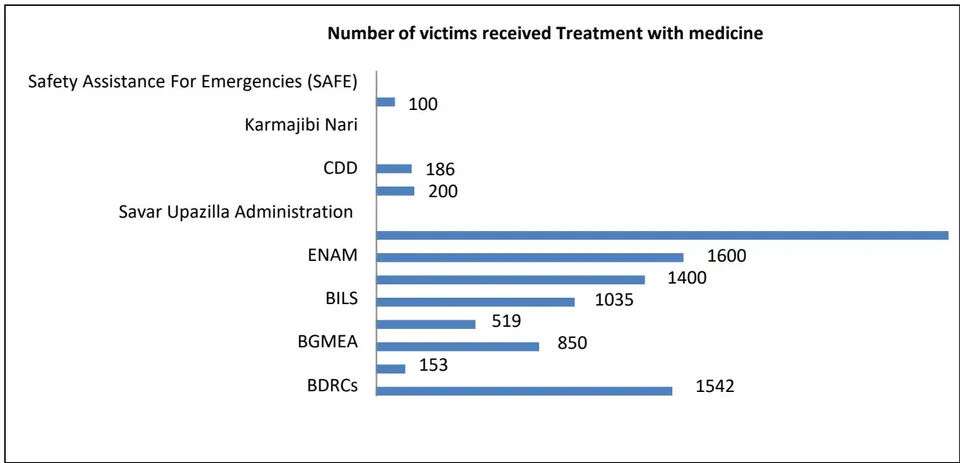
Following the initial rescue efforts, the focus rapidly shifted to medical treatment. Figure 3 documents the various sources of medical support received. Public hospitals played a central role, yet victims reported unequal access to private healthcare. A striking example is the case of a pregnant survivor denied emergency cesarean delivery at a private hospital due to inability to pay BDT 30,000. She was later pronounced dead at Suhrawardy Hospital in Dhaka. Such incidents reveal the deep structural inequities in healthcare access that disaster victims often face.
These findings resonate with the theoretical framework of structural violence (Galtung, 1969), which argues that social structures can harm individuals by preventing them from meeting basic needs. In contrast to the health equity models that emphasize universal access, Bangladesh's dual healthcare system disproportionately affected poor, marginalized victims of the industrial workforce.
The RPCC played a vital remedial role by compiling lists of injured victims, liaising with public hospitals, and ensuring equitable distribution of treatment support. It attempted to shift the emergency response from an ad hoc relief paradigm to a more institutionally supported and documented framework—a model consistent with the Integrated Emergency
Management System (IEMS), which emphasizes coordinated, multi-agency collaboration in disaster response (Sylves, 2008).
b) Victim Identification and Data Management
Conflicting data across agencies severely hampered service delivery in the aftermath of the Rana Plaza collapse. The RPCC played a pivotal role in consolidating disparate lists maintained by local administration, BGMEA, NGOs, and DNA testing facilities. By cross-checking and triangulating these sources, RPCC was able to establish a centralized database that reduced duplication and improved accountability.
| SL | Name of Organization | Number of Deceased Victims | Number of Missing Worker | Number of Survivors | Total Worker | Source |
| 1 | UNO office | 1132 | 165 | 1176 | 2473 | UNO, 2013 |
| 2 | DC Office, Dhaka/MoLE | 1134 | 165 | 2438 | 3729 | DC office, 2013 |
| 3 | BGMEA | 1061 | 261 | 2790 | 4112 | BGMEA, 2013 |
| 4 | BILS | 1131 | -- | 803 | 1934 | CPD, 2014 |
| 5 | PRIMARK | 3600 | 3600 | PRIMARK,2013 | ||
| 6 | ActionAid | 1134 | - | 1510 | 2644 | CPD, 2013 |
| 7 | CPD | 1134 | 98 | 2436 | 3668 | CPD, 2013 |
A prominent example involved the Jurain graveyard, where 291 bodies were interred, but only 206 were positively identified through DNA testing—leaving 85 bodies unidentified. Further investigations revealed that lists from the Prime Minister's Office, military bodies, and labor organizations often contained overlapping or inconsistent entries. RPCC's consolidation efforts concluded that the number of confirmed deceased stood at approximately 1,121.
This experience reflects the broader challenges discussed in disaster information management literature. Comfort (1999) argues that in high-stakes emergencies, the lack of an integrated information infrastructure often leads to redundant or contradictory data, complicating timely response. RPCC's strategy mirrors best practices from adaptive governance frameworks, which emphasize the importance of flexible, learning-based approaches to managing uncertainty and complex coordination (Folke et al., 2005).
Moreover, the chaos of conflicting data aligns with Perrow's (1984) Normal Accident Theory, which posits that in tightly coupled, complex systems like post-disaster administration failures are nearly inevitable without systemic safeguards. By centralizing data,
RPCC introduced those safeguards, turning a reactive environment into one where decisions could be guided by accurate information.
However, contrasting perspectives from bureaucratic theory (Weber, 1947) would critique RPCC's approach as ad hoc and vulnerable to politicization, since it bypassed traditional hierarchical structures. Yet, this case also demonstrates the value of collaborative governance (Ansell & Gash, 2008), wherein shared decision-making among stakeholders improved responsiveness despite institutional limitations.
In summary, RPCC's data management initiatives helped restore coherence in an otherwise fragmented response system and underscored the value of coordinated information infrastructure in industrial disaster recovery. Victim Identification and Data Management has been enriched with theoretical perspectives, including Adaptive Governance (Folke et al., 2005), Normal Accident Theory (Perrow, 1984), and contrasting views from Bureaucratic Theory (Weber, 1947) and Collaborative Governance (Ansell & Gash, 2008).
c) Challenges in Reintegration
The paper found that There were a total of 2,438 (RPCC, 2014) survivors in the Rana Plaza incident who were indifferent physical conditions. It is found by the study conducted by ILO and GIZ that of the rescued victims had a permanent disability because of amputation and paralysis, had severe difficulty in walking. The database of the RPCC also represented this same scenario. So in this situation, it was a tough job to explore and integrate these types of special worker. On the other hand, of the survivor required support for initiating a small business (AAB, 2013). So in this Regard with the help of related stakeholder CRP, DAM, ILO, GIZ, Spandan-B, BRAC, GP, LFMEAB, Taranga RPCC developed interventions for small business support. It was based on market needs and existing pro-poor approaches used and sensitivity was shown to the process of psychological recovery according to the Action Plan of Rana plaza Study found that maximum victims were not willing to join in industry or had a trauma to join in the concrete infrastructure job environment. So to engage them in small business and also to overcome the trauma was a primacy of the job for all. The number of victims covered in this regard is shown in Figure 4. It is seen that career counselling and trauma management was in the significant percentage provided by RPCC in an association of its stakeholder (Figure: 4).
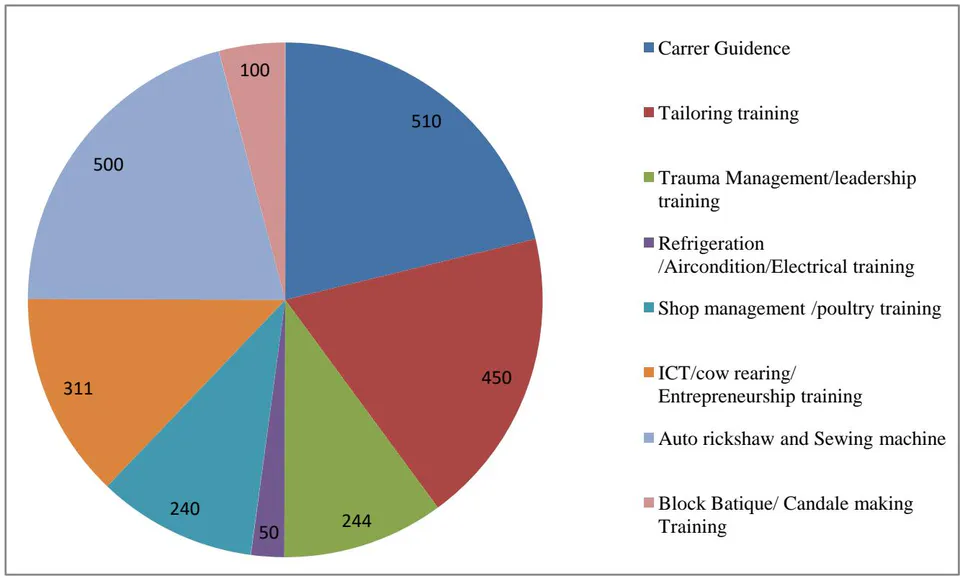
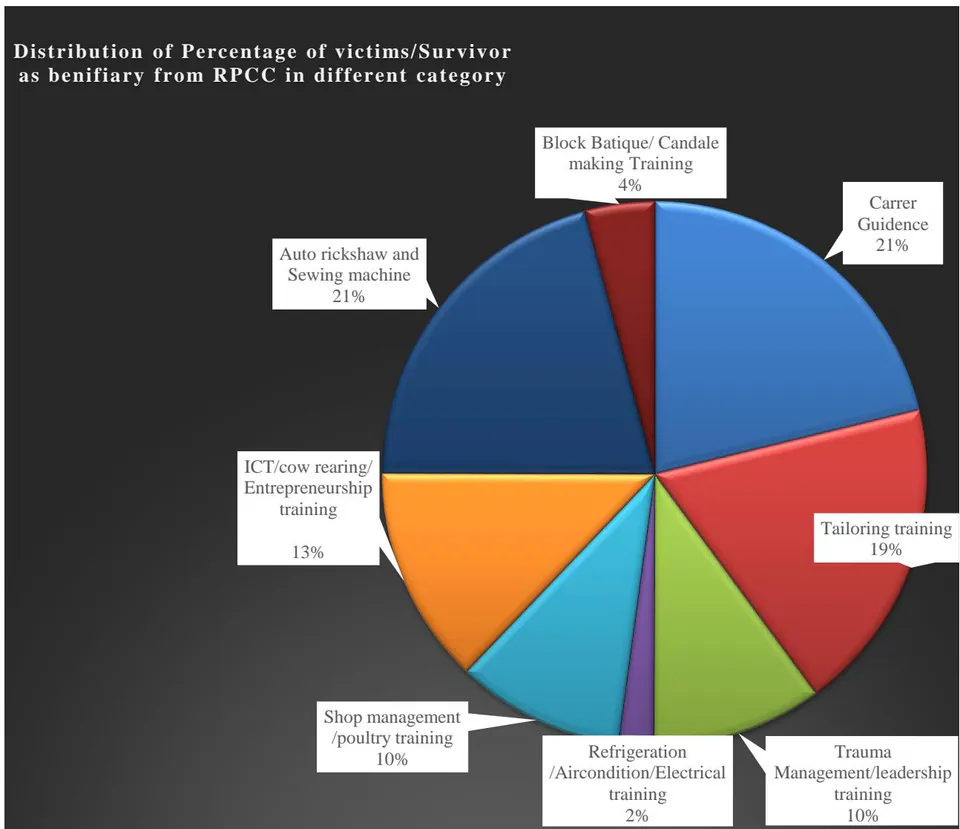
sustainable rehabilitation by fostering dependency rather than empowerment. Among the 2,438 survivors (RPCC, 2014), had permanent disabilities. A significant portion expressed interest in small businesses rather than returning to factory work. RPCC, in collaboration with CRP, BRAC, and ILO, provided vocational training, career counseling, and micro-loans. Despite these efforts, victims were often reluctant to relocate or re-enter formal employment due to trauma. RPCC facilitated job placements in leather and footwear sectors and monitored psychological recovery.
d) Identification of Victims for Compensation and RPCC
RPCC applied verification mechanisms developed during the course of its rehabilitation activities to assess the validity of victims' identities, wage records, and documentation prior to distributing compensation.
However, finally, with the help of Rana Plaza Coordination cell $30 million was distributed to the eligible victims and their dependents through different instalments.
e) Challenges in Determining Compensation and Role of RPCC
This paper found that three major criteria were fixed to overcome the challenges related to the amount of compensation, which are:
a. Age (Here, the age of victims during the time of the accident on 24 April 2013, and major challenge here is that lots of workers joined in Rana Plaza before the age of 18 by hiding their actual age) b. Wage (Wage during the time of Accident or the salary of Last month /March 2013, but some victims joined in the month of March or a week before the accident and some victims used to work using the identity of former worker of Rana Plaza) c. Dependent (How many dependents had on the income of the deceased before the accident and their present age, also and major challenge here is that dependents tend to manipulate documents to avail the total award of compensation). RPCC played a crucial role, as shown in the figure Figure 6. It emerged as challenge in the determination of compensation with this criteria as some decessisd getting more compensation than others. This paper finds the use of ILO Convention 121 as a guiding framework presented limitations, as its global parameters often conflicted with the socioeconomic realities of Bangladesh. Scholars like Barder (2009) and de Waal (2007) suggest that standardized international norms may lead to misalignments when applied without localization, particularly in compensation and rights-based mechanisms in post-crisis societies.
VIII. DISCUSSION
RPCC's establishment marked a shift in Bangladesh's disaster management paradigm from ad hoc responses to institutional coordination. Key strengths included:
- Inclusive governance involving government, civil society, and international actors.
- Centralized data systems that minimized fraud.
- Use of digital platforms to overcome logistical barriers.
However, challenges remained. Victim dependency on relief (Chambers, 1983), lack of long-term mental health support, and poor industrial safety compliance still pose risks. To overcome the challenges described by Chambers (1983) regarding "dole dependency," one relevant theoretical approach is the Sustainable Livelihoods Framework (SLF), developed by the UK Department for International Development (DFID, 1999). This framework emphasizes enhancing people's capabilities, assets, and activities needed for a means of living, moving beyond immediate relief to build resilience and long-term economic autonomy. RPCC's small business support, vocational training, and psychological rehabilitation initiatives align with SLF by aiming to shift victims from dependency to self-reliance. However, these efforts could be further strengthened by explicitly adopting livelihood-based planning, tailored to individual capabilities and contexts.
IX. RECOMMENDATIONS
RMG sector contributes to the GDP is over and of export earnings came from this sector (EPB, 2016). So it should be nurtured more carefully as jobs and lives of the worker-related here so after the in-depth analysis this paper recommends to
Institutionalization of RPCC as a disaster coordination agency.
Develop an industrial disaster policy separate from natural disaster frameworks.
Set or prepare a national standard/parameters for compensation with the specific elaboration of calculating the loss of income, definition of dependent, economic assumptions, length of payments, health and benefits considering socioeconomic status/structure of Bangladesh and ILO convention 121.
Collect and preserve DNA samples for all deceased to identify the unidentified victims.
Establish educational and vocational funds for children of deceased workers.
X. CONCLUSION
The Rana Plaza Coordination Cell represents a unique model of institutional response in the face of an industrial disaster. While Bangladesh has made notable progress in disaster management, this case underscores the need for dedicated mechanisms tailored to industrial contexts. Learning from RPCC's successes and limitations can help ensure that future industrial tragedies are met with greater preparedness, equity, and accountability.