
I. INTRODUCTION
a) Dinajpur's Cultural Context
The Dinajpur district stands out from other regions of Bengal for its distinct geographical, ethnographic, and cultural features. Archaeological and historical evidence indicates that human settlement in this area dates back to ancient times. Over the centuries, the growth of civilisation, cultural practices, and political structures has shaped Dinajpur into a region of considerable historical and cultural importance.
b) Defining Folk Culture
Sarkar (Sarker 12) describes "folk" in the context of folk culture as referring to a predominantly rural, agricultural population that depends on close-knit social networks and subsistence-based exchange. Culture, in this sense, encompasses the collective body of knowledge, beliefs, arts, values, and skills shared by these communities. Dr. Ashutosh Bhattacharya further defines folk drama as creative expressions rooted in rural public life, often transmitted orally and shaped by religious and communal traditions (Hoq 28).
c) Introducing Palatiya
Palatiya is a distinctive folk theatre form native to Dinajpur. It integrates folk songs, dances, short dialogues, and traditional instruments to narrate drama-like stories about rural life. More than just entertainment, Palatiya preserves local memory, showcases the rhythms of agrarian life, and embodies community values. Yet, despite its cultural richness, this tradition is gradually disappearing under the pressures of modernisation and cultural homogenisation.
d) Research Aim and Gap
While Bengali folk theatre has been the subject of significant scholarly attention, Palatiya remains understudied in both regional and comparative contexts. This paper addresses this gap by examining how Palatiya reflects Dinajpur's rural realities, functions as a cultural archive, and differs from other folk theatrical forms in Bengal and South Asia. It also considers the challenges of sustaining Palatiya in the contemporary era.
e) Looking Ahead
In later sections, this study incorporates visual ethnographic documentation—performance images, scripts, and stage layouts—to deepen understanding of Palatiya's performative elements. The research also proposes future directions, such as interactive community mapping of related forms like Khon, as part of a broader digital humanities initiative for cultural preservation.
f) About Dinajpur in Brief
When discussing Dinajpur's folk culture, it is vital to consider the area's geography, population, and natural environment.
Dinajpur is the last district in northwest Bangladesh. (Bangladesh District Gazetteers, P. 1) This district belongs to the Rajshahi division. West Dinajpur (India) and Bogura districts to the south; Jalpaiguri and Darjeeling in West Bengal to the north; Purnia and West Dinajpur districts to the west; Rangpur and Bogura districts to the east. (Bangladesh District Gazetteer, P. 1).
There is no accurate history about the naming of Dinajpur. However, according to Buchanan Hamilton, the name Dinajpur originated from the title of King Ganesha, Dhanujmardandev. However, there is no reliable data behind this opinion. (Sarkar 1)
Most of the rivers in Dinajpur district flow from north to south, and their final destination is the Ganga, or the Yamuna River. Dinajpur district is located in the foothills of the Himalayas. Although the ethnic traits of the population in Dinajpur district, located on Bangladesh's northern border, generally align with the broader national pattern, there are certain unique and diverse features that set it apart.
The naming of the common languages of the northern area has given rise to many opinions. George Grierson referred to this language as the "Rajbanshi Dialect" due to the high concentration of the Rajbanshi community residing in the area. After re-examining the language samples of the region, he identified the language of the region as "Northern Bengali." Sunidhi Kumar Chattopadhyay (ODBL) and Sukumar Sen call it "Kamrupi Dialect." Some scholars name it "Kamta Bihari" because of the medieval kingdom boundaries without identifying it with ethnically narrow terminology.
Professor Munir Chowdhury, adopting the opinion of Sir George Grierson, identifies the language prevalent in this region as belonging to North Bengal, said to be the "North Bengal Dialect." (Sarkar 205) As stated by Hoq (Hoq 23), the folk culture of this area has evolved from the emotions and experiences—joys and sorrows, hopes and disappointments—of rural people who rely on agriculture and have historically lacked access to education. The folk culture of this region encompasses various forms such as feminine songs, Bhawaiya, Kabigan, Pala-Kirtan, Punthipath, Shiklidhal dance, Karam dance, Kaicha dance, Yug dance, Mansar Bhasan Pala, Bhasan dance, Chokra dance, Palatiya, and others.
g) Khon and Palatiya
When exploring the meaning of "Khon," it is found to refer to various concepts such as a moment, the sound of a metal instrument, digging, or an auspicious time. Reverend Gananendramohan Das wrote in the Dictionary of the Bangala Language that the word "Khon" means moment. In Brajabuli, the word "Khon" means soft form.
Different people have interpreted Khon with different meanings. However, it is crucial to remember that Khon is a traditional folk drama native to Dinajpur. For example, Khongan is known as "Charyagan," "Khanajatra," and "Lilagan" in Kantanagar, Birol Thana, and Rangamati regions, respectively (Bangladesh State). "Khongan" in the Balurghat area of South Dinajpur district and "Debkoti Khan" in the Gangarampur area. Khongan is known as "Khissa" or "Khon" in Kaliaganj, Hemtabad, Raiganj, and Itahar regions of Bansihari, Kushmandi, Harirampur, and Uttar Dinajpur districts. Even though Khongan goes by various names in various parts of the larger district, the tradition, customs, mannerisms, or performance of the song remain unchanged, meaning that neither the context nor the meaning has changed. Khongan is again known as Palatiya, Khaspachali, and Rangpachali in Jalpaiguri and Cooch Bihar districts, respectively. (Roy 10). In Dinajpur (Bangladesh), people generally call it "Palatiya" instead of "Khon."
h) Types of Palatiya
According to the classification of drama, there are two types of Palatiya:
A. Formal (Bondhupucha, Bondhuwala, Halua-Haluani, Notua, etc.) B. Informal (Dhakoshori, Mayyabondhoki, Hokchairman etc.)
There is another type of Palatiya in the Informal Section: "Khon-khissa" Without a doubt, the lifestyle and culture of the Palatiya community in Dinajpur will be reflected in all Palatiya dramas.
II. LITERATURE REVIEW
a) Definitions and Forms of Folk Theatre
Scholars agree that folk theatre in Bengal is deeply rooted in rural, agrarian communities whose social life, economy, and traditions shape its artistic forms. Dey (1-3, 11) defines folk culture as a body of beliefs, customs, and practices maintained primarily by rural, often illiterate, populations. Folk songs such as Bhatiyali, sung by boatmen, exemplify this close link between performance and everyday life. Bhattacharya (Hoq 28) describes folk dramas as oral, community-based compositions that draw on rural experience and religious themes.
Within this broader frame, Palatiya emerges as a regional folk theatre tradition of Dinajpur, North Bengal. It blends song, dance, brief dialogues, and traditional instruments such as the harmonium, dotara, and bamboo flute to narrate stories of rural life (Tito 2019). Comparable forms exist under different names—e.g., Khongaan, Khaspachali, and Rongpachali in Jalpaiguri and Kochbihar (Roy 10)—but the Dinajpur variant retains distinctive linguistic, performative, and musical features.
b) Cultural Context of Palatiya
Dinajpur's geographic and ethnographic distinctiveness provides fertile ground for Palatiya's development. Sen ("Khon: Lyrical Folk Drama") frames it as a community-based performance historically linked to agricultural cycles and often considered "low culture" in mainstream theatrical discourse. Tito (2019) situates Palatiya within the changing social and economic landscape of Dinajpur, noting that shifts in agriculture, urbanisation, and local economies have altered its form and function. Kamat (2019) emphasises the role of such performances in disseminating local knowledge and communicating social messages in accessible language.
c) Modern Transformations
While earlier performances were primarily nighttime events catering to rural audiences, modern Palatiya is increasingly staged during the day, adapted for urban audiences, and sometimes condensed for quicker consumption. Scripts, costumes, props, and even musical arrangements are being updated to maintain relevance. The spread of digital recording and social media has further expanded the audience base beyond local communities. Scholars such as Bose (60) suggest that historically, rulers used Palatiya to alleviate monotony among subjects; today, its function has shifted towards both entertainment and cultural preservation in a commercialised context.
d) Convergences and Divergences in Scholarship
Most existing studies (Sen; Tito; Roy) agree on Palatiya's rural origins, its close link to agricultural life, and its community-based performance style. However, they differ in emphasis:
- Sen highlights its marginalisation within the hierarchy of theatrical forms.
- Tito stresses the adaptive transformations under social and economic pressures.
- Roy traces its regional variations and nomenclature.
Few works systematically integrate these perspectives to address both performance practice and the lived realities of the Palatiya community.
e) Gaps in Existing Literature
The literature largely focuses on describing Palatiya's structure, historical background, or thematic content. There is a lack of sustained analysis of:
- How Palatiya reflects and negotiates the changing lifestyle and cultural identity of its practitioners.
- The impact of audience diversification (rural–urban, local–global) on performance content and form.
- The intersection of economic change and cultural preservation strategies within the Palatiya community.
Addressing these gaps requires integrating ethnographic study of performers' lives with textual and performance analysis.
III. METHODOLOGY
a) Data Sources
This research adopted a qualitative approach, relying on both primary and secondary data. Primary data were gathered through interviews, field observations, and photographic documentation. Secondary data were obtained from books, academic journals, research papers, and credible online resources. Sources included the researcher's personal library, Dinajpur Public Library, and Dinajpur
Government College Library. Materials in Bengali were translated into English by the researcher for analytical purposes.
b) Participant Selection
Participants were selected using purposive sampling, a method suited to ethnographic research as it prioritizes information-rich cases over random selection. The sample included key informants such as Palatiya performers, community elders, and audience members with deep cultural knowledge. Initially, two core participants were interviewed, and additional contacts were identified through snowball sampling to capture broader perspectives.
c) Interview Design
Interviews were semi-structured, comprising 19 questions (Appendix A) that were both open- and closed-ended, ensuring flexibility while maintaining focus. No double-barreled questions were included. Interviews were conducted in Bengali, recorded with informed consent, and later translated into English. Translation integrity was maintained through peer review by bilingual scholars and, where necessary, backtranslation to verify accuracy.
d) Fieldwork and Observation
The researcher conducted field visits to Birgonj, Birol, Kaharol, Khansama, and other Upazilas where Palatiya performances were staged. Immersive observation included attending performances, conversing informally with participants, and staying for two nights within the community. Field notes documented performance details, audience engagement, and cultural nuances.
e) Data Analysis
Interview transcripts and field notes were thematically coded to identify recurring patterns related to cultural heritage, rural hardship, and gendered experiences. Coding was conducted manually following Braun and Clarke's thematic analysis framework. This iterative process involved generating initial codes, collating them into themes, and refining these themes for interpretative depth. Analytical rigor was maintained through triangulation of interview, observation, and secondary data.
f) Ethical Considerations
Participants' identities were kept confidential, and pseudonyms were assigned in all documentation. Informed consent was obtained verbally and in writing before data collection. The research adhered to ethical guidelines for social science fieldwork, ensuring respect for participants' autonomy and cultural norms.
g) Researcher Positionality
The researcher shares a regional familiarity with the Palatiya context but is not a member of the community. This outsider-with-insider-access position enabled both cultural sensitivity and a critical lens, allowing for reflexive engagement throughout the research process.
IV. RESULTS
a) Heritage and Legacy
All participants highlighted the intergenerational nature of Palatiya involvement. Participant A, a 45-year-old male artist, stated, "Palatiya is our heritage. To keep the legacy, I practice it," noting that his father had also been a performer. Participant C, a 30-year-old female artist, similarly credited her father as her inspiration. However, Participant B, a 21-year-old newcomer, joined out of personal passion rather than family tradition—indicating a generational shift from inheritance-driven to interest-driven participation.
b) Social Transformation
Participants observed significant changes in the Palatiya community and rural life more broadly. Participant A noted improvements in "education, agriculture, and transportation," emphasizing that increased educational opportunities, especially for girls, have reduced the number of Palatiya practitioners. Participant B described a thematic shift in performances toward contemporary social issues such as child marriage, HIV/AIDS, COVID-19, women's empowerment, superstition, and sanitation—reflecting Palatiya's evolving role as a medium for rural awareness.
c) Gender Dynamics
While Participant C affirmed that women have long been part of Palatiya, she acknowledged ongoing
Field Work Data
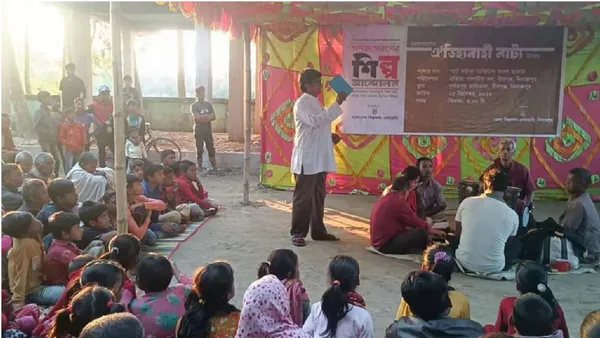
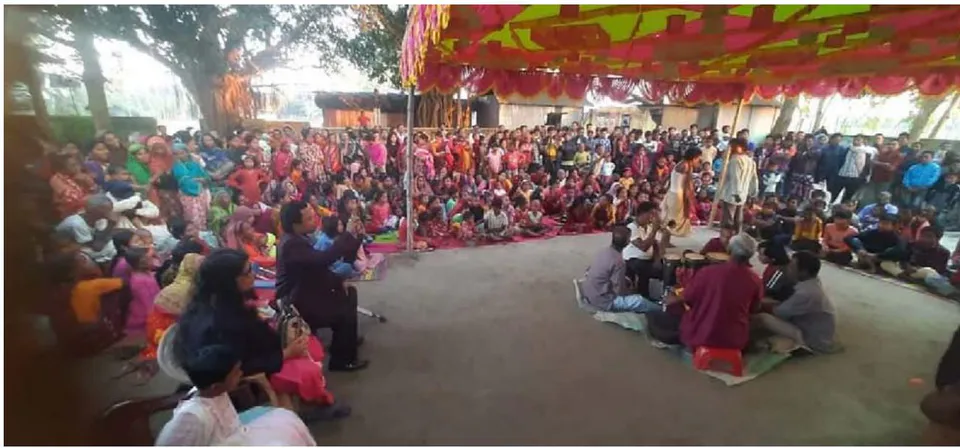
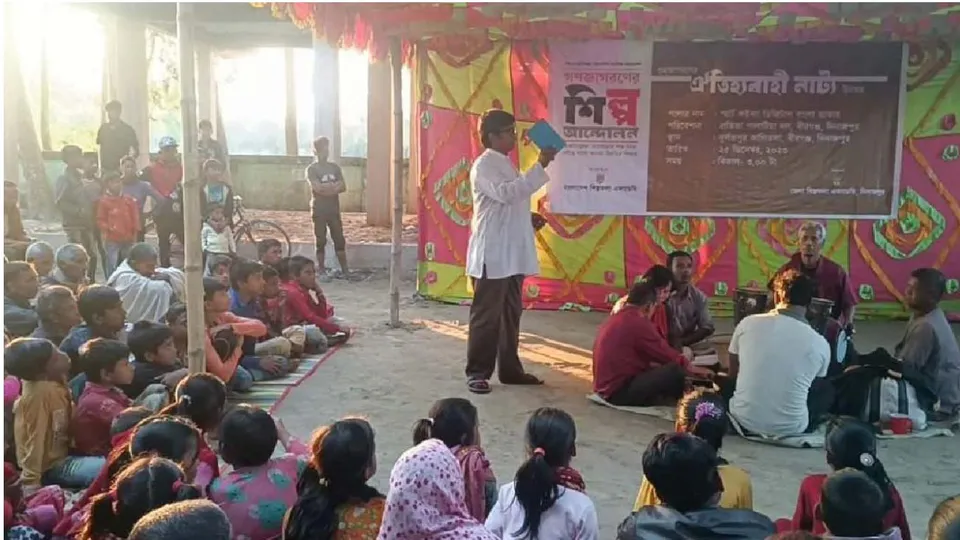
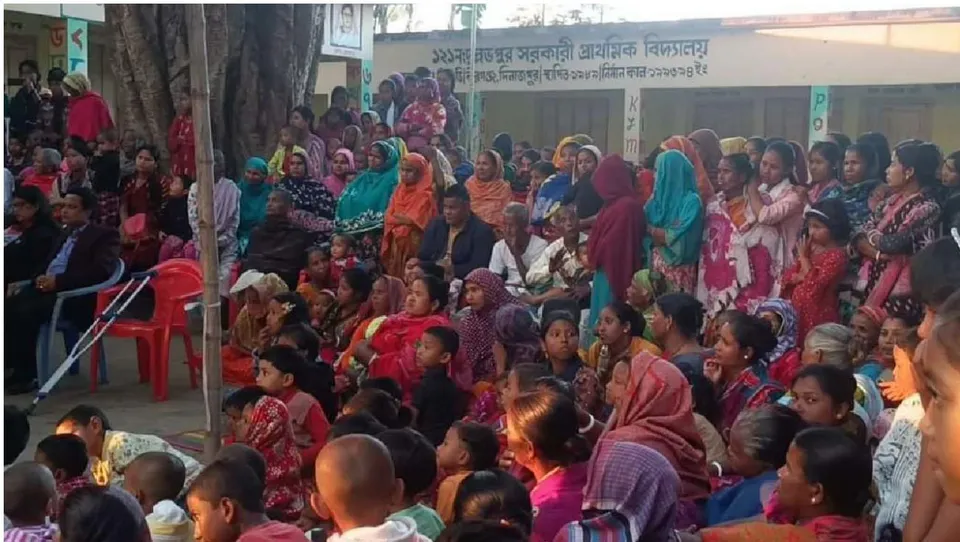
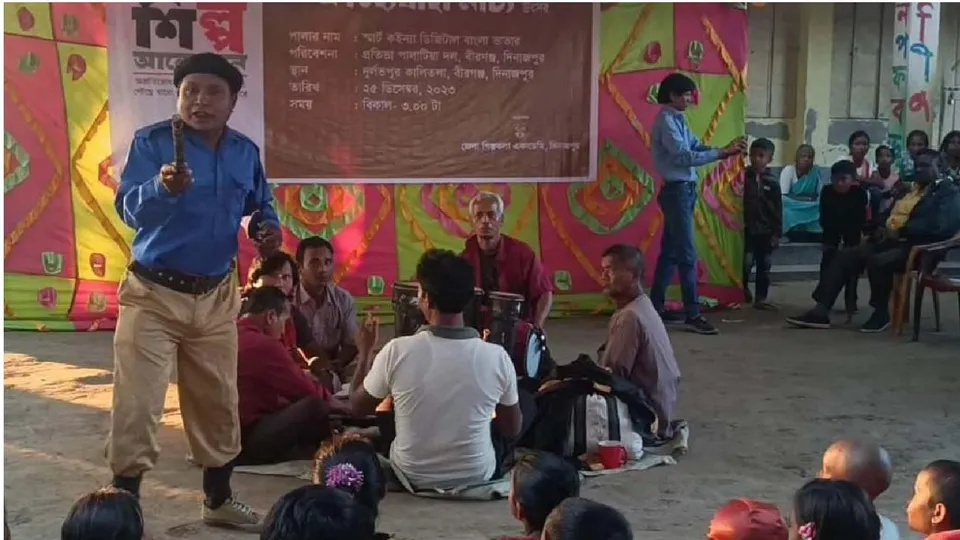
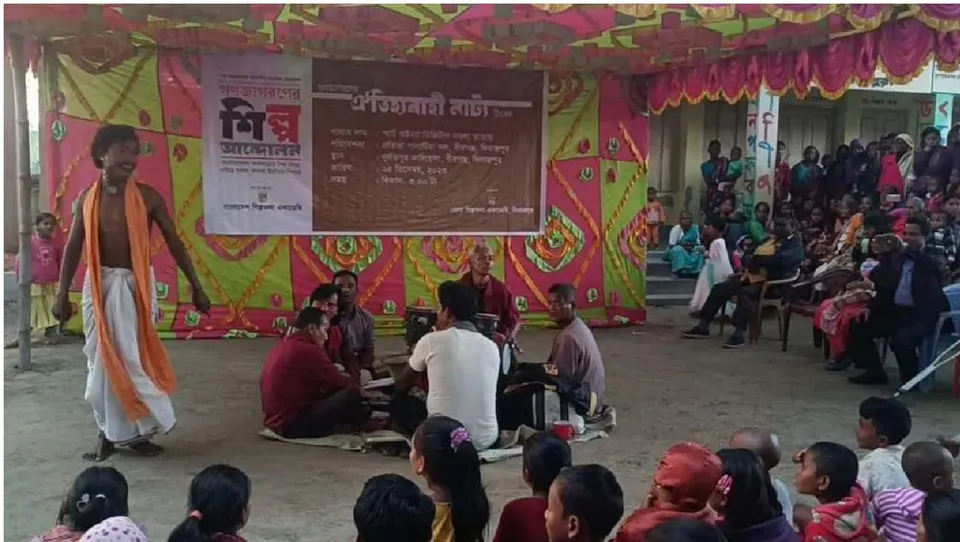
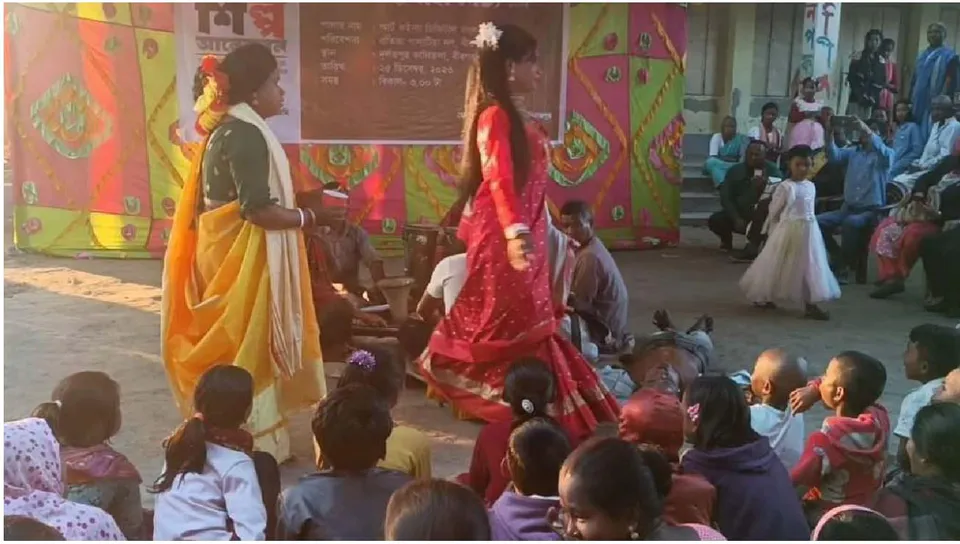
The following are the six photographs that were taken during the fieldwork for this study:
challenges. She recounted instances where "male artists are prioritized" in both role distribution and payment, and noted that female performers are sometimes objectified. This contrasts with Participant A's and B's accounts, which did not address gender bias, suggesting gendered differences in lived experience.
d) Performance Evolution
Performance styles and content have adapted to changing audiences. Participant A mentioned the incorporation of English words into scripts, while Participant B explained that although overnight performances remain common, shorter, commercially motivated shows are becoming more frequent. Costumes, according to Participant A, vary by story rather than following a strict traditional style.
e) Economic Shifts
Economic factors also influence participation. Participant C now dedicates less time to Palatiya due to her small business, funded through a local NGO loan. This shift illustrates how economic diversification can reduce time available for traditional cultural activities, particularly for women balancing multiple roles.
f) Audience Engagement
When discussing why audiences continue to watch Palatiya, Participant C emphasized cultural resonance: "When rural audiences watch Palatiya, they can easily connect the stories to their own." This highlights the enduring relevance of Palatiya despite the availability of alternative entertainment.
V. DISCUSSION
a) Cultural Transmission and Heritage Decline
Dinajpur, located in northern Bangladesh, is rich in agricultural products (e.g., Chinigura rice, sweet mangoes, lychees) and folk traditions such as Bhawaiya songs, Kantajir Shobhajatra festival, and the Palatiya drama form. Historically, Palatiya has been sustained by rural, working-class communities whose lives it depicts (Tito, 2013).
However, both literature and interviews indicate a decline in intergenerational transmission. As artist Jaga Baishyo observed, the "overall form and modalities" of Khon/Palatiya are changing, with oral traditions now partially documented for preservation (Sen, 2020). This aligns with broader studies on folk theatre in South Asia, where modernization and shifting livelihoods reduce younger generations' participation (e.g., Hansen, 2011; Sarkar, 2019).
"Palatiya is our heritage. To keep the legacy, I practice it," said Participant A, whose father was also an artist. In contrast, Participant B, a 21-year-old performer, joined out of personal interest, suggesting a shift from inheritance-based to voluntary engagement.
b) Gender Inclusion and Inequality
While women have long participated in Palatiya, gender disparities persist. Participant C reported that male artists are still prioritized in both casting and payment, and female performers are sometimes objectified. This echoes findings from Rahman (2018), who documented similar patterns of gendered marginalization in rural theatre groups across Bangladesh.
Palatiya's narratives often center on women's struggles, as in Hadangkali Biswadhagri and Dhakoshori, yet backstage realities reveal inequalities that challenge the plays' thematic emphasis on justice and dignity.
c) Modernization vs. Traditional Art Forms
Palatiya performances have adapted to new audience expectations. Sen (2020) notes that form and structure are evolving to attract broader, even urban, audiences. Interview data supports this: Participant A mentioned incorporating English words into dialogue, while Participant B noted shifts toward contemporary topics—child marriage, HIV/AIDS, COVID-19, women's empowerment, superstition, and sanitation.
This reflects what Bharucha (2000) describes as "cultural negotiation," where traditional performance must mediate between heritage preservation and social relevance.
Participant C remarked: "When rural audiences watch Palatiya, they can easily connect the stories to their own." This suggests that modernization, when contextually grounded, can sustain audience engagement rather than erode it.
d) Economic Factors and Artistic Sustainability
Economic pressures influence both participation and practice. Historically, related folk trades such as pottery thrived in Dinajpur but declined sharply with the introduction of plastic goods, harming artisan livelihoods. Similar dynamics now affect Palatiya artists, whose earnings are inconsistent and often insufficient.
Participant C reduced her Palatiya work after starting a small business with NGO support, reflecting broader trends where alternative income sources compete with time for traditional arts. This mirrors studies from rural India and Nepal (Kale, 2017; Tamang, 2021) showing that artistic sustainability is often contingent on economic diversification.
e) Research Contribution
This study extends existing literature on South Asian folk performance by:
- Documenting gendered experiences within Palatiya, a dimension often overlooked in regional theatre scholarship.
- Tracing modernization's impact on performance content, language, and audience reach in a rural Bangladeshi context.
- Providing a localized ethnographic account of how agricultural communities negotiate cultural heritage and economic survival.
f) Discussion of Interview
i. Changes in Palatiya Community: Contemporary Life
The increase in Dinajpur's population had an impact on the way of life of the Palatiya community. Due to the constant rise in population and the scarcity of land, the Palatiya people are being compelled to change careers to increase their income. Some are relocating to Dhaka. There was a time when there was enough land in proportion to the population, and people did not have to worry about their livelihoods. At the time, the Palatiya community wrote, produced, and performed Palatiya with dedication. However, they are now required to consider finances. For the price increase, simply performing Palatiya is insufficient; it does not generate enough money.
ii. Educational Advancements
From the conversation of Participant "A", it is found that the Palatiya community's way of life has evolved due to educational advancements. The reason I mention this is that, due to improvements in education, children in the Palatiya community are now enrolling in educational institutions at a greater rate than before. So, their primary focus will be on obtaining an education and finding a suitable job. Their parents also value this, having experienced many difficulties themselves due to their own lack of education. Girls in the Palatiya community are receiving the same education as boys. Girls in the Palatiya community were once neglected and thought to be only suitable for domestic work. In Palatiya society, this is unquestionably a positive development. This development is appreciative and helpful for the Palatiya community. However, the risk of the Palatiya culture disappearing is growing, which is truly alarming.
iii. Changes in Family Structure
Based on Participant "A" 's remarks, shifts in the family structure within the Palatiya community have been noticed. The author noticed a tendency toward joint family living within the Palatiya community. Nowadays, joint families are beginning to fragment. For this reason, it means that the united effort of every member involved in Palatiya performance is missing. As a result, the Palatiya's performances are losing their perfection.
iv. Impact of NGO
Participant "C"s conversation clearly shows that NGOs in Dinajpur have a significant impact on the lives of the Palatiya community. According to the researcher, Palatiya artists lack financial stability. So, they have the pressure of becoming solvent. From this perspective, they seek guidance and financial help from local NGOs. In addition to taking initiative, they are getting training from those NGOs. As a result, most women in the Palatiya community are changing their lifestyles. In certain respects, it is commendable, but it is also concerning. Because the NGOs are making the village people consumers. Culture survives through its practices. Palatiya also needs nourishment. Regular performances keep Palatiya culture alive. The involvement of Palatiya artists in outside works will impede this art.
v. Impact of British Culture
In the narrative of Participant "A," it is found that they dress according to the story of the drama. According to the history of the people of Palatiya, it is observed that there were no fixed costumes for Palatiya. However, the idea of costume in Palatiya developed following the colonial influence of English culture. They started wearing English dresses (coats, pants, and ties) according to the character's demand. Moreover, it is observed that there was no use of makeup. Later, influenced by British culture, Palatiya artists began incorporating makeup into their performances.
vi. Use of English Words
Usually, contemporary English words are not used in traditional Palatiya. Following the conversation of Participant "A," a lot of contemporary English words are being used in present times, Palatiyas. Numerous catchy English words are being used as the titles of contemporary Palatiya dramas. The paper's author observed a Palatiya performance titled Smart Koinna Digital Bangla Bhatar. By doing so, the Palatiya community is attempting to adhere to contemporary standards while also expanding its area.
vii. Women's Empowerment in Palatiya
According to the conversation of Participant "C," women's empowerment and acceptance have increased in the Palatiya community. Now, women are playing female characters. That is why it does not only mean that they are participants only; rather, they are standing beside males and being an equal part of a society. This is an excellent example of women's empowerment.
viii. Breaking Traditional Structure: Time and Duration
Generally, Palatiya is performed all night. It begins at noon and ends at midnight. It lasts five to six hours. Palatiya's performance has been observed to change in time and duration. Participant "B" mentioned that palatiyas are staged during the daytime on special occasions or events. Furthermore, the palatiyas held during the daytime are brief. These are the breaks in Palatiya culture's traditions.
Despite all these changes and alterations, Palatiya continues to preserve the heritage of the Palatiya community. Hopefully, this legacy will be continued. Of course, there are good and bad sides to a change. The audience should embrace the positive aspects and steer clear of the negative ones. So, the culture never loses its flow.
ix. Social Issues Reflected in Palatiya
Based on Participant B's account, modern Palatiya dramas focus on social issues such as child marriage, HIV/AIDS, COVID-19, women's rights and empowerment, the value of education, superstitions, hygiene, and self-employment. These issues are chosen for Palatiya dramas because they are the main problems in the rural areas of North Bengal. To educate local people about these social problems, Palatiya writers chose them. This subject selection has become a tradition from decade to decade. For instance, in Hadangkali Biswadhagri and Dhakoshori, similar themes are portrayed, such as women's empowerment, their freedom, social position, child marriage, and related issues. In these lines of Hadangkali Biswadhagri depicts women's empowerment by the lead character "Bishobala":
"Hajar pachek taka de mok mui kor bebsa sokal bikal paan khowaim tok mosolla dia.
Somonde Tui Holurevai para-porsha bautar daray bapdar dewaim tomray songra"
Give me five thousand takas so that I can start a business
I will give you an expensive Paan in the morning and afternoon.
You are my brother as well as a relative
My son will accept you as my friend.
x. Discussion of the Two Selected Narratives
In Hadangkali Biswadhagri, the researcher notices that Dukhiya, Bishobala's only child, and Tupa. In a world beset by deprivation, poverty knows no limits. Bishobala is ambitious and unable to bear poverty, so she engages in anti-social activities. Bishobala becomes reckless when some raw cash from her illegal business arrives unexpectedly. His behaviour alters. She constantly tortures her husband and children, both physically and mentally, for no apparent reason.
Bishobala eventually met Dakatsardar Amal as a result of her involvement in an illegal business. Bishobala formed a partnership with Dakatsardar and launched her new business. Bishobala mingled with various business people and high-class clients, informing Amal Dakat of their wealth and money. Amal Dakat seizes the opportunity, loots the wealth, and shares it with Bishobala. Munshi, a wealthy man in the area, is a client of Bishobala. Munshi's outer dress is religious, but he is a philanderer at heart. Bishobala, with the assistance of Amal Dakat, also seizes him. Although Tupa tried, Bishoebala's older brother failed to guide her back onto the right path. Bishobala seeks help from the future saint. Bishobala eventually realises her mistake and returns to her family, thanks to Sadhu's assistance.
xi. Hadangkali Biswadhagri: Life and Culture
In Hadangkali Biswadhagri, the everyday lives, dreams, and aspirations of the rural people of Dinajpur are portrayed in a ordinary and a straightforward manner. This drama presents the tale of exploitation and deprivation in Dinajpur's rural society—marked by hunger, poverty, and marital conflict—in a clear and uncomplicated manner.
According to Tito, the Palatiya showcases moral ideals and values alongside captivating images of joy, pain, and eternal love. Furthermore, this Palatiya sheds light on the presence of protesting rural labourers in Dinajpur (76). This drama presents the tale of exploitation and deprivation in Dinajpur's rural society—marked by hunger, poverty, and marital conflict—in a clear and uncomplicated manner. So that no one can dismiss their show. This ritual is known as "Asarbond" in Palatiya. Another reason for incorporating magic spells in Palatiya is the influence of the cultural traditions of various ethnic groups, including the Santal, Munda, Orao, Rajbangshi, and others. Spells have played a significant role in their tradition. As Rajbanshi and the Paliya community are the holders of Palatiya, it is usual that magic spells will be used (77). According to Hadangkali Biswadhagri, it is clear that there is no austerity in etiquette in Palatiya. Thus, although the impoverished rural communities of Dinajpur lack access to traditional knowledge, their keen and attentive minds remain active and engaged (81).
The protagonist, Bishobala, broke social norms and emerged from society free of all social bonds. She challenges the traditional Bengali woman's lifestyle, which is defined by the three primary identities of daughter, wife, and mother, to challenge the patriarchal society. According to a hymn, another character, Munshi, wears religious robes during the day and issues Fatwas; at night, he performs Bishobala.
"Joto Hajar taka lage mai tui korek bebsa
More sathe jabar hobe dekhibar sinema.
Joto hajar takagamei tor bilasita
Joto voron-poshon nage tor khawa-dawa."
O girl, how much money do you need for your business? I will provide.
But you need to go to the cinema with me.
I will give you plenty of money for your luxury
I will cover your living expenses, including food. (83)
The character Munshi seems exaggerated, but this is built on the brutal truth of our society. This social situation is not new; instead, a group of religious merchants is exploiting religion for profit and seeking personal gain. In the villages, girls use bicycles and motorcycles to carry out their agricultural work. Some extremist and capitalist classes that criticise girls.
Munshi shares a similar perspective with them:
"O dada geil re geil,
Ekta maale choli geil
Morder moton chengrila chalache saikel"
Brother, look, look
A girl is riding a bicycle.
Like boys, girls are riding bikes. (83, 84)
Through the character of Tupa, the tradition of eternal love for family integrity in the rural society of Dinajpur is very vividly portrayed. Tito states that, on the one hand, by being a representative of patriarchy in society, Tupa is showing support for women's freedom by giving a thumbs up to patriarchy. And sometimes the man hidden inside him also wakes up. (86) In the songs of Palatiya, the impact of Bhawaiya songs is observed. There is a deep connection between Bhawaiya songs and the dialect of Dinajpur language.
At the end of the Pala, Hadangkali Biswadhagri, Bishobala seeks forgiveness from her husband by the order of his elder brother. (Tito 99) That means the structure of the social control of rural society in Dinajpur is visible here.
Therefore, this Pala illustrates how women's freedom has consistently been restricted by a patriarchal society. Although the storyline is rooted in a rural context, the issue is equally relevant in urban settings.
In the drama Dhakoshori, the audience will see the position of women in Palatiya society from the perspective of the main character, "Dhakoshori":
"Mui honu ekelay nari keu nai morSONGER SATHI
maa mui ashinu taratari"
I am a poor, weak girl
I have no partner in this world.
Mother, I am coming fast.
Dhakoshori is the daughter of Subasu and Khaiya. She is a young and beautiful girl. Her parents are looking for a bride for her, and they are concerned about it. One day, Subasu went to his friend Karkha's house. Dhako's mother ordered her to bring the goats back home; it's late. Dhakoshori didn't agree to go outside alone in that dry weather. At that time, Dhurut, son of Murmu Sarkar (brother-in-law of Subasu), was trying to convince Dhako to marry. Dhako felt uneasy, and then she returned home quickly. Gosai, a Vaishnava spiritual teacher, visited the home of his disciple, Pachu. Pachu asked Gosai about his marriage. Then Gosai assured him about his marriage. Gosai went to Subasu's house, where Dhako's mother told Dhako to bring some water to pour into Gosai's feet. Again, Khaiya asked Gosai about selecting the bridegroom for her daughter. Khaiya told Dhako to bathe in the well. But Dhako replied that she wanted to soak in the lake. While going to the lake, Dhurut came and again proposed to Dhakoshori to marry him. On this occasion, Dhurut attempted to lure Dhako by offering her jewellery, cosmetics, etc. Dhako became annoyed. Then they enter. In front of Dheru, Dhurut made a promise that he would marry Dhako today or tomorrow, and Dhurut told Dhako that he would take revenge for this insult. Dhurut took on the challenge of changing Dhako's consent with the power of money. Goshai went to the house of Karkha and Alanu from the house of Subasu. Then Dhurut took the help of a Mahat (magician) so that he could get Dhakoshori. Mahat gave Dhurut some medicine and oil. Dheru and Dhurut feed that medicine to Dhako. From then on, Dhako fell in love with Dheru instead of Dhurut. In the meantime, Alanu and Karkha went to Subasu's house to submit the proposal that Alanu wanted to marry Dhakoshori. Subasu and Khaiya agreed. Moreover, Khaiya told Alanu to go to the market and bring some food and vegetables. Alanu disagreed with Khaiya's proposal, and Khaiya became so angry. Later on, Alanu and Dhako married each other. But Dhako was not in agreement with her marriage. While working with her husband, Dhurut came. Dhako told Dhurut about her feelings for him. Dhurut suggested Dhako return home today; otherwise, her husband will torture her. Dhako's brother, Batasu, witnessed the incident. Dhako requested that Batasu not tell this to anyone. Batsu told this to Khaiya. Khaiya warned Dhakoshori strictly. Batasua and Subasu went shopping for the marriage, and Dheru went to give an invitation to the relatives. Dhako's marriage would be to Alanu. When everything was okay, Dhako flew away with Dhurut. Subasu blamed Khaiya for all these incidents. Alanu got married to Dhurut's sister, Jamuna, coincidentally. Dhurut and Dhako went to Yaju's house. Yaju was not at home. Kaanchul Natua was there. By words, Natua convinced Dhako, and they went to the Kishanganj Fair, leaving Dhurut alone.
Xii. Dhakoshori: Life and Culture
Dhakoshori is a traditional Bangladeshi tale that revolves around a young, unmarried, and beautiful girl named Dhakoshori. It is evident here: Dhakoshori's father comes from a well-off economic background. Because he assumes,
"Mui Honu O Dhakai er maa
Naya moricher paikari...
Listen to me, Dhakai's mother;
I am the businessman of green chillies
Dhakoshori is the only child of her parents. That's why her parents are very concerned about her. Moreover, she is beautiful, and her parents worry about her a lot. Khaiya, Dhako's mother, says:
"Baper holo ekta beti naam rakhilo Dhakeshorri
maitar ghorjaya anni"
Only one daughter of the father
Is named Dhakoshori
Bring a bridegroom for your daughter
Women are portrayed in most Palatiyas, including this one, as being frail, weak, and reliant on men. In a similar vein, Dhakoshori is portrayed to the audience as helpless and dependent on men in this instance as well. Women are considered weak in most of the rural areas of Bangladesh. Dhakoshori sings,
"Chagla bandhiba jachu eklay nari
O mui bandhim bokrakundi."
I am going to lock the goats Where should I lock them?
I am nothing but a poor lady.
In every society, some bad people tease young girls. Dhurut is like that. He disturbs and even forces Dhako to marry him. He even offers ornaments and cosmetics to marry Dhako. His tone of conviction was poetic. With this sweet word, he was determined to win Dhako's heart:
"Tui hobo golaper fool muhe
Hobo vomra.
tui boro sundor nari tin kal telokdani mon."
You will be the rose.
I will be the bee.
You are so beautiful
Your beauty can defeat time
I won my heart.
The literacy rate is relatively low in rural areas. Due to a lack of education, village people depend on local saints and sadhus. They think that those saints have supernatural power, and because of that, they can do anything. There are lots of Palatiyas where this rural culture is reflected. In Dhakoshori, we also find a character, Gosai, who is a saint or sadhu. He goes from house to house, and members of these residents share their problems with him and ask for solutions. For example, Pachu, a disciple of Gosai, asked him when he would get his life partner. Gosai answers:
"Sunre pachu olpo boyoshe gosaigiri mok saje
Na. olpo boyose
Honu gosai, gosaigiri saje na, monta koiche
Pachu koina juriba"
Pachu, I do not feel comfortable with it.
At this young age
I have become Gosai; my inside is saying
Pachu, you will get a wife.
When Gosai went to Subasu's house, Khaiya also asked him who would be the perfect match for Dhako's bridegroom. The villagers of Dinajpur are quick to believe things. In their helplessness, they rely on these saints for support. They admire saints a lot. Even in today's modern society, many rural residents of Dinajpur still rely on Telpora, Panipora, Tabeez, and similar practices. For this reason, it has become a part of their tradition, and it has been continued for a long time. In Dhakoshori, Dhurut used a magic-spelt oil or potion to try to win over Dhako's heart.
Not only in rural but also in urban areas, male society tends to buy the heart of a female with money. This belief is also deeply rooted in Palatiya society. Here too, Dhurut repeatedly tries to win over Dhako by offering her costly gifts and money.
In most of the Palatiyas, women are always presented as wrongdoers. Most of the time, they are blamed. As if women have taken on all family's responsibilities. For this sake, it is nothing but an odd implication of the male ego in females. In Dhakoshori, Subasu blames Khaiya:
"Tui holo betir maa, betir khobor rakhis na
O tok marim bandhiya"
You are a mother; you do not take care of your daughter
I will beat you by tying a rope.
VI. DISCUSSION OF FIELDWORK
a) Performance Space and Community Engagement
Field photographs reveal that Palatiya is consistently staged in open, public spaces where audiences form a circle around the performers (Photo 1, Photo 3). This spatial configuration mirrors other folk and classical traditions—Greek open-air amphitheaters encouraged communal visibility, while Roman theatres used elaborate scaenae frons to convey civic grandeur. Palatiya's circular formation ensures inclusivity: all spectators, regardless of position, share an equitable viewing experience.
In Photo 3, villagers of all ages are gathered in a common space, reinforcing that accessibility is central to Palatiya's success. As Schechner's (2006) performance theory notes, the "performance environment" is inseparable from the meaning of the performance itself—Palatiya thrives in spaces that belong to the community rather than elite cultural venues. This directly connects to Research Question 3, as the open, local staging is what enables Palatiya to remain the primary form of entertainment for rural folk.
b) Palatiya as a Tool for Social Education
Photo 2 captures the character Lalon—dressed as a schoolteacher—delivering a dialogue on the importance of literacy. This is pedagogic theatre in the Freirean sense: a cultural form that educates while entertaining. The irony that many performers themselves are illiterate yet passionately advocate for education highlights a deep consciousness about collective uplift.
Participant A remarked: "Even if we cannot read, we can tell others to read." Here, performance acts as a bridge between lived experience and aspirational values. This supports Research Question 1, showing how Palatiya portrays life and culture not only through realistic depictions of rural living but also through aspirational visions for social improvement.
c) Symbolism in Costuming and Humor
Photo 4 shows performer Kanai as a uniformed policeman—an element absent in historical Palatiya, where ordinary attire sufficed. This costuming serves two symbolic purposes: (1) authenticity, visually situating the character for immediate audience recognition, and (2) comic inversion, where an authority figure is humanized and even mocked. As Bakhtin's concept of the "carnivalesque" suggests, such role reversals allow communities to temporarily subvert power hierarchies.
In rural Bangladesh, where interactions with police are often fraught, seeing a jovial, joke-cracking "policeman" invites laughter and catharsis. This aligns with Research Question 1 (representation of lived realities) and Research Question 2 (sustaining cultural heritage by embedding local power relations into narrative form).
d) Music and Improvisation in Oral Traditions
Photo 5 emphasizes the centrality of live music, with musicians seated at the center while performers orbit them. This spatial-musical arrangement reinforces the symbiotic relationship between dialogue and rhythm—a hallmark of oral traditions (Finnegan, 2012).
Improvisation is both a survival skill and an artistic choice: missed lines are immediately replaced with spontaneous, contextually relevant dialogue. Such flexibility keeps performances responsive to audience mood, social context, and even unexpected events during staging. This supports Research Question 2, as the improvisatory nature helps preserve heritage in a living, adaptable form.
e) Gender Dynamics in Folk Theatre
Although not explicitly captured in the provided photos, field interviews indicate that women participate but remain marginalized—echoing Rahman's (2018) findings in rural theatre groups. Family and marital conflict, frequently dramatized in Palatiya, reflects deeper gendered realities: unequal household labor distribution, domestic authority struggles, and the vulnerability of women in lower-class rural contexts.
Integrating visual ethnography theory (Pink, 2013), the absence or limited visibility of women in key photographic moments is itself an ethnographic finding—what is not shown can be as telling as what is. This theme directly engages Research Question 1 and Research Question 2, showing both the portrayal of gendered life and the inheritance of gendered performance traditions.
f) Integrating the Three Research Questions
1. How are
Through open, community-centered staging, realistic yet symbolic characters, and plots rooted in everyday struggles and aspirations (Photos 1-4).
2. How
By maintaining oral improvisation, embedding local languages and customs, and passing social values across generations (Photos 2, 5).
3. How has Palatiya
Through its accessibility, affordability, and relevance to rural audiences lived experiences (Photos 1, 3).
VII. CONCLUSION AND RECOMMENDATION
a) Conclusion
Palatiya serves as both a mirror and a voice for the working-class community of Dinajpur, portraying their social, economic, and political realities while reflecting resistance against oppression. Through dramas such as Hadangkali Biswadhagri and Dhakoshori, Palatiya artists vividly depict the struggles, resilience, and cultural pride of ordinary people. Field observations reveal that most Palatiya artists—despite working as day labourers, van pullers, vegetable sellers, or hawkers—continue to create compelling narratives rooted in lived experience. For instance, scenes portraying Bishobala's defiance against corrupt landlords or Dhakoshori's determination to challenge exploitation show a nuanced understanding of justice, tradition, and community life. These performances bridge rural and urban audiences, preserving an art form that connects past traditions to contemporary realities. The study confirms that Palatiya is not merely entertainment but a vital cultural document, sustaining the heritage and identity of the Dinajpur region.
b) Recommendations
To ensure the survival and wider recognition of Palatiya, this study proposes the following actions:
Integration into National Folk Heritage Programs: Recognize Palatiya under Bangladesh's official folk heritage initiatives to safeguard its practice and transmission.
Targeted Funding Models: Establish grants through the Ministry of Cultural Affairs or regional cultural boards to support artist livelihoods and production costs.
Partnerships with NGOs: Collaborate with rural development and literacy-focused NGOs to incorporate Palatiya performances into community education and awareness programs.
Digital Preservation and Outreach: Create a digital archive of scripts, recordings, and interviews, alongside mobile performance units to reach audiences in remote areas.
Capacity Building for Artists: Organize training workshops in script development, stagecraft, and digital media skills to help artists adapt while maintaining authenticity.
By implementing these measures, Palatiya can continue to thrive as a living cultural tradition, ensuring that future generations inherit not only the performances themselves but the values, struggles, and resilience they embody.
APPENDIX: A
Questionnaire:
Q.1: What is your name?
Q.2: How old are you?
Q.3: What is your occupation?
Q.4: How long have you been involved in Palatiya?
Q.5: For Women, Is it as easy for male participants to join Palatiya?
Q.6: Does your main profession affect your participation in Palatiya?
Q.7: While performing in Palatiya, does a female member face gender discrimination by the Palatiya authority?
Q.8: Are you the first person from your family who is involved in Palatiya?
Yes
No
Q.9: Who was the first person who motivated you to join Palatiya?
Q.10: Why are you interested in joining Palatiya after him?
Q.11: What is the rate of inspired participants like you who have joined Palatiya?
Q.12: Do you see any differences between modern-day Palatiya and Palatiya from the past?
Q.13: Are there any traditional costumes specified for Palatiya?
Q.14: On what topics are Palatiyas created?
Q.15: Why are Palatiyas created only on these topics?
Q.16: Are Palatiyas performed only at night, as before?
Q.17: Why are these topics focused on making Palatiya?
Q.18: With so many entertainment options nowadays, why do you think people watch Palatiya?
Q.19: What do you think about why people watch Palatiya?