## I. INTRODUCTION
Over the last decade, geothermal energy development progress has been documented worldwide, eliciting great interest from governments, development financiers, scholars and practitioners alike. Understandably, the successful financing, delivery, completion and commissioning of geothermal energy projects play an enabling role in accelerating green energy transition and stimulating overall economic growth. Notwithstanding the growing adoption of PPPs, these projects remain capital-intensive and high-risk investments, especially in the Sub-Saharan Africa region. This argument complicates the ongoing debate between proponents and pessimists of the PPP models even further.
a) Kenya is Africa's Pioneer in Geothermal Energy Development
- Kenya, a country located in Sub-Saharan Africa, is endowed with significant geothermal energy potential primarily along its Rift Valley belt, estimated at over 10,000 MW (Ouma et al., 2021). The Olkaria I (45 MW) is the pioneer geothermal power project completed in 1985 (KenGen, 2021). Geothermal energy is the core of the national sustainable and affordable energy transition strategy, contributing around $45\%$ of the country's electricity generation mix (Energy and Petroleum Regulatory Authority, EPRA, 2022).
b) Delivery Capability, Project Completion and Theoretical Perspectives
The concept of delivery capability in the context of PPP geothermal projects transcends isolated notions of project implementation capacity or institutional readiness. Drawing on Dynamic Capability Theory (Teece et al., 1997), delivery capability refers to an organization's ability to reconfigure resources and adapt operational strategies in response to dynamic environments, such as geological uncertainties or regulatory shifts (Ngugi & Mugo, 2021; Kiplagat et al., 2020). Furthermore, informed by Systems Theory (Bertalanffy, 1968; Meadows, 2008), delivery capability acknowledges the interconnectedness of technical, financial, and socio-environmental components, recognizing that delays in one area (say, financial close or land acquisition or permitting) can cascade to late completion across the entire project life cycle (Sterman, 2000; Andrews et al., 2016; Ejderyan et al., 2019). This theoretical integration positions delivery capability not merely as a set of static competencies but as a dynamic, systemic enabler that mediates the effectiveness of external support and internal resources. This is crucial because, as noted by Zhang et al. (2022), inadequate delivery capability can derail even well-funded infrastructure projects with good government backing when bureaucratic inertia or policy rigidity limit adaptive responses.
c) Research Problem: Why the Study?
Adoption of PPPs in Geothermal Development has Recorded Mixed Performance: To effectively harness this strategic resource and join the prestigious 1000 MW
Club, the government has increasingly turned to Public-Private Partnerships (PPPs) through the Independent Power Producer (IPP) model since 1999 (Olando, Mwenda, Kikwatha, & Rambo, 2024a), although with mixed results. These IPP arrangements are largely advocated for their capacity to facilitate risk-sharing, stimulate private investment, and leverage technical expertise, thereby accelerating geothermal project development (World Bank Group, 2020). Despite the strategic importance of geothermal energy and the perceived advantages of PPPs, a paltry $9\%$ of the potential has been exploited, while many such projects face persistent completion delays or fail to reach definitive completion in Kenya (Olando et al., 2024b; Ngugi & Aduda, 2019). A recent study by Olando et al. (2024a) found that only $52\%$ of geothermal projects in Kenya were on course, while the rest had either delayed or stalled.
Noteworthy Empirical Gaps Exist: The empirical literature has extensively explored factors such as project capital structures (debt and equity, excluding grants and hybrids), regulatory frameworks, organizational factors, and project performance, albeit in isolation and as longitudinal studies covering largely the developed or developing economies (Atmo et al., 2016; Kanyamyoga, 2020; Mburu & Karanja, 2022). However, a critical synthesis of scholarly work reveals a conceptual omission regarding the delivery capability of the involved entities. While a number of studies recognized the need for streamlined regulations and sustained political commitment (Mburu & Karanja, 2022), the operational and organizational ability to translate these enabling conditions into tangible project completion outcomes remains underexplored (Olando, Mwenda, Kikwatha, & Rambo, 2025). Geothermal is the least covered compared to hydropower and other renewable energy sources.
The Concept of Delivery Capability is Evolving: Notably, recent empirical studies have begun to identify delivery capability, defined as the wholesome organizational capacity to execute projects effectively, as a crucial but under-researched factor in PPP project completion (Olando, Mwenda, Kikwatha, & Rambo, 2025). Deficiencies in technical expertise and project management capacity often compromise the effectiveness of PPP frameworks, as evidenced in the broader Sub-Saharan African infrastructure projects (Kudtark, 2020) and explicitly in Nigeria's energy sector (Olojede et al., 2020). In the Kenyan geothermal context, these capability gaps are particularly observed in areas like drilling and reservoir management expertise, and the establishment of reliable supply chains for specialized equipment (Mwangi & Aduda, 2023; Olando et al., 2024a).
Further Research Using a Hybrid Theoretical Framework is Feasible: While extensive scholarship on PPPs in
Kenya has provided crucial insights into financial viability (e.g., Atmo et al., 2016; Kanyamyoga, 2020) and regulatory challenges (Ochieng' et al., 2021), alongside an understanding of principal-agent dilemmas and political considerations through Public Choice and Agency theories (Atela, 2019; Kanyamwa, 2021; Ochieng' et al., 2023), these perspectives ofteneline the critical role of operational and organizational execution. Their focus has largely been on what policies are in place or how projects are financed, rather than how effectively they are delivered. This has led to a limited understanding of how execution capabilities somehow intervene in project completion.
Complementing the Dynamic Capability theories with the Public Choice and Agency theories (Atela, 2019; Ochieng' et al., 2023) offers valuable insights into the structural misalignments and principal-agent dilemmas that frequently plague PPPs, leading to issues like protracted licensing and land acquisition delays (Kanyamwa, 2021). However, even when these structural issues are theoretically understood or policy interventions are designed, the ultimate translation into project completion still critically depends on the delivery capability of the implementers, that is, their ability to navigate these complexities and ensure efficient execution.
### d) Research Question and Null Hypothesis
The current study addresses the foregoing conceptual, methodological, and contextual gaps with the hope of providing a new window for further research on the study themes. It systematically interrogates the role of delivery capability in the completion of PPP geothermal energy projects in Kenya, aiming to answer a key research question: To what extent does delivery capability influence the technical, financial, and socio-environmental completion outcomes of PPP geothermal energy projects in Kenya?
By understanding this interaction, the research strives to identify leverage points where improvements in delivery capability can mitigate inherent PPP project risks and optimize holistic project completion. This study, therefore, tested the following null hypotheses:
$H O_{1}$: The influence of financing structure on the completion of public-private partnership (PPP) geothermal projects is not significant;
$H O_{2}$: The association between the financing structure and the completion of public-private partnership (PPP) geothermal projects is not significantly mediated by the delivery capability of developers; and
$H O_{3}$: Delivery capacity and public-private partnership (PPP) financing structure do not jointly affect the completion of geothermal projects in a significant manner.
## II. CRITICAL LITERATURE REVIEW
The successful financing, implementation and completion of PPP geothermal energy projects hinges on several critical factors that have been examined through different theoretical lenses and empirical studies. A synthesis of existing literature is presented under three main thematic areas, namely: theoretical frameworks explaining PPP dynamics; empirical findings on the nexus between delivery capability, PPP financing and project completion; as well as government assistance for geothermal development PPPs. A summary of research gaps and a conceptual model integrating the three study variables are derived from this, at the tail end. Understanding the complexities of PPP geothermal project completion in Kenya necessitates a multifaceted conceptualization of delivery capability, PPP financing structures and project completion.
### a) Theoretical Framework
The study integrates viewpoints mainly from the Dynamic Capability and Systems theories, which are complemented by Public Choice and Agency standpoints. These theories help illuminate not only the structural and motivational challenges but, critically, the organizational and systemic capacities required for successful project delivery. While individually potent, their collective application highlights the gaps in understanding the practical 'how' of project completion, particularly concerning delivery capability.
Dynamic Capability theory provides crucial insights into how organizational adaptability and governance structures influence project outcomes. In the context of Kenya's geothermal sector, this theory explains how project entities that demonstrate agility in resource reconfiguration and risk management achieve better project outcomes (Ngugi & Mugo, 2021). The ability to modify operational strategies in response to geological uncertainties or regulatory changes emerges as a particularly valuable dynamic capability in this sector (Kiplagat et al., 2020). Furthermore, adaptive governance mechanisms that allow for contractual flexibility have been shown to enhance project resilience against unforeseen challenges (Were et al., 2022).
Public-private partnership (PPP) projects, particularly in complex sectors like geothermal energy, function as interconnected systems where multiple components (technical, financial, governance, and socio-political) interact dynamically (Bertalanffy, 1968; Meadows, 2008).
Systems Theory provides a valuable lens for understanding these relationships, emphasizing how feedback loops and emergent properties shape project completion outcomes (Andrews et al., 2016; Ejderyan et al., 2019). For instance, delays in permitting can trigger financing bottlenecks, which in turn stall progress, a reinforcing loop that underscores the systemic nature of PPP challenges (Sterman, 2000). Similarly, unexpected resistance from local communities may emerge from the complex interplay of social, economic, and political factors rather than any single stakeholder's actions.
Integration of Dynamic Capability and Systems theoretical perspectives is imperative: The Systems theory emphasizes the interconnectedness of project life cycle components, from initiation to completion, commissioning and operation phases, which is a crucial complement to the Dynamic Capability theory. This integration reveals how organizational adaptability mediates project success within complex systems. Effective PPP consortia leverage dynamic capabilities – the capacity to sense environmental shifts (regulatory changes), seize opportunities (including financing), and transform structures (adopting agile governance) – to navigate the systemic feedback loops and emergent properties identified by Systems Theory. This theoretical integration thus positions robust delivery capability as both an internal organizational competence (derived from dynamic capabilities) and a systemic enabler, explaining why even well-designed projects may falter when broader systemic factors like bureaucratic inertia or policy rigidity limit adaptive responses (Zhang et al., 2022).
Public Choice and Agency Theories offer complementary perspectives on the structural challenges inherent in PPP arrangements. Public Choice theory elucidates how political and bureaucratic considerations often create misalignments between public energy access goals and private sector profit motives (Atela, 2019). These misalignments manifest in practical challenges such as protracted licensing procedures, permitting and land acquisition delays that frequently stall project initiation (Kanyamwa, 2021). Agency Theory further unpacks the principal-agent dilemmas that arise between government bodies and private contractors, suggesting that performance-based contracts and robust monitoring mechanisms can help align stakeholder interests (Ochieng' et al., 2023).
### b) Delivery Capability, PPP Project Financing and Completion
Despite recent progress, significant opportunities for gaining a deeper understanding of the operational dimensions of PPP project completion, especially in the context of the geothermal energy development sector, exist. This gap is increasingly acknowledged by recent empirical studies that identify delivery capability, defined as the organizational capacity to execute projects effectively, as a critical but under-researched factor (Olando, Mwenda, Kikwatha, & Rambo, 2025). For instance, Kudtark's (2020) broad analysis of African infrastructure projects critically reveals how pervasive deficiencies in technical expertise and project management capacity frequently undermine the very viability of otherwise well-structured PPPs, leading to inefficiencies that financial models alone cannot resolve. Parallel findings by Olojede et al. (2020) in Nigeria's energy sector further emphasize this by demonstrating how weak contractor capabilities consistently lead to costly project overruns, often overshadowing initial financial prudence.
### c) Government Assistance and Geothermal Energy Development PPPs
Recent research on PPP implementation in the geothermal sector has yielded important patterns regarding financing structures and government assistance mechanisms. Studies by Atmo et al. (2016) compellingly demonstrate the efficacy of innovative risk-sharing arrangements, such as viability gap funding, in attracting private investment for infrastructure projects. Similarly, Kanyamyoga (2020) explicitly highlights the positive impact of Kenya's policy instruments, including feed-in tariffs and exploration grants, on the financial viability of geothermal ventures. However, while these studies underscore the foundational importance of financial and policy support, they also consistently reveal that such mechanisms, taken in isolation, are insufficient for project success without complementary government support manifested through streamlined regulations and sustained political commitment (Mburu & Karanja, 2022).
In the Kenyan Context, these critical capability gaps are not merely theoretical but they tend to manifest explicitly during the geothermal drilling and reservoir management phases, as well as the establishment of reliable supply chains for specialized equipment and technologies (Mwangi & Aduda, 2023; Olando et al., 2024a). This consistent pattern across contexts underscores the methodological and conceptual limitations of selected studies that do not adequately account for the 'how' of project delivery. Commissioning a focused investigation into delivery capability as a key driver is hereby justified. The strategic role of Geothermal Development Company (GDC) in de-risking early geothermal energy project development phases provides a compelling case study of effective government intervention through unbundling of institutional mandates (Ouma, 2021).
### d) Summary of Empirical Research Gaps
A critical review of recent studies uncovered justifications for the modern study.
Conceptual Limitations: Restricting project financing structure to the traditional concepts of debt and equity, while excluding innovative sources such as hybrids (mezzanine finance) and grants, is not practical in the geothermal PPP space. More importantly, defining delivery capability with a limited focus on the private investor's capacity to finance and implement projects within budget and schedule, turning a blind eye to the governance and organization agility capabilities, seems unrealistic.
A Silo Theoretical Approach: None of the studies applied the dynamic capability and systems theories in combination, as supplemented with the agency and public choice theoretical foundations. An integrated application of these theories would yield deeper knowledge on the project management practices, especially in the geothermal PPP industry. Conversely, completion of PPP geothermal projects ought to be assessed holistically to identify the root causes of the research problem, including the financial, technical and socio-environmental metrics.
Methodological Gaps: Recent research was largely designed to collect and analyze quantitative data mined from secondary repositories over some time, such as the World Bank PPP Databases (longitudinal studies). They also relied heavily on data collected from private developers regarding the technical and geological aspects of geothermal PPPs, ignoring the voice of the public and development sector participants. Gathering a mixture of crosssectional quantitative data and qualitative insights from the key sector participants will enrich the findings of the current study.
Contextually, existing research on geothermal energy development has exposed significant knowledge gaps, especially regarding Sub-Saharan Africa, where these projects are often understudied. For example, the scope of recent studies has narrowed to developing economies, more so in the Americas, Europe and Asia. A few scholars covered project success factors and PPPs in hydropower, rather than geothermal, in Africa.
This study will therefore seek to address the foregoing research gaps and shed light on the relationship between delivery capability, PPP financing structure and PPP geothermal project completion in SSA, ultimately advancing modern knowledge of the research topic and themes. Kenya is a preferred choice due to its pioneering experience in the African content.
### e) Conceptual Model
Building on the theoretical and empirical analysis, this study proposes an integrated conceptual model as presented in Figure 1.
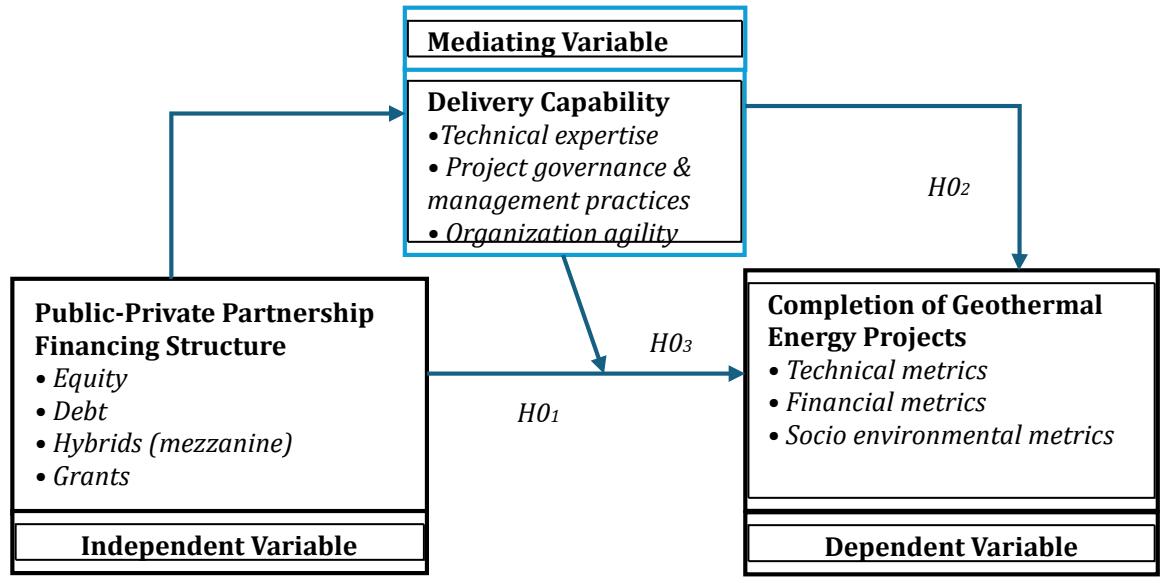 Figure 1: Conceptual Model
The model positions delivery capability as the central mediator between financing structures (input variable) and PPP geothermal project completion (output variable). It is founded on the presumption that for any PPP to work, there must be an enabling environment for private investments, implying that the government must deliberately support while the private sector takes the investment risks. For geothermal PPPs, the financing structure is usually comprised of a mixture of private and government equity, commercial loans at market-interest rates, low-interest concessional loans from Development Financing Institutions (DFIs), a hybrid of loans and equity (mezzanine), and grants from development partners and government. The conceptual framework asserts that financial resources and policy frameworks are not directly sufficient but must be transformed through operational capabilities to achieve holistic project completion. The completion outcomes are measured in terms of technical (contract period variations, Metric tons or MWs produced), financial (budget variations, key economic indicators) and socio-environmental risk mitigation (sustainable energy outcomes).
## III. METHODOLOGY
Guided by the research objective and hypotheses, a mixture of research philosophies, designs, methods and strategies was selected with good justifications for each choice. Figure 2 shows a chronology of the research process organized under three broad steps.
### Research Preparation
- Problem conceptualization and initial literature review
- Proposal development
- Peer reviews by Faculty and subject matter experts
- Ethical considerations
- Fundraising and resourcing
- Training of research assistants
- Pilot study
#### Data Collection and Analysis
- Field data collection: Administer questionnaires and KII guide
- Data cleaning, coding and entry (SPSS)
- Data analysis and presentation - Descriptive statistics, Linear regression models and content reduction
- Data triangulation and interpretations
- Continuous literature review
#### Report Writing and Dissemination
- Study report preparation
- Reviews by Faculty and subject matter experts
- Presentation of conference papers
- Publications in high-impact and peer-reviewed journals
- Track emerging opportunities for further research
Figure 2: Research Flow Chart
### a) Research Philosophy
The current study was founded on two schools of thought in academic research. It relied heavily on the positivist philosophical fundamentals, thereby using quantitative methods to collect and analyze field data (Wambugu et al., 2015). However, the positivists' assumption that science is limited to facts, observable and quantifiable cause-and-effect variables, excluding human factors (qualitative aspects), is a bit unrealistic in social sciences, as also observed by Hilary (2018). Cognizant of this limitation, the study also utilized the pragmatist philosophical tenets to enable the gathering of qualitative data from key informants, thereby interrogating the research problem in a more representative manner.
### b) Research Design
This study employed a mixed-methods research design to comprehensively examine the interplay between delivery capability, PPP financing structure and geothermal project completion. The cross-sectional quantitative survey was supplemented by qualitative Key Informant Interviews (KIIIs), allowing for both breadth of data collection and depth of understanding (Creswell & Plano Clark, 2018). The survey established broad patterns and tested hypothesized relationships between the study variables, providing statistical breadth and generalizability. Furthermore, the cross-sectional design was deemed effective for capturing the prevailing relationships and current state of delivery capabilities and their effect on project completion outcomes across the project profile diversity, at a specific point in time, providing valuable and actionable insights for contemporary policy and practice. The KIIIs provided additional contextual insights and explanations for the observed quantitative findings, offering a deeper understanding of the practical operationalization of delivery capability within Kenya's geothermal sector.
### c) Unit of Analysis and Population
The unit of analysis was each of the 48 geothermal PPP projects licensed in Kenya as of December 2023, as registered with the national regulator (EPRA). A population of 117 participants was targeted: 96 primary respondents drawn from the industry divide covering all 48 projects (census survey): private sector project managers $(n = 48)$ and government project team leaders $(n = 48)$, where the average of their responses for each project was considered fairly representative of the reality. Moreover, we also targeted 19 key informants, comprising senior directors purposively sampled from the lead State agencies and devolved governments hosting the projects, development and commercial financial institutions, academia and geothermal institutes, and the national renewable energy association. This industry-wide approach ensured representation across critical project phases (exploration, development, implementation, and operation) and project sizes (small-scale $< 50\mathrm{MW}$, medium 50-100MW, large-scale $>100\mathrm{MW}$ ).
### d) Quantitative Data Collection from Project Managers (Team Leaders)
We administered structured questionnaires to all the 96 primary respondents through the Survey Monkey platform between May and August 2024, following best practices for survey research in infrastructure projects (Saunders et al., 2019).
Operationalization of Variables: The three study variables were broken down into subvariables based on the theoretical and empirical review findings.
The PPP financing structure, as the independent variable, was operationalized to reflect its theoretical underpinnings in the capital structure theory of Modigliani and Miller (1958), specifically as applied to infrastructure projects by Yescombe (2011). The components were measured using Equity ratio measurement following the PPP financial modelling approaches of Farquharson et al. (2011), while the debt financing proportion was calculated using the project finance ratios recommended by Gatti (2013), and grant components were assessed through the subsidy measurement framework of Engel et al. (2013).
Delivery capability, as the mediating variable, incorporated three sub-constructs: (1) project governance framework measured through the strategic project performance indicators of Mu Iler et al. (2014); (2) technical efficiency assessed using the transaction cost economics framework of Williamson (1985); and (3) organizational agility evaluated through the dynamic capabilities' measurement scale of Pavlou and El Sawy (2011).
Project Completion, as the dependent variable, employed a multidimensional assessment framework: (1) technical indicators followed the project performance indicators of the Project Management Institute (2017); (2) financial indicators used the capital budgeting evaluation methods of Brealey et al. (2012); and (3) socio-environmental indicators were verified against the ESIA evaluation criteria of the International Association for Impact Assessment (2020). This comprehensive measurement approach ensured construct validity through different established indicators (Cook & Campbell, 1979).
Measurement Instrument: A 35-item Likert-scale instrument was carefully designed based on validated measurement scales from previous PPP studies (Zhang, 2005; Osei-Kyei & Chan, 2015). The measurement of delivery capability (12 items) incorporated dimensions identified in the project management literature (Muller & Jugdev, 2012), including geothermal specific technical expertise, project management and governance structures adapted from Klijn and Koppenjan (2016), and Turner (2016) project governance model, as well as organizational agility facets developed from agile project management research by Conforto et al. (2014). The PPP financing structures (8 items) were measured using indicators derived from the World Bank's PPP financing guidelines (World Bank, 2017) and the OECD's principles for private sector participation in infrastructure (OECD, 2015). Project completion metrics (8 items) incorporated technical, financial, and socio-environmental dimensions aligned with the triple-bottom-line approach to project success (Elkington, 1997), the Sustainable Development paradigm (UNDP), and the infrastructure project performance indicators recommended by Flyvbjerg (2014).
Reliability and Construct Validity: Before full roll-out of the data collection activities, the research tools were piloted on the Ngong Wind Power Project located within the Rift Valley Region of Kenya. The questionnaire underwent rigorous pretesting with 15 industry experts, achieving Cronbach's $\alpha$ scores exceeding 0.82 for all constructs, surpassing the 0.70 reliability and construct validity threshold recommended by Nunnally (1978). Our $81\%$ response rate, which was achieved through Dillman's (2007) tailored design method, including three follow-up reminders and telephone prompts, is significantly higher than typical response rates for organizational surveys (Baruch & Holtom, 2008).
### e) Qualitative Data Collection from Key Informants
We used a semi-structured Key Informant Interview (KII) guide to conduct 18 interviews following the methodological guidelines of King and Horrocks (2010) for open-question interviews. The senior directors from target constituents were selected through purposive sampling to ensure representation of diverse perspectives (Patton, 2002) and achieve theoretical sufficiency (Baker & Edwards, 2012). The interview protocol was developed based on the critical incident technique (Flanagan, 1954) and drew upon the PPP implementation framework of Hodge and Greve (2007).
The KII questions explored responses on four essential themes: (1) project implementation challenges, building on the risk factor taxonomy developed by Bing et al. (2005); (2) operationalization of delivery capability, informed by the dynamic capabilities framework (Teece et al., 1997); (3) government support effectiveness, using the policy implementation lens of Pressman and Wildavsky (1984); and (4) best practice (critical) geothermal project completion indicators, applying the project success determinants identified by Chan et al. (2004). Interviews lasted 45-60 minutes, following recommendations for qualitative data collection in organizational research by Myers (2019). Audio recording and verbatim transcription procedures followed best practices outlined by Poland (2002) and recommendations on enhancing validity by Lincoln and Guba (1985). Theoretical saturation was achieved after 15 interviews (Guest et al., 2006), with three additional confirmatory interviews conducted to verify emerging patterns (Morse, 2015).
### f) Quantitative Data Analysis
Quantitative data analysis followed a statistical approach to examine the hypothesized relationships between study variables. Initial descriptive analyses were conducted to characterize the sample composition and distribution patterns of all measured variables, following established protocols for data screening in social science research (Tabachnick & Fidell, 2019). Bivariate relationships between key constructs were examined using Pearson correlation coefficients, providing preliminary insights into the strength and direction of associations between PPP financing structures, delivery capability, and project completion.
### g) Qualitative Data Analysis and Triangulation
Interview transcripts were analyzed using content analysis (Braun & Clarke, 2006). An inductive coding approach identified emergent patterns, which were then mapped to the quantitative findings through data triangulation aligned to the study themes. Illustrative statements were selected to illustrate key themes about delivery capability implementation.
### h) Ethical Considerations
The researchers ensured compliance with applicable Faculty regulations, national laws and best practice research ethics. All the participants provided informed consent, with options for anonymity. Data was stored on password-protected servers, with identifiers removed during analysis. Publication of these findings aims to widen the audience reach as much as possible, inform future research directions and global PPP project management practices.
## IV. FINDINGS AND DISCUSSION
Both descriptive and inferential statistics unveil noteworthy patterns in Kenya's geothermal PPP sector, directly addressing the stated hypotheses: $H O_{1}$: The association between the financing structure and the completion of public-private partnership (PPP) geothermal projects is not significantly mediated by the delivery capability of developers; and $H O_{2}$: Delivery capacity, and the finance structure of public-private partnership (PPP) do not significantly affect the completion of geothermal energy development.
Our analysis utilized both descriptive and inferential statistics to unveil noteworthy patterns in Kenya's geothermal PPPs, directly addressing the two stated hypotheses.
### a) Descriptive Statistical Results and Interpretation
Delivery Capability: Project governance demonstrated particularly strong performance (mean = 3.93), closely followed by risk allocation strategies (mean = 3.68) and organizational agility (mean = 3.78). These results align with Zhang's (2005) findings on the importance of structured governance in PPP success and Osei-Kyei and Chan's (2017) work on organizational factors in project delivery.
PPP Financing Structure: Accessibility to a particular financing option presented an interesting dichotomy in our findings. Private equity demonstrated relatively high accessibility (mean = 3.98) compared to government equity (mean = 3.79), a pattern that may reflect systemic challenges in public sector financing mechanisms. Remarkably, concessional loans stand out for their cost-efficiency (mean = 4.05), confirming their established role as risk mitigation instruments in infrastructure financing as also advanced by the World Bank Group (2018).
Government Assistance: While institutional support mechanisms and policy frameworks generally perform well (mean range = 3.76-4.23), the study identifies persistent bottlenecks in land acquisition and permitting processes (mean range = 3.34-3.50). These implementation challenges coincide findings of lka and Donnelly (2017) about operational hurdles in African infrastructure development contexts, where robust policy frameworks often encounter execution difficulties.
### b) Inferential Statistical Results and Interpretation
The core empirical contribution of this study lies in dissecting the influence of the predictor variables on project completion, beginning with mediation and then examining their joint effect.
Delivery Capability's Mediation on Financing Structure and PPP Geothermal Project Completion: Testing $H0_{1}$ and $H0_{2}$
To assess the mediating role of delivery capability, a step-wise regression analysis was conducted, following the Baron & Kenny (1986) modelling strategy.
Table 1: Model Summary for Mediation Analysis
<table><tr><td>Model</td><td>R</td><td>R Square</td><td>Adjusted R Square</td><td>R Square Change</td><td>df1</td><td>df2</td><td>Sig F Change</td></tr><tr><td>1</td><td>0.663</td><td>0.439</td><td>0.433</td><td></td><td>1</td><td>92</td><td>0.000</td></tr><tr><td>2</td><td>0.813</td><td>0.661</td><td>0.654</td><td>0.222</td><td>1</td><td>91</td><td>0.000</td></tr></table>
Table 2: Coefficients for Mediation Analysis
<table><tr><td>Model</td><td>Variable</td><td>Beta(unstandardized Coefficient)</td><td>Std Error</td><td>Beta(unstandardized Coefficient)</td><td>t</td><td>Sig.</td></tr><tr><td rowspan="2">1</td><td>Constant</td><td>.624</td><td>0.397</td><td></td><td>1.575</td><td>0.119</td></tr><tr><td>PPP Financing Structure</td><td>0.875</td><td>0.103</td><td>0.663</td><td>8.492</td><td>0.000</td></tr><tr><td rowspan="4">2</td><td rowspan="2">Constant</td><td rowspan="2">-0.132</td><td rowspan="2">0.325</td><td></td><td>-</td><td>0.686</td></tr><tr><td></td><td>0.406</td><td></td></tr><tr><td>PPP Financing Structure</td><td>0.430</td><td>0.099</td><td>0.326</td><td>4.346</td><td>0.000</td></tr><tr><td>Delivery Capability</td><td>0.633</td><td>0.082</td><td>0.579</td><td>7.717</td><td>0.000</td></tr></table>
Model 1 (Tables 1 and 2) shows that PPP Financing Structure significantly predicts project completion (Beta = 0.875, p = 0.000); it explains $43.3\%$ variance in completion, indicating that other factors such as delivery capability, government assistance and geological conditions could account for the remaining bulk $(53.7\%)$. Thus, we reject $H O_{1}$: The influence of financing structure on the completion of PPP geothermal projects is not significant. When Delivery Capability is added as a mediator in Model 2, its effect on project completion is highly significant (Beta = 0.633, p = 0.000), while the direct effect of PPP Financing Structure on project completion is substantially reduced (Beta decreases from 0.875 to 0.430), though remaining significant. The significant Sobel test statistic (5.137, p \<.001) confirmed the significance of this indirect effect through project execution skills. This pattern confirms that delivery capability significantly mediates the relationship between PPP financing structure and project completion, indicating that the positive impact of financing structures on completion is partly channelled through robust delivery capabilities. This evidence leads to the rejection of $H0_{2}$: The association between the financing structure and the completion of PPP geothermal projects is not significantly mediated by the delivery capability of developers. A similar, statistically significant indirect effect was observed using the Sobel test.
Combined Influence of Delivery Capability and Financing Structure on PPP Geothermal Project Completion: Testing $H0_{3}$
The comprehensive regression model, which includes Delivery Capability, Financing Structure, and other PPP enabling factors (government assistance), assesses their combined influence on geothermal project completion.
<table><tr><td colspan="3">Table 3(a): Comprehensive Regression Results</td></tr><tr><td>Statistic</td><td colspan="2">Value</td></tr><tr><td>R</td><td colspan="2">0.814</td></tr><tr><td>R- squared (R2)</td><td colspan="2">0.663</td></tr><tr><td>Adjusted R2</td><td colspan="2">0.652</td></tr><tr><td>Significance</td><td colspan="2">0.000</td></tr></table>
<table><tr><td colspan="6">Table 3(b): Comprehensive Regression Results</td></tr><tr><td>Variable</td><td>Beta(unstandardized Coefficient)</td><td>Std Error</td><td>Beta(unstandardized Coefficient)</td><td>t</td><td>Sig.</td></tr><tr><td>Constant</td><td>0.243</td><td>0.364</td><td>-</td><td>1.669</td><td>0.021*</td></tr><tr><td>Delivery Capability</td><td>0.607</td><td>0.091</td><td>0.555</td><td>6.682</td><td>0.000***</td></tr><tr><td>PPP Financing Structure</td><td>0.400</td><td>0.109</td><td>0.303</td><td>3.681</td><td>0.000***</td></tr><tr><td>Other Enabling Factors</td><td>0.260</td><td>0.124</td><td>0.240</td><td>2.690</td><td>0.042*</td></tr></table>
As presented in Table 3 (a-b), the overall model yielded a strong R-squared $(R^2)$ of 0.663, with an Adjusted $R^2$ of 0.652. This indicates that $65.2\%$ of the variance in geothermal project completion is explained by the joint effect of delivery capability, PPP financing structure, and government assistance (other PPP enabling factors). The model's overall significance (Sig. $= 0.000$ ) strongly confirms that delivery capability and PPP financing structure collectively and significantly affect project completion. Based on this robust evidence, we reject H03: Delivery capacity and public-private partnership (PPP) financing structure do not jointly affect the completion of geothermal energy projects in a significant manner.
### c) Evidence of Delivery Capability's Strong Influence
Individually, delivery capability emerged as the strongest predictor (Beta = 0.607, p < 0.001), highlighting its paramount importance, compared to PPP Financing Structure (Beta = 0.400, p < 0.001) and other enabling factors/government assistance (Beta = 0.260, p < 0.05). Furthermore, the quantitative findings were enriched by stakeholder interviews, where participants highlighted how specialized geothermal expertise enables teams to navigate unique geological challenges (Karingi & Wanjala, 2018), while identifying financial and liquidity management as crucial in maintaining a project's momentum (Gatti, 2013). The analysis revealed that streamlined governance structures correlate with 25% faster approval processes (Flyvbjerg, 2014), while technical expertise among contractors and developers reduces execution time by 18% (Chan et al., 2019).
Specifically, PPP structuring skillsets and financial management proficiency showed powerful effects, with efficient fund utilization correlating with $22\%$ improvement in budget adherence (Yescombe, 2011). Projects with optimal delivery systems demonstrate markedly superior outcomes. Technically proficient teams experience $30\%$ fewer delays compared to less skilled counterparts (Babatunde et al., 2020), while diversified financing models achieve $80\%$ completion rates versus $40\%$ for underfunded projects (OECD, 2015). Robust oversight mechanisms reduce corruption risks by $35\%$ (Transparency International, 2020), confirming Bing et al. (2005) findings about governance in PPP projects.
### d) Discussion and Implications
The research reveals that successful PPP implementation in Kenya's geothermal sector operates as a complex adaptive system where delivery capability functions as the mediator between project inputs and completion outcomes. This dual theoretical thinking offers important insights that advance both academic understanding and practical management of renewable energy infrastructure projects.
Theory Building: The empirical findings provide robust support for Dynamic Capability theory (Teece et al., 1997) while simultaneously demonstrating the value of a Systems theory perspective (Bertalanffy, 1968) in understanding geothermal PPP project completion determinants. They provide empirical validation for the systems theory principle that project outcomes emerge from subsystem interactions rather than linear cause-effect relationships (Bertalanffy, 1968). The findings widen the scope of Dynamic Capability theory by quantifying how organizational adaptability intercedes between structural factors and project completion; and finally, it addresses the methodological gaps identified by Flyvbjerg (2014) by providing measurable evidence of delivery capability effects in complex project lifecycle environments.
Re-defining the Delivery Capability Concept: The dominant explanatory power of delivery capability, accounting for $61\%$ of the variance in project completion outcomes, can be understood through the Systems theoretical concept of emergent properties (Meadows, 2008). Rather than operating in isolation, delivery capability represents the organizational agility to integrate and coordinate across technical, financial, and governance subsystems. As Sterman (2000) notes in his work on system dynamics, such integrative capabilities are especially important in complex projects, like geothermal, where various feedback loops influence outcomes. The finding that technical expertise reduces execution time by $18\%$ aligns with inferences made by Zhang et al. (2022), alluding that specialized competencies help navigate system complexities in infrastructure projects.
From a Dynamic Capability theory perspective, these results extend Teece et al.'s (1997) framework by demonstrating how sensing, seizing, and transforming capacities operate within constrained institutional systems. The persistent bottlenecks in land and way leave acquisition processes (mean rating = 3.34) exemplify what North (1990) describes as institutional rigidities that limit organizational adaptability. This finding supports Babatunde et al (2020) argument that capability development in African infrastructure projects must account for systemic constraints. This study advances PPP theory and practice by demonstrating that delivery capability serves as the crucial mechanism through which project systems achieve successful outcomes.
A System-Wide Delivery Framework is Ideal: By integrating Dynamic Capability with systems theory perspectives, it provides both a diagnostic framework for assessing project risks and an evidence-base for strategic interventions. For policymakers and practitioners, these findings underscore the importance of moving beyond structural and contractual considerations to develop the organizational capacities that enable effective navigation of complex project ecosystems. As Kenya and other emerging economies continue to expand their renewable energy infrastructure, this systems-wide approach to capability development will be essential for achieving sustainable project success.
Recommendations for PPP Project Management Practice: First, procurement processes should incorporate more rigorous assessment of bidder competencies, as recommended by the World Bank's (2018) PPP guidelines. Second, capacity-building programs should adopt the systems-aware approach advocated by the OECD (2015), developing skills that span technical, financial, socio-environmental and stakeholder management domains. Third, financial models should incorporate the liquidity buffers that Yescombe (2011) identifies as crucial for managing systemic uncertainties.
## V. CONCLUSION AND FUTURE RESEARCH DIRECTIONS
This research contributes to the broader PPP literature by highlighting delivery capability as a critical success factor, particularly in the renewable energy project life cycle (Ika et al., 2021). The findings, discussions and recommendations are expected to inform policymakers, private investors, and project managers on optimizing delivery mechanisms to mitigate delays and cost overruns. By aligning with Kenya's Vision 2030, the Least Cost Power Development Plan, Green Energy Transition (Net Zero) blueprints, and the global Sustainable Development Goal 7 (affordable and clean energy), this study underscores the transformative potential of robust delivery systems in achieving sustainable energy security and coverage (UNDP, 2023). This study provides compelling evidence that delivery capability serves as the linchpin for successful geothermal PPP implementation in Kenya, fundamentally mediating the effect of financial structures and policy frameworks on project completion outcomes.
a) Novel Contributions to the Body of Knowledge, Practice and Policy While reinforcing certain established principles of PPP success, the research breaks new ground by offering three significant contributions to the field.
The study provides empirical quantification of the delivery capability's predominant influence by demonstrating its ability to explain around $61\%$ of the variance in PPP geothermal project completion outcomes.
It extends the application of Dynamic Capability theory to the geothermal energy sector, validating its explanatory power in this specific context.
It offers precise measurements of operational impacts, such as the $18\%$ reduction in project timelines attributable to technical expertise, including geotechnical and geological skillsets and technologies.
It underscores the transformative potential of strengthening delivery capabilities within Kenya's renewable energy sector. By focusing on enhancing implementation capacity, stakeholders could unlock substantial value and accelerate the achievement of national energy transition goals.
It points to the need for a strategic reorientation in how geothermal PPPs are conceived and executed, with greater emphasis placed on building execution competencies rather than solely enhancing financial or contractual arrangements.
The findings provide an integrated diagnostic framework for assessing PPP geothermal project readiness in support of Kenya's renewable energy transition. As the global community increasingly turns to PPPs to deliver critical infrastructure, the proposed integrated framework offers timely guidance for balancing structural design with operational execution in complex renewable energy development projects. Ultimately, this study advances our understanding of what makes geothermal PPPs work in practice, moving beyond theoretical ideals to identify the concrete operational capabilities that determine success. It provides a strategic roadmap for enhancing geothermal PPP implementation effectiveness.
### b) Limitations and Opportunities for Future Research
While this study provides valuable insights into the determinants of geothermal PPP completion in Kenya, some limitations are acknowledged. These research shortcomings suggest important directions for future study.
Generalizability: The research focused exclusively on Kenya's geothermal sector, which may limit the generalizability of findings to other renewable energy sectors or geographical contexts, as suggested by Ika et al. (2021). Moreover, the temporal scope of the research did not account for potential long-term effects of capacity-building initiatives or evolving policy frameworks.
Timelines: Longitudinal research tracking projects from inception to completion would provide valuable insights into how delivery capabilities develop over time and their longterm impact on project outcomes. Additionally, cross-country comparative studies could reveal how institutional and regulatory contexts influence the relative importance of different factors. Future research could also benefit from more granular analysis of capability development processes. In-depth case studies of successful and unsuccessful projects could reveal the micro-level dynamics of capability building and deployment.
Technological Integration: Additional research exploring the interaction between delivery capabilities and emerging technologies, such as Artificial Intelligence (AI) for project monitoring and blockchain for contract management, could provide additional insights into how digital transformation might reshape PPP implementation.
Transferability of Capabilities Across Projects and Sectors: Further research could explore whether and how capabilities developed in one project or sector can be leveraged in others, potentially reducing the learning curve for new initiatives. Finally, studies examining the role of international partnerships in capability development could provide valuable insights for optimizing knowledge transfer in PPP projects.
These guidelines would not only address the current study's limitations but also contribute to a more comprehensive understanding of how to optimize PPP financing structures for sustainable infrastructure development in emerging economies. By building on this study's findings while addressing its limitations, future research can provide even more actionable insights for policymakers, investors, financiers, and project developers.
Generating HTML Viewer...
References
33 Cites in Article
Rhys Andrews,Malcolm Beynon,Aoife Mcdermott (2016). Organizational Capability in the Public Sector: A Configurational Approach.
J Atela (2019). Political economy of geothermal energy in Kenya.
G Atmo,C Duffield,L Zhang (2016). Enhancing PPP financing for infrastructure development.
S Babatunde,S Perera,L Zhou (2020). Barriers to public-private partnership projects in developing countries: A case of Nigeria.
Li Bing,A Akintoye,P Edwards,C Hardcastle (2005). The allocation of risk in PPP/PFI construction projects in the UK.
A Chan,J Yeung,C Yu,S Wang,Y Ke (2019). Empirical analysis of the critical success factors for PPP projects in China.
Olivier Ejderyan,Franziska Ruef,Michael Stauffacher (2019). Geothermal Energy in Switzerland: Highlighting the Role of Context.
Harriet Kung (2022). Science for Energy.
B Flyvbjerg (2014). What you should know about megaprojects and why: An overview.
S Gatti (2013). Project finance in theory and practice: Designing, structuring, and financing private and public projects.
C Hilary (2018). The importance of research within the creative industries.
L Ika,A Diallo,D Thuillier (2021). Critical success factors for World Bank projects: An empirical investigation.
Michael Jensen,William Meckling (1976). Theory of the firm: Managerial behavior, agency costs and ownership structure.
G Kanyamyoga (2020). Policy frameworks for geothermal PPPs in Kenya.
S Karingi,B Wanjala (2018). Geothermal energy development in Kenya: A review of policy and institutional frameworks.
J Kiplagat,R Wang,T Li (2020). Renewable energy in Kenya: Resource potential and status of exploitation.
A Kudtark (2020). Delivery capability in infrastructure projects: A missing link in PPP research.
P Mugambi,W Kithyoma (2020). Challenges facing geothermal energy development in Kenya.
J Ngugi,J Aduda (2019). Financing renewable energy projects in Kenya: The PPP model.
(2015). Principles for public governance of public-private partnerships.
S Olando,M Mwenda,R Kikwatha,C Rambo (2024). Mediating Effect of Delivery Capability on Public-Private Partnership Financing Structure and Geothermal Energy Development Project Completion in Kenya.
Sitati Olando,Mary Mwenda,Reuben Kikwatha,Charles Rambo (2024). EFFECT OF PUBLIC PRIVATE PARTNERSHIP FINANCING STRUCTURE ON COMPLETION OF GEOTHERMAL ENERGY DEVELOPMENT PROJECTS IN KENYA.
S Olando,M Mwenda,R Kikwatha,C Rambo (2025). The Synergistic Effect of PPP Financing Structure, Delivery Capability and Government Support on Completion of Geothermal Energy Development Projects in Kenya.
Abdirahman Abass,Francis Mwaura (2007). Re-membering the Drylands of Kenya:.
D Teece,G Pisano,A Shuen (1997). Dynamic capabilities and strategic management.
M Utkina (2020). Financing infrastructure projects during martial law: corruption challenges and transparency mechanisms.
(2023). UNDP.
L Wambugu,D Kyalo,M Mbii,R Njonye (2015). The Effectiveness Of Charismatic Movements In Fostering New Evangelization: Case Of Vincentian Ministries In The Archdiocese Of Nairobi, Kenya.
(2018). Financing renewable energy in developing countries.
(2020). Did Public-Private Partnerships Deliver?.
E Yescombe (2011). Project Finance and PPPs.
X Zhang,S Chen,Y Liu (2022). The role of delivery capability in infrastructure PPPs.
No ethics committee approval was required for this article type.
Data Availability
Not applicable for this article.
How to Cite This Article
Dr. Sitati Olando. 2026. \u201cDelivery Capability as a Key Driver of PPP Geothermal Energy Project Completion: Evidence from Kenya\u201d. Global Journal of Human-Social Science - H: Interdisciplinary GJHSS-H Volume 25 (GJHSS Volume 25 Issue H3).
Explore published articles in an immersive Augmented Reality environment. Our platform converts research papers into interactive 3D books, allowing readers to view and interact with content using AR and VR compatible devices.
Your published article is automatically converted into a realistic 3D book. Flip through pages and read research papers in a more engaging and interactive format.
Our website is actively being updated, and changes may occur frequently. Please clear your browser cache if needed. For feedback or error reporting, please email [email protected]
Thank you for connecting with us. We will respond to you shortly.