
I. INTRODUCTION
High school represents a pivotal stage in students' educational trajectories, during which decisions are made that have direct impacts on their life plans, such as continuing their studies or entering the workforce. Although higher education is widely recognized as a strategic factor for economic and social development, not all students intend to pursue further studies after this stage, particularly in contexts marked by significant educational and socioeconomic inequality.
In Brazil, data from the Higher Education Census indicate that only of high school graduates in 2022 enrolled in higher education in 2023, with considerable variation according to the type of school: in federal schools, in private schools, and only in state schools (Brazil, 2024). Furthermore, according to the Brazilian Institute of Geography and
Statistics (IBGE), in 2023, only of young people aged 18 to 24 were enrolled in undergraduate programs, with a higher enrollment rate among women than among men .
These inequalities reflect not only differences in immediate access but also factors that influence the continuation of studies. Among young people aged 15 to 29 with a complete high school education or incomplete higher education, the main reason for not continuing their studies was the need to work, especially among men (54.9%) and white individuals (47.6%). Other relevant factors include the perception of having already reached the desired educational level, lack of interest, and insufficient financial resources. Among women, 14% cited household chores or caregiving responsibilities, while only 0.3% of men mentioned this reason (IBGE, 2023).
Understanding these factors requires engagement with the literature, which mobilizes two central theoretical frameworks. First, Human Capital Theory, which views education as an investment that increases productivity and income, generating both private and social benefits and guiding educational choices based on expected returns (Schultz, 1961; Becker, 1993). Second, the Theory of Social Reproduction (Bourdieu, 1986), which emphasizes how economic, social, and cultural capital, as well as embodied dispositions (habitus), shape life trajectories and reproduce inequalities, often under the guise of meritocracy (Bourdieu & Passeron, 1992). In this study, these theories are not tested as competing hypotheses but are employed as conceptual lenses to interpret how structural constraints and individual expectations interact in shaping educational intentions.
At the empirical level, studies indicate consistent effects of socioeconomic background and parental education, type of school, and academic performance or progression, with grade repetition acting as a barrier, particularly in Latin America (Sena, 2021; Zonta et al., 2022; Souza & Vazquez, 2015). Evidence also highlights gender inequalities in aspirations and informational constraints, such as limited knowledge of access mechanisms and financial aid, which reduce the intention to pursue higher education, especially among vulnerable groups (Deming & Dynarski, 2009; Perna, 2006; Amador, Cowan & Nillesen, 2022).
From a comparative perspective, the influence of these determinants varies across countries, reflecting the specific institutional arrangements and educational pathways in each country. For instance, differences emerge between Latin American countries, Finland, with its distinction between academic and vocational tracks, and South Korea, where competitive dynamics shape aspirations (Varjo et al., 2020; Tolonen & Aapola-Kari, 2022; Choi, 2020; Kim & Kim, 2025).
Despite this evidence, the literature still presents limitations. National or local studies predominate, analyzing determinants of educational continuation in isolation. There is a relative scarcity of comparative investigations using standardized and recent data to contrast the Brazilian case with countries at different levels of development. This gap is particularly relevant, as it allows identification of whether the factors shaping educational intentions in Brazil, characterized by substantial inequalities, are reproduced in more equitable contexts or, conversely, reveal specific patterns. This is the space in which this article is situated, proposing a comparative analysis between Brazil and developed and developing countries.
In light of this scenario, this study seeks to answer the following question: How do social, educational, and familial inequalities shape high school students' intentions to enter higher education? Moreover, to what extent do these relationships differ between Brazil and other countries with different educational contexts and levels of development? The study is guided by the hypothesis that students with higher cultural and socioeconomic capital, better academic performance, greater vocational clarity, access to information, and family and school support are more likely to express the intention to pursue higher education.
To address this question, the objective of this study is to analyze the determinants of high school students' intention to enter higher education, based on data from the 2022 Programme for International Student Assessment (PISA), using logistic regression models. Specifically, the study aims to identify the socioeconomic and academic profile of students considering their intentions to continue their studies; estimate the influence of socioeconomic, academic, and familial variables on these intentions; and compare the determinants of this intention between Brazil and high-income countries (United States, Finland, South Korea, Portugal, Chile, and Uruguay) and upper-middle-income countries (Argentina, Mexico, and Colombia).
The primary contribution of this research is to link the Brazilian case to different national realities, enabling an examination of how socioeconomic, academic, and familial variables interact in diverse contexts. In addition, focusing on intention, rather than solely on enrollment, enables identification of inequalities at early stages of the educational trajectory, enhancing understanding of the relationship between expectations and structural conditions. The results aim to provide support for the formulation of more effective public policies focused on promoting educational aspirations, reducing informational barriers, and strengthening support for vulnerable groups.
Beyond this introduction, the article is organized as follows: Section 2 presents the theoretical frameworks (Human Capital Theory and the Theory of Social Reproduction) and the empirical review on determinants of aspirations; Section 3 details the data, variables, and multinomial logit model; Section 4 presents descriptive statistics and model results; Section 5 discusses the findings, and Section 6 provides the concluding remarks.
II. THEORETICAL AND EMPIRICAL FRAMEWORK
The decision to enter higher education is a complex phenomenon involving multiple theoretical and empirical dimensions. Over the past decades, different schools of thought have sought to explain how economic, social, cultural, and institutional factors shape individuals' educational aspirations and trajectories. In this context, it becomes essential to revisit classical theories and recent evidence that help to understand the mechanisms of social mobility associated with schooling and the barriers that limit access to and persistence in education for specific groups.
Initially, Human Capital Theory, developed by Schultz (1961) and Becker (1993), views education as an individual investment that increases productivity and generates future economic returns, considering both direct and opportunity costs. Schultz (1961) identifies five forms of investment in human capital—health, on-the-job training, formal education, adult education, and migration—highlighting education and training as decisive for economic development. Becker (1993) expands this perspective by including the social returns of schooling, such as health, civic participation, and family stability, reinforcing the need for public policies to reduce inequalities and promote educational equity.
In a critique of the economistic perspective on education, the Theory of Social Reproduction, developed by Bourdieu and Passeron (1992), highlights that schools are neither neutral nor meritocratic but act to perpetuate inequalities by valuing the cultural, economic, and social capital of dominant classes. Cultural capital, in its embodied form (dispositions acquired through family socialization, such as language and habits), objectified form (ownership of cultural goods), and institutionalized form (educational credentials), directly influences academic success. At the same time, habitus, formed by internalized dispositions of individuals, guides educational trajectories, favoring students whose families share the values legitimized by the school (Bourdieu, 1986; 2013).
The belief in merit as the sole determinant of academic success contributes to the maintenance of inequalities, as evidenced by phenomena such as "credential inflation," in which expanded access to education reduces the distinctive value of degrees and frustrates expectations of social mobility (Bourdieu, 1986; Bourdieu et al., 1992). Furthermore, the interaction between economic, cultural, and social capital explains the different strategies adopted by social classes. Elites, with greater resources, can prolong education or use it to reinforce their position; middle classes invest in schooling as a means of upward mobility; and lower-income groups, facing financial constraints and limited support networks, encounter greater barriers to advancing in education (Bourdieu et al., 1992).
In this sense, the decision to continue studies is influenced by multiple socioeconomic and cultural factors, as evidenced by national and international research. Studies in South Korea indicate that students from higher-income and more educated families tend to attend more prestigious high schools, thereby increasing their chances of admission to selective universities (Kim & Kim, 2025). Similar findings are observed in Brazil, where parental income and education are key determinants of the intention to pursue higher education (Sena, 2021; Zonta et al., 2022). Students' own perceptions reinforce this pattern: in São Paulo, students from lower-income backgrounds perceive their chances of access as limited, particularly to public universities (Souza & Vazquez, 2015). In the United States, Jacob and Wilder (2010) observed that while students from advantaged backgrounds tend to maintain or raise their expectations throughout schooling, those from disadvantaged backgrounds tend to lower them.
The structure of each country's education system is also a fundamental predictor of students' aspirations. In contexts of high inequality between school networks, such as in Brazil, the distinction between public and private schools creates divergent pathways: students in private schools tend to receive earlier and more targeted preparation for university, whereas public school students face more challenging paths (Teixeira, 2019). In other contexts, the primary differentiation occurs through the study tracks offered within the system itself. In South Korea, the choice between general and vocational high school is decisive, to the point that the factors influencing continuation of studies change drastically depending on the chosen track: academic performance prevails for students in the general track, while economic factors become more critical for those in the vocational track (Choi, 2020). The importance of the study track takes on an even deeper dimension in Finland, where qualitative research shows that the choice between academic and vocational paths is a complex process in which young people assess their own "value" and construct futures that reflect and reinforce their class origins (Varjo et al., 2020; Tolonen & Aapola-Kari, 2022).
Alongside school structure, individual academic performance and history emerge as consistent predictors. In his analysis of Latin America, Sena (2021) shows that higher scores in reading and mathematics increase aspirations, while grade repetition drastically reduces them, with significant differences between public and private networks. In Brazil, age-grade lag, often associated with grade repetition, also decreases the intention to continue studying (Zonta et al., 2022). Moreover, Carneiro and Heckman (2002), using data from the United States, argue that cognitive ability developed in childhood is more relevant than short-term financial constraints, reinforcing the importance of the entire educational trajectory.
Beyond material and academic resources, family and social influences shape educational choices. In South Korea, Park and Kim (2020) found that parental expectations have more influence on first-year students. In contrast, students seeking reentry place greater value on the social prestige of the university. In Brazil, explicit family encouragement is one of the most significant positive factors in young people's educational decisions (Braga & Xavier, 2016). Additionally, peer networks serve as a powerful channel of influence. In an experiment conducted in Mexico, Amador, Cowan, and Nillesen (2022) demonstrated that aspirations are malleable and that exposure to peers with higher expectations tends to expand students' own horizons, indicating that social interactions can both reinforce and redirect educational trajectories.
The literature also points to clear gender differences. In some countries, being female increases the likelihood of aspiring to higher educational levels, as noted by Sena (2021) in Latin America and Zonta et al. (2022) in Brazil, where female students were more likely to intend to pursue higher education. In the United States, Goyette (2008) linked the rise in female expectations to the pursuit of careers that require higher levels of education. However, this advantage in aspirations does not eliminate inequalities, as studies such as Braga and Xavier (2016) in Brazil indicate that women, despite studying longer, still concentrate in fields with lower social prestige.
Financial constraints and access to information are decisive barriers. In the United States, Deming and Dynarski (2009) demonstrated that scholarships and financial aid causally increase enrollment rates among low-income students. However, access to these resources is often hindered by a lack of information. Perna (2006) highlighted that many young people underestimate the availability of financial aid, reducing their chances of entry. This issue is particularly acute in Brazil: in Barra do Bugres (MT), Obara et al. (2018) found that while the need to work is the main obstacle, few students are aware of student assistance programs. Similarly, Souza and Vazquez (2015) found that many students are unfamiliar with access mechanisms, including the National High School Exam (Enem) , the University for All Program (Prouni) , and the Unified Selection System (Sisu) . Teixeira (2019) also found that private school students tend to have greater familiarity with these selection instruments, revealing informational inequalities between school networks.
The combined analysis of these studies reveals that the interaction between socioeconomic background, school trajectory, and access to information shapes the intention to pursue higher education. However, much of this research focuses on specific national or local contexts. Thus, a gap remains in the literature regarding quantitative, comparative studies that use recent and standardized data to investigate how these determinants operate across different education systems and levels of development. It is precisely this gap that the present article seeks to address through the methodology presented in the following section.
III. METHODOLOGY
In this study, data from the 2022 Programme for International Student Assessment (PISA), made available by the Organization for Economic Cooperation and Development (OECD), were used. PISA is an international comparative study conducted every three years to evaluate the performance of 15-year-old students, an age at which basic compulsory education is generally expected to be completed in most countries. In addition to measuring skills in reading, mathematics, and science, PISA collects information on students' socioeconomic context, their attitudes toward learning, and factors that influence their performance both inside and outside the school environment (Brazil, 2025).
PISA results allow participating countries to assess their students' knowledge and skills in comparison with those of other nations. These data are essential for countries to learn from educational policies and practices adopted in different contexts and also serve as a basis for formulating policies and educational programs aimed at improving the quality and equity of learning outcomes (Brazil, 2025).
Since its first edition in 2000, the number of participating countries and economies in PISA has increased significantly. In 2022, 81 countries and economies participated in the program, including 37 OECD member countries and 44 partner countries/economies. Brazil has participated in PISA since its first edition, contributing to international comparative analysis and using the results to guide public education policies (OECD, 2023). For this study, in addition to Brazil, the following countries were selected for analysis: Argentina, Chile, Colombia, Mexico, Uruguay, and Portugal, due to their regional and cultural proximity to Brazil; the United States, for having a federal system and large territorial extension similar to Brazil; and South Korea and Finland, as developed countries that generally exhibit high PISA performance.
The analytical method selected is the multinomial logit (MNL) model, suitable for dependent variables with more than two unordered categories (Wooldridge, 2002). In this context, the dependent variable (y) corresponds to students' educational expectations, obtained from question ST327 of the 2022 PISA student questionnaire, based on the International Standard Classification of Education (ISCED) of the United Nations Educational, Scientific, and Cultural Organization (UNESCO). The original responses, which range from "less than ISCED 2" to ISCED 8, were grouped into three categories: (i) Basic education (ISCED 0 to 4), (ii) Associate degree (ISCED 5), and (iii) Higher education (ISCED 6 to 8). When more than one option was selected, only the highest level reported by the student was considered. Thus, the MNL models the probability that an individual chooses alternative ( ) as:
Where is a random variable that takes values for categories; is a vector of observable individual characteristics; and are the parameters estimated for each alternative , with (reference category).
The interpretation of the parameters in the multinomial logit model is carried out through the relative odds ratios, as expressed in the equation:
Therefore, the direction of the partial effects in the multinomial model is not determined solely by the coefficient , unlike in the binary case ( ). The estimated coefficients represent effects relative to the reference category (basic education), where a relative risk ratio (RRR) greater than 1 indicates that, for a one-unit increase in the independent variable, the relative likelihood of belonging to the analyzed category (associate degree or higher education) compared to the reference category (basic education) increases. Conversely, a relative risk ratio below 1 suggests a reduction in this relative likelihood.
The explanatory variables were defined based on the literature, encompassing individual, family, and school characteristics of the students. At the individual level, gender and wealth were considered (an index capturing the material resources and goods available at home, serving as a proxy for family wealth). Regarding family characteristics, parental education was included (ranging from "1," less than ISCED 1, to "10," corresponding to ISCED 8) as well as family support (an index measuring the frequency of support received in relation to school life and emotional well-being).
Additionally, a variable indicating whether the student has clarity about their future occupation was included, along with two further indices: career information-seeking (measuring the extent to which the student seeks information about professional options) and growth mindset (assessing the student's belief in their ability to develop skills through effort, persistence, and practical strategies).
Concerning school characteristics, the following were considered: PISA performance, grade repetition history, school management type (public or private), school belonging index (measuring socioemotional wellbeing within the school environment), and weekly frequency of study or homework outside of school hours (on a scale from 0, none, to 10, ten or more study sessions per week). Finally, control variables related to student nationality were included, based on the information available in the PISA database.
Chart 1: Description of Explanatory Variables
| Variable | Description |
| Career and Mindset Indices | |
| Vocational clarity | Equals 1 if the student has a clear idea about their future job and 0 otherwise. |
| Information seeking | Index measuring the extent to which students seek information about future careers. |
| Growth mindset | Index measuring students' mindset regarding the development of their skills. |
| Individual Characteristics | |
| Gender | Equals 1 for male and 0 otherwise. |
| Wealth | Index measuring the level of material resources and assets available in the student's household. |
| Family Characteristics | |
| Mother's education | Mother's level of education. |
| Father's education | Father's level of education. |
| Family support | Index measuring the frequency of family support perceived by students. |
| School Characteristics | |
| Grade repetition | Equal to 1 if the student has repeated a grade at least once, and 0 otherwise. |
| Math performance | Student's performance in mathematics. |
| Reading perform. | Student's performance in reading. |
| Science perform. | Student's performance in science. |
| School type | Equal to 1 if the school is public, and 0 otherwise. |
| School belonging | Index measuring socioemotional well-being in the school environment. |
| Studying at home | Frequency with which students study or do homework outside school hours. |
| Regional Characteristics | |
| Argentina | Equal to 1 if residing in Argentina, 0 otherwise. |
| Brazil | Equal to 1 if residing in Brazil, 0 otherwise. |
| Chile | Equal to 1 if residing in Chile, 0 otherwise. |
| Colombia | Equal to 1 if residing in Colombia, 0 otherwise. |
| South Korea | Equal to 1 if residing in South Korea, 0 otherwise. |
| United States | Equal to 1 if residing in the United States, 0 otherwise. |
| Finland | Equal to 1 if residing in Finland, 0 otherwise. |
| Mexico | Equal to 1 if residing in Mexico, 0 otherwise. |
| Portugal | Equal to 1 if residing in Portugal, 0 otherwise. |
| Uruguay | Equal to 1 if residing in Uruguay, 0 otherwise |
To ensure the robustness of the results, the Wald test was conducted to examine combinations of the dependent variable categories, and the Hausman test was applied to verify the validity of the independence of irrelevant alternatives (IIA) assumption. This assumption establishes that the odds ratio between any two choices is independent of the presence or absence of other alternatives in the choice set, a fundamental requirement for using the multinomial logit model (Hausman & McFadden, 1984; Wooldridge, 2002). After excluding observations with missing values in any of the selected variables, the final sample consisted of 46,875 students distributed across the ten countries analyzed.
IV. RESULTS
a) Descriptive Statistics
Figure 1 shows the distribution of educational expectations among high school students in the countries analyzed. In all contexts, there is a predominance of aspirations toward higher education, although with varying intensity. In Brazil, approximately of students report an intention to pursue higher education, a proportion similar to that observed in other Latin American countries. In Finland and South Korea, however, the distribution is more balanced across categories, suggesting a greater appreciation for alternative educational paths. These results confirm the dominance of higher education as the main educational goal but reveal relevant differences between countries, possibly associated with institutional, cultural, and economic factors.
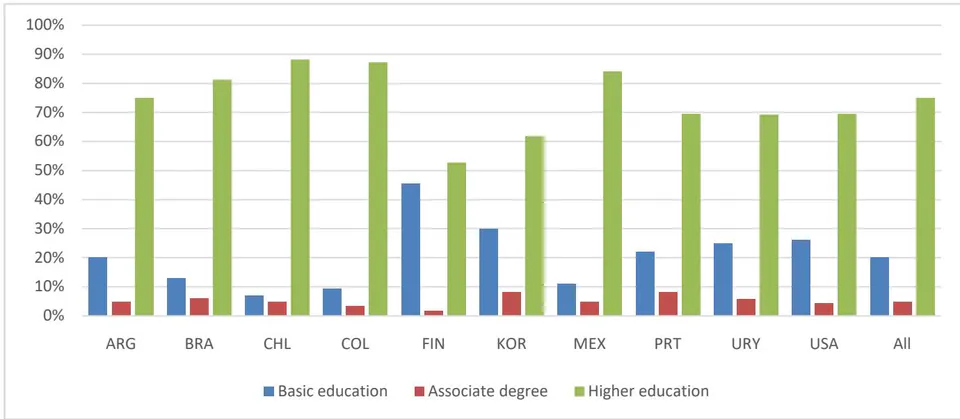
Source: Authors' elaboration based on PISA 2022 data.
Table 1 presents the descriptive statistics of the explanatory variables, providing an overview of the student profile according to their intention to continue studying. The results show that students who aspire to higher education tend to have greater vocational clarity, seek more information about careers, and exhibit a more developed growth mindset compared to those who intend to pursue only basic education. In addition, they display more favorable socioeconomic conditions, reflected in higher wealth indices. It is also observed that the male presence is more pronounced among those who plan to complete only basic education or opt for technological-level courses.
| Variable | Basic Education | Associate degree | Higher Education | All | ||||
| Mean | S.D. | Mean | S.D | Mean | S.D. | Mean | S.D. | |
| Career and Mindset Indices | ||||||||
| Vocational clarity | 0.75 | 0.01 | 0.88 | 0.01 | 0.89 | 0.00 | 0.86 | 0.004 |
| Information seeking | -0.32 | 0.02 | -0.15 | 0.04 | 0.02 | 0.01 | -0.05 | 0.01 |
| Growth mindset | 0.08 | 0.02 | 0.13 | 0.03 | 0.21 | 0.01 | 0.18 | 0.01 |
| Individual Characteristics | ||||||||
| Gender | 0.59 | 0.01 | 0.59 | 0.02 | 0.43 | 0.00 | 0.47 | 0.004 |
| Wealth | -0.43 | 0.03 | -0.53 | 0.04 | -0.31 | 0.02 | -0.34 | 0.021 |
| Family Characteristics | ||||||||
| Mother's education | 5.59 | 0.07 | 5.78 | 0.11 | 6.40 | 0.04 | 6.21 | 0.042 |
| Father's education | 5.29 | 0.07 | 5.36 | 0.08 | 6.12 | 0.05 | 5.92 | 0.043 |
| Family support | -0.18 | 0.02 | -0.13 | 0.04 | 0.13 | 0.01 | 0.05 | 0.012 |
| School Characteristics | ||||||||
| Grade repetition | 0.13 | 0.01 | 0.10 | 0.01 | 0.09 | 0.00 | 0.10 | 0.004 |
| Math performance | 433.77 | 2.98 | 436.60 | 4.30 | 449.96 | 2.31 | 446.04 | 2.19 |
| Reading performance | 460.58 | 3.46 | 466.64 | 4.71 | 486.41 | 2.41 | 480.23 | 2.291 |
| Science performance | 462.41 | 3.48 | 463.16 | 4.82 | 480.10 | 2.54 | 475.71 | 2.367 |
| Study. at home | 4.17 | 0.07 | 4.98 | 0.13 | 5.81 | 0.05 | 5.44 | 0.046 |
| School type | 0.92 | 0.01 | 0.88 | 0.01 | 0.85 | 0.01 | 0.86 | 0.008 |
| School belonging | -0.32 | 0.02 | -0.27 | 0.04 | -0.12 | 0.01 | -0.17 | 0.011 |
| Regional Characteristics | ||||||||
| Argentina | 0.04 | - | 0.04 | - | 0.04 | - | 0.04 | - |
| Brazil | 0.11 | - | 0.21 | - | 0.19 | - | 0.17 | - |
| Chile | 0.01 | - | 0.02 | - | 0.02 | - | 0.02 | - |
| Colombia | 0.03 | - | 0.04 | - | 0.07 | - | 0.06 | - |
| South Korea | 0.09 | - | 0.10 | - | 0.05 | - | 0.06 | - |
| United States | 0.61 | - | 0.41 | - | 0.43 | - | 0.47 | - |
| Finland | 0.02 | - | 0.00 | - | 0.00 | - | 0.01 | - |
| Mexico | 0.09 | - | 0.16 | - | 0.18 | - | 0.16 | - |
| Portugal | 0.01 | - | 0.02 | - | 0.01 | - | 0.01 | - |
| Uruguay | 0.00 | - | 0.00 | - | 0.00 | - | 0.00 | - |
| Total | 1 | - | 1 | - | 1 | - | 1 | - |
Students aspiring to higher education also exhibit advantages in family and school contexts: they have parents with higher educational attainment, report higher levels of support, and stand out for lower rates of grade repetition, higher academic performance, greater dedication to studying, and a stronger sense of school belonging. Additionally, the lower presence of students from public schools in this group suggests inequalities in access and opportunity.
In regional terms, the composition of the final sample is uneven. Countries such as Brazil and Mexico contribute a high number of observations (see Table 2). However, when sample weights are applied to ensure population representativeness, the United States becomes the most influential in the weighted sample, reflecting its vast student population.
Thus, Table 1 shows that the intention to pursue higher education is not randomly distributed. It is strongly associated with a student profile that has more resources (economic, cultural, and support-related), a more successful school trajectory, and a more future-oriented and planned attitude.
Table 2 presents the descriptive statistics of the independent variables for the ten selected countries. A comparative analysis of the data reveals significant particularities regarding the context of Brazilian students relative to other countries.
Regarding the career and mindset indices, Brazil shows notably distinct values. The country ranks highest in vocational clarity and growth mindset, surpassing even highly developed nations. However, these findings coexist with one of the lowest scores in seeking career information, falling far behind Finland's performance. This discrepancy suggests that Brazilian students' professional clarity, although high, may be more subjective than based on concrete information.
Furthermore, the analysis of individual and family characteristics highlights pronounced socioeconomic vulnerability. Brazil records the second-lowest family wealth index among the selected countries, exceeded only by Colombia. This condition is compounded by low parental education levels, indicating lower cultural and educational capital in the home environment, a pattern similar to that observed in other Latin American countries. Additionally, the perceived family support indicator is the lowest across the group, which may imply a lower perception of parental support for academic and personal matters.
School-related variables also reveal a challenging scenario. Brazil shows the second-highest rate of grade repetition, in contrast to the virtually nonexistent rates in high-performing educational systems such as those of Finland and South Korea. Academic performance in mathematics, Portuguese, and science is consistently low, aligning the country with other Latin American nations and highlighting a significant learning gap. Interestingly, the high dedication to studying at home does not translate into better academic outcomes. Moreover, the predominance of students from the public school system in the sample indicates that these challenges largely reflect the reality of the country's public education system. From a broader perspective, this proportion is lower than in almost entirely public systems, such as those of Finland and the United States, but drastically higher than in Chile, where private school participation is the highest in the sample. Finally, the sense of school belonging is also unfavorable, with Brazil presenting one of the lowest indicators, suggesting a weaker connection of students to the school environment.
In summary, the profile of Brazilian students, when compared to those in other countries, is characterized by a contrast between subjective optimism (high vocational clarity and a growth mindset) and the reality of structural disadvantages (low wealth, low parental education, limited family support, and high rates of grade repetition). It is therefore concluded that the analysis of determinants of higher education intentions must incorporate structural inequalities between countries, as these factors vary substantially and can influence young people's educational aspirations in different ways.
| Variable | ARG | BRA | CHL | COL | FIN | KOR | MEX | |||||||
| Mean | S.D. | Mean | S.D. | Mean | S.D. | Mean | S.D. | Mean | S.D. | Mean | S.D. | Mean | S.D. | |
| Career and Mindset Indices | ||||||||||||||
| Vocational clarity | 0.86 | 0.01 | 0.94 | 0.00 | 0.84 | 0.01 | 0.91 | 0.00 | 0.62 | 0.01 | 0.88 | 0.01 | 0.90 | 0.01 |
| Information seeking. | -0.20 | 0.02 | -0.16 | 0.02 | 0.06 | 0.02 | 0.18 | 0.01 | 0.45 | 0.01 | -0.20 | 0.02 | -0.03 | 0.02 |
| Growth mindset | 0.23 | 0.02 | 0.31 | 0.02 | 0.19 | 0.02 | 0.09 | 0.02 | -0.01 | 0.02 | -0.02 | 0.02 | 0.05 | 0.02 |
| Individual Characteristics | ||||||||||||||
| Gender | 0.47 | 0.01 | 0.46 | 0.01 | 0.50 | 0.01 | 0.47 | 0.01 | 0.48 | 0.01 | 0.50 | 0.02 | 0.47 | 0.01 |
| Wealth | -0.67 | 0.03 | -1.08 | 0.02 | -0.52 | 0.03 | -1.22 | 0.04 | 0.30 | 0.01 | 0.41 | 0.03 | -0.95 | 0.03 |
| Family Characteristics | ||||||||||||||
| Mother's education | 6.39 | 0.07 | 5.72 | 0.05 | 6.29 | 0.06 | 5.59 | 0.07 | 7.28 | 0.04 | 6.21 | 0.06 | 5.21 | 0.07 |
| Father's education | 5.88 | 0.09 | 5.36 | 0.05 | 6.15 | 0.06 | 5.25 | 0.08 | 6.81 | 0.05 | 6.33 | 0.06 | 5.33 | 0.07 |
| Family support | -0.06 | 0.02 | -0.09 | 0.02 | -0.03 | 0.02 | 0.35 | 0.02 | 0.05 | 0.02 | 0.09 | 0.02 | 0.00 | 0.02 |
| School Characteristics | ||||||||||||||
| Grade repetition | 0.08 | 0.01 | 0.15 | 0.01 | 0.12 | 0.01 | 0.34 | 0.01 | 0.01 | 0.00 | 0.03 | 0.00 | 0.06 | 0.01 |
| Math performance | 409.19 | 2.62 | 397.90 | 2.00 | 428.51 | 2.25 | 399.86 | 2.81 | 499.11 | 1.99 | 536.75 | 3.50 | 407.32 | 2.37 |
| Reading performance | 441.34 | 2.94 | 437.60 | 2.58 | 466.12 | 2.91 | 430.21 | 3.57 | 511.15 | 2.27 | 524.74 | 3.19 | 431.08 | 3.18 |
| Science performance | 442.54 | 2.59 | 428.12 | 2.44 | 464.30 | 2.67 | 430.70 | 3.36 | 528.99 | 2.59 | 538.85 | 3.26 | 423.20 | 2.57 |
| Studying at home | 4.51 | 0.06 | 6.13 | 0.05 | 4.39 | 0.06 | 7.33 | 0.06 | 5.00 | 0.06 | 5.57 | 0.09 | 6.84 | 0.06 |
| School type | 0.56 | 0.02 | 0.84 | 0.02 | 0.34 | 0.02 | 0.77 | 0.02 | 0.95 | 0.01 | 0.68 | 0.03 | 0.85 | 0.02 |
| School belonging | -0.11 | 0.02 | -0.15 | 0.02 | -0.20 | 0.02 | -0.14 | 0.02 | 0.13 | 0.01 | 0.29 | 0.02 | -0.15 | 0.02 |
| N° observations | 5,393 | 5,031 | 3,767 | 5,079 | 6,540 | 5,352 | 4,442 | |||||||
b) Estimation Results
The estimation results of the multinomial logit model are presented in Tables 3 and 4, where the dependent variable represents students' educational aspirations, categorized as basic education, associate degree, and higher education, with basic education as the reference category. Initially, the model was estimated using only the career- and mindset-related indices as explanatory variables (Model 1). In the next step, variables related to individual, family, and school characteristics were incorporated (Model 2). Finally, regional variables were added to capture potential contextual effects (Model 3). Subsequently, the full model was estimated using replicate weights, following OECD methodological recommendations, both for the overall sample and for each country disaggregated.
To verify the model's fit, two statistical tests were conducted. First, the Wald test for the combination of dependent variable categories rejected the null hypothesis that the coefficients are equal to zero, confirming the suitability of the multinomial logit model to capture differences in aspirations between basic education, associate degree, and higher education. Second, the Hausman test confirmed the independence of irrelevant alternatives (IIA) assumption, indicating that the multinomial logit model is the most suitable for analyzing the data, as it captures heterogeneity across educational aspiration categories.
Overall, the results in Table 3 indicate that career- and mindset-related indices have a significant influence on the intention to pursue higher education. Vocational clarity exhibited the most potent effects across all models, showing that having a defined vision of one's future profession more than doubles a student's relative likelihood of aspiring to university over basic education. While active career information seeking and a growth mindset are also positively associated with higher aspirations, their effects are comparatively modest, reinforcing that concrete life planning is the main individual driver of educational expectations.
Among individual characteristics, being male nearly halves the likelihood of aspiring to higher education, whereas family wealth increases it. In the family domain, parental education and perceived family support also raise the relative probability of aiming for university. Although these effects are smaller than those of vocational clarity, they demonstrate that the family environment continues to shape youth opportunities and expectations.
School characteristics also exerted a strong influence. Among the factors with a negative impact, grade repetition is one of the strongest, reducing the probability of aspiring to higher education by more than . Attending a public school also decreases this likelihood. Conversely, study time at home and a sense of school belonging increase the probability. Academic performance, while significant, had a relatively small magnitude of effect.
Finally, important cross-country differences were observed. Compared to students from the United States, those from Latin American countries and Portugal have higher odds of aspiring to higher education, which is often viewed as the primary pathway to social mobility. In contrast, Finland exhibits a greater appreciation for alternative pathways, while South Korea demonstrates a distinct preference for associate degree programs, reflecting the specific characteristics of their respective educational systems.
| Variable | Model 1 | Model 2 | Model 3 | Model 3 (With Replicate Weights) | ||||
| A | H | A | H | A | H | A | H | |
| Career and Mindset Indices | ||||||||
| Voca. clarity | ||||||||
| Info. seeking | ||||||||
| Growth mind | 1.055 | 1.043 | 1.043 | |||||
| Individual Characteristics | ||||||||
| Gender | 1.091 | 1.061 | ||||||
| Wealth | 1.015 | |||||||
| Family Characteristics | ||||||||
| Mother's education | ||||||||
| Father's education | 1.004 | 1.004 | ||||||
| Family support | 0.987 | 1.013 | ||||||
| School Characteristics | ||||||||
| Grade repetition | ||||||||
| Math performance | 1.000 | 0.999 | ||||||
| Reading performance | 1.002Δ | 1.002Δ | 1.003Δ | 1.002Δ | 1.001Δ | 1.001Δ |
| Science performance | 0.997* | 0.998* | 0.998° | 0.998* | 0.998Δ | 0.999Δ |
| Studying at home | 1.069Δ | 1.140Δ | 1.033* | 1.092Δ | 1.033Δ | 1.092Δ |
| School type | 0.632Δ | 0.572Δ | 0.858 | 0.795Δ | 0.858Δ | 0.792Δ |
| School belonging | 1.026 | 1.175Δ | 1.003 | 1.183Δ | 1.002Δ | 1.183Δ |
| Regional Characteristics | ||||||
| Argentina | 1.687Δ | 2.129Δ | 1.673Δ | 2.105Δ | ||
| Brazil | 3.301Δ | 4.034Δ | 3.317Δ | 4.012Δ | ||
| Chile | 4.751Δ | 6.891Δ | 4.730Δ | 6.854Δ | ||
| Colombia | 2.751Δ | 5.658Δ | 2.687Δ | 5.558Δ | ||
| South Korea | 1.593Δ | 0.534Δ | 1.520Δ | 0.543Δ | ||
| United States | 1 | 1 | 1 | 1 | ||
| Finland | 0.196Δ | 0.287Δ | 0.191Δ | 0.287Δ | ||
| Mexico | 2.982Δ | 4.495Δ | 2.977Δ | 4.517Δ | ||
| Portugal | 2.382Δ | 1.129° | 2.320Δ | 1.144Δ | ||
| Uruguay | 1.587Δ | 1.442Δ | 1.579Δ | 1.440Δ | ||
| Statistics | ||||||
| Number of observations | 46.875 | 46.875 | 46.875 | 46.875 | ||
| Pseudo R2 | 0.0323 | 0.1015 | 0.1382 | - | ||
| Prob > chi2 | 0.0000 | 0.0000 | 0.0000 | - | ||
The analysis of the country-specific estimates (Table 4) shows how the determinants of educational expectations vary across national contexts. Career- and mindset-related factors are influential in most countries. In Brazil, vocational clarity, information-seeking, and a growth mindset are positively associated with the intention to pursue higher education. However, the magnitude of these effects is generally more modest compared to countries such as Argentina, the United States, and Mexico, where career planning appears even more decisive.
Individual and family characteristics also vary in impact. In Brazil, as in Chile and Portugal, a gender divide is observed, with men more inclined toward associate degrees and women toward higher education. Socioeconomic factors, such as family wealth and parental education, are significant in Brazil, but they exert less influence than in countries like Portugal, Finland, and the United States, where family social and educational capital carries greater weight. Additionally, perceived family support had a positive impact in Brazil, but again with a smaller magnitude than in Mexico, Portugal, and the United States, where family support proves particularly relevant in shaping educational aspirations.
Regarding school characteristics, a history of grade repetition in Brazil significantly reduces the chances of aspiring to higher education, a trend similar to other Latin American countries, contrasting with
Finland and South Korea, where the effect is positive. Similarly, attending a public school reduces the aspiration for higher education in Brazil and the United States, but has the opposite effect in Mexico, Colombia, and Portugal, possibly reflecting higher relative quality or value of public schools in these contexts. Furthermore, school belonging and study time are positive in Brazil, but with lower intensity than in other contexts. Interestingly, academic performance alone has a low impact across all countries.
In summary, the analysis reveals a key finding regarding the development of educational aspirations. A student's decision to pursue higher education is shaped by both their socioeconomic context and personal initiatives. On the one hand, factors such as parental education, family wealth, and the type of school attended confirm that background conditions continue to significantly influence educational trajectories. On the other hand, the most notable finding of this study is the substantial impact of vocational clarity. Having a defined career plan shows a consistently stronger association with the intention to pursue higher education than many socioeconomic variables, indicating that career planning can be a decisive factor in overcoming the disadvantages of origin. However, the student's school trajectory directly affects this process: the substantial negative impact of grade repetition demonstrates that academic failure can limit the young person's potential for initiative, reinforcing existing barriers.
| Variable | ARG | BRA | CHL | COL | FIN | KOR | MEX | PRT | URY | USA | ||||||||||
| A | H | A | H | A | H | A | H | A | H | A | H | A | H | A | H | A | H | A | H | |
| Career and Mindset Indices | ||||||||||||||||||||
| Voca. clarity | 2.459Δ | 2.004Δ | 1.171Δ | 1.942Δ | 1.380Δ | 1.935Δ | 1.400Δ | 1.885Δ | 1.286Δ | 1.783Δ | 2.139Δ | 1.198Δ | 1.118Δ | 2.035Δ | 1.255Δ | 2.044Δ | 1.592* | 1.564Δ | 2.485Δ | 2.202Δ |
| Info. seeking | 1.287Δ | 1.404Δ | 0.983Δ | 1.208Δ | 1.077Δ | 1.279Δ | 1.442Δ | 1.433Δ | 1.362Δ | 1.137Δ | 0.973Δ | 1.171Δ | 1.200Δ | 1.304Δ | 0.980Δ | 1.080Δ | 1.270Δ | 1.229Δ | 1.388Δ | 1.525Δ |
| Growth mindset | 1.066Δ | 1.076Δ | 1.042Δ | 1.099Δ | 0.936Δ | 1.109Δ | 1.038Δ | 1.041Δ | 0.902Δ | 1.054Δ | 0.984Δ | 1.012Δ | 0.947Δ | 1.043Δ | 1.020Δ | 1.000Δ | 0.929Δ | 1.026Δ | 1.123Δ | 1.206Δ |
| Individual Characteristics | ||||||||||||||||||||
| Gender | 0.723Δ | 0.572Δ | 1.254Δ | 0.534Δ | 1.037Δ | 0.526Δ | 1.537Δ | 0.548Δ | 1.154Δ | 0.593Δ | 0.937Δ | 0.830Δ | 0.950Δ | 0.466Δ | 1.133Δ | 0.579Δ | 0.937Δ | 0.510Δ | 0.958Δ | 0.442Δ |
| Wealth | 1.060Δ | 1.084Δ | 1.304Δ | 1.156Δ | 0.930Δ | 1.077Δ | 0.969Δ | 1.038Δ | 1.484Δ | 1.085Δ | 1.343Δ | 1.182Δ | 0.935Δ | 1.225Δ | 1.108Δ | 1.441Δ | 0.969Δ | 1.190Δ | 0.926Δ | 1.042Δ |
| Family Characteristics | ||||||||||||||||||||
| Mother's edu. | 1.044Δ | 1.063Δ | 0.973Δ | 1.058Δ | 1.185Δ | 1.107Δ | 1.052Δ | 1.091Δ | 0.931Δ | 1.110Δ | 1.050Δ | 1.302Δ | 1.102Δ | 1.090Δ | 0.971Δ | 1.116Δ | 0.949Δ | 1.050Δ | 1.128Δ | 1.116Δ |
| Father's edu. | 1.025Δ | 1.060Δ | 1.073Δ | 1.074Δ | 0.954Δ | 1.033Δ | 0.926Δ | 0.984Δ | 1.229Δ | 1.094Δ | 1.095Δ | 1.306Δ | 0.902Δ | 1.033Δ | 1.078Δ | 1.116Δ | 0.978Δ | 1.035Δ | 0.985Δ | 1.114Δ |
| Family support | 1.040Δ | 1.144Δ | 1.034Δ | 1.122Δ | 1.312Δ | 1.176Δ | 1.000Δ | 1.176Δ | 0.883Δ | 1.150Δ | 0.891Δ | 0.988Δ | 1.170Δ | 1.226Δ | 1.080Δ | 1.218Δ | 0.932Δ | 1.080Δ | 0.928Δ | 1.208Δ |
| School Characteristics | ||||||||||||||||||||
| Grade repetition | 0.514Δ | 0.702Δ | 0.778Δ | 0.703Δ | 0.729Δ | 0.660Δ | 0.745Δ | 0.937Δ | 1.408 | 1.259Δ | 1.480Δ | 1.190Δ | 0.626Δ | 0.511Δ | 0.893Δ | 0.524Δ | 0.874Δ | 0.789Δ | 0.391* | 0.711Δ |
| Math perform. | 1.001Δ | 1.000Δ | 0.998Δ | 1.001Δ | 0.995Δ | 1.002Δ | 1.003Δ | 1.005Δ | 1.003Δ | 1.004Δ | 1.001Δ | 1.002Δ | 1.001Δ | 1.001Δ | 0.999Δ | 1.004Δ | 1.001Δ | 1.004Δ | 1.001Δ | 1.001Δ |
| Reading perform. | 0.999Δ | 1.001Δ | 1.004Δ | 1.003Δ | 1.000Δ | 1.001Δ | 1.004Δ | 1.002Δ | 0.997Δ | 1.001Δ | 1.000Δ | 1.001Δ | 1.001Δ | 1.003Δ | 0.998Δ | 1.001Δ | 1.001Δ | 1.003Δ | 1.001Δ | 1.001Δ |
| Science perform. | 1.001Δ | 1.001Δ | 1.001Δ | 1.002Δ | 1.001Δ | 0.999Δ | 1.001Δ | 0.998Δ | 0.999Δ | 0.997Δ | 1.000Δ | 1.000Δ | 1.002Δ | 1.000Δ | 0.998Δ | 1.000Δ | 1.001Δ | 1.000Δ | 0.998Δ | 0.999Δ |
| Study. at home | 0.958Δ | 1.030Δ | 1.023Δ | 1.064Δ | 1.043Δ | 1.091Δ | 1.042Δ | 1.071Δ | 1.029Δ | 1.019Δ | 1.091Δ | 1.133Δ | 1.045Δ | 1.067Δ | 0.947Δ | 1.105Δ | 1.003Δ | 1.025Δ | 1.011Δ | 1.103Δ |
| School type | 1.283Δ | 0.846Δ | 1.008* | 0.883Δ | 1.209Δ | 0.875Δ | 1.980Δ | 1.062Δ | 1.316 | 0.776Δ | 0.846Δ | 0.872Δ | 3.282* | 1.390Δ | 0.706Δ | 1.077Δ | 1.482* | 0.946Δ | 0.324* | 0.464Δ |
| School belong. | 1.068Δ | 1.073Δ | 0.959Δ | 1.070Δ | 1.046Δ | 1.018Δ | 1.032Δ | 1.048Δ | 1.079Δ | 1.066Δ | 1.085Δ | 1.076Δ | 1.071Δ | 1.183Δ | 1.054Δ | 1.065Δ | 1.050Δ | 1.043Δ | 0.885Δ | 1.267Δ |
| Statistics | ||||||||||||||||||||
| N° observations | 5.393 | 5.031 | 3.767 | 5.079 | 6.540 | 5.352 | 4.442 | 4.809 | 2.924 | 3.538 | ||||||||||
| Pseudo R2 | 0.078 | 0.101 | 0.098 | 0.105 | 0.092 | 0.193 | 0.098 | 0.179 | 0.105 | 0.142 | ||||||||||
| Prob > chi2 | 0.000 | 0.000 | 0.000 | 0.000 | 0.000 | 0.000 | 0.000 | 0.000 | 0.000 | 0.000 | ||||||||||
V. DISCUSSION
This study analyzes the determinants of students' intentions to enter higher education from a comparative cross-country perspective. The results, while corroborating established evidence in the literature, reveal significant contextual differences, demonstrating how individual, family, and school factors interact differently across countries.
Vocational clarity and the active search for information emerged as the most consistent factors explaining students' intentions to pursue higher education. This finding aligns with Human Capital Theory (Becker, 1993; Schultz, 1961), suggesting that educational decisions are a rational process of information gathering and expectation formation regarding the returns to education, rather than random acts. These results are consistent with recent literature emphasizing the importance of information in educational decision-making, especially in contexts of high uncertainty and inequality (Perna, 2006; Amador, Cowan, & Nillesen, 2022).
From another perspective, the findings are supported by Bourdieu's Social Reproduction Theory (1986), revealing how socioeconomic and cultural conditions shape educational aspirations. Parental education, school type, and family wealth illustrate the role of economic, social, and cultural capital in reproducing educational inequalities, corroborating studies focused on Brazil (Zonta et al., 2022; Teixeira, 2019), South Korea (Kim & Kim, 2025), and Finland (Tolonen & Aapola-Kari, 2022). This reinforces Bourdieu's argument that, although schools may appear as meritocratic spaces, they frequently function as mechanisms for reproducing social structures, favoring those who already possess higher levels of cultural and economic capital (Bourdieu & Passeron, 1992).
Grade repetition also emerges as a relevant barrier, especially in Latin America, where it is often perceived not only as academic delay but also as a negative signal associated with student failure. This stigmatizing effect is associated with limited future opportunities and a higher risk of dropout (Sena, 2021; Souza & Vazquez, 2015). Gender differences also persist: women exhibit higher educational aspirations but still tend to concentrate in lower-prestige courses (Braga & Xavier, 2016).
The central contribution of this study lies in its comparative analysis across countries, which reveals how the influence of these determinants varies according to the national context. Grade repetition, which is negatively associated with students' trajectories in Brazil and other countries, takes on a different meaning in countries such as Finland and South Korea, where it may represent a reorientation of the educational trajectory rather than an indication of academic failure. The effect of attending a public school also varies: in
Brazil and the United States, it was negative, but in other contexts, it was positive or not significant, possibly reflecting the higher quality or relative prestige of public schools in those countries. These differences highlight that it is not only the factor itself that matters but also how it is embedded in each country's institutional structure.
The analysis of specific cases, such as Finland and South Korea, further deepens the understanding of these contextual dynamics. In Finland, the main decision occurs during the transition to upper secondary education, between academic (lukio) and vocational (ammattikoulu) tracks. In this model, immediate entry into higher education is less pressing, as both pathways offer good labor market prospects (Varjo, Kalalahti, & Jahnukainen, 2020; Chen, 2024). In South Korea, although higher education remains highly valued as a mechanism for social mobility and a requirement for prestigious jobs, diploma saturation and the strengthening of technical alternatives have led to a more balanced distribution of educational aspirations (Choi, 2020; Park & Kim, 2020; Kim & Kim, 2024). Additionally, the high costs associated with private education and extracurricular preparation (hagwons) create barriers for many students, especially from lower-income families, who may consider pathways outside higher education (Kim & Kim, 2024).
These results offer insights with potential implications for education policy aimed at promoting equity and social justice. First, the strong association between vocational clarity and aspirations suggests that investing in career guidance programs in secondary schools is a high-potential strategy. Providing high-quality information about courses, professions, and the labor market is not a complement but a central tool for helping young people, particularly those from more vulnerable backgrounds, to build ambitious and realistic life projects, mitigating information barriers (Perna, 2006; Obara et al., 2018). Second, the persistence of origin-related barriers shows that guidance alone is insufficient. It is essential to strengthen and simplify access to student support policies, such as scholarships and financial aid, which have been shown to increase enrollment rates among low-income students (Deming & Dynarski, 2009). Finally, the findings are consistent with the literature that highlights the role of early childhood and basic education in reducing skill inequalities that form very early in life (Carneiro & Heckman, 2002).
The rationale for these measures is further strengthened by recognizing that, in addition to the economic returns often highlighted by Human Capital Theory, education also generates non-monetary benefits, such as better health, higher civic engagement, and greater life satisfaction. Oreopoulos and Salvanes (2011) show that these external effects of education enhance its social value, reinforcing the need for policies that promote not only access but also persistence and completion of higher education. In this sense, the policies mentioned are justified not only by their impact on individuals' future income but also by their potential to produce broader social gains, with positive effects on social cohesion and collective wellbeing.
For academic discussion, this study offers two main contributions. First, by analyzing ten countries with different realities, it provides a robust external validity test for theories of educational inequality, such as the theory of effectively maintained inequality (Kim & Kim, 2025), showing that mechanisms of social reproduction operate consistently across multiple contexts. Second, the findings underscore the need for quantitative models to incorporate social and informational factors more systematically. The literature already indicates that peer networks are crucial in shaping aspirations (Amador, Cowan, & Nillesen, 2022), and the strength of variables such as "information seeking" in our models suggests that integrating these elements is an important step toward a more comprehensive understanding of educational decisions.
However, this study has some limitations that must be acknowledged. The main limitation concerns the cross-sectional nature of PISA data, which provides only a snapshot of students' educational intentions. Consequently, it is not possible to track the evolution of these aspirations over time or verify whether they translate into higher education enrollment and subsequent career trajectories. In addition, the analysis relied on self-reported information from PISA questionnaires, which does not capture more subjective aspects, such as implicit social pressures, psychological motivations, or the impact of mental health on educational decisions. Another important limitation relates to causal inference: although the multinomial logit model used is robust for identifying associations, the results cannot be interpreted as direct causal effects.
Another point to consider is the absence of direct household income variables, which required the use of proxies, such as the household wealth index. Similarly, institutional school factors—such as teaching quality, teacher performance, academic climate, and vocational guidance programs—were not explored in depth. This limited understanding of how intra-school dynamics shape young people's aspirations. It was also not possible to examine in detail the nature of higher education course choices, including the influence of gender and social class on career segmentation.
These limitations open important avenues for future research. Longitudinal studies would be particularly useful to track students from secondary education through entry into the labor market, allowing an assessment of the extent to which their intentions are realized and how they evolve. Mixed-methods investigations, combining large-scale quantitative analyses with qualitative case studies, could deepen the understanding of the subjective mechanisms influencing the formation of aspirations, including perceptions of the returns of different courses, peer and teacher influence, and the impact of public policies such as affirmative action programs. Moreover, it would be relevant to develop studies that examine the nature of higher education course choices in depth, exploring how gender and social class shape career segmentation. Future research could also examine the role of vocational guidance and the communication of inclusion policies more closely, as well as the relationship between associate degrees and higher education, considering how these trajectories interact or compete in different national contexts.
In summary, this study demonstrates that the intention to enter higher education is influenced by the interaction between vocational, family, school, and contextual factors, with varying effects across countries. Clarity about future careers and access to information emerge as central determinants, while socioeconomic, school, and gender inequalities remain significant barriers. These findings reinforce the importance of integrated educational policies that combine vocational guidance, financial support, and investments in basic education, and provide valuable insights for understanding the dynamics of social reproduction in different contexts. They also indicate directions for future research to explore further the temporal, subjective, and institutional aspects of educational choices.
VI. FINAL CONSIDERATIONS
The transition from secondary to higher education represents a decisive moment in young people's trajectories, yet the intention to pursue this path remains unequal across different social and national contexts. This study analyzed the factors determining the intention to enter higher education among secondary school students, based on 2022 PISA data, considering a set of ten countries with varying levels of development and educational structures. By applying multinomial logit models, it was possible to identify the significant influence of socioeconomic, academic, and family-related variables on the educational aspirations of young people.
The results confirm the central hypothesis of the study: students with higher cultural and socioeconomic capital, better academic performance, greater perception of family and school support, as well as higher vocational clarity and access to information, are more likely to express an intention to pursue higher education. An educational stratification was also observed among the analyzed countries, where the intention to enroll in higher education is more pronounced in Latin American countries, reflecting a search for social mobility in that context. In contrast, countries such as Finland and South Korea revealed a greater appreciation for technical pathways and a more balanced distribution of educational options, reflecting distinct cultural and institutional patterns.
Additionally, the findings provide a dual diagnosis of educational inequality. On the one hand, the strong influence of socioeconomic and cultural capital, as well as school type, corroborates the Theory of Social Reproduction, showing that origin structures continue to shape trajectories. On the other hand, the predictive power of vocational clarity and information seeking indicates that aspirations are also a rational calculation, as postulated by Human Capital Theory, in which the perception of future returns guides present decisions.
This study contributes to the literature by adopting a comparative cross-country approach to educational intentions, demonstrating how universal determinants have their impact modulated by distinct institutional contexts and shedding light on the stage before actual higher education enrollment. It is acknowledged, however, that the cross-sectional nature of the data provides only a snapshot, not allowing for causal inference. In this regard, future research would benefit from longitudinal studies to track the realization of these aspirations over time.
In summary, the results of this study suggest that educational opportunity inequality emerges long before the competition for a university place, being rooted in the very formation of aspirations. Socioeconomic factors, cultural capital, school trajectory, and access to information create an unequal horizon of possibilities. To address this reality, coordinated public policies are necessary to promote the development of broader and more equitable aspirations from early education, expand access to quality information on higher education and the labor market, provide vocational guidance, strengthen school and family support, reduce economic inequalities, and ensure inclusive educational pathways. Such measures are essential for higher education to cease being merely a distant dream and become a tangible possibility for all young people, allowing their future to be determined by individual potential rather than social origin.
ACKNOWLEDGMENTS
This study was financed in part by the Coordenação de Aperfeicoamento de Pessoal de Nível Superior — Brasil (CAPES) — Finance Code 001.