I. INTRODUCTION
Increasingly, students in today's secondary social studies classrooms in America are bilingual English language learners (ELLs), a rapidly growing student population in the US public schools (National Center for Education Statistics, 2024). In New York City, where the article writer has worked, about of the public-school students speak a language other than English at home, and one in every five secondary students is a bilingual ELL (New York City Department of Education: ELL demographics, 2023-2024).
Those students receive ESL instruction to learn English, while receiving bilingual content instruction to acquire subject matter content. Every day in the subject matter class, these students encounter language barriers, dense subject matter content, and academic language use, as well as unfamiliarity with cultural references and background knowledge, which often leads to a significant achievement gap in academic performance when compared to their English-proficient peers (Beck, 2008). In recent years, the need for bilingual ELLs to achieve graduation standards has become more pressing in New York City public schools. A recent count (NYC public schools: New York State Report Card 2023-2024) showed an academic achievement gap in Regents' exams in global history and US history and government, required New York State standardized tests for high school graduation, comparing English-proficient students with ELLs (see table 1).
| Regents' exams | English Proficient Students | English Language Leaners |
| Global history passing rate | 75% | 45% |
| US history and government passing rate | 73% | 45% |
As shown in Table 1, ELLs were lagged behind of their English proficient peers in Regents' global history and US history and government exams in the 2023-2024 school year.
While many bilingual social studies teachers strive to tailor their instruction to their bilingual ELLs' levels and needs, and recent research literature has shown tremendous potential for incorporating the culturally relevant pedagogy and translanguaging pedagogies into social studies instruction, still, limited research has focused on what a social studies teacher can do to use the culturally relevant pedagogy and translanguaging teaching methods and techniques to teach bilingual ELLs. Therefore, there is an urgent need to research effective teaching methods and techniques that capitalize on ELLs' prior educational, cultural, and literacy backgrounds as well as their native language to teach social studies.
As a secondary bilingual education program director for many years, the article writer has taught bilingual education courses to certified social studies teachers in grades 7-12, helping them earn their bilingual licenses in various languages as an extension added to their subject matter certifications. The program contains 15 credits or five courses, covering principles and teaching methods and techniques of working with bilingual students who are ELLs in different subjects, such as English language arts, mathematics, science, and social studies.
Based on the practical needs and research findings, this article aims to investigate how bilingual ELLs' native language, culture, and literacy learning experiences influence their social studies learning, and what a bilingual social studies teacher can do to promote social studies and biliteracy skills learning for this group of students. Specifically, based on the research results, this article is going to demonstrate how a social studies teacher can 1) identify those students' cultural, educational backgrounds; 2) plan a social studies lesson using culturally relevant and translanguaging objectives by using student native linguistic and cultural assets; and 3) promote culturally relevant social studies instruction and critical thinking skills.
II. LITERATURE REVIEW
a) Culturally Relevant Pedagogy in Bilingual Social Studies Instruction
Many secondary bilingual ELLs come to US schools with grade-level equivalent social studies content knowledge and literacy skills in their native languages gained from schools back in their home countries. Research has shown that those students do have background knowledge, prior schooling, and perspectives shaped by their previous educational and cultural experiences about history even though they may be unfamiliar with the names of the US presidents, geographic locations, US historical events, social studies readings, and language use (Choi, 2013; Dong, 2017, 2021, 2023; Jaffee, 2021; Ramirez & Jaffe, 2016).
Working with this group of students, culturally relevant pedagogy has an important role to play in recognizing, embracing students' native cultural backgrounds, prior schooling and perspectives, and integrating them into the social studies instruction (Dong, 2017; Jaffee, 2016a, 2016b, 2021; Ladson-Billings, 1995a, 1995b; Moll et al., 1992). Ladson-Billings' culturally relevant pedagogy framework (1995a, 1995b) called for all teachers to engage students from non-mainstream cultures in actively connecting, exploring, and reflecting on the concepts and topics under study to promote their participation and learning and develop their critical thinking skills. In bilingual social studies instruction, culturally relevant pedagogy draws on students' native culture and prior schooling during the instruction, and motivates them to use what they know to learn new knowledge and become active participants in the learning process.
Using a qualitative case study method, Jaffee (2016) studied a high school social studies teacher's global history teaching to bilingual ELLs in an urban newcomer high school in northeast. Findings from classroom observations and the teacher's reflections showed positive impacts of culturally relevant pedagogy on connecting bilingual ELLs' native cultures to social studies content, thus developing students' critical thinking of the concepts such as citizenship, identity, etc.
Working with bilingual ELLs, a cross-cultural lens can be used along with other history teaching methods to analyze historical, social, and cultural issues in order to engage those students in relating, exploring, and questioning the topic under study (Beck, 2008; Choi, 2013; Cruz & Thornton, 2009; Deroo, et al., 2024; Dong, 2017; Jaffee, 2016; Keefer, et al., 2024; Ramirez & Jaffee, 2016; Salinas, et al., 2006; Schleppegrell, et al., 2024). A meaningful way to do it in particular is through comparing and contrasting different cultural perspectives and practices. In so doing, students not only have access to the social studies content but also are challenged to think deeply about the issue under study, power structures, and why different cultures view the topics differently. Dong (2017) studied effective high school social studies teachers' use of cross-cultural comparisons to examine various texts depicting different views on the Korean War from culturally varied perspectives. The social studies teacher engaged his bilingual ELLs from Korea and China to articulate their views in comparison of those texts from the US, Korea, and China. The critical discussion afterwards revealed cultural biases in history writing and promoted critical inquiry among all his students.
b) Translanguaging Pedagogy in Social Studies Instruction
Translanguaging is what bilingual ELLs do daily in their social and family lives when they switch between two or more languages, using them to communicate with fellow bilinguals. However, for many years in New York State public schools, bilingual education programs use either the TBE (Transitional Bilingual Education) model, whose goal is to use students' native language to learn English first in order to facilitate a complete transition to an English-only instruction in the end of the school year or the DL (Dual Language Program) model where bilingual language teaching rotates language instruction by days of the week or time of the day (New York State Education Department: Program options, 2021). Those models are not efficient or effective in supporting bilingual ELLs for learning both languages and subject matter knowledge, as they view bilingual language learning as a separate endeavor, learning one language at a time, and students learn each language in isolation or using arbitrary breakdowns. In doing so, bilingual ELLs are not provided with ample opportunities in the classroom to utilize both languages they know simultaneously to learn complex subject matter knowledge and develop bilingual and biliteracy skills (Collins & Cioe-Pena, 2016; Dong, 2021, 2023; Garcia, et al., 2023; Garcia, 2024; Hornberger & Link, 2012; Lang, 2019; Ramirez & Salinas, 2021; Rodriguez, 2024).
Translanguaging pedagogy aims at transferring students' bilingual language skills from family and social communication to academic learning, where teachers selectively and intentionally use bilingual students' two or more languages to teach how to communicate, learn, and think in a subject matter (Garcia, 2024; Garcia et al., 2023; Garcia & Schleppegrell, 2021; Garcia & Kleyn, 2016; Hornberger & Link, 2012; Schlepperell et al. 2025). In social studies instruction, for example, translanguaging pedagogy calls for the social studies teacher to develop a translanguaging stance that values bilingual ELLs' full linguistic repertoire and use it as a valuable resource and asset to promote social studies and biliteracy learning.
Garcia and Kleyn (2016) proposed key ingredients for effective translanguaging pedagogy. First, the teacher must develop a translanguaging stance, a belief in their bilingual ELLs' multilingual assets and embracing their full linguistic repertoire in classroom instruction. Second, a translanguaging teacher must design their lessons with translanguaging objectives, space, materials, and activities in mind. Third, a translanguaging teacher must be willing to make spontaneous translanguaging shifts during the instruction based on their students' reactions to the teaching and needs to promote content and biliteracy learning (pp. 20-24).
Recent research (Collins & Cioe-Pena, 2016; Garcia & Kleyn, 2016; Keefer et al., 2024; Lang, 2019; Ramirez & Salinas, 2021; Rodriguez et al., 2017) has shown that bilingual social studies teachers are essential in implementing translanguaging pedagogy through classroom discussions, readings and videos, and writing assignments. When students have access to social studies content in their native language and draw on what they have learned back home, they are capable of making meaningful connections to the reading and concepts and articulating their understanding and perspectives in social studies.
One study conducted by Ramirez and Salinas (2021) investigated a high school social studies teacher's creation of translanguaging space and intentionality in teaching civic education to her Spanish bilingual ELLs in Arizona. Through examining classroom observations, teacher interviews, and artifacts, the researchers found that translanguaging, when used intentionally, fostered students' engagement in class- room discussions and writing and expanded their understanding of concepts such as identity, membership, and belonging. The researchers argued for the teacher's use of their students' full linguistic repertoire when teaching bilingual ELLs for both social studies and bilingual language learning.
Despite previous research findings on the benefits of using culturally relevant pedagogy or translanguaging approaches in social studies teaching, the gap of scholarship exists for researchers to explore the implications when two approaches are used together. Dealing with content rich, culture-bound, and language complex subject like social studies, we need to study how a social studies teacher uses both approaches to teach social studies to bilingual ELLs. This study aims to bridge that gap by examining how the integration of culturally relevant pedagogy and translanguaging can create more equitable, inclusive, and empowering learning environments for bilingual ELLs. By synthesizing these approaches, this research seeks to offer practical strategies and theoretical insights for educators to use to connect to their bilingual ELLs meaningfully and critically when teaching social studies.
This study focused on Sam (fictitious name), a Spanish bilingual global history teacher, using culturally relevant and translanguaging pedagogies to teach social studies in his 9th-grade Spanish-English bilingual class. Research questions were:
- How did Sam tap into his students' prior schooling and native culture as well as bilingual language and literacy skills to teach social studies?
- What did Sam do to promote history learning and biliteracy skills in the class discussion through cultural comparisons and translanguaging?
c) Research Contexts
The researcher used a qualitative case study design, involving an investigation of a social studies teacher in a real-life teaching context. Case study design enables a contextualized and detailed examination of complex issues in teaching and learning within a bilingual social studies class (Yin, 2003, p. 2). The study took place in a multilingual and multicultural school in New York City. At the time of the study, the school had over 2,000 students, with two-thirds of them being Hispanic and Latino/a Americans. More than twenty-three percent, or 475 of its students, were bilingual ELLs, being served by bilingual subject matter teachers in content-specific classes and ESL language teachers in ESL language classes.
Sam, the social studies teacher, a Latino-American in his late twenties, held a New York State social studies teaching license for grades 7-12. The researcher selected Sam using the criteria of 1) his passion and success in bilingual social studies teaching, 2) having three years of high school social studies teaching experiences, and 3) having native-Spanish language skills and rich Latino cultural knowledge. While at the time of the study, Sam taught five social studies classes during the semester. Some of them were regular social studies classes for English proficient students, while others were Spanish bilingual social studies classes. Students in Sam's 9th-grade social studies class for this study shared native language and culture among themselves and between students and the teacher. The class had 32 students, and the majority of them came from the Dominican Republic, being native Spanish speakers, which reduced the potential confounding factors.
Following the prescription by his school, Sam taught his bilingual social studies class using the Transitional Bilingual Education model (TBE)(New York State Education Department: Program options, 2021). Under this model, typically at the beginning of their social studies learning, students receive the majority of social studies lessons in their native language. Progressively, the instructional language is transitioned into English only, reducing the teacher's use of the students' native language in order to develop their English proficiency by the end of the school year.
After three years of teaching, Sam enrolled in the bilingual education program at a local college to work toward his bilingual education license. Through the coursework, Sam gained a deeper understanding and appreciation for what it meant to be bilingual and how to teach social studies using culturally relevant and translanguaging pedagogies. Sam delved eagerly into those language, literacy, and cultural issues related to bilingual social studies education. He was enthusiastic to design and implement the bilingual teaching methods and techniques into his daily instruction. Reflecting on his bilingual social studies instruction, Sam started questioning this model and articulating his view toward bilingual education as follows:
Effective bilingual instruction is when my students use their two languages side by side, as shown in the video clip we just watched. I enjoyed watching how the teacher in the video explained the types of rocks to her students using both English and Spanish, and asked them to create a vocabulary chart in both Spanish and English to help them grasp complex scientific concepts. This is how I learned social studies concepts, as I had a good foundation in history and Spanish. Using the two languages simultaneously deepened my understanding and accelerated my learning.
d) Data Collection and Analysis
cultural values and traditions of the education system in the Dominican Republic and students' social studies learning histories. Data gathered were then examined and coded based on student responses using constant comparison between data sources and inductive analysis (Strauss & Corbin, 1994). Salient themes emerged were 1) making connections between cultures and social studies 2) using native language and cultural background to make meaning of the social studies content and language, and 3) engaging in cultural/ societal issue discussions.
e) Results
This study investigated 1) How the teacher tapped into his students' prior schooling and native culture as well as bilingual language and literacy skills to teach global history and 2) what the teacher did to promote history learning and biliteracy skills in the class discussion through translanguaging. In the following, the results are organized following those three major themes. They are: 1) connecting students' cultures to social studies 2) student engagement in cultural/societal issue discussions and 3) students' using cross-cultural and translanguaging to make meaning of the social studies content and language.
f) Connecting Students' Cultures to Social Studies
Sam's understanding of the cultural backgrounds of his students began with his personal belief in bilingual and biliteracy teaching and learning, and from his own journey from the Dominican Republic to America. Sam reflected on his journey as follows:
I became bilingual when I moved to the United States six years ago from the Dominican Republic (DR). First, I registered for English classes at a local community College. I spent a year and a half studying English before attending College to become a teacher. I am fluent in both languages (English and Spanish). Spanish is my stronger language, but I can easily navigate both languages.
I teach Global History I and II to Spanish-bilingual ELLs in grade 9. Most of my students are newcomer ELLs, ranging from a few months to two years in the United States and their English language proficiency levels range from the beginning to intermediate. Most of them have high literacy skills in Spanish, their native language. Based on my personal language and social studies learning history, I am a firm believer of using their native cultural and literacy skills to teach social studies because that was how it worked for me.
As the majority of his students came from the Dominican Republic as well, Sam established a strong bond with his students early on in the semester. This bond also fueled Sam's desire to help students like him succeed academically and culturally. As Sam progressed in his graduate training in bilingual education, he had an opportunity to conduct a cross-cultural literacy study for one of his bilingual education classes. The study was twofold. First, the bilingual teachers read two or three scholarly readings about the education and culture in the country under study. Second, they interviewed three cultural insiders about literacy education in the Dominican Republic. For this project, Sam read about scholarly articles (Cox, et al., 2015; Foucault & Schneider, 2009; Herrer, 2007) about the Dominican Republic cultural and education system, social studies education, teaching styles, etc. He also conducted three interviews with his students and fellow Spanish bilingual teachers who had had schooling up to junior high school in the Dominican Republic. One question that Sam asked was about the students' memorable learning experiences back in the Dominican Republic. One student reported:
One memorable learning I remembered back in the Dominican Republic was that my social studies teacher assigned us to interview people who experienced a specific period in Dominican history. We all went to interview this lady, who was 85 years old at the time, in our community after class. The teacher also came with us. We were learning about Joaquin Balaguer, a Dominican President in the 60s and 70s. Talking with her made history come alive. Even today, I still remember it. I remember my teacher telling us afterwards that even though Balaguer and the police controlled by him killed many young people, people who lived in the countryside supported him because Balaguer invested in agriculture. I liked it because I could see two perspectives on this. Afterwards, the teacher assigned us to read a newspaper article written by a journalist criticizing Balaguer. So here was another perspective.
The cross-cultural literacy project provided Sam with an updated understanding of what his Dominican Republic students brought into his social studies class. Inspired by what he learned, Sam sent a clear message to his students to connect their cultures with social studies topics because despite language and cultural differences, there were always connections to make between learning social studies in the US and those of students' native countries. To Sam, global history presented a natural and rich opportunity to utilize culturally relevant and translanguaging pedagogies for teaching and learning. Sam reflected on his newly gained understanding of his students after completing the cross-cultural literacy study, like this:
We tend to think the Dominican Republic's education system is very traditional in comparison to the US. However, my interviews with my students found that their parents are very close to their children's teachers and care about their students' academic success. Their parents visit the school and communicate constantly with the teachers.
I was pleasantly surprised that the Dominican social studies teachers even used creative ways to teach social studies, such as interviews with the elderly on historical events, figures, and perspectives. The Dominican teachers even used chat groups through WhatsApp to communicate with students for clarification and further explanation, which shows me the potential to use those when teaching social studies.
Having conducting this study and listening to my students' perspectives made me realize that connecting students' prior cultural and educational and personal experiences is a must for me as a social studies teacher to make global history relevant to them and come alive for them.
Having completed the cross-cultural literacy project and learned about the culturally relevant and translanguaging pedagogies, Sam was motivated to design his social studies lessons using the newly gained knowledge and insights. For example, Sam articulated his global history lesson plan for the unit of Greek civilization, like this:
The topic of my lesson is about Ancient Greece, which often led students to complain about their difficulty in connecting to the topic and find it boring. In this first lesson about Greek city-states: the characteristics of Athens and Sparta, I plan to tap into students' personal, cultural experiences to make the lesson relevant to their lives. The focus question for the lesson is: What are the key characteristics of the ancient Greek city-states of Athens and Sparta?
g) Translanguaging to make Meaning of the Social Studies Content and Language
Besides welcoming students to use their previous cultural, educational, and personal experiences as a way into the new social studies topic, Sam is also a firm believer that two languages are better than one for students to learn social studies content and language. He planned his lessons with translanguaging in mind as follows:
Given that all my students are Spanish bilinguals, I plan to create a translanguaging space by giving students the freedom to use their preferred language to participate in the discussion. I also want my students to use their own lives and cultural experiences to identify and relate to those characteristics. Two translanguaging strategies I plan to provide bilingual language, reading, and writing support and group and whole class discussions in both English and Spanish.
Guided by culturally relevant and translanguaging pedagogies, Sam began his initial lesson on Greek civilization by directing the class's attention to a question in both English and Spanish on the board: "Would you prefer to live in a society known for being smart or known for being strong? ÚPreferirías vivir en una société conocida por ser inteligente o conocida por ser fuerte?" To ensure comprehension, Sam first reviewed the key vocabulary that was associated with the question, including words like prefer, known for, and smart as the whole class. He also divided the class into groups of three to five to discuss and respond to the board question using whichever language they preferred. Sam reconvened afterwards and launched a whole-class discussion as follows:
Excerpt 1
Teacher: Would you prefer to live in a society known for being smart or known for being strong??Preferirías vivir en una société conocida por ser inteligente o conocida por ser fuerte?
Juan: Yo prefero vivir en una société que es fuerte porque con miintelligence yo poder crear armas en caso de una guerra" [Translation: I prefer to live in a society that is smart because with my intelligence I can make guns if a war happens].
Maria: Being strong can help you get things in life.
Teacher: Can you clarify what you mean?
Diego: Túanguardes ser inteligente pero si no eres fuerte, las personas poderánendarvas sobre ti [Translation: You can be smart but if you're not strong, people can take advantage of you].
Sean: You need to have fuerza [Translation: strength] to run or fight. Otherwise, the enemy can beat you.
Teacher: What do you mean by that?
Sean: I would rather live in a society that values physical strength because I like to exercise and play sports. Also, you cannot get everything in life only with intelligence.
Elena: You know, some people look strong but are dumb.
The above classroom discussion, though not as substantive or in-depth yet, students did involve themselves by voicing their points of views, personal preferences by drawing on their lived experiences. This initial discussion, focusing more on students' engagement and inviting students to speak, showed that even students new to English, like Juan and Diego, still participated when they were given opportunities to access the subject matter through bilingual language support and group work. They were not silent participants due to their beginning English language proficiency but actively engaged. Even with the intermediate English proficient student, like Sean, Sam was happy to see his use of the Spanish word fuerza to justify his response. Research in bilingual/ESL and translanguaging instruction has argued that bilingual/ELLs are capable of thinking in their native language to explain or argue their points of views in subject matter learning (Dong, 2017; Jaffee, 2016; Ramirez & Jaffee, 2016; Salinas, et al., 2008; Salinas, et al., 2006).
An inviting atmosphere in his class by Sam's modeling translanguaging in his own speech, in his board work, providing language support, as well as assigning students to do group work to use the language with which they were comfortable got the class involved in the discussion. Throughout weeks of classroom discussions, students with a beginning level of English proficiency and those with a higher level of English proficiency all participated enthusiastically. For students like Juan and Diego, who have a beginning level of English proficiency, they used Spanish, their native language, to articulate their thoughts and views. As students progressed in their English language proficiency levels, Sam required more from them, like in Sean's case, to encourage him to translanguage by using Spanish as well.
Back to this lesson, based on the initial discussion, Sam engaged the class in reading and viewing a short excerpt about the City-States Sparta and Athens in both English and Spanish (Sam created the Spanish version of the reading). After that, Sam asked the class in their groups to fill out a bilingual T-chart to show those characteristics based on the reading and video (See Figure 1 below).
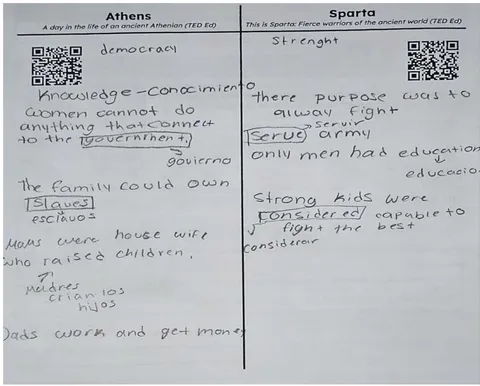
As shown in the T-chart, students used both Spanish and English to verbalize their understanding and preference for the societies based on the reading and viewing of bilingual texts and video about Athens with Sparta. The vocabulary squared was the ones that group worked on them together to comprehend using translanguaging. Next, Sam launched the second whole-class discussion as follows:
h) Engaging in Critical Understanding of Cultural/Societal Issues
Excerpt 2
Teacher: Now, after our reading and viewing, can you relate this part of Greek history to your own experiences? Ahora, cuando de nuestralectura y visualizacion, ¿puede relacionar esta parte de la historia griega con tus propias experiencias?
Elena: My grandmother never went to school, and my mother married very young, so education is huge for my family, and women deserve education.
Juan: Yo prefero vivir en Atenas, excepta si está bien malo que las mujeres eran como esclavas [I prefer to live in Athens, though it is very bad that women were treated like slaves].
Teacher: I understand. Can you say it in English?
Juan: I prefer to live in Athens, except es malo para las mujeres [though it is bad for women].
Teacher: How come? Keep in mind that women were poorly treated in Athens.
Diego: Ciento, pero si uno tiene un buena espeso, él le va a permitir estudiar excepte sea a escondidas [True, but if you have a good husband, he will allow you to study even if you have to do it in secret].
Gabriel: So, you are talking about machismo?
Teacher: Class, have you heard this Spanish word? What does it mean in Spanish?
Diego: Se esperas que los hombres argentos sean el jefe de la familia para proveer yizarar decisiones. [Latino men are expected to be the head of the family to provide and make decisions]
Sean: In Dominican Republican culture, machismo is about how to be a man. Men should be strong physically to take care of women and their families. Women are about taking care of their family like children. We do have educated women.
Maria: I don't like machismo. We are in America now. We don't need men's permission to go to school and get educated.
Teacher: What did the reading say about the women's role in Athens in comparison to Sparta?
Elena: I now understand. In Athens, women are not allowed to attend school. What does knowledge matter if you are not even allowed to learn? I choose Spartan now.
Maria: I prefer to live in Sparta because women were treated better and had more rights.
Sam's opening question in this second round of the discussion focused on students making connections between the characteristics identified in the Athens and Sparta societies in the reading and video to their own lives. Instead of giving lectures, Sam invited students to relate the topic to what they know. That prompted Elena's response to relate it to the fact that her family values education, despite the fact that women in her family did not attend school. Even though Juan did not change his view, he did sympathize with Elena. Hearing Juan's response, all in Spanish again, Sam nudged him to use English to restate his response. Juan phrased his response in half English and half Spanish. In addition, Sam pushed further by asking the class to consider the issue from the women's perspective and promoting critical thinking of those societal issues.
Diego responded by drawing on his cultural knowledge of what a good husband was: to support the wife's education, even if it had to be done in secret. Diego's comment prompted Gabriel to mention the Spanish word maschimo. Although Sam did not plan for this point of discussion, seeing the students' interest, he did not stop the discussion; instead, he made a translanguaging shift to follow the students' train of thought, using this point to deepen student thinking and further the discussion. Sam knew that although there is no direct English translation for it, machismo is a deeply rooted concept in many Latino and Hispanic cultures whose people view it as a cultural value and expectation for males to have a strong sense of masculine pride, dominance, and superiority when compared with females. Sam's open invitation led to a back-and-forth interaction among students, allowing them to filter, question, and think critically about the topic under study. Maria and Elena concluded the discussion with their reasoning to substantiate their views and contextualize the key points articulated in the reading. Below is a sample of a student's writing on the reasoning behind choosing a city-state to live in.
English Version:
I prefer to live in the city-state of Sparta because it's a safe city-state to live. According to the document and video, "The purpose of their existence is to serve their beloved Sparta." This demonstrates that their soldiers are trained to keep Sparta safe and sound at all times. The document and video also state, "So what was Sparta doing differently than every other state was to produce such fierce soldiers." That's why Sparta would be the best city-state to live in.
Spanish Version:
Prefiero vivir en la ciudad-estate de Esparta porque es una ciudad-estate segura. Según el documento y el video, «El propósito de su existencia es servir a su amada Esparta>. Esto demuestra que sus soldados estáncretnados para mantener a Esparta sana y saliva en todo momento. El documento y el video también affirman: «Entones, lo que hacía Esparta diferente aequalquiero estado era producir soldados tan feroces. Por ese Esparta sera la mejor ciudad-estate para vivir»
The fluidity and focus of the class discussions with students by drawing on their own personal, family, and cultural experiences to justify their reasoning through translanguaging and cross-cultural connections as well as their writing to connect with the reading is noteworthy here. Making cross-cultural connections and critiques is an important part of culturally relevant pedagogy confirmed by Ladson-Billings (1995) in that "teachers allowed students to use their community circumstances as official knowledge. Their pedagogy and students' learning became a form of cultural critique" (p. 477).
Sam reflected on his semester-long teaching implication using the culturally relevant and translanguaging pedagogies as follows:
Although the school where I work uses the Transitional Bilingual Education (TBE) model to teach social studies, I now realize that incorporating the use of two languages and students' native cultural and educational backgrounds to teach social studies makes more sense. The cross-cultural literacy study made it possible for me to be in tune with my students' native cultural and educational backgrounds and understand why the bilingual ELLs may feel overwhelmed by the demands of the social studies. Therefore, bilingual teachers must incorporate students' cultural and educational knowledge into social studies topics to make them feel welcomed and valued, and to provide them with opportunities to contribute something meaningful and develop their critical thinking skills.
Additionally, translanguaging has become a significant aspect of my class. Last week, I asked my students to write down the lyrics of their favorite Spanish song and share them with the class. Afterwards, I asked them to translate their song lyrics into English. The activity motivated them, and the class had a lot of fun doing it. Some even compared the terms in Spanish with their English counterparts and got into a debate, discussing the cultural meanings behind certain words. Now I see that I have added tools to teach social studies. They are culturally relevant and translanguaging pedagogies.
III. DISCUSSION/CONCLUSION
The findings of the study on Sam's teaching practices to his 9th-grade Spanish bilingual ELLs confirm the previous research and show the transformative potential for the implementation of both culturally relevant and translanguaging pedagogies to teach social studies to enrich social studies teaching and empower bilingual ELLs' social studies learning (Choi, 2013; Dong, 2017; Jaffee, 2021; Ramirez & Jaffe, 2016). By interweaving both approaches in his instruction, Sam created a rich learning environment where his bilingual ELLs can leverage their cultural and linguistic assets to access social studies content, articulate multiple points of views, develop bilingual and biliteracy skills, and critically think about social and cultural issues.
However, the small sample size and short-term class observations limit the study. Due to the qualitative case study on one teacher's social studies instruction, the study is not representative of a larger context. Future research should include a large sample size and a broader educational context to support a longitudinal study on the implementation of these two teaching pedagogies by social studies teachers. Also, more research needs to study how the school and teacher wrestle with and understand the tension between the social studies curriculum and standards and changing student body, what they bring to the classroom, such as cultural and educational backgrounds, linguistic assets, in order to close the achievement gap between English proficient students and bilingual ELLs.
Still, what is unique and important about this study is Sam's native Spanish-speaking abilities and Latino insider cultural knowledge, his previous education in the Dominican Republic, and his updated cultural knowledge gained through his cross-cultural literacy project. All this has given him extra credibility among his students, an advantage in understanding their needs to make the challenging and seemingly remote topic of Greek civilization relevant and meaningful to them, and in incorporating their cultural and language assets into his teaching.
The teacher education program where Sam attended has also influenced Sam's educational stance, and his teaching endeavors to use culturally relevant and translanguaging pedagogies to teach social studies to bilingual ELLs. To Sam, translanguaging is more than translating isolated new words or phrases from one language to another. Sam has utilized translanguaging to provide students with multiple access points to social studies content, including bilingual language support, bilingual videos, bilingual reading, bilingual group and whole-class discussions, and bilingual writing in both English and Spanish. The multiple ways of engaging students' full language repertoire have enabled even beginners, such as Juan and Diego, to contribute to the discussion and learn by articulating their views and understanding in Spanish first, and then in a mix of Spanish and English.
In addition to multiple entry ways to teach content through translanguaging, Sam's incorporation of both culturally relevant instruction and translanguaging pedagogies simultaneously has created a coconstructive space and opportunity for his students to examine social and cultural issues critically. Although Sam did not plan or initiate the discussion about the Spanish word machismo, he quickly made a translanguaging shift to focus the discussion on it after the student brought up the word. By integrating that word into the discussion, he guided students to draw connections between cultures, promoting more deeper understanding of the topic under study. The results of this study have shown the transformative power of translanguaging and culturally relevant pedagogies used together to channel students' existing cultural knowledge and bilingual language skills and facilitate their learning of social studies (Collins & Cioe-Pena, 2016; Dong, 2021, 2023; Garcia, et al., 2023; Garcia, 2024; Hornberger & Link, 2012; Lang, 2019; Ramirez & Salinas, 2021; Rodriguez, 2024).
This study calls for school administrators, teacher educators, and policy makers to require teachers who are bilingual to obtain bilingual education certification or get trained in developing bilingual language skills and cross-cultural knowledge when teaching bilingual ELLs. For subject matter teachers who have limited exposure to the cultures from which their students come, they must learn about their students' native cultures and previous schooling by conducting a cross-cultural literacy study, like what Sam did. In addition, non-bilingual teachers can utilize bilingual speakers in their schools and/or advanced bilingual students in their classes to help with bilingual readings and provide bilingual language support.
Bilingual ELLs bring an array of native language, cultural, and literacy experiences to the social studies classroom. By viewing what those bilingual ELLs bring to the social studies class as assets and incorporating them in their culturally relevant and translanguaging pedagogy, social studies teachers can create learning opportunities for those students to participate, make the social studies topic relevant and meaningful to them, thus promoting those students' historical thinking and social studies learning. It is only when those students are fully engaged and connected to what they know with the new social studies topic that they become active and critical learners of social studies.
Conflict of Interest
The author declares that the research was conducted in the absence of any commercial or financial relationships that could be construed as a potential conflict of interest.
Biographical Note
Yu Ren Dong is a Professor Emerita of Queens College, City University of New York, U.S.A. She taught secondary school teacher education courses, and her research areas include preparing mainstream subject area teachers for English language learners and preparing secondary bilingual teachers to teach biliteracy in their subject matter classes.