## I. INTRODUCTION
The last decade has seen growing global interest in alternative economic models that prioritize social justice, collective ownership, and community resilience. The solidarity economy an umbrella term that includes cooperatives, mutuals, community finance, producer networks and other forms of collective economic organization offer promising pathways to recover livelihoods, redistribute power, and bolster social protection where conventional markets and state support have failed.[1] For fragile and conflict-affected contexts such as Afghanistan and parts of Pakistan, where formal employment opportunities for women remain severely constrained and state institutions are often weak, solidarity economy models present not only an economic option but a social-political strategy for resisting exclusion and rebuilding community agency.
Afghanistan and Pakistan present both shared and divergent challenges for women's economic participation. In Afghanistan, the erosion of formal rights and restrictions on women's mobility and employment since 2021 have dramatically reduced women's access to public life and to formal labour markets, generating deep setbacks in their livelihoods and well-being. Consultations and large-scale assessments report that a large majority of Afghan women face constrained access to public spaces and income-generating opportunities, compounding household vulnerability and sharply increasing the risk of poverty.[2] In Pakistan, while legal and institutional environments are more permissive, entrenched gender gaps in labour force participation, pay, and access to productive assets persist; Pakistan's national and World Bank analyses document slow-moving progress and clear structural barriers that leave many women dependent on informal and unpaid work. $^{3}$ Together, these realities make it urgent to explore models that enable women to secure meaningful livelihoods outside or alongside constrained formal markets.
Traditional human resources (HR) practice focuses on recruitment, training, performance and compliance within firms and public agencies. When reframed through a "social change" lens, HR becomes a strategic lever for designing inclusive organizational forms, enabling participatory governance, and building collective capacities that advance gender justice. In solidarity economy initiatives, HR functions are less about top-down personnel management and more about facilitating cooperative governance, supporting peer-to-peer learning, mediating power relationships, and institutionalizing gender-equitable practices that endure despite political or economic shock. This reconceptualization is especially relevant in Afghanistan and Pakistan where community-based organizations, women's cooperatives, and mutual-aid networks often substitute for absent or inaccessible formal services.
Existing evidence and illustrative models. Empirical and practitioner literature from the region points to multiple, modestly scaled examples where solidarity-based initiatives have generated tangible benefits for women. Micro-cooperatives, tailoring and handicraft cooperatives, community savings-and-loan circles, and social enterprise hybrids have helped women pool resources, access markets, and create safer workspaces often accompanied by non-financial supports such as literacy, legal rights education, and psychosocial services. International and local development organizations have supported the formation of women-led cooperatives in Afghan provinces and Pakistan's rural districts, reporting improvements in income diversification, social capital, and risk-sharing. Moreover, prominent regional examples of solidarity finance such as Pakistan's Akhuwat model demonstrate how interest-free, community-based finance and social solidarity can scale inclusion while maintaining high repayment and social cohesion. These cases suggest important design principles for HR in solidarity organizations: participatory governance, community accountability, gender-sensitive capacity building, and integrated support services.
Despite practical interest and numerous pilots, there remains sparse consolidated academic and policy analysis that links HR practices directly to outcomes for women within solidarity economy organizations in Afghanistan and Pakistan, and articulates how such HR approaches can be adapted under severe sociopolitical constraints (for example, restrictions on women's mobility or limits on external funding). Most existing assessments document project outputs (e.g., numbers of cooperative members, income changes) but pay limited attention to internal governance practices, leadership pathways for women, conflict resolution mechanisms, and the ways HR-like functions are performed informally by community leaders. This article therefore asks: What HR practices and organizational designs within solidarity economy models most effectively promote women's empowerment in Afghanistan and Pakistan? How do these practices navigate political constraints and cultural norms, and what lessons can be generalized for HR practitioners seeking social change in fragile contexts?
The analysis adopts a multi-dimensional understanding of women's empowerment that spans economic agency (income, access to finance and markets), social agency (mobility, voice, participation in decision-making), and psychological agency (self-efficacy, collective identity). Drawing on social movement, feminist political economy, and organizational studies literatures, the article treats solidarity economy organizations as hybrid social institutions where HR functions are enacted through both formal structures (bylaws, membership rules, leadership elections, training curricula) and informal practices (mentoring, kinship networks, moral economies). The conceptual framework positions HR for social change as comprising four interlocking domains: inclusive governance and leadership development; capacity-building and skills for market and non-market activities; protective social supports and risk-sharing mechanisms; and linkages to markets, policy actors and solidarity finance. This multi-domain lens enables analysis of both internal organizational processes and external enabling factors that determine whether solidarity economy efforts translate into durable empowerment.
This study contributes to scholarship and practice in three ways. First, it foregrounds HR as a purposeful set of practices for social transformation not merely administrative tasks thereby expanding what counts as workforce development in fragile settings. Second, it synthesizes recent empirical evidence (2024-2025) about women's economic conditions and programmatic responses in Afghanistan and Pakistan to identify transferrable HR design principles and pitfalls. Recent assessments by UN agencies and development partners underline both the scale of the problem and the resilience of local actors; this article mines those findings to propose practical, context-sensitive HR approaches that solidarity organizations can adopt.[11] Third, by comparing two neighboring contexts with different political constraints, the paper teases out adaptive strategies that can work when formal policy environments are hostile (as in Afghanistan) and when they are uneven but open (as in Pakistan). Such cross-contextual learning fills a pressing gap for practitioners designing interventions that must be robust under political uncertainty.
The next section reviews the political-economic landscapes in Afghanistan and Pakistan with attention to indicators that shape women's participation in economic life. Part three unpacks the solidarity economy its theoretical roots and practical manifestations in the region and identifies HR-related design elements that recur across successful initiatives. The fourth section analyzes challenges and risks, including elite capture, sustainability and the limits imposed by restrictive norms and policies. The final sections synthesize lessons for practitioners and policymakers, and propose an agenda for HR-led research and pilot interventions to scale solidarity approaches that center women's empowerment.
The urgency of strengthening women's livelihoods in Afghanistan and Pakistan cannot be overstated: setbacks in women's economic rights not only undermine individual well-being but also erode community resilience and national recovery prospects. Solidarity economy models when paired with intentional, gender-aware HR practices offer a promising route to rebuild inclusive local economies that protect women's rights, expand their agency, and sustain collective action in the face of political and economic shocks. This article begins from that premise and proceeds to examine how HR for social change can be designed, implemented, and institutionalized to make that promise real.
## II. METHODOLOGY
This study employs a qualitative, secondary-synthesis approach to examine how human resources (HR) practices within solidarity economy organizations contribute to women's empowerment in Afghanistan and Pakistan. Drawing on peer-reviewed journal articles, development agency reports, and institutional assessments published between 2024 and 2025, the analysis prioritizes high-quality, contextually relevant evidence from both formal and informal organizational settings. Key sources include UN and UNDP country assessments, World Bank reports, NGO case studies, and academic research that document women's economic participation, cooperative models, and solidarity finance initiatives.
To strengthen validity, the study triangulates quantitative indicators such as labor force participation, access to finance, and income generation with qualitative evidence on governance, leadership pathways, and lived experiences of women participants. This combination allows for a nuanced understanding of both measurable outcomes and the mechanisms by which HR practices foster inclusion, agency, and social recognition.
The analytical framework is grounded in social movement theory, feminist political economy, and organizational studies, focusing on four interrelated HR domains: inclusive governance and leadership development, capacity-building and skills for market and non-market activities, protective social supports and risk-sharing mechanisms, and linkages to markets, policy actors, and solidarity finance. This framework enables systematic examination of internal organizational processes, external enabling factors, and the translation of HR practices into durable empowerment outcomes, particularly under the socio-political constraints characterizing fragile and conflict-affected contexts.
### a) Solidarity Economy in Fragile and Conflict-Affected Contexts
In fragile and conflict-affected contexts, the solidarity economy serves not merely as a source of income but as a crucial mechanism of social protection, resilience, and locally grounded welfare. In settings where formal state welfare is weak and markets are unstable, practices such as women's handicraft cooperatives, savings-and-loan circles, and community-based enterprises have taken on additional importance: they provide safe social spaces, foster trust across fractured communities, and help to sustain cultural practices threatened by conflict or displacement.
For example, in Pakistan conflict-affected regions, informal social protection via familial or tribal networks helps to buffer vulnerable households against harm, especially when formal welfare systems are unable to reach them. However, these informal networks are uneven and can at times reproduce patterns of domination or clientelism.[12] Such studies show that in places like Bajor, households rely on informal social protection, but these systems alone are inadequate to address gendered vulnerabilities in the long term.[13] In neighbouring fragile settings, the importance of social capital and networks in resilience becomes even more evident. Research in 2024 on "Social Capital and Community Resilience in the wake of disasters, conflicts and displacements" highlights that strong social ties, local mutual aid, and participatory engagement in community processes significantly improve recovery after shocks.[14] Similarly, systematic reviews of what makes communities resilient emphasise the bridging role of solidarity economy forms, especially when formal governance is weak.[15]
Beyond Pakistan, in contexts like South Sudan, agribusiness cooperatives operating in fragile contexts have improved livelihood outcomes by strengthening value chains and enabling collective action among smallholder farmers. Such initiatives not only provide income but also stimulate local agency in supply, processing, and marketing under conditions of instability.[16] Parallely, the global policy framing of SSE (Social and Solidarity Economy) is increasingly recognizing that cooperatives and SSE entities deliver inclusive, community-driven care solutions and gender-responsive collective governance (e.g. ILO-led initiatives 2025).[17] In Afghanistan, the fiscal constraints caused by shrinking donor support combined with high security spending force trade-offs that affect social welfare. In this environment, solidarity economy practices emerge
as adaptive strategies: local social entrepreneurship, communal savings, and women's groups become sites not only of income generation but of social repair and trust building. $^{18}$
Across South Asia more broadly, solidarity economy initiatives are found to bridge formal and informal economies, especially for women. In urban Pakistan, for instance, women in the informal sector report that cooperative work and collective production provide more than economic benefits: they enhance voice, social respect, and safety when other institutions fail. Though empirical work remains limited, recent studies point to the potential of such models to strengthen women's agency across ethnic and class divides.[19] While solidarity economy initiatives in fragile and conflict-affected contexts are not a panacea, they play critical roles: offering social protection, preserving cultural identity, and knitting together social cohesion in the aftermath or midst of violence. As formal welfare systems remain stretched or in collapse, such locally rooted, collectively run economic practices are central to strategies of resilience.
### b) Women's Empowerment and Alternative Economic Models
Women's empowerment in fragile states is inherently multidimensional, spanning economic, social, political, psychological and relational domains. Empowerment cannot be reduced to income alone; instead, it encompasses enhanced decision-making power, mobility, recognition within households and communities, and shifts in social status and norms.[20] Empirical evidence from South Asia suggests that women's participation in cooperatives, savings or credit groups, community enterprises, or solidarity finance institutions offers both tangible benefits higher income, savings, better access to credit and intangible ones greater self-confidence, collective identity, better negotiation capacity in the household.[21] In Afghanistan, even under restrictive regimes, studies show small-scale collective and enabling practices produce meaningful empowerment. For example, The Transformative Power of ICT in
Empowering Women in Afghanistan (2024) finds that technology access helps women gain financial independence and social recognition despite mobility and legal constraints.[22] Barriers to healthcare utilization among married women in Afghanistan (2024) show how asset ownership and decision autonomy correlate with greater use of health services, illustrating that control (not just income) matters.[23] Policy reports such as UN Women's Resolve of Afghan women in the face of erasure (2024) document persistence of women entrepreneurship, informal organizing, and community resilience even with shrinking formal supports.[24] In Pakistan, solidarity finance models and cooperative-Islamic microfinance have delivered more pronounced outcomes. Microfinance's Business Breakthrough for Women Empowerment (Punjab, 2024) shows that microfinance participation improves women's wealth, reduces exposure to certain domestic vulnerabilities and boosts psychological well-being.[25]
The 2025 case study Impact of Microfinance Services on Women Empowerment in Pakistan shows improvements not only in income but also in domestic decision-making and social independence among women borrowers. Studies on financial inclusion more broadly (Nexus between Women Empowerment and Financial Inclusion, 2024) show that inclusion via credit, savings, and access to financial services correlates with enhanced autonomy and status.[26] And the study of Islamic microfinance in South Punjab (Akhuwat clients) shows that aligning finance with religious-ethical norms can facilitate greater social acceptance, reduce stigma, and enhance women's voice in households and communities.[27] To visually illustrate these differences and commonalities, Figure 1 presents a comparative framework of women's empowerment pathways through alternative economic models in Afghanistan and Pakistan.
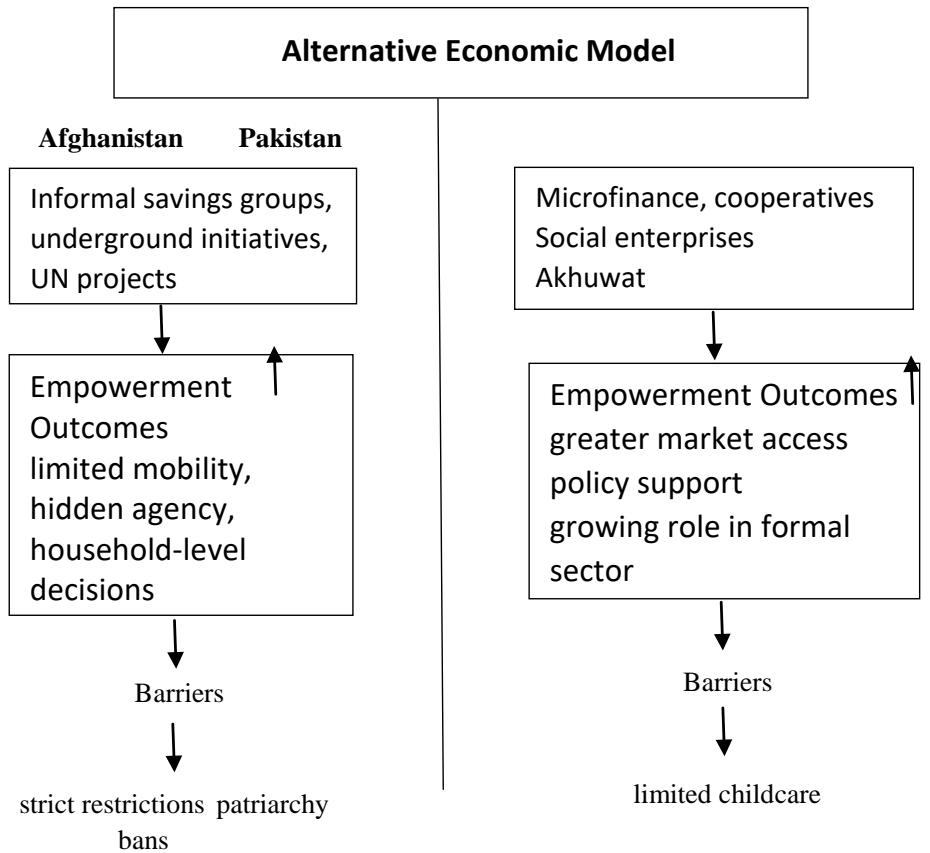 Figure 1: Alternative Economic Models and Women's Empowerment Pathways in Afghanistan and Pakistan.
These findings suggest that solidarity economy models microfinance, savings groups, cooperatives, ICT-enabled inclusion, interest-free or Islamic finance offer important pathways for empowerment where state or private sector employment is inaccessible.
## III. HUMAN RESOURCES AS A LEVER FOR SOCIAL CHANGE
### a) From Administrative Function to Social Justice Mechanism
Traditional human resources (HR) management has been framed as an administrative function: recruitment, training, evaluation, and compliance. Yet within solidarity economy organizations, HR becomes more than bureaucracy; it evolves into a lever for advancing inclusion, equity, and trust. Feminist HRM scholars highlight that in fragile contexts where formal gender equality mechanisms are absent HR functions often act as de facto social justice tools.[28] This redefinition positions HR as a societal rather than purely organizational mechanism.
### b) Participatory Governance as HR Practice
One of the defining HR innovations in solidarity economy organizations is the shift from hierarchical control to participatory governance. Cooperative structures integrate collective decision-making, regular assemblies, and peer-driven evaluations into HR policies. Research from South Asian cooperatives shows that women's involvement in governance significantly increases their visibility and participation in organizational life. These practices ensure that HR functions are not imposed top-down but are negotiated inclusively, thereby democratizing organizational power.[29]
### c) Peer-to-Peer Learning and Rotational Leadership
Solidarity economy HR also prioritizes horizontal learning models and rotational leadership. Instead of formalized, top-down training, members exchange skills in peer-to-peer environments. For women in fragile states, this provides recognition of experiential knowledge whether in agriculture, handicrafts, or informal trade and builds confidence in public participation. Rotational leadership systems allow women to occupy leadership roles regularly, breaking entrenched gender hierarchies while strengthening organizational resilience.[30]
### d) Social Norms and Community Accountability
Unlike conventional HR systems, solidarity organizations often lack enforceable contracts. Instead, HR accountability rests on community trust, kinship ties, and moral obligations. This reliance on reputation and reciprocity functions as a form of informal HR governance. For example, trust-based lending in South Asian cooperatives creates accountability through reputational risks rather than legal enforcement.[31] While these mechanisms are culturally legitimate and resilient, they also risk reinforcing existing gendered expectations if not carefully balanced.
### e) Linking Individual Empowerment with Collective Outcomes
The transformative dimension of HR lies in connecting personal empowerment with collective progress. Women who engage in solidarity HR practices such as recruitment boards, training committees, or conflict resolution councils gain not only technical skills but also negotiation power, mobility, and public recognition.[32] These outcomes transcend income alone, embedding empowerment across social and political domains.
### f) Challenges and Risks of Reproducing Inequality
Despite their promise, solidarity HR practices are not automatically equitable. Gendered power imbalances sometimes persist, with men dominating leadership even under rotational rules.[33] Informal enforcement mechanisms can also place heavier obligations on women, particularly in patriarchal kinship structures.[34] Scholars stress the need for explicit gender-sensitive HR frameworks to prevent reproducing the exclusions of formal labor markets.[35] When designed with intentional equity principles, HR within solidarity economy organizations acts as a transformative lever of social change. By prioritizing participatory governance, peer-to-peer learning, and community accountability, HR is reconceptualized from a control mechanism into an emancipatory practice. In fragile states like Afghanistan and conflict-affected regions of Pakistan, where women
are excluded from formal labor markets, these HR innovations not only sustain livelihoods but also build resilience, cohesion, and social justice.
### g) Regional Evidence: Afghanistan and Pakistan
Evidence from Afghanistan since 2021 highlights a sharp deterioration in women's access to formal employment, with restrictions on mobility and public presence limiting their options.[36] Women increasingly rely on informal, home-based cooperatives in tailoring, poultry farming, and food processing as economic lifelines and safe social environments.[37] In contrast, women in Pakistan face fewer formal restrictions but continue to experience structural barriers, including wage gaps, lack of childcare, and disproportionate unpaid care responsibilities. Community-based solidarity finance initiatives, especially Akhuwat's interest-free loan system, have expanded women's credit access and enabled the growth of women-led enterprises.[38]
Table 1: Comparative Evidence on Women's Empowerment and Solidarity Economy Practices in Afghanistan and Pakistan
<table><tr><td>Dimension</td><td>Afghanistan</td><td>Pakistan</td></tr><tr><td>Formal Employment Opportunities</td><td>Severe contraction since 2021; restrictions on women's mobility, education, and public presence have led to a dramatic decline in workforce participation.39</td><td>Relatively higher but still among the lowest in South Asia; women remain concentrated in informal and low-paid sectors, with persistent wage gaps.40</td></tr><tr><td>Dominant Livelihood Strategies</td><td>Informal, home-based cooperatives in tailoring, poultry farming, handicrafts, and food processing serve as survival strategies and safe social spaces.41</td><td>Women increasingly rely on microenterprises (tailoring shops, salons, handicrafts) supported by solidarity finance institutions such as Akhuwat.42</td></tr><tr><td>HR/Solidarity Practices</td><td>Emphasis on pooled savings, collective purchasing of raw materials, and rotational leadership within small cooperatives; HR functions operate informally through trust and kinship.43</td><td>Akhuwat's interest-free loans embed group training, skills-sharing, and peer accountability; HR-like practices include participatory governance and collective monitoring.44</td></tr><tr><td>Social and Cultural Barriers</td><td>Patriarchal norms reinforced by restrictive policies; limited visibility and recognition for women outside the home.45</td><td>Entrenched gender norms (care burden, mobility restrictions, lack of childcare) limit formal participation despite fewer legal prohibitions.46</td></tr><tr><td>Empowerment Outcomes</td><td>Maintenance of survival income, safe spaces, and minimal agency within restricted contexts; symbolic resistance through collective action.47</td><td>Expanded access to credit, modest increase in income, enhanced intra-household decision-making, and improved social recognition.48</td></tr><tr><td>Overall Trend (2024-2025)</td><td>Solidarity economy as a lifeline for survival and dignity in the absence of state or market support.49</td><td>Solidarity finance and community enterprises as complements to market participation, though structural inequalities persist.50</td></tr></table>
- 36 Impacts of the Taliban's ban on women's work and education - Afghanistan. https://reliefweb.int/report/afghanistan/impacts-talibans-ban-womens-work-and-education
- [37] United States Institute of Peace. (2024, June 25). How to Support Female Entrepreneurs in Afghanistan. https://www.usip.org/publications/2024/06/how-support-female-entrepreneurs afghanistan
- 38 Malki, I., Ghalib, A., & Kausar, R. (2024). The impact of microfinance on entrepreneurship and welfare among women borrowers in rural Pakistan. https://doi.org/10.1016/j.wdp.2024.100616
- 39 World Bank. (2025, April). Afghanistan Policy Note - Employment. https://thedocs.worldbank.org/en/doc/235ca6d24cc8d08112064fc153f9bf13-0310012025/original/Afghanistan-Policy-Note-Employment-April -2025.pdf
- 40 United Nations in Pakistan. (2025, March 11). Media Update: United Nations Pakistan, 11 March 2025. https://pakistan.un.org/en/290699-media-update-united-nations-pakistan-11-march-2025
- 41 Food and Agriculture Organization of the United Nations. (2025, August 18). Sealing jars, opening doors: A women-led food processing centre in Afghanistan. https://www.fao.org/newsroom/story/sealing-jars-opening-doors/en
- Abdelbasset, R., Ali, I., & Khattak, F. H. (2025). The effect of women's development on the relationship between the social impact of green microfinance institutions and poverty in Pakistan. https://doi.org/10.1007/s43621-025-00790-0
- 43 Schwartz, L., & Hassanpoor, Z. (2024). Economic constraints and gendered rules: Understanding women's perspectives of how government-imposed restrictions impact women's mental health and social wellbeing across Afghanistan. Conflict and Health. https://doi.org/10.1186/s13031-024-00624-9
- 44 Naveed, S. T., & Siddique, N. (2024). Empowering communities through Akhuwat Foundation's Microfinance Initiative in Bhakkar, Punjab. https://doi.org/10.51980/crss.v6i1.233
- 45 Ike, F. N., Ogbodum, M. U., Usang, O. U., Okolo-Francis, P. N., & Ahmadi, A. (2025). Closing gender equality gaps in Taliban-ruled Afghanistan. https://doi.org/10.1186/s12982-025-00636-0
- 46 Farooq, M., Nawaz, F., Shahzad, M., & Shahid, Z. (2024). Addressing women's mobility challenges in the public transportation system of Lahore, Pakistan. https://doi.org/10.1016/j.cstp.2024.101185
- 47 United Nations Development Programme. (2024, April 17). Listening to women entrepreneurs in Afghanistan: Their struggle and resilience. https://www.undp.org/afghanistan/publications/listening-women-entrepreneurs-afghanistan-their-struggle-and-resilience
- Malki, I., Ghalib, A., & Kausar, R. (2024). The impact of microfinance on entrepreneurship and welfare among women borrowers in rural Pakistan. https://doi.org/10.1016/j.wdp.2024.100616
- 49 United Nations Development Programme. (2024, April 17). UNDP report reveals the struggle and resilience of women entrepreneurs in Afghanistan. https://www.undp.org/asia-pacific/press-releases/undp-report-reveals-struggle-and-resilience-women-entrepre-neurs-afghanistan
- 50 Bari, F., Malik, K., Meki, M., & Quinn, S. (2024). Asset-Based Microfinance for Microenterprises: Evidence from Pakistan. https://doi.org/10. 1257/aer.20210169
As shown in Table 1, Afghanistan reflects a survival-oriented solidarity economy under restrictive conditions, while in Pakistan such models operate as complementary strategies to enhance women's economic agency within broader but still unequal labor markets.
## IV. CONCLUSION
This article has examined the potential of solidarity economy models as vehicles for promoting women's empowerment in Afghanistan and Pakistan through the lens of human resources for social change. The review of recent literature (2024-2025) underscores that solidarity-based organizations whether in the form of cooperatives, savings-and-loan circles, or community enterprises are not merely economic arrangements but also social and political institutions that can challenge entrenched gender inequalities. In fragile contexts where formal markets are inaccessible and state protections are weak, these models provide women with critical platforms to generate income, share risks, and build collective agency.
The analysis highlights several key findings. First, solidarity economy initiatives in both Afghanistan and Pakistan create alternative pathways for women's participation in economic life, offering safe spaces and collective forms of protection where patriarchal restrictions and political instability would otherwise exclude them. Second, human resource practices within these organizations such as participatory governance, rotational leadership, peer-to-peer learning, and gender-sensitive training function as levers for empowerment. Rather than focusing only on administrative management, HR in solidarity contexts enables women to exercise leadership, develop capacities, and engage in decision-making processes that directly affect their lives. Finally, cross-country comparison reveals important differences: while Afghan initiatives must adapt to a highly restrictive environment where women's mobility and visibility are severely curtailed, Pakistani initiatives benefit from relatively more supportive institutional frameworks but continue to face structural gender inequalities, including wage gaps and limited childcare provisions.
Taken together, these insights suggest that HR for social change is not an abstract ideal but a practical necessity for sustaining solidarity economy initiatives. By embedding inclusive HR practices, these organizations can institutionalize gender equity and ensure that empowerment outcomes persist beyond short-term project cycles. This has significant implications for development practitioners and policymakers: supporting women's empowerment requires moving beyond income-based interventions toward systemic investments in governance, leadership, and collective capacity building.
At the same time, important challenges remain. Many solidarity initiatives operate at a small scale and face sustainability risks due to limited access to finance, market linkages, and legal recognition. Without broader institutional support, women-led cooperatives and enterprises may struggle to scale or survive under restrictive regimes. Future research should therefore focus on comparative, longitudinal analysis of HR practices within solidarity organizations, paying particular attention to how women navigate power dynamics, cultural norms, and policy barriers.
Solidarity economy models hold significant promise for advancing women's empowerment in Afghanistan and Pakistan, but their transformative potential depends on how intentionally they integrate HR practices that promote inclusion, accountability, and resilience. By centering human resources as tools for social change, policymakers, practitioners, and communities can reimagine development not as a top-down intervention but as a participatory, collective process led by women themselves.
Generating HTML Viewer...
References
71 Cites in Article
Unknown Title.
J Ali,A Javed,M Sherazi (2008). Women political empowerment in Pakistan: A study of post-Musharraf era.
S Amaral,S Sheth,P Aggarwal,A Guha,O Safeer,S Manzur (2024). Women’s Economic Empowerment in Pakistan: An Evidence Guided Toolkit for More Inclusive Policies.
(2024). United Nations Entity for Gender Equality and the Empowerment of Women (UN Women) -Asia and the Pacific.
G Bocciarelli,D Panzera (2024). Social networks, normenforcing ties and cooperation.
D Zhu,Y Zhang,L Chen (2024). Gender Dynamics in Cooperative Governance: Insights from Women Led Social Enterprises.
M Abdel-Gawad,M Hammad (2024). A bibliometric review on gender equity in human resource management.
Vorakarn Chalermchaikit,Metin Kozak,Sirichai Preudhikulpradab (2024). Gender inclusion: The practices of organizational development and human resource management.
V Chalermchaikit,M Kozak,S Preudhikulpradab (2024). Gender inclusion: The practices of organizational development and human resource management.
(2024). How to Support Female Entrepreneurs in Afghanistan.
Issam Malki,Asad Ghalib,Rukhsana Kaousar (2024). The impact of microfinance on entrepreneurship and welfare among women borrowers in rural Pakistan.
(2025). Afghanistan Policy Note -Employment.
(2025). Food and Agriculture Organization of the United Nations (FAO)./List of library publication[s] / Food and Agriculture Organisation of the United Nations, Livestock Development for Food Security in Afghanistan..
R Abdelbasset,I Ali,F Khattak (2025). The effect of women's development on the relationship between the social impact of green microfinance institutions and poverty in Pakistan.
L Schwartz,Z Hassanpoor (2024). Economic constraints and gendered rules: Understanding women's perspectives of how governmentimposed restrictions impact women's mental health and social wellbeing across Afghanistan.
S Naveed,N Siddique (2024). Empowering communities through Akhuwat Foundation's Microfinance Initiative in Bhakkar.
Felicity Ike,Molly Ogbodum,Ola Usang,Pauline Okolo-Francis,Attaullah Ahmadi,Yusuff Adebisi,Elvis Okolie (2025). Closing gender equality gaps in Taliban-ruled Afghanistan.
M Farooq,F Nawaz,M Shahzad,Z Shahid (2024). Addressing women's mobility challenges in the public transportation system of Lahore.
(2024). Afghanistan development co-operation report / United Nations Development Programme (UNDP),.
Issam Malki,Asad Ghalib,Rukhsana Kaousar (2024). The impact of microfinance on entrepreneurship and welfare among women borrowers in rural Pakistan.
Faisal Bari,Kashif Malik,Muhammad Meki,Simon Quinn (2024). Asset-Based Microfinance for Microenterprises: Evidence from Pakistan.
Faisal Bari,Kashif Malik,Muhammad Meki,Simon Quinn (2024). Asset-Based Microfinance for Microenterprises: Evidence from Pakistan.
M Fakhri,D Selvaratnam (2025). Cooperatives as tools for poverty alleviation and welfare enhancement: A case study of developing countries.
Schmahl Stefanie (2017). United Nations Entity for Gender Equality and the Empowerment of Women (UN-Women).
S Amaral,S Sheth,P Aggarwal,A Guha,O Safeer,S Manzur (2024). Women’s Economic Empowerment in Pakistan: An Evidence Guided Toolkit for More Inclusive Policies.
(2025). The Afghanistan activities and the civil society forum Afghanistan..
Faisal Shahzad,Shahid Mir,Chaman Ghaffar,João Ferreira (2025). Women, networks and enterprise: the impact of social capital on rural artisans’ entrepreneurship.
S Rahman (2025). Cooperatives and women's empowerment: Mapping research trends and future directions.
J Ali,A Javed,M Sherazi (2008). Women political empowerment in Pakistan: A study of post-Musharraf era.
S Amaral,S Sheth,P Aggarwal,A Guha,O Safeer,S Manzur (2024). Women's economic empowerment in Pakistan: An evidence guided toolkit for more inclusive policies.
(2025). United Nations Entity for Gender Equality and the Empowerment of Women (UN Women) -Asia and the Pacific.
(2024). Communications concerning the status of women.
Setara Javed,Tamanna Quraishi,Nargis Hakimi (2021). The Systematic Oppression of Afghan Women and Girls Since the Taliban’s Takeover in 2021.
Z Mumtaz,M Sumarto (2025). Suffering and harm in insecurity welfare regimes: Conflict and the nexus of formal and informal welfare in Pakistan.
Zahid Mumtaz,Mulyadi Sumarto (2025). Suffering and harm in insecurity welfare regimes: Conflict and the nexus of formal and informal welfare in Pakistan.
Sandra Carrasco,Chiho Ochiai,Liyaning Tang (2024). Social Capital and Community Resilience in the wake of disasters, conflicts and displacements.
Melisa Güngör,Zeynep Elburz (2024). Beyond boundaries: What makes a community resilient? A Systematic Review.
Ali Sheikh Ali,Mohamed Ali Farow,Zeinab Abdirahman Mohamud (2025). Enhancing Agribusiness Performance and Livelihood Outcomes in Fragile Contexts: A Case Study of Somalia’s Agricultural Value Chains.
(2025). The ILO and the social and solidarity economy in Latin America and the Caribbean.
Aqib Aslam,Enrico Berkes,Martin Fukac,Jeta Menkulasi,Axel Schimmelpfennig (2014). Afghanistan: Balancing Social and Security Spending in the Context of a Shrinking Resource Envelope.
F Malhi (2024). Invisible No More: Unmasking the Underestimated Female Labour Market Work.
Naila Mengal,Beenish Malik,Saeeda Kakar (2024). Empowering Women Entrepreneurs in Baluchistan: An Investigation into the Role of Entrepreneurial Education, Access to Capital and Network Dynamicscation, Access to Capital and Network Dynamics.
Sadia Mahwish,Furrukh Bashir,Faisal Abbassi,Shahbaz Khan (2024). Empowering Women through Financial Inclusion and Governance: Evidence from 30 Developing Economies.
S Abbas,S Jabeen (2024). Women's Economic Empowerment through Agriculture: Analyzing Barriers and Solutions.
H Cai,X Li,Y Tang (2020). The impact of digital marketing on business performance.
S Naveed,N Siddique (2024). Empowering Communities through Akhuwat Foundation's Microfinance Initiative in Bhakkar.
Issam Malki,Asad Ghalib,Rukhsana Kaousar (2024). The impact of microfinance on entrepreneurship and welfare among women borrowers in rural Pakistan.
R Abdelbasset,I Ali,F Khattak (2025). The effect of women's development on the relationship between the social impact of green microfinance institutions and poverty in Pakistan.
Zahid Iqbal,Muhammad Afzal,Ali Khan (2024). The Role of Akhwuat Islamic Microfinance in Fulfillment of Basic Needs, Improving Living Standard and Promoting Self-Employment in Pakistan.
M Fotaki (2024). Feminist theories and activist practices in organization studies.
(2024). Social impact measurement for the Social and Solidarity Economy.
L Zouhri,A El Hadri,M Aziza,A El Hajjaji (2024). Empowering women through agricultural cooperatives: a multilevel analysis in Morocco's Marrakech-Safi region.
G Bocciarelli,D Panzera (2024). Social networks, norm-enforcing ties and cooperation.
D Zhu,Y Zhang,L Chen (2024). Gender Dynamics in Cooperative Governance: Insights from Women Led Social Enterprises.
M Abdel-Gawad,M Hammad (2024). A bibliometric review on gender equity in human resource management.
Vorakarn Chalermchaikit,Metin Kozak,Sirichai Preudhikulpradab (2024). Gender inclusion: The practices of organizational development and human resource management.
V Chalermchaikit,M Kozak,S Preudhikulpradab (2024). Gender inclusion: The practices of organizational development and human resource management.
(2012). Afghanistan Campaign to Ban Landmines (ACBL)/Annual report / Afghanistan Campaign to Ban Landmines (ACBL)..
Juliane Zenker (2024). Business training, networks, and seed grants for female entrepreneurs in Afghanistan.
I Malki,A Ghalib,R Kausar (2024). The impact of microfinance on entrepreneurship and welfare among women borrowers in rural Pakistan.
(2025). Afghanistan Policy Note -Employment.
(2025). Food and Agriculture Organization of the United Nations (FAO)./List of library publication[s] / Food and Agriculture Organisation of the United Nations, Livestock Development for Food Security in Afghanistan..
R Abdelbasset,I Ali,F Khattak (2025). The effect of women's development on the relationship between the social impact of green microfinance institutions and poverty in Pakistan.
L Schwartz,Z Hassanpoor (2024). Economic constraints and gendered rules: Understanding women's perspectives of how government-imposed restrictions impact women's mental health and social wellbeing across Afghanistan.
S Naveed,N Siddique (2024). Empowering communities through Akhuwat Foundation's Microfinance Initiative in Bhakkar.
Felicity Ike,Molly Ogbodum,Ola Usang,Pauline Okolo-Francis,Attaullah Ahmadi,Yusuff Adebisi,Elvis Okolie (2025). Closing gender equality gaps in Taliban-ruled Afghanistan.
M Farooq,F Nawaz,M Shahzad,Z Shahid (2024). Addressing women's mobility challenges in the public transportation system of Lahore.
(2024). Afghanistan development co-operation report / United Nations Development Programme (UNDP),.
Issam Malki,Asad Ghalib,Rukhsana Kaousar (2024). The impact of microfinance on entrepreneurship and welfare among women borrowers in rural Pakistan.
(2024). Afghanistan development co-operation report / United Nations Development Programme (UNDP),.
Faisal Bari,Kashif Malik,Muhammad Meki,Simon Quinn (2024). Asset-Based Microfinance for Microenterprises: Evidence from Pakistan.
No ethics committee approval was required for this article type.
Data Availability
Not applicable for this article.
How to Cite This Article
Jamila Asef. 2026. \u201cHuman Recourses for Social Change: Promoting Women’s Empowerment Through Solidarity Economy Models in Afghanistan and Pakistan\u201d. Global Journal of Human-Social Science - E: Economics GJHSS-E Volume 25 (GJHSS Volume 25 Issue E3).
Explore published articles in an immersive Augmented Reality environment. Our platform converts research papers into interactive 3D books, allowing readers to view and interact with content using AR and VR compatible devices.
Your published article is automatically converted into a realistic 3D book. Flip through pages and read research papers in a more engaging and interactive format.
Our website is actively being updated, and changes may occur frequently. Please clear your browser cache if needed. For feedback or error reporting, please email [email protected]
Thank you for connecting with us. We will respond to you shortly.