This paper proposes the Principles of Matter or Laws of Unity as a unified framework for understanding gravity, inertia, and the formation of physical structures across all scales. In this model, matter organises into hierarchical unities through two intrinsic forms of energy: sharing-energy (Es) and excess-energy (Ee). Together they cause the generalised inertia or unity force (Fu = Es + Ee), in which Es causes an active and constant pull toward a unity centre as inertia-at-rest or gravity or weight, and Ee produces inertia-in-motion or heat. This approach challenges the foundations of relativity by asserting that matter moves only relative to its unity centre. The paper applies the Principles of Matter to atomic structure, electricity, photonic behaviour, nuclear fusion, planetary motion, and galactic organisation, arguing that unity force or inertia is the single fundamental force underlying all natural forces. The model further explains galaxies as ultimate unities centred on black holes in which potential-energy fully converts to sharing-energy, producing infinite pull. A measurement method-the Breaking-point Excess-energy Method-is proposed to quantify inertia-at-rest (gravity) based on the minimum energy required to break a unity, with an optional empirical mass-distance equation for estimation. Overall, the Principles of Matter provide a cohesive reinterpretation of natural forces, energy transfer, and cosmic structure formation.
## I. INTRODUCTION
In 1666, Isaac Newton famously observed an apple falling from a tree, that inspired him to formulate the law of universal gravitation, which states that every particle attracts every other particle in the universe with a force $F$ equal to $G$ (the gravitational constant) multiplied by the product of the masses of the two particles $(M_1$ and $M_2)$ and divided by the square of the distance $R$:
$$
F = G M_1 M_2 / R^2
$$
where the gravitational force is also called gravity. But Newton acknowledged that how the force is propagated was unknown.[1][2]
Then, in 1687, Isaac Newton published his three laws of motion. In the first law, Newton described inertia as the natural tendency of objects in motion to remain in motion and objects at rest to remain at rest, unless a force causes the velocity to change.[3]
So, Newton had realised that inertia has two states: inertia at rest and inertia in motion. But the causes of them were also unknown.
More than two hundred years later, in 1915, Albert Einstein published the theory of general relativity, which explained gravity as a geometric spacetime curvature caused by mass and energy.[1][2]
1. Since it can only move forward and not backward, time is not a dimension, as a dimension requires moving forward and backward (bi-directional movements).
2. Spacetime [4] is proposed as a mathematical model that combines the three dimensions of space and the one dimension of time into a single four-dimensional continuum. Since time is not a dimension, spacetime can only be a mathematical construct, not a physical reality.
3. The following Principles of Matter will nullify the base of the observational reference frame [5] and relativity.
So, what causes the attraction between the apple and Earth? What causes gravity? And what causes inertia? The following Principles of Matter explains everything.
## II. THE PRINCIPLES OF MATTER
Here are the Principles of Matter or Laws of Unity, updated from my original version:[6][7][8][9][10]
1. Matter is any substance that has mass $(m)$ and energy. Mass and energy are properties of matter, not physical entities. Matter's energy is scalar, not vector.
2. Matter shows its energy as forces. A force is a measurable vector that transfers energy.
3. Matter organises itself into hierarchical units, called unities, through its energies: matter retains its potential-energy (Ep) and sharing-energy (Es) within a unity as a unity member, until it becomes a free particle with sufficient excess-energy (Ee ≥ Es) from external excess-energy (see Figure 1: Matter).
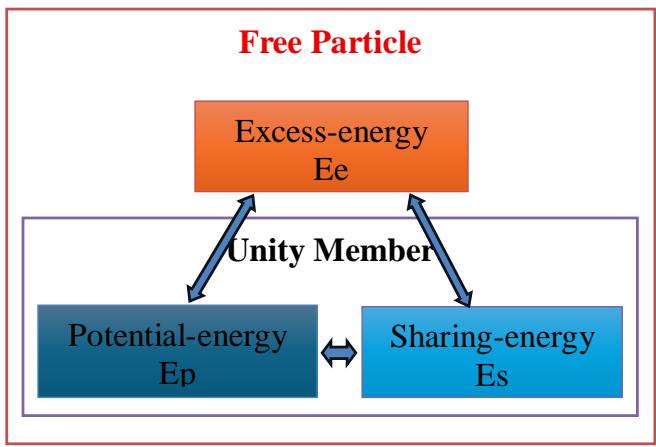
Figure 1: Matter
### 4. Matter forms and maintains unity with its unity force or inertia:
$$
F u = E s + E e,
$$
where Es causes an active and constant pull, as inertia-at-rest or gravity $(F)$ or weight $(W)$, towards the unity centre $(\mathrm{Es} = \mathrm{F} = \mathrm{W})$; and Ee produces inertia-in-motion or heat, away from the external excess-energy.
- 4.1. Matter oscillates away with the excess-energy $(\mathrm{Ee} \geq \mathrm{Es})$ as a free particle, transferring the Ee as inertia-in-motion or heat $(\mathrm{Ee} \rightarrow \mathrm{Ee} \rightarrow 0)$ such as light waves if the particle is a photon or a neutrino, or electron waves with magnetic effects if the particle is an electron—until returning or joining a unity $(\mathrm{Ee} = 0)$.
- 4.2. In the unity, $\mathrm{Ee} = 0$, leaving only Es in its unity force, matter orbits or gravitates to the unity centre, like an electron orbiting an atomic nucleus or a planet orbiting a star, showing as inertia-at-rest or gravity (F) or weight (W): $\mathrm{Fu} = \mathrm{Es} = \mathrm{F} = \mathrm{W}$.
5. Matter does not show its potential-energy but converts its potential-energy between its sharing-energy and excess-energy (As shown in Figure 1: Matter). For example, when going up in an airplane, our weight is decreasing while our potential-energy is increasing $(\mathrm{Es} \rightarrow \mathrm{Ep})$. At the same time, the plane's external excess-energy also increases our potential-energy $(\mathrm{Ee} \rightarrow \mathrm{Ep})$. When going even higher in a spacecraft, we become "weightless" (weighing less). When landing on the Moon or Earth, our potential-energy is decreasing while our weight is increasing $(\mathrm{Ep} \rightarrow \mathrm{Es})$.
6. Breaking free a member with Es from a unity requires sufficient external excess-energy (Ee ≥ Es), causing inertia-in-motions and heat transfers (Ee → Ee), leading to new unities. The more energy is shared (Ep → Es, such as in a
nuclear fusion), the tighter the formed unity (such as the produced nucleus unity), the more external excess-energy is required to break the unity, and vice versa (such as in beta decay).
#### Therefore:
1. Gravity or weight or inertia-at-rest is redefined as matter's active and constant pull towards its unity centre due to its sharing-energy.
2. Inertia is redefined and generalised as the unity force resulting from both sharing-energy (as inertia-at-rest or gravity or weight) and excess-energy (as inertia-in-motion or heat).
3. Matter moves relative to its unity centre, as its reference point, nullifying the base of the observational reference frame [5] and relativity.
4. The Principles of Matter or Laws of Unity is governed by matter's unity force or inertia:
$$
Fu = Es + Ee, where,
$$
Es $= \mathsf{F} = \mathsf{W} = \mathsf{mg}$ where m is the mass of the matter, g is the acceleration by the Es or F or W,
Ee = ma, where m is the mass of the matter, a is the acceleration by the Ee.
Hence,
$\mathrm{Fu} = \mathrm{mg} + \mathrm{ma} = \mathrm{m(g + a)}$ cycling through the following states:
$a = 0$ (the matter is in its unity),
$\mathsf{a}\geq \mathsf{g}$ (the matter is out of the unity), a $\rightarrow 0$ (the matter is returning or joining a unity).
## III. INERTIA-AT-REST OR GRAVITY OR WEIGHT FROM SHARING-ENERGY
In a unity, through its sharing-energy (Es), each member pulls the unity centre actively and constantly, as inertia-at-rest or gravity (F) or weight (W): Es = F = W, mediated or transferred by any member in between, so that each member is also a medium.
The speed of transfer would be close to light and electricity because the transfer media are mainly photons, neutrinos and electrons.
As proposed in my paper The Photon and the Principles of Matter[6]: Created in nuclear fusion centres and moved out, those nuclei share energy with electron unities in their orbits, forming atom unities: $n(2pve) + n(e\gamma)$, where atomic number $n \geq 2$, with the same number of protons (p) and electrons (e), but only half the number of photons ( $\gamma$ ) and neutrinos ( $\nu$ ). The other half of photons and neutrinos are free particles as visible and invisible light in the universe. So, the universe is filled with free photons and neutrinos, although most neutrinos do not carry enough excess-energy to be
currently detectable. Therefore, there is no vacuum in the universe.
For example:
a) The Pull between the Moon and Earth
Earth and everything around it, including the Moon, is a unity. The unity centre is the centre of Earth.
The Moon transfers its sharing-energy as an active and constant pull (as inertia-at-rest or gravity or weight) through the photons and neutrinos (visible and invisible light), the electrons (electronic fields), and the air, to the surface of Earth then to the centre of Earth. When the pull transfers to the surface of Earth, the surface water gets pulled, first by the Moon actively, then by Earth reactively, causing tidal waves. Although everything in the path gets pulled while transferring the sharing-energy (including the air particles, causing wind), the tidal waves are more spectacular and easier to observe.
The calculation of the pull (inertia-at-rest or gravity or weight) should be simple.
In the equilibrium of the Earth unity, the pull of the inertia-at-rest or gravity (F) or weight (W) of the Moon equals the push of Earth's excess-energy transfer to the Moon $(E e_{m})$:
$$
F = W = E e_{m}
$$
### b) A Star System
In a star system, each planet orbits its star, pulling as inertia-at-rest or gravity (F) or weight (W) towards its star. The orbit is the path where $\mathrm{Ee} = 0$, leaving Es in its unity force or inertia as its orbiting equilibrium:
$$
Fu = Es = F = W.
$$
To stress again, the planets orbiting their star are only inertia-at-rest, not inertia-in-motion. That is, our Earth orbits the sun in a state of inertia-at-rest. Only an extraterrestrial rock with sufficient excess-energy to knock our Earth off its orbit can cause our Earth to be inertia-in-motion. Then, that would be the end of the Earth as we know it, if we still exist at all.
So, it is simple to calculate the inertia-at-rest or gravity (F) or weight (W) of each unity member towards its unity centre. For example:
In the equilibrium of the sun unity, the active and constant pull of gravity (F) or weight (W) of Earth unity (including Earth and its Moon) towards the sun equals the constant push from the sun's excess-energy (including sunlight) to the Earth unity—the Third Rock $(\mathrm{Ee}_3)$:
$$
F = W = Ee_3
$$
### c) A Spacecraft
While landed on Earth, the spacecraft pulls the centre of Earth as its inertia-at-rest or gravity or weight (besides being a medium of the atmospheric pressure).
The inertia-at-rest or gravity (F) or weight (W) of the spacecraft in Earth unity is even simpler to calculate, as it can be measured directly:
$$
F = W
$$
When launched successfully into an orbit of Earth like a new moon, the spacecraft is still in Earth unity with a weight loss (instead of weightless). The lost weight is the lost sharing-energy with Earth that has been converted to its potential-energy $(\mathrm{Es} \rightarrow \mathrm{Ep})$. That is, the spacecraft now has more potential-energy and less sharing-energy with Earth, hence less weight or gravity or inertia-at-rest.
When landing on the Moon (the new unity centre), the spacecraft is losing potential-energy and gaining weight (gravity or inertia-at-rest) with the Moon $(\mathrm{Ep} \rightarrow \mathrm{Es})$. When landed on the Moon, the spacecraft becomes part of the Moon, a member of the Moon unity, weighing more, but still much lighter than on Earth because of less energy sharing with the Moon on the Moon surface (and much less atmospheric pressure).
Again, the gravity $(\mathsf{F}_{\mathfrak{m}})$ or weight $(W_{m})$ or inertia-at-rest of the spacecraft in the Moon unity can be directly measured:
$$
F _ {m} = W _ {m}
$$
After flying out of the Moon unity, in outer space in the Solar System, the spacecraft still has a weight (gravity or inertia-at-rest), to the sun, the new unity centre, except when the spacecraft gets too close to another planet (another unity centre).
## IV. INERTIA-IN-MOTION OR HEAT FROM EXCESS-ENERGY
When provided with sufficient excess-energy $(\mathrm{Ee} \geq \mathrm{Es})$, a member with Es becomes a free particle $(\mathrm{Es} + \mathrm{Ee})$ with inertia-in-motion or heat and transfers the heat to other particles $(\mathrm{Ee} \rightarrow \mathrm{Ee})$, causing subsequent heat transfers (radiation). After transferring all the excess-energy $(\mathrm{Ee} = 0)$, the particle returns or joins a unity, becoming a member with Es, showing inertia-at-rest or gravity or weight. This process shows partly how unity is maintained—by transferring out the excess-energy.
### a) Electronic Heat
Electronic heat (electricity) is the heat of free electrons. To be precise, electronic heat is free electrons transferring their excess-energy as inertia-in-motion. Therefore, "electric charge" is a misconception.
In an atom unity, electrons share energy (Es) with their nucleus by orbiting and pulling, as inertia-at-rest or gravity or weight.
The outermost electrons of different elements have different easiness to break free of their nuclei, determining the conductivity of the elements. Metal elements are generally good conductors, as the outermost electrons of metal elements are fewer (1 to 3) and further from the nuclei, hence sharing less energy with the nuclei, and easier to break free.
Sufficient external excess-energy (Ee $\geq$ Es), like electronic forces, can break free those outermost electrons from the atom unities of a conductor, align and energise them, producing an electronic field (currently called "electric field"—another misconception, as "electric charge" is a misconception), forming stronger electron waves with magnetic effects, and simultaneously cause them to flow as inertia-in-motion or heat, along the potential difference as electronic currents (electricity)[6][8].
Magnetic effects result from stronger electron waves aligning weaker ones through excess-energy transfer (Ee $\rightarrow$ Ee): the electrons with stronger excess-energy bump the electrons with weaker excess-energy into the same direction and energy level. In the electronic field, the aligned electrons all repel in the same direction to one end, causing the opposite end of the electronic field attracting, forming a continuous electronic flow, out from the repelling end and into the attracting end.
Therefore, there are no such things as magnetism, magnetic fields, or magnetic waves.
Electricity is the synchronised excess-energy of the electronic currents, in which each electron unity $(\mathrm{e}\gamma)^+$ transfers its excess-energy to an electronic device or to its bonded photon, causing light $\gamma^{+}$:
$$
(e \gamma) ^ {+} \rightarrow e + \gamma^ {+}
$$
Free electrons $(e\gamma)^{+}$ breaking free their energy-sharing photons with sufficient excess-energy, causing photon waves as light, is called electronism.
Therefore, "electromagnetism" is another misconception, besides there being no "magnetism".
The least or breaking-point excess-energy $(\mathrm{Ee}_1)$ an electron requires to break free of its nucleus equals its sharing-energy (Es) or gravity (F) or weight (W) to its nucleus—the Breaking-point Excess-energy Method:
$$
\mathrm{Ee}_1 = \mathrm{Es} = \mathrm{F} = \mathrm{W}
$$
### b) Photonic Heat
Photonic heat (light) is the heat of free photons. To be precise, photonic heat is free photons transferring their excess-energy as inertia-in-motion.
A photon $(\gamma)$ tends to share energy (Es) with an electron (e) as an electron unity (eγ), where the photon orbits (pulls) its electron as inertia-at-rest or gravity or weight.
A photon with sufficient excess-energy (Ee $\geq$ Es) oscillates away as a free photon, leaving the external excess-energy as waves. The stronger of the excess-energy, the higher frequency (f) of the waves, with the causal-effect equation:
Ee = hf, where $h$ is the Planck constant [11].
The least excess-energy $(\mathrm{Ee}_1)$ a photon requires to break free of its electron equals its sharing-energy (Es) or gravity (F) or weight (W) to its electron:
$$
\mathrm{Ee}_1 = \mathrm{Es} = \mathrm{F} = \mathrm{W}
$$
Even visible light (e.g. part of sunlight) is invisible until the free photons bump into other matter, transferring their excess-energy $(\mathrm{Ee} \rightarrow \mathrm{Ee})$, causing more inertia-in-motion if the excess-energy is sufficient $(\mathrm{Ee} \geq \mathrm{Es})$, while the photons themselves get deflected with lesser excess-energy $(\mathrm{Ee} \rightarrow 0)$ or absorbed $(\mathrm{Ee} = 0)$ by electrons that lost their photons previously.
Whatever we see is the last excess-energy transfer of the free photons before they are deflected and strike our retina. Our retina can only detect the energy transfers in a certain energy range, outside which our eyes cannot even detect the energy transfers, for example, of gamma rays, X-rays, or radio waves.
### c) Atomic and Molecular Heat
Atomic and molecular heat is free gas or liquid particles transferring their excess-energy as inertia-in-motion.
#### For example:
- The free air particles of the wind transfer their excess-energy as inertia-in-motion to our body, changing our body temperature.
- The synchronised free and hot air particles from a combustion chamber transfer their excess-energy as inertia-in-motion to the engine.
- The free water molecules in a flowing river transfer their excess-energy as inertia-in-motion to turbines connected to generators, producing electricity.
Again, the inertia-at-rest or gravity (F) or weight (W) of an atom or a molecule in Earth unity can be measured by the Breaking-point Excess-energy Method:
$$
Ee_{1} = Es = F = W.
$$
### d) Returning or Joining Unities
After transferring all their excess-energy, those free particles return or join their own unities:
- An electron returns or joins an atom unity that lost an electron previously, pulling again as inertia-at-rest or gravity or weight.
- A photon returns or joins an electron that lost its photon previously: $\gamma + e \rightarrow e\gamma$.
- A neutrino returns or joins a proton that lost its neutrino previously: $\nu + p \rightarrow pv$.
- A gas or liquid particle falls closer to the centre of Earth, or another planet it belongs to.
## V. UNITY FORCE AS INERTIA
Unity force or inertia: $\mathrm{Fu} = \mathrm{Es} + \mathrm{Ee}$, is matter's intrinsic tendency to form and maintain unity, where Es causes an active and constant pull, as inertia-at-rest or gravity (F) or weight (W) towards the unity centre; and Ee produces inertia-in-motion or heat away from the external excess-energy.
That is, unity force or inertia is a two-way action that includes inertia-at-rest or gravity or weight, and inertia-in-motion or heat.
For example:
### a) Human Activity
We and everything around us share energy (Es) with Earth as weight or gravity or inertia-at-rest. Our every activity, like walking, running, jumping, and working, adds sufficient excess-energy (Ee ≥ Es) to the weight (Es) to move it, causing inertia-in-motions and heat transfers (Ee → Ee), leading to new unities.
A recent measurement of my weight (W) or gravity (F) to Earth showed:
$$
W = F = 58\mathrm{kg}.
$$
So, I must have lost some weight recently (was $60\mathrm{kg}$ previously checked), which makes my activities a little bit easier, unless what I lost was mainly muscle, which would reduce my ability to produce excess-energy.
### b) A Dust
Breaking the inertia-at-rest or gravity or weight of a dust on my table requires sufficient external excess-energy (Ee ≥ Es), like a blow of air particles that transfer the excess-energy to the dust (Ee → Ee), causing it to fly away with inertia-in-motion. Then, the dust transfers its excess-energy to other air particles (Ee → Ee), causing more inertia-in-motion as heat, while sharing more energy with Earth, hence more weight (gravity), but lost that much potential-energy: Ep → Es = F = W, and falls to the ground (closer to the centre of Earth) to form a new unity (Ee = 0).
Again, the inertia-at-rest or gravity (F) or weight (W) of the dust can be measured directly:
$$
F = W
$$
### c) Nuclear Fusion
In a nuclear fusion centre, which is also a unity centre, the base unities $(\mathsf{pv}$ and $\mathsf{e}\gamma)$ have been so dense and hot that they have become more energy sharing $(\mathsf{Ep}\rightarrow \mathsf{Es})$ and have started nuclear fusion, forming helium-4 nucleus unities: $2(^{2}\mathrm{pve})$, with tighter gravity and inertia-at-rest, while transferring high-energy photons, neutrinos and electrons as excess-energy and inertia-in-motion $(\mathsf{Es}\rightarrow \mathsf{Ee})$. Then, these energised particles bump into outside particles, transferring their excess-energy $(\mathsf{Ee}\rightarrow \mathsf{Ee})$, causing subsequent inertia-in-motion as heat (radiation)[6][7][8][9][10]. So, the whole nuclear fusion process has this energy flow: $\mathsf{Ep}\rightarrow \mathsf{Es}\rightarrow \mathsf{Ee}\rightarrow$ Ee.
The Breaking-point Excess-energy Method can be used to measure the pulling force (inertia-at-rest or gravity or weight) of a member in a formed nucleus unity:
$$
Ee_{1} = Es = F = W,
$$
as discussed in the next section.
## VI. MEASURING THE PULLING FORCE (INERTIA-AT-REST OR GRAVITY OR WEIGHT)
As stated in the Principles of Matter, breaking free a member with Es from a unity requires sufficient external excess-energy: $\mathrm{Ee} \geq \mathrm{Es}$, so that the Breaking-point Excess-energy Method is the fundamental way to measure the pulling force (inertia-at-rest or gravity or weight) of the member:
$$
Ee_1 = Es = F = W.
$$
For example:
1. Direct measurement: the scale or balance is the tool to break the pull towards the Earth centre from the matter being measured, with the breaking-point excess-energy when balanced and steady.
2. The excess-energy pushing from the sun to the Earth unity is the least excess-energy to break the pull from the Earth unity. The same goes with Earth to the Moon. Or a nucleus to an electron. Or an electron to a photon.
3. In a beta decay, external excess-energy breaks free a member from the unstable nucleus unity naturally, while in a nuclear fission, induced external excess-energy breaks free a member from the unstable nucleus unity artificially.
4. To break free a member from a stable nucleus unity, artificial collision methods, like a particle collider may have to be used (although the Large Hadron Collider is an overkill and irrelevant).
If, for some reason or some situation, the Breaking-point Excess-energy Method is unavailable, how about an empirical equation, using masses and distance to estimate gravity like Newton did?
Well, yes, except the gravity has been redefined, so that the equation would be different:
where $F$ is the pulling force (inertia-at-rest or gravity or weight), $P$ is the pulling constant, $M_1$ is the mass of the member being measured, $M_2$ is the mass of the whole unity excluding $M_1$, $R$ is the distance between the two centres.
Since the result should be a weight measure, like kg, the masses should be in kg, the R should be in meter (m), so that the P should be in m/kg.
As an empirical equation, it needs lots of empirical data to estimate the pulling constant $P$, and it needs estimations of the two masses and the distance between them.
## VII. UNITY FORCE OR INERTIA AS THE FUNDAMENTAL FORCE UNDERLYING ALL NATURAL FORCES
1. As stated in the Nuclear Fusion section before, nuclear fusion is the unity force or inertia in action, creating nucleus unities so that every two protons (p) share energy with one neutrino (v) and one electron (e) as $n(^{2}\mathrm{pve})$, where atomic number $n \geq 2$. In a nucleus unity, electrons and neutrinos are energy sharing agents, orbiting protons to share and distribute energy. Thus, unity force or inertia replaces strong force and quantum chromodynamics.[6][7][8][9][10]
2. Beta decay is also unity force or inertia in action: sufficient external excess-energy (Ee ≥ Es) breaks free a neutrino and an electron (electron emission) or just a neutrino (electron capture) from an unstable nucleus unity, leading to inertia-in-motion and radiation (Ee → Ee), and a more energy-sharing and hence more stable nucleus unity. Thus, unity force or inertia also replaces weak force.[6][7][8][10]
3. Electromagnetism is free electrons $(\mathsf{e}\gamma)^+$ showing magnetic effects while transferring their excess-energy as photon waves: $(\mathsf{e}\gamma)^{+} \rightarrow \mathsf{e} + \gamma^{+}$. Therefore, "electromagnetism" is a misconception, and should be called electronism, as stated in the Electronic Heat section before.
4. Gravity or weight results from matter's sharing-energy Es, which is part of the unity force or inertia: $\mathsf{F}\mathsf{u} = \mathsf{E}\mathsf{s} + \mathsf{E}\mathsf{e}$
Therefore, unity force or inertia is the single fundamental force underlying all natural forces.
## VIII. UNITY FORCE OR INERTIA IN THE FORMATION OF THE UNIVERSE
Most nuclear fusion centres with excess-energy-releasing (inertia-in-motion) form stars and planets. The rest, extra-large fusion centres with inner cores unable to release excess-energy as a repelling force, form black holes.[6][8][9][10] In a black hole, matter converts its potential-energy completely into sharing-energy $\mathrm{Ep} \rightarrow \mathrm{Es}$, so that $\mathrm{Ep} = 0$, and sharing-energy becomes infinity: $\mathrm{Es} = \mathrm{Fu} = \mathrm{F} \rightarrow \infty$, producing infinite pull towards the centre, making the black hole into a physical singularity.
Every galaxy is a unity, the ultimate unity with its ultimate unity force or inertia, with at least one black hole as the unity centre. If two or more black holes exist in one galaxy, they are close enough to attract each other and will eventually merge into one.[6][7]
Unity force or inertia (its sharing-energy Es showing as gravity) forms the hierarchical structure of each galaxy, making the black hole as its unity centre. Under a galaxy, each star is the unity centre of a star system. Under the star system, each planet is the unity centre of its moons. Then, each atomic nucleus is the unity centre of an atom. Inside the nucleus, every proton is a unity centre. Outside the nucleus, each electron is the unity centre of an electron unity $(e\gamma)$.[6][7][9] In almost all the nested unity levels, the sublevel unities or members pull their unity centres actively, as mentioned before. Except at the galaxy level, each unity centre (the black hole) is the active pulling force, keeping the star systems from moving away, and keeping the galaxy unity in dynamic equilibrium. The difference may come from this reason: black holes are the only unity centres that only pull energy in, without pushing energy out.
The large-scale structures (the groups of galaxies) originate from the expansion of the universe from the Big Bang: the distribution of matter was random and uneven, although the universe on larger scales is relatively uniform.[9]
## IX. CONCLUSION
1. Matter organises itself into hierarchical units, called unities, through its energies: matter retains its potential-energy (Ep) and sharing-energy (Es) within a unity as a unity member, until it becomes a free particle with sufficient excess-energy (Ee ≥ Es) from external excess-energy.
2. Matter forms and maintains unity with its unity force or inertia: $\mathrm{Fu} = \mathrm{Es} + \mathrm{Ee}$, where Es causes an active and constant pull, as inertia-at-rest or gravity (F) or weight (W) towards the unity centre, and Ee produces inertia-in-motion or heat away from the external excess-energy.
3. That is, gravity or weight or inertia-at-rest is redefined as matter's active and constant pull towards its unity centre due to its sharing-energy.
4. Inertia is redefined and generalised as the unity force resulting from both sharing-energy (as inertia-at-rest or gravity or weight) and excess-energy (as inertia-in-motion or heat).
5. Matter moves relative to its unity centre, as its reference point, nullifying the base of the observational reference frame [5] and relativity.
6. In a unity, through its sharing-energy (Es), each member pulls the unity centre actively and constantly, as inertia-at-rest or gravity (F) or weight (W), mediated or transferred by any member in between, so that each member is also a medium.
7. When provided with sufficient excess-energy (Ee ≥ Es), a member with Es becomes a free particle (Es + Ee) with inertia-in-motion or heat and transfers the heat to other particles (Ee → Ee), causing subsequent heat transfers (radiation). After transferring all the excess-energy (Ee = 0), the particle returns or joins a unity, becoming a member with Es, showing inertia-at-rest or gravity or weight. This process shows partly how unity is maintained—by transferring out the excess-energy.
8. For example, electronic heat is free electrons transferring their excess-energy as inertia-in-motion. Therefore, "electric charge" is a misconception.
9. Magnetic effects result from stronger electron waves aligning weaker ones through excess-energy transfer (Ee $\rightarrow$ Ee): the electrons with stronger excess-energy bump the electrons with weaker excess-energy into the same direction and energy level. In the electronic field (currently called "electric field"—another misconception, as "electric charge" is a misconception), the aligned electrons all repel in the same direction to one end, causing the opposite end of the electronic field attracting, forming a continuous electronic flow, out from the repelling end and into the attracting end.
10. There are no such things as magnetism, magnetic fields, or magnetic waves.
11. Electromagnetism is free electrons $(e\gamma)^{+}$ showing magnetic effects while transferring their excess-energy as photon waves: $(e\gamma)^{+} \rightarrow e + \gamma^{+}$. Therefore, "electromagnetism" is another misconception, besides there being no "magnetism".
12. Even visible light (e.g. part of sunlight) is invisible until the free photons bump into other matter, transferring their excess-energy $(\mathrm{Ee} \rightarrow \mathrm{Ee})$, causing more inertia-in-motion if the excess-energy is sufficient $(\mathrm{Ee} \geq \mathrm{Es})$, while the photons themselves get deflected with lesser excess-energy $(\mathrm{Ee} \rightarrow 0)$ or absorbed (Ee = 0) by electrons that lost their photons previously.
13. Most nuclear fusion centres with excess-energy-releasing (inertia-in-motion) form stars and planets. The rest, extra-large fusion centres with inner cores unable to transfer out excess-energy as a repelling force, form black holes.
14. Every galaxy is a unity, the ultimate unity with its ultimate unity force or inertia, with at least one black hole as the unity centre. If two or more black holes exist in one galaxy, they are close enough to attract each other and will eventually merge into one.
15. Unity force or inertia forms the hierarchical structure of each galaxy, making the black hole as its unity centre. Under a galaxy, each star is the unity centre of a star system. Under the star system, each planet is the unity centre of its moons. Then, each atomic nucleus is the unity centre of an atom. Inside the nucleus, every proton is a unity centre. Outside the nucleus, each electron is the unity centre of an electron unity $(e\gamma)$.
16. In almost all the nested unity levels, the sublevel unities or members pull their unity centres actively. Except at the galaxy level, each unity centre (the black hole) is the active pulling force. The difference may come from this reason: black holes are the only unity centres that only pull energy in, without pushing energy out.
17. Breaking free a member with Es from a unity requires sufficient external excess-energy: $\mathrm{Ee} \geq \mathrm{Es}$, so that the Breaking-point Excess-energy Method is the fundamental way to measure the pulling force (inertia-at-rest or gravity or weight) of the member: $\mathrm{Ee}_1 = \mathrm{Es} = \mathrm{F} = \mathrm{W}$.
18. Optionally, an empirical mass-distance equation can be used to estimate the gravity or weight or inertia-at-rest:
where $F$ is the pulling force (gravity or weight or inertia-at-rest), $P$ is the pulling constant, $M_1$ is the mass of the member being measured, $M_2$ is the mass of the whole unity excluding $M_1$, $R$ is the distance between the two centres.
19. Unity force or inertia is the single fundamental force underlying all natural forces.
Generating HTML Viewer...
Funding
No external funding was declared for this work.
Conflict of Interest
The authors declare no conflict of interest.
Ethical Approval
No ethics committee approval was required for this article type.
Data Availability
Not applicable for this article.
Dr. Changming Wang. 2026. \u201cGravity and Inertia\u201d. Global Journal of Science Frontier Research, Global Journal of Science Frontier Research - A: Physics & Space Science GJSFR-A Volume 25 (GJSFR Volume 25 Issue A6): .
This paper proposes the Principles of Matter or Laws of Unity as a unified framework for understanding gravity, inertia, and the formation of physical structures across all scales. In this model, matter organises into hierarchical unities through two intrinsic forms of energy: sharing-energy (Es) and excess-energy (Ee). Together they cause the generalised inertia or unity force (Fu = Es + Ee), in which Es causes an active and constant pull toward a unity centre as inertia-at-rest or gravity or weight, and Ee produces inertia-in-motion or heat. This approach challenges the foundations of relativity by asserting that matter moves only relative to its unity centre. The paper applies the Principles of Matter to atomic structure, electricity, photonic behaviour, nuclear fusion, planetary motion, and galactic organisation, arguing that unity force or inertia is the single fundamental force underlying all natural forces. The model further explains galaxies as ultimate unities centred on black holes in which potential-energy fully converts to sharing-energy, producing infinite pull. A measurement method-the Breaking-point Excess-energy Method-is proposed to quantify inertia-at-rest (gravity) based on the minimum energy required to break a unity, with an optional empirical mass-distance equation for estimation. Overall, the Principles of Matter provide a cohesive reinterpretation of natural forces, energy transfer, and cosmic structure formation.
Our website is actively being updated, and changes may occur frequently. Please clear your browser cache if needed. For feedback or error reporting, please email [email protected]
×
This Page is Under Development
We are currently updating this article page for a better experience.
Thank you for connecting with us. We will respond to you shortly.