The purpose of this article is to highlight the role played by remittances from international migrants in access to healthcare for Cameroonian households. It uses the instrumental variables approach to address the endogeneity problem associated with the migrant remittances variable. Using data from the fourth Cameroonian household survey (ECAM 4), the results obtained with the instrumental variables method (IV-2SLS) converge with those obtained using the generalised method of moments (GMM) and highlight the dual role played by remittances in access to healthcare. On the one hand, they show that households receiving these transfers change their choice of healthcare facilities in favour of private healthcare units. On the other hand, these results more generally show that remittances enable households to meet their basic needs and thus change their position according to Engel’s law (1857). Thus, public authorities should improve the incentive framework for these transfers, not only to combat monetary poverty but also to improve life expectancy and reduce mortality rates.
Résumé- Leprésent article a pour objectif demettre en évidence le role joué par les transferts de fonds des migrants internationaux dans l'accès aux soins des menages camerounais. Il mobilise l'approche des variables instrumentales pour traiter le problème d'endogénéité lié à la variable transferts de fonds des migrants. En utilisant les données de la quatrième enquête camerounaise auprès des menages (ECAM 4),les résultats obtenus avec la méthode des doubles moindres carrés (IV-2SLS) convergent avec ceux atteints par la méthode des moments généralisés (GMM) et mettent en évidence le double role joué par les tranaferts de fonds dans l'accès aux soins de santé. D'une part,ils montrent que les menages bénéficiaires de ces transferts modifiert leurchoix des établissements sanitaires au profit des unités de soins privées.D'autre part,ces résultats font valor plus généralement que,les transferts de fonds permettent aux menages de satisfaire leur besoin de première nécessité et donc, de modifier leur position selon la loi d'Engel (1857).Ainsi,la puissance publique devrait-elle améliorer le cadre incitatif de ces tranferts,non seulement pour litter contré la pauvreté monétaire mais aussi améliorer l'esperance de vie et de réduire le taux de mortality.
## INTRODUCTION
Faciliter l'accès aux soins de santé reste un défi majeur pour les pays en développement. En effet, malgré quelques efforts consentis ces dernières décennies, le problème d'accessibilité aux soins de santé est loin d'être résolu. Selon l'OMS (2019), la moitié de la population mondiale n'a pas accès aux services de santé essentiel. Selon la même source, des millions de femmes accouchent sans l'aide d'une personne qualifiée et des millions de personnes souffrent et meurent sans receivevoir de traitement dans les centres de santé. Outre le problème épineux de la prestation des soins de qualité s'ajoutent des difficultés liées au financement des systèmes de santé (Ridde et al., 2011; Ridde, 2012). Tout ceci ayant un impact désastreux sur la population notamment les plus pauvres qui n'arrivent pas à bénéficier de soins de qualité.
Au Cameroun, l'accès dans les établissements sanitaires est soumis à des contraintes majores qui influent négativement la santé des menages. En effet, les coûts relatifs aux soins de santé sont souvent difficiles à assumer en ce qui concerne non seulement les consultations, la mobilité et l'hospitalisation mais aussi l'accès aux médicaments. Ce qui fait que certaines de ces menages optent pour les plantes Médicinales et le recours au pratique d'automédication\[^1\](OMS, 2020). Aussi, les travaux de Nkoma (2015) constatent que 80% de la population camerounaise revêt un profil de consommation pauvre. Cela entraine une faible capacité de recours aux soins de qualité, laissant ainsi transparaitre que la décision de consulter un médecinès l'apparition de la maladie est largement tributaire des moyens financiers disponibles.
Pourtant, le Cameroun consacre paradoxalement une part importante de son budget aux dépenses en soins de santé. En principe, ces dépenses doivent être assimuees à $51\%$ en moyenne par les administrations publiques, à $35\%$ par les individus sous forme de dépenses directes et par d'autres entités telles que les régimes d'assurance-maladie facultative, les régimes prévus par les employeurs et les organisations non gouvernementales et les partenaires (Mawuema et Okey, 2020). Or, ce sont les menages camerounais euxmèmes qui assume la plus grande partie de ce fardeau financier comme l'indique la figure 1.
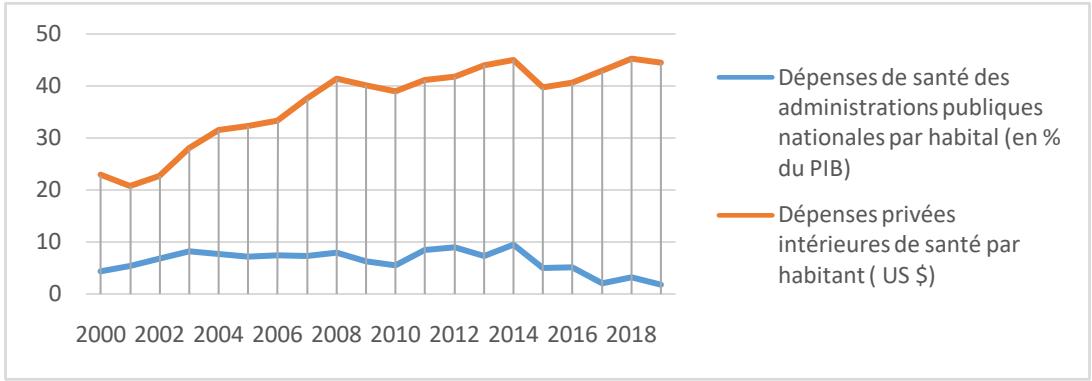 Figure 1: Evolution des dépenses de santé au Cameroun (2000-2019)
Source: Auteurs à partir des données de la Banque mondiale (2021).
Par ailleurs, pour améliorer l'accès dans les établissements sanitaires, la littérature récente suggère la migration des membres de la famille et les envois de fonds des migrants comme facteurs importants affectant l'accès aux soins de santé (Cevallos et Chi, 2012; Ambrosiuse et Cuecuecha, 2013; Nabeel, 2021).
En 2019, la somme des envois de fonds des pays riches vers les pays à revenus faibles et intermédiaires à atteint 550 milliards de dollars. Ce chiffre pourrait faire du transfert d'argent l'une des principales sources de financement extérieur des pays en développement. La part orientée vers le continent african est estimée à 48 milliards de dollars (Mawuema et Okey, 2020). L'étude des transferts des fonds des migrants est donc Cruciale pour comprendre la situation sociale en Afrique subsaharienne (Ch'ngom et Tamokwe, 2018), et particulièrement au Cameroun, du fait de sa grande dépendance aux remises de fonds. En effet, au Cameroun, les transferts des fonds des migrants ont connu une progression considérable au cours des dernières décennies comme l'indique la figure 2.
D'après, le rapport[^2] sur le panorama des transferts de fonds dans les pays de la commission économique des États de l'Afrique centrale (CEEAC), le Cameroun, avec 345 millions d'euros, soit 201 milliards de francs CFA, est le second pays de la CEEAC à avoir bénéficié des transferts de fonds des migrants africains derrière la République démocratique du Congo (RDC) en 2018. Selon le rapport de la Banque des Etats d'Afrique Centrale (BEAC, 2020), ces transferts sont passés de 40,5 milliards de F CFA en 2005 à 103,4 Milliards de F CFA en 2011 pour atteindre 184,5 Milliard de F CFA en 2018. Bien plus, comme l'indique la même figure, les envois de fonds vont graduallement croître et atteindre leur pic à 356 millions de dollars en 2019 (0,91% du PIB) pour connaître ensuite, une baisse de l'ordre de 334 millions de dollars en 2020 (0,82% du PIB) certainement causée par la pandémie de la Covid-19.
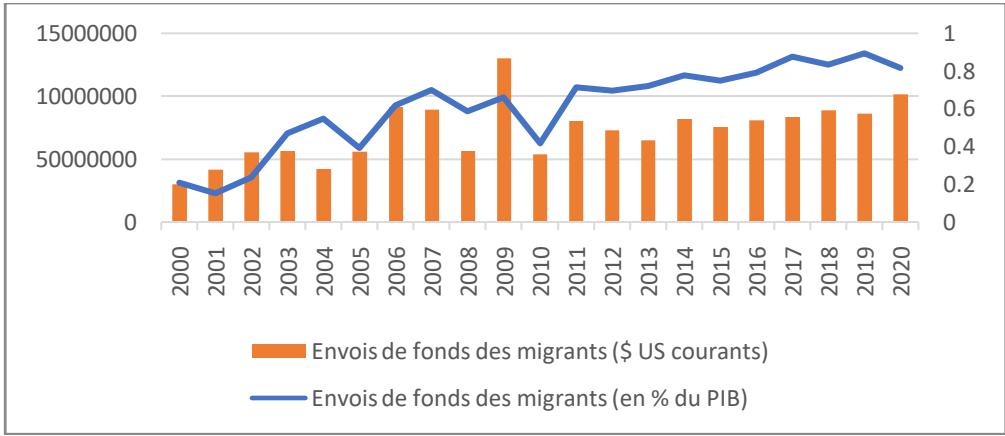 Figure 2: Evolution des envois de fonds des migrants au Cameroun sur la période 2000-2020
Source: Auteurs à partir des données de la Banque mondiale (2021).
A ce qui précède, les études sur le role des transferts de fonds de migrants se sont intérissées à la mesure du budget du menage. Si ces mesures sont importantes, l'orientation des menages dans les choix des structures sanitaires demeure un problème social important car, il permet de comprendre que les menages réci piendaires de fonds de migrants changent de classe sociale. En conséquence, ces menages s'orientent vers les structures sanitaires privées ou la prise en charge parait beaucoup plus intéressante que les structures sanitaires publiques où cette même prise en charge reste problématique. L'étude de ces orientations a un effet sur les politiques publiques qui, désormais doivent considérer les effets des transferts de fonds des migrants sur la structure des inégalités en matière d'accès aux soins de santé.
L'objectif de ce papier est de mettre en évidence le role joué par les transferts de fonds des migrants internationaux dans l'accès aux soins des menages camerounais. Cette étude présente un triple intérêt. Premièrement, elle permet de repositionner la santé au centre des politiques de développement. La santé étant la condition sinequa nône de l' individu à participer activement au marché du travail. Deuxièment, elle permet également de comprendre comment se fonde la décision pour un menage de désirir une unité de soins par rapport à une autre en fonction des transferts de fonds. Troisièment, elle permet aux autorités publiques d'élaborer une politique active du financement en matière de santé.
La suite de l'article est organisée de la manière suivante. Dans la deuxième partie, nous exposons une revue de la litterature; dans la troisième, la méthodologie; la quatrième partie présente les résultats et enfin, la dernière partie conclut.
## I. REVUE DE LA LITTERATURE
De nombreux travaux ont étudié l'impact du phénomène de la migration – transferts de fonds sur la santé et particulièrement sur l'accès aux soins des ménages. Certains d'entre eux ont analysé l'impact de ce phénomène sur les déterminants de la demande de santé, et d'autres uniquement sur les dépenses en soins de santé (Rosenstock-Strecher, et Becker, 1988) $^3$. Chaquechercheur se base sur des tests et des hypothèses spécifiques différentes, et sur un échantillon d'une région donnée qui se caractérisé par la structure économique spécifique. Tous ces éléments peuvent expliquer les différences des résultats obtenus par ces nombres travaux. Dans ce qui suit, nous proposons de rappeler une brève litterature tant théorique qu'empiérique expliquant la relation transferts de fonds'accès aux soins de santé des menages.
Du point de vue théorique, les unités sanitaires offrent un ensemble de prestations qui constituent un panier de biens pour lequel le consommateur tire une certaine'utilité. Les soins de santé sont un bien qui inclue de plus en plus le goût (ou préférence) car, tout individu qui demande les soins de santé se comporte comme un consommateur pour n'importe quel autre bien. En conséquence, les choix des individus en matière de consommation dépendant de leur préférence qui sont par essence subjectifs, des contraintes financières auxquelles ils sont soumis. A cela, les recherches d'Andersen et Newman (1973) ont affirmé que l'accessibilité et la disponibilité des services de santé constituent un élément crucial, déterminant de l'utilisation des services de santé. Ainsi, la décision du menage de désirir un prestataire de soins de santé ou d'utiliser les services de soins dépend non seulement de la qualité des services offerts mais aussi de la disponibilité physique du fournisseur de services dans sa région d'origine. Les travaux de Kim et al. (2012) ont montré l'importance de la qualité perché par les individus sur l'utilisation des services de santé. Ainsi, avec une perception accrue des services de santé, la probabilité d'utilisation de ces services augmente, et vice versa.
En outre, l'objet essentiel qui impacte fortement la décid tion du menage à recourir aux unités de soins de santé est le coût du traitement car, les dépenses de santé élevées rendent les individus moins susceptibles d'utiliser ces services. Ce qui les pousse à rechercher ailleurs d'autres alternatives comme l'automédication (Andersen et Newman, 1973). Ainsi, dans le contexte de pays en développement où la pauvreté monétaire constitue un obstacle majeur à l'accès aux soins, la littérature a identifié divers mécanismes parmi lesquels les transferts de fonds des migrants. La migration peut avoir un effet positif sur la santé des menages réci piendaires si les envois de fonds des migrants contribuient à l'assouplir les contraintes budgétaires et à investir dans la santé des menages. Cela a été le cas du Mexique, où les envois de fonds contribuient de manière significative à la réduction du taux de mortalité chez les enfants de moins de cinq ans et sont également associés aux nouveaux nés pesant au-dessus de la moyenne dans les familles réci piendaires des envois de fonds (Duryea et al., 2005). L'étude fait valor que les transferts de fonds des migrants constituent une source de financement Cruciale pour l'accès aux soins de santé dans les établissements sanitaires formels.
La réduction des inégalités d'accès aux soins de santé grâce aux transferts de fonds des migrants est retrouvée dans les travaux de Atake (2018) au Togo, preuve que la migration contribue grandement à l'amélioration de la naissance à l'hopital, l'aide aux accouchements qualifiés, soins prénataux et postnataux notamment dans les centres sanitaires de pédiatrie. Ces conclusions sont conformes à celles des études antérieures dans les pays en développement, qui ont montrées que la migration, par le biais des transferts de fonds, améliore l'accès à la santé des enfants, la santé maternelle et l'utilisation des soins de santé de qualité et réduit par conséquent le taux de mortalité infantile.
Par ailleurs, l'augmentation des dépenses en services de santé des menages migrants peut en effet, améliorer l'accès aux services de santé du secteur privé pour tous les membres de la communauté. Car, c'est en réponse à cette demande accrue que les prestataires de services s'instant dans les communautés. Dans une étude sur les conséquences de la migration au Kerala en Inde, Zachariah et al. (2000) constatent que la réception de transferts de fonds est associée à une plus grande utilisation des installations hospitalières pourtraiter les maladies, et à une multiplication par trois du recours aux hôpitaux privés pour les accouchements.
De même, Lindstrom et Munoz-Franco (2006) utilise les données de l'enquête guatemalaque de 1995 sur la santé des familles (EGSF) menée dans quatre régions rurales du Guatemala pour étudier comment l'expérience de la migration et les liens sociaux avec les migrants influencent la probabilité d'utiliser les services formels de soins de santé maternelle. Ils constatent que l'expérience de la migration urbaine et le fait d'avoir les parents à l'étranger sont associés à une plus grande probabilité de recours aux soins prénataux formels, après avoir pris en compte les caractéristiques du milieu et les ressources favorables. L'expérience de la migration à tous les niveaux est également fortement associée à l'assistance formelle à l'accouchement dans les zones rurales du Guatemala.
Les transferts de fonds affectent ainsi la santé des membres des menages des migrants, en assouplissant les contraintes de liquidité qui, autrement, restreindraient l'accès aux soins de santé (Amuedo-Dorantes et Pozo, 2009). Ces résultats suggèrent alors que l'on peut améliorer sensiblement les services de santé maternelle et infantile notamment en mettant en œuvre des politiques assurant l'utilisation efficente des fonds transférés par les migrants tout comme le modele des pays africains subsahariens, tels que le Mali et la République démocratique du Congo (RDC), ou les transferts des migrants contribuent enormément à la construction d'infrastructures sanitaires (hopitaux et cliniques), ce qui permet d'améliorer à la fois la santé des familles des migrants et des non-migrants dans les pays d'origine. Cet impact posit sur l'accès aux soins de santé des menages est pourtant nuancé dans les travaux de Terrelonge (2014). Ce qui prouve que la relation entre les transferts des fonds des migrants sur le bien être des menages reste ambigu et nécessite encore des études de cas pour éclairer la litterature.
Malgré la littérature relativement abondante, au cours de ces dernières décennies, plusieurs travaux ont étudié l'impact des transferts de fonds sur le développement économique au Cameroun. La litterature comprend l'évaluation de cet impact sur l'investissement en education et logement (Méka'a, 2015), sur les conditions de vies de menages d'origine (Nouetagni et Hamadou, 2015), sur le capital humain (Amassangka et al., 2020), sur les résultats scolaires (Fambeu, 2021). Néanmoins, au Cameroun, les liens possibles entre les transferts de fonds et l'accès aux soins dans les établissements sanitaires sont rarement explorés par la litterature. De plus, aucune de ces études n'ont intégré la notion de préférence des menages réci piendaires en matière de des unités de soins de santé.
## II. METHODOLOGIE
### a) Sources de données
Les données utilisées dans la presente étude proviennent de la quatrième enquête camerounaise auprès des menages (ECAM 4) réalisée en 2014 par l'Institut National de la Statistique (INS). Cette enquête, menée auprès d'un échantillon de représentatif d'environ 17430 menages, fournit des informations sur la migration, les transferts de fonds des migrants, le patrimoine et les autres caractéristiques socioeconomiques du menage. ECAM 4 étant, comme la précédente enquête (ECAM 3), une enquête à objectifs multiples, son questionnaire est articulé autour d'un certain nombre de module correspondant aux domaines d'investigation en fonction des objectifs retenus. Les différentes sections abordées touchent, entre autres, les domains ci-après: l'education, l'emploi et les revenus, les travaux domestiques et le travail des enfants, le standing et les équipements des menages, le patrimoine, l'environnement du menage, la mobilité résidentielle et les migrations[^4], l'accessibilité aux infrastructures de base, l'agriculture et les activités du monde rural, la gouverance et la corruption, le tourisme interne, les dépenses et la consommation finale des menages, la santé des membres du MENAGE[^5].
Toutefois, il convient de souligner que cette enquête n'a pas spécialément eté concue pour l'étude de la migration. En effet, elle a collecte des informations sur celles-ci et les transferts de fonds. Malheureusement, cette enquête n'a fourni aucune information sur les revenus obtenus par les migrants dans leur localité d'accueil. Dans cette enquête, les données sur les transferts de fonds des migrants ont eté collectees grâce à une série de question[^6] adressées aux menages concernant leur situation par rapport aux fonds qu'ils reçoivent.
Afin d'évaluer l'effet des transferts des fonds des migrants sur l'accès aux soins de santé des ménages, il est important de bien identifier les indicateurs qui capturent ces variables. Pour capter l'accès aux soins de santé, nous utilisons l'information liée aux types d'établissement sanitaire. Cette information, recueillies sur la base d'une série de question[^7], nous permet de construire la variable dépendante qui représenté le comportement du menage malade (demande conditionnelle). Ainsi, lorsqu'un menage est malade, il a lechioir de se rendre dans un établissement sanitaire. Nous distinguons trois niveaux du secteur de la santé conformément à l'organigramme de 2002 du Ministère de la santé publique au Cameroun. Dans cette étude, l'unité des soins fait reference à un établissement de santé (ou service de soins). Ainsi, nous définissons une unité de soins comme une entité regroupant des activités de soins de santé (soins Médicaux ou soins infirmiers). C'est dans cette acceptation de l'unité de soins de santé, plus global mais au contenu problème bien circconsinit, que nous employerons indistinctement les termes unité de soins, établissement de santé ou encore prestataires de soins dans le cadre de cette étude.
De ce fait et conformément à l'Organisation Mondiale de la Santé (OMS, 2020), nous définissons l'accès (aux services de santé) comme la capacité, réelle ou/perçue, d'acceder aux services de santé ou aux établissements de santé (emplacement, délays, et facilité d'accès). Concernant les migrations, nous définissons un menage migrant comme étant celui dont au moins un membre est installé dans une autre localité depuis 2001 et qui n'est pas revenu. Ainsi, la variable d'intérêt est mesurée par un indicateur binaire prénant la valeur 1 si le menage a reçu de l'argent du migrant au cours des douze derniers moins et 0 sinon. Les autres variables explicatives sont liées au lieu de résidence du menage, aux caractéristiques du menage et aux caractéristiques liées à la santé. Ainsi, le tableau représentant le recodage de ces variables selon leur modalité estprésenté en annexe. Le tableau 1 cédessous présente plus en détail les variables utilisées, ainsi que les statistiques descriptives.
Tableau 1: Statistiques descriptives
<table><tr><td>Variables</td><td>Observations</td><td>Mean</td><td>Std. Dev.</td><td>Min</td><td>Max</td></tr><tr><td colspan="6">Unités de soins</td></tr><tr><td>Publique</td><td>17.437</td><td>0.1893566</td><td>0.3918028</td><td>0</td><td>1</td></tr><tr><td>Privée</td><td>17.437</td><td>0.7482509</td><td>0.4340303</td><td>0</td><td>1</td></tr><tr><td>Automédication</td><td>17.437</td><td>0.0623925</td><td>0.241874</td><td>0</td><td>1</td></tr><tr><td>Transfert de Migrants</td><td>17.437</td><td>0.509884</td><td>2.306441</td><td>1</td><td>23.02585</td></tr><tr><td>Cout consultation</td><td>17.437</td><td>1.317102</td><td>2.70409</td><td>0</td><td>11.0021</td></tr><tr><td>Satisfaction des prestations offertes</td><td>17.437</td><td>0.6815002</td><td>0.4659079</td><td>0</td><td>1</td></tr><tr><td>Satisfait</td><td>17.437</td><td>0.1149214</td><td>0.3189363</td><td>0</td><td>1</td></tr><tr><td>Insatisfait</td><td></td><td></td><td></td><td></td><td></td></tr><tr><td>Sexe du chef de Ménage</td><td>17.437</td><td>0.8257254</td><td>0.3793563</td><td>0</td><td>1</td></tr><tr><td>Masculin</td><td>17.437</td><td>0.1742746</td><td>0.3793563</td><td>0</td><td>1</td></tr><tr><td>Féminin</td><td></td><td></td><td></td><td></td><td></td></tr><tr><td colspan="6">Niveau de vie</td></tr><tr><td>Pauvre</td><td>17.437</td><td>0.4973047</td><td>0.5000071</td><td>0</td><td>1</td></tr><tr><td>Riche</td><td>17.437</td><td>0.5026953</td><td>0.5000071</td><td>0</td><td>1</td></tr><tr><td>Age chef ménage</td><td>17.437</td><td>27. 37539</td><td>23.43131</td><td>0</td><td>99</td></tr><tr><td colspan="6">Catégorie socialeprofessionnelle</td></tr><tr><td>Cadre</td><td>17.437</td><td>0.0658906</td><td>0.2480979</td><td>0</td><td>1</td></tr><tr><td>Employé</td><td>17.437</td><td>0.5459915</td><td>0.4978946</td><td>0</td><td>1</td></tr><tr><td>Auto employé</td><td>17.437</td><td>0.3881179</td><td>0.4873356</td><td>0</td><td>1</td></tr><tr><td>Taille chef de Ménage</td><td>17.437</td><td>3.281684</td><td>2.985699</td><td>1</td><td>43</td></tr><tr><td colspan="6">Milieu de résidence</td></tr><tr><td>Urbain</td><td>17.437</td><td>0.7121229</td><td>0.4527865</td><td>0</td><td>1</td></tr><tr><td>Rural</td><td>17.437</td><td>0.2878771</td><td>0.4527865</td><td>0</td><td>1</td></tr><tr><td colspan="6">Revenu du Ménage</td></tr><tr><td>Stable</td><td>17.437</td><td>0.0575181</td><td>0.2328365</td><td>0</td><td>1</td></tr><tr><td>Instable</td><td>17.437</td><td>0.9424819</td><td>0.2328365</td><td>0</td><td>1</td></tr><tr><td colspan="6">Statut matrimonial</td></tr><tr><td>Marié</td><td>17.437</td><td>0.4058378</td><td>0.4910675</td><td>0</td><td>1</td></tr><tr><td>Célibataire</td><td>17.437</td><td>0.5941622</td><td>0.4910675</td><td>0</td><td>1</td></tr><tr><td colspan="6">Niveau d'instruction</td></tr><tr><td>Non scolarisé</td><td>17.437</td><td>0.1553504</td><td>0.3622488</td><td>0</td><td>1</td></tr><tr><td>Primaire</td><td>17.437</td><td>0.5639982</td><td>0.4959015</td><td>0</td><td>1</td></tr><tr><td>Secondaire</td><td>17.437</td><td>0.2286386</td><td>0.419968</td><td>0</td><td>1</td></tr></table>
L'observation du tableau 1 révèle qu'en matière d'accès aux soins de santé, 74,8% des ménages optent pour les unités de soins privées, contre 18,9% des bénéficiaires qui désistent de se soigner dans les unités de soins publiques. Seulement 6% des bénéficiaires de fonds s'automédicamentent. Ainsi, les ménages bénéficiaires de fonds utilisent plus les services de soins privés que les autres services. De manière générale, 68% de ces ménages se déclarent satisfaits des soins reçus contre 11% insatisfaits et 20% indifférents.
### b) Stratégie d'estimation
Pour mettre en évidence le rôle des transferts de fonds dans l'accès aux soins de santé, la présente étude a élaboré une spécification économétrique où la variable dépendante est une variable discrète à trois modalités.
- 1 si l'individu se soigne les unités de soins publiques
- 2 si I'individu frquele les unités de sanfe privées
- 3 si l'individu pratique l'automédication
Ainsi, au moyen d'une approche des variables instrumentales, nous analysons la probabilité de se soigner dans un établissement sanitaire public, privé ou la pratique de l'automédication. Ce type de spécification permet d'expliquer la probabilité pour un individu malade de se trouver dans une situation par rapport à une autre, conditionnellement aux variables explicatives. En conséquence, le modèle empirique s'inspire des travaux de Nabeel(2021)et se présente comme suit:
$$
a s _ {i j} = \alpha_ {0} + \beta_ {i} t r a n s _ {i} + \sigma_ {i} X _ {i j} + e _ {i j}
$$
ou $a s_{ij}$ représenté le choix de soins de santé du menage $i$ utilisant $j$ le type d'établissement de santé. $\text{trans}_i$, le montant des transferts de fonds reçus par le menage, $X_{ij}$ est le vecteur de caractéristiques du menages. Ces facteurs peuvent influencer le comportement du décidateur qui désit entre les services de santé publics, privés ou l'automédication. $e_{ij}$ représenté le terme d'erreur, qui peut inclure des attributs non observables pouvant affecter la variable de résultat.
La présente étude a fait recours à des régressions avec variables instrumentales en raison du fait que les estimations obtenues par l'utilisation des moindres carrés ordinaires (MCO) sont susceptibles d'être corrélées avec le terme d'erreur. Ainsi, la méthode des moindres carrés en deux étapes(2-SLS)et la méthode des moments généralisés (GMM) seront utilisées pour régresser les indicateurs de mesure de l'accès aux soins de santé avec les transferts de fonds des migrants internationaux et les variables socio-économiques et démographiques des ménages. Ainsi, le recours à ces variables instrumentales se justifie notamment par le fait que la littérature établit de manière formelle un biais d'endogénéité lié à la corrélation entre les transferts de fonds des migrants et le terme d'erreur(McKenzie et Sasin, 2007; Bouoiyour et Miftah, 2014). En conséquence, une régression par les MCO donnerait des résultats biaisés. De ce fait, il convient de corriger le problème d'endogénéité lié à la variable explicative (transferts de fonds de migrants internationaux). Plusieurs études ont conclu à la nécessité de prendre en compte l'endogénéité des transferts des migrants(Bouoiyour et al., 2016; Fambeu, 2021). En réalité, l'introduction des transferts financiers des migrants comme variable explicative pourrait entraîner un biais potentiel d'endogénéité.
Elle peut être corrélée avec le terme d'erreur de notre équation d'intérêt, dans la mesure où des variables omises dans cette équation peuvent expliquer le comportement de transfert des migrants camerounais. Aussi, il est possible que certaines caractéristiques non observées du menage du menage qui affecte simultanément le choix des soins de santé et les transferts de fonds soit omise, par exemple: le role de l'emigrant dans la prise de décision en matière de soins de santé et le coût des soins de santé privés. Par ailleurs, les envois de fonds peuvent avoir comme motifs le financement des soins de santé des menages. Or, notre équation de base explique l'accès aux unités de soins de santé, entre autres, par les transferts de fonds des migrants. Ces problèmes rendent difficile l'établissement de la causalité et biaisent le cadre typique des régressions sous forme réduite. Dans notre cas, les problèmes à prendre en compte sont notamment: la causalité inverse (par exemple, le besoin d'un prestataire de soins de santé privés peut induire un besoin de ressources financières plus importantes, augmentant ainsi l'afflux de transferts de fonds). Ainsi, pour réduire la probabilité d'un biais potentiel causé par l'endogénéité de la variable de traitement (transfers de fonds des migrants), nous utilisons la technique de la variable instrumentale, où les transferts de fonds reçusont instrumentés par les variables liées au menages.
## III. RÉSULTATS
Avant de passer à l'analyse des résultats, il est nécessaire de clarifier la validité économique du modele, des tests de validité des instruments et d'endogénéité. Du fait de l'absence de certaines variables dans la base, les caractéristiques liées aux menages sont utilisées comme instruments pouvant identifier notre modele. Ces caractéristiques sont le sexes, l'âge et le niveau d'education etc. Le test de sur-identification de Sargan permet de confirmer la validité de nos instruments. Étant donné nos P-value > 5%, on accepte l'hypothèse nulle de validité des instruments. Le test d'endogénéité de Hausman montre que le modele ne souffre d'aucun biais d'endogénéité et permet ainsi de valider l'endogénéité de la variable d'intérêt (transfert des fonds de migrants) par la méthode des variables instrumentates.
Le tableau 2 présente les paramètres estimés du modele à l'aide de l'approche desvariables instrumentales opposant les trois situations suivantes: unité de soins publique, unité de soins privée et automédication. Les résultats montrent que globalement, les transferts de fonds des migrants ont des effets variés sur l'accès aux soins dans les unités de santé. Pris individuellement, les transferts des fonds ont des effets négatifs chez les menages se soignant dans les établissements publics alors qu'ils ont un effet positif dans les autres unités de soins.
En effet, suivant la méthode (IV-2SLS), une augmentation de $1\%$ du montant des transferts de fonds entraine une hausse de $66.1\%$ et de $92.3\%$ la chance pour les menages bénéficiaires de recourir aux unités de soins privées et à la pratique de l'automédication, respectivement.
Ceci peut s'expliquer par le fait que les menages camerounais ont davantage besoin de moyens financiers pour recourir aux soins dans les unités privées. Dans ces unités de soins où le coût de consultation parfois élevé a un effet négatif (-6,68e-05) sur le choix de ces dernières alors que la prise en charge des patients et les services sont de qualités. En conséquence, les transferts de fonds des migrants réduisent donc ces contraintes bugetataires des menages bénéficiaires leur permettant de désirir ces unités de soins en raison de leur commodité. Ce résultat est cohérent avec celui de la variable satisfaction qui montre que les menages qui font recourt à ces unités de soins privées (0,261) sont satisfaits par rapport à ceux des unités publiques (-0,007). Les résultats corroborent ceux de Nabeel (2021) et Zachariah et al. (2000) qui montrent que les menages qui recoivent les fonds sont plus susceptibles d'être hospitalisés dans les unités de soins privées au Pakistan et en Inde, respectivement.
Concernant la pratique de l'automédication, ceci pourrait s'expliquer par le fait qu'une part importante des menages bénéficiaires des transferts se trouvent non seulement dans une situation de précarité, mais aussi dans les zones géographiques où les unités de soins formelles (publique et privée) ne sont toujours opérationnelles et donc ils sont contraints de recourir à cette pratique. Aussi, les montants des transferts peuvent être insuffisants pour satisfaire leur besoin de première nécessité et ils préférent donc l'automédication afin de rationaliser leur dépense. Ceci estsemblable aux études de Mora-Rivera et al (2024) qui montrent que ces résultats sont liés aux disparités socio-economiques structurelles qui caractérisent les pays en développement et dépendent également de la perception de ce revenu supplémentaire comme permanent ou transitoire.
Dans les unités de soins publiques, les résultats montrent qu'une augmentation de 1 point de pourcentage du montant de transferts entraîne une diminution de 158,4 points de pourcentage la chance de recourir aux unités de soins publiques. L'explication pourraitvenir du fait que dans les unités de santé publiques, les coûts de consultations et de prise en charge subventionés par l'Etat font de ces centres, de unités de préférence des menages pauvres[^8] qui vivent dans des conditions éloignées du comfort social[^9]. Dans ces unités, à l'exception de quelques grandes structures hospitalières, une file d'attente longue, l'absence et le retard manifeste de certains professionnels de santé découragent les menages bénéficiaires de transferts de fonds qui optent plutôt pour les unités de soins privées.
Les caractéristiques individuelles sont également des déterminants deCHOix des unités de soins au Cameroun. La probabilité de renconcer aux unités de soins publiques dinimue de 10,1 points de pourcentage chez les hommes comparativement aux femmes. En revanche, cette probabilité augmente de 8,67 et 1,04 points de pourcentage chez les hommes comparativement aux femmes de solliciter les unités de soins privées et la pratique de l'automédication, respectivement. Ce résultat pourrait s'expliquer par le fait que généralement, contrairement aux femmes qui sont très attentives à leur sensation corporelle et à celle de leur famille, les hommes sont moins. Ces derniers qui ne jouent pas souvent le role de soignant principal ne perçoivent pas mieux les risques liés à l'utilisation des médicaments hors prescription Médicale (automédication). Ce résultat est en accord avec ceux des travaux de Ndonou et Fomba (2024).
En outre, la probabilité d'accès aux unités de soins publiques augmente de 0,18 point de pourcentage avec l'âge du chef de menage tandisque cette probabilité dans les unités de soins privées et l'automédication diminue de 0,14 et 0,04 point de pourcentage, respectivement. Ces résultats confirment l'idée selon laquelle l'âge s'accompagne de l'expérience et les personnes âgées sont généralement plus conscientes des résultats potentiels des différents unités de santé (Hughes et al., 2001). Un autre résultat important est celui du niveau d'instruction. Les montrent que le niveau d'instruction a un effet varié suivant les différents unités de soins. En effet, la probabilité d'accès aux soins dans les unités publiques plutôt que de recourir aux autres prestataires diminue de 0,73 point de pourcentage lorsque le chef de menage a au plus le niveau primaire et augmente de 1,16 point de pourcentage lorsque celui-ci a au moins le niveau secondaire. Par contre, dans les unités de soins privées et la pratique de l'automédication, l'education a un effet négatif et positif quelque soit le niveau d'instruction, respectivement. Ceci est cohérent aux résultats des travaux antérieurs qui attestent que l'education améliore niveau de connaissance. Ce qui confer la capacité de s'informer et de comprendre les enjeux liés aux risques sanitaires, rendant les individus plus enclins à recourir aux prestataires de soins (Raynaud, 2008; Gurmu et Tesfu, 2012; Ndonou et Fomba, 2024).
Tableau 2: Résultats de l'estimation de l'effet des transferts de fonds internationaux sur l'accès aux soins dans les unités de santé (Méthodes des variables instrumentales)
<table><tr><td rowspan="2">Variables</td><td colspan="2">Publique</td><td colspan="2">Privé</td><td colspan="2">Automédication</td></tr><tr><td>IV-2SLS</td><td>GMM</td><td>IV-2SLS</td><td>GMM</td><td>IV-2SLS</td><td>GMM</td></tr><tr><td>Transfert de Migrants</td><td>-1.584*** (1.087)</td><td>-1.541*** (1.013)</td><td>0.661 (0.817)</td><td>0.871 (0.920)</td><td>0.923 (0.657)</td><td>1.069 (0658)</td></tr><tr><td>Coût Consultation</td><td>7.17e-05*** (2.48e-06)</td><td>7.14e-05*** (1.38e-05)</td><td>-6.68e-05*** (3.30e-6)</td><td>-6.74e-05*** (1.32e-05)</td><td>-3.67e-06*** (1.99e-06)</td><td>-3.58e-06*** (1.60e-06)</td></tr><tr><td>Satisfait</td><td>-0.00771** (0.0117)</td><td>0.00197** (0.0131)</td><td>0.261* (0.0156)</td><td>0.0268* (0.0145)</td><td>-0.0254*** (0.00943)</td><td>-0.232*** (0.00940)</td></tr><tr><td>Homme</td><td>-0.101*** (0.0133)</td><td>-0.0983*** (0.0159)</td><td>0.0867* (0.0178)</td><td>0.0872* (0.0171)</td><td>0.0104* (0.0107)</td><td>0.0169* (0.0105)</td></tr><tr><td>Agecm</td><td>0.00185*** (0.000835)</td><td>0.00164** (0.000940)</td><td>-0.00143*** (0.00111)</td><td>-0.00147*** (0.00104)</td><td>-0.000423*** (0.000671)</td><td>-0.000555*** (0.000674)</td></tr><tr><td>Cadre</td><td>-0.00547*** (0.0197)</td><td>-0.00256*** (0.0225)</td><td>0.00368*** (0.0262)</td><td>0.00289*** (0.0245)</td><td>-0.00915 (0.0158)</td><td>-0.0119 (0.0155)</td></tr><tr><td>Employé</td><td>0.0321** (0.0165)</td><td>0.0356* (0.0187)</td><td>-0.0279*** (0.0220)</td><td>-0.0272*** (0.0204)</td><td>0.00412* (0.0133)</td><td>0.00208 (0.0131)</td></tr><tr><td>Taillem</td><td>0.00651 (0.00192)</td><td>0.00626* (0.00220)</td><td>-0.00628 (0.00256)</td><td>-0.00633** (0.00240)</td><td>-0.000237 (0.00155)</td><td>-0.000460 (0.00160)</td></tr><tr><td>Urbain</td><td>-0.0163*** (0.0145)</td><td>-0.0124*** (0.0166)</td><td>0.0394** (0.0193)</td><td>0.0398** (0.0182)</td><td>-0.0230** (0.0117)</td><td>-0.0201*** (0.0117)</td></tr><tr><td>Revenu stable</td><td>0.00310** (0.0136)</td><td>0.00180** (0.00180)</td><td>-0.0214*** (0.0181)</td><td>-0.0219*** (0.0173)</td><td>-0.0183*** (0.0109)</td><td>0.0184* (0.0103)</td></tr><tr><td>Niveau de vie du ménage (Pauvre)</td><td>0.101*** (0.0312)</td><td>0.0937*** (0.352)</td><td>-0.0792* (0.0416)</td><td>-0.0807* (0.0387)</td><td>0.0221* (0.0251)</td><td>0.0273* (0.0251)</td></tr><tr><td>Non scolarisé</td><td>-0.0630*** (0.251)</td><td>-0.0592*** (0.0287)</td><td>-0.0167*** (0.0334)</td><td>-0.0161*** (0.0313)</td><td>0.0798* (0.0202)</td><td>0.0821* (0.0191)</td></tr><tr><td>Primaire</td><td>-0.00730** (0.0270)</td><td>-0.00176*** (0.0307)</td><td>-0.0487*** (0.0389)</td><td>-0.0479*** (0.0334)</td><td>0.0560** (0.0217)</td><td>0.0593* (0.0205)</td></tr><tr><td>Secondaire</td><td>0.0116* (0.0148)</td><td>0.0115* (0.0184)</td><td>-0.0389*** (0.0197)</td><td>-0.0391** (0.0191)</td><td>0.0273* (0.0119)</td><td>0.0270* (0.00877)</td></tr><tr><td>Constant</td><td>-1.072*** (1.631)</td><td>-1.492*** (1.836)</td><td>3.833 (2.172)</td><td>3.748 (2.022)</td><td>-1.762*** (1.312)</td><td>-2.053*** (1.314)</td></tr><tr><td>Wald Chi2(18)</td><td>3734.73</td><td>1468.07</td><td>2977.40</td><td>2436.02</td><td>552.46</td><td>403.85</td></tr><tr><td>R-squared</td><td>0.6790</td><td>0.7211</td><td>0.6223</td><td>0.8119</td><td>0.5612</td><td>0.7122</td></tr><tr><td>Prob > chi2</td><td>0.0000</td><td>0.0000</td><td>0.0000</td><td>0.0000</td><td>0.0000</td><td>0.0000</td></tr><tr><td>Sargan P-value</td><td>0.6112</td><td>0.6507</td><td>0.7092</td><td>0.5732</td><td>0.5823</td><td>0.5402</td></tr><tr><td>Observations</td><td colspan="2">17,437</td><td colspan="2">17,437</td><td colspan="2">17,437</td></tr><tr><td colspan="7">Standard errors in parentheses *** p<0.01, ** p<0.05, * p<0.1</td></tr></table>
L'analyse des résultats sous le prisme du niveau de vie des menages montre que la probabilité d'accès aux unités de soins publiques et à l'automédication augmente de 10,1 et 2,21 points de
pourcentage respectivement lorsque le menage se situe dans la classe des menages pauvres. Par contre dans les unités de soins privées, cette probabilité diminue 7,92 points de pourcentage. Ce résultat est conforme aux recherches qui montrent que les individus des menages pauvres aux contraintes financières d'accès aux unités de soins formelles privées. Ceci dû à une insuffisance des capacités financières à couvir les frais de services Médicaux et une absence de couverture d'assurance santé. Les résultats sont dans le même sens des travaux de Shafie et al (2018) et Awojobi (2019).
Ce tableau revèle également qu'au Cameroun, il existe une disparité géographique en matière d'accès aux soins dans les unités sanitaires. En effet, la probabilité de recourir aux unités de soins publiques et à la praticque de l'automédication diminue respectivement de 1,63 et 2,3 points de pourcentage en milieu urbain comparativement au milieu rural. En revanche, cette probabilité augmente l'accès dans les unités de soins privées de 3,94 points de pourcentage en zone urbaine comparativement en zone rural. Ceci pourrait s'expliquer par le fait qu'en milieu urbain, il existe une diversité d'établissement en matière d'offre santé privée, parmi lesquelles les unités de soins privées formelles et informelles. D'une part, les structures sanitaires privées formelles offrent des commercités en termes de prise charge rapide, des équipements, infrastructures adéquats ce qui pouraient favoriser l'attractivité vers ces unités sanitaires. D'autre part, les unités de soins informelles qui sont pratiquées dans les structures clandestines où les personnes de santé publics en service et même ceux en retraite mettent leur compétence contre rémunération aux populations. Ces populations déjà pauvres font recourt à ces unités parfois à crédit avant de régler les factures plus tard. Ce résultat corroboreaux de Duchesne (1998) qui montrent qu'en Tanzanie, les individus habitant le milieu urbain accédent plus aux formations hospitalières privées que ceux habitant le milieu rural.
La catégorie socioprofessionnelle est également un déterminant deCHOix d'acces aux soins de santé. En effet, le fait d'être cadre diminue de 0,54 et augmente par contre de 0,36 point de pourcentage la probabilité d'acces aux unités de soins publiques et privées, respectivement. En revanche, le fait d'être employé augmente de 3,21 points de pourcentage la probabilité de recourir aux unités de soins publiques et diminue de 2,79 points de pourcentage la probabilité de recourir aux unités de soins privées. Ces résultats pourraient s'expliquer par le fait que d'une part, les cadres sont des individus d'une classe sociale aisée ou riche et disposant de personnes de santé privés. De ce fait, ils préférent se faire consulter soit à domicile soit dans les hôpitaux privés de référence. D'autre part, les employés sont des individus ayant des revenus relativement stables et donc sont couverts par un régime d'assurance maladie dans les hôpitaux publics puis que ces revenus sont généralement faibles pour solliciter les unités de soins privées dont les services sont très couâteux. Ce résultat est cohérent avec celui de la variable revenu stable qui montre que les individus disposant de ce type de revenu ont une préférence pour les unités de soins publiques que celles de soins privées et la pratique de l'automédication.
## IV. CONCLUSION
L'objectif du présent papier a été de mettre en évidence le role joué par les transferts de fonds des migrants internationaux dans l'accès aux soins des menages camerounais. En utilisant la méthode des variables instrumentales et les données d'ECAM 4, nous trouvons que les menages qui reçoivent des fonds des migrants internationaux sont plus susceptibles de solliciter le secteur de santé privé et la pratique de l'automédication. Cette préférence de ces secteurs par rapport à celui du public par les menages laisse penser que les transferts de fonds sont l'un des déterminants importants qui influencent le choix des prestataireses de soins au Cameroun. Du point de vue d'implications de politique en matière de santé, la puissance publique devrait intégrer les camerounais de la diaspora dans les politiques de développement notamment dans le financement de la santé. Ainsi, ces fonds pourront servir dans la construction d'infrastructures sanitaires en particulier dans les zones rurales afin de réduire les disparités géographiques en matière d'offre de soins.
Bien que cette étude fournit des effets statistiquement significatifs des transferts de fonds sur l'accès au soins de santé, elle n'offre qu'une vision partielle du problème abordé, invétablement entachée de limites principalement liées au type de données utilisées dans l'analyse. Premièrement, compte des objectifs d'ECAM 4, il est possible que l'ensemble des transferts de fonds déclarés par les sources officielles ne soit pas pris compte. Ceci souligne la nécessité d'enquêtes plus précises sur les revenus provenant des transferts de fonds. Deuxièmement, il serait souhaitable de-disposer des données longitudinales permettant de suivre les mêmes menages à différents moments et de stratifier les transferts de fonds en tranche de revenus. Ceci permettrait de tirer des conclusions plus complètes sur la dynamique entre les flux de transferts de fonds et leurs effets sur l'accès de soins de santé. Troisièmement et enfin, il serait souhaitable de tener compte des différentes composantes de l'automédication à savoir s'automédicamente à la pharmacie, vente de rue et plantes médecinales. Ceci dans l'optique de s'introger sur les perspectives de développement de l'automédication dans le contexte camerounais où la demande dépend très largement de facteurs économiques et culturels. Ces limites ne remettent aucunement en cause la pertinence de nos résultats mais souligner la nécessité de leur prise en compte pour des recherches ultérieures.
### ANNEXE
Tableau 1: Récapitulatif des variables selon leur modalité
<table><tr><td>Variables</td><td>Modalités</td></tr><tr><td>Réception des transferts de fonds</td><td>1 si le ménage a reçu un transfert de fonds des migrants et 0 sinon.</td></tr><tr><td>Unité de soins de santé</td><td></td></tr><tr><td>Unité de soins publique</td><td>1 si le ménage a reçu des soins venant du publique 0 si non</td></tr><tr><td>Unité de soins privée</td><td>1 si le ménage a reçu des soins venant du privé 0 si non</td></tr><tr><td>Automédication</td><td>1 si le ménage s'automédicamente 0 si non</td></tr><tr><td>Niveau d'éducation du chef de ménage</td><td></td></tr><tr><td>Non scolarisé</td><td>1 si le chef de ménage n'a pas été scolarisé 0 si non.</td></tr><tr><td>Primaire</td><td>1 si le chef de ménage a un niveau primaire 0 si non</td></tr><tr><td>Secondaire</td><td>1 si le chef de ménage a un niveau secondaire 0 si non</td></tr><tr><td>Supérieur</td><td>1 si le chef de ménage a un niveau Supérieur 0 si non</td></tr><tr><td>Situation des revenus</td><td></td></tr><tr><td>Stable</td><td>1 si le ménage a des revenus stable 0 si non</td></tr><tr><td>Instable</td><td>1 si le ménage a des revenus stable 0 si non</td></tr><tr><td>Catégorie sociale professionnelle</td><td></td></tr><tr><td>Cadre</td><td>1 si le chef de ménage est un cadre 0 si non.</td></tr><tr><td>Employé</td><td>1 si le chef de ménage est un employé 0 si non.</td></tr><tr><td>Auto employé</td><td>1 si le chef de ménage s'auto employé 0 si non.</td></tr><tr><td>Niveau de vie</td><td></td></tr><tr><td>Pauvre</td><td>1 si un ménage pauvre a reçu un transfert de fond 0 si non.</td></tr><tr><td>Riche</td><td>1 si un ménage riche a reçu un transfert de fond 0 si non.</td></tr><tr><td>Satisfaction des prestations offertes</td><td></td></tr><tr><td>Satisfait</td><td>1 si un ménage est satisfait des soins reçus 0 si non.</td></tr><tr><td>Insatisfait</td><td>1 si un ménage est insatisfait des soins reçus 0 si non.</td></tr><tr><td>Sexe du chef de Ménage</td><td></td></tr><tr><td>Masculin</td><td>1 si le chef de ménage est de sexy masculin 0 si non.</td></tr><tr><td>Féminin</td><td>1 si le chef de ménage est de sexy féminin 0 si non.</td></tr><tr><td>Age du chef du ménage</td><td>Age du chef de ménage</td></tr><tr><td>Milieu de résidence</td><td></td></tr><tr><td>Urbain</td><td>1 si le ménage réside en milieu urbain 0 si non.</td></tr><tr><td>Rural</td><td>1 si le ménage réside en milieu rural 0 si non.</td></tr><tr><td>Revenu du Ménage</td><td></td></tr><tr><td>Stable</td><td>1 si le ménage a des revenus stables 0 si non.</td></tr><tr><td>Instable</td><td>1 si le ménage a des revenus instables 0 si non.</td></tr><tr><td>Statut matrimonial</td><td></td></tr><tr><td>Marié</td><td>1 si le chef du ménage est marié 0 si non.</td></tr><tr><td>Célibataire</td><td>1 si le chef du ménage est célibataire 0 si non.</td></tr><tr><td>Taille du ménage</td><td>Taille du ménage</td></tr><tr><td>Coût de consultation</td><td>Coût de consultation</td></tr></table>
[^1]: L'automédication est l'utilisation, hors prescription Médicale, par des personnes pour elles-mêmes ou pour leurs proches et de leur propre initiative, des médicaments considérés comme tels et ayant reçu l'AMM (l'autorisation de mise sous le marché), avec la possibilité d'assistance et de conseils de la part des pharmaciens (Pouillard, 2001). _(p.1)_
[^2]: Rapport publié en 2018 par le secretariat en charge du groupe des États d'Afrique, des Caraïbes et du Pacifique (ACP) et la Commission Européenne. _(p.2)_
[^4]: Confer section 07: Migration et mobilité résidentielle (questionnaires Q24 et Q25 d'ECAM 4). _(p.5)_
[^5]: Confer section 02: Santé des membres du ménages (questionnaires Q7, Q8 et Q9 d'ECAM 4). _(p.5)_
[^6]: Les questions suivantes ont ainsi eté posées: i) Au cours des douze derniers mois le migrant a-t-il/elle envoyé de l'argent ou des biens à votre ménage? ii) Si où, à combien estimez - vous la valeur de l'ensemble des biens et/ou le montant total d'argent qu'il/elle a envoyé à votre ménage au cours des 12 derniers mois? _(p.5)_
[^7]: Les questions suivantes ont aussi été posé: i) Dansquel secteur a-t-il/elle été consulté(e)? ii)quel était le principal motif de ce besoin? iii) dansquel type de structure de soins a-t-il/elle été consulté(e)? _(p.5)_
[^8]: Confert les travaux de Owoundi (2013) pour qui, au Cameroun, $51\%$ de la population vit avec moins de deux dollars par jour, tandis que la propension moyenne de la consommation medicale totale des menages est elevée. _(p.8)_
[^9]: L'indice de développement humain du Cameroun a regressed. En effet, cet indice est passé de 0,52 en 2020 contre 0,56 un an plutôt, soit en baisse de 0,04 point. Le Cameroun occupe ainsi le $156^{\mathrm{e}}$ rang mondial sur 189 pays du classement du PNUD (Banque Mondiale, 2021). _(p.8)_
[^3]: Ces auteurs ont proposé un modele théorique pour tenter expliquer l'accès aux soins de santé en se concentrant sur l'attitude et les croyances de l'individual, et sur leur état de santé. _(p.3)_
Generating HTML Viewer...
References
21 Cites in Article
Amassangka Haman,V Nourou,M Dawe,D Tchaltouang,C (2020). Effets Des Transferts Des Migrants Sur Les Facteurs Favorisant L’accumulation Du Capital Humain.
R Andersen,J Newman (1973). Societal and individual determinants of medical care utilization in the United States.
E Atake (2018). The impacts of migration on maternal and child health services utilisation in Sub-Saharan Africa: evidence from Togo.
O Awojobi (2019). Impact of Remittances on Healthcare Utilisation and Expenditure in Developing Countries: A Systematic Review.
Banque Mondiale (2013). Financement basé sur la performance au Cameroun: Résultats de l'enquête de référence sur les établissements de santé.
D Duchèsne (1998). Evaluation de la fonction de demande de soins de santé en Tanzanie.
S Duryea,E Córdova,A Olmedo (2005). Remittances to Latin America From Japan.
E Engle (1098). The Production and Consumption Ratios of the Kingdom of Saxony, Bulletin of the Origin Country? Some Evidence From Some Arab Countries.
J Bouoiyour,R Selmi (2016). Bitcoin: a beginning of a new phase?.
L Cevallos,C Chi (2012). Migration, remittances, and health care utilization in Ecuador.
N Cha'ngom,P Tamokwe (2018). Do remittances contribute to inclusive growth in Subsaharan Africa?.
Ambrosius Cuecuecha,A (2013). Graphique 6.12. Dans la majorité des pays partenaires, les ménages recevant des transferts de fonds sont nettement plus susceptibles d’avoir un compte bancaire.
J Ponce,I Olivie,M Onofa (2011). The role of international remittances in health outcomes in Ecuador: Prevention and response to shocks.
D Raynaud (2008). Les déterminants du recours à l'automédication.
V Ridde (2012). L'accès aux soins de santé en Afrique de l'Ouest. Au-delà des idéologies et des idées reçues.
V Ridde,B Meesen,S Kouanda (2011). L'abolition sélective du paiement direct en Afrique subsaharienne: une opportunité pour le renforcement des systèmes de santé.
Irwin Rosenstock,Victor Strecher,Marshall Becker (1988). Social Learning Theory and the Health Belief Model.
G Sorgho,D Walque,J Robyn (2013). Cérémonies publiques de randomisation.
S Terrelonge (2014). For Health, Strength, and Daily Food: The Dual Impact of Remittances and Public Health Expenditure on Household Health Spending and Child Health Outcomes.
(2013). Migration and Remittances Team, Development Prospects Group, Migration and Remittance Flows: Recent Trends and Outlook, 2013-2016.
K Zachariah,E Mathew,S Rajan (2000). Social, Economic and Demographic Consequences of Migration on Kerala.
No ethics committee approval was required for this article type.
Data Availability
Not applicable for this article.
How to Cite This Article
Duclo BOUWAWE. 2026. \u201cDo Remittances from International Migrants Improve Access to Healthcare for Households in Cameroon?\u201d. Global Journal of Human-Social Science - E: Economics GJHSS-E Volume 25 (GJHSS Volume 25 Issue E3).
Explore published articles in an immersive Augmented Reality environment. Our platform converts research papers into interactive 3D books, allowing readers to view and interact with content using AR and VR compatible devices.
Your published article is automatically converted into a realistic 3D book. Flip through pages and read research papers in a more engaging and interactive format.
Our website is actively being updated, and changes may occur frequently. Please clear your browser cache if needed. For feedback or error reporting, please email [email protected]
Thank you for connecting with us. We will respond to you shortly.