## I. INTRODUCTION
The study of African languages has increasingly attracted the attention of linguists, not only for purposes of documentation but also for the insights they provide into linguistic diversity and universal grammar. Among these languages is Tupuri (also spelled Toupouri), classified by Boyd (1974) as part of the Niger-Congo phylum, the Adamawa-Ubangi family, and the Mbum group. The present study focuses on the bango dialect, spoken in Cameroon. Tupuri is of particular interest because of its rich phonological, morphological, and especially syntactic structures, which remain underexplored in linguistic literature.
One syntactic phenomenon that plays a central role in the organisation of discourse is topicalisation. Crystal (2008) defines topicalisation as a syntactic process that places an element, such as a noun phrase or a prepositional phrase, at the beginning of the sentence to mark it as the topic of discourse. Similarly, Jackendoff (1972) views topicalisation as a principle of preposing, which moves sentence constituents from their canonical positions to the left periphery of the clause. In structural terms, topicalisation is characterised by three core features: (i) movement, where a constituent is displaced from its base position to the front of the sentence; (ii) emphasis, which highlights the topicalised element in discourse; and (iii) the establishment of a topic–comment structure, in which the fronted constituent serves as the topic and the remainder of the sentence functions as the comment.
To illustrate, consider the following examples from English cited by Alnabi and Muhammad (2022):
- 1.a. Does she like tea?
b. Tea, she doesn't like. (Ross, 1967)
- 2.a. I liked the subject.
b. The subject, I liked. (Baltin, 1982)
These examples demonstrate how topicalisation restructures the canonical word order to foreground a particular constituent. While such constructions have been widely studied in English and other Indo-European languages, there remains a scarcity of research on topicalisation in Tupuri.
This study therefore investigates the syntactic structure of topicalisation in Tupuri within a cartographic framework. By applying cartographic syntax (Rizzi, 1997; Cinque & Rizzi, 2010), which maps the hierarchical structure of the left periphery, the research seeks to identify how topicalised constituents are represented in Tupuri.
## II. THEORETICAL ASSUMPTION
This study is grounded on the Cartographic Approach to syntactic theory, as developed by Rizzi (1997) and further elaborated by Cinque and Rizzi (2010). The cartographic framework assumes that syntactic structures can be represented in a highly articulated hierarchy of functional projections, particularly in the left periphery of the clause, where discourse-related categories such as Topic and Focus are encoded.
The Following Assumptions Guide the Present Analysis:
Hierarchical structure of the left periphery
The left periphery is not a single undifferentiated position but a sequence of functional projections. According to Rizzi (1997), the structure includes ForceP, TopicP, FocusP, and FinP, among others. Topicalisation in Tupuri is therefore assumed to target the TopicP projection within this hierarchy.
- Movement Operations
- Topicalisation is assumed to involve syntactic movement from an argument or adjunct position to the specifier of TopicP. This displacement accounts for the sentence-initial position of the topicalised constituent.
- Topic–comment articulation
- The sentence is divided into a topic (what the sentence is about) and a comment (what is said about the topic). Topicalisation structures in Tupuri are assumed to follow this articulation, consistent with cross-linguistic evidence (Lambrecht, 1994).
- Multiplicity of Topic Positions
Following cartographic studies (Frascarelli & Hinterholzl, 2007), it is assumed that a language may allow multiple Topic projections (e.g., aboutness topics, contrastive topics). This study explores whether Tupuri permits such distinctions or restricts topicalisation to a single position.
## III. METHODOLOGY
a) Data Collection
- To collect the data, a field visit was conducted for one month in the Guidiguis subdivision, an area inhabited by a large Tupuri community. This fieldwork enabled the recording and transcription of texts. It should be noted that the topic-building examples analyzed in this study were drawn exclusively from these field recordings. Consequently, the research is limited, as it does not capture all possible instances of topicalization.
b) Measures
The collected data were systematically organized according to the type of topicalisation. For each sentence, the dataset includes: the original tupuri sentence, a literal English gloss of the Tupuri sentence and the English translation.
Each example was then analyzed following the Cartographic Syntax approach, with a focus on the left periphery of the clause (Spec-TopP, Spec-FocP, and FinP projections), to reveal the syntactic positions of topicalised constituents and the operations that motivate their displacement.
## IV. RESULTS
### a) Subject Topicalisation
Subject topicalisation occurs when the subject of a clause is moved from its canonical position to the left periphery, specifically to the specifier of TopicP. This fronting highlights the subject as the discourse topic, while the remainder of the clause functions as the comment, expressing what is said about that topic. In Tupuri, the topicalised subject is often marked with a definite article or discourse marker, which signals its prominence in the sentence. Syntactically, this process involves movement from Spec-TP to Spec-TopicP, leaving the predicate, verb, and any complements in their original positions within the TP/FinP domain. Examples
(1) Maíba, é de reege
Maiba 3SG. PRO eat
Maiba, she is eating
,
(2) Way no, a nii paadu no
Dog DEF 3SG. chased cat DEF
The dog, it chased the cat.'
From the example above, we realize that in the sentences (1), the subject Maiba is topicalised to the clause-initial position. Similarly, in (2), the subject Way no is fronted to serve as the topic. Both sentences exhibit the characteristic Topic-Comment articulation: the fronted subject is the topic, and the following clause provides the comment. It should be noted that the topicalised subjects are followed directly by the resumptive pronouns as "á" both in sentence (1) and (2).
The diagram representation of one these sentences, showing the hierarchical organisation of the topicalised subject within the left periphery, is as follows:
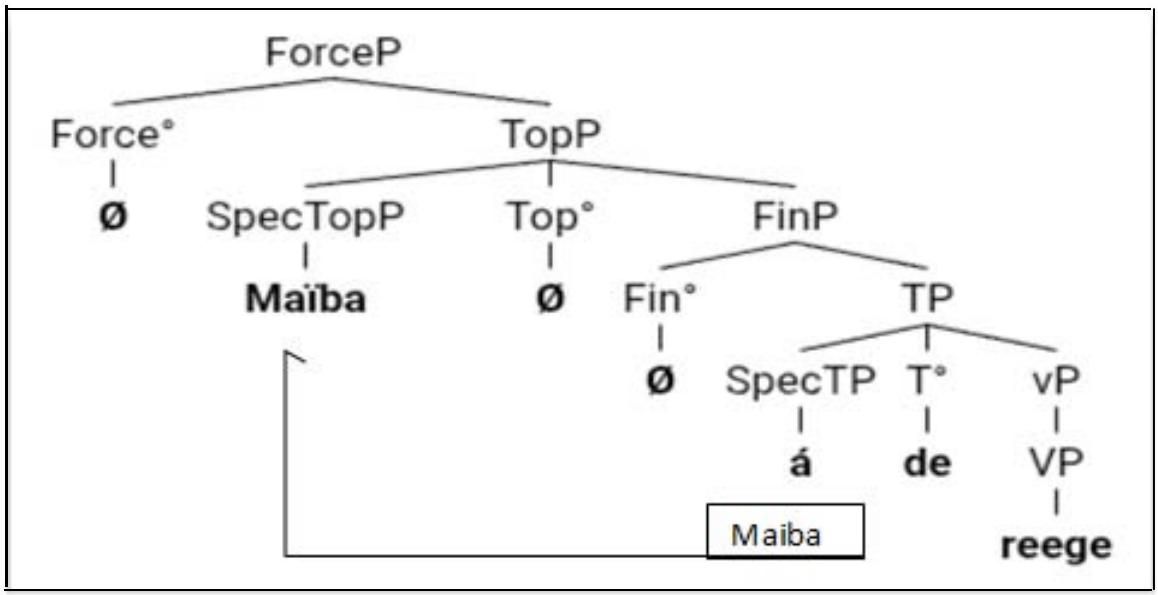
From this diagram, we realize that, in Tupuri, topicalisation involves moving a constituent from its canonical position in the clause to the left periphery to mark it as the topic, or what the sentence is about. In the sentence "Maïba, à de reege", the DP Maïba is originally generated in the SpecTP position but is moved to SpecTopP to signal its discourse prominence. To maintain grammatical and referential integrity, a resumptive pronoun `á` is inserted in the original subject position, co-referential with the topicalised DP. This pronoun ensures that the syntactic relation between the subject and the predicate remains intact while allowing the topic to appear at the front of the clause. Meanwhile, the verbal predicate `de reege` stays in its base position within TP/vP, preserving the canonical event structure and maintaining the core argument-predicate relations
### b) Object Topicalisation
Object topicalisation is a syntactic phenomenon whereby the object of a clause is fronted to the left periphery, specifically to Spec-TopicP, to serve as the discourse topic. This displacement highlights the object while the remainder of the clause forms the comment, expressing what is said about the object. In many cases, Tupuri uses a resumptive pronoun in the canonical object position within the VP to maintain grammatical and semantic coherence. The process involves movement from the base VP position of the object to Spec-TopicP, leaving the verb and any other complements in their original positions within FinP/TP. For instance:
(4) Tiŋ no, wur tor ne go suu
House DEF 1PL clean 3SG yesterday '
The house, we cleaned it yesterday.'
In the sentence (3), the object Kefder no is fronted to clause-initial position as the topic, while be functions as a resumptive pronoun in VP. Similarly, in (4), the object Tiy no is topicalised, with the resumptive pronoun ne maintaining the link to its original position.
The diagram representation of one of the sentences, showing the hierarchical organisation of the topicalised object within the left periphery, are as follows:
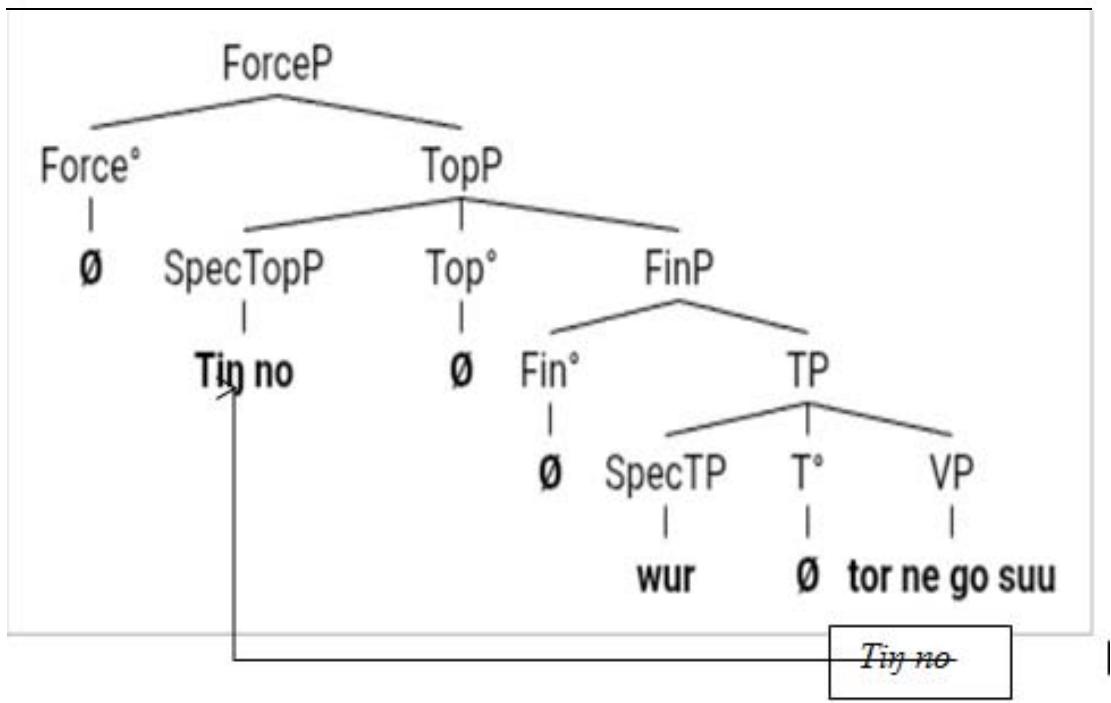
The above diagram shows that in Tupuri, object topicalisation occurs when a constituent that is normally the object of the verb is moved to the left periphery of the clause to mark it as the topic, or the entity the sentence is about. In the sentence "Tin no, wur tor ne go suu" ("The house, we cleaned it yesterday"), the DP Tin no ("the house") is topicalised and occupies SpecTopP in the left periphery, signaling its discourse prominence. To maintain grammatical and referential relations, a resumptive pronoun 'ne' is inserted within the VP, co-referential with the topicalised object, ensuring that the verb can still assign its argument properly. The VP itself remains intact, containing the verb complex 'tor go' ("cleaned"), the resumptive pronoun 'ne', and the temporal adjunct 'suu' ("yesterday"), while the subject pronoun 'wur' ("we") occupies SpecTP. This structure demonstrates that Tupuri uses left-dislocation plus resumptive pronouns as a strategy for object topicalisation, preserving both syntax and discourse coherence
### c) Adjunct Topicalisation
In Tupuri, adjunct topicalisation occurs when temporal, locative, or manner adjuncts are fronted to the left periphery, specifically to Spec-TopicP, to function as the discourse topic. This fronting highlights the adjunct and situates the comment, the remainder of the clause, in relation to it. Unlike argument topicalisation, adjunct topicalisation typically does not require a resumptive pronoun, as the adjunct is external to the VP and does not affect core argument structure.
(5) Ti gel luumo no, Karga hay yed nee be go At market DEF, Karga sold vegetables DEF-POSS At the market, Karga sold his vegetables.'
(6) Suu, wur hay ti luumo Yesterday 1PL COP at market' Yesterday, we were at the market For example, in the sentence (5), the locative adjunct Ti gel luumo no is topicalised to clause-initial position. Similarly, in (6), the temporal adjunct Suu is fronted.

The diagram representation, showing the hierarchical organisation of the topicalised adjunct, is as follows:
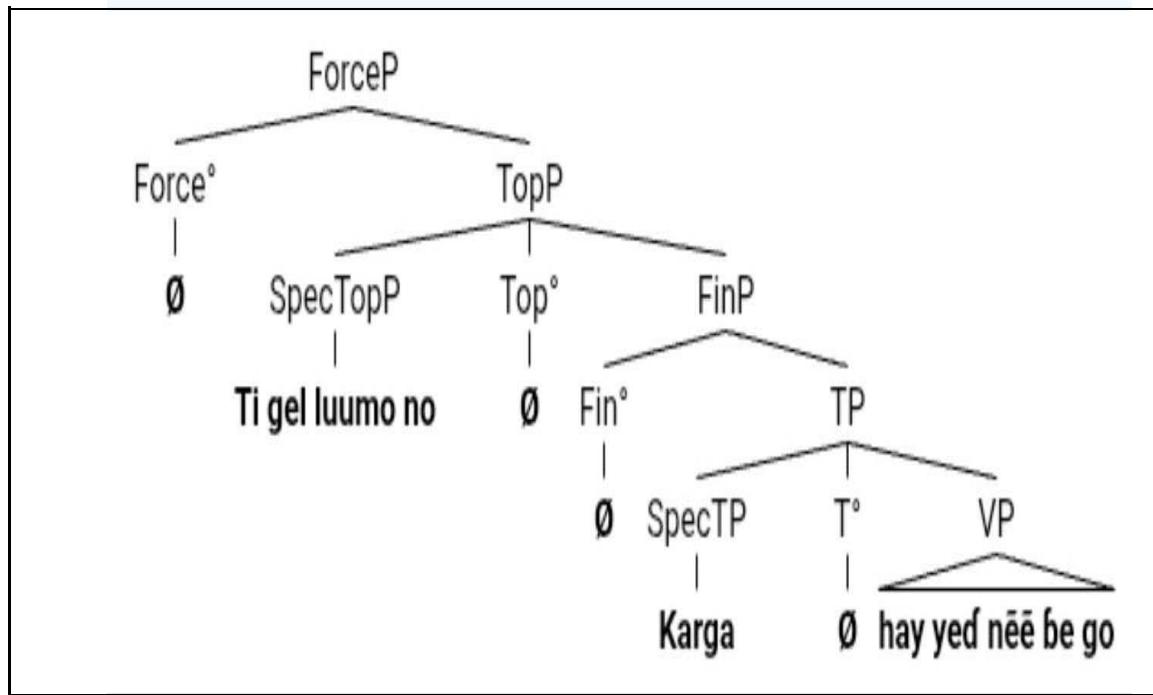
From the diagram above, we realize that adjunct topicalisation occurs when an adjunct, such as a locative phrase, is moved to the left periphery of the clause, specifically to SpecTopP within TopP, to signal discourse prominence. For example, in the sentence "Ti gel luumo no, Karga hay yed nee be go" ("At the market, Karga sold his vegetables"), the locative phrase Ti gel luumo no is topicalised and occupies SpecTopP, while the subject Karga remains in SpecTP and the VP hay yed nee be go remains intact, preserving the canonical argument structure. Unlike topicalised objects, adjuncts do not require a resumptive pronoun, as seen in this example where no pronoun links Ti gel luumo no to the VP. This structure illustrates that Tupuri uses the ForceP-TopP-FinP-TP hierarchy to allow left-peripheral movement of adjuncts for discourse emphasis while maintaining grammatical relations and the integrity of the VP.
### d) Resumptive Pronouns
In Tupuri, resumptive pronouns are used when a topicalised constituent, whether a subject or an object, is displaced to the left periphery. These pronouns appear in the canonical argument position within the VP, maintaining syntactic and semantic coherence by linking the fronted topic to its original position. This ensures that the sentence remains well-formed and that the Topic-Comment structure is preserved, allowing the fronted element to retain its discourse prominence while the comment conveys the predicate information.
#### (7) May geemanbin no, á hay raw wo mban were
SisterDEF 3SG. Went to village
My sister, she went to the village.
(8) Je tãâbe no, á hay sii ree maga hres go jag paâre ge deban
Old man DEF 3SG told story long about past
The old man, he told a long story about the past.
(9) Kamliiri wo, á hay joŋ wo hrag bil fèele no child PL 3PL play yard DEF '
The children, they played in the yard.'
In the sentence (7), the topicalised subject May geemanbin no is fronted to Spec-TopicP, while the resumptive pronoun á appears in the VP. Similarly, in (8), the pronoun á resumes the topicalised subject, maintaining grammatical integrity. In (9), the plural resumptive pronoun á links back to the fronted topic Kamliiri wo.
The linear bracketed representations of these sentences are as follows:
[ForceP [TopicP May geemanbin no] [Top' [FocusP [FinP a hay raw [VP wo mban were]]]]
[ForceP [TopicP Je tãâbe no] [Top' [FocusP [FinP á hay sii ree maga [VP hres go jag pãâre ge debane]]]]]]
[ForceP [TopicP Kamliiri wo] [Top' [FocusP [FinP a hay joŋ [VP wo hrag bil fèele no]]]] In these structures, the topicalised constituents occupy Spec-TopicP, while the resumptive pronouns in VP preserve argument structure and coreference. This pattern illustrates how Tupuri utilises resumptive pronouns to maintain both syntactic well-formedness and clear Topic-Comment articulation within the Cartographic framework.
## V. CONCLUSION
In conclusion, the analysis of topicalisation in Tupuri demonstrates that the language systematically employs the left periphery to encode discourse prominence. Subjects, objects, and adjuncts can be fronted to Spec-TopicP, marking them as topics while the remainder of the clause constitutes the comment. Resumptive pronouns are used when necessary to maintain grammatical integrity and preserve coreference. The tree diagrams and the linear bracketed representations show that Tupuri aligns with the Cartographic framework, where movement to the left periphery serves as a key mechanism for highlighting discourse-relevant elements. Overall, this study highlights the intricate interplay between syntax and discourse in Tupuri, confirming that topicalisation is a productive strategy for managing information structure and ensuring clear Topic-Comment articulation in the language.
### ABBREVIATION LEGEND
TOP = Topic marker
DEF = Definite marker
PST = Past tense
1SG/1PL = First person singular/plural
#### 3SG.M/3SG.F= Third person singular masculine/feminine
3PL= Third person plural
Generating HTML Viewer...
References
9 Cites in Article
Mark Baltin (1982). Movement to the Higher V Is Remnant Movement.
R Boyd (1974). Linguistic classification of the Adamawa-Ubangi languages.
G Cinque,L Rizzi (2010). The cartography of syntactic structures.
D Crystal (2008). A dictionary of linguistics and phonetics.
M Frascarelli,R Hinterhölzl (2007). Types of topics and their syntactic positions.
R Jackendoff (1972). Semantic interpretation in generative grammar.
Knud Lambrecht (1994). Information Structure and Sentence Form.
Luigi Rizzi (1997). The Fine Structure of the Left Periphery.
J Ross (1967). Constraints on variables in syntax.
No ethics committee approval was required for this article type.
Data Availability
Not applicable for this article.
How to Cite This Article
Ebenezert Welyang Le Grand. 2026. \u201cTopicalisation in Tupuri: A Cartographic Approach\u201d. Global Journal of Human-Social Science - A: Arts & Humanities GJHSS-A Volume 25 (GJHSS Volume 25 Issue A7).
Explore published articles in an immersive Augmented Reality environment. Our platform converts research papers into interactive 3D books, allowing readers to view and interact with content using AR and VR compatible devices.
Your published article is automatically converted into a realistic 3D book. Flip through pages and read research papers in a more engaging and interactive format.
Our website is actively being updated, and changes may occur frequently. Please clear your browser cache if needed. For feedback or error reporting, please email [email protected]
Thank you for connecting with us. We will respond to you shortly.