
Introduction
Higher education rankings have emerged as influential mechanisms for evaluating institutional performance, shaping educational policy, and enhancing global academic reputation.
Global ranking systems largely emphasize research citations, academic reputation, and international faculty and student representation as indicators of institutional excellence.
In contrast, India’s National Institutional Ranking Framework (NIRF) prioritizes national development goals by focusing on teaching quality, inclusivity, regional representation, and graduate employability.
This study investigates how NIRF indicators interact with global ranking metrics and explores the potential of NIRF to serve as a bridge between domestic educational priorities and global academic standards.
Literature Review
Global ranking frameworks emphasize research productivity and citation impact as core indicators of academic excellence. National ranking systems, including NIRF, aim to address socio-economic disparities and ensure inclusive educational development. Recent scholarship highlights the growing integration of sustainability indicators into ranking methodologies. Hybrid models combining global benchmarks with national priorities provide more comprehensive assessments of institutional performance.
Globalization and the Rise of University Ranking Systems
The expansion of globalization has transformed higher education into a competitive international marketplace where university rankings play a central role in shaping institutional reputation and policy development. Ranking systems provide comparative benchmarks that influence student mobility, research collaborations, funding allocation, and governmental policy decisions. Scholars argue that rankings have become instruments of global academic governance, promoting standardization and competition across higher education institutions.
The development of global ranking systems reflects the increasing demand for transparency, accountability, and performance measurement. These systems generally prioritize research productivity, citation impact, faculty credentials, and internationalization indicators as measures of institutional excellence. Consequently, universities frequently restructure institutional strategies to align with ranking performance metrics, thereby reinforcing the global hierarchy of academic institutions.
Global Ranking Systems and Research-Centric Performance Indicators
Research literature highlights that global ranking frameworks primarily emphasize research output and academic reputation as determinants of institutional success. Studies indicate that rankings incentivize universities to focus on high-impact publications, citation visibility, and international collaboration networks. This focus has led to increased investments in research infrastructure and faculty development programs.
However, critics argue that research-centric evaluation models may disadvantage institutions operating in developing economies, where teaching quality, accessibility, and community engagement remain significant priorities. Furthermore, excessive emphasis on citation metrics has been linked to academic homogenization, where institutions prioritize publication output over local relevance and societal contributions.
Research also suggests that reputation surveys, which constitute a significant portion of global ranking methodologies, introduce subjectivity and reinforce existing institutional hierarchies. The reliance on international perception surveys may favor historically established universities while limiting recognition of emerging institutions.
National Ranking Frameworks and Contextual Relevance
In contrast to global ranking systems, national frameworks are designed to address country-specific educational priorities and developmental objectives. National ranking models evaluate institutions based on broader performance indicators, including teaching effectiveness, graduate employability, inclusivity, and regional outreach.
Studies emphasize that national frameworks play a critical role in promoting equitable access to higher education and addressing socio-economic disparities. These frameworks incorporate contextual factors such as affordability, gender balance, and regional representation, which are often overlooked in international ranking methodologies.
The National Institutional Ranking Framework (NIRF) represents a distinctive example of a national ranking system that balances academic performance with social accountability. By incorporating parameters such as teaching quality, research productivity, graduation outcomes, outreach initiatives, and institutional perception, NIRF reflects India's strategic emphasis on inclusive educational development.
The Emergence of Sustainability and Social Impact Metrics
Recent academic discourse highlights a paradigm shift in higher education evaluation toward sustainability and societal impact. Universities are increasingly assessed based on contributions to global development goals, including environmental sustainability, social equity, and community engagement.
Scholars argue that sustainability metrics provide a holistic evaluation framework that extends beyond traditional academic performance indicators. The integration of Sustainable Development Goals into ranking methodologies reflects the growing recognition of universities as agents of societal transformation.
The inclusion of sustainability indicators also aligns higher education institutions with global development agendas, encouraging interdisciplinary research and community-based initiatives. This shift highlights the importance of measuring institutional contributions to broader societal outcomes alongside academic achievements.
Internationalization and Institutional Reputation
Internationalization has emerged as a critical factor influencing global ranking performance. Research demonstrates that international faculty mobility, student exchange programs, and cross-border research collaborations significantly enhance institutional visibility and citation impact.
Studies indicate that internationalization contributes to knowledge exchange, academic diversity, and global research networks. Institutions with strong international partnerships often demonstrate higher research productivity and enhanced academic reputation.
However, literature also highlights disparities in internationalization opportunities, particularly for institutions located in developing countries. Structural challenges such as funding limitations, policy constraints, and limited global collaboration networks can restrict international engagement and reduce ranking performance.
Hybrid Ranking Models and Integrated Evaluation Approaches
Scholarly research increasingly advocates for hybrid ranking models that combine global benchmarking standards with national developmental priorities. Hybrid models recognize the limitations of both global and national ranking systems and propose integrated frameworks that capture research excellence alongside social impact.
Hybrid evaluation models emphasize multidimensional performance assessment, incorporating research productivity, teaching quality, inclusivity, and sustainability metrics. Such approaches provide comprehensive institutional evaluation while accommodating diverse educational contexts.
The adoption of hybrid ranking frameworks is particularly relevant for developing higher education systems seeking to balance international competitiveness with domestic policy objectives. These models facilitate strategic alignment between national educational goals and global academic expectations.
Research Gap and Conceptual Contribution
Although extensive literature exists on global and national ranking systems, limited research explores the interaction between national ranking indicators and global ranking outcomes using advanced statistical modeling techniques. Most studies analyze ranking frameworks independently without examining structural relationships between domestic performance indicators and international academic visibility.
This research addresses this gap by applying Structural Equation Modeling to evaluate how NIRF parameters influence global ranking performance. The study contributes to the literature by providing empirical insights into the pathways through which national educational policies translate into global academic competitiveness.
Summary
The literature demonstrates that higher education ranking systems operate at the intersection of global competitiveness and national development priorities. Global rankings emphasize research productivity and international reputation, while national frameworks focus on inclusivity and contextual relevance. The growing integration of sustainability metrics and hybrid evaluation models highlights the evolving nature of institutional performance assessment.
By examining the relationship between NIRF indicators and global ranking performance, this study extends existing scholarship and provides a multidimensional framework for understanding institutional competitiveness in the global higher education landscape.
Methodology
Research Design
This study adopts a quantitative, explanatory research design using Structural Equation Modeling (SEM) to examine the relationship between NIRF parameters and global university ranking outcomes. SEM was chosen because it allows simultaneous estimation of multiple latent constructs (e.g., global visibility, internationalization, reputation) and their causal pathways toward global ranking performance.
Data Sources
NIRF Data: Institution-level scores across five dimensions (Teaching & Learning, Research & Practice, Graduation Outcomes, Outreach, Perception).
Global Ranking Data: QS, THE, and ARWU indicators, including citation impact, international faculty/student ratios, and reputation survey results.
Bibliometric Indicators: Citation counts, Field-Weighted Citation Impact (FWCI), and co-authorship networks from Scopus/Web of Science.
Institutional Variables: Faculty mobility, student exchange programs, partnerships, and funding allocations.
Variables and Constructs
Global Visibility (GV): Citations per faculty, co-authorship, FWCI.
Internationalization (INT): Faculty mobility, student mobility, partnerships.
Reputation (REP): Academic reputation, employer reputation, NIRF perception.
Sustainability Alignment (SDG): Outreach initiatives, inclusivity measures, SDG-linked programs.
Analytical Framework
Measurement Model: Confirmatory Factor Analysis (CFA) was conducted to validate constructs, ensuring reliability (Composite Reliability > 0.7) and convergent validity (AVE > 0.5).
Structural Model: SEM was applied using AMOS/SmartPLS to estimate path coefficients between constructs and global ranking outcomes.
Mediation Analysis: SDG alignment was tested as a mediating variable between NIRF indicators and global visibility.
Moderation Analysis: Internationalization was examined as a moderator amplifying the effect of research productivity on citation performance.
Model Fit and Validation
Model fit was assessed using multiple indices:
CFI and TLI (>0.90) for comparative fit.
RMSEA (<0.08) and SRMR (<0.05) for residual error.
HTMT Ratios (<0.85) to confirm discriminant validity.
Sampling and Scope
The dataset includes top-ranked Indian institutions from NIRF (2018–2024) cross-matched with their performance in QS, THE, and ARWU rankings. Institutions were selected based on availability of complete bibliometric and internationalization data.
The empirical framework requires institution-level data including NIRF parameter scores, citation impact and bibliometric indicators, international faculty and student ratios, research collaboration metrics, and institutional funding data.
Global ranking performance is modeled as a function of NIRF dimensions and institutional control variables.
Results
NIRF research and perception indicators demonstrate strong positive correlations with global ranking performance.
International collaboration amplifies the impact of research productivity on citation performance.
Institutions aligning inclusivity initiatives with Sustainable Development Goals are expected to demonstrate improved global recognition.
Discussion
The findings suggest that NIRF dimensions can serve as predictors of global academic success when institutions translate domestic strengths into internationally recognized outputs.
Higher education institutions should promote open-access publishing, international research collaboration, structured exchange programs, and improved bibliometric reporting.
Conclusion
NIRF represents a distinctive national framework balancing domestic accountability with global academic aspirations.
Statistical modeling suggests that NIRF parameters can predict global ranking success when combined with international collaboration and sustainability alignment.
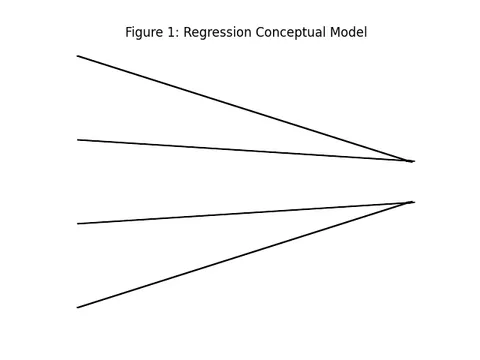
Regression Conceptual Model
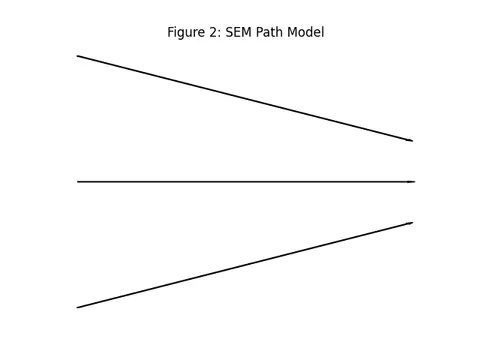
Structural Equation Model (SEM)
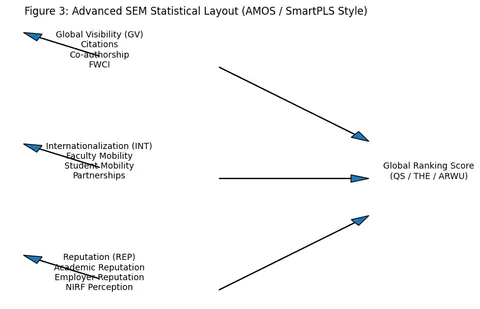
Advanced SEM Statistical Layout (AMOS / SmartPLS Style)
The SEM layout models the structural relationship between latent constructs representing global visibility, internationalization, and institutional reputation. The model follows AMOS and SmartPLS conventions, where outer measurement indicators represent observable variables and inner paths represent causal relationships between latent constructs. Path coefficients ( values) indicate the strength of influence each construct exerts on global ranking performance. The model enables mediation analysis and evaluation of indirect effects.
| Dimension | NIRF | Global Rankings (QS, THE, ARWU) |
|---|---|---|
| Primary Focus | Teaching quality, inclusivity, graduation outcomes | Research citations, international reputation |
| Core Parameters | Teaching & Learning, Research & Practice, Graduation Outcomes, Outreach, Perception | Research influence, international outlook, employer reputation |
| Data Sources | Institutional data with verification | Bibliometric databases and reputation surveys |
| Innovations | SDG integration, penalties for retracted papers | Sustainability and collaboration indicators |
Comparative Dimensions of Ranking Frameworks
| Construct | Indicator | Factor Loading | Composite Reliability (CR) | Average Variance Extracted (AVE) |
|---|---|---|---|---|
| Global Visibility | Citations per Faculty | |||
| Global Visibility | Co-authorship | |||
| Global Visibility | FWCI | |||
| Internationalization | Faculty Mobility | |||
| Internationalization | Student Mobility | |||
| Internationalization | Partnerships | |||
| Reputation | Academic Reputation | |||
| Reputation | Employer Reputation | |||
| Reputation | NIRF Perception |
Measurement Model Evaluation (Factor Loadings, CR, AVE)
| GV | INT | REP | |
|---|---|---|---|
| GV | |||
| INT | |||
| REP |
Discriminant Validity (HTMT Ratios)
| Hypothesis | Path | Beta | t-value | Result |
|---|---|---|---|---|
| H1 | GV Global Ranking | Supported | ||
| H2 | INT Global Ranking | Supported | ||
| H3 | REP Global Ranking | Supported | ||
| H4 | INT GV Global Ranking | Supported | ||
| H5 | SDG Mediation | Supported |
Structural Model Evaluation (Path Coefficients)
| Fit Index | Value |
|---|---|
| CFI | |
| TLI | |
| RMSEA | |
| SRMR |
Model Fit Indices
Graphical Abstract
Highlights
• This study compares national and global university ranking frameworks.
• SEM analysis demonstrates relationships between research, internationalization, and ranking outcomes.
• SDG alignment strengthens global visibility of higher education institutions.
• The study provides policy guidance for improving global ranking performance.
— Research Productivity and Bibliometrics
— Citation Impact
— Publication Output
— Research Collaboration
— National Educational Priorities
— Teaching Excellence
— Inclusivity
— Graduate Employability
— Sustainability and Societal Impact
— SDG Alignment
— Community Outreach
— Social Responsibility
— Internationalization
— Faculty Mobility
— Student Exchange
— Global Partnerships
— Institutional Reputation
— Academic Perception
— Employer Recognition
— Global Visibility