
1. Introduction
It is assumed that the University is responsible for training competent professionals to meet the demands of the labor market (López, 2008). In the professional training process in Cuba, competencies also take into account ethical commitment and values. Student training follows the guiding principle of integrating study and work, which includes the development of values and ethical conduct within its educational function (Mena, 2008; Casanova et al., 2020). The curriculum for agricultural programs was designed according to the objectives-based approach (García and Callejas, 2007). It lacks guidelines and activities for developing competencies in knowledge management and innovation for local agricultural development among students. It only addresses the development of communication and language skills (López et al., 1999). This research builds upon the doctoral theses of Garcés (2013), Martínez (2018), and others. It explores the development of competencies in knowledge management and innovation for local agricultural development among agricultural science students. The need for this research stems from the Science and Innovation-Based Government Management System (Díaz-Canel, 2021). This policy demands Changes at the University that have not yet been achieved.
The implementation of the Economic and Social Policy Guidelines of the Communist Party of Cuba (PCC, 2021) is a challenge that demands changes in higher education (Diaz-Canel, 2012; Alarcón, 2016; and Núñez et al., 2021). It requires “… fostering links between universities and government in the territories” and “… ensuring that managers, upon identifying a problem, go to the university” (Diaz-Canel, 2012). The government aims to explore actions to promote the science-government link, with the active participation of the university (Diaz-Canel and Fernández, 2021).
This problematic situation leads to the need for a training model for developing competencies in knowledge management and innovation for agricultural students. Thus, the general objective of this research is: To implement a training model for developing competencies in knowledge management and innovation for local agricultural development in agricultural science students.
2. Methodology
The research involves a study group comprised of a cohort of 26 agricultural science students from the Encuentro Course (EC) at the Camajuaní University Center (CUM), out of a total population of 134, selected randomly. These students, in addition to being local stakeholders, participate in the local development of Camajuaní. The Model is implemented in the Agricultural Extension course, where increasingly complex learning sequences are applied to develop the competency being studied in the students. This helps optimize their contribution to local agricultural development. Thus, the course focuses on training students to find solutions to problems, contribute to local agricultural development, innovate, and achieve competitive, high-value-added production.
The agricultural students are trained with the knowledge, skills, and values to analyze producers’ needs and promote participatory dynamics and technologies adapted to those needs. To achieve this objective, students develop competencies in knowledge management and innovation for local agricultural development through their coursework. The curriculum is relevant to the local community and supports the Ministry of Agriculture’s (MINAG) Agricultural Extension System.
The courses are based on the principle that students can construct their knowledge through experiences, readings, and, above all, practical fieldwork. Through dialogue with professors, farmers, managers, and technicians, students build shared knowledge, incorporate it into their practice, and develop competencies. A participatory approach is used to develop a training model that emphasizes the process of shared knowledge management and innovation, utilizing didactic sequences of increasingly complex learning tasks, following the guidelines of Díaz (2013).
The process is based on shared knowledge and analysis of the socio-productive reality. The environment of the production units is observed, and research tools are applied to identify strengths and weaknesses. The explicit and motivated demands of the producers are defined. Visits are made to farms, ranches, and producers’ homes to learn about food production and understand their explanations. For efficient use of time, each student coordinates with the cooperative’s board of directors to locate the units and organize the visit beforehand.
The information obtained is processed through brainstorming in a team with the directors of the production unit, producers, leading farmers, and community members. A cause-and-effect diagram is used to determine the main causes influencing the situation of each farm. The practical significance lies in the teaching materials, methodological guidelines, brochures, pamphlets, workshops, and learning sequences provided to the program to implement the development of this competency in response to an urgent social need. The theoretical contribution is the design and implementation of a training model based on the higher education experience at Municipal University Center (CUM).
The thesis is grounded in the principles of dialectical materialism as a general method. The methodology adopted is essentially qualitative (Hernández et al., 2014). It uses methods and techniques of Participatory Action Research (PAR) to obtain theoretical and practical references (interviews, group meetings, discussion forums, working meetings, and questionnaires).
The empirical data used spans the years 2016 to 2022. The research methods are subordinate to the research objective and adhere to the qualitative research paradigm. The analytical-synthetic method is used to study the literature and clarify the theoretical foundations and conditions of the Competency Development Model under study, determine the Model’s structure, and arrive at conclusions and recommendations.
The inductive-deductive method (Nocedo and Abreu, 2011) allowed us to establish regularities for designing and implementing the Model and integrating its organizational components. The historical-logical analysis method allowed for verifying the historical nature of the problem and the evolution of the solutions found in the research, based on the history of local agriculture and the role of higher education in Camajuaní. The genetic method allowed us to determine the relationship between local actors directed by the government. Modeling is employed in to allow us to designing the Model, graphing, and comparing experiences with local agricultural development theories. It allows for the synthesis of the process and is the conception that is materialized in practice.
From the methods and techniques of the empirical level, documentary analysis is used to study documents generated at the CUM (Municipal University Center), the National Association of Farmers (ANAP), the government, and the Ministry of Agriculture (MINAG). Interviews are conducted with directors, professors, students, specialists, and advisors; participant observation is used; and focus groups are held with management councils, professors, students, and professionals, in consultations between the government and Higher Education Institutions (HEIs), and in meetings with advisors and specialists. Methodological triangulation is used to verify the accuracy and plausibility of the results.
The research is conducted from the perspective of educational sciences due to the conditions provided by the CUM’s connection with the government and other local actors. This allows for the study of the relationship between the municipality’s conditions and knowledge management and innovation for local agricultural development based on the intervention of different social actors (Báez et al., 2018). The patterns of competence development in knowledge management and innovation for local agricultural development in Camajuaní are determined. Documents from institutions such as the government (AMPP, 2018), the Municipal Directorate of Economy and Planning, the MINAG Delegation, ANAP, and CUM are reviewed. Interviews are used to corroborate and update the information collected in the documents.
3. Results and Discussion
Model Description
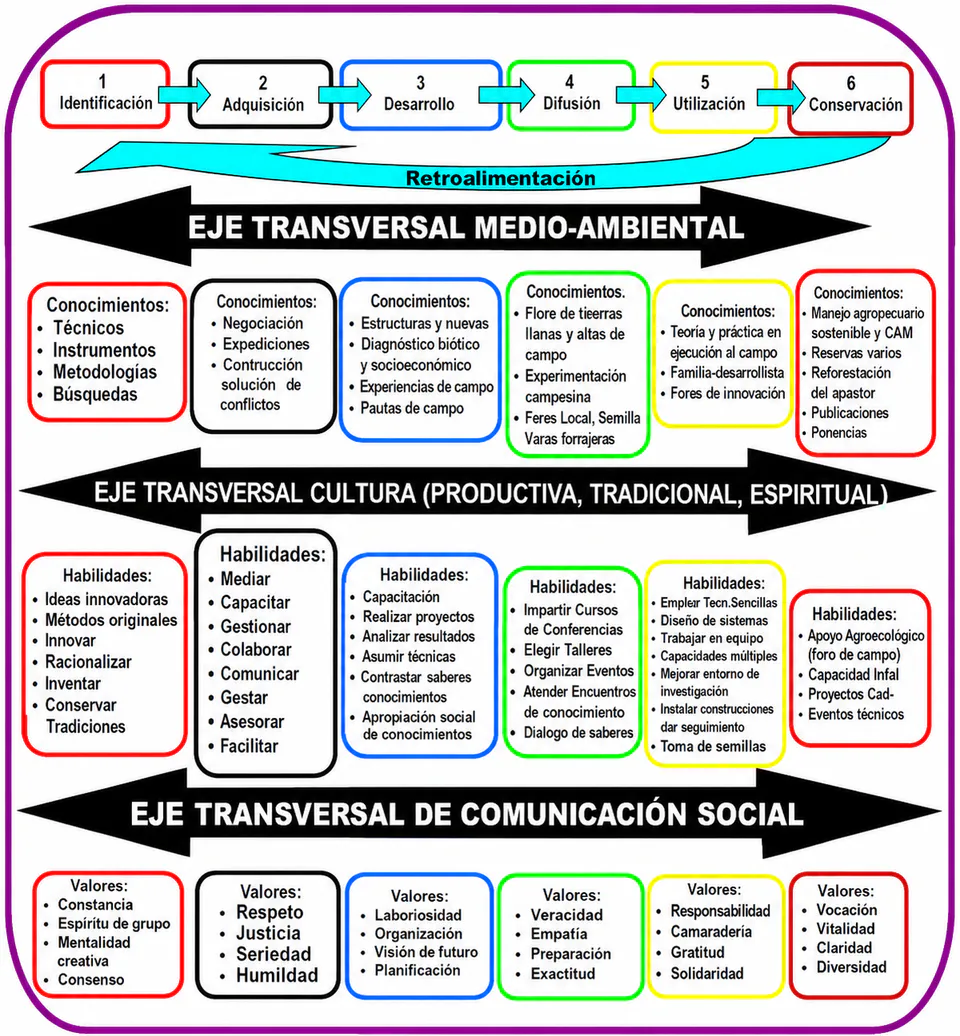
The knowledge, skills, and values that comprise the competency in knowledge management and innovation for local agricultural development, as developed in students, align with the six dimensions of knowledge management in the Model. Each of these dimensions is part of the knowledge management and innovation process for local agricultural development. The description of the Model’s dimensions and cross-cutting themes is explained below. It is structured around three cross-cutting themes that ensure the sustainability of knowledge management and innovation for local agricultural development and establish priorities to consider in any socio-economic transformation project and to reinforce sustainability:
Cultural: It conserves and improves the cultural, organizational, and relational heritage in communities and production units. It maintains ancestral productive and spiritual traditions and culture, establishing a dialogue with parents and grandparents who preserved and enriched it so that it has reached the present day.
Environmental: Knowledge is analyzed from the perspective of its effect on the environment to generate knowledge compatible with the environment and guarantee the sustainability of the impact achieved.
Social communication: The processes of information exchange for decision-making permeate the Model for training competence in knowledge management and innovation for local agricultural development and, therefore, are a cross-cutting axis that cannot be overlooked for knowledge management in communities in each dimension of the Model.
Role of Higher Education in Knowledge Management
The development of the studied competency is incongruous without considering the role of higher education within the context of the University of Montevideo (CUM). Universities are institutions called upon to generate and disseminate knowledge. Research should be geared towards solving concrete problems, and projects should be based on real needs. (Hernández, 2015).
Several authors explore the dimensions of knowledge management. Rao and Osey (2017) use the dimensions of creation, capture, retrieval, access, and use. Tarí and García (2019) suggest the dimensions of creation, transfer, storage, application, and use. Torres et al. (2014) refer to the dimensions of identifying, retaining and socializing, protecting and valuing, using, and creating. González (2014) and Acevedo et al. (2020) propose methodological approaches for formulating knowledge management and innovation models in higher education, theoretically validating the ontological and epistemological dimensions, inspired by the theory of Nonaka and Takeuchi (1999).
The dimensions of knowledge management and innovation, as defined by Garcés (2014) and adopted by the author, are: identification, acquisition, development, dissemination, utilization, and retention. These dimensions are continuous, allowing for the creation of an expanded, repetitive cycle; they enhance the local innovative imagination and align with the research interests. The author favors these dimensions because they closely match the needs of a model that integrates them into the development of competence in knowledge management and innovation for local agricultural development.
The literature lacks references to modeling the relationship between CUM (Competency in Management and Innovation) and the development of competence in knowledge management and innovation for local agricultural development. This demonstrates that the problematic situation generated by the scientific problem remains unresolved, as it presents shortcomings both in the theoretical-methodological sphere and in relation to the practical object of study. There is a need to investigate the development of competence in knowledge management and innovation for local agricultural development among agricultural science students.
The models and standards used to identify, regulate, and develop competencies, among which SCONUL (2011) and Espinoza and Campuzano (2019) stand out, have the merit of contributing to the development of competent professionals. Their limitation is that they are conceived from the perspective of the information manager. According to these authors, libraries are the natural setting for the training studied.
It is concluded that the specific context in which the models, standards, and guidelines were conceived does not align with the particularities of higher education in Cuba or with the training model for agricultural science students. This research compels us to focus on teachers, rather than information managers, as those responsible for guiding the competency development process in agricultural science students. It also necessitates considering the training process in general, and the Professional Development Program (PDE) in particular, as the ideal context for developing competency in knowledge management and innovation for local agricultural development.
Solution to the problematic situation and conceptualization of the object of study
There is an absence of a model for developing the competency being studied, a competency that is being demanded by the country’s leadership. This gap in the theory of competency development reveals a contradiction between the training demands of agricultural students and the limitations of teachers in addressing competency development within subjects lacking methodological recommendations for achieving it in educational practice.
The competency in knowledge management and innovation for local agricultural development is presented as: “A configuration of personality that integrates knowledge, skills, and values that are formed and will be mobilized by the agricultural student in their performance as a professional by identifying, acquiring, developing, disseminating, using, and retaining relevant knowledge to solve professional problems in relation to local agricultural development, taking into account the socially desirable performance model of the agricultural professional, constructed within the specific historical context of Cuba.”
On-the-job training
Competence in knowledge management and innovation is developed through action learning in the transfer of technologies for sustainable food production. This fosters biodiversity in agro-ecosystems, sustainable management, and student participation as extension agents of scientific results that promote agricultural innovation within the production unit. Students develop the capacity to promote research and apply empirical experiences.
This training methodology develops students’ capacity for empathetic and participatory interaction. Through action learning, they learn from their own experiences in exchange with others. They diagnose a production problem and propose solutions. In this process, the professors, the PDE facilitation team, coordinate each cycle of learning sequences with increasingly complex tasks to develop this competence.
Students are trained based on the understanding that the subjects develop their knowledge, skills, and values for teamwork, communication, training, and creative thinking. The PDE is implemented in a participatory manner so that students become extension agents. The faculty’s aspiration is to follow the paradigm of being "itinerant teachers" (Martí, 2015). This allows them to share cutting-edge agroecological technologies within the community.
Students and professors operate on the premise that the courses should develop competencies by working on the production unit, communicating, educating adults, fostering creative thinking, and contributing to values formation. This enables the dissemination and adoption of the most appropriate agroecological techniques for the diagnosed problem by farmers and state producers. The technology transfer needs of producers for sustainable production on the production units are identified. The scientific novelty lies in its contribution and testing of a Knowledge Management and Innovation Development Competency and a Model for Knowledge Management and Innovation Development in Local Agricultural Development. The novelty lies in the theoretical synthesis of the Model and in the geographic and institutional application of the Model to the Camajuaní Agricultural System, based on six dimensions defined by Garcés (2014). The Model designs methods and forms for organizing competence’s development within the teaching and learning process and a system of methodological teacher training offered by the CUM (Municipal University Center) to the region.
Modeling the development of competence and preparation of teachers
The innovative aspect of this research lies in its methodological approach, which relies on the participation of students as extension agents and key players in the knowledge management and innovation process for local agricultural development at the CUM (University Center of Montevideo). The methodology used in its different stages follows this sequence: 1. Training in the implementation of technologies, 2. Selection and preparation of the experimental area, 3. Setting up the experiment, 4. Evaluating the experiment and collecting experimental data, 5. Processing the information, and 6. Writing the results report. The focus of novelty is focused on the fact that innovation is based on the participatory research model that is student-led, as part of their comprehensive training.
The integration of agricultural students and professors into the transfer of technologies for sustainable food production highlights the need for a model for developing competence in knowledge management and innovation for local agricultural development (Hernández et al., 2021). The previous results and the conceptualization of the competence studied serve to define the dimensions for the model. This might seem to contradict research based on the qualitative paradigm. However, the model does not emerge from a hypothetical-deductive reasoning process, but rather from an investigative process of successive approaches to the actions of the CUM (Municipal University Center) and agricultural science students in the training process. Its conceptualization is based on an inductive approach, discovering, describing, and systematizing regularities in local agricultural development. This is achieved through research and generalizations arising from the approach to the phenomenon studied in the literature and the pedagogical practice of the CUM. Criteria from researchers who used models to solve problems in educational sciences were examined. No research was found. Regarding models for developing competence in knowledge management and innovation for local agricultural development, the literature reveals a scarcity of research on the use of models in knowledge management and innovation. Criteria are established to substantiate the model, its usefulness, feasibility of implementation, and impact on pedagogical research.
The model is based on knowledge management and innovation for local agricultural development. This topic is rarely addressed within the pedagogical sciences, despite the need to develop agricultural knowledge management and innovation and to place the community at the center of appropriation of agricultural culture by local actors. Therefore, a systematization of authors who investigate models for problem-solving is undertaken (Torres et al., 2014; Boffill, 2010; Reyes, 2011; Rodríguez, 2011; Valle, 2012; Gámez, 2013; and Sañudo, 2014).
As It is regularly determined that these authors view the model as a simplified representation of reality that fulfills a heuristic function by discovering and studying new relationships and qualities of the object, reflecting the reality upon which the researcher acts, in place of the object of study. They consider that a model should reveal the nature of the object being modeled and the theoretical and methodological positions that mediate its implementation.
The model responds to and represents an objective reality and has a material basis that supports it. Local agricultural development requires knowledge managed by actors with training obtained in the production and management of knowledge, a process that occurs based on an ideal model of structures and relationships. Therefore, it reproduces characteristics, structure, and system of relationships of the object of study based on qualities that differentiate it and make it an ideal to be achieved.
The emergence of the model for developing the studied competency stems from the observation of practice. It allows for the conception and study of the object by serving as the foundation for the interconnection of reality, where producers, the productive-pedagogical context, CUM teachers, and professors and researchers from the Agricultural Faculty of Central University Marta Abreu of Las Villas (UCLV), intervene.
The Model It fulfills the requirements, functions, and conditions for training and knowledge management and innovation proposed by Díaz-Canel (2021b). Through abstraction, it allows for the interpretation of the relationships between its elements, determining the essential aspects and qualities that manifest themselves in a change towards a new organization of its elements, which contributes to the qualitative enrichment of the practice.
Implementation of the Model in Local Pedagogical Practice
Once the Model was designed, it was implemented from the Camajuaní University Center (CUM) to the local pedagogical practice setting. The implementation of its dimensions was validated with all actors in the production process in cooperatives, farms, and ranches. Adjustments were made to adapt the expected results to the practice, following the criteria of Benítez and Miranda (2018). This validation process yielded relevant knowledge from the participating actors, allowing for improvements to the initial Model based on the tacit knowledge accumulated by students, professors, researchers, producers, and communities.
As part of the implementation process, the Model was considered defined and needed to be implemented in the pedagogical and agricultural practice of the Camajuaní University Center. It became evident that there was a parallel process of implementing competency in knowledge management and innovation for local agricultural development. The skills, knowledge, and values that define the model are established as implementation parameters, defined in its dimensions and cross-cutting themes according to the students’ hierarchical level and the strategic objectives of the participating organizations, as described by Quiroga and Kausel (2015).
There are factors that contribute to the complexity of implementing a model in social practice. According to Sanghi (2007), implementation in the agricultural pedagogical setting of the Camajuaní University Center (CUM Camajuaní) is no exception. Examples include the limited understanding of the concept of knowledge management and innovation for local agricultural development and its usefulness in the production process, the limited involvement of some local stakeholders, and resistance from MINAG (Ministry of Agriculture) and ANAP (National Association of Small Farmers) officials.
During the initial introduction, a space is created to present the model and the expectations for local agricultural development, along with other topics related to information, technology management, and collaboration. Email is another way to disseminate information. At this stage, the dissemination of the Model is uncommon and the only referenced milestone is Campion (2011).
Observation of the impacts of the implementation of the Model
This study observes the transformations achieved in agricultural science students after the implementation of the Competency Development Model in their training process and determines the impacts of its implementation on the local development of Camajuaní. The proposed Model is part of the continuing education process. It is based on the need to consciously structure the professional training process within the context of the students’ professional activity as local actors. It takes into account its multifaceted nature based on the specific conditions of the production scenario in relation to local agricultural development. Therefore, the components of the Competency Development Model express a systemic character that is energized by interactions between the teacher/trainer and the production scenario/agricultural actor.
Essentially, the students’ training gives a significant economic dimension to the teachers’ educational work by recognizing them as a productive factor. In addition to preparing students for their performance, the knowledge acquired allows for improvements in the production environment. Therefore, the essence of the research object cannot be analyzed in isolation.
The emerging model is an indirect link, mirroring and reflecting the object of investigation, and maintains an objective correspondence with it. This correspondence occurs in its functional and relational aspects (dynamic) and in the systemic aspect that interprets its structure and components (static). This gives it the capacity to provide information susceptible to experimental verification.
The modeling achieves a mediated reflection of knowledge management and innovation as an objective reality. To this end, a study of the context is conducted, identifying elements that, from objective reality and in their interaction, act upon knowledge management and innovation. Relationships and properties of the object are determined, related to the continuous nature of knowledge management and innovation, and its extensionist character and transmission of local agricultural culture. This allows for explaining the process and discovering new relationships that enrich the theory of knowledge management and innovation for local agricultural development.
The model is arrived at through successive approximations, starting from simplified representations of the object that became more complex as the essence of the process was explored. It allows for the integration of two processes: training and production, and highlights the need to contextualize current pedagogical theories to the training conditions within a workplace. Thus, the Model also becomes an instrument for improving the training of all stakeholders in relation to local agricultural development.
The graphic representation of the Model’s implementation process appears in three figures that explain the dynamics of the relationship between the Model’s components, the methodology for preparing teachers for competency development, and the Competency Development Model in knowledge management and innovation for local agricultural development.
The Model is the integration of a group of didactic sequences of teaching tasks and resources of increasing complexity and scope. These develop in students’ values, knowledge, and skills to bring about a quantitative and qualitative increase in behaviors aimed at enhancing their competency. Its essential components are the students and professors of the CUM (Figure 1), who are also production specialists linked to the knowledge management and innovation process, and agricultural actors within the production units. It is developed within their work context and utilizes local technical resources. Characteristics of the student/agricultural actor include: heterogeneity in educational level, diversity of ages and genders, responsibility for the means of production, and dynamic performance in diverse productive scenarios and activities.
Evaluation of the improvement in students and in local agriculture
It is effective to consider the benefits of developing competencies in knowledge management and innovation for the production unit, agricultural students, the knowledge management and innovation process, and local agricultural development. For the production unit, it is a factor of productivity and prestige, as it allows them to fulfill their productive role and effectively generalize best practices. Agricultural science students receive ongoing training that prepares them to transform their particular, family, and socio-community environment, and to transform themselves, in accordance with sustainable local agricultural development (Fernández et al., 2021).
The knowledge management and innovation process is strengthened by improving the quality of the integration between academia and society (community, organizations, companies, ANAP, MINAG, and farms). Finally, for local agricultural development, the outcome of developing this competency—expressed as a professional who manages knowledge and innovation to solve local problems—is an essential asset. This is based on the Model, which emerges as a necessity through knowledge management and innovation. It does so through functional relationships established between the structural components of the process, as a dynamic aspect, and which support its sustainable character. As a result of the mediation between the subjects and the modeled object, an objective correspondence with the object of study is achieved, facilitating constant feedback and allowing for the prediction of future events. The model is a mediating instrument for the personal growth of students, the community, and other stakeholders.
The Model possesses another added value, related to reflecting a little-studied reality. It is continuous in nature because, through the ongoing and renewed training of agricultural science students, it maintains updating, reconversion, enrichment, and permanent development, strengthened by the joint participation of other community actors. This implies modeling a structured process that integrates two processes of different natures: formative and productive. This elevates, according to Mena (2008), the principle of linking study with work to the highest level. The complexity of the training process, within which the object of study is contextualized, inherently requires a holistic approach. This allows for an understanding of its qualities and relationships, the components of the process, and the internal organization of the object’s properties in relation to its environment. This is characterized by an institutional duality with shared functions that contribute to the common goal.
The implementation of the Model has a positive impact on student training and the state of productive activities, extending its influence to the local productive structure. It generates employment and incorporates women into agricultural activities, nursery work, composting, vermiculture, food preservation, and process management (Báez et al., 2019). Another source of employment is the bamboo workshop and furniture production. Another positive factor is the diversification of production, as the promoters of agroecological practices have farms with various crops and reference gardens with fruit trees, medicinal plants, and ornamental plants.
This contributes to environmental education, reforestation, and the care of flora and fauna, and creates productive inputs such as organic fertilizer and animal feed. Economic benefits are reported from the manufacture of silos, which represent a source of income for cooperatives and the country. Savings are achieved by preserving crops, as the silo is a safe and ecological container that conserves 100% of the grain. It is a long-lasting investment that yields benefits and replaces sacks, which are scarce, short-lived, and susceptible to pests. Human health benefits are reported through the control of disease vectors.
Other improvements to human health include the installation of biodigesters, which reduce methane emissions by 95%. They replace wood-burning stoves with efficient ones that run on biodigester gas, leading to a decrease in acute respiratory illnesses. Environmental benefits are reported through the use of agroecological techniques, reforestation, and the reduction of pollutants.
These impacts exemplify how university students in agricultural programs promote development and strengthen the agricultural production network, create infrastructure, generate jobs with a gender focus, generate income, manufacture animal feed and supplies, and achieve reforestation. Production increases through improved yields without chemicals. Local seed conservation is encouraged, as is the use of renewable energy sources such as solar energy and biogas. Production is diversified, including purees, pulps and juices, and dried and candied sweets.
Evaluation of the transformation in students, teachers and the environment
With the participation of producers and guidance from professors at CUM, the Faculty of Agricultural Sciences at UCLV, CUM students, and CIAP researchers, 10 technologies are being tested successfully: sorghum production for human and animal consumption, common and cowpea beans, flowers, yams, peanuts, integrated pest management, the use of entomophagous insects, entomopathogens, and antagonists, and sustainable soil and water management technologies (Table 1). In this work, students implement sustainable food production technologies in local agricultural practices, without resistance from the stakeholders who adopt them, thanks to the participatory process.
Table 1: Results of 10 technologies that are being tested in Camajuaní.
| Tested technologies | Yield increases | Adoption rates |
|---|---|---|
| Sorghum production for human consumption | From 1 t./ha. To 2,3 t/ha. | 85% |
| Sorghum production for animal consumption | From 1 t./ha. To 2,3 t/ha. | 92% |
| Common beans | From 0,8 t./ha. To 1,2 t/ha. | 76% |
| Cowpea beans | From 0,9 t./ha. To 1,8 t/ha. | 54% |
| Flowers Production | From 100 dozens/ month to 500 dozens/month | 100% |
| Yams | From 12 t./ha. To 25,3 t/ha. | 87% |
| Peanuts | From 0,8 t./ha. To 1,5 t/ha. | 58% |
| Integrated Pest Management | 87% of reduction in damages by insects and diseases | 100% |
| Entomophagous insects, entomopathogens virus and bacteria, and antagonists' fungi | 40% in pest and diseases damages | 87% |
| Sustainable soil and water management | Estimated 40% of yields increasing | 58% |
Source: Prepared by authors based on estimated improvements in yields and reduction in losses due to pests and diseases.
They learn that everyone shares in the research and develop a sense of ownership among producers regarding innovation. They are able to adapt to the local context because they adapt to the participatory research process and contribute to the expansion of biodiversity. Because the students optimize the knowledge management and innovation process for solving the diagnosed problems, the results are applied quickly and improvements are achieved rapidly. Beyond the increase in food production, the significance of the outcome lies in its social impact. Through participation, students empowered farmers, boosted their self-esteem, enhanced their innovative capacity, and improved their role in the community.
They revitalized local organizational life from the ground up and fostered communication between the population and external stakeholders involved in knowledge exchange with local actors. These effects are related to the real possibility of improving rural living conditions offered by the Model’s implementation and the sense of autonomy it generates.
The Model promotes participatory research by students, breaks with the methodological paradigm of agricultural technology transfer, and cultivates a new attitude among students, producers, and professors in agricultural programs at CUM. All, to varying degrees according to their abilities, demonstrate respect for ancestral peasant knowledge passed down from generation to generation.
The methodological shift occurs through the student’s participatory action in local agricultural innovation. Students and teachers are empowered to become key players in knowledge management and innovation for local agricultural development. Everyone learns, to varying degrees depending on their abilities, to facilitate technological diversity as the foundation of local agricultural development. This requires a shift in mindset to effectively implement the model.
Breaking with the conventional paradigm of transferring technology from a research center, which owns the results, to producers who must comply without considering their needs and culture, requires a new attitude from both students and teachers and is not easy to achieve. Students become protagonists and extension agents of new technologies. The Model, with a strong formative-productive component, is implemented through the educational sciences.
Based on an initial diagnosis with the participation of students and teachers, the objective of agricultural programs—designing rural extension programs adapted to the conditions of the local production environment—is fulfilled. Furthermore, students develop skills, values, and knowledge, to varying degrees according to their abilities, to design agricultural extension programs, fostering competence in knowledge management and innovation for local agricultural development.
Applying didactic sequences with tools adapted to the context and objectives to facilitate students’ adaptation to the changing production environment allows for finding solutions. Students and faculty members apply, to varying degrees according to their abilities, a producer support tool. They present the Model, its results, conclusions, and recommendations for its generalization.
In the process, students value scientific knowledge from research centers and the empirical knowledge of producers. They enhance the training capacity of higher education, in partnership with the MINAG Training System. They strengthen the institutional capacity for communication to solve problems. From the perspective of educational sciences, they achieve a fruitful alliance between local and external stakeholders that contributes to local agricultural development.
To share the results of the Model’s implementation with local stakeholders and as a further training activity for students, a feedback meeting with local stakeholders and the community is used. This activity takes place in production units with problems identified in the initial diagnosis. Through verbal and written presentations summarized in brochures, the students share the results with local stakeholders. They present technologies to solve the problem based on the results of the experiments conducted in their courses. They learn to create and present materials, brochures, and banners that promote the Model and new technologies or productive solutions to local problems, taking into account the productive experience of local stakeholders. Through extension work, they support the MINAG Extension System.
They are a success factor in technology transfer because: 1. Involving students and professors in diagnosis and experimentation at the production unit and sharing the results improves the training dynamic and accelerates technology transfer, 2. Horizontal communication between students, farmers, and researchers, along with dialogue and a participatory attitude in the process, enhances innovative capacities in students and producers, 3. Knowledge management and innovation are carried out by students and professors with a dialogical approach, 4. Students live alongside producers, integrate into local cultural dynamics, and develop a fraternal relationship with rural families, 5. An open attitude to dialogue and teamwork characterize the innovative process, 6. A determining factor in success is the support of the cooperative’s board of directors for the process, and 7. The CUM’s coordination allows for linking research centers, local authorities, and the Ministry of Higher Education.
Productive impacts of the implementation of the Model
It is effective to consider the benefits of developing competencies in knowledge management and innovation for the production unit, agricultural students, the knowledge management and innovation process, and local agricultural develop-ment. For the production unit, it is a factor of productivity and prestige, as it al-lows them to fulfill their productive role and effectively generalize best practices. Agricultural science students receive ongoing training that prepares them to transform their particular, family, and socio-community environment, and to transform themselves, in accordance with sustainable local agricultural develop-ment (Fernández et al., 2021).
Evaluation of the improvement in students and in local agriculture
Yields, variety, and quality of production in production units and farms increased. Table tab:grain-oilseed-impact shows the productive impact of implementing the Competency Training Model in Knowledge Management and Innovation for Local Agricultural Development on grain and oilseed production in 2018 compared to 2017. There were increases in planted area, number of producers, and yield, except for the bean crop planted in September, which was affected by heavy rains in October.
Table 2: Impact of the Model on grain and oilseed production.
| Crops | Area planted 2017 (ha.) | Area planted 2018 (ha.) | Number of producers 2017 | Number of producers 2018 | Yield 2017 (t./ha.) | Yield 2018 (t./ha.) |
|---|---|---|---|---|---|---|
| Sorghum | 10.5 | 18.90 | 15 | 35 | 1.5 | 2.3 |
| Beans | 10.5 | 11.1 | 30 | 35 | 0.8 | 1.2 |
| Peanuts | 8.0 | 13.4 | 5 | 9 | 0.8 | 1.5 |
Source: Author's own elaboration.
The Model aligns with several guidelines governing the Economic and Social Policy of the Party and the Revolution from the Eighth Congress of the PCC. Among them is Guideline No. 200: Develop a comprehensive training system in accordance with structural changes, aimed at the training and retraining of managers and workers (PCC, 2021).
Implementing the Model fulfills the main instructional objective of agricultural programs, which incorporates basic principles of participatory plant breeding (Montes, 2014). Characterizing the production unit, recognizing technology transfer needs, and implementing and restoring technologies fulfills the educational objective of the program. Through the courses, students and local stakeholders develop the capacity for collective action regarding local agricultural development.
Didactic-methodological transformations of the implementation of the Model
The implementation of the Model by students and professors helps managers, producers, and local stakeholders, fostering the development of skills, knowledge, and values. This training, tailored to varying degrees according to their abilities, develops competencies in knowledge management and innovation for local agricultural development among students in agricultural programs. The Municipal University Center (CUM) provides training and support to improve production systems through participatory diagnosis, identifying problems, managing knowledge, and finding innovative solutions. Students learn, experiment with, and apply extension methodologies, embracing innovation as a principle for adapting external results to the local context, through the design of a Local Agricultural Innovation System (SIAL) (Romero et al., 2018; Hernández et al., 2020).
From a methodological perspective, students develop skills in teamwork, communication, creative thinking, and values. The Educative Docent Process (PDE), characterized by its focus on on-the-job training, was implemented in a participatory manner. (Fernández et al., 2021) Teachers and students are on the same level; courses involve teamwork; concepts and definitions are collectively constructed based on lived experiences; and animation techniques are used when appropriate.
The Model is implemented in such a way that: 1. The diagnostic process identifies technological needs to guarantee sustainable food production; 2. Participatory and sustainable technologies for local agricultural development are implemented; 3. The restitution process is a pedagogical dynamic for generalizing technologies, improving a sense of belonging, and adapting stakeholders to changes in the production environment; 4. The program improves local agricultural production, increases the well-being of stakeholders, and implements the economic and social policy guidelines of the VIII Congress of the PCC; and 5. The Model allows for the fulfillment of the instructional and educational objectives of the program’s courses and the development of competencies in knowledge management and innovation for local agricultural development.
It is very important to point out that different degrees of transformation were observed among the students as a result of the implementation of the Model. The variability of these transformations, to varying degrees according to each student’s abilities, ranged from those who barely met the requirements to pass the subjects to those who reached the highest levels of performance, participating in publications and receiving important awards.
Impacts of the implementation of the Model
The impact on local agricultural development in Camajuaní stems from the fact that, during the competency development process and as a result of the students’ acquisition of this competency, through a work-study approach, they solved 26 local agricultural problems. Furthermore, they not only solved these problems within the specific production unit where they conducted their research but also shared their solutions with all local farmers due to their mastery of the studied competency.
This is because the competency development process, occurring in the workplace, gives educational research a dual impact: 1. On the development of the studied competency in university students of agricultural programs, and 2. On local agricultural development, as these students contribute to solving essential agricultural production problems by applying their innovative approaches to addressing production issues while simultaneously developing their competency.
Following the CITMA (2008) impact assessment methodology, the following were evaluated:
Scientific and Theoretical Impacts:
Implementation of the Competency Development Model for Knowledge Management and Innovation for Local Agricultural Development.
Knowledge flows to the region facilitate training for the introduction of new technologies that impacted local agricultural production.
Publication of 8 books, 64 articles, and participation in 23 scientific events.
Rector’s Award 2016, Minister’s Award 2017, ACC Awards 2016 and 2019, and CITMA Award 2018 and 2023. Practical Impacts:
Delivery of the competency development procedure for knowledge management and innovation for local agricultural development.
Methodology for the CUM Camajuaní faculty training system. Methodological Impacts:
The outcome enabled the transfer of agricultural technology and the development of skills in knowledge management and innovation for local agricultural development.
The model for developing skills in knowledge management and innovation for local agricultural development under the CUM conditions can be generalized.
The CUM, involved with local stakeholders, strengthened the local agricultural innovation system.
The training approach to solving local agricultural problems was strengthened.
University-society integration facilitates access to local genetic and technological diversity. Social Impacts:
Local skills training for problem-solving was improved.
The municipality’s productive life is richer and more comfortable.
Local stakeholders have greater access to professional development and scientific and academic training, broaden their cultural horizons, and lead more fulfilling lives, which leads to increased productivity.
Women, the elderly, children, adolescents, and young adults have access to innovation spaces. Environmental Impacts:
The implemented technologies are cutting-edge and reduce harm to health and the environment.
Local biological and technological diversity increased by developing the studied expertise.
Increased awareness among local stakeholders regarding the use of agroecological practices.
The application of renewable energy reduced emissions of liquid, solid, and gaseous pollutants into the atmosphere, soil, and water, improving health. Economic Impacts:
Introduction and management of bean varieties with yields exceeding 1.0 t/ha.
Introduction of FIHA plantain and banana cultivars resistant to Black Sigatoka disease.
Widespread adoption of INIVIT sweet potato clones with minimal pest damage and superior production.
Widespread adoption of INIVIT cassava clones that allow for year-round harvesting.
Increased yield of root crops by 12% and grain crops by 8%.
4. Conclusions
- Validation of the Model through the satisfaction of key local stakeholders, as expressed in their endorsements, demonstrates the advantages of its design and implementation in improving knowledge management and innovation for local agricultural development and overcoming the weaknesses that contributed to its development. The Model’s implementation has achieved positive impacts in the municipality of Camajuaní, as endorsed by its main authorities.
- The indicators used to evaluate knowledge management and innovation for local agricultural development in core university processes and local agricultural practice, serving as a starting point and monitoring tool for the implementation of the developed methodological framework, provide useful guidance for identifying the extent to which the process meets established requirements and contributes to decision-making regarding the Local Agricultural Development Strategy. This strategy aims to achieve food sovereignty and improve the population’s quality of life through science and innovation, supported by the core processes of higher education at the University of Camajuaní (CUM).
- The implementation of the Model in the training of agricultural science students allowed for transformations in teachers and students who, by solving didactic sequences of teaching tasks of increasing complexity as part of the PDE, acted locally as key actors who managed knowledge and innovation based on local agricultural development and promoted transformations in higher education to respond to their social mandate.