
Introduction
Across the Middle East, public agencies and private firms are delivering projects that touch daily life: safe mobility, reliable access to goods, rapid medical distribution, and world-class pilgrim services. These ambitions demand coordination across ministries, city authorities, global and local suppliers, and specialized logistics providers—often in fast-moving regulatory and market environments. Persistent findings—nearly nine in ten megaprojects exceed initial budgets—underline the need for execution models that anticipate uncertainty rather than react to it [1, 2]. In this context, SCM provides the connective tissue that aligns plans, people, materials, and information.
This paper explains how SCM improves outcomes. It defines the challenge, details core SCM principles, and then demonstrates those principles through four Middle East examples outside oil refineries and LNG.
Why Megaprojects Drift—and How scm Counters It
Large initiatives drift for three recurring reasons. First, optimism and scope growth reduce realistic timelines and understate risk [1, 2]. Second, fragmented responsibilities create blind spots across engineering, procurement, logistics, and operations; minor slippages cascade into material shortages, idle crews, or rework. Third, external shocks—such as sudden demand swings, regulatory updates, or geopolitical events—disrupt supply, transportation capacity, or labor availability.
Effective SCM counters these forces in four ways. It addresses feasibility early, confirming that what is designed can actually be sourced, manufactured, transported, and installed within constraints. It establishes one version of the truth for plans and status across partners, reducing guesswork. It builds optionality into categories and transport routes—so a single disruption does not stall progress. And it uses measurement and feedback—from real-time tracking to milestone variance analysis—to correct course early rather than late.
Regional Context and Ambition
The region’s policy environment reinforces the centrality of logistics. Saudi Arabia’s National Transport and Logistics Strategy (NTLS) seeks to position the Kingdom as a global logistics hub by integrating modes and upgrading infrastructure through 2030 [11]. The National Industrial Development and Logistics Program (NIDLP) links industrial growth to logistics capability, accelerating private-sector participation and technology adoption [12]. In the UAE, long-standing investment in ports, air cargo, and urban mobility enables city-scale projects to stage deliveries, de-risk customs processes, and interconnect land-sea-air corridors—capabilities that proved critical during the pandemic response [3–5].
Principles of Supply Chain Advantage
Plan early, ensure clarity, and stage delivery. Credible schedules are built from proven lead times and transport realities, not aspirations. Delivery should be structured in stages so that benefits start earlier and risks are concentrated in manageable increments. Clear roles and decision rights prevent drift.
Partner for reliability, not just price. High-stakes projects prioritize partners that can demonstrate schedule adherence, quality, and surge capacity. Multi-year visibility—through long-term purchase agreements (offtake), multi-year framework contracts, or reserving capacity in advance with key suppliers—enables suppliers to commit resources and protect production and logistics slots when demand spikes.
Design optionality into critical flows. Backup suppliers, alternative specifications that meet performance needs, and contingency transport routes reduce single-point failures. Optionality costs less than wholesale delays.
Measure what matters and respond fast. Timely KPIs—procurement cycle time, on-time delivery, site readiness, and first-pass acceptance—allow leaders to act before issues become crises. Transparent, shared dashboards foster accountability across all parties.
Respect the end user. Whether the end user is a commuter, a patient, a pilgrim, or a shopper, service reliability depends on last-mile readiness: opening hours, staffing, clear signage, and simple customer interfaces.
Regional Examples
Dubai’s Vaccine distribution Hub
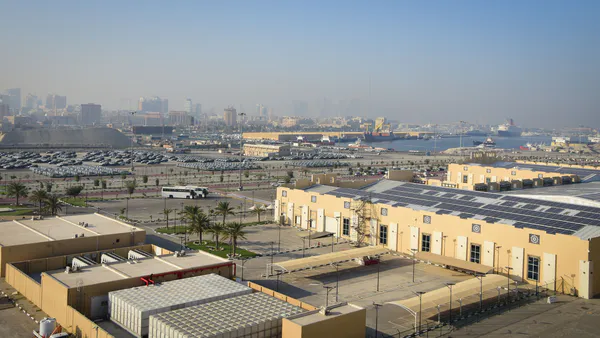
At the height of the pandemic, Dubai convened airlines, airports, port operators, and humanitarian organizations into the Dubai Vaccine Logistics Alliance to accelerate vaccine distribution to low- and middle-income countries [3]. The alliance leveraged existing cold-chain facilities, priority customs lanes, and synchronized flight and vessel schedules. By December 2021, Emirates SkyCargo had transported approximately 600 million COVID-19 vaccine doses to more than 80 destinations, complementing UNICEF, WHO, and International Humanitarian City operations [4]. WHO reporting on the Dubai logistics hub emphasizes its multi-crisis role and global reach since 2020 [5]. The lesson is straightforward: pre-existing logistics muscle, coordinated under one umbrella, can scale life-critical delivery rapidly.
Noon.com’s Customer-Centric Fulfillment Network
Noon, a homegrown e-commerce platform backed by major regional investors, built its operating model around local fulfillment centers, proprietary delivery networks, and end-to-end tracking [6]. In 2022, Noon opened a 45,000 m² fulfillment center in Riyadh to support same-day and next-day service a national scale [7]. Proximity and visibility beat distance and guesswork: keeping inventory close to customers and maintaining full shipment traceability improves reliability during peak demand.
Dubai Metro’s Staged Expansion
Urban mobility programs show how thoughtful staging reduces disruption. The Route 2020 extension of Dubai Metro’s Red Line—15 km with seven stations—was delivered with a project value of about AED 11 billion, adding capacity and linking to Expo 2020 [8, 9]. More recently, the Blue Line contract—30 km and 14 stations—was awarded at AED 20.5 billion, reinforcing the city’s long-term network plan [10]. The SCM lessons are consistent: prepare major elements away from congestion, synchronize staged deliveries with city operations, and align interfaces and permits early so that onsite assembly is efficient.
Hajj Operations Logistics
Serving millions of pilgrims safely each season requires meticulous planning of food, water, health, and mobility services. Official statistics report more than 32,500 medical and health personnel during a recent Hajj season, supported by extensive facilities and emergency teams [17]. Vision 2030 program reports highlight digitized services and coordinated operations to maintain smooth flows across sites and dates [18, 19]. The disciplines are familiar: forecasting demand by day and location, temperature-controlled storage, timed deliveries to avoid congestion, and clear public information to keep flows smooth.
Leadership Playbook for Predictable Delivery
Start with a realistic baseline. Anchor plans in verified supplier lead times, port and air-freight capacity, and actual permitting cycles. Where uncertainty is high, use scenario ranges rather than single-point targets [1, 2]. Document assumptions behind every date and cost so changes are traceable.
Make commitments visible across the chain. Share rolling 12- to 24-month demand signals with strategic suppliers. Where feasible, secure capacity through options or call-off agreements that allow flexible drawdown without punitive charges.
Stage for early benefits. Break delivery into operational increments that offer public value early (e.g., initial station openings, partial warehouse go-lives, phased health-service coverage). Staging builds confidence and reveals issues while stakes are lower.
Shorten feedback loops. Use live tracking for shipments and site-readiness checks. Tie milestone payments to verifiable events—goods received, installation complete, service hours maintained—so commercial incentives reinforce operational truth.
Design for people. Plan last-mile flows for commuters, patients, pilgrims, and shoppers. Clear wayfinding, staff briefings, and channel capacity (apps, call centers) convert logistic success into user satisfaction.
Institutionalize learning. After each phase, capture root causes of delays or defects and adjust the plan. Build a reusable playbook so subsequent projects start from a higher base.
Measuring What Matters
Measurement turns aspiration into control. A balanced scorecard for megaproject SCM tracks four domains. Time: purchase-order cycle time, supplier on-time delivery, shipment transit and dwell, site-readiness to install, and opening-date adherence [1, 2, 8–10]. Cost: variance to committed budgets at key gates, logistics unit costs, and inventory holding exposure. Quality and service: first-pass acceptance at delivery; complaint and defect rates; hours of service availability. Resilience: number of qualified alternates for critical items, buffer stocks at choke points, and time to recover from a disruption. Reporting should be monthly at the executive level and weekly within delivery teams, with each variance assigned and tracked to closure.
Conclusion
Megaprojects will always carry uncertainty, but outcomes need not be uncertain. The Middle East examples show that when institutions and firms treat supply chains as strategic assets—planning early, partnering deeply, staging delivery, and instrumenting progress—performance improves. Vaccine distribution at continental scale, customer-centric e-commerce, uninterrupted urban mobility expansion, and the orchestration of Hajj services all demonstrate the same logic: reliable supply chains convert vision into everyday value. As national strategies continue to elevate logistics, organizations that institutionalize these disciplines will deliver faster, more predictably, and with greater public trust.