Introduction
Background and Motivation
The electrical distribution system has played a vital role in supplying the electricity to end users. Distribution systems account for a higher amount of electrical power loss. However, in many of the developing countries the losses in the distribution systems are in the range of 10-20% [1]. Another significant issue in the distribution network is voltage regulation. The instability in the voltage levels in the distribution is mainly because the electricity demand keeps rising, the number of devices connected to the system creates uneven power usage and the integration of the renewable energy sources to the systems like solar, wind will create the instability in the voltage levels. Because of the emergence of new technologies towards the smart grids and cleaner energy systems the researchers are majorly focusing on the new way to reduce the power losses and keeping the voltage steady [2].
Problem Statement
The traditional methods in the distribution systems such as capacitor banks, on-load tap changers and feeder reconfiguration have the ability to deliver cost-effective solutions and are also widely adopted [3], [4]. The major disadvantage lies in the lack of adaptability according to the situations and also often fail under the dynamic load conditions and requiring the human interventions to control the conditions [5]. Conversely, modern approaches are able to address these limitations but these techniques may face the challenges like high computational costs, high deployments costs, data dependency and mainly limited real-world adoption [6]. This creates a significant gap between the theoretical advancements and practical implementation. So, without a proper review on the existing methods such as their strengths, weaknesses and limitations. The researchers may face a huge problem in creating a clear roadmap to transition towards robust, efficient and adaptive distribution systems [7].
Scope and Objective
This review mainly focuses on the approaches that have been discussed and developed in the years 2020 to 2025 for reducing the electrical power losses and enhancing the voltage regulation particularly in the distribution system. The objectives of this study is as follows:
To develop the knowledge on how the distribution system works majorly focusing on the technical losses such as electrical power losses and challenges of voltage regulation.
To conduct a systematic review of how conventional methods and modern approaches in the distribution system are used in order to reduce the electrical losses and control the voltage.
To carefully review the kind of the performance metrics and test systems used in the recent research studies.
To clearly examine the kind of challenges and limitations such as technical, financial and practical that limit the real-world application of the advanced method.
Review Methodology
This review is primarily focused on identifying, analyzing and selecting the relevant papers that are related to the electrical losses, voltage regulation in the distribution system. To perform this, relevant papers are collected from the well-established scientific databases such as IEEE Xplore, Scientific Reports, Springer, MDPI, Wiley Online Library, Elsevier. To select the appropriate papers, search has been carried out using the relevant keywords such as the distribution system losses, capacitor placement, FACT devices, on-load tap changers, Linear Programming (LP), Non-linear Programming (NLP), Mixed-Integer Linear Programming (MILP), Metaheuristic Optimization Algorithms. In order to maintain the relevance and applicability, the papers have been selected between the years 2020 and 2025.
Systematic review Methodology
Data Sources
This study has used the academic publications papers collected from the well-known databases and it includes the IEEE, Scientific Reports, Nature, Springer, MDPI, Wiley Online Library, Elsevier, IOP, Taylor & Francis, Academia, ResearchGate.
Search Strategy
In order to collect the related reference papers for this study, it has carried out through the searching publications in the academic databases through a key word and it includes Power Losses, Voltage Regulation, Power distribution networks, Capacitor Bank, Metaheuristic Optimization, IEEE-33, IEEE-69, IEEE-118, IEEE-123, Smart Grid, DG, ML in power systems.
Inclusion Criteria
From the observed papers, only the academic publications which are published during the years 2020 and 2025 have been reviewed.
Fundamentals of distribution system
The distribution system is the last stage to deliver the electrical power and this system mainly bridges the transmission networks to the end users. Because of its high exposure, this system is mainly subjected to the electrical power losses and where voltage regulation challenges are mostly experienced [8], [9]. In order to clearly understand the overall distribution system is essential like architecture, loss mechanism and regulation issues. These are required for the evaluation of both the traditional and modern mitigation approaches in the distribution system.
Distribution system architecture
The main objective of the distribution system is to step down the transmission level voltages. Usually, the transmission voltage levels are in the range between 66 kV to 132 KV and it transmits the electric power over the long ranges. But the equipment used in the consumer level, industry levels are dealing with the voltage levels in between the range 440 V to 33 kV. In order make use of the electrical power, the distribution system has stepped the down the voltage level from the (66kV - 132 kV) to the medium voltage levels such as 11 kV to 33 kV and further it steps down to the voltage level of the 400 to 440 V for the end users.
In order to efficiently step down the voltage levels and maintain the distribution system in a secure way, this system consists of different equipment like primary feeders, distribution transformers, protective devices (CTs, PTs, Relays), Metering equipment and control systems. The distribution has been further divided based on the several techniques such as based on the type of the construction (i.e., overhead distribution system and underground distribution system), Based on the scheme of connection (Radial Distribution System, Ring Main Distribution System and Interconnected Distribution System). Each of the architectures has unique advantages and weaknesses and imitations.
The overhead distribution system has visible infrastructure like poles, conductors and it is easy to install [14]. Conversely, the underground distribution system has run the conductors in the ground and there is a minimal visibility of the infrastructure [15]. This has more protection against the different weather conditions but takes higher installations when compared to the overhead distribution system.
The radial distribution system [10], [11] is the most commonly used configuration in the distribution system especially in the areas like rural and semi-urban areas. Because in this type of distribution every consumer receives the electricity through the single feeder and in a unidirectional way and also it is economically easy to design. But the major drawback of this design is it has high losses, poor voltage regulation and low reliability.
Conversely, the ring main distribution system [12], [13] provides the advantage of the close-loop path and it mainly supplies the electrical energy in both directions rather than in a unique direction. This kind of the design enhances the overall reliability and voltage stability and makes them more suitable for the urban and commercial areas. Finally, the interconnected distribution system and this design represent the multiple feeders and sub-stations in the network are interconnected together in order to form a mesh network. This kind of advanced configuration enhances the overall system stability and lowers the electrical losses.
From an operational point of view, radial distribution systems are highly influenced by the electrical power losses, voltage regulations at receiver end in the system. Whereas the ring and interconnected systems often provide the improved performance by significantly reducing the electrical power loss, voltage regulation but these systems have introduced the operation complexity compared to the radial distribution system [43].
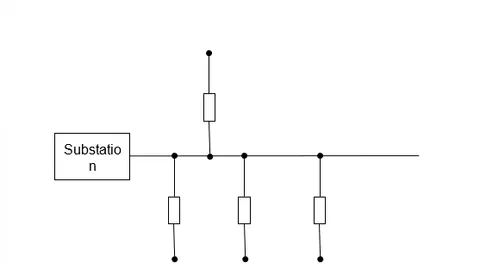
With the rise of the smart grid technologies [16], the conventional passive distribution feeders are majorly transforming into the Active Distribution Networks (ADNs) [17]. The modern designs are also characterized by the two-directional power flow and this leads to the presence of the distributed energy resources and the use of the advanced monitoring and control systems such as the SCADA platforms, smart meters and IoT based sensors [18]. Figure 1 has illustrated the radial distribution systems, this system generally considered as one of the commonly used configurations in research and it used to compute the electrical power loss, voltage regulation at the receiver ends in an easy way because of the unidirectional power flow.
Power Losses in distribution system
The power losses in the distribution systems are majorly classified into technical and non-technical losses. The technical losses mainly constitute loss arise from the physical components in the distribution system like I2R losses (Due to the conductors and transformers), Core losses in the distribution transformers, Dielectric and corona losses in the cables and overhead lines. The non-technical losses mainly include the due to the meter tempering, billing errors and poor data management [19].
Voltage Regulation Challenges
In order to safely maintain the customer end voltages within the level of (+5% or -5%) the distribution system may face challenges due to the many factors. This includes the frequent change of the load on the distribution system especially in the areas like residential and commercial. Integration of the renewable energy sources in the system, without proper control strategies they may induce the higher voltage into the network. High penetration of the distribution generators and this causes the over voltage at the light load conditions and voltage drops during the peak load conditions [20], [21].
3. Traditional Approaches for Loss Reduction and Voltage Control
Conventional Loss Reduction methods
By using the conventional methods in order to reduce the losses in the distribution system includes the conductor upgradation, feeder reconfiguration [22], [23] and installation capacitor banks [24], [25]. Conductor upgradation has the ability to minimize the resistive losses (I2R) in the system but the major drawback is this process involves the high capital cost for replacing the conductors. Conversely, feeder reconfiguration could be achieved by placing the switches in the system and by changing the position of the switches in the network, load flow and power losses in the network is minimized but it introduces new issues like requiring additional switching infrastructure. The most commonly used technique is installing the capacitor banks in the network, these banks able to supply the reactive power to the system and minimizes the electrical power losses in the system.
Voltage Regulation techniques
Conventional voltage regulation methods have mainly depended on the devices in order to maintain the stable voltage levels in the distribution system. It consists of the devices like on-load tap changers (OLTCs) [26], [27], Switched Capacitor banks. The OLTCs are mainly integrated into the distribution transformers and this device maintains the voltage in safer limits by adjusting the voltage ratios by means of changing the tap positions. Conversely, switched capacitor banks are placed in the distribution network at suitable positions and these banks are able to supply the reactive power and thus improves the voltage profile [28], [29].
Limitations of Traditional approaches
Even though these traditional approaches were able to reduce the electrical losses and enhance the voltage profile in the distribution system. These approaches have certain limitations like mostly designed for the static load conditions and lack the adaptability and flexibility under the dynamic load conditions. Frequent switching in the capacitor banks and OLTCs, introduces issues like mechanical wear and reduces the operational lifespan. Furthermore, these methods often fail to adapt to the uncertainty, dynamic operating conditions and these issues limiting the effectiveness in the smart grids. Even though these traditional approaches are suitable for the cost-sensitive and low complexity networks, they face the challenges in the future ready power systems.
3.4 Economic and Technical Comparison of Distribution System Loss Reduction Strategies
Table 1 shows the different strategies which have been utilized in order to effectively reduce the power loss in the distribution system.
Table. 1. Economic and Technical Comparison of Distribution System Loss Reduction Strategies
| Strategy | Key Contributions | Cost of Implementation | Time required for implementation |
|---|---|---|---|
| Network Reconfiguration | Service restoration, Loss Minimization, Enhancing the voltage profile | Medium | Weeks to Months (Depending on the size of the network) |
| Capacitor Allocation | Minimizing the loss, Voltage Profile enhancement | Medium | Months |
| DG Allocation | Loss minimization, Voltage Improvement | High | Months |
| Load Balancing | Loss minimization, Voltage Improvement | Low | Few Months |
| Voltage Upgrade | Voltage Improvement | Very High | Years (Depending on the network size) |
| Conductor Upgrade | Loss Minimization, Voltage Profile Enhancement | High | Months |
Modern approaches and techniques
Mathematical optimization methods
In order to minimize the electrical power losses and improve the voltage profile in the distribution system some of the mathematical optimization models have been implemented on the network. This includes the mathematical optimization models such as Linear Programming (LP) [30], Non-linear Programming (NLP) and Mixed-Integer Linear Programming (MILP) [31], [32]. Among these optimization models, LP and MILP have been extensively used because these methods offer computationally efficient solutions.
However, these methods mostly simplify the physical characteristics of the distributions system which leads to the limiting the accuracy. Conversely, the Non-Linear Programming (NLP) has given the ability to capture the nonlinear behavior of the system but this method faces the difficulties with the stability and convergence. In order to balance these kinds of trade-offs recent studies are majorly focusing on the convex relaxations of the AC optimal power flow problem, this has the ability to maintain the computational tractability while moving close to the global optimal solutions. Moreover, these methods show promising progress but often these approaches are tested only on the standard IEEE test feeders.
Metaheuristic optimization Algorithms
The emergence of advanced technologies in order to mitigate the issues in the distribution system like reducing the electrical losses and improving the voltage has shown promising improvements. This includes the metaheuristic algorithms like Genetic Algorithms (GA) [33], Particle Swarm Optimization (PSO) [34], Ant Colony Optimization (ACO), Differential Evolution (DE) and some of the new bio-inspired algorithms like Whale Optimization, Grey Wolf Optimizer [35], [36].
These approaches have shown superior performance when compared to the traditional methods in terms of minimizing the electrical power losses and enhancing the voltage profile in the network. But the major drawback using these approaches in the system is they are computationally intensive and also rarely tested in the real-world environments and this limits the scalability for the practical deployment.
Artificial and Machine learning approaches
Artificial Intelligence (AI) and Machine Learning (ML) [37] approaches have shown promising improvements in the power distribution systems in the applications like predictive modeling, load forecasting and adaptive voltage regulation. This includes approaches like Artificial Neural Networks (ANNs), Support Vector Machines (SVM), Reinforcement Learning (RL) [38] and advanced deep learning models that have the ability to handle the diverse kind of tasks like fault detection, predicting the voltage stability.
When compared with the traditional models these approaches have the ability to offer better accuracy while dealing with the non-linear pattern in the load and the uncertainties mainly caused by the renewable energy variability. But these methods often face challenges in areas like requiring large volumes of high-quality data and causing problems in the resource-constrained grids, which requires more computational power.
Distributed Generation (dg) and Renewable Integration
The integration of the distributed generation (DG) especially renewable sources like solar and wind helps in reducing the feeder losses and supply the power to the local loads efficiently and also provides the valuable support for maintaining the voltage at safe levels. The major problem with renewable sources is the generation mainly depends on the weather conditions and resulting in the bidirectional power flows which introduces the major challenges for voltage regulation.
For example, excess generation of electricity during the light load conditions would result in the overvoltage’s and similarly the lesser generation of electricity during the peak demand would lead to the under voltage issues. This research also identifies that the proper placing of DG is crucial for the efficient power supply with minimal losses while maintaining the voltage levels at table condition.
Demand response and Smart Grid Architectures
Smart grid technologies are used as indirect and highly effective tools for reducing the electrical power losses and improving the voltage stability in the modern distribution systems through the Demand Response (DR) in the distribution mainly involves reducing the electricity usage from the peak demand to the off-peak times in response to the price signals from the utilities. This helps in reducing the burden on the electricity especially during the peak demand and thus ensures the greater reliability and stability [41].
In addition, enabling technologies such as the advanced metering infrastructure (AMI), IoT-Based Sensors, Supervisory Control and Data Acquisition (SCADA) platforms have provided the advantage of continuous monitoring and allowing the operators to apply adaptive and real-time control strategies. Together, these innovations provide the advantage of creating more resilient and robust network management. But the major challenges in this network involve lack of large-scale implementation and face the more challenges, regulatory policies may vary based on the different regions. This kind of limitation degrades the ability of the smart grid solutions to deliver the most optimum results across the diverse distribution systems.
Fact Devices
In order to provide dynamic voltage regulation and reactive power compensation in the distribution systems more frequently the Flexible AC Transmission System (FACTS) devices have been applied in the networks. FACTS devices include the devices such as the Static VAR Compensators (SVC) [42], Static Synchronous Compensators (STATCOM) [40], Dynamic Voltage Restorers (DVR) and Unified Power Control Conditioners (UPQC) [39].
Among these devices, STATCOM and DVR have shown promising effectiveness in handling the variabilities caused by renewable energy sources. Conversely, SVC is widely used because of its cost-effectiveness and simplicity but the major disadvantage of SVC is slower response time. This factor limits this device in the rapidly changing g conditions. When it is compared with the other devices, STATCOM offers the faster and more reliable compensation but this involves the higher investment and operational costs. DVR and UPQC have the benefits of handling a wide variety of power quality issues but their economic justification is generally stronger in the urban or industrial grids where particularly service quality is vital.
The below table 1 shows how the capacitor, DG and DSTATCOM was able to reduce the power loss and maintained the better voltages at the bus level when it was tested under the IEEE 33-Bus system. Not only electrical power loss (Ploss) but also shown better results in the other parameters in the electrical power system.
![Performance Analysis of IEEE-33 bus test system [11]](https://doc.globaljournals.org/wyk95x_258888/author_package/media/derivatives/42/4293b1c97fe1b4cfca54882821f4a281775a4cc72b8bd0cc02d1b4941c55b663.webp)
Figure 2 illustrates before applying the compensation techniques on the distribution system, it has observed the active power loss of 210.98 kW, minimum voltage in the entire IEEE 33-bus system at 0.9037 p.u.. After applying the compensation techniques and it includes the capacitor placement, incorporating the DG and FACT devices (DSATACOM) Subsequently, they provide better control on the system and reduces the active power loss in the system and enhances the overall system efficiency.
4.7 Taxonomy of Loss reduction and voltage regulation techniques
Table 2 indicates the different types of the methods which have been applied for the distribution systems in order to reduce the power loss and enhance the voltage profile and limitations faced by each of the techniques.
Table. 2. Different Techniques employed for enhancing the system stability
| Approach | Examples | Limitations |
|---|---|---|
| Fixed Devices | Capacitor Banks, OLTCs | Failed to provide the compensation under the dynamic environments |
| Mathematical and Metaheuristic | MILP, NLP, PSO, GA, ACO | Computationally Intensive |
| AI and ML-based | RL, ANN, SVM | Need high-quality data for training the models and also limits its applicability due to the “black-box” nature model decisions |
The below table 3 shows the voltage levels at all the 33 bus levels before and after applying the compensation on the system.
Table. 3. Voltage at each bus (With and Without Compensators) [11]
| Bus No | Without Compensation | With Capacitor | With DG | With DSTATCOM |
|---|---|---|---|---|
| 1 | 1 | 1 | 1 | 1 |
| 2 | 0.9970 | 0.9976 | 0.9979 | 0.9974 |
| 3 | 0.9829 | 0.9865 | 0.9888 | 0.9853 |
| 4 | 0.9754 | 0.9812 | 0.9849 | 0.9793 |
| 5 | 0.9679 | 0.9761 | 0.9813 | 0.9735 |
| 6 | 0.9495 | 0.9659 | 0.9711 | 0.9605 |
| 7 | 0.9459 | 0.9624 | 0.9677 | 0.9570 |
| 8 | 0.9323 | 0.9489 | 0.9544 | 0.9434 |
| 9 | 0.9259 | 0.9427 | 0.9482 | 0.9372 |
| 10 | 0.9201 | 0.9369 | 0.9425 | 0.9314 |
| 11 | 0.9192 | 0.9360 | 0.9417 | 0.9305 |
| 12 | 0.9177 | 0.9346 | 0.9402 | 0.9290 |
| 13 | 0.9115 | 0.9284 | 0.9342 | 0.9229 |
| 14 | 0.9092 | 0.9262 | 0.9320 | 0.9206 |
| 15 | 0.9078 | 0.9247 | 0.9306 | 0.9192 |
| 16 | 0.9064 | 0.9234 | 0.9292 | 0.9178 |
| 17 | 0.9043 | 0.9213 | 0.9272 | 0.9157 |
| 18 | 0.9037 | 0.9207 | 0.9266 | 0.9151 |
| 19 | 0.9965 | 0.9971 | 0.9974 | 0.9969 |
| 20 | 0.9929 | 0.9935 | 0.9938 | 0.9933 |
| 21 | 0.9922 | 0.9928 | 0.9931 | 0.9926 |
| 22 | 0.9916 | 0.9921 | 0.9925 | 0.9920 |
| 23 | 0.9793 | 0.9829 | 0.9852 | 0.9817 |
| 24 | 0.9726 | 0.9762 | 0.9786 | 0.9751 |
| 25 | 0.9693 | 0.9729 | 0.9753 | 0.9718 |
| 26 | 0.9475 | 0.9652 | 0.9712 | 0.9594 |
| 27 | 0.9450 | 0.9643 | 0.9714 | 0.9580 |
| 28 | 0.9335 | 0.9637 | 0.9703 | 0.9537 |
| 29 | 0.9253 | 0.9636 | 0.9699 | 0.9509 |
| 30 | 0.9217 | 0.9629 | 0.9712 | 0.9493 |
| 31 | 0.9176 | 0.9589 | 0.9673 | 0.9452 |
| 32 | 0.9167 | 0.9580 | 0.9665 | 0.9443 |
| 33 | 0.9164 | 0.9577 | 0.9662 | 0.9441 |
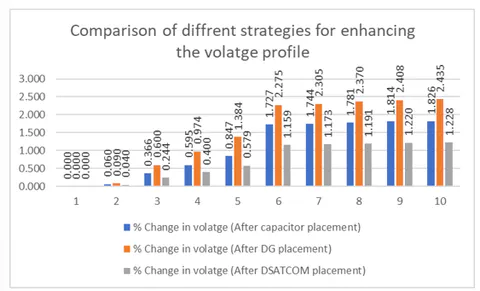
Figure 3 indicates the comparison of different compensating techniques such as capacitor bank, distributed generation (DG), DSTATCOM across the 10 buses in the IEEE 33-bus system. Based on the results, DG has demonstrated significant performance in enhancing the voltage profiles compared to the other two compensating techniques.
Performance evaluation and comparison
The effectiveness of both the traditional and modern approaches in order to reduce the electrical losses and improve the voltage regulation has been assessed through rigorous evaluation. This is usually carried out by the set of performance metrics, validating against the standard test systems, comparing the analysis across the different techniques.
Evaluation Metrics
In order to effectively measure the electrical losses and voltage regulation in the distribution systems, many researchers have relied on the set of the technical and economic performance indicators. This includes the electrical power losses could be measured in terms of Kilo Watts (kW) or Mega Watts (MW) or in percentages (%) and improvement of the voltage profiles or voltage regulations are usually measured like minimum bus voltages or the voltage deviation index or the voltage drop percentage or voltage regulation or in per unit (p.u).
The active power loss in the distribution system is given by:
Where,
I = Current (Amps) flowing the line
R = Resistance (ohms) of the line
In addition to that, in order to effectively evaluate the effectiveness of the compensating techniques. The percentage improvement in the voltage profiles has been calculated by using equation 2.
Where,
VCom = Voltage Value in Volts or p.u after applying the compensation
VWithout Com = Voltage Value in Volts or p.u before applying the compensation
Most of the conventional approaches are usually assessed in terms of the ability to reduce the losses and voltage levels. But modern approaches like AI or advanced approaches place a stronger emphasis on multi-objective evaluations and by considering technical, economic and environmental performance.
Test system analysis
To effectively test the designed or implemented model in the distribution systems majority of the studies has mostly been dependent on the IEEE standard distribution test feeders. This includes the IEEE-33, IEEE-69, IEEE-118 and IEEE-123 bus systems. These bus systems have formed the main basis for the many of the researchers to develop and test and compare the various techniques for the analysis and optimization. This kind of environment provides the benefits like capacitor placement strategies, comparison between the various optimization algorithms and voltage regulation techniques.
![Schematic of IEEE 33-Bus Radial Network [29]](https://doc.globaljournals.org/wyk95x_258888/author_package/media/derivatives/32/321fcf0a0a73af9277a1695abfaab555f6a15d0b5bdf99a50fc1da07d6c53ae0.webp)
![Schematic of IEEE 69-Bus Radial Network [29]](https://doc.globaljournals.org/wyk95x_258888/author_package/media/derivatives/d4/d4aae8b01e813fa7c773eaa409d2dd7a362fbcc5806e08123cf138d4c72c9d3b.webp)
Even though these IEEE test feeders provide the advantage of testing the various methods, they lack the adaptability and flexibility in capturing the heterogeneity of the real-world feeders, because in the real-world the feeders may experience different conditions like highly unbalanced loads, distribution generation variability. By majorly depending on the IEEE feeders, it creates a significant gap between the simulation and reality.
Many of the existing researchers have been primarily focused on validating their developed models in the application of electrical loss calculations, voltage regulations, optimal device placement on the IEEE test feeders because of their accessibility, reproducibility. Although, these test feeders have demonstrated significant performance in the controlled environment. But the same methods are applied to the real-world feeders, the performance may vary. Because in the real-world the feeders introduce several challenges such unbalanced loading, aging of equipment, different conductor material, switching events.
Comparative analysis
The below table 4 shows the comparison of the traditional and modern approaches used for the application of the reduction of the electrical power losses and maintaining the better voltage regulation in the distribution systems.
Table. 4. Comparison of Traditional and Modern Approaches for the Electrical Loss Reduction and Voltage Regulation
| Approach | Techniques | Strengths | Limitations | Performance Metrics |
|---|---|---|---|---|
| Traditional Methods | Capacitor Banks, OLTCs, Feeder Reconfiguration | Simple is design, widely used and easy maintenance | Ineffective under the renewable variability, lack of adaptability and flexibility, mostly static. | Electrical Power loss Reduction (%), Voltage Regulation (%), Bus Voltage (p.u) |
| Mathematical Models | Linear Programming (LP), Non-Linear Programming (NLP), MILP | Accurate Formulations | Faced issues during the convergence particularly for the non-linear problems | Voltage Deviation Index, Power Loss (kW/MW), Optimal Device Placement Efficiency |
| Metaheuristic Algorithms | GA, PSO, ACO, DE, Grey Wolf Optimization | Ability to handle the non-linear problem in the system, Robust Search Capability | High Computation and also risk of the local optima. | Loss Minimization (%), Voltage Stability Index, Convergence Speed |
| Artificial Intelligence (AI) and Machine Learning (ML) | ANN, Reinforcement Learning (RL), SVM, Deep Learning | Adaptive and Flexible, Effective for the forecasting and real-time control | High-quality data needed, Interpretation Issues. | Forecast Accuracy (MAPE), Loss Reduction |
The below figure 6 shows how the capacitor could affect the electrical power losses and that includes both the active power loss and reactive power. Gradually the capacitance value is increased in the different types of the distribution system and outcomes suggest that the capacitance is used in the distribution system and it will help in reducing the power loss in the system.
![Active Power Loss (kW) comparison for the different capacitance values in the distribution system [24]](https://doc.globaljournals.org/wyk95x_258888/author_package/media/derivatives/ba/ba31cb904e609ae1db0557eb87541006a2e5eeda4697a88251a0b0d6a5a1cf5f.webp)
Furthermore, different metaheuristic algorithms have been applied in order to minimize the electrical power losses in the distribution system and also to maintain the voltage profile and the outcomes are shown in the figure 7.
![Comparative Evaluation of different optimization algorithms to minimize the electrical power loss and improve the voltage profile [44]](https://doc.globaljournals.org/wyk95x_258888/author_package/media/derivatives/f9/f9e141a4eaad8c4b2d277569e59d632688f3a6501468e3cd2973872a577ad73e.webp)
Figure 7 illustrates that among all the optimization methods, PSO has demonstrated significant performance in reducing the active power loss (kW) in the distribution system by placing the compensating equipment.
Challenges and Limitations
Even though there are significant improvements reducing the electrical power losses and enhancing the voltage profile at a stable level in the distribution systems. But there are several kinds of challenges to appear while deploying both the traditional and modern approaches in the distribution system. These kinds of challenges have been further categorized into technical, economic and implementation related barriers. Each of these challenges limit the scalability and practicality of the current solutions.
From a technical point of view, modern and AI-based approaches are majorly facing the challenges like these methods demand complex architectures, scalability and uncertainty. Even though the metaheuristic approaches are proven strong in the simulations studies but are computationally intensive and unstable for the real-time deployment on the large-scale networks. Similarly, AI and machine learning approaches demand the more accurate and high-quality to train the models and this causes the problem where data is rarely available in the distribution utilities more especially in the developing regions.
Furthermore, the integration of the distribution generation and renewable energy sources into the distribution systems has further caused the issues like intermittency and variability. As a result, it further causes the problems in the deterministic models to capture the behavior of the distribution system and make them less reliable for the real-world operation.
From an economic point of view, the installation of FACT devices like STATCOMs, UPQCs and large-scale smart grid structures requires a huge capital cost and also significant maintenance charges. Even though these kinds of devices and systems are able to drive superior performance in reducing the electrical power losses, improving the voltage profile in the distribution systems, their capital cost makes it less applicable for where budget is the primary factor.
Moreover, the advanced methods based on optimization and artificial intelligence have shown promising results in the simulations but when they are practically implemented in the real-world, they demand heavy investment on the digital infrastructure like advanced metering systems, sensor networks, reliable communication channels and cloud-based computing platforms. This kind of the financial demand has posed a barrier to utilities particularly in the developing regions especially where the resources are limited.
The major concern is developed models for the application of reducing the losses and improving the voltage profile has achieved significant performance at the level but the practical and implementation barriers limit the transition from the theory to practice. Most of the developed methods have been tested and evaluated by using the IEEE test feeders. But these kinds of test feeders are not able to capture the heterogeneity of the real-world networks. Furthermore, at current advanced approaches or AI decisions are like black-box and this creates another concern on fully trusting the AI decision made in significant situations. This kind of the misalignment between the technical solutions and the socio-economic realities has significantly created a big research gap between the research progress and practical implementation.
Future Directions
As the distribution systems are continuously becoming smarter and intelligent, there is a need for smart solutions that could overcome the issues caused in the traditional methods. A promising direction for future research is hybrid optimization framework. In this framework, there are multiple techniques such as mathematical modeling, metaheuristic algorithms and artificial intelligence. By integrating these approaches into a unified framework, it is possible to design and implement a framework that could reduce the electrical losses and improve the voltage profile in the distribution network. Not only this kind achievement but also make the system more robust and resilient against different kinds of problems raised in the distribution systems.
Another possible future direction would be integration of the explainable AI in the advanced approaches such as machine learning and artificial intelligence. These methods especially when used for improving the voltage regulation or reducing the electrical losses in the distribution system. Even though they provide an efficient solution, these model decisions are like a “black-box” and this creates a problem in building complete trust on the model decisions. So, future research should majorly focus on the integration of the explainable AI in the designed models, in this way the models do not only deliver the accurate outcomes but also offer the interpretable insights for the system operators.
The other future direction should focus on renewable-aware device design. Because in the traditional approaches like capacitor banks, FACT devices are particularly designed for the stable conditions but they face issues when the variability introduced by the distributed solar and wind generations in the distribution systems. So, future research should mainly focus on designing novel adaptive capacitor banks, inverter-integrated reactive power controllers and cost optimized FACT systems. These kinds of designs could efficiently handle the issues introduced by the renewable sources and deliver the accurate performance in the distribution system like reducing the electrical losses by supplying the reactive power and improving the voltage profile.
The other promising future direction is the implementation of the metaheuristic algorithms such as the Hunter-Prey Optimization (HPO) in order to effectively improve the efficiency of the overall distribution system by minimizing the losses. Because HPO has the ability to show superior performance in the exploration-exploration capabilities particularly in the optimization studies. Many of the existing approaches have not fully captured the information related to the distribution systems. So, implementing the HPO in the distribution systems in order to minimize the electrical power losses and improving the voltage profile or voltage regulation is an effective solution.
Conclusion
In distribution systems, electrical power losses and voltage regulation severely impact the overall effectiveness of the system especially where grids evolve into dynamic and renewable-rich networks. This review mainly focuses on the traditional approaches such as capacitor banks, feeder reconfiguration and OLTCs and some of the modern approaches including mathematical optimization, metaheuristic algorithms, Artificial Intelligence/Machine Learning (AI/ML) models, Demand Response and FACT devices.
This review further discusses what different kinds of distribution system architecture has available and further divided based on the type of construction, based on the type of configuration and further discussed their advantages and limitations. This review also discusses what are different kinds of electrical losses present in the distribution system.
Even though the traditional methods have shown significant performance in the distribution system in terms of reducing the electrical loss and village regulation because of the lack of adaptability and flexibility to the modern grid. They face issues particularly under the high variability and bidirectional power flows. Conversely, the modem approach has shown significant performance in order to address the issue but with large volumes of high-quality data, huge computational resources and smart metering when it is implemented in real-world applications. These kinds of factors limit its usability in real-world scenarios.
This review also compares the various test results obtained when tested on the IEEE 33-bus system and observed the key values like power loss and voltage at each of the bus levels at both the scenarios like before compensation and after compensation of the system. The results highlight the significance of the compensation devices in the system by improving the voltage levels at each bus and reducing the overall electrical power loss in the system.
This review also discuss about the how the power loss and voltage regulation has been measured and highlight importance when they are used in the any kind of analysis and also discuss about the future directions could be implemented in the distribution system in order to further enhance the overall system stably in terms of reducing the electrical power losses, improving the voltage profile and increasing the overall distribution system efficiency.
Overall, this review concludes that it has discussed the existing literature during the period 2020 to 2025 by critically evaluating the merits and limitations and future directions in order to further accelerate the smarter and more resilient distribution system.