Introduction
Dew harvesting has fascinated Man for over 2000 years, and references to this phenomenon can be found in ancient and modern literature. The oldest referenced radiative condensers for atmospheric vapour (dew) have been discussed since 1667 by Flamel [1]. In the first quarter of the 20th century, the massive dew collectors were erected by F. I. Zibold in 1912, Knapen (1929) and Chaptal (1932) [2-3]. The work published by Monteith (1957) [4] can be considered a turning point in dew research, from observation and towards understanding energy and heat transfer balance mechanisms of dew formation and dew evaporation. In 1963, Monteith et al. [5] give also some dew techniques to the scientific community. More recently, such passive dew collection has been the object of several researches to increase the amount of collecting water (H. Vuollekoski [6] and D. Beysens [7-8]). Unfortunately, by 2025 two thirds of the worldwide population is expected to live in regions with water scarcity (Macedonio et al., 2012) [9]. In recent years, the increasing human population, the growing demand from industry and over-exploitation of natural water sources in the semi-arid regions have led to negative environmental effects, and, consequently, to a growing need for developing sustainable sources of water. One of these alternative sources is dew water harvesting. Dew water can have a significant impact as new sources of water, especially in arid and semi-arid areas. Atmospheric water vapor is a potential source of fresh water that is accessible everywhere. The atmosphere contains about 13,000 km of fresh water, 98% of which vapor and only 2% is in a liquid phase (cloud droplets, fog) [10].
Dew is a frequent and natural phenomenon where humid air condenses on a condenser sheet. It is the consequence of passive condensation of atmospheric water vapor into liquid due to radiative cooling phenomena [11-13]. The originality of this phenomenon lies in its capacity to reach cooling without any external energy. Dew yield harvesting is favored by light winds. Dew formation is visible only when atmospheric moisture condenses at a rate greater than that at which it evaporates again. The passive cooling mechanism has the potential to dissipate excess heat from the earth to the space, with the increasing probability of extreme heat waves as a result of climate change [14]. In the wavelength range of 750-1250 cm (Atmospheric window, 8-13 microns), the atmosphere is highly transparent to thermal radiation [15]. This atmospheric transparency window coincides with the peak wavelength of thermal radiation from terrestrial objects at a typical ambient temperature and provides a means for passive cooling mechanism by eliminating heat via radiative reemission. Thus, any sky-faced terrestrial object with high emissivity in the atmospheric window can radiate heat to outer space [16-17].
On a practical point of view, a thin film of the mineral calcite could be considered as a suitable material for large scale radiative dew condenser (collector sheet), as in our study it presented several advantages over the reference material, such as high emissivity in the transparent atmospheric spectral window (higher dew collection performance), longer lifespan and much lower cost. The increased cooling of exposed shields by radiative thermal energy loss to the cold sky via the atmospheric window was investigated using a thin film of calcite as IR-selective materials. The dew harvesting happens when the temperature of the thin film is below the dew point temperature. Thin film of calcite can be used as selective shield enabling radiative and convective cooling during the night. The thin calcite film exhibit high emissivity in the atmospheric window region in the thermal infrared; which indicates that it be used for dew harvesting.
This paper describes the implementation of a model for dew formation on a surface condenser (thin film of the calcite) using the meteorological factors input from the semi-arid mirleft data [18]. These meteorological parameters affecting dew formation were found to be ambient temperature (), cloud cover (), wind speed (), soil heat flux (), and relative humidity (). On the other hand, the temperature of the dew condenser () dew forms on is also important. Numerical simulations using the energy balance equation were performed in order to predict the nightly water yield. In this global modelling study, we focus on the deposition of dew with high yield as a function of condenser temperature and thickness condenser.
The paper is organized as follows: Sec. II is devoted to the description and characterization of the sample. Information on the Raman and IR modes the vibration is also provided. Sec. III describes the simulation modelling (Theoretical background). Our theoretical results concerning the nightly water yield on the condenser surface are presented and discussed in Sec. IV. Finally, summary and concluding remarks are made in Sect. V.
Calcite description and characterization
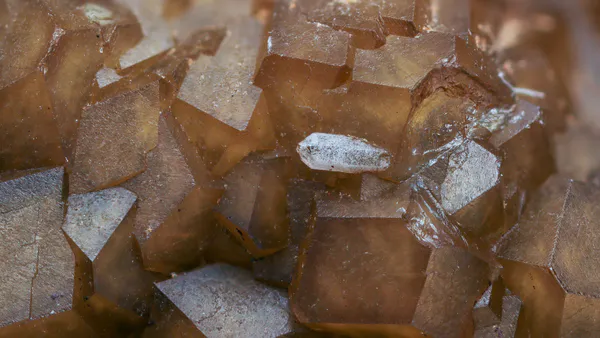
Calcite or calcspar is the mineral name of the low-pressure, hexagonal form of calcium carbonate, . Calcite is the principal constituent of limestone, marble and chalk. Calcium carbonate nucleates in three crystalline forms: aragonite, calcite and vaterite, with orthorhombic, rhombohedral and hexagonal structure, respectively. Calcite is the most stable phase thermodynamically at surface conditions, then aragonite or vaterite [19]. Calcite is one of the main components of the scaling which arises in various drainage situations in the chemical industry, in circulating water for heating and cooling in living environments and is also used as an additive in various industrial fields, e.g., building materials, food, paper, plastics [20,21].
Calcite is an important polymorph of . Its structure [rhombohedral, space group ( point group symmetry), with two formula units () per cell, but often described in a hexagonal cell with ] consists of a stacking of planar groups and ions along the axis of the hexagonal cell [22]. The following designations of crystallographic axes (equilibrium geometry of calcite) are Å, Å, and Å. The rhombohedral cell of calcite contains two formula units, for a total of atoms (Fig. 1). The number of vibration normal modes is ; there are a total of 27 vibration modes at the center of the Brillouin zone. A symmetry analysis in the point group [23] shows that the 27 normal modes are classified as:
The and modes are Raman-active, the and are IR active, whereas the and are spectroscopically inactive (silent modes).
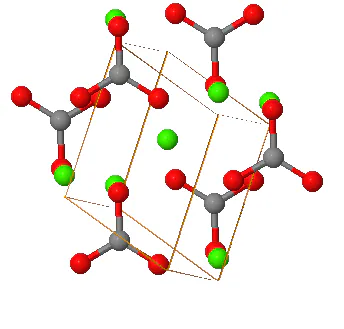
Fig. 1: Rhombohedral unit cell of calcite ( space group), containing six units and seven ions.
As shown in Fig. 1, we have presented the different vibration modes stretching of calcite calculated by PM3 semi-empirical method. The calculated frequencies are in general very close to the experimental ones [24-25]. Most of the calcite vibrational IR and Raman frequencies are related to specific vibrational modes of the carbonate anion (). Vibrations with frequency in the range 700-900 cm mainly correspond to bending modes of carbonate ions: the two and modes (709, 711 cm, respectively) are in-plane deformation of planar units, whereas the and modes (874, 882 cm) are out-of-plane deformations. The remaining higher frequencies above 1000 cm correspond to the symmetrical and modes (1083, 1088 cm, respectively) and asymmetrical and modes (1400, 1432 cm) stretching modes of the carbonate.
Table I: Vibrational IR and Raman frequencies of calcite, symmetry types and possible assignments in the atmospheric window region.
| Frequency IR () | Frequency Raman () | Symmetry type | Assignments |
|---|---|---|---|
| 709 | ---- | bending in plan | |
| 711 | ---- | bending in plan | |
| 874 | ---- | bending out of plan | |
| 882 | ---- | bending out of plan | |
| ----- | 1083 | stretching symétric | |
| ----- | 1088 | stretching symétric | |
| ----- | 1400 | stretching antisymétric | |
| ----- | 1432 | stretching antisymétric |
Dew formation generally occurs during night-time or early in the morning as a result of a radiative loss of heat from the soil or a passive radiative condenser, followed by condensation of water vapor. Table I lists summary Raman and IR vibration modes of natural calcite in the atmospheric window (769 - 1250 cm). The use of calcite mineral is enhancing the radiative cooling by maximizing its emissivity properties in the near infrared range (769 - 1250 cm; 8 - 13 m) where the atmosphere is partly transparent provided that the humidity is low. Therefore, we remark that the calcite as dew condenser presented six absorption bands (709, 711, 874, 882, 1083 and 1088 cm) in the 769 - 1250 cm region due to the vibrational behavior of structured group. The higher the emissivity of calcite as a dew condenser in the atmospheric window involves its higher rate of cooling by radiation than that of the hydrophilic mechanism [26-27].
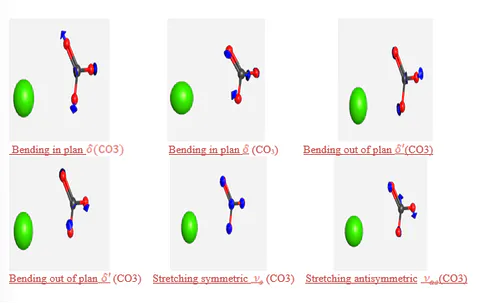
Fig. 2: Calcite vibrational modes stretching (vibration of ) calculated by PM3 semi-empirical method.
Model description
Dew harvesting can be determined from meteorological data according to the approach presented by Nikolayev et al., Jacobs et al. and H. Vuollekoski et al. [28-31]. The estimation of the dew yield requires solving the heat equation based on an equilibrium equation between sensitive and latent heat fluxes. The heat energy balance is given by the following equation:
Here , and are the dew condenser’s temperature, mass and specific heat capacity, respectively. The dew condenser’s mass is given by , where , and are its density, surface area and thickness. and are the specific heat capacity and mass of water, representing the cumulative mass of dew water that has condensed onto the collector sheet.
The right term of Eq. (2) describes the powers involved in the heat exchange processes. The radiation term, consists of three parts:
where and are the incoming thermal infrared radiation flux from the atmosphere and the outgoing radiative power from the dew condenser, respectively. and are the condenser and the sky emissivity.
The conductive heat-exchange term describes the conductive heat exchange between the dew condenser surface and the ground (blackbody). We consider perfect insulation; the conductive heat exchange is negligible.
Returning to Eq. (2), and describe the powers involved in the heat exchange processes. The convection term, , can be written as:
Here is the ambient air temperature, is the wind speed and is the heat transfer coefficient [32].
The last term in Eq. (2), represents the latent heat released by the condensation of water:
where is the specific latent heat of condensation of water.
The equation representing the condensed mass is described by the rate of condensation:
where is the saturation pressure at the dew point temperature, is the vapor pressure over the condenser sheet and is the mass transfer coefficient.
where is the psychrometric constant, is the atmospheric air pressure and is the specific heat capacity of air, is the specific latent heat of vaporization for water and is the heat transfer coefficient [33].
As condensation occurs when the temperature of the condenser sheet is below the dew point temperature, significant dew deposition can only occur during night-time. The dew point temperature can be defined as the temperature at which the partial vapour pressure of water in moist air would be sufficient to saturate the air.
The dew point temperature is expressed by the following equation [34]:
where RH is the relative humidity.
Modelling results
Estimating and quantifying the nightly water yield under specific climatic conditions (semi-arid or arid regions), using different harvesting techniques and physical models to predict the potential of dew formation are of great interest to water managers. In this modelling approach study, we focus on a simplified energy balance that would demand only a few statistically independent meteorological parameters and simple condenser properties, such as the dew condenser IR emissivity, the dew condenser specific heat capacity and the dew condenser density. In this section, we are interested in assessing the amount of dew recovery from the atmosphere in the Mirleft semi-arid region. The main objective of this study was to (I) assess a simple night-time condenser () energy balance model, (II) provide a complete description and quantification of dew yield and the components of the energy balance from meteorological parameters and (III) validate the model estimations against experimental results.
The condenser in our model is a horizontally aligned sheet of mineral. Experimentally, the condenser sheet should be inclined at 30° while the surface should allow easy condensate nucleation. The condensate needs to be removed promptly right after condensation happens on the surface. The condenser sheet is also thermally insulated from the ground at a height of 2 m because the dew formation model requires the wind speed at a height of two meters [31]. Unless specified otherwise, Table 2 lists the particular parameter values used in the model.
Table 2. Some parameters used in the dew model [35].
| Parameters | Value |
|---|---|
| Sheet specific heat capacity | 852 J kg K |
| Sheet density () | 2710 kg m |
| Sheet IR emissivity (8-13 m) | 0.9 |
| Surface area | 1 m |
| Soil heat flux | 20 W/m |
| Ambient air temperature | 25 °C |
First, it is important to gain insight into how dew formation is generally caused by efficient radiative cooling of the sheet condenser as a result of high IR emissivity (8-13 microns). Second, dew formation is caused also by inefficient nocturnal cooling of the sheet condenser as a result of high incoming long-wave radiation, which occurs due to a high cloud fraction and too high humidity in the atmosphere [36]. The dilemma for the efficient radiative cooling dew condenser is that the local atmosphere should have a high humidity that can be condensed, while the presence of a large amount of water vapor inevitably limits the radiative cooling power due to the infrared absorption of the molecule. The meteorological data input for the dew formation model is obtained from the study of I. Lekouch et al. (Mirleft, Southern Morocco) [18]. Under favorable meteorological conditions of the Mirleft site, such as high relative humidity above 80% and low wind speed (2.47 m s) [37], the condenser sheet may become colder than the dew point temperature and attract a high modelled yield of dew harvesting. These meteorological parameters are suitable for efficient dew formation onto the sheet condenser. The high yield of dew is probably caused by lower wind speeds, weaker diurnal cycle in air temperature and favorable humidity, resulting in amplified long-wave radiation upwards, and therefore strong cooling. On the other hand, in some climates evapo-transpiration rates may be reduced in the morning during the dry season due to increase stomatal resistance of the plant [38]. The average of relative humidity (RH) in the Mirleft coastal site is about 80.6% in the dry season, but reaches 75.8% in the wet one. In Table 3, we present the key statistics of the daily RH average of the day and night average, maxima and minima.
Table 3. The relative humidity () data during the dry and wet seasons [18].
| (%) | Daily | Daily maximum | Daily minimum | Diurnal | Nocturne |
|---|---|---|---|---|---|
| Dry season | |||||
| Average | 80.6 | 88.7 | 69.6 | 77.9 | 83.6 |
| Wet season | |||||
| Average | 75.8 | 86.0 | 63.7 | 75.7 | 76.7 |
In Table 4, we summarize the wind speed data during the dry and wet seasons that are taken from the mean experimental values from the Mirleft site. From this table, we observe that the wind speed is not higher during the day than at night for both dry and wet seasons. In addition, the daily wind speed recorded at the Mirleft station does not exceed 2.47 m s. We note also that the wind speed is therefore not too much higher for the dry season than the wet one.
Table 4. The wind speeds data during the dry and wet seasons [18].
| Wind speed () | Daily | Daily maximum | Daily minimum | Diurnal | Nocturne |
|---|---|---|---|---|---|
| Dry season | |||||
| Average | 2.47 | 4.98 | 0.46 | 2.65 | 2.25 |
| Wet season | |||||
| Average | 2.08 | 4.49 | 0.16 | 2.19 | 1.93 |
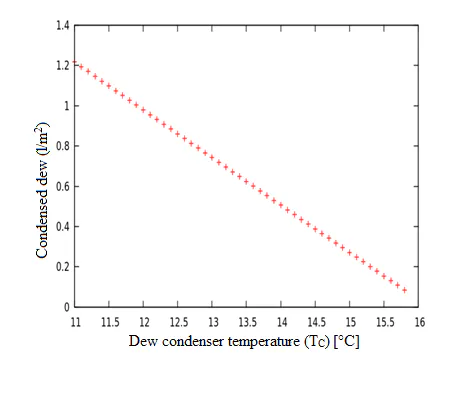
Fig. 3: Estimated dew as a function of dew condenser temperature ().
The three parameters such as dew point temperature , Ambient temperature and dew condenser temperature affect significantly dew water condensation. Cumulative dew was calculated hourly for 12 h period (per night) as a function of the temperature dew condenser is shown in Fig. 3. It shows that the effect of condenser temperature on dew yield is linear for all combinations of values used in the calculations and that how condenser temperature decreases continuously with condenser temperature. We note that the modeling dew formation starts to form onto when the condenser temperature is above a certain nominal value (). The dew point temperature is that at which water vapor starts to condense out of the air or the temperature at which air becomes completely saturated [39]. On the other hand, it was found that dew yield dropped linearly with the increase in the condenser temperature up to some value (dew point temperature, ), which means that the formation of dew occurs when the temperature of the condenser is lowered to the dew point temperature.
The algorithm imposes an approximate relation condition, with and , providing a reasonable estimation of dew occurrence [6-7]:
The daily dew yield obtained varied from 0.75 to 1.2 L/m per night as a function of dew condenser temperature (L is for liter). This finding is in good agreement with the experimental results obtained by A. Vazquez et al. for hematite and calcite (0.89-1.88 L/m/night) in Alvarez city, Guerrero State (Mexico) [39].
This condition cannot be used to estimate the cumulative dew; however; it can give a good estimation of its occurrence. The condition cited above (12) can be expressed as a condition in relative humidity [40]. The occurrence of dew enhances when the temperature of the dew condenser () is below the dew point temperature ().
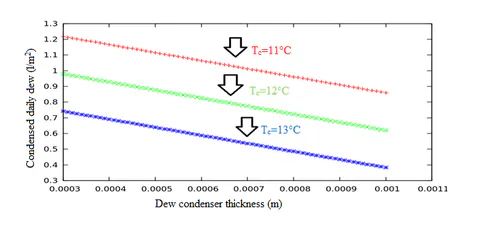
Fig. 4: The net effect of condenser thickness on estimated dew yield at three different values of condenser temperature .
Fig. 4 presents the sensitivity of the estimated dew yield to the dew condenser thickness as well as to the different values of dew condenser temperature. First and foremost, it is important to note that the dew daily yield depends on how far the temperature condenser is changed for the same thickness. Second, the dew condenser temperature plays a crucial role in determining the dew daily yield. It has a big influence on the condensate collected, thereby increasing the dew condenser temperature reduces the estimated dew, whereas decreasing the dew condenser temperature increases dew yield. On the other hand, we remark that the dew yield increases almost linearly with the condenser thickness’s and the condenser thickness seems to be the most important factor to consider when designing condenser materials. It should be noted that the dew formation onto occurs when the condenser thickness is between and . In addition, the optimal harvest thickness for condenser is about .
Conclusion
In this study, we establish a new design with a novel approach to collect dew on condenser. Our model based on solving the heat and mass balance equations exhibits a general linear relationship between dew yield and condenser thicknesses. The dew yield evaluation is compared with experimental data obtained in Alvarez city (Mexico). A good agreement between calculated and collected values was found, in spite of the simplifications being made in the model dew formation. We note that the proposed condenser holds promise for passive dew formation on a large scale.