




Introduction
Food waste remains a major global sustainability challenge, with fruits and vegetables representing the most frequently discarded food categories due to their high perishability. According to the FAO, approximately one‑third of all food produced worldwide—around 1.3 billion tonnes annually—is lost or wasted, with fruits and vegetables constituting a significant share of this total [1]. This loss not only represents a substantial economic burden but also contributes to avoidable environmental impacts, including greenhouse gas emissions and inefficient use of water and soil resources.
Spain illustrates this problem with particular clarity. Between 2018 and 2024, more than 480,000 tonnes of fruits and vegetables were discarded before entering commercial distribution, as documented by a CSIC-led study published in Water [2]. These discards required nearly 36 hm³ of water—equivalent to 36 billion litres—and generated approximately 37,000 tonnes of CO₂, a critical issue in a country where over 60% of the territory is classified as arid or semiarid [3]. The study highlights structural inefficiencies in Spain’s agricultural model, including overproduction, price volatility, and resource overexploitation.
At the consumer level, Spain’s 2024 Annual Food Waste Report shows that households remain the primary source of waste, accounting for 97.5% of total discarded food, with fruit (32.4%) and vegetables (13.8%) being the most frequently wasted items [4]. Despite a 4.4% reduction in overall waste compared to 2023, the persistence of high fruit and vegetable losses underscores the need for integrated interventions across production, distribution, and consumption.
According to an article published in the ‘Diario de Navarra’ (Spain) in April 2024 [5], the agri-food industry faces the challenge of reducing agricultural waste, a problem that accounts for 14% of total production and may be significantly higher for certain products. In the case of broccoli, between 30% and 35% of production is discarded, mainly due to the stem not being used and consumers rejecting yellowed florets. More critical situations arise with artichokes and asparagus, where between 60% and 70% of their weight is discarded, and with cardoons, which suffer even higher levels of waste.
In recent years, consumers have become increasingly aware of the impact of food waste, driving the demand for portion-controlled products that enable more efficient food use. In this context, single-serving products, such as fresh-cut vegetables and other ready-to-eat produce, have gained prominence by facilitating consumption that is better aligned with actual consumer needs and by reducing household food waste. Furthermore, these products meet the demands of modern lifestyles, which are characterized by a preference for convenience, time-saving solutions, and practicality, without compromising on healthy and high-quality eating habits.
In the case of fresh-cut produce, packaging takes on particular importance both for extending the shelf life of these products and for facilitating their transport and storage in supermarkets. Such packaging is usually made of plastic, which may lead to rejection by environmentally conscious consumers; however, there are a multitude of solutions to this problem, such as the use of microperforated films. These microperforations allow for better breathability of the packaged produce, maintaining its freshness and relative humidity, and striking a balance between the permeability of the plastic and the external atmosphere [6]. Furthermore, research continues into the use of films made from biodegradable and compostable plastics as an alternative to conventional ones [7].
Thus, the objective of this study was to evaluate the postharvest quality parameters of fresh-cut broccoli packaged using different plastic materials commonly employed in the minimally processed vegetable industry, including both conventional petroleum-based plastics (oriented polypropylene (OPP), polyethylene (PE) and mixed plastic OPP + PE) and biodegradable/compostable plastics, such as polylactic acid (PLA), all plastics were tested with and without microperforations. In addition to investigating whether micro-perforations alter the properties of biodegradable PLA plastic and whether it can be used for packaging and preserving fresh-cut broccoli.
Materials and Methods
Plant material and experimental design
Broccoli heads (Brassica oleracea var. italica), cultivar ‘Calabrese’, were grown according to conventional agricultural practices and harvested at commercial maturity. After harvest, the samples were rapidly transported under refrigerated conditions and subsequently selected. The stalks were then trimmed, leaving only the florets with approximately 3 cm of stem and a floret diameter of 6 cm. Finally, the florets were washed with hyperchlorinated water and centrifuged to reduce surface water content.
Broccoli florets were packaged in bags made from different plastic materials, including conventional petroleum-based plastics [oriented polypropylene (OPP), polyethylene (PE), and a laminate of OPP + PE] and the biodegradable/compostable polymer polylactic scid (PLA). Each plastic material was tested in both microperforated and non-micro-perforated forms. All bags measured 20 × 22 cm and contained approximately 125 g of broccoli florets. Packaged broccoli samples were evaluated at 0, 5, 10, 15, and 20 days of refrigerated storage (≈ 3 °C). All determinations were carried out in triplicate.
Commercial packaging films based on oriented polypropylene (OPP), polyethylene (PE), OPP/PE laminate, and polylactic acid (PLA) were provided by a confidential industrial partner involved in the distribution of food-packaging materials. In accordance with the confidentiality agreement established between the supplier and the authors, the company name is not disclosed.
Gaseous composition
Before opening the packages, the oxygen and carbon dioxide concentrations inside each bag were measured using a portable gas analyzer (Dansensor CheckPoint, Ringsted, Denmark). A silicone septum was provided on the bag surface for sampling gas inside the package. Results were expressed as %O₂ and %CO₂, respectively. Additionally, the risk of fermentation was estimated based on the aforementioned thresholds of internal gas composition. Specifically, fermentation risk was classified according to %O₂ and %CO₂ levels, assigning a high risk (5) when %O₂ < 2 or %CO₂ > 15, a medium risk (3) when %O₂ ranged between 2–5 or %CO₂ between 10–15, and a low risk (1) when %O₂ > 5 and %CO₂ < 10. This classification allowed for a simplified assessment of anaerobic conditions and potential microbial activity associated with fermentation processes within the packaging system.
Weight loss
Each package was weighed on the day of preparation (day 0) and at each sampling date. The percentage of weight loss relative to the initial weight was calculated according to the following equation (1):
Weight loss (%) = [(Initial package weight − Final package weight) / Initial package weight] × 100 (1)
Odour
Immediately after opening the packages, the odor of the broccoli florets was evaluated according to the method described by Winkler et al. (2007) [8]., using a subjective scale from 1 to 5, where: 1 = typical odor; 2 = slight off-odor; 3 = moderate off-odor; 4 = strong off-odor; and 5 = moldy odor [9]. This is repeated every sampling day.
Overall appearance
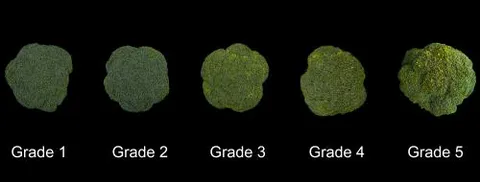
For overall appearance, a pictorial scale (Figure 1) was used together with a brief description of each score level, where: 1 = excellent, no defects; 2 = very good, minor defects; 3 = fair, moderate defects; 4 = poor, major defects; and 5 = inedible [9]. A score of 3 was considered the limit of marketability, while a score of 4 was defined as the threshold of edibility [10].
Statistics
SPSS 15.0 (SPSS Inc., Chicago, IL, USA) was used for statistical analyses. Data were expressed as mean ± standard deviation (SD) from independent analyses and samples. Mean values were compared using Student’s t-test with the significance level set at α = 0.05. All analyses were performed in triplicate to ensure reproducibility.
Principal component analysis (PCA) was performed using Microsoft Excel v. 2603 to evaluate relationships among samples and variables. Sample scores and variable loadings were calculated, and a two-dimensional biplot based on the first two principal components was generated to visualise sample distribution and variable contributions. All analyses were carried out using Microsoft Excel (Microsoft Corp., Redmond, WA, USA).
Results and discussion
Gaseous composition
Broccoli is a vegetable with high metabolic activity and a high postharvest respiration rate. During storage, it consumes oxygen and releases carbon dioxide, progressively modifying the gas composition inside the packaging [11]. The rate of these changes depends primarily on the product's respiration rate and the permeability of the packaging material to gas exchange [12].
The Figure 2 shows that all treatments start from normal atmospheric conditions (~21% O₂ and 0% CO₂) but subsequently evolve toward modified atmospheres with varying intensity depending on the material and the presence of microperforations.
Treatments with non-microperforated OPP and PLA showed a very pronounced decrease in O₂, reaching values close to 0-1% at the end of storage. Simultaneously, CO₂ increased to approximately 20-24%. This behavior indicates that the gas permeability of these materials was insufficient to compensate for the high respiration rate of broccoli.
O₂ concentrations below 1–2% in broccoli induce anaerobic respiration and favor the accumulation of fermentative metabolites such as ethanol and acetaldehyde, responsible for unpleasant odors and flavors [13] in addition, excessively restrictive atmospheres can cause physiological disorders, loss of sensory quality and tissue deterioration in fresh vegetables [14].
The most extreme behavior is observed in PLA, where O₂ reaches approximately 0.5% and CO₂ around 24%. This suggests a lower effective permeability of PLA compared to PE and possibly also compared to OPP. Several studies have indicated that many PLA-based bioplastics exhibit low oxygen permeability and limited CO₂ diffusion capacity, which can generate anaerobic atmospheres when used with high-respiration products [15, 16].
On the other hand, non-microperforated PE shows a more moderate reduction in O₂ (~6%) and a CO₂ accumulation close to 10%. This suggests greater gas permeability of PE, allowing for a more balanced atmosphere. These values are close to the ranges considered optimal for storing fresh broccoli, where concentrations of 2-10% O₂ and 5-10% CO₂ reduce respiration and delay senescence without inducing anaerobiosis [11].
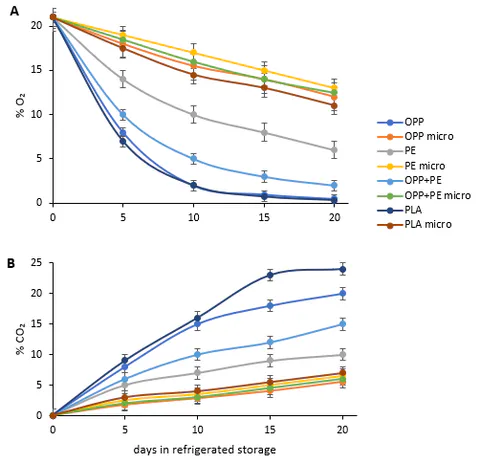
Microperforations significantly altered the internal gas composition in all materials. In the microperforated treatments, O₂ remained between 11-13%, while CO₂ remained at relatively low levels (5-7%). This demonstrates that the perforations significantly increased gas transfer between the inside and outside of the packaging. Mahajan et al. (2007) [17] describe how gas diffusion through perforations can be several orders of magnitude greater than diffusion through the polymer matrix, meaning that small perforations have a decisive effect on the internal atmosphere of the packaging. These types of systems, known as Perforation-Mediated Modified Atmosphere Packaging (PM-MAP), are particularly suitable for highly respiratory fruits and vegetables.
Although differences between polymers decrease when microperforations are incorporated, some variations are still observed. Microperforated PE maintained slightly higher O₂ and lower CO₂ values, while microperforated OPP and microperforated PLA exhibited somewhat more modified atmospheres. This indicates that, although perforations dominate gas exchange, the polymer's intrinsic permeability still influences the final system equilibrium. Robertson (2013) [12] notes that the final atmospheric composition in a microperforated package depends on the combination of material permeability, perforation size and number, storage temperature, and product respiration rate.
Risk of fermentation
Taking into account that fermentation risk was classified according to %O₂ and %CO₂ levels, assigning a high risk (5) when %O₂ < 2 or %CO₂ > 15, a medium risk (3) when %O₂ ranged between 2–5 or %CO₂ between 10–15, and a low risk (1) when %O₂ > 5 and %CO₂ < 10, the values obtained were presented in Figure 3.
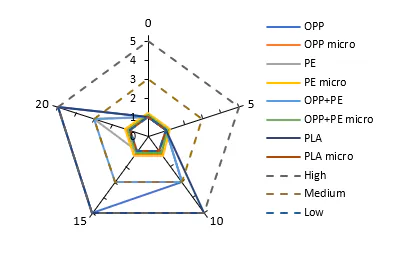
As shown in Figure 3, fermentation risk remained low (score 1) throughout storage in most microperforated packages, irrespective of the polymer used. This behaviour indicates that microperforations enhanced gas exchange between the package headspace and the external environment, preventing excessive CO₂ accumulation and O₂ depletion. Similar effects have been reported in modified atmosphere packaging (MAP) of fresh-cut vegetables, where microperforations help maintain atmospheric compositions within physiological limits and reduce the risk of anaerobic respiration and fermentative metabolism [17].
In contrast, non-perforated PLA packages showed a progressive increase in fermentation risk, reaching the maximum score from day 10 onwards. This result suggests that the gas permeability of PLA was insufficient to balance the respiratory activity of broccoli florets stored at 3 °C, leading to atmospheres characterized by low O₂ and/or elevated CO₂ concentrations. Fresh-cut broccoli exhibits a relatively high respiration rate, and when O₂ levels fall below approximately 2% or CO₂ levels exceed 10-15%, anaerobic metabolic pathways may be activated, resulting in the production of ethanol, acetaldehyde, and other off-flavour compounds associated with quality deterioration [18, 19].
The conventional petroleum-based films (OPP, PE, and OPP+PE) exhibited intermediate behaviour. Although fermentation risk increased during storage in some treatments, the values generally remained lower than those observed for non-perforated PLA. These differences can be attributed to the specific gas transmission properties of each packaging material, which determine the equilibrium atmosphere established inside the package. The balance between product respiration and film permeability is a key factor in designing successful MAP systems for fresh-cut produce [20].
Overall, the results demonstrate that microperforation was more influential than the polymer type in controlling fermentation risk. Maintaining adequate O₂ availability while avoiding excessive CO₂ accumulation is essential for preserving the sensory and nutritional quality of fresh-cut broccoli during refrigerated storage. Therefore, the incorporation of microperforations appears to be an effective strategy for both conventional and biodegradable packaging materials.
Weight loss
The Figure 4 shows the percentage weight loss of broccoli florets stored in different packaging materials (OPP, PE, PLA, and combinations), with and without microperforations, over 20 days of storage. In all treatments, a progressive increase in weight loss is observed over time, although the magnitude of this loss clearly depends on the type of material and the presence of microperforations. Weight loss in fresh fruits and vegetables is primarily associated with transpiration and respiration. Transpiration involves the loss of water from the tissues to the environment due to vapor pressure gradients, while respiration contributes partially through the release of CO₂ and water vapor [18]. In fresh vegetables, even small weight losses can lead to loss of firmness, wilting, and visual deterioration [21].
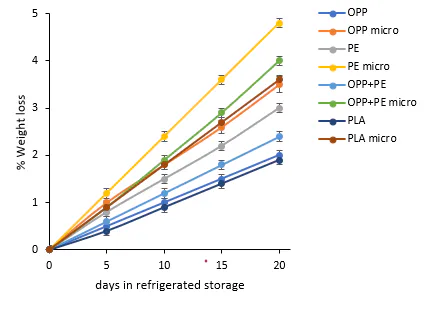
Microperforated treatments showed the greatest weight loss in virtually all materials. The most notable case was microperforated PE, which reached approximately 4.8% weight loss by day 20, followed by OPP+PE micro and PLA micro, with values close to 4.0% and 3.6%, respectively. This behavior can be attributed to the fact that microperforations significantly increase the transfer of water vapor between the inside of the package and the external environment. According to Yuan et al. (2021) [22], perforations simultaneously increase gas diffusion and water vapor permeability, promoting product dehydration. Although microperforations help prevent anaerobic conditions, they also reduce the package's ability to maintain high internal relative humidity.
The significant weight loss observed in micro-perforated polyethylene (PE) packaging may also be related to the high intrinsic permeability of polyethylene to water vapor. Robertson (2013) [12], indicates that PE has a relatively high permeability to moisture, which favors higher transpiration rates compared to more barrier-like materials. These results are consistent with studies conducted on minimally processed fresh vegetables, where micro-perforated packaging typically exhibits greater weight loss due to a lower barrier effect against moisture migration [23].
Treatments without microperforations showed lower weight loss throughout storage. The lowest values were observed in OPP and PLA, with losses of approximately 1.9–2.0% by day 20, followed by OPP+PE (~2.4%) and PE (~3.0%). The lower weight loss in OPP and PLA can be explained by their greater water vapor barrier capacity. These materials limit moisture loss from inside the packaging and help maintain high relative humidity around the product. Kader et al. (1989) [11] indicate that high relative humidity inside the packaging significantly reduces transpiration and helps preserve the turgor of plant tissues. In the case of PLA, in addition to its previously observed low gas permeability, it can also exhibit moderate water vapor permeability depending on its formulation and thickness [15]. This would explain the reduced weight loss recorded in this treatment.
In the case of broccoli, weight loss is particularly important because dehydration accelerates yellowing, loss of firmness, and loss of commercial quality [9]. However, while lower weight loss is generally desirable, in this study the most effective barrier materials also generated atmospheres with extremely low O₂ levels and excessive CO₂ accumulation. Therefore, less weight loss does not necessarily imply better overall product preservation, as it can coexist with anaerobic conditions detrimental to the physiological quality of the broccoli.
Odour
Figure 5 illustrates the evolution of odour in broccoli florets stored at 3 °C for 20 days under different packaging systems. Odour was assessed using a subjective 5-point scale, where 1 = typical odour, 2 = slight off-odour, 3 = moderate off-odour, 4 = strong off-odour, and 5 = mouldy odour. Therefore, increasing scores indicate progressive sensory deterioration and reduced consumer acceptability.
At the beginning of storage, all treatments exhibited odour scores close to 1, indicating the absence of sensory defects and the preservation of the characteristic aroma of fresh broccoli. After 5 days, only slight increases in odour scores were observed, suggesting that the packaging systems were initially effective in maintaining product quality. However, clear differences among packaging treatments became evident as storage progressed.
Conventional films without microperforations, particularly PE, OPP and OPP+PE, exhibited the most pronounced increase in odour scores throughout storage. By day 20, PE and OPP reached values approaching 4-5, corresponding to strong off-odours and, in some cases, sensory characteristics associated with mouldy odours. Such changes are consistent with the accumulation of undesirable volatile compounds resulting from the high respiratory activity of broccoli florets and the development of unfavourable in-package atmospheres. When oxygen availability becomes limited and carbon dioxide accumulates, anaerobic metabolism may be induced, leading to the production of ethanol, acetaldehyde and sulphur-containing volatiles that contribute to unpleasant odours and sensory rejection [24, 25].
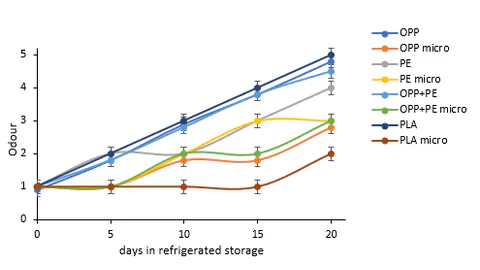
In contrast, microperforated films consistently maintained lower odour scores throughout storage. Among all treatments, PLA micro showed the best sensory performance, with values remaining close to 2 after 20 days, indicating only a slight off-odour. Similarly, OPP micro and OPP+PE micro delayed the development of off-odours compared with their non-perforated counterparts. These findings suggest that microperforation enhanced gas exchange between the package headspace and the external environment, preventing excessive oxygen depletion and reducing the accumulation of fermentation-related metabolites. Similar effects have been reported for fresh-cut Brassica vegetables, where microperforated packaging improved atmospheric equilibrium and reduced the development of sensory defects during storage [26-28].
Particularly noteworthy is the behaviour of PLA-based packaging. While non-perforated PLA reached the highest odour scores at the end of storage, indicating severe sensory deterioration, the incorporation of microperforations substantially mitigated this effect. This result highlights the importance of tailoring the gas transmission characteristics of biodegradable packaging materials to the physiological requirements of highly respiring fresh produce. Previous studies have demonstrated that although biodegradable polymers may exhibit lower gas permeability than conventional films, appropriate package design can significantly improve product quality and shelf life [28,29]. From a commercial perspective, odour scores above 3 indicate the presence of moderate to strong off-odours that may negatively affect consumer acceptance. Consequently, the microperforated treatments, especially PLA micro, were more effective in preserving the sensory quality of broccoli florets during refrigerated storage.
Overall appearance
Figure 6 presents the evolution of overall appearance scores of broccoli florets stored at 3 °C under different packaging systems. According to the sensory scale used, increasing scores indicate progressive deterioration of visual quality, with a score of 3 representing the limit of marketability and a score of 4 corresponding to the limit of edibility. Therefore, treatments that remain below these thresholds for longer periods can be considered more effective in preserving the commercial quality of the product.
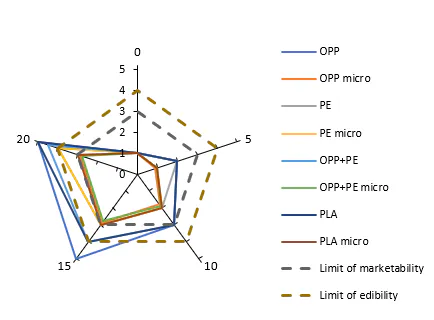
At the beginning of storage, all treatments exhibited scores close to 1, reflecting the excellent visual quality expected for freshly processed broccoli. During storage, overall appearance gradually deteriorated in all packaging systems; however, the rate and magnitude of quality loss varied considerably depending on the packaging material and the presence of microperforations. The most pronounced deterioration was observed in non-perforated PLA, OPP, and OPP+PE packages. These treatments reached the marketability threshold (score 3) between 10 and 15 days of storage and approached or exceeded the edibility limit by day 20. In particular, PLA showed the fastest decline in visual quality, indicating that this packaging configuration was less effective in maintaining acceptable appearance throughout storage. The rapid deterioration may be associated with excessive accumulation of CO₂ and depletion of O₂ within the package, conditions that can accelerate physiological disorders, tissue senescence, chlorophyll degradation, and the development of condensation-related defects [11, 30].
In contrast, microperforated treatments consistently maintained lower appearance scores throughout storage. OPP micro, PE micro, OPP+PE micro, and especially PLA micro remained below the marketability limit even after 20 days of refrigerated storage. This finding suggests that microperforation improved the balance between product respiration and gas exchange, preventing the development of excessively restrictive atmospheres while reducing moisture accumulation inside the package. Similar benefits of microperforated modified-atmosphere packaging have been reported for fresh-cut Brassica vegetables, where adequate gas permeability contributed to the preservation of colour, texture, and overall visual quality [19, 28].
Interestingly, although PLA without microperforations exhibited one of the poorest performances, PLA micro showed visual quality comparable to or better than most conventional plastic treatments. This result highlights that the effectiveness of biodegradable packaging depends not only on the intrinsic properties of the polymer but also on package design. The incorporation of microperforations appears to compensate for the relatively low gas transmission characteristics of PLA, creating a more suitable atmosphere for maintaining broccoli quality during storage [29].
Principal Component Analysis (PCA)
Principal component analysis (PCA) was applied to reduce the dimensionality of the dataset comprising packaging quality and product evolution variables (Figure 7). The first two principal components accounted for 94.3% of the total variance (PC1 = 76.9% and PC2 = 17.4%), indicating a highly robust representation of the relationships among physicochemical, sensory, and internal atmosphere variables storage [31].
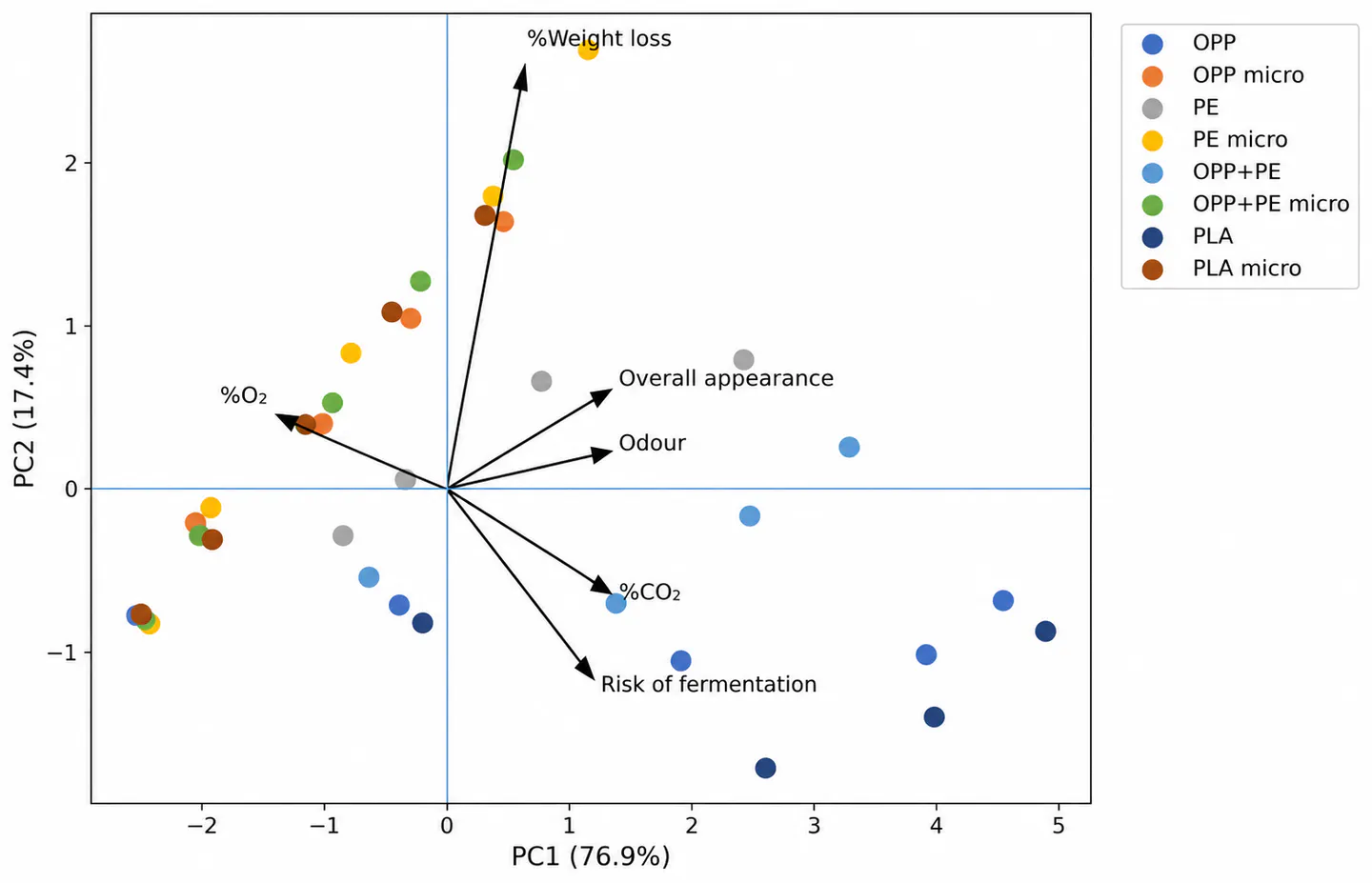
PC1 was primarily associated with variables related to product deterioration, including CO₂ percentage, fermentation risk, odor, and overall appearance. In contrast, it showed a negative correlation with O₂ content. Accordingly, this axis can be interpreted as an internal packaging atmosphere quality gradient, where positive scores correspond to more anaerobic conditions and increased risk of product degradation and sensory deterioration. PC2 was mainly driven by weight loss (%), suggesting that this component reflects mass transfer phenomena, particularly moisture loss or water vapor migration, with a comparatively lower direct relationship to sensory or microbiological quality parameters.
The results revealed a clear separation of samples according to packaging material type and the presence of microperforation. In general, non-microperforated systems (OPP, PE, and PLA) were positioned toward the positive region of PC1 or in proximity to variables associated with CO₂ accumulation. This indicates a greater tendency to develop anaerobic conditions, thereby increasing the risk of fermentation and sensory deterioration. In contrast, microperforated systems (OPP micro, PE micro, and PLA micro) were shifted toward regions associated with higher O₂ availability and lower contributions from fermentation-related variables. This behavior confirms that microperforation enhances gas exchange, reduces CO₂ accumulation, and mitigates degradation processes associated with sealed atmospheres.
Polylactic acid (PLA) exhibited a distinct behavior compared with conventional polymers (OPP and PE). Under non-microperforated conditions, PLA samples were associated with higher PC1 positive scores, indicating greater susceptibility to CO₂ accumulation and the development of fermentation-favorable conditions. However, the introduction of microperforation significantly shifted PLA samples toward regions characterized by higher O₂ availability and reduced fermentation risk, highlighting a strong dependence of this material on system permeability. Additionally, PLA showed a stronger association with weight loss compared to OPP and PE, suggesting higher sensitivity to water vapor transfer processes.
Overall, OPP and PE exhibited more stable responses under packaging conditions, although their performance remained dependent on microperforation to optimize internal atmosphere quality. Notably, non-microperforated PE showed a stronger tendency toward extreme positive PC1 values, indicating a higher propensity for the development of unfavorable atmospheres in sealed systems.
Taken together, the results demonstrate that microperforation is the most influential factor in modulating internal atmosphere composition, surpassing the effect of polymer type. Nevertheless, PLA, despite its biodegradable nature, exhibits greater sensitivity to gas exchange conditions, requiring more specific packaging design strategies to prevent product deterioration, such as microperforations.
Conclusions
The results highlight the importance of adapting the properties of the packaging to the physiological characteristics of the product. In vegetables with high respiration rates and a short shelf life, such as broccoli, a material with too high a barrier can quickly lead to anaerobic conditions, whilst excessive permeability reduces the beneficial effect of the modified atmosphere.
In this study, although the microperforated treatments resulted in greater weight loss, they probably provided better respiratory conditions and sensory quality. It has been demonstrated that the use of microperforated biodegradable packaging (PLA micro) as a sustainable alternative to conventional petroleum-based plastics for maintaining the postharvest quality of minimally processed broccoli.
In addition to its positive effects on product quality, microperforated PLA packaging may contribute to broader sustainability goals. The replacement of conventional plastic materials with biodegradable alternatives aligns with current efforts to reduce plastic waste, while the preservation of broccoli quality and sensory attributes may help mitigate food waste by increasing consumer acceptance and extending the product's usable shelf life. These combined benefits support the development of more sustainable packaging solutions for fresh and minimally processed vegetables.
Author Contributions: M.F.F.-L. conceptualization, formal analysis, investigation, methodology, supervision, writing—original draft and writing—review and editing. A.M.F.-L. conceptualization, formal analysis, investigation, methodology, funding acquisition and writing—review and editing. All authors have read and agreed to the published version of the manuscript.


