

Introduction
Artificial Intelligence (AI) is increasingly being integrated into higher education, transforming communication practices, learning approaches, and digital literacy development. AI utilizes adaptive algorithms and natural language processing to enable personalized learning experiences, enhance efficiency in interactions, and foster inclusive educational environments. Broadly defined, AI refers to digital systems capable of performing tasks that require human-like intelligence, including learning, decision-making, and pattern recognition (Chiu et al., 2023). The application of AI in education has led to enhanced productivity (Gao & Feng, 2023) and improvements in communication competence (Davenport & Kalakota, 2019). AI-driven technologies, such as intelligent tutoring systems and learning management systems, support personalized learning, automated assessments, and real-time academic assistance (Lin et al., 2023). These tools promote stronger teacher-student interactions and create more flexible learning environments (Kamalov et al., 2023). Notably, the development of generative AI tools like ChatGPT has introduced virtual academic assistants, offering instant feedback, language practice, research assistance, and content generation (Memarian & Doleck, 2023a; Kohnke et al., 2023). Despite these advancements, AI remains a complementary tool that cannot replace human educators (Yu, 2024). Contemporary scholarship has increasingly called for a reconceptualization of communication competence to encompass AI-mediated interactions, recognizing that students must now navigate both human and machine communication contexts (Xi, 2025).
The proliferation of AI in academic settings has fundamentally altered how students access information, engage with course materials, and develop essential competencies for their professional futures. Generative AI platforms, in particular, have demonstrated remarkable capabilities in supporting writing development, language acquisition, and critical thinking through iterative feedback and scaffolding (Montenegro-Rueda et al., 2023). These tools enable students to refine their communication skills through continuous practice and real-time corrections, thereby accelerating the development of linguistic accuracy and expressive clarity (Stepanenko & Stupak, 2023). Empirical evidence suggests that AI-powered language learning tools significantly enhance students' communicative competence by providing personalized, adaptive feedback that traditional instructional methods cannot replicate (Zhang, 2025). Furthermore, AI-powered learning analytics provide educators with valuable insights into student progress, enabling timely interventions and personalized support that traditional pedagogical approaches cannot easily replicate (Firat, 2023). The integration of AI into higher education also promotes digital literacy, as students must develop the competencies to navigate, evaluate, and utilize digital platforms effectively (George & Wooden, 2023). This dual benefit—enhancing both communication skills and technological proficiency—positions AI as a transformative force in contemporary education.
However, the adoption of AI in education is not without significant challenges. Ethical concerns surrounding data privacy, algorithmic transparency, and academic integrity have emerged as critical issues requiring careful consideration (Nguyen et al., 2023; Zhao & Gómez Fariñas, 2023). The digital divide further complicates AI integration, as students from resource-constrained backgrounds may lack equitable access to the technologies that are becoming increasingly central to academic success (Veluvali & Surisetti, 2022). These challenges are particularly pronounced in developing countries like Bangladesh, where infrastructural limitations and varying levels of technological readiness create disparities in AI adoption and utilization (Kamalov et al., 2023). Research from other developing regions, such as West Africa, has similarly highlighted the complex interplay between affective, behavioral, cognitive, and ethical dimensions of AI literacy, underscoring the need for context-sensitive approaches to AI integration (Asghar et al., 2025). Existing research primarily focuses on the technological aspects of AI, overlooking its impact on communication competence and digital literacy in specific socio-educational contexts, such as Bangladesh. This study aims to bridge this gap by investigating the role of AI-driven tools in enhancing communication competence and digital literacy among university students in Bangladesh. The study is guided by Communication Competence Theory, which focuses on the ability to communicate effectively and appropriately across various contexts. This framework emphasizes the importance of linguistic accuracy, clarity, adaptability, and interactional effectiveness—dimensions that are increasingly mediated by AI in contemporary learning environments.
Literature review
Artificial Intelligence has become an essential force in higher education, influencing how students engage with learning, develop communication skills, and enhance their digital literacy. AI is broadly defined as the ability of digital systems to perform tasks traditionally requiring human intelligence, such as problem-solving, learning, and decision-making. This technology has been widely acknowledged for its capacity to improve educational outcomes (Chiu et al., 2023; Davenport & Kalakota, 2019). Over the past few years, AI-driven tools like intelligent tutoring systems, AI-powered Learning Management Systems (LMS), and generative AI platforms such as ChatGPT have revolutionized education by providing customized learning, immediate feedback, and adaptable instructional assistance (Lin et al., 2023; Memarian & Doleck, 2023a; Kohnke et al., 2023).
Research globally has shown that AI boosts productivity, encourages self-regulated learning, and enhances interaction between students and teachers (Gao & Feng, 2023; Kamalov et al., 2023). AI tools like Grammarly and writing assistants support students in improving their language skills, including grammar, vocabulary, and clarity, which are all vital for effective communication. These improvements align with communication competence, a multifaceted concept encompassing clarity, adaptability, and effective interactions (Davenport & Kalakota, 2019; Memarian & Doleck, 2023a). Furthermore, AI plays a crucial role in enhancing students' digital literacy by enabling them to effectively use digital platforms, critically analyze information, and apply technology for academic problem-solving (Firat, 2023; George & Wooden, 2023).
However, despite these advantages, integrating AI in education presents several challenges. Ethical issues such as data privacy, algorithmic biases, and maintaining academic integrity remain concerns (Nguyen et al., 2023; Zhao & Gómez Fariñas, 2023). These issues are even more pronounced in developing countries, where limited infrastructure and digital inequalities may hinder widespread access to AI tools (Kamalov et al., 2023; Veluvali & Surisetti, 2022). In Bangladesh, the adoption of AI in higher education is still in its infancy, and there is a significant gap in research regarding how AI impacts communication skills and learning behaviors within this specific context. Much of the existing research has been focused on technological implementation, rather than exploring the socio-educational effects of AI adoption (Montenegro-Rueda et al., 2023; Memarian & Doleck, 2023b).
Communication Competence Theory offers a valuable perspective on understanding AI's role in education. This theory emphasizes the importance of communicating effectively and appropriately across various situations, incorporating key aspects such as linguistic precision, clarity, adaptability, and effective interaction (Yu, 2024). Studies suggest that AI-enhanced learning environments help students develop these skills by providing instant feedback, enabling collaboration, and guiding structured communication exercises (Stepanenko & Stupak, 2023; Kohnke et al., 2023).
AI also supports student engagement by fostering an interactive learning environment. AI-powered tools help facilitate real-time feedback, encourage collaborative learning, and provide more engaging content delivery, leading to a more dynamic educational experience (Llovet & González-Rodríguez, 2023; Ruiz-Rojas et al., 2023). Observations indicate that students who regularly use AI tools tend to display greater confidence in academic discussions and presentations, which reflects their improved ability to communicate ideas effectively (Memarian & Doleck, 2023a; Lin et al., 2023).
To conclude, the literature emphasizes AI's transformative potential in higher education, but it also acknowledges the challenges, particularly concerning ethics and digital equity. Effective integration of AI requires context-specific strategies, institutional policies, and initiatives aimed at enhancing digital literacy, especially in resource-limited settings like Bangladesh. Although promising, more research is needed to fully understand how AI affects communication competence, digital literacy, and student engagement, particularly in developing countries where AI adoption is still evolving (Chiu et al., 2023; Kamalov et al., 2023; Yu, 2024).
Research Problem
Although prior studies demonstrate that AI significantly enhances the educational process through personalized learning, intelligent tutoring systems, and improved teacher–student collaboration (Kamalov et al., 2023; Lin et al., 2023), the existing literature remains largely technology-centric and lacks sufficient focus on communication competence development among university students, particularly in developing countries like Bangladesh.
AI-driven tools such as Learning Management Systems (LMS), virtual classrooms, and generative AI applications have improved student engagement, facilitated uninterrupted learning, and supported customized educational content (Veluvali & Surisetti, 2022; Montenegro-Rueda et al., 2023). However, despite these advancements, there is limited empirical understanding of how these technologies influence students' communication skills, digital literacy, and interactive learning behaviors within higher education contexts.
Furthermore, the rapid integration of AI in education raises critical concerns regarding data privacy, algorithmic transparency, and ethical usage (Nguyen et al., 2023; Zhao & Gómez Fariñas, 2023). The issue is further complicated by the digital divide, particularly in resource-constrained educational environments, where unequal access to AI tools may hinder equitable learning opportunities (Kamalov et al., 2023).
In the context of Bangladesh, where higher education institutions are increasingly adopting digital technologies, there is a significant research gap in understanding:
How do AI tools contribute to communication competence?
How do students adapt to AI-driven learning environments?
How do ethical and infrastructural challenges influence this integration?
Therefore, this study seeks to bridge this gap by examining the role of AI in shaping communication competence among university students in Bangladesh and addressing the associated opportunities and challenges.
Research Focus
This study examines the transformative role of AI-driven technologies in higher education, with particular emphasis on communication competence, digital literacy, and student engagement. It aims to explore how AI tools facilitate interactive learning, enhance communication processes, and support the development of essential academic and professional skills among university students.
At the same time, the study critically investigates the challenges associated with AI adoption, including ethical concerns, data privacy, algorithmic bias, and unequal access to technology. by integrating both opportunities and constraints, the research provides a balanced and context-specific analysis relevant to the higher education landscape in Bangladesh.
The findings are expected to contribute to the development of practical recommendations for policymakers, educators, and institutions, enabling the effective and ethical integration of AI in teaching, learning, and academic communication.
Research Aim
The primary aim of this study is to analyze the impact of AI-driven technologies on the development of communication competence among university students in Bangladesh, with a focus on identifying both opportunities and challenges associated with AI integration in higher education.
Research Objectives
To explore how AI tools influence communication competence among university students
To examine the role of AI in developing digital literacy
To identify challenges and ethical concerns in AI integration
Research Methodology
Research design
This study adopts a qualitative-dominant design, as the primary objective is to explore participants' lived experiences, perceptions, and contextual interpretations of AI use in higher education. Although the questionnaire included structured items, the study is qualitative in nature, as the analysis primarily focused on open-ended responses, classroom observations, and thematic interpretation. The core analysis is based on qualitative data derived from open-ended responses, observations, and reflective discussions, ensuring an in-depth interpretive understanding rather than statistical generalization.
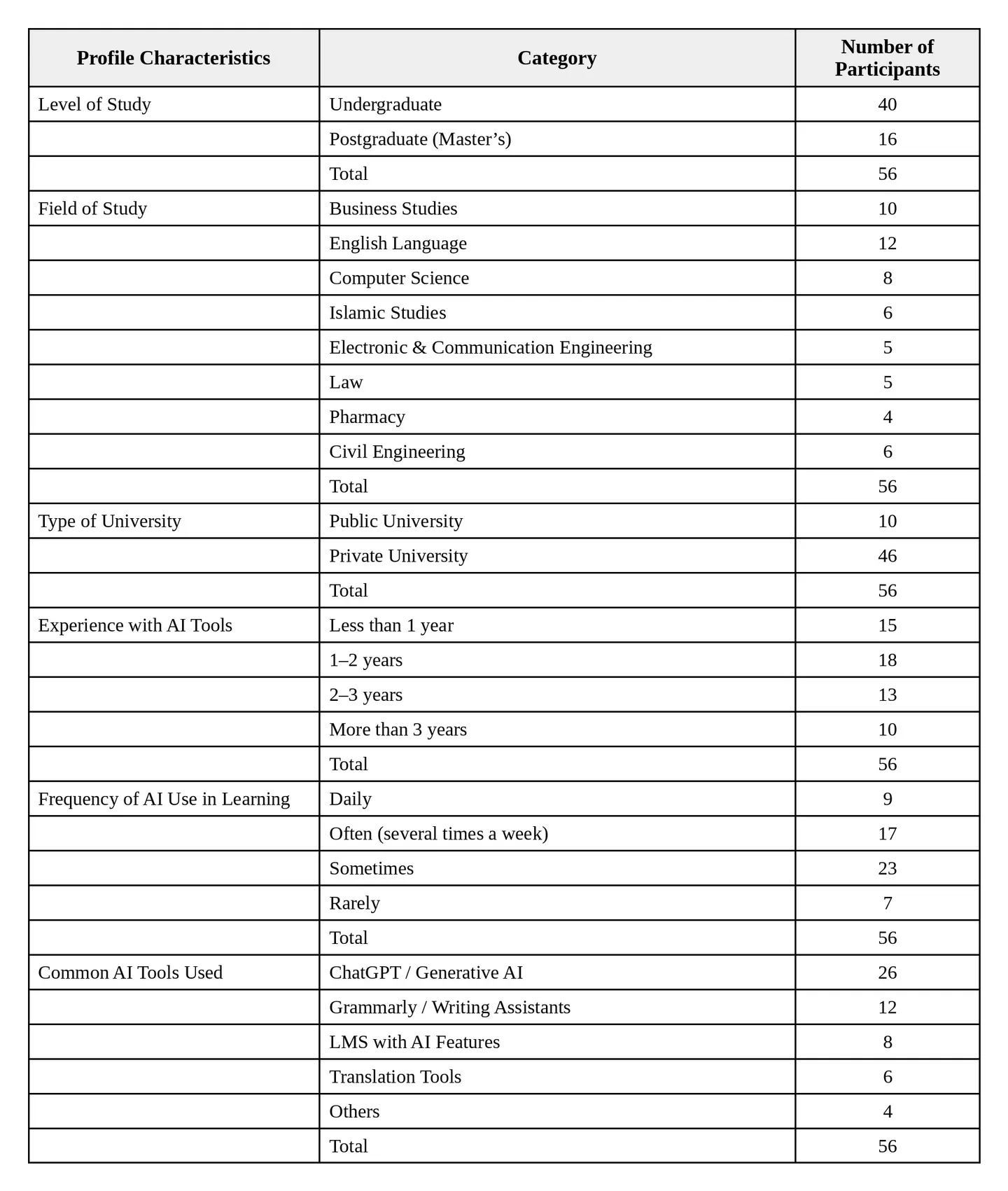
The study involved 56 university students from both public and private universities in Bangladesh, selected through purposive sampling. Participants were chosen based on their exposure to AI tools in academic activities and their willingness to share experiences.
Data Collection methods
Data were collected using:
Semi-structured online questionnaires (including open-ended questions)
Classroom observations
Post-observation reflective discussions
Data analysis
The data were analyzed using thematic analysis, categorization, and theme development related to communication competence, digital literacy, and AI integration in learning.
Ethical Considerations
Participation was voluntary, anonymous, and based on informed consent. Confidentiality and ethical research standards were strictly maintained.
Table 1 shows the profile characteristics of the participants.
Table 1: Participants' Profiles
Source: based on the author's development.
This study employed a qualitative-dominant mixed-methods approach to explore the role of AI-driven technologies in shaping communication competence and learning practices in higher education. the integration of multiple data collection methods enabled a comprehensive and in-depth understanding of participants’ experiences and perceptions.
Survey Instrument
Data were collected through an online questionnaire comprising both closed-ended and open-ended questions. The questionnaire was developed based on an extensive review of existing literature on AI applications in education. To ensure clarity, relevance, and reliability, a pilot study was conducted before the main data collection phase, allowing refinement of the instrument and improvement of feedback mechanisms.
The final questionnaire consisted of 32 structured items measured on a Likert scale ranging from "Strongly agree" to "Strongly disagree," alongside 10 open-ended questions designed to capture participants' detailed perspectives, experiences, and attitudes toward the use of AI tools in higher education.
While the structured items provided supportive descriptive insights, the open-ended responses formed the primary qualitative data source, enabling deeper exploration of themes related to communication competence, digital literacy, and AI integration.
Classroom Observations
In addition to the survey, classroom observations were conducted to examine the practical use of AI technologies in real educational settings. A structured observation framework was developed before data collection, incorporating key indicators such as:
Teacher–student interaction
Student engagement
Use of AI tools in instructional delivery
Quality of learning materials
Assessment practices
Ethical considerations (e.g., privacy, bias, transparency)
These indicators were evaluated along a continuum from "Positive impact" to "Adverse effect," allowing systematic documentation of AI's role in classroom dynamics. During the observation phase, the researcher recorded the frequency and nature of AI usage, as well as its influence on communication patterns, instructional effectiveness, and student participation.
Post-Observation Reflection
Following each observation session, post-observation discussions were conducted with participants to gather reflective feedback on the use of AI in teaching and learning. These discussions helped identify strengths, challenges, and areas for improvement in AI integration, adding further depth to the qualitative findings.
Data analysis
The qualitative data obtained from open-ended survey responses, observations, and post-observation reflections were analyzed using thematic analysis. This involved coding the data, identifying recurring patterns, and developing key themes related to communication competence, digital literacy, and AI usage.
Methodological Justification
Although the study incorporated structured survey elements, its primary emphasis remained on qualitative interpretation, as the research aimed to understand participants' experiences, perceptions, and contextual realities rather than to test hypotheses or establish statistical relationships.
Findings and Discussion
The thematic analysis of qualitative data collected from open-ended survey responses, classroom observations, and post-observation reflections revealed several recurring patterns regarding the role of AI-driven technologies in higher education. The findings are organized into key themes reflecting students' experiences, perceptions, and challenges in using AI tools for communication and learning. This finding aligns with Communication Competence Theory, as AI tools enhance students' linguistic accuracy, clarity, and confidence—core components of effective communication in academic contexts.
Theme 1: Enhancement of Communication Competence through AI Tools
One of the most prominent findings indicates that AI-driven tools significantly contribute to the development of students' communication competence. Participants reported that tools such as generative AI and writing assistants helped improve their academic writing, vocabulary usage, grammatical accuracy, and clarity of expression.
Students particularly emphasized the role of AI in:
Structuring assignments and reports
Practicing formal and professional communication
Receiving instant feedback on language use
Classroom observations further confirmed that students who frequently used AI tools demonstrated greater confidence in presentations and interactive discussions. AI-supported learning environments encouraged active participation and idea articulation, especially among students who previously experienced communication barriers.
Theme 2: Digital Literacy and Self-Directed learning
The findings reveal that AI tools play a crucial role in enhancing students' digital literacy and independent learning capabilities. Participants indicated that regular use of AI applications improved their ability to:
Navigate digital platforms
Evaluate information critically
Utilize technology for academic problem-solving
Students reported increased reliance on AI for exploring complex topics, generating ideas, and accessing personalized learning support. Observational data also showed that AI integration promoted self-directed learning behaviors, where students actively engaged in knowledge exploration beyond traditional classroom instruction.
Theme 3: Increased Student Engagement and Interactive learning
Another key theme highlights the role of AI in fostering student engagement and interactive learning environments. AI-supported tools enabled more dynamic classroom interactions by:
Facilitating real-time feedback
Supporting collaborative learning activities
Enhancing visual and interactive content delivery
Students expressed that AI made learning more accessible, flexible, and engaging, particularly in courses requiring communication and analytical thinking. Observations indicated that classrooms incorporating AI tools experienced higher levels of participation and improved teacher–student interaction.
Theme 4: Ethical Concerns and Challenges in AI Integration
Despite the positive outcomes, participants raised several concerns regarding the use of AI in education. The most frequently mentioned challenges include:
Data privacy and security risks
Over-reliance on AI tools, potentially limiting critical thinking
Bias and lack of transparency in AI-generated outputs
Academic integrity issues, particularly in assignments
Students and educators expressed uncertainty about the ethical boundaries of AI usage, highlighting the need for clear institutional guidelines. Observations also revealed inconsistencies in how AI tools were used and monitored across different classrooms.
Theme 5: Digital Divide and Accessibility Issues
The study identified a significant disparity in access to AI technologies among students. While some participants reported frequent and effective use of AI tools, others faced limitations due to:
Lack of access to reliable internet
Limited familiarity with advanced AI tools
Institutional constraints in adopting AI technologies
This digital divide affects the equitable development of communication competence and digital skills among students, particularly in resource-constrained settings within Bangladesh.
Theme 6: Future Potential of AI in Higher Education
Participants expressed optimism regarding the future applications of AI in education. They highlighted several potential developments, including:
AI-powered personalized learning systems
Advanced virtual tutoring and mentoring
Automated feedback mechanisms for communication skills
Integration of AI in curriculum design and assessment
Students and educators agreed that, if implemented responsibly, AI has the potential to transform higher education by enhancing both academic performance and communication competence.
Overall Interpretation
The findings align with Communication Competence Theory, as AI-driven tools contribute to key dimensions of communication competence, including linguistic accuracy, clarity of expression, adaptability, and interactional effectiveness. The use of AI in academic writing, presentations, and collaborative learning environments demonstrates how technology mediates communication processes and enhances students' ability to communicate effectively across academic contexts.
Contribution of the study
This study makes several important contributions to the existing literature on Artificial Intelligence in education. First, it provides empirical qualitative evidence on the role of AI-driven technologies in enhancing communication competence and digital literacy among university students, addressing a gap in current research that is largely technology-focused.
Second, the study contributes a context-specific analysis from Bangladesh, offering insights into how AI is adopted and experienced within a developing country context characterized by digital inequality and evolving technological infrastructure.
Third, by applying Communication Competence Theory, the study extends theoretical understanding by demonstrating how AI tools support not only linguistic accuracy but also adaptability, interactional effectiveness, and communication confidence in academic environments.
Finally, the study offers practical and policy-relevant implications for educators, institutions, and policymakers, emphasizing the need for ethical AI integration, digital literacy development, and equitable access to technology in higher education.
Conclusion
This study explored the role of AI-driven technologies in shaping communication competence, digital literacy, and learning engagement among university students in Bangladesh. The findings reveal that AI tools significantly enhance students' communication abilities by improving writing quality, language accuracy, and confidence in academic interactions. Additionally, AI facilitates self-directed learning and strengthens digital literacy, enabling students to navigate complex information environments more effectively.
The integration of AI in higher education also contributes to more interactive and engaging learning experiences. AI-supported platforms encourage active participation, foster collaborative learning, and improve the overall quality of instructional delivery. These findings indicate that AI has the potential to transform traditional educational practices by promoting adaptive, student-centered learning environments.
However, the study also highlights several critical challenges associated with AI adoption. Ethical concerns, including data privacy, algorithmic bias, and academic integrity, remain significant issues that require careful attention. Furthermore, the digital divide continues to limit equitable access to AI technologies, particularly among students from resource-constrained backgrounds. These challenges underscore the need for a balanced and responsible approach to AI integration in higher education.
In the context of Bangladesh, where digital transformation in education is rapidly evolving, this study contributes to a deeper understanding of how AI can support the development of communication competence while also identifying the barriers that must be addressed. The findings emphasize that AI should be used as a complementary tool to enhance, rather than replace, human interaction and pedagogical practices.
Policy Recommendations
Based on the findings of this study, several policy recommendations are proposed to support the effective and ethical integration of AI in higher education in Bangladesh.
Development of Institutional AI Guidelines
Higher education institutions must establish comprehensive and clear policies governing the use of AI tools in academic settings to ensure responsible and transparent adoption. These guidelines should explicitly address ethical usage of AI, academic integrity and plagiarism concerns, and data privacy and security protocols. Without such structured policy frameworks, institutions risk inconsistent application of AI tools, potential misuse, and erosion of academic standards. A well-defined policy approach will not only protect students and faculty but also foster an environment where AI technologies can be leveraged confidently and ethically, ensuring that their integration aligns with institutional values and educational objectives while safeguarding against potential risks associated with unregulated AI usage.
Integration of AI Literacy into Curriculum
Universities should systematically incorporate AI literacy and digital skills training across academic curricula to prepare students for technology-enhanced learning environments and future professional contexts. Such integration will enable students to use AI tools effectively and ethically, develop critical thinking alongside technological competence, and enhance their communication skills through AI-supported learning experiences. By embedding AI education into course offerings, institutions can ensure that students graduate with the necessary competencies to navigate an increasingly AI-mediated world, rather than relying on self-directed and potentially superficial engagement with these technologies. This curricular approach will empower students to become discerning consumers and ethical users of AI, capable of leveraging these tools to augment their learning without compromising their intellectual development.
Faculty Training and Capacity Building
Educators must be provided with sustained professional development opportunities to understand AI tools and their pedagogical applications, integrate AI into teaching strategies effectively, and guide students in the responsible use of AI. Faculty readiness remains essential for successful AI adoption, as instructors serve as the primary mediators between students and emerging educational technologies. Comprehensive training programs should move beyond basic technical familiarization to address pedagogical integration, ethical considerations, and assessment strategies that account for AI usage. When faculty members are adequately prepared, they can model appropriate AI utilization, design meaningful learning activities that incorporate AI tools, and help students navigate the complex ethical terrain associated with AI-assisted academic work.
Bridging the Digital Divide
Government and institutional stakeholders should undertake concerted initiatives to reduce disparities in access to AI technologies by improving digital infrastructure, providing affordable internet access, and ensuring availability of AI-enabled learning platforms across all regions and institutions. The digital divide represents one of the most significant barriers to equitable AI integration in Bangladesh's higher education system, with students in rural areas and resource-constrained institutions facing substantial disadvantages. Addressing these infrastructural inequalities requires coordinated investment in connectivity, hardware, and software resources, alongside targeted support for underserved institutions. Such efforts will promote equitable learning opportunities for all students, ensuring that the benefits of AI-enhanced education are not reserved for those at privileged institutions but are accessible across the diverse landscape of Bangladeshi higher education.
Promoting Ethical and Transparent AI Use
There exists a pressing need to establish robust mechanisms for monitoring AI usage in academic work, ensuring transparency in AI-generated outputs, and minimizing bias and misinformation in AI applications. Ethical governance will enhance trust in AI-based educational practices and protect the integrity of academic institutions. Institutions should develop frameworks for auditing AI tools, implementing transparency requirements for AI-generated content, and creating accountability structures that address potential harms. These mechanisms should be developed collaboratively with students, faculty, and technology experts to ensure they are practical, proportionate, and responsive to emerging challenges. By prioritizing ethical governance, institutions can harness AI's benefits while mitigating its risks, building a foundation of trust that supports sustainable technology adoption.
Encouraging Research and Innovation
Universities should actively promote further research on AI in education, particularly within the Bangladeshi context, to explore long-term impacts of AI on learning outcomes, develop localized AI solutions that address specific educational challenges, and inform evidence-based policy decisions. The rapid evolution of AI technologies demands continuous inquiry into their effects, applications, and implications for higher education. Research initiatives should be interdisciplinary, bringing together educators, technologists, social scientists, and policymakers to generate comprehensive insights. By investing in research capacity and fostering innovation, Bangladeshi universities can contribute to the global knowledge base while simultaneously developing contextually appropriate approaches to AI integration that reflect local needs, values, and aspirations. This research agenda will ensure that policy development remains grounded in empirical evidence rather than technological enthusiasm or unfounded concerns.
Limitations and Future research
Limitations of the study
Although this study provides meaningful insights into the role of AI-driven technologies in enhancing communication competence and digital literacy among university students in Bangladesh, several limitations should be acknowledged.
First, the study adopts a qualitative-dominant design, which prioritizes depth of understanding over statistical generalization. Therefore, the findings cannot be generalized to all university students in Bangladesh or other international contexts.
Second, the research relies partly on self-reported data collected through questionnaires and interviews. Such data may be influenced by participants' personal perceptions, subjective interpretations, or varying levels of familiarity with AI tools, which may introduce response bias. Although classroom observations were conducted to improve data triangulation, some level of researcher interpretation remains unavoidable in qualitative analysis.
Third, the sample size (N = 56) and its distribution across selected universities may not fully represent the diversity of higher education institutions in Bangladesh, particularly institutions in rural or less technologically advanced regions. This may limit the broader applicability of the findings.
Finally, the rapid evolution of AI technologies means that students' usage patterns, tools, and educational applications are continuously changing. As a result, the findings represent a snapshot of current practices rather than a permanent or stable phenomenon.
Future research Directions
Future studies should build upon these findings in several important ways. First, large-scale quantitative or mixed-methods studies could be conducted to examine the relationship between AI usage and communication competence across a broader student population in Bangladesh, allowing for greater generalizability.
Second, comparative research between public and private universities, as well as urban and rural institutions, could provide deeper insights into how institutional and infrastructural differences influence AI adoption and digital literacy development.
Third, future research should include multiple stakeholder perspectives, such as faculty members, curriculum developers, and educational policymakers, to develop a more comprehensive understanding of AI integration in higher education.
Fourth, longitudinal studies are recommended to investigate the long-term effects of AI use on students' communication competence, critical thinking abilities, and academic performance over time.
Finally, further studies should explore the ethical, legal, and regulatory dimensions of AI in education, particularly in developing country contexts like Bangladesh, where institutional policies and governance frameworks are still evolving.