As a final result are received many models with similar shapes and content. For example, the pair in one direction of complex complementary vortex objects is a model of the electron-proton chain, and in the opposite direction is an antiproton-positron chain model. “We can not solve the problems by using the same way of thinking we used when we created them.” Einstein I.
## I. INTRODUCTION
### THE ESSENCE OF AXIOM 1
### a) The Classic Axiom
The classic axiom in the Theory of the Electromagnetic Field certifies Maxwell's laws (1864). It postulates that the movement of an electric vector $E$ in a closed loop is evenly:
$$
\operatorname{div} (\operatorname{rot} E) = 0, \tag{1}
$$
where (rot E) is the movement of the vector E in a closed loop; div (rot E) is the divergence (the variation in increase or decrease) of the vector E during its movement in a closed loop (rot E); the movement of the vector E in a closed loop (rot E) with zero divergence (variation) of the vector E is equivalent to evenly movement or to movement with constant velocity V[1].
The defect of the classic axiom (1) is that it does not describe movements in an open loop or a vortex, or movements with a non-constant or variable velocity $V$.
# b) The New Axiom for
For the purpose of describing a larger range of movements, it is obviously necessary to expand the foundation of service theory. This means that such an axiom must be used which can certify wider set of movements.
The main motivation for altering the classic axiom (1) follows after the need to describe the causative relationships in uneven movements in open systems. It turns out that open vortices are the cause of closed vortices, which means that open vortices are more fundamental than closed ones [2].
So it is the necessity to change the existing axiom of the Classic Field Theory for close loop to axioms of Expanded Field Theory for open loops [3].
In order to expand the concepts, the notion (1) of movement of vector $\mathsf{E}$ in a closed loop (div (rot $\mathsf{E}$ ) = 0) in 2D (Figure 1A, a) is replaced by the notion (2) of movement in an open loop (div (rot $\mathsf{E}$ ) ≠ 0 in 2D (Figure 1A,b).
The new axiom describes an open loop movement:
$$
\operatorname{div} (\operatorname{rot} E) \neq 0,
$$
c) The extension of the term of vortex (vor) from Classic Fluid Theory
- Unreal term of vortex: evenly vortex (vor) is used in Classic Theory:
The term vortex (vor) is used in fluid dynamics and defined as "an area in fluids, where the flow rotates evenly along a spiral around an axis line, which can be straight or curved" [4]. Fluid movement is uniform (evenly) in 3D. To begin with, we can use this classic definition, having in mind that here the term (vortex, vor) is for a uniform vortex in the classical sense.
Real term of vortex: unevenly vortex (Vor) means that the velocity (V) is variable and as a result – the steps are not constant.
For the purposes of the present study the term must extend to both 3D and 2D and modified for an unevenly vortex or a vortex with uneven movement.
In fact, in nature it does not exist evenly vortex with the constant steps between the rotations. If a movement is evenly, it forms a closed circle rather than an open vortex. There is an unevenly vortex in nature, and because it is uneven it is not centered, but it is eccentric.
Thus the designation of an evenly vortex "vortex, vor" is replaced with a designation for an uneven vortex "Vortex, Vor" with a capital letter.
So the description of an "evenly vortex", that can not exist in nature: div (vorE) > 0; div (vorE) < 0 will replace of description of an unevenly (natural) vortex that exists in nature: div (VorE) > 0; div (VorE) < 0
Definition: The monotone accelerated or decelerating vortex (VorE) of the vector En is called a natural vortex (vorE) for which:
$$
\operatorname{div} (\operatorname{VorE}) > 0; \operatorname{div} (\operatorname{VorE}) < 0.
$$
Definition: An unevenly cross vortex $(\mathsf{E}_{2\mathsf{D}})$ is an unevenly vortex (E) spinning transversally in a 2D plain.
The cross open vortex in 2D is designated as Vortex $\mathsf{E}_{\mathsf{2D}}$ or simply V or $\mathsf{E}_{\mathsf{2D}}$ (Figure 1A, b).
Definition: An unevenly longitudinal vortex $(H_{3D})$ is an unevenly vortex (H) spinning in the volume of 3D.
The longitudinal open vortex in 3D is designated as Vortex $\mathsf{H}_{\mathsf{3D}}$ or simply Vor $\mathsf{H}_{\mathsf{3D}}$ (Figure 1A,d).
Both definitions for natural unevenly vortices ignore the thickness of the vortex itself, be it cross or longitudinal. Differences in geometry reflect the difference in distance between the coils and the diameter of the coils.
### d) The New Axiom for rotor and vortex
It exists a vortex div (VotE) $\neq 0$ as an_open loop (div (rotE) $\neq 0$ ) in 2D or: div (VotE) $\neq 0$. 3a. It exists a vortex div (VotH) $\neq 0$ as an_open loop (div (rotH) $\neq 0$ ) in 3D or: div (VotH) $\neq 0$. 3b
The existence of an open loop means that it can exist a decelerating or an accelerating vortex in 2D:
$$
\operatorname{div} (\operatorname{VorE}) < 0; \quad \operatorname{div} (\operatorname{VorE}) > 0; \quad 4 a.
$$
The existence of an open loop means that it can exist a decelerating or an accelerating vortex in 3D:
$$
\operatorname{div} (\operatorname{VorH}) < 0; \quad \operatorname{div} (\operatorname{VorH}) > 0; \quad 4 b.
$$
Axiom 1. The moving of vector $\mathbf{E}$ along an open loop is unevenly $\mathrm{div}(\mathrm{rot}\mathbf{E}) = / = 0$, or velocity is variable.
Consequence (of moving in vortex)
- Moving with monotone-decreasing or monotone-increasing velocity becomes along an open vortex:
div $(\mathrm{VotE})\neq 0$ for vector E in 2D(in plane) that was named as cross vortex, or div $(\mathrm{VotH}) \neq 0$ for vector H in 3D(in volume) that was named as longitudinal vortex. 5.
- The motion of vector $E$ with monotone-decreasing or monotone-increasing velocity is along the open loop in 2D vortex: div (VotE) $0$, for which div (VorE) $<0$; div (VorE) $>0$. The motion of vector $H$ with monotone-decreasing or monotone-increasing velocity is along the open loop in 3D vortex: div (VotH) $\neq 0$, for which div (VorH) $<0$; div (VorH) $>0$.
Consequence (of variation of moving):
- The main result of Axiom 1 is that there have been 4 types of vortices: a cross vortex in 2D $(E_{2D})$ that can be accelerated $(E_{2D+})$ or decelerated $(E_{2D-})$ and a longitudinal vortex in 3D $(H_{3D})$ that can also be accelerated $(H_{3D+})$ or decelerated $(H_{3D-})$, (Figure1 A, c, d).
- We immediately received 4 types of movements - cross (3a), which can be accelerated or decelerating(4a) and longitudinal (3b), which can also be accelerated or decelerating(4b).
Consequence (of visual perception)
It is known that light is spreading crosswise.
- Therefore, the cross vortex will reflect the light rays, and an external observer will perceive the image of the cross vortex.
- But the thread of the longitudinal vortex does not reflect the light. The light crosses the thread of longitudinal vortex, surrounds the thread, and continue its path without reflecting the longitudinal vortex. So it forms diffraction. Therefore, the longitudinal vortex is invisible to an external observer.
The Classic axiom uses the definition of a closed loop (div (rot E) = 0) (1)[1]. The new Axiom 1 (5) postulates that the movement of vector E in an open loop is always unevenly and uses a new definition (2) with an open loop (div (rot E) ≠ 0) (Figure 1A,b), [2, crp 233-241], [3].
Consequence (vortex turns to a dipole).
The reason is in the acceleration of velocity. For example, in decelerating vortex (Figure 1A, b) $E1 > E3$ and the Geometric Center will aim to move to the larger vector $E1(\mathrm{up})$. In the same vortex $E2 > E4$ and at the same time the Geometric Center will aim to move to the larger vector E2(to the left). Therefore, the Geometric Center will move to a second quadrant or to the Gravity Center.
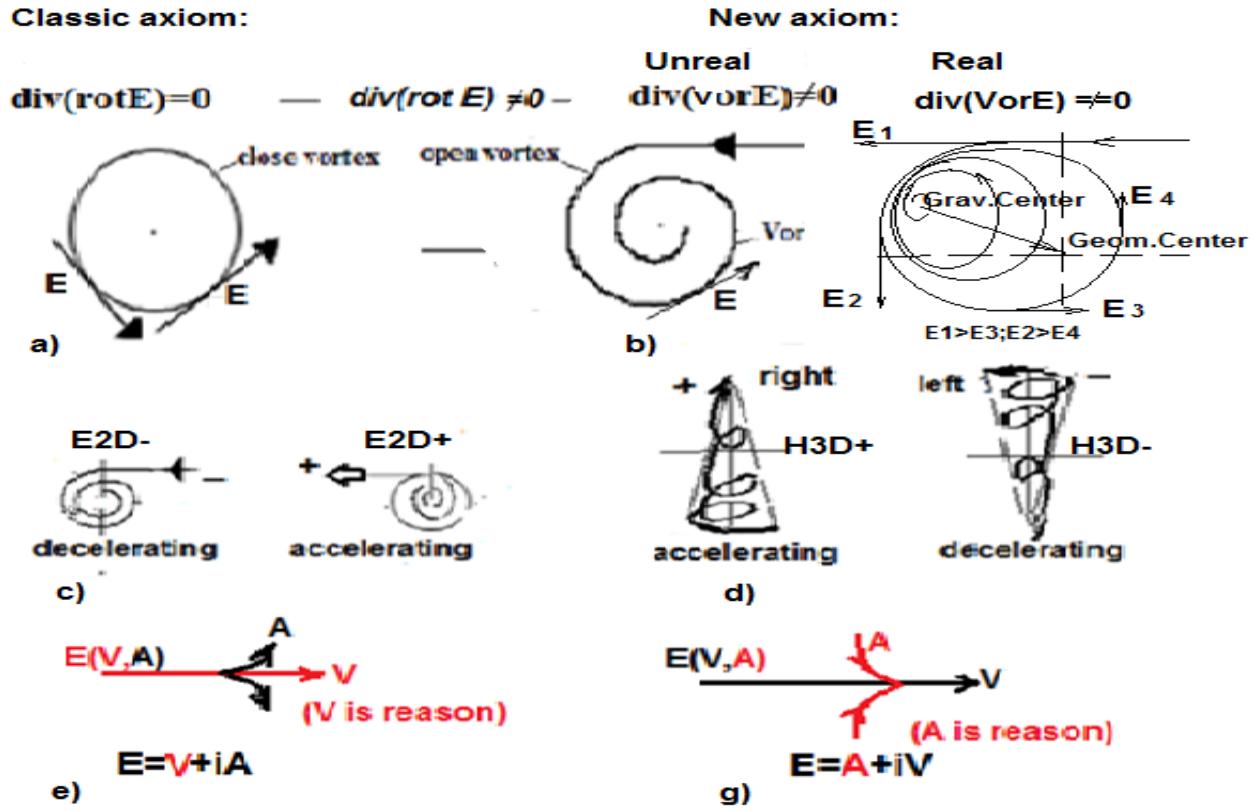 Figure 1A: The classical axiom is replaced by a new axiom
Consequence (of complex vector)
The vector $E$ is not a simple but complex vector. It contains the velocity (V) of the real (reason) flow and the amplitude (A) of the imaginary (result) cross vortices (Figure1 A, e) or the amplitude (A) of the real (reason) cross vortices and velocity (V) of the imaginary (result) flow (Figure1A,g).
## II. THE ESSENCE OF AXIOM 2
### a) Two directions of pair of complementary objects
The reason is that the vector $\mathbf{E}$ is a complex vector. When $\mathsf{E}_1 = \mathsf{A} + \mathrm{i}\mathsf{V}$, the amplitude $\mathsf{A}$ is superimposed and as a result generates a velocity $\mathsf{V}$ (Figure1B, c). When $\mathsf{E}_2 = \mathsf{V} + \mathrm{i}\mathsf{A}$, the velocity $\mathsf{V}$ is transformed as a result of the amplitude $\mathsf{A}(\mathsf{Figure1B}, \mathsf{b})$.
Definition: Pair of complementary objects is such pair of vortices which is generated by complementary vectors $E_1 = A + iV$, $E_2 = V + iA$, and as a result the objects have complementary actions.
If one object pushes (Figure1B, c), but the other pulls (Figure 1 B, b) or inverse, they form a pair of complementary objects. Because of one object pushes (Figure1B,c), the other- pulls (Figure1B,b), the both of them are active generators or they form a pair of active generators in complementary work.
Consequence: The first pair is in straight direction: amplitude (A) can be the reason but the speed (V) is the result $(E_1 = A + iV)$ (Figure1B,c) and the velocity (V) can be the cause and the amplitude (A) - the result $(E_2 = V + iA)$ (Figure1B,b). The second pair is in the oposite direction: amplitude (-A) can be the reason but the speed (-V) is the result $(-E_1 = -A - iV)$. Or the velocity (-V) can be the cause and the amplitude (A) is the result $(-E_2 = -V - iA)$. This situation is not depicted in the figure because it is much less probable.
Consequence: Pair of complementary objects $(E_1 = A + iV, E_2 = V + iA)$ exists at the same time.
Consequence: Pair of complementary objects $(E_1 = A + iV, E_2 = V + iA)$ is connected by a links - in one direction (1,2,3), and in opposite direction (3,4,1), (Figure1B,b,c).
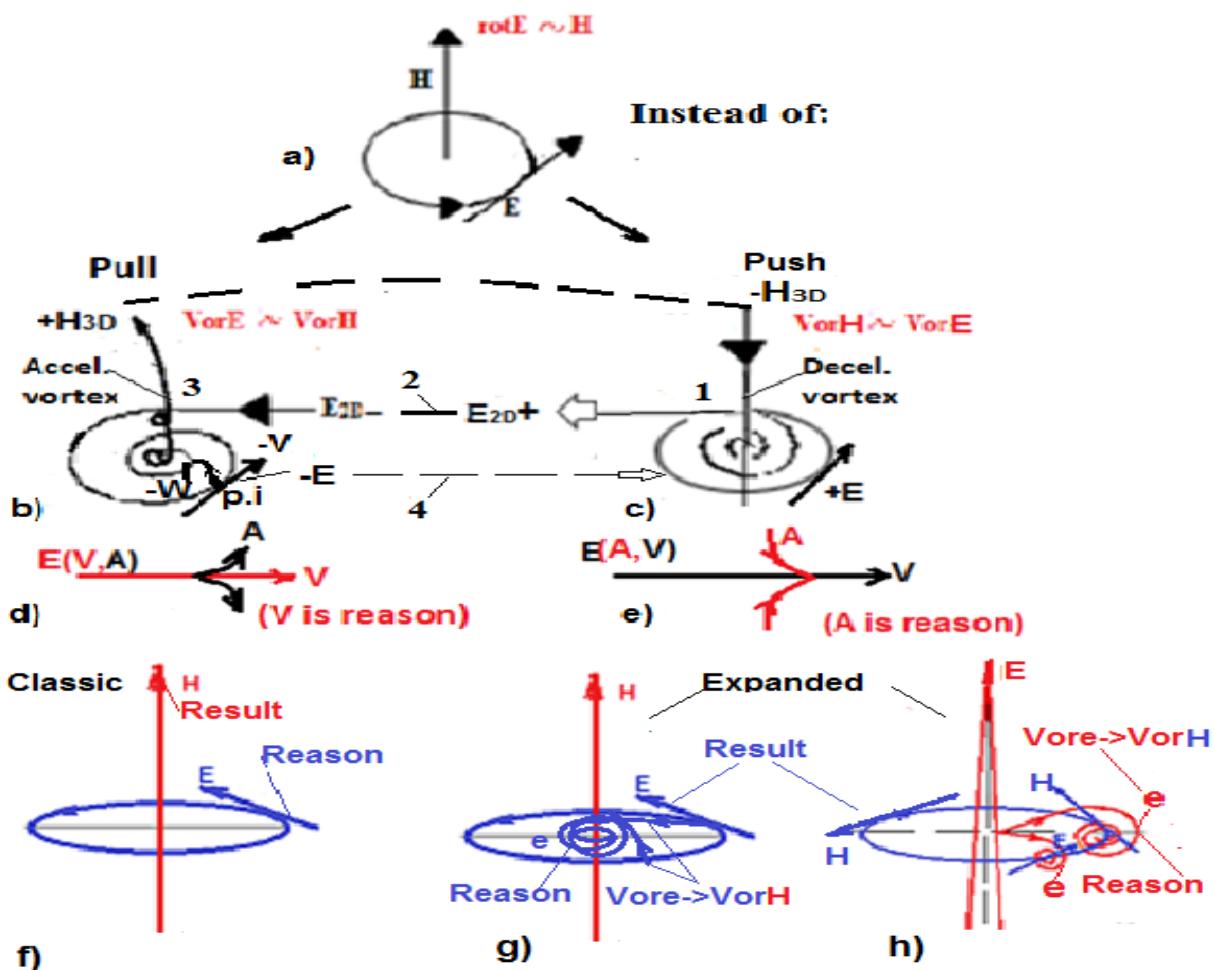 Figure 1B: One pair (in one direction) of complex vortices in 3D
Axiom 2: A pair of complementary vortices forms a system.
As is known from cybernetics, the system is a set of interconnected parts that work together through some process of control. The definition of a system includes simultaneity at unified internal time and bidirectional and also commitment to the exchange of matter and energy.
"A system is called a multitude of objects and relationships between them, which are treated as one. A link can connect two or more objects. It can be information, material or energy. The set of connections defines the structure of the system. The management of an arbitrary system is studied by cybernetics using two approaches... "(Wikipedia).
Consequence: Two pairs of complementary vortices exist simultaneously, at the same time: one pair in one direction in 2D: $+E_{1} = +A + iV$; $+E_{2} = +V + iA$ and the complementary pair in opposite direction in 2D:
$$
-E_{1} = -A - iV; -E_{2} = -V - iA.
$$
Consequence: A pair of complementary vortices exists at the same time, It is connected by links that exchanges energy and matter.
### b) A pair of active generators forms resonance system
Because of one object pushes (Figure1B,c), the other-pulls (Figure1B,b), the both of them are active generators or they form a pair of active generators in complementary mode.
Consequence: In the pair of complementary objects, the both of them form resonance system.
Consequence: In the pair of complementary objects, the both of them are active generators.
For comparison in the Electromagnetic Field, the electrical circuit contains one generator element and one or several passive consumers that only transform energy from one view(kinet.) to the other view (poten.).
## III. EXPANDING OF MAXWELL'S LAW
### a) The inconvenience of the first Classic Maxuell's Law
According to the classic axiom (1), the first classic law of Maxwell named "the law of electromagnetic induction" is presented as follows:
$$
\operatorname{rot} E = - \mu \partial H / \partial t, \tag{7.}
$$
where (rot E) is the evenly movement of the electric vector E in a closed loop, $\mu$ is the coefficient of magnetic permeability, $\partial H / \partial t$ is the variation of the magnetic vector $H$ in time $t$ [1]. On the one hand, a change in magnetic induction over time $(\partial H / \partial t)$ generates an evenly movement of the electric vector (rot $E$ ). It is named "the law of electromagnetic induction", where the sign " $\rightarrow$ "means generation:
$$
- \mu \partial \mathrm{H} / \partial \mathrm{t} \rightarrow \operatorname{rot} \mathrm{E}. \quad 7 \mathrm{a}.
$$
- On the other hand, an evenly movement of the electric vector (rot E) must generate a magnetic induction vector (H) in the center of the closed loop (rotE is right proportional to H):
$$
\operatorname{rot} E \sim H, \quad 7 b.
$$
where the sign $-$ means proportionality.
Consequence (about the sense of the first Classic Maxuell's law):
This presentation of Classic Maxuell's law refers only to evenly movement of the electric vector (rot E) that must generate a magnetic induction vector (H) in the center of the closed loop.
### b) Expanded Law of Maxwell
- According to the new axiom (2) (div (rotE) $\neq 0$ ) and the new definition of vortex (3)(div (VorE) $\neq 0$ ), the Expanded Maxwell's Law is modified like this: a cross vortex in 2D(Vor E) of vector (E) continues in the center as an one single and simple longitudinal vortex in 3D (VorH) of vector (H)(Figure 1B, b)
- According to the new axiom (2) Expanded Maxwell's Law states that the cross vortex (Vor E) of vector (E) generates an one single and simple longitudinal vortex (VorH) of vector (H) in the center:
$$
\left(\operatorname{Vor} E\right) _ {2 D} = k (\cdot \operatorname{Vor} H) _ {3 D}, \quad 7 c.
$$
where (Vor E) is a cross vortex in 2D of vector (E); (VorH) is an one single and simple longitudinal vortex in 3D of vector (H), (k) is an estimator of medium viscosity.
- The direction of the resulting vector (H) is determined by the well known Right-hand Rule.If the right hand is facing down and the fingers indicate the direction of the velocity (V)(right), and the thumb indicates the amplitude direction (W)(left), the piercing through the palm will show the upward direction of the vector (H).
- It expands the content of the meanings of movement of vector (E) and vector (H) in the development of laws later. Their main philosophy is affirmed as (E) is the cause vortex, and (H) is the result vortex. So in particular the cross vortex (VorE) generates in center a longitudinal vortex(VorH) (7c).
## IV. LAWS OF TRANSFORMATION
### (TRANSFORMATIONS $\Delta 1, \Delta 2$ )
### a) Laws of the transformation of a cross vortex $(E_{2D})$ into a longitudinal vortex $(H_{3D})$
At every (i) point $p(i)$ of a decelerating cross vortex $E$ there are two simultaneous movements: velocity vector (-V) and amplitude of the cross vortex (-W). The two simultaneous movements (V and W) also exist at all points of longitudinal vortices. The cross vortex ( $E_{2D}$ ) is transformed into a longitudinal vortex ( $H_{3D}$ ). This is accomplished through a specific operator ( $\Delta 1$ ) for cross-longitudinal transformation (Figure 1B, b).
The cross $(\mathsf{E}_{2\mathsf{D}})$ and the longitudinal $(\mathbf{H}_{3\mathbb{D}})$ vortex are not an original and an image by analogy with the well-known transformations of Laplace or Fourier. They are representatives of spaces with qualitatively different structures. Therefore the introduced operator $(\Delta 1)$ connects the original in one type (transverse) of space with its image in another type (longitudinal) of space, i.e. the transformation $\Delta 1$ connects two spaces with different qualities.
Law 1: The open cross vortex $\left(\mathrm{E}_{2 \mathrm{D}}\right)$ generates (inward or outward) an open longitudinal vortex $\left(\mathrm{H}_{3 \mathrm{D}}\right)$ in its center through a cross-longitudinal transformation $\Delta 1$:
$$
\Delta 1 \operatorname{Vor} \left(\mathrm{E} _ {2 \mathrm{D}}\right) = > - \operatorname{Vor} \left(\mathrm{H} _ {3 \mathrm{D}}\right), \tag{8.}
$$
where Vor (for Vortex, meaning an unevenly vortex) replaces rot (for rotor, meaning closed loop); the cross vortex in 2D $(\mathsf{E}_{2\mathsf{D}})$ continues its development in 3D as a longitudinal vortex $(\mathbf{H}_{3\mathbf{D}})$ (Figure1Bb).
While Maxwell's law (7) states that vector E generates vector H, the present law (8) postulates that the cross vortex Vor $(E_{2D})$ of E in 2D generates a longitudinal vortex Vor $(H_{3D})$ of H in 3D. The sign (-) for Vor $(H_{3D})$ 3D means that $E_{2D}$ and $H_{3D}$ have opposite dynamics. For example when div (Vor $E_{2D}$ ) < 0 (is decelerated), div (Vor $H_{3D}$ ) > 0 (is accelerated).
Definition: A decelerating cross vortex $(\mathsf{E}_{2\mathsf{D}})$ is a cross open vortex $(\mathsf{E}_{2\mathsf{D}})$ for which div $(\text{Vor } \mathsf{E}_{2\mathsf{D}}) < 0$.
Figure 2c shows a decelerating cross vortex $(E_{2D})$ inward.
Definition: A decelerating longitudinal vortex $(\mathsf{H}_{3\mathsf{D}})$ is a longitudinal open vortex $(\mathsf{H}_{3\mathsf{D}})$ for which div $(\text{Vor } \mathsf{H}_{3\mathsf{D}}) < 0$.
Figure 2d shows a decelerating longitudinal vortex $\left(\mathrm{H}_{3\mathrm{D}}\right)$ inward.
Definition: An accelerating cross vortex $(\mathsf{E}_{2\mathsf{D}}^{+})$ is a cross open vortex $(\mathsf{E}_{2\mathsf{D}})$ for which div $(\text{Vor } \mathsf{E}_{2\mathsf{D}}) > 0$.
Figure 2b, d shows an accelerating cross vortex $(\mathsf{E}_{2\mathsf{D}}^{+})$ outward.
Definition: An accelerating longitudinal vortex $(\mathsf{H}_{3\mathsf{D}}^{+})$ is a longitudinal open vortex $(\mathsf{H}_{3\mathsf{D}})$ for which div $(\mathsf{Vor}\mathsf{H}_{3\mathsf{D}}) > 0$
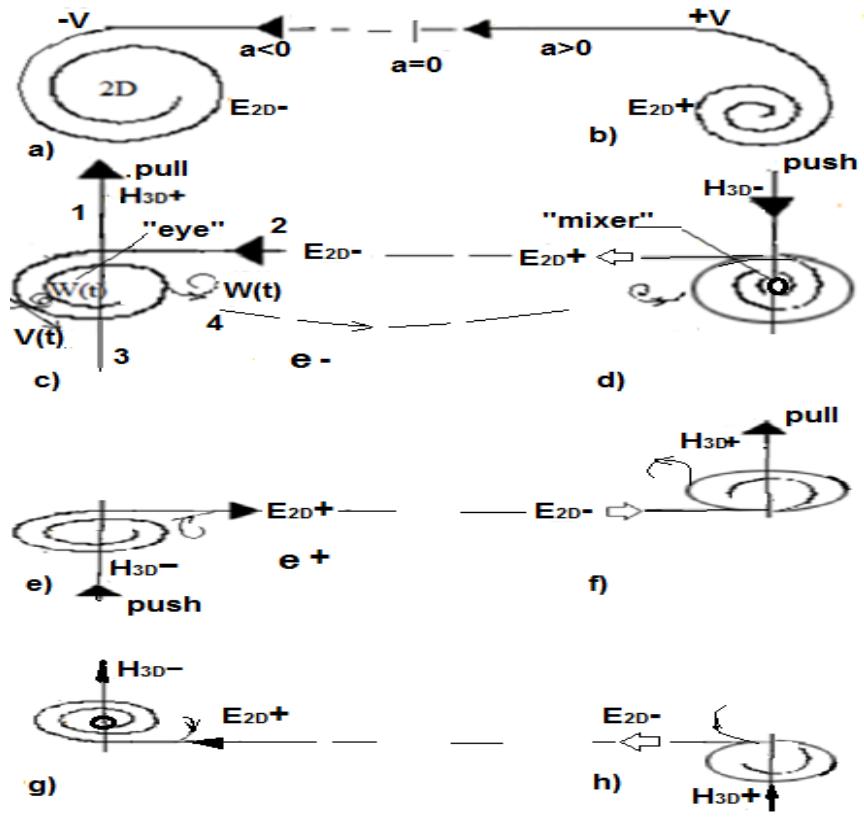 Figure 2c shows an accelerating longitudinal vortex $(\mathsf{H}_{3\mathsf{D}}^{+})$ outward. Figure 2: Two Transformation Laws. Options in two complementary complex objects
The present paper describes only the chain of matter: the push-pull chain (Figure 2d - Figure 2c) or inverse pull-push chain (Figure 2f - Figure 2e). The decelerating cross vortex $(E_{2D}^{-})$ inward generates an accelerating longitudinal vortex $(H_{3D}^{+})$ outward in its center through a physical transformation ( $\Delta 1$ ) (Figure 2c).
- This transformation ( $\Delta 1$ -) is achieved through a phenomenon called full resonance (resonance in amplitude, frequency and phase). This type of resonance will be described in detail in further developments and reports.
Consequence: The open decelerating cross vortex (E2D-in) generates inward an open accelerating longitudinal vortex (H3D) out outward. This action takes place from the center of decelerating cross vortex (E2D-) through a particular cross-longitudinal transformation $\Delta 1$:
$$
\Delta 1 - \text{Vor} (\mathrm{E} 2 \mathrm{D} -) \mathrm{i n} = > \text{Vor} (\mathrm{H} 3 \mathrm{D}) \text{out}. \quad 8 \mathrm{a}.
$$
Figure 2c shows this transformation in 3D.
The Consequence (8a) of Law1 corresponds only to the pulling part from inside center (Figure 2c) of the cross vortex pair of objects in 2D (Figure 2c - Figure 2d).
The Consequence (8a) of Law1 describes in 2D the model of electron as the decelerating inward vortex (dec (e-)) (Figure2c) in the chain of proton-electron (Figure 2d - Figure 2c). Every electron (dec(e-)) of this type pulsates in 3D in two modes of: expanded cross vortex and a shortened longitudinal vortex and "shrunken cross vortex and extended longitudinal vortex" (Figure 6A, Figure 6C).
- If the Consequence (8a) of Law1 generates in 3D a simple and single longitudinal vortex, it would describe the Expanded Maxuel for Electromagnetic Field: $(\text{Vor} \mathsf{E})_{2\mathrm{D}} = \mathsf{k}(\text{Vor} \mathsf{H})_{3\mathrm{D}}(7\mathrm{c}).$
- If the Consequence (8a) of Law1 generates in 3D a pipe - wrapped vortices from longitudinal vortices inserted into each other, it describes another field with properties inverse to the Electromagnetic Field. It describes the Gravity Field as a Gravity Funnel. Gravity funnel is generated in 3D tube of longitudinal vortices as an longitudinal energy in pulling part outward (Figure2c) of the pair of complementary objects (Figure2c - Figure2d).
Consequence: The open accelerating cross vortex $(E2D+)$ generates inward an open decelerating longitudinal vortex (H3D-) outward. This action takes place from the center of accelerating cross vortex $(E2D+)$ through a particular cross-longitudinal transformation $\Delta 1+$:
$$
\Delta 1 + \operatorname{Vor} (\mathrm{E} 2 \mathrm{D} +) \mathrm{i n} = > \operatorname{Vor} (\mathrm{H} 3 \mathrm{D} -) \text{out}.
$$
- The Consequence (8b) of Law1 describes in 2D the model of electron (e-) as the accelerating inward vortex(acc(e-)) (Figure2c) in the chain of proton-electron (Figure 2d - Figure 2c). Every electron (e-) of this type pulsates in 3D in two modes of: "expanded cross vortex and a shortened longitudinal vortex" and "shrunken cross vortex and extended longitudinal vortex" (Figure 6A, Figure 6C).
Consequence: The Consequence (8a) and Consequence (8b) describe decelerating (dec(e-)) or accelerating (acc(e-)) cross vortex to inward as two models of electrons(e-) (Figure 6A).
- We immediately obtain 4 type of electrons(e-): (dec(e-)) and (acc(e-)) electrons, which each of them pulsates in two modes: "expanded cross vortex and a shortened longitudinal vortex" and "shrunken cross vortex and extended longitudinal vortex" (Figure 6A, Figure 6C).
Consequence: It exists another two consequences (not described in the article), but they describe decelerating or accelerating cross vortices to outward. This is the 2 type of positrons: $(\mathrm{dec}(\mathrm{e} + ))$ and $(\mathrm{acc}(\mathrm{e} + ))$ positrons.
- We immediately obtain 4 type of positrons: $(\mathrm{dec}(\mathrm{e} + ))$ and $(\mathrm{acc}(\mathrm{e} + ))$ that each of them pulsates in two modes:" expanded cross vortex and a shortened longitudinal vortex" and "shrunken cross vortex and extended longitudinal vortex" (Figure 6B, Figure 6C).
b) Laws of the transformation of a longitudinal vortex $(H_{3D})$ into a cross vortex $(E_{2D})$.
For the opposite transformation a new operator $\Delta 2$ is introduced to transform a longitudinal $(\mathsf{H}_{3\mathsf{D}})$ into a cross $(\mathsf{E}_{2\mathsf{D}})$ vortex. The physical nature of this $\Delta 2$ transformation is quite different in comparison with $\Delta 1$.
- Generally speaking, the transformations $\Delta 1$ and $\Delta 2$ are orthogonal rather than symmetrical to each other.
Law 2: The open longitudinal vortex $(\mathsf{H}_{3\mathsf{D}})$ generates (inward or outward) an open cross vortex $(\mathsf{E}_{2\mathsf{D}})$ in its center through a longitudinal-cross transformation $\Delta 2$:
$$
\Delta 2 \text{Vor} (H _ {3 D}) = > - - V o r (E _ {2 D}) \quad 9.
$$
Consequence: The open decelerating longitudinal vortex (H3D-) in generates inward an open accelerating cross vortex (E2D+) out outward. This action takes place in the center of accelerating cross vortex (E2D+) through a particular longitudinal-cross transformation $\Delta 2$ -:
$$
\Delta 2 - \text{Vor} (\mathrm{H} 3 \mathrm{D} {-}) \mathrm{i n} = > \text{Vor} (\mathrm{E} 2 \mathrm{D} {+}) \text{out}. \quad 9 \mathrm{a}.
$$
- The Consequence (9a) of Law 2 describes in 2D the model of proton $(p+)$ as the decelerating outward vortex $(acc(p+))$ (Figure2d) in the chain of proton-electron (Figure 2d - Figure 2c).
- The Consequence (9a) of Law2 in 3D refers to the pushing part (Figure2 d) of the pair of complementary objects (Figure2c–Figure2d). The transformation $\Delta 2$ -emphasizes that the movement of the longitudinal vortex (H3D) inward is the cause, but the movement of the cross vortex(E2D) outward is the result (Figure 2d).
- When the Consequence (9a) of Law2 are generated by the pipe - wrapped longitudinal vortices, it describes Gravity field. It has the inverse properties to the Electromagnetic Field. This Gravity field exists as a tube from inserted one in another the longitudinal vortices. It forms a Gravity funnel which has a pushing and a pulling ends. In this case the down end of Gravity Funnel (H3D-) has pushing effect because the pushing end of Gravity funnel is attached to the pushing part (Figure2d) of the pair of objects (Figure2c - Figure2d). This end decelerates in 3D direction and generates in 2D plane, perpendicular to 3D, cross vortex from inside to outside as a matter.
Consequence: The open accelerating longitudinal vortex $(H_{3D}^{+})$ in generates inward an open decelerating cross vortex $(E_{2D}^{-})$ outward in its center through a special longitudinal-cross transformation $\Delta 2+$:
$$
\Delta 2 + \operatorname{Vor} \left(\mathrm{H} _ {\mathrm{3 D} +}\right) \mathrm{i n} = > \operatorname{Vor} \left(\mathrm{E} _ {\mathrm{2 D}}\right) \text{out}. \quad 9 \mathrm{b}.
$$
The Consequence (9b) of Law2 describes in 2D the model of proton $(p+)$ as the accelerating outward vortex dec $(p+)$ (Figure2d) in the chain of proton-electron (Figure 2d - Figure 2c). Every proton $(\mathrm{acc}(p+))$ of this type pulsates in 3D in two modes of: "expanded cross vortex and a shortened longitudinal vortex" and "shrunken cross vortex and extended longitudinal vortex" (Figure 6A, Figure 6C).
Consequence: The Consequence (9a) and Consequence (9b) describe decelerating or accelerating cross vortex to outward (Figure 6A).
- We immediately obtain 4 types of proton: $(\mathrm{dec}(p+))$ and $(\mathrm{acc}(p+))$ that each of them pulsates in two modes:" expanded cross vortex and a shortened longitudinal vortex" and "shrunken cross vortex and extended longitudinal vortex" (Figure 6A, Figure 6C).
Consequence: It exists another two consequences (not described in the article), but they describe decelerating or accelerating cross vortices to inward. This is the 2 models of antiproteons (dec(p-)) and (acc(p)) (Figure 6B).
- We immediately obtain 4 types of antiproton: (dec(p)) and (acc(p-)) that each of them pulsates in two modes:" expanded cross vortex and a shortened longitudinal vortex" and "shrunken cross
vortex and extended longitudinal vortex " (Figure 6B, Figure 6C).
## V. CONCLUSIONS
a) Two type electrons
- The first type of electron(acc(e-)): when the electron is inside a proton-electron system(connected in the atom) has accelerating cross vortex (E2D+) inward that generates a decelerating longitudinal vortex(H3D-) upward.
Therefore, an electron, bound into an atom (acc(e-)) is strongly linked to a cross component $(\mathrm{E2D + })$ and poorly connected along a longitudinal component (H3D-).
- A second type of electron(dec(e-)): when the electron is free (outside of the atom) has decelerating cross vortex (E2D-) inward, which generates an accelerating longitudinal vortex upward $(\mathrm{H}3\mathrm{D}+)$. When electron is free (second type (dec(e-)), the decelerating cross vortex (E2D-) is interrupted.
- On account of that accelerating longitudinal vortex $(\mathrm{H}3\mathrm{D}+)$ shoots a fast ingredient, tears in dashes (due to pulsation) and connects to the decelerating longitudinal vortex (H3D-) at input of the proton.
Therefore, the free electron $(\mathrm{dec}(\mathrm{e}-))$ is poorly linked in cross component (E2D-) and highly bound to the longitudinal component $(\mathrm{H3D+})$.
Consequence: There is a significant difference in the states of a bound electron (acc(e-)) and a free electron (dec(e-)).
Consequence: Scientists measure the mass of a free electron (dec(e-)) with a decelerating cross vortex $(\mathsf{E}_{2\mathsf{D}})$ inward, and can't measure the mass of a connected electron (acc(e-)) with an accelerating cross vortex $(\mathsf{E}_{2\mathsf{D}+})$ inward.
Consequence: The measured mass of free electrons is much more then the mass of linked in atom inside electrons.
### b) Electromagnetic and Gravity field
- If Consequence (8a) of Law 1 generates a simple and single longitudinal vortex, it would refer to the Electromagnetic field.
- If he Consequence (8a) of Law 1 generates a pipe - wrapped vortices from accelerating longitudinal vortices inserted into each other, it really generates accelerating Gravity Funnel.
- If the Consequence (9a) of Law 2 is generated by a pipe - wrapped vortices from decelerating longitudinal vortices inserted into each other, it refers to the decelerating Gravity Funnel.
- The new extended meaning of the term "Complementarity" is when the two parts are generating and they act anti-phase - one push and the other pulls.
- The two transformations $\Delta 1$ (Law1) and $\Delta 2$ (Law2) are not symmetrical but rather form pairs of objects that complement each other in their action. So they form a pairs of complementary objects or they are mutually orthogonal.
- The two vortices in the described above vortex pairs (Figure 2c - Figure 2d) play the role of generators (!) - one push (Figure 2d), the other - pulls (Figure 2c). Obviously in described above chain (Figure 2c - Figure 2d) there is not the consumer. Therefore this chain has not energy losses. It is well known that in every Electromagnetic chain has generator and one or more consumers. That's why Electromagnetic chain has energy losses.
- Both transformations, $\Delta 1$ (Law1) and $\Delta 2$ (Law2), are not regulated by external regulator or external parameters. Therefore the processes are regulated only by internal laws and are not determined by outside parameters.
## VI. LAW OF NONPARAMETRIC MOVEMENT OF
### THE VORTEX
Obviously the processes of acceleration and deceleration of the longitudinal vortex is a nonparametric process. Processes of accelerating and decelerating longitudinal vortices manifest both quantitative and qualitative changes [5]. This mechanism of amplification is known in cybernetics as Positive Feedback.
Law 3: Accelerating and decelerating of the main vortex is going by internal logic as a nonparametric process through Positive Feedback.
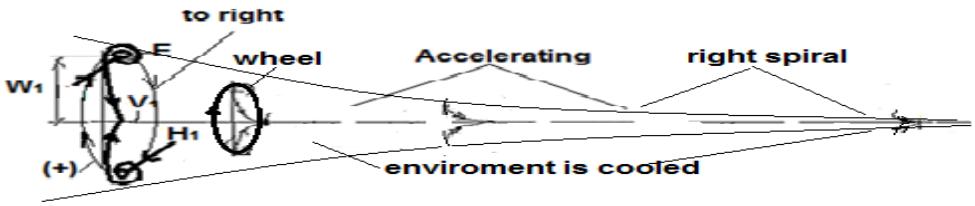
- The Law 3 shows that velocity $\mathrm{V_i}$ increases by redistribution with cross vortices. There is also redistribution of mass. The mass of the cross vortices is added in portions (quanta) with acceleration to the initial mass of the longitudinal vortex with velocity $\mathrm{V_i}$ and thus accelerates it more and more (Figure 3a).
- The accelerating longitudinal vortex sucks in more cross vortices from outside that accelerate further the longitudinal vortex with velocity Vi and so on. Thus the longitudinal vortex at output(Vi) increases its velocity and acceleration which returns at input. The reason is that it suck in more cross vortices and increases of the acceleration and mass to the entrance (Figure 3a).
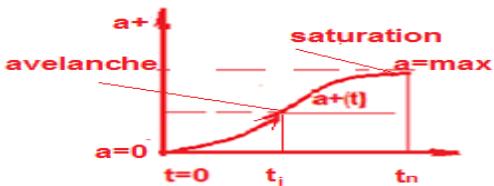
- This process runs avalanche until it reaches a saturation level where the acceleration becomes maximum $(a_{\max})$ for a time slice $(t_0 - t_n)$, (Figure 3b).
 a)
 b) Figure 3: Positive Feedback
- When, for example, an accelerating longitudinal vortex sucks in with acceleration the cross vortex, then in start moment $(t = 0)$ its first derivative is minimum: $a = 0$. However the accelerated absorption of the cross vortex increases and when in the end moment $(t = t_{n})$ the positive acceleration of the cross vortex becomes maximum: $a_{\max} >> 0$. The mass of this cross vortex is added to the longitudinal vortex accelerating it further (Figure 3b).
- It is an example of the avalanche process. In the next cycle the accelerated longitudinal vortex again sucks in a portion (quantum) of the cross vortex and so on. Through Positive Feedback the level of saturation constantly increases, the time interval needed for saturation becomes longer, etc.
- Positive Feedback turns the described above avalanche process from an amplifier to a generator procces.
Consequence: The Positive Feedback in a longitudinal vortex turns the process of amplification to a process of generation. The Positive Feedback can be a base for constructing an energy generator.
- Probably this generative effect of the Positive Feedback was used by Nikola Tesla in the construction of the electronic block for his electro mobile. The original engine worked in generator mode and needed a battery only at start up.
## VII. LAW OF THE CONSTANT POWER OF THE VORTEX
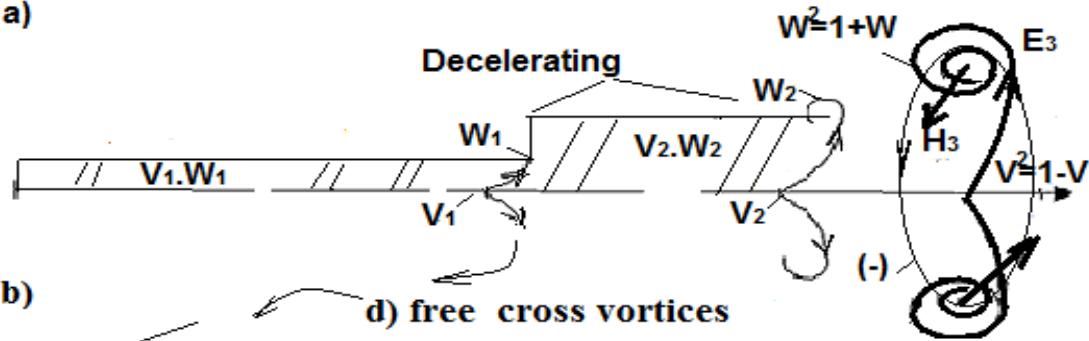
As we saw above there are two qualitatively different movements at each (i) point $p$ (i) of the decelerating vortex E: longitudinal vector velocity (V) and cross vortex with amplitude (W) (Figure 1B, b).
The reason of that is the vector $E$ is not a simple vector but it is a complex vector (Figure 1B,d).
- It is well known that in Classic Mechanic the simultaneous operation of two independent vectors is equal to the sum of these vectors.
- According to Law 3, the transforming one vector (V) into a vortex (W) and vice versa is a nonparametric process. Transformation is done by internal laws but not by setting parameters from outside.
- The nonparametric transformation of two variables $V(t)$ and $W(t)$ is mathematically described by the product $V(t) \cdot W(t)$ of these variables.
 a) b)
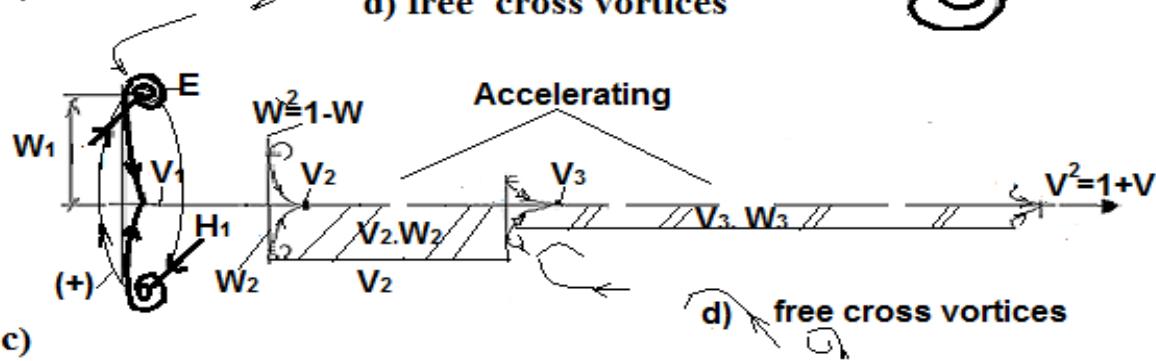 Figure 4: A system of accelerating and decelerating vortices
We have seen that at each (i) point of the vortex E there is simultaneously a vector velocity (V) in 1D and vortex pressure (W) in 2D (Figure1B,d).
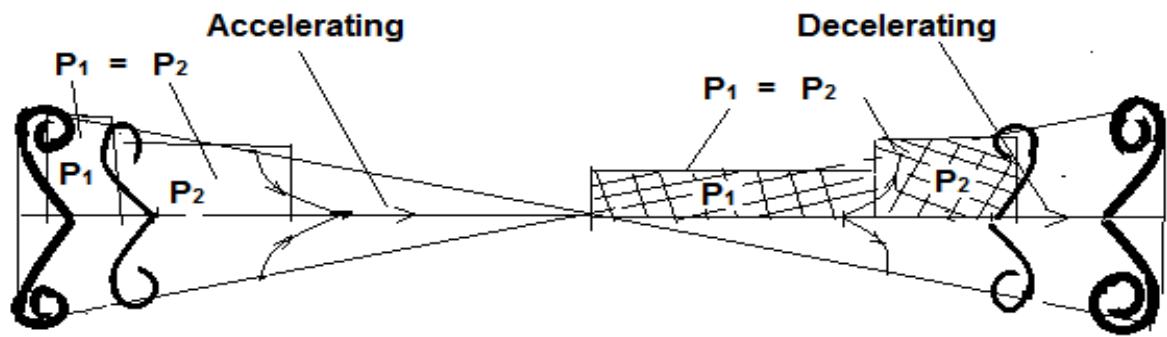
- In the case of the decelerating longitudinal vortex the velocity decreases (V-), while the amplitude of the cross vortices increases $(W+)$ in such a way that their product (V-). $(W+)$ remains constant all along the longitudinal vortex. The product (V-). $(W+)$ is proportional to the power $(P-)$ of the decelerating longitudinal vortex. (Figure 4a, b).
- In the case of the accelerating longitudinal vortex the velocity increases $(V+)$, while the amplitude of the cross vortices decreases $(W-$ ) in such a way that their product $(V+).(W-$ ) remains constant all along the longitudinal vortex. The product $(V+).$. $(W-$ ) is proportional to the power $(P+)$ of the accelerating longitudinal vortex(Figure 4a,c).
Law 4: For an uneven (accelerating or decelerating) vortex the product between current velocity (Vi) of longitudinal movement on one and the same current line and current amplitude (Wi) of its perpendicular cross vortices is a constant in every (i) step:
$$
(\mathrm{V i}). (\mathrm{W i}) = \text{const}. \quad 1 0.
$$
where $i = 0 \div \infty$ is current point from step to step; the product (Vi).(Wi) is proportional to the current power(Pi) of the uneven vortex.
Consequence: The simultaneous operation of two mutually - dependent vectors is equal to the product of these variables (in Expanded Field Theory) while the simultaneous operation of two independent vectors is equal to the sum of these variables (in Classic Mechanic).
Consequence: The product (Vi). (Wi) is proportional to the current power $(P i)$ of the uneven vortex in current (i) step. The current power $(P i)$ of the uneven vortex is a constant in every (i) step:
$$
-\mathrm{Pi}=\mathrm{Vi}.\mathrm{Wi},
$$
Consequence: The Total energy (Eo) in Expanded Field Theory is equal to the product of Kinetic energy -Ek(Vi) and Potential energy Ep(Wi):
$$
Eo=Ek(Vi).Ep(Wi),
$$
Consequence: At a decelerating vortex vector velocity (V) is transformed according to internal law (10) into the amplitude of the cross vortex (W) (Figure 4a, b).
Consequence: At a accelerating vortex vector velocity (V) is transformed according to internal law (10) into the amplitude of the cross vortex (W) (Figure 4a, c).
## VIII. LAWS OF THE VELOCITY OF THE LONGITUDINAL VORTEX (V) AND THE AMOUNTITUDE OF THE CROSS VORTICES (W)
We saw in the previous point (p.6) that at a decelerating vortex vector velocity (V) is transformed according to internal law into the amplitude of the cross vortex (W) (Figure 4a,b). More precisely- the reduction in speed (V) is transformed into an increase in the amplitude(W) of cross vortices.
Law 5: The deceleration vortex in 2D is described with a system of 2 equations in which: longitudinal velocity (V) decreases in (n) portions $(\psi^n)$ times; the amplitude (W) increases in (n) portions $(\psi^n)$ times:
$$
|V|^2 = V_0(1 - V),
$$
$$
|W|^2 = W_0(1 + W),
$$
where $\mathsf{v}_{\mathsf{n}}, \mathsf{w}_{\mathsf{n}}$ are periodic roots with period $n$; $\mathsf{v}_{\mathsf{n}}, \mathsf{w}_{\mathsf{n}}$ are mutual orthogonal that fulfill the requirement for orthogonality: $\mathsf{v}_{\mathsf{n}} \cdot \mathsf{w}_{\mathsf{n}} = \mathsf{V}_{0} \cdot \mathsf{w}_{0}$, $\mathsf{v}_{\mathsf{n}} \cdot \mathsf{\omega}_{\mathsf{n}} = \mathsf{V}_{0} \cdot \mathsf{W}_{0}$; $n = 0 \div \infty$; the roots $\mathsf{v}_{\mathsf{n}}, \mathsf{w}_{\mathsf{n}}$ are expressed as: $\mathsf{v}_{\mathsf{n}} = (1 / \psi^{\mathsf{n}}) \cdot \mathsf{V}_{0}$, $\mathsf{\omega}_{\mathsf{n}} = \psi^{\mathsf{n}} \cdot \mathsf{W}_{0}$; linear velocity $\mathsf{V}_{0}$ is the starting value of $\mathsf{V}_{\mathsf{n}}$, amplitude of cross vortex $\mathsf{W}_{0}$ is the starting value of $\mathsf{\omega}_{\mathsf{n}}$; $\psi$ is a proportional that fulfills the requirement: $\psi - 1 / \psi = 1$.
Consequence: The deceleration vortex in 3D is described with a system of 4 equations in which: longitudinal velocity (V) decreases in (n) portions $(\psi^n)$ times; the angular velocity (w), the amplitude (W) and the number (N) of cross vortices increase in (n) portions $(\psi^n)$ times:
$$
\mathrm{IV}^{2} = \mathrm{V}_{0} (1 - \mathrm{V}),
$$
$$
\mathsf{I}W^{2} = W_{0}(1 + W),
$$
$$
\mathrm{I}W^{2} = W_{0}(1 + W)
$$
$$
\mathrm{I}N^{2} = N_{0}(1 + N)
$$
where $\mathsf{v_n}, \mathsf{w_n}$ are periodic roots with period $n$; $\mathsf{v_n}, \mathsf{w_n}$ are mutual orthogonal that fulfill the requirement for orthogonality: $\mathsf{v_n.w_n} = \mathsf{V_0.w_0}$, $\mathsf{v_n.}\omega_{\mathrm{n}} = \mathsf{V_0.W_0}$; $n = 0 \div \infty$; the roots $\mathsf{v_n}, \mathsf{w_n}$ and $\omega_{n}$ and $n_n$ are expressed as: $\mathsf{v_n} = (1 / \psi^n).\mathsf{V_0}, \omega_n = \psi^n.\mathsf{W_0}; \mathsf{w_n} = \psi^n.\mathsf{W_0}, [n_n] = \psi^n.N_0$; linear velocity $V_{0}$ is the starting value of $V_{n}$, amplitude of cross vortex $W_{0}$ is the starting value of $\omega_{n}$, angular velocity $w_{0}$ is starting value of $w_{n}$, number $N_{0}$ is starting value of $n_{n}$, $[n_{n}]$ is the closest integer; $\psi$ is a proportional that fulfills the requirement: $\psi - 1 / \psi = 1$.
It is noteworthy that: When starting number $N_0 = 1$ the number $n_n$ is calculated with the row: 1; 1.62; 2.62; 4.25; 6.88, 11.15; 18.07; 29.28; 47.43,... The closest integer $[n_n]$ form row: 1, 2, 3, 4, 7, 11, 18, 29, 47,... For comparison, Fibonacci's order is: 0, 1, 1, 2, 3, 5, 8, 13, 18, 21, 34,... Obviously there is a similarity between the two rows at the beginning. But finally (after $18^{th}$ ) the number $[n_n]$ rises sharply (29 > 21, 47 > 34,...) compared to the order of Fibonacci.
Consequence: A decelerating vortex $\left(E_{2D} -\right)$ with a velocity vector (V) emits to the environment decelerating vortices with increasing amplitude (W) (because of sign + in second equation of system 11,11a).
- The amplitude (W) increases in perpendicular direction to the velocity vector(V).
- In decelerating longitudinal vortex, the amplitude (W) increases only if it is directed from the inside to the outside, ie. if the decelerating vortex emits outward cross vortices with increasing amplitude (W) (Figure 4b).
- According to the Law1(8) and Rule of the Right Hand, the decelerating cross vortex (E) generates at the center to outside (to left) a longitudinal vortex (H). So at every $n_i$ point forms left rotating wheel perpendicular to the velocity (V).
- Therefore, the decelerating longitudinal vortex in 3D forms left rotating spiral (left- counterclockwise when observer watches against the movement) (Figure 4b).
Consequence: Decelerating longitudinal vortices rotate counterclockwise (-)(Figure 4b).
Consequence: Because of increasing of the amplitude (W) the angular velocity (w) and the number of cross vortices (N) it forms decelerating, thickening and expanding left rotating Funnel in which: $W_{\max}; w_{\max}; N_{\max}$
Consequence: Two or more decelerating longitudinal vortices repel each other. The reason is due to the emission of cross vortices from center to outside.
Law 6: The acceleration vortex in 2D is described with a system of 2 equations in which: longitudinal velocity (V) increases in (n) portions $(\psi^n)$ times; the amplitude (W) decreases in (n) portions $(\psi^n)$ times:
$$
\mathrm{IV}^{2} = \mathrm{V}_{0} (1 + \mathrm{V}),
$$
$$
\mathsf{I}W^{2} = \mathsf{W}_{0}(1 - \mathsf{W}),
$$
where $\mathsf{v}_{\mathsf{n}}, \mathsf{w}_{\mathsf{n}}$ are n periodic roots with period n; $\mathsf{v}_{\mathsf{n}}, \mathsf{w}_{\mathsf{n}}$ are mutual orthogonal that fulfill the requirement for orthogonality: $\mathsf{v}_{\mathsf{n}} \cdot \mathsf{w}_{\mathsf{n}} = \mathsf{V}_{0} \cdot \mathsf{w}_{\mathsf{0}}$, $\mathsf{v}_{\mathsf{n}} \cdot \mathsf{\omega}_{\mathsf{n}} = \mathsf{V}_{0} \cdot \mathsf{W}_{\mathsf{0}}$; $\mathsf{n} = 0 \div \infty$;
the roots $\mathsf{v}_{\mathsf{n}}$, $\mathsf{w}_{\mathsf{n}}$ are expressed as: $\mathsf{v}_{\mathsf{n}} = (\psi^{\mathsf{n}}) \cdot \mathsf{V}_{0}$, $\omega_{\mathsf{n}} = (1 / \psi^{\mathsf{n}}) \cdot \mathsf{W}_{0}$; linear velocity $\mathsf{V}_{0}$ is the starting value of $\mathsf{V}_{\mathsf{n}}$, amplitude of cross vortex $\mathsf{W}_{0}$ is the starting value of $\omega_{\mathsf{n}}$; $\psi$ is a proportional that fulfills the requirement: $\psi - 1 / \psi = 1$.
Consequence: The acceleration vortex in 3D is described with a system of 4 equations in which: longitudinal velocity (V) increases in (n) portions $(\psi^{n})$ times, the angular velocity (w), the amplitude (W) and the number (N) of cross vortices decrease in (n) portions $(\psi^{n})$ times:
$$
\mathrm{I}V^{2}=\mathrm{V}_{0}(1+\mathrm{V}),
$$
$$
\mathrm{I}W^{2}=W_{0}(1-W),
$$
$$
\mathrm{I}W^{2}=W_{0}(1+W)
$$
$$
\mathrm{I}N^{2}=N_{0}(1+N)
$$
where $\mathsf{v}_{\mathsf{n}}, \mathsf{w}_{\mathsf{n}}$ are periodic roots with period $n$; $\mathsf{v}_{\mathsf{n}}, \mathsf{w}_{\mathsf{n}}$ are mutual orthogonal that fulfill the requirement for orthogonality: $\mathsf{v}_{\mathsf{n}} \cdot \mathsf{w}_{\mathsf{n}} = \mathsf{V}_{0} \cdot \mathsf{w}_{0}$, $\mathsf{v}_{\mathsf{n}} \cdot \omega_{\mathsf{n}} = \mathsf{V}_{0} \cdot \mathsf{W}_{0}$; $n = 0 \div \infty$; the roots $\mathsf{v}_{\mathsf{n}}$, $\mathsf{w}_{\mathsf{n}}$ and $\omega_{\mathsf{n}}$ and $n_{n}$ are expressed as: $\mathsf{v}_{\mathsf{n}} = (\psi^{\mathsf{n}}) \cdot V_{0}$, $\omega_{\mathsf{n}} = (1 / \psi^{\mathsf{n}}) \cdot W_{0}$, $w_{n} = (1 / \psi^{n}) \cdot W_{0}$, $n_{n} = (1 / \psi^{n}) \cdot N_{0}$; linear velocity $V_{0}$ is the starting value of $V_{n}$, amplitude of cross vortex $W_{0}$ is the starting value of $\omega_{n}$, angular velocity $w_{0}$ is starting value of $w_{n}$, number $N_{0}$ is starting value of $n_{n}$; $\psi$ is a proportional that fulfills the requirement: $\psi - 1 / \psi = 1$.
- The first positive root of the first equation (12a) is: $v_{1} = \psi. V_{0} = 1$, 62. $V_{0}$. The periodic roots of the first equation (12a) are obtained from the expression: $v^{n} = V_{0}$. $(v^{n - 1} + v^{n - 2})$.
- The first positive root of the second equation (12b) is: $w_{1} = \frac{1}{\psi} \cdot W_{0} = 0.62 \cdot W_{0}$. The periodic roots of the second equation (12a) are obtained from the expression: $w^{n - 2} = W_{0}$. ( $w^{n} - w^{n - 1}$ ).
Consequence: When velocity (V) increases, the amplitude (W) decreases so that at each step $(n_i)$ (according to Consequence of Law 4) the product (Vi). (Wi) is a constant (Figure 4a). For an accelerating longitudinal vortex, the amplitude (W) decreases only if it is directed from the outside to inside, ie. if the accelerating vortex sucks in cross vortices with decreasing amplitude (W)(Figure 4c).
Consequence: It exists an expanded sense of the simultaneous action of equations from each of systems (11) and (12). They portray a qualitatively new, specific and combined movement in the form of a system:
- The system expresses the joint action of two movements - longitudinal and transverse vortex;
- This system is mutually orthogonal; the direction of velocity of the longitudinal vortex $V$ is perpendicular to the direction of the amplitude $W$ of the transverse vortices and, respectively, to the direction in which the transverse vortices
- This system is open (not closed) i.e. the system contains: a closed inner part - the longitudinal vortex, and an open outer part - the cross vortices.
- Exactly the openness of the system of two mutually orthogonal, simultaneous and cooperative movements is the cause of the exchange of cross vortices (inward or outward) with the environment.
Consequence: An accelerating vortex $(E_{2D} + )$ with a velocity vector (V) sucks in accelerating vortices with decreasing amplitude (W) in perpendicular direction (because of sign - in second equation of system 12,12a).
According to the Consequence 8b of Law1 the accelerated cross vortex $(E_{2D}+)$ generates (sucking) to its center a longitudinal vortex $(H_{3D})$ from the outside to inside (to the right). At each point $(n_i)$ a right rotating wheel is formed. The spiral vortex in 3D is formed as a right rotating spiral (Figure 4c).
Therefore, the acceleration vortex will twist to the right - clockwise (+), viewed against the movement (Figure 4c).
Consequence: Accelerating longitudinal vortices wind clockwise $(+)$ (Figure 4c).
Consequence: Because of the amplitude(W), angular velocity (w) and the number of cross vortices(N) decreases it forms accelerating, stretching, narrowing, right rotating Funnel in which: $W_{\min}$, $W_{\min}$, $N_{\min}$
Consequence: Accelerating longitudinal vortices form a tube like: the vortex is inserted at the center with the maximum lineal speed, the minimum number of coils and the minimum distance, the slower vortex is with more coils and a longer way along the spiral and the vortex at the periphery is winding with a minimum lineal speed, maximum number of coils and a maximum spiral path. Because of acceleration this tube turns to the so called Gravity Funnel.
Consequence: Two or several accelerating longitudinal vortices, due to the suction of cross vortices, are attracted.
## IX. LAWS OF CONTINUITY
In Euclidean geometry has an axiom that postulates that only one straight line passes through two points. The Axiom 2 for two complementary objects resemble an axiom in Euclidean geometry. But in essence Axiom 1 and Axiom 2 are physical, rather than geometrical. Instead of points as geometric objects there is a pair of vortices with different dynamics as physical objects: the both of them are generators-one pulls, the other pushes (Figure 2c, d).
Provisionally vortices can be classified as primary (W) and secondary (E) uneven vortices. The primary uneven vortices are micro cross vortices (W) (Figure 5c, d). The secondary uneven vortices are macro cross vortices (E) (Figure 2c,d). The primary cross vortices exist as a free form or free cross vortices. They are also called as "free energy" (Figure 5 c,d).
Definition: Primary vortices are emitted to the environment or sucked in from environment by the secondary (main) vortex.
### a) Law of continuity in a closed loop in 2D
According Law 5 (11) decelerating cross vortex (E2D-) emits decelerating primary cross vortices in perpendicular direction (Figure 5b).
- In general the primary micro vortices are derivatives of the main secondary macro vortices.
- Since cross vortex objects are physical particles, they must fulfill the main Physical Law of continuity cycle of movement matter and energy.
- The Axiom 2 contains within itself the question of the link in the opposite direction which closes the full circle (loop) of cross vortices in $2D$ (6).
- In order to fulfill the fundamental law of continuity, the feedback must pass through empty space (feedback 2D). It contains elementary primary cross vortices generated and emitted by the secondary decelerating cross vortex (Figure 5c) and consumed and sucked in by the secondary accelerating cross vortex (Figure 5d). This feedback is closed through the so called "empty space". The feedback is in inverse direction to the direction of the main cross vortices.
- Therefore, in order to satisfy this fundamental law in physics, apparently this space cannot be "empty", as we often call it. The imaginary space is filled with primary cross vortices.
- The primary cross vortices are copies of the secondary cross vortices but at a much smaller scale.

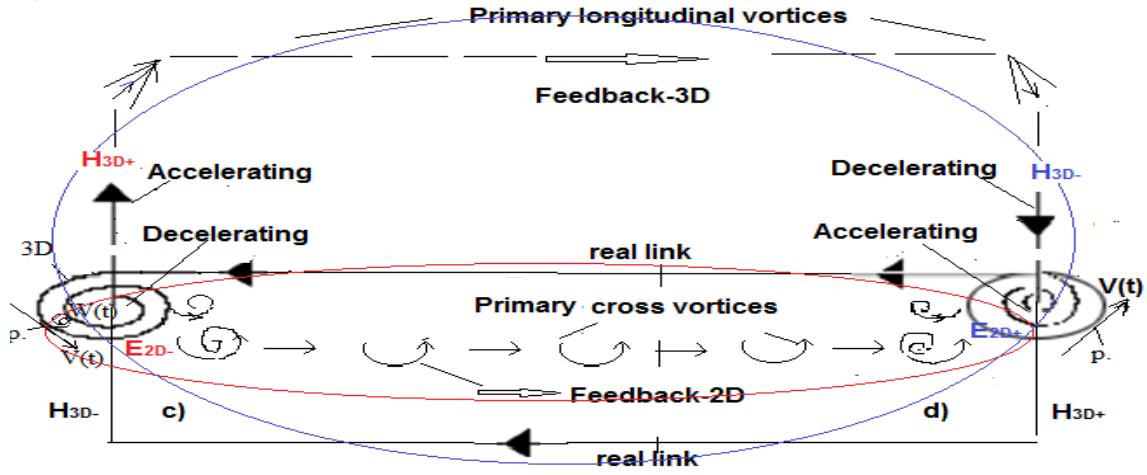 Figure 5: System of one pair of complementary vortices
Law 7: A pair of open cross objects forms a closed loop in $2D$ by feedback of primary cross vortices. This pair conducts energy through the real connection: (Figure 5d - Figure 5c), $(E2D + - E2D-)$ and conducts matter through the back link: (Figure 5c -Figure 5d), $(E2D-E2D+)$ or through the feedback $2D$.
The reason for the emission of primary elementary cross vortices is the deceleration of the main longitudinal vortex (E2D-) (Figure 4b, Figure 5c).
But their movement in the space between the two vortex objects in 2D is due to the sucking action of the accelerating main longitudinal vortex (E2D+) (the second vortex in the pair) (Figure 4c, Figure 5d).
### b) Law of continuity in a closed loop in 3D
In order to fulfill the fundamental law of physics the feedback of the main longitudinal vortices in 3D must close through the space (feedback 3D). It contains elementary primary longitudinal vortices, generated and consumed by the main secondary longitudinal vortices.
- This imaginary space is filled with primary longitudinal vortices resembling copies of the secondary longitudinal vortices but at a much smaller scale. All longitudinal vortices (primary and secondary) create a new type of field that contributes to our knowledge of the field as a form of matter.
- The real link (Figure 5d - Figure 5c) of the chain in 3D conducts real pulsating energy $(\mathrm{H}3\mathrm{D} + ) \div (\mathrm{H}3\mathrm{D} - )$
- The back link (Figure 5c- Figure 5d)) of the 3D chain conducts pulsating matter as a pulsating, longitudinal primary vortices.
- Because of that the objects of complementary pair include both cross and longitudinal vortices, connected internally with reason-result transformations, either $(\Delta 1)$ or $(\Delta 2)$, they are called complex vortex objects.
Definition: A complex vortex object is an object that contains a cross and a longitudinal vortex connected internally by reason-result transformations, either $(\Delta 1)$ or $(\Delta 2)$.
Law 8: A pair of open complex vortex objects forms a closed loop in $3D$ by feedback of primary longitudinal vortices, so that the objects conduct energy through the real connection: (Figure 5d - Figure 5c) and conducts matter through the back link: (Figure 5c -Figure 5d) or through the feedback $3D$.
- This pair conducts energy through the real connection and conducts matter through the imaginary link, so that the primary elementary longitudinal vortices form the feedback link in 3D (Figure 5c - Figure 5d).
- The reason for their movement in the space between the pair of vortex objects in 3D is the sucking action of the entrance of secondary longitudinal funnel that has a decelerating exit (H3D-) (Figure 2d), (Figure 5d).
- The reason for generation of primary longitudinal vortices
- Is the pulsating accelerated longitudinal vortex $(\mathrm{H}3\mathrm{D}+)$. The pulsating accelerated longitudinal vortex $(\mathrm{H}3\mathrm{D}+)$ make dashes in the form of primary longitudinal vortices. As these longitudinal vortices are highly accelerated they attract, suck and form longitudinal packets as a micro funnels [6]. They move in the opposite direction as a feedback in 3D.
Consequence: The reason for the emission of primary elementary longitudinal vortices is that the secondary longitudinal vortex tears in dashes by high frequency pulses $(\mathrm{H}3\mathrm{D}+)$ (Figure 5c).
- The real links in 2D and 3D are simple, but the imaginary links in 2D (feedback 2D) and 3D (feedback 3D) are most likely multi-ciphered. Feedback (2D and 3D) connects a pair of complementary vortex objects (Figure 5 c, d).
- Let us consider the nature of the link in the opposite direction that closes the full circle (loop) of main longitudinal vortices in 3D, perpendicular to the circle (loop) in 2D.
Consequence: (of continuity in two mutually perpendicular closed loops in 2D and 3D).
Two complex vortex objects are connected with mutually perpendicular closed loops in 2D and 3D. The closed loop: $\{\mathrm{E}2\mathrm{D}(+) \div \mathrm{E}2\mathrm{D}(-)\} \div \{(\text{feedback}(2\mathrm{D}) \text{ (Figure 5d,c).})\}$ is perpendicular to the closed loop: $\{\mathrm{H}3\mathrm{D}(-) \div \mathrm{H}3\mathrm{D}(+)\} \div \{(\text{feedback} (3\mathrm{D})\}$, (Figure 5c,d).
## IX. CONCLUSIONS
# a) The
The extension of the classical Maxuell's axiom led to a new Axiom1 that certifies open or non-uniform vortices. As a result, the decelerated and accelerated longitudinal vortices were obtained. Their acceleration realizes forces as in the direction of the plain of a cross vortex and as in the perpendicular direction of the plain (in volume) in longitudinal vortex. The accelerating longitudinal vortices attract each other because of sucking in (out to in) the cross vortices.
- So the accelerating longitudinal vortices form a pipe in which the fastest vortex is in the center, and the slowest vortex is in the periphery. Due to the acceleration, this tube becomes a funnel called Gravity Funnel The Gravity Funnel has two ends— one end in repulsion mode and the other end in suction mode.
- The introduction of Axiom2 certifies the presence of complementary pairs of complex objects. Both objects in a pair are complex cross-longitudinal vortices that operate in generator mode. If one work in pulling mode, the other work in pushing mode. They describe complementary relations between the complex vortex objects, which include the gravitational impact of both types.
### b) Two tips of electrons
- The first type of electron (acc(e-)): when the electron is inside a proton-electron system(connected in the atom) has accelerating cross vortex $(\mathrm{E2D} + )$ inward that generates a decelerating longitudinal vortex (H3D-) upward.
Therefore, an electron, bound into an atom (acc (e-)) is strongly linked to a cross component $(E2D+)$ and poorly connected along a longitudinal component $(H3D-$.
- A second type of electron (dec (e-)): when the electron is free (outside of the atom) has decelerating cross vortex (E2D-) inward, which generates an accelerating longitudinal vortex upward $(\mathrm{H}3\mathrm{D}+)$. When electron is free (second type (dec (e-)), the decelerating cross vortex (E2D-) is interrupted.
On account of that accelerating longitudinal vortex (H3D+) shoots a fast ingredient, tears in dashes (due to pulsation) and connects to the decelerating longitudinal vortex (H3D-) at input of the proton.
Therefore, the free electron (dec (e-)) is poorly linked in cross component (E2D-) and highly bound to the longitudinal component $(H3D+)$.
Consequence: There is a significant difference in the states of a bound electron (acc (e-)) and a free electron (dec (e-)).
Consequence: Scientists measure the mass of a free electron (dec (e-)) with a decelerating cross vortex $(\mathsf{E}_{2\mathsf{D}})$ inward, and can't measure the mass of a connected electron (acc (e-)) with an accelerating cross vortex $(\mathsf{E}_{2\mathsf{D}+})$ inward.
Consequence: At the similar logic there are two tips of protons as well. Therefore there are 2 tips electrons and 2 tips protons. Therefore there are 2 tips positrons and 2 tips antiprotons too.
c) Electromagnetic and Gravity field
- If Consequence of Law 1 generates a simple and single longitudinal vortex, it would refer to the Electromagnetic field.
- If the Consequence of Law 1 generates a pipe - wrapped vortices from accelerating longitudinal vortices inserted into each other, it really generates accelerating Gravity Funnel
- If the Consequence of Law 2 is generated by a pipe-wrapped vortices from decelerating longitudinal vortices inserted into each other, it refers to the decelerating Gravity Funnel.
- The new extended meaning of the term "Complementarity" is when the two parts are generating and they act anti-phase - one push and the other pulls.
- The two transformations $\Delta 1$ (Law1) and $\Delta 2$ (Law2) are not symmetrical but rather form pairs of objects that complement each other in their action. So they form a pairs of complementary objects or they are mutually orthogonal.
- The two vortices in the described above vortex pairs (Figure 2c - Figure 2d) play the role of generators (!) - one push (Figure 2d), the other -pulls (Figure 2c). Obviously in described above chain (Figure 2c - Figure 2d) there is not the consumer. Therefore this chain has not energy losses. It is well known that in every Electromagnetic chain has generator and one or more consumers. That's why Electromagnetic chain has energy losses.
- Both transformations, $\Delta 1$ (Law1) and $\Delta 2$ (Law2), are not regulated by external regulator or external parameters. Therefore the processes are regulated only by internal laws and are not determined by outside parameters.
d) Description of complex design of complementary pairs
- The decelerating vortex(1) is similar to a toroid. Vector of eccentricity (p.F-p.O) decomposes along
x-axis and y-axis. The x-axis is pulling him to the accelerating vortex(2). The y-axis rotates decelerating vortex(1) around the accelerating vortex(2). Simultaneously primary cross vortices(3) rotates the decelerating vortex(1) around Gravity center p.F.(second quadrant).
- The accelerating vortex (2) is similar to a very tight ball. Vector of eccentricity $(p.F - p.O)$ is much smaller than that one of decelerating vortex (1). The number of cross coils in accelerating (2) is much more than of decelerating vortex (1) and because this number determine much more mass of substance for accelerating vortex (2): $m2 >> m1$
- In center (green) it has an accelerating longitudinal vortex(4) from down to up (direction of internal gravity wave).
- In middle (red) because of resistance it has an decelerating longitudinal vortex that form internal "Back wave" (direction of external gravity wave).
A pair of complementary complex objects
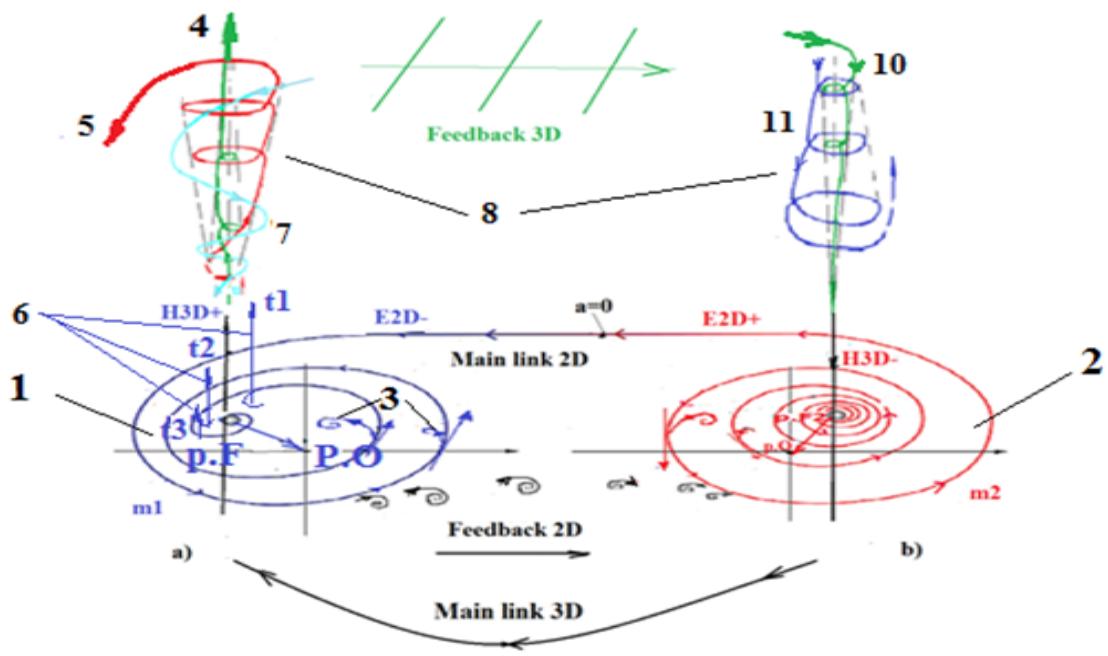 Figure 6: Complex design of complementary pairs
- At periphery (light green) because of internal cross vortices (5) there is a reduction in the lengths of longitudinal vortices (6), corresponding to the decreasing development time $(t1 > t2 > t3 >)$. They form external "Back wave"(7) (direction of internal magnetic wave).
- Longitudinal vortices (8) are invisible. They don't have mass as a substance. They exist alone or in a package such as a pipe or funnel (9). When the pipe (funnel) is not active, the energy inside the package exists as a standing wave. When it enters into denser environment of primary free cross vortices the funnel becomes active and it acts as a mixer. At the center (10) it turns to right, but at periphery (11) it turns to left.
### e) Visibility
## i. Visible
Particle (1) is visible as an empty toroid. It is a model of the electron or one of internal planets.
- Particle(2) is visible as a very tight ball. It is a model of proton or (the respective to one) bulk resonator inside the sun. ii. Invisible
- Main link in 2D is total invisible. Because of the thread of link form diffraction to the light waves, this link does not reflect light waves and it is invisible. It is a model of so called "Black energy"
- Feedback in 2D is invisible.Because of primary cross vortices emitted from decelerating particle (1)
to accelerating particle (2) are commensurable with waves of light, they do not reflect the waves of light. They are the model of so called "Black matter".
- Main link in 3D is total invisible too, because of the thread of link form diffraction to the light waves too.
- Feedback in 3D is invisible too. Because of primary longitudinal vortices emitted from accelerating longitudinal funnel (4) of decelerating particle (1) to the decelerating funnel (10) of accelerating particle (2) are proportional to diameter with waves of light, they do not reflect the waves of light.
## iii. Conclusion
We see that there are many more invisible objects (95%) and very few actually (only two) visible objects (5%).
### f) Model of Fractal structures
- The complementary pairs of elementary particles: decc(e-), p+. It shows the model of (free electron) - proton link or the model of Earth-Sun link.
- The complementary pairs of elementary particles: acc(e-), p+. It shows the model of (bound electron)-proton link or it shows the model of Venus-Sun link.
- The complementary pairs of elementary particles: e+, p-. It shows the model of positron-antiproton.
g) Some explanation of view and work of cross vortex objects
- The acceleration (positive or negative) is the reason for the eccentricity of the cross vortex objects (Axiom1, Law 1), (Figure 1b).
- Two complementary pairs work counter-phase as generators(Axiom 2, Law 1, Law 2) (Figure 2c).
- The center of Gravity(p.F) is in different quadrants: in first quadrant is center in accelerating cross vortex (2), but in second- is center in decelerating cross vortex (1)(Law 5, Law 6), (Figure 6).
h) Some explanation of particle charge as direction and size of the acceleration
- The direction (inward or outward) of cross vortex determines the charge (negative or positive) of cross objects. When direction is from out to in (1) - the "charge" is negative(E2D-)). When direction is from in to out (2) - the "charge" is positive $(E2D+)$ (Figure 6).
- The stationary mode describes creation of objects, but pulsating mode explains their work in time and pulsating and transmitting transverse waves at the speed of light.
- It explains the cause for mass increasing of an elementary particle, described in Theory of Relativity of Einstein and confirmed by the experiment. For example an electron that moves at the speed of light, increases its mass (Law5, Law 6). The reason is in structure of electron as an vortex from outside to inside(1, Figure 6). When electron is not connected to the proton, it is in free form. The cross vortex of electron sucks inward the free primary vortices. The higher the speed - the more primary vortices are sucked in and are glued to the electron.
i) Some explanation of longitudinal vortex
- Explanation why according to the Law 6, a longitudinal vortex, because of maximum velocity and minimum amplitude, is moving in minimum time. But a longitudinal vortex, because of minimum velocity and maximum amplitude, is moving in maximum time.
- Explanation why accelerating longitudinal vortices, because of suck in the cross vortices outside-inward, are attracted each other and form Gravity Funnel.
- In Gravity Funnel distance(S) along the accelerating spiral is inverse proportional to the velocity(V). In Electromagnetic Field the distance(S) is right proportional to the velocity (V)[3].
j) Some explanation of Gravity field
Gravity field participates in a stationary structure in the tube (at the entrance or at the exit) of Gravity funnel that generates the cross part of object. Gravity field participates and in a pulsating structure as a wrap around the object.
Gravity funnel consists by accelerating longitudinal vortices inserted one in another. It has one push end and one pull end. It attracts in both directions - along the axis of the funnel and perpendicular to the axis. The Gravity funnel has an accelerating central axis and decelerating periphery (due to the resistance on border surface) (Law 1, Law 2 and Consequences). Then It returns back and envelops the cross object.
- In the pulsating mode, the cross vortex of object is stretched and collapsed and the longitudinal funnel is extended and shortened. Thus, a gravitational pulsating envelope is generated around the object and so on.
Generating HTML Viewer...
References
11 Cites in Article
L Landau,E Lifshitz (1975). CONSTANT ELECTROMAGNETIC FIELDS.
V Markova (2005). The other axioms.
V Markova (2016). Three space times obtained by combined vortex movements.
Surendra Mund,Abhi Raj (2016). Does the Causality Principle prove that there exists Greater Speed than the Speed of Light, Is the Speed of Light not the Maximum Speed in Universe?.
V Markova (2017). A generator using a tube of longitudinal accelerating open vortices nested one inside the other for positive feedback.
V Markova (2018). Extended Field Theory. New axioms, Laws and consequences..
Valentina Markova (2018). Modeling an Antigravity Device Based on New Laws and Axioms.
Valentina Markova (2018). Modeling an Antigravity Device Based on New Laws and Axioms.
V Markova (2018). Extended Field Theory. New axioms, Laws and consequences..
V Markova (2019). Expanded Field Theory. New Axioms, Laws and Consequences..
V Markova (2019). Generator of "free energy" according to the explanation of the phenomenon based on new axioms and laws.
No ethics committee approval was required for this article type.
Data Availability
Not applicable for this article.
How to Cite This Article
Dr. Valentina Markova. 2026. \u201cExpanded Field Theory New Axioms, Laws and Consequences\u201d. Global Journal of Science Frontier Research - A: Physics & Space Science GJSFR-A Volume 22 (GJSFR Volume 22 Issue A2).
Explore published articles in an immersive Augmented Reality environment. Our platform converts research papers into interactive 3D books, allowing readers to view and interact with content using AR and VR compatible devices.
Your published article is automatically converted into a realistic 3D book. Flip through pages and read research papers in a more engaging and interactive format.
Our website is actively being updated, and changes may occur frequently. Please clear your browser cache if needed. For feedback or error reporting, please email [email protected]
Thank you for connecting with us. We will respond to you shortly.