Yoga and meditation have been playing vital roles in our holistic wellbeing and attaining our spiritual goals since ancient time. During second wave of Covid-19 and lock-down its importance became more significant and visible around the globe. Many patients have easily recovered with the help of their boosted immunity by doing yoga and meditation (like breathing exercise, Bhramari Pranayama and meditation etc) and could keep themselves stress-free. During and post pandemic maintaining mental health is a great challenge. It is very difficult to be relaxed, peaceful and healthy due to increased level of anxiety, stress and depression as a consequence of loss of health, lives, jobs, migration, inaccessibility to health education and other basic facilities, changes in life styles and so on. Yoga can help us to stay calm, manage our health and anxiety without any extra intervention if understood well and made a part of our daily routine. For the young adults it becomes even more important to do yoga and meditation because they are the future of India.
## I. INTRODUCTION
Yoga and meditation has been playing a vital role to fit our physical and mental health since ancient time. During second wave of Covid-19 and lock-down its importance become more than compare to previous. Many patients have easily recovered with the help of habit of doing yoga and meditation (like breathing exercise, Bhramari Pranayama and meditation). During this scenario good mental health is very important to survive because level of anxiety, stress and depression growing very fast. Yoga can help us to stay calm, manage our blood pressure and anxiety. For the young adults it becomes more essential to do yoga and meditation because they are the future of country.
The pandemic has been difficult for everyone. According to the Centers for Disease Control and Prevention, one in five Americans report struggling with mental or behavioral health issues associated with COVID-19, including anxiety, depression, increased substance use, and suicidal thoughts. The highest burden of distress has been reported by the younger generation (ages 18-29) and minority communities. [1]
Keeping all these point in mind we have conducted online survey among young adults group with the help of Google form including questions related to yoga and meditation, to know the present scenario regarding habit of yoga, its benefits and satisfaction level of young adults towards mental health well-being.
## II. LITERATURE REVIEW
Mental health issues increased during COVID-19 pandemic. Yoga and meditation can help in reducing mental stress and improving psychological wellbeing. The frequency of practice is positively associated with a higher level of mental wellbeing in case of both yoga and meditation, with daily practice having the highest wellbeing scores. [8]
Change in eating and sleeping pattern during the pandemic was significantly higher in people who did not practice yoga and meditation, and it was least in those practicing both. A large proportion of study subjects reported a change in relationship with family members during the COVID-19 pandemic. [8]
A significant effect of duration of practice was found on illness perception, and wellbeing related measures. Long term practitioners reported higher personal control and lower illness concern in contracting COVID-19 than the mid-term or beginner group. The improved physiological functions are believed to reduce stress, anxiety, depression, and enhance overall well-being. [9]
## III. OBJECTIVE
- To find out the proportion of young adults of Uttar Pradesh who are doing yoga and meditation regularly.
- To find out satisfaction level of young adult, how much yoga and meditation is helpful for their mental health well-being.
- To find out Behavior change in young adult during Covid-19 pandemic regarding yoga and meditation.
- To find out benefits of yoga and meditation for young adults (18-35 years).
- To find satisfaction level (dependent variable), ordinal logistic regression analysis used for independent variables (Gender, Age, Education Qualification, and Native Area) and dependent variable (satisfaction level).
## IV. METHODOLOGY
- A survey was conducted among the young adults (18- 35 years) of Uttar Pradesh, India with the help of Google form using Convenient Sampling Technique (Non-probability sampling technique).
- There were total 11 questions in the Questionnaire including sociodemographic variables (like age, education qualification, gender, district, native area), out of them 4 questions related to yoga and meditation was close-ended and 1 question based on likert-scale (1-5) related to satisfaction level and one question was open-ended (benefits of yoga and meditation).
- Total 203 responses were used for analysis.
- Analysis is based on Frequency, Cross-tab, Ordinal logistic Regression Analysis.
- For analysis SPSS version.21 and Excel software used.
- This study is an exploratory study based on primary data.
- Data come from the following Districts Of Uttar Pradesh, India
- Agra, Allahabad, Ambedkar Nagar, Amethi, Ballia, Banda. Barabanki, Basti, Bijnor, Bulandshahr, Deoria, Ghazipur, Gonda, Gorakhpur, Hamirpur, Hardoi, Jhansi, Kanpur, Kushinagar, Lakhimpur-Kheri, Lucknow, Maharajganj, Mathura, Muzaffarnagar, Pratapgarh, RaeBareli, Shahjahanpur, Siddharth Nagar, Sitapur, Unnao, Varanasi.
- Maximum data collected from Lucknow district.
## V. INTERPRETATION
Table 1: Demographic details of 203 respondent
<table><tr><td>Variables</td><td>Frequency(%)</td></tr><tr><td>Gender</td><td></td></tr><tr><td>Female</td><td>54.7</td></tr><tr><td>Male</td><td>45.3</td></tr><tr><td>Others</td><td>0</td></tr><tr><td>Age</td><td></td></tr><tr><td>18 - 24 Years</td><td>61.1</td></tr><tr><td>24 - 30 Years</td><td>30.5</td></tr><tr><td>30 - 35 Years</td><td>8.4</td></tr><tr><td>Education qualification</td><td></td></tr><tr><td>Higher than postgraduate</td><td>8.4</td></tr><tr><td>Intermediate</td><td>9.4</td></tr><tr><td>Other</td><td>2.5</td></tr><tr><td>Postgraduate</td><td>42.9</td></tr><tr><td>Undergraduate</td><td>36.9</td></tr><tr><td>Districts</td><td></td></tr><tr><td>Lucknow</td><td>65.5</td></tr><tr><td>Other than Lucknow</td><td>34.5</td></tr><tr><td>Native area</td><td></td></tr><tr><td>Rural</td><td>28.1</td></tr><tr><td>Urban</td><td>71.9</td></tr></table>
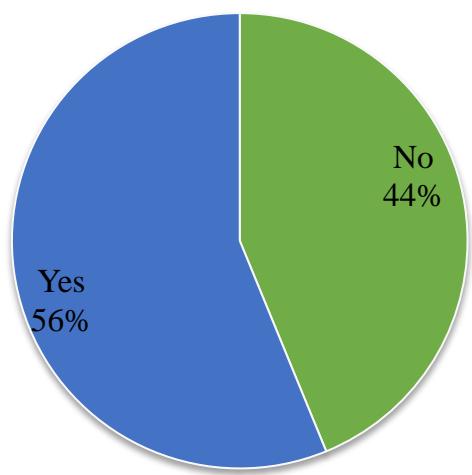 Do you do yoga/Meditation? Fig. 1: Out of the 203 respondent 56 percent (114) of respondent said yes, they are doing yoga and meditation and 44 percent of respondent said No
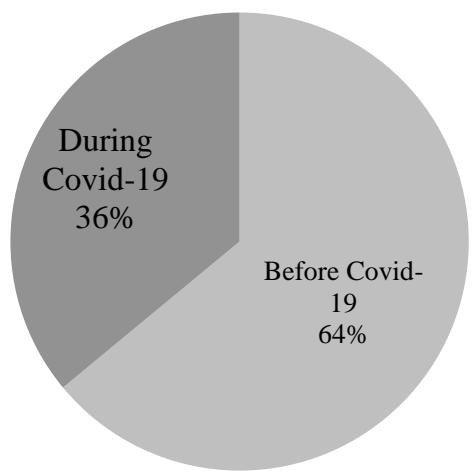 When did you start yoga and meditation? Fig. 2: Out of the 114 respondent there are 36 percent of respondents who have started yoga and meditation during Covid-19 pandemic and 64 percent of respondent started before Covid-19 pandemic
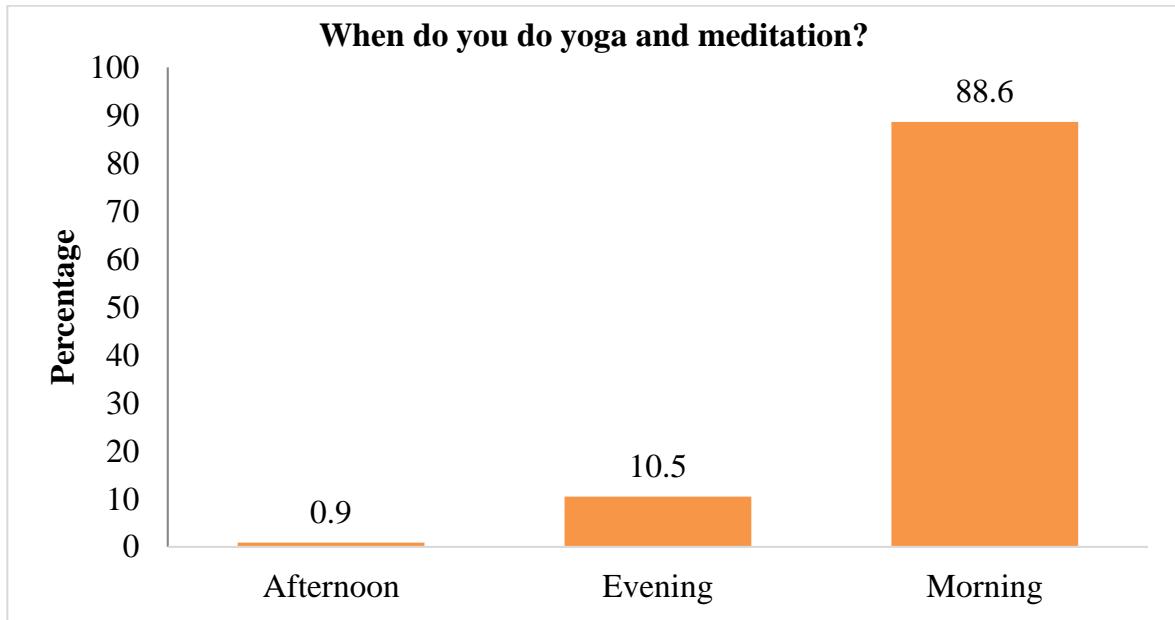
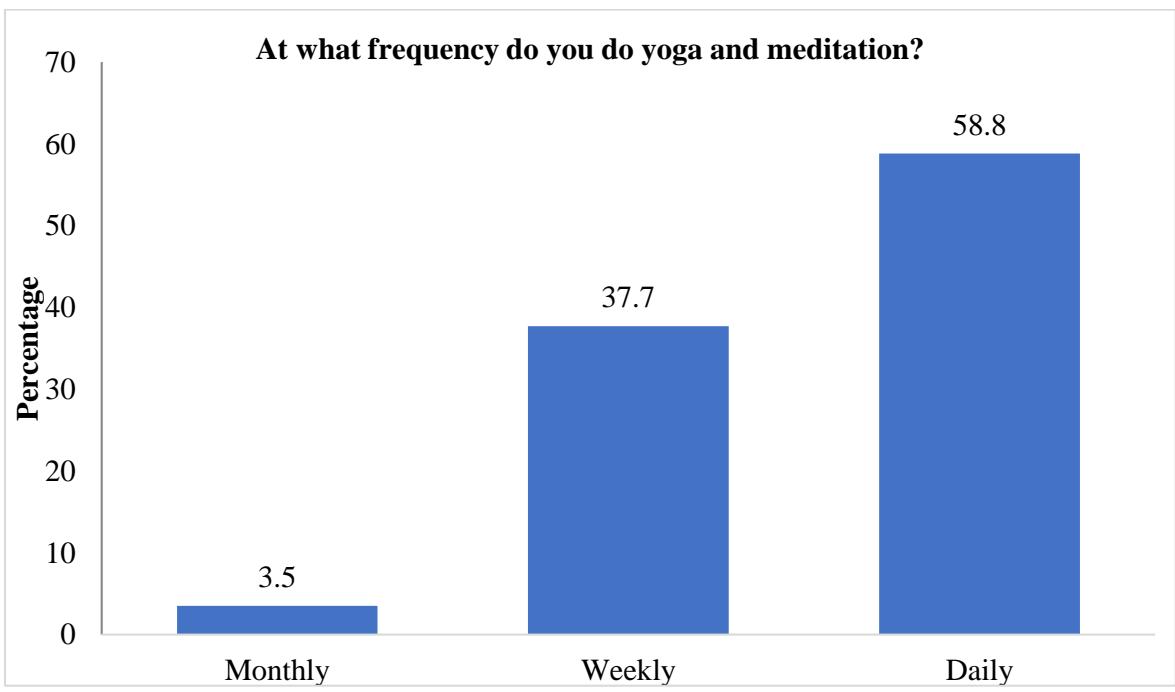 Fig. 3: There are 89 percent of respondent who have doing yoga and meditation in the Morning, 11 percent of respondent are doing it in the Evening and only 1 percent of respondent doing yoga and meditation in the Afternoon Fig. 4: There are 59 percent respondent who are doing yoga and meditation daily, 38 percent of respondent doing weekly and 4 percent respondent doing in monthly
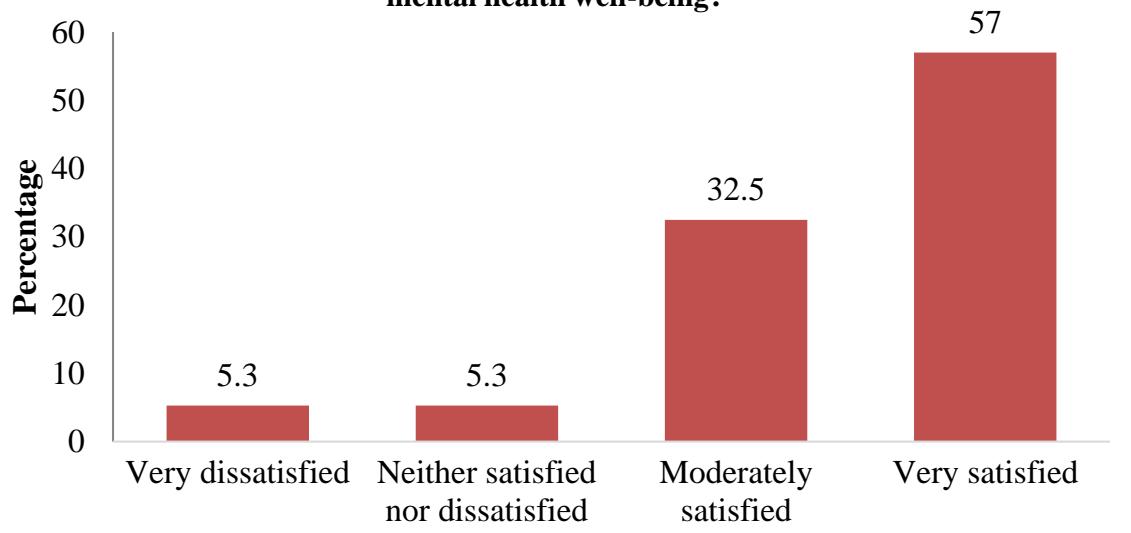 How satisfied you are that yoga and meditation is helpful to your mental health well-being? Fig.5: There are 57 percent respondent who are very satisfied that yoga and meditation is helpful to their mental health well-being, 33 percent respondent are moderately satisfied and only 5 percent of respondent are very dissatisfied
## VI. ORDINAL LOGISTIC REGRESSION ANALYSIS
We have apply Ordinal logistic Regression on the dependent variable (satisfaction level) which is ordinal variable and independent variable (Gender, Age, Education Qualification, and Native Area) which is categorical variable.
To know the satisfaction level of independent variables that yoga and meditation is helpful to their mental health
We find the following results
- $\succ$ Total respondents are 114, who are doing yoga and meditation.
- > Out of them 57 percent of respondent who are very satisfied that yoga and meditation is helpful to their mental health well-being and 33 percent are moderately satisfied.
- $\succ$ 43 percent are Male respondent and 57 percent are Female respondent.
For model fitting we have taken-
Ho: there is no significant different between baseline model to final model
The significant value is 0.255 which is $>0.05$ so we accept null hypothesis and conclude that there is no significant different between baseline model to final model For goodness of fit we have taken-
Ho: the observed data is having goodness of fit with the fitted model
Significant value is 0.806 which is $>0.05$ so we accept the null hypothesis and conclude that the observed data is having goodness of fit with the fitted model.
From Pseudo $R$ -Square
The Nagel kerke value should be 0.7 but here the value is 0.099, means 0.099 variation proportion of variance the independent variable (Gender, Age, Education Qualification, and Native Area) is explaining on the dependent variable (satisfaction level).
It means more independent variable should be used.
Table 2
<table><tr><td colspan="9">Parameter Estimates</td></tr><tr><td rowspan="2" colspan="2"></td><td rowspan="2">Estimate</td><td rowspan="2">Std. Error</td><td rowspan="2">Wald</td><td rowspan="2">df</td><td rowspan="2">Sig.</td><td colspan="2">95% Confidence Interval</td></tr><tr><td>Lower Bound</td><td>Upper</td></tr><tr><td rowspan="3">Threshold</td><td>[Howsatisfiedyouarethathyogaandmeditationishelpfultoyourmentalheal = 1(Very dissatisfied)</td><td>-3.736</td><td>1.538</td><td>5.902</td><td>1</td><td>0.015</td><td>-6.751</td><td>-0.722</td></tr><tr><td>[Howsatisfiedyouarethathyogaandmeditationishelpfultoyourmentalheal = 3](Neither satisfied nor dissatisfied)</td><td>-2.968</td><td>1.511</td><td>3.862</td><td>1</td><td>0.049</td><td>-5.929</td><td>-0.008</td></tr><tr><td>[Howsatisfiedyouarethathyogaandmeditationishelpfultoyourmentalheal = 4](Moderately satisfied)</td><td>-0.999</td><td>1.49</td><td>0.45</td><td>1</td><td>0.502</td><td>-3.92</td><td>1.921</td></tr><tr><td rowspan="12">Location</td><td>[Male=1]</td><td>0.59</td><td>0.392</td><td>2.265</td><td>1</td><td>0.132</td><td>-0.178</td><td>1.358</td></tr><tr><td>[Female=2]</td><td>\(0^a \)</td><td>.</td><td>.</td><td>0</td><td>.</td><td>.</td><td>.</td></tr><tr><td>18 - 24 Years</td><td>-1.613</td><td>1.349</td><td>1.429</td><td>1</td><td>0.232</td><td>-4.258</td><td>1.032</td></tr><tr><td>24 - 30 Years</td><td>-2.17</td><td>1.289</td><td>2.835</td><td>1</td><td>0.092</td><td>-4.695</td><td>0.356</td></tr><tr><td>30 - 35 Years</td><td>\(0^a \)</td><td>.</td><td>.</td><td>0</td><td>.</td><td>.</td><td>.</td></tr><tr><td>Intermediate</td><td>-0.272</td><td>1.633</td><td>0.028</td><td>1</td><td>0.868</td><td>-3.472</td><td>2.928</td></tr><tr><td>Undergraduate</td><td>0.519</td><td>1.543</td><td>0.113</td><td>1</td><td>0.737</td><td>-2.505</td><td>3.543</td></tr><tr><td>Postgraduate</td><td>0.846</td><td>1.492</td><td>0.321</td><td>1</td><td>0.571</td><td>-2.079</td><td>3.77</td></tr><tr><td>Higher than postgraduate</td><td>0.702</td><td>1.538</td><td>0.208</td><td>1</td><td>0.648</td><td>-2.314</td><td>3.717</td></tr><tr><td>Other</td><td>\(0^a \)</td><td>.</td><td>.</td><td>0</td><td>.</td><td>.</td><td>.</td></tr><tr><td>[Nativearea=Urban]</td><td>0.278</td><td>0.409</td><td>0.462</td><td>1</td><td>0.497</td><td>-0.524</td><td>1.08</td></tr><tr><td>[Nativearea=Rural]</td><td>\(0^a \)</td><td>.</td><td>.</td><td>0</td><td>.</td><td>.</td><td>.</td></tr><tr><td colspan="9">Link function: Logit.</td></tr><tr><td colspan="9">a. This parameter is set to zero because it is redundant.</td></tr></table>
We can see the satisfaction level of Gender, Age, Education Qualification, and Native Area For gender null hypothesis was -
Ho: There is no significant difference between the gender towards satisfaction level.
The estimate for male is positive which indicate that male have more positive satisfaction level than female, the sig value for male is $0.132$, $>0.05$ we accept null hypothesis and conclude that male and female does not have any significant difference in level of satisfaction.
Similarly, we had taken null hypothesis for other independent variables also.
### Interpretation from Table 2
- Estimate value of male is positive means male is more positive satisfied than female or we can say female have less satisfied than male. Compare to female male are not significant.
- Students of Undergraduate, Postgraduate, and Higher than Postgraduate having more positive satisfaction level than other education level but Students of Intermediate having less satisfaction than other education level. Compare to students of other education level, Students of Intermediate, Undergraduate, Postgraduate, and Higher than Postgraduate are not significant.
- Students of Urban area having more positive satisfaction level than rural area. Compare to rural area students, students of urban area are not significant.
- Students of (30-35) age group having more satisfaction than other age groups. Compare to (30-35) age group other age groups are not significant.
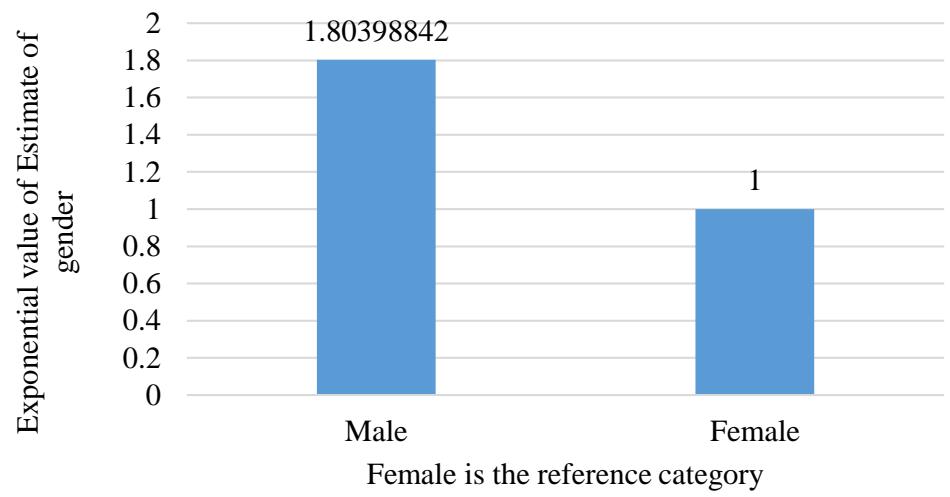 Exponential Value Chart Fig. 6: Male is having 1.764 times more satisfaction than female
Key-Points
<table><tr><td>Data in Percentage
Total 144 (Doing
yoga and
meditation)</td><td>yoga started during Covid-19 (36%)114</td><td>Yoga in morning</td><td>Yoga on daily</td><td>Yoga on weekly</td><td>Yoga is helpful for Mental health well-being, Very satisfied</td></tr><tr><td>Male</td><td>44</td><td>56</td><td>52</td><td>65</td><td>51</td></tr><tr><td>Female</td><td>56</td><td>44</td><td>48</td><td>35</td><td>49</td></tr><tr><td>18-24 years</td><td>63</td><td>55</td><td>64</td><td>42</td><td>57</td></tr><tr><td>24-30 years</td><td>29</td><td>39</td><td>28</td><td>51</td><td>32</td></tr><tr><td>Rural</td><td>29</td><td>35</td><td>34</td><td>28</td><td>29</td></tr><tr><td>Urban</td><td>71</td><td>65</td><td>66</td><td>72</td><td>71</td></tr><tr><td>Postgraduate</td><td>42</td><td>44</td><td>37</td><td>51</td><td>45</td></tr><tr><td>Undergraduate</td><td>27</td><td>38</td><td>46</td><td>21</td><td>35</td></tr><tr><td>Intermediate</td><td>17</td><td>7</td><td>7</td><td>9</td><td>6</td></tr><tr><td>Higher education</td><td>10</td><td>10</td><td>9</td><td>12</td><td>11</td></tr></table>
### Benefits of yoga and meditation experience by respondents
Mind stability, Positive thinking, Healthy lifestyle, Make calm, increase creativity and thinking level, Enhance focus and concentration power, Manage anxiety, stress, and anger, Make us happier, Boost our immune system, Feel energised and active
- Clarity in thoughts, powerful connection with almighty, Help in weight gain/loss, Help in breathing and good health, increase blood flow, flexibility, Good for physical and mental health, feel relax
- Increase confidence level, fitness of body, improve sleep quality, Healthy and fresh start of the day, Helps to stay away from disease (like fever, cough), Helps in time management, balance life, Improve body posture and stamina.
- Increase overall metabolism of the body, organs of body work properly, Improve decision-making ability, less frequent headache, Maintain discipline in morning routine, Increase body awareness
- □ It is helpful for recovering from diseases like brain cancer, kidney, stress, heavyweight gain, headache and many more diseases
- Good for heart health, respiratory, digestion system, Keep glowing skin, getting to know one own self, back pain relief.
## VII. CONCLUSION
- Out of 203 young adult respondent more than half (56%) respondent are doing yoga and meditation. So we need to generate awareness among young adults about importance and benefits of doing yoga and meditation on regular basis, so that we can get much better data for the same.
- From analysis we find positive result that out of the 114 respondents
- □ there are $36\%$ respondents who have start doing yoga and meditation during Covid- 19 pandemic out of them $44\%$ are male and $56\%$ are female, and 64 percent have started before the pandemic. This indicates the behavior change in young adults during pandemic.
- □ Young adults prefer to do yoga and meditation in the morning (89%) and 11% prefer to do it in evening time. Means morning and evening are the good time to do yoga and meditation.
- $59\%$ respondent doing yoga and meditation on Daily basis. This is also a good result.
- □ $57\%$ respondent are very satisfied that yoga and meditation is helpful to their mental health well-being. This shows that yoga and meditation are actually helpful to our mental health well-being.
From ordinal logistic regression analysis
- Since the significance value of Model Fitting information is 0.255 which is $\zeta 0.05$, so we are unable to fit a good model.
- Since the significance value of Goodness of fit is 0.806 which is $\angle 0.05$, so we accept the null hypothesis and conclude that the observed data is having goodness of fit with the fitted model.
- Further we can go with more independent variable for better result because Pseudo R-square should be $>=0.7$ and data results 0.099
- Male and female does not have any significant difference in level of satisfaction, from Parameter Estimate.
- Male have more positive satisfaction level than female.
- □ With the help of exponential value chart we conclude that male is having 1.80398842 times more satisfaction than female.
- Students of Undergraduate, Postgraduate, and Higher than Postgraduate having more positive satisfaction level than other education level but Students of Intermediate having less satisfaction than other education level.
- Students of Urban area having more positive satisfaction level than rural area.
- Students of (30-35) age group having more satisfaction than other age groups.
- In the same way we can conduct survey for other states also.
- $57\%$ respondent are very satisfied that yoga and meditation is helpful to their mental health well-being. This shows that yoga and meditation are actually helpful to our mental health well-being.
From ordinal logistic regression analysis
- Since the significance value of Model Fitting information is 0.255 which is $\zeta 0.05$, so we are unable to fit a good model.
- Since the significance value of Goodness of fit is 0.806 which is $\angle 0.05$, so we accept the null hypothesis and conclude that the observed data is having goodness of fit with the fitted model.
- Further we can go with more independent variable for better result because Pseudo R-square should be $\zeta = 0.7$ and data results 0.099
- Male and female does not have any significant difference in level of satisfaction, from Parameter Estimate.
- Male have more positive satisfaction level than female.
- □ With the help of exponential value chart we conclude that male is having 1.80398842 times more satisfaction than female.
- Students of Undergraduate, Postgraduate, and Higher than Postgraduate having more positive satisfaction level than other education level but Students of Intermediate having less satisfaction than other education level.
- Students of Urban area having more positive satisfaction level than rural area.
- Students of (30-35) age group having more satisfaction than other age groups.
- In the same way we can conduct survey for other states also.
Generating HTML Viewer...
References
8 Cites in Article
B Fallon (2021). Can Meditation and Yoga Help Reduce Anxiety Related to COVID-19?.
E Van Hoof (2020). World Economic Outlook, April 2020.
S Grover,S Sahoo,A Mehra,A Avasthi,A Tripathi,A Subramanyan (2020). Psychological impact of COVID-19 lockdown: An online survey from India.
Güler Boyraz,Dominique Legros (2020). Coronavirus Disease (COVID-19) and Traumatic Stress: Probable Risk Factors and Correlates of Posttraumatic Stress Disorder.
Keith Petrie,Linda Cameron,Chris Ellis,Deanna Buick,John Weinman (2002). Changing Illness Perceptions After Myocardial Infarction: An Early Intervention Randomized Controlled Trial.
R Ransing,F Adiukwu,S Pereira,R Ramalho,L Orsolini,A Teixeira (2020). Mental health interventions during the COVID-19 pandemic: A conceptual framework by early career psychiatrists.
Priyanka,S Rasania (2021). A cross--sectional study of mental wellbeing with practice of yoga and meditation during COVID-19 pandemic.
P Sahni,K Singh,N Sharma,R Garg (2021). Yoga an effective strategy for self -management of stress-related problems and wellbeing during COVID19 lockdown: A cross-sectional study.
Explore published articles in an immersive Augmented Reality environment. Our platform converts research papers into interactive 3D books, allowing readers to view and interact with content using AR and VR compatible devices.
Your published article is automatically converted into a realistic 3D book. Flip through pages and read research papers in a more engaging and interactive format.
Our website is actively being updated, and changes may occur frequently. Please clear your browser cache if needed. For feedback or error reporting, please email [email protected]
Thank you for connecting with us. We will respond to you shortly.