This paper reviewed gender issues on accessibility to agricultural production resources and extension services amongst rural farmers in the predominant crises regions of North-East Nigeria, The study applied qualitative analysis in reviewing related literatures, workshop proceedings, seminars, intervention projects, and situation reports on the crisis-torn regions of the Country to elicit cogent facts and figures, The findings revealed that there is a great deal of gender disparity in favor of the men folk as against women and youths in the accessibility to production resources and extension services in the affected regions of the study. This has not only affected their production output but also makes them vulnerable in crisis situations. The paper thus recommends strongly for gender mainstreaming policies towards ensuring equitable access to production resources and extension services in periods of emergencies in these regions.
## I. INTRODUCTION
Agriculture is critical to achieving sustainable development, by generating a greater proportion of rural households' incomes. In Nigeria, women are involved in food production and provide a majority share of the total agricultural labour force. Despite their significant contribution, women still face challenges in participating in agricultural production. For example, both men and women have different levels of access to agricultural resources, despite the equal roles they play in agricultural activities. It has been argued that if women's incomes were increased, they would have more access to resources and invest in their children's education, health care and nutrition (World Bank 2018).
Women are often hampered in accessing new opportunities by poor access to resources, including new markets, due to their limited educational background, poor networks and mobility restrictions. Also, women have poor access to financing, which hinders them from hiring labour for agricultural activities, forcing them to depend on their own labour and that of family members. Women face high transaction costs for credit, a situation that is exacerbated by their limited property rights and their poverty. Although men also face this barrier, women are more vulnerable in rural areas. In cases where women have access to credit, the amounts are usually very small and repayment conditions are unsuitable (Anaglo et al., 2018).
Gender equality doesn't mean that men and women will become the same, but rather that their rights, responsibilities and opportunities will not depend on whether they were born male or female. Empowering and enabling men and women to participate more effectively in agriculture also translates into improved well-being for their children, thereby building human capital for future generations. As such, achieving gender equality and empowering rural women, men, girls and boys will not only improve nutrition, health and education outcomes, it will also bring both immediate and long-term economic and social benefits for families, communities and nations at large.(FAO, 2017).
For agricultural transformation to be truly inclusive, women must have equitable opportunities to participate and prosper. Around the world, women play important roles in agriculture, including growing crops and tending livestock. But despite high levels of participation, women have consistently lower productivity than men. While this gap is partly due to cultural circumstances, evidence shows that systemic barriers affect the ability of women farmers to control productive resources and access information, credit, and markets. The consequences include lower farm yields and lower household incomes, as well as less potential to improve family welfare, given that women tend to invest more readily than men in their family's well-being. Our efforts to empower women farmers therefore magnify our contributions to improving productivity, income, and nutrition outcomes for vulnerable households Bill & Melinda Gates Foundation (2021).
Given the prominence of women in the agricultural sector in Nigeria, women are particularly affected by frequent crisis and the climate-related impacts. While the need to build rural adaptive capacity and to empower rural women is well documented, there needs to be greater recognition of women's agency and attention to how women's entrepreneurship development can improve adaptation responses (Akinbami et al., 2019). A study on women's empowerment in farming communities in Southeast Nigeria recommends, for example, that women's participation in the construction, maintenance and management of sustainable water and irrigation systems should be encouraged to counter the impacts of water shortage (Nnadi et al., 2019).
Since 2009, northeastern Nigeria has been hit by a violent conflict which have led to continued large-scale displacements, disruption of basic services, food insecurity, malnutrition, and protection issues. As a matter of fact, the extreme violence caused by non-state armed groups (NSAGs) has resulted in the forced displacement of several millions of civilians from their homes and total loss of their livelihoods. Agricultural livelihoods have been devastated through the destruction of irrigation and farming facilities, the loss of livestock and reduced access to fishing grounds, the collapse of extension services. The value chain for crops, livestock and fisheries has been also severely disrupted as a consequence of the conflict. Additionally, looting and fear of attacks have prevented farmers from working in their fields, leading to reduced harvests, loss of productive assets and extremely reduced purchasing power (FAO.2017).
The impact of the conflict on agriculture in the Northeast was estimated at USD 3.7 billion in 2015, in a country where the agriculture sector provides livelihoods for about 90 percent of the rural population. According to the October 2018 Displacement Tracking Matrix (DTM)3 developed by the International Organization for Migration (IOM) and the National Emergency Management Agency (NEMA), 2,026, 602 internally displaced persons (IDPs) were identified in the six northeastern State. The states in the North East badly hit by the ongoing crisis includes: Borno, Adamawa and Yobe (OCHA Nigeria. 2017).
Agricultural livelihoods in these regions have been devastated through the destruction of irrigation and farming facilities, the loss of livestock, reduced access to fishing grounds, the collapse of extension services. The value chain for crops, livestock and fisheries has been also severely disrupted as a consequence of the ongoing conflict. Additionally, looting and fear of attacks have prevented farmers from working in their fields, leading to reduced harvests, loss of productive assets and extremely reduced purchasing power. (FAO 2016).
In recent years, the conflict has worsened the food security and nutrition situation, with widespread loss of livelihoods and reduced access to essential social services. OCHA Nigeria. (2018). The conflict has reduced the food security of both internally displaced persons and host communities as farmland has become inaccessible, irrigation material destroyed and animals looted. Food prices have increased, and labour wage rates fallen. Other contributors to severe food insecurity include below-average crop production and a financial crisis linked to local currency depreciation. NSRP & UNICEF Nigeria. (2017).
Though there are available literatures on women's access to resources in general, but there is little or a lack of consensus on the actual magnitude and effects of gender differences in access to agricultural resources in the crisis zones of the North-Eastern part of Nigeria. This paper thus intends to critically review the gender accessibility to agricultural production resources and extension services amongst rural farmers in the crisis regions of North-East Nigeria.
## II. METHODOLOGY
The study applied a qualitative analysis of reviewing related works of literature, workshop proceedings, seminars, intervention projects, and situation reports on the crisis-torn regions of North-East Nigeria to elicit cogent facts and figures. A total of 50 materials were reviewed on the subject matter of which 45 were found to be directly relevant to the study.
## III. FINDINGS AND DISCUSSIONS
### a) Gender Disparity and its Effect on the Accessibility to Production Resources
Rural women play a key role in supporting their households and communities in achieving food and nutrition security, generating income, and improving rural livelihoods and overall well-being. They contribute to agriculture and rural enterprises and fuel local and global economies. As such, they are active players in achieving the MDGs. Yet, every day, around the world, rural women and girls face persistent structural constraints that prevent them from fully enjoying their human rights and hamper their efforts to improve their lives as well as those of others around them. In this sense, they are also an important target group for the MDGs.FAO 2017, In a report by World Bank 2018, which reveals that Agricultural gender inequalities remain strong, women farmers are particularly at risk of hunger, especially when crisis strikes. On average, rural women account for nearly half the agricultural workforce in developing countries. Despite their crucial roles in household food security, they face discrimination and limited bargaining power. Patriarchal norms create
disadvantages for women farmers, specifically in land rights (small plots, difficulties attaining ownership, discriminatory inheritance rights), productive resources (no access to credit, extension services or inputs), unpaid work, insecure employment and exclusion from decision making and political representation. Within the household, because of weaker bargaining position they frequently eat least, last and least well. Women farmers who control resources generally have better-quality diets. World Bank (2018).
Women are vulnerable on all dimensions of food security: availability, access, utilization and stability. They suffer the most from macro- and micronutrient deficiencies, especially during reproductive years, with long-term negative development impacts for society as a whole. Food-price spikes have negative repercussions for female household heads. They suffer labour market discrimination, which confines them to informal and casual employment, as well as pay inequity. Also, they frequently spend a bigger share of their family budget on food than male heads of household. Women's coping strategies In times of crisis, poor households face asset losses and lower incomes. Men have more access to social capital and pathways out of crisis (their income pays past debts and secures new farm loans), whereas women often face severe time burdens, given their household food-security roles. As they usually have a weak bargaining position with regard to household income, they frequently must reduce spending on nutrition and family well-being. Indeed, households adjust to reduced food purchasing power by shifting to cheaper, less diverse diets. Women tend to buffer the impact through extreme strategies: reducing their own consumption to feed others, collecting wild food, migrating or selling assets, and even taking on risky jobs. World Bank (2018).
In a report by OXFAM 2019 titled: 'Gender inequalities and food insecurity in Northern Nigeria' reveals that poor households face asset losses and lower incomes. Men have more access to social capital and pathways out of crisis (their income pays past debts and secures new farm loans), whereas women often face severe time burdens, given their household food-security roles. As they usually have a weak bargaining position with regard to household income, they frequently must reduce spending on nutrition and family well-being. Indeed, households adjust to reduced food purchasing power by shifting to cheaper, less diverse diets. Women tend to buffer the impact through extreme strategies: reducing their own consumption to feed others, collecting wild food, migrating or selling assets, and even taking on risky jobs.
In a study by (FAO, 2018) which reveals that on the average, women make up about 43 percent of the agricultural labour force in developing countries. Evidence indicates that if these women had the same access to productive resources as men, they could increase yields on their farms by 20 to 30 percent, raising total agricultural output in developing countries by 2.5 to 4 percent, in turn reducing the number of hungry people in the world by 12 to 17 percent.
More so, for rural women and men, land is perhaps the most important household asset to support production and provide for food, nutrition and income security. Yet an international comparison of agricultural census data shows that due to a range of legal and cultural constraints in land inheritance, ownership and use, less than 20 percent of landholders are women. Women represent fewer than 5 percent of all agricultural land holders in North Africa and West Asia, while across Sub-Saharan Africa, women average 15 percent of agricultural land holders (UN, 2017).
In a related study by Oxfam (2019) with extensive evidence shows that rural female-headed households also have more limited access than male-headed households to a whole range of critical productive assets and services required for rural livelihoods, including fertilizer, livestock, mechanical equipment, improved seed varieties, extension services and agricultural education. Similarly, in seven out of nine countries across Africa, Asia and Latin America, female-headed households were less likely to use credit than male-headed households.
(FAO, 2019) in a report reveals that rural women play a key role in supporting their households and communities in achieving food and nutrition security, generating income, and improving rural livelihoods and overall well-being. They contribute to agriculture and rural enterprises and fuel local and global economies. As such, they are active players in achieving the MDGs. Yet, every day, around the world, rural women and girls face persistent structural constraints that prevent them from fully enjoying their human rights and hamper their efforts to improve their lives as well as those of others around them. In this sense, they are also an important target group for the MDGs.
These findings tallies with a study by (Mercy corps, 2017), titled: 'An assessment on the joint livelihood and market recovery in the Northeast of Nigeria'. It highlights the progress of rural women against key Millennium Development Goal (MDG) indicators, pointing to some of the advancements made and gaps that still exist. It suggests that globally, and with only a few exceptions, rural women fare worse than rural men and urban women and men for every MDG indicator for which data are available. While data collection along these lines has improved in recent years — in part because of increased donor and government interest — there still remains a general lack of data not only disaggregated by sex, but also by rural and urban areas. This has an impact on our global ability to confidently monitor progress toward the MDGs for all people in all regions, urban and rural, and particularly where progress is needed most.
Similarly, (IFAD 2019) in a study reveals that on average, women make up about 43 percent of the agricultural labour force in developing countries. Evidence indicates that if these women had the same access to productive resources as men, they could increase yields on their farms by 20 to 30 percent, raising total agricultural output in developing countries by 2.5 to 4 percent, in turn reducing the number of hungry people in the world by 12 to 17 percent.
For rural women and men, land is perhaps the most important household asset to support production and provide for food, nutrition and income security. Yet an international comparison of agricultural census data shows that due to a range of legal and cultural constraints in land inheritance, ownership and use, less than 20 percent of landholders are women (UNESCO, 2019). Women represent fewer than 5 percent of all agricultural land holders in North Africa and West Asia, while across Sub-Saharan Africa, women average 15 percent of agricultural land holders (UN, 2019).
(UNDP, 2019) in a study reveals that because rural women tend to underreport their employment as contributing family members, according to available data female employment in agriculture is consistently lower than it is for men across the total adult population in developing countries, although it varies greatly by region. The jobs of rural women who are employed tend to be shorter term, more precarious and less protected than those of rural men and urban people. The lack of flexible hours to accommodate family work combined with wage and job discrimination and limited representation of women in workers' organizations are partly responsible for this.
FAO, 2019 in a report reveals that in Nigeria, gender plays a critical role in land ownership. While women farmers contribute about 70 per cent of food production in the country, land rights discrimination, fuelled by social, economic and cultural factors, affects their productivity. This low-productivity trap, in turn, inhibits an efficient functioning of value chains and an expansion of trade, as women input providers miss out on potential markets, and agribusinesses miss out on the potential for high-quality and reliable supplies of produce from women farmers and agro-processors (FAO, 2019). This denotes that there is a significant correlation between accessibility to land resources and Agricultural productivity.
Figure 1 below shows the distribution of land ownership by gender in the Northern regions of Nigeria. In the North-east, plagued by the jihadist Boko Haram insurgency, only four per cent of women own land against 52.2 per cent of men. In the North-west, which is also facing a severe security crisis caused by herders and the so-called bandits, 4.7 per cent of women own land compared to 50.1 per cent of men. In the North-central, the ratio is 7.9 per cent against 41.2 per cent. (FAO, 2017). These findings connotes that there is wide gap disparity in the ownership of land by the Gender groups especially in the worst affected regions in North Eastern Nigeria.
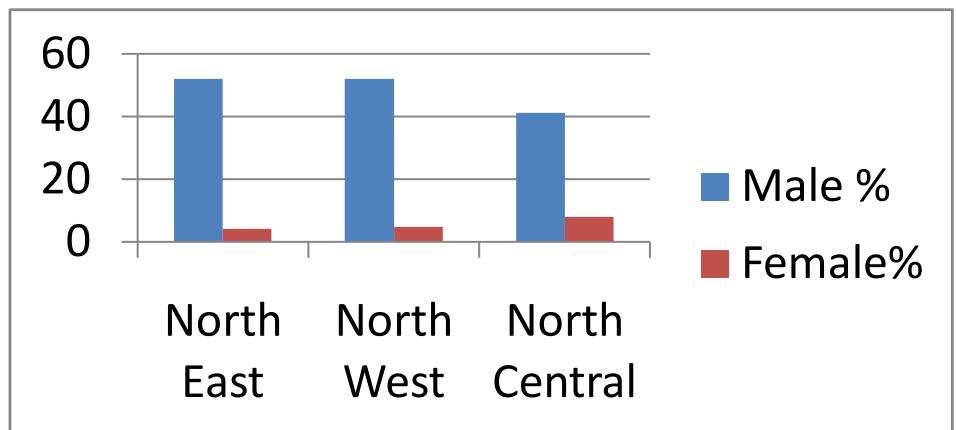 Source: National Bureau of Statistics (NBS, 2016) Figure 1: Distribution of Land Ownership by Gender in the Northern Regions of Nigeria
Table 1: Mean Distribution of Characteristics of Male House Holds (MHHs) and Female House Holds (FHHs)
<table><tr><td>Gender</td><td>Rural (N)</td><td>Urban (N)</td><td>Land Size (Acres)</td><td>Non Farm Income</td><td>Farm Income</td><td>House hold Size</td></tr><tr><td>Male</td><td>871</td><td>153</td><td>2.33</td><td>32.69</td><td>202.04</td><td>7.09</td></tr><tr><td>Female</td><td>58</td><td>14</td><td>0.49</td><td>22.53</td><td>59.53</td><td>4.62</td></tr></table>
Table 1 above shows that, on average, MHHs have about 3.4 and 1.4 times more farm and nonfarm income than FHHs, respectively. One reason for the large difference in farm income between both types of households is that FHHs generally have less access to agricultural land. Even in cases where they do have similar access, they may not have enough family labor, access to markets, and inputs to cultivate their land productively.
MHHs are larger than FHHs. (NBS. 2016). These findings imply that MHH have better opportunities of maximizing their agricultural productivity due to their access to land, labour and market.
Table 2: The table depicts that in terms of ownership structure, men typically own more land compared to women in Nigeria. Majority of the land owners inherited it from their family, while only 7 and $2.2\%$ of male and female, respectively, reported purchase of land. (National Bureau of Statistics, 2019). World Bank and Federal Ministry of Agriculture and Rural Development. This findings implies that on the average men own more land in comparison to their female counterparts and thus more likely to increase their agricultural productivity.
Table 2: Land ownership structure in Nigeria Outright purchase Rented Used free of charge Allocated by Family community Inheritance
<table><tr><td>Male</td><td>Female</td><td>Male</td><td>Female</td><td>Male</td><td>Female</td><td>Male</td><td>Female</td><td>Male</td><td>Female</td></tr><tr><td>%</td><td>(%)</td><td>(%)</td><td>(%)</td><td>(%)</td><td>(%)</td><td>(%)</td><td>(%)</td><td>(%)</td><td>(%)</td></tr><tr><td>7.0</td><td>2.2</td><td>6.8</td><td>11.8</td><td>7.9</td><td>11.8</td><td>7.1</td><td>5.9</td><td>71.2</td><td>68.4</td></tr></table>
FAO, 2017 in a related report recognizes that rural women and men, together, hold the keys to ending hunger and extreme poverty. Rural women and girls, in particular, are recognized as major agents of change. Across low-income countries, women make up 48 percent of agricultural employment. As farmers and farm workers, horticulturists and market sellers, businesswomen, entrepreneurs and community leaders, they fulfill important roles throughout agrifood value chains, as well as in the management of natural resources such as land and water.
Women are more likely to be food-insecure than men in every region of the world. And as producers, rural women face even greater constraints than their male counterparts in accessing essential productive resources and services, technology, market information and financial assets. They are under-represented in local institutions and governance mechanisms, and tend to have less decision-making power. In addition to these constraints, prevailing gender norms and discrimination often mean that women face an excessive work burden, and that much of their labour remains unpaid and unrecognized.
More so, on decision-making, findings by a Gender based violence Sub Sector Working Group Nigeria (2017) in a study in the North East, the respondents indicated that, traditionally, it is the men (father, spouse, intimate partner) who incarnate authority within the household and are the decision makers in the family. They continue to control decisions about how family income has to be spent, which includes income earned by women. Women and children are considered to be the persons with low status at community level. Induced change in gender roles has created female headed households with the primary responsibility of ensuring family economic survival, hence women have had to take on extra roles which traditionally were not theirs before the conflict (GBV SSWGN, 2017).
## IV. CONCLUSION AND RECOMMENDATIONS
This review therefore unravels the various explanations for gender disparity in the accessibility to production recourses, highlighting the core place of social gender relations in structuring unequal female and male access in the crisis regions of the North-East zone of Nigeria. Variations in intensity of access barriers were determined by existing gender orders around household provisioning. Land access was deeply entrenched within social norms and customs, deriving from the customary rules that govern household provisioning in NE, which require both women and men to make contributions towards the family meal. Male provisioning roles override female, a fact that was dominant within all the crisis raveled states in the NE. Generally, agricultural activities engaged by the men attract more value and therefore are favored when it comes to the distribution of resources and extension services. Women's provisioning according to traditional norms, however, was not considered crucial to family survival and therefore not worthy of investments like time, money, and other agricultural inputs, especially land. This paper therefore posits for a greater attention to the existing gender disparity and thus the need for an aggressive approach to ensure gender participation in all the agricultural endeavors in the impending crisis torn regions of the NE. Indeed, women make a significant contribution to food production and processing in these regions, but men seem to take more of the farm decisions and control the productive resources. Food sufficiency can only be guaranteed by continued gender involvement in agriculture. Therefore, there is a need for all stake holders in agricultural policies and programs in these regions to uphold gender sensitivity and mainstreaming with regards to accessibility to production resources. Thus, this would ensure an accelerated rate in agricultural productivity and the attainment of food sustainability in the crisis regions of North-East of Nigeria.
Generating HTML Viewer...
References
29 Cites in Article
C Akinbami,J Olawoye,F Adesina,V Nelson (2019). Exploring potential climate-related entrepreneurship opportunities and challenges for rural Nigerian women.
Keith Tomlins,Ben Bennett (2018). New uses and processes for cassava.
Mgf (1991). Women's Empowerment in Agriculture Index (pro-WEAI) metrics.
Carlo Cafiero (2016). What do we Really Know about Food Security?.
Kamola Khasanova,Nigora Yoqubova (2019). The economy.
(2016). FAO framework on ending child labour in agriculture.
(2016). Livestock in protracted crises: The importance of livestock for resilience-building and food security of crisis-affected populations.
(2015). North-East Nigeria Recovery and Peace Building Assessment.
(2018). Northeastern Nigeria: Adamawa, Borno and Yobe states. Response overview (November 2023).
(2016). The State of Food Security and Nutrition in the World 2017: Building Resilience for Peace and Food Security. Rome: Food and Agricultural Organization of the United Nations. Gendered access to land and household food.
(2017). Strategy for Gender Based Violence Prevention, Mitigation and Response in the Humanitarian Context.
Nema Iom (2018). Displacement Tracking Matrix (DTM): Round XXV Report.
(2017). Mercy Corps.
(2019). Orr, David Campbell, (born 27 March 1955), Chief Executive Officer, National Housing Federation, since 2005.
Nbs (2016). National Bureau of Standards (NBS).
O Nnadi,E Liwenga,J Lyimo,M Madukwe (2019). Impacts of variability and change in rainfall on gender of farmers in Anambra, Southeast Nigeria.
Powei Kerry (2017). The Psychological Menace of Children Formerly Associated with Non-state Armed Groups (CFANSAG) in Northeast Nigeria.
(2017). Humanitarian needs and funding results in 2018.
(2017). Improving humanitarian needs analysis and response planning.
(2018). Improving humanitarian needs analysis and response planning.
Oxfam (2019). Gender inequalities and food insecurity in Nigeria.
Victor Ogharanduku,Rachel Slater,Rebecca Holmes (2016). Institutional Perspectives on Targeting in the Humanitarian and Social Protection Sectors in North East Nigeria.
(2017). Humanitarian response.
(2017). Afghanistan crisis : UNDP strategy : a transition strategy for Afghanistan and the immediate region / UNDP..
U Relations With Nigeria Bilateral Relations Fact Sheet.
Wfp (2016). World Food Projects.
(2018). World Development Report 2008 (Overview).
(2018). Gender in Climate-Smart Agriculture: Module 18 for Gender in Agriculture Sourcebook.
(2015). North-East Nigeria Recovery and Peace Building Assessment.
No ethics committee approval was required for this article type.
Data Availability
Not applicable for this article.
How to Cite This Article
Aliyu M.K.. 2026. \u201cGender Accessibility to Agricultural Production Resources and Extension Services amongst Rural Farmers in the North-East Nigeria\u201d. Global Journal of Science Frontier Research - D: Agriculture & Veterinary GJSFR-D Volume 22 (GJSFR Volume 22 Issue D3).
Explore published articles in an immersive Augmented Reality environment. Our platform converts research papers into interactive 3D books, allowing readers to view and interact with content using AR and VR compatible devices.
Your published article is automatically converted into a realistic 3D book. Flip through pages and read research papers in a more engaging and interactive format.
Our website is actively being updated, and changes may occur frequently. Please clear your browser cache if needed. For feedback or error reporting, please email [email protected]
Thank you for connecting with us. We will respond to you shortly.