K NTan
I. INTRODUCTION
Detergent is used for cleaning purposes and is always present in wastewater. Detergent content in wastewater is not only a source of pollutant when discharged to the water course [1], its present can severely affect the normal functioning of conventional wastewater treatment because of severe foaming when aerated and can adversely affect water reclamation by membrane technology [2]. Detergent removal from wastewater had been of concern in wastewater treatment in the past [3] and recently, in view of water scarcity, wastewater generated from laundry industry has become a potential source for water reclamation for reuse. Advanced oxidation process (AOP) using ozonation with combination of hydrogen peroxide was reported as an efficient way to treat detergent wastewater [4]. Combined biological and physicochemical treatment with UV/ozonation had also efficiently reduced the COD and completely removed the detergent from the laundry wastewater [5].
As reported in our earlier papers [6][7], a detergent destruction method with the use of biosorption and intimate mixing of activated sludge with WHD has enabled treatment of WHD with the efficient, cost effective and relatively simple conventional aerobic activated sludge process (ASP). This is particularly useful for wastewater generated from the detergent manufacturing and processing industry as even though the quantity of wastewater is small, detergent content is extremely high which poses problems for its aerobic treatment. The detergent destruction method engages the strategy of breaking down the detergent content prior to aeration so as to prevent detergent foaming. Incidentally the strategy is in fact a reversed idea of breaking down the activated sludge with the detergent. ie consuming the detergent to disintegrate the sludge. A good understanding of sludge breakdown is therefore important to reveal the details of the detergent destruction method.
Intended sludge breakdown is usually not a common practice of wastewater treatment processes and has not been emphasized in wastewater treatment technology. However there are many issues and advantages calling for the need to enhance sludge breakdown and hence it has been a rather popular topic for research studies. Basically, studies of sludge breakdown are for the purposes of improving aerobic and anaerobic digestion [8][9], to enhance biogas production [9], to facilitate a more efficient sludge dewatering process [10], to cope with excess or surplus sludge production in the ASP [11] and even to overcome the problem of nutrient deficiency in the anaerobic digestion process [14]. Interestingly, sludge breakdown is now used as an approach to treat detergent – wastewater – aerobically. This takes advantage that sludge is disintegrated by the cleaning action of the detergent which in turn removes the detergent content to prevent foaming when the detergent water, especially, the WHD is aerated.
Many methods or strategies were used to enhance breakdown of the aerobic or anaerobic sludge, basically depending on the the purposes of sludge breakdown.
a) Improving sludge digestion and bio-gas production by ultrasonic treatment
Ultrasonic pretreatment before the anaerobic or aerobic digestion of the sludge were found to be able to release much of the extracellular polymeric substances (EPS) which are otherwise tightly bound on the surface of sludge floc or even be embedded in the pellets of the sludge floc. With the release of the EPS into the solution phase, prompt aerobic or anaerobic metabolic reactions can take place instantly and hence a more efficient sludge digestion process [8][9]. Enhance sludge solubilization generating more low molecular substances with alkaline-ultrasonic pretreatment has also resulted in increase in biogas production [9]. Sludge breakdown strategy is also useful for sludge digestion of industrial waste lacking in nutrient content. High sludge reduction by ultrasonic pretreatment has resulted in low sludge growth yield and hence a lower demand of nutrient for cell growth (14)
b) To enhance efficiency of anaerobic digestion and dewater ability of secondary sludge
Surplus activated sludge or the excess sludge generated in the aeration process is well known to be difficult for anaerobic digestion and has poor dewater ability.
Recent studies [10] on the rheological properties of the ultrasonicated waste activated sludge had revealed the significant release of soluble protein and a loosening and disruption of the internal structure of the WAS enabling the anaerobic metabolic reaction and favouring the dewatering process.
Similar investigation of sludge breakdown by pretreatment of the WAS with high ammonia concentration [11] had resulted in an increase in volatile solids breakdown and hence an increase in dewatered sludge solids content from to . Improved rate of anaerobic digestion is shown by an increase of of biogas production
c) Reducing the quantity of sludge generated
Sludge breakdown was found to be able to significantly reduce the quantity of sludge for anaerobic digestion. This is particularly important for the large quantity of secondary sludge generated in the ASP. Investigation of sludge breakdown by induced acidic pretreatment and by mechanical means have both given high% of sludge reduction. The acidic pretreatment was achieved with inoculated special ammonia-oxidizing bacterium, 'Candidatus Nitrosoglobus' [12] while the mechanical approach uses rotor stator type hydrodynamic cavitation reactor for sludge disintegration [13].
d) Sludge breakdown by high detergent content in the wastewater which is also the objectives of this study.
Treating WHD by aerobic ASP is successfully done by breaking down the detergent prior to the aeration [7] This takes advantage of the cleaning nature of the detergent. Biosorption and intimate mixing of the sludge with the detergent water or the WHD facilitate the sludge disintegration process. It was initially anticipating that the components, mainly the ESP from the disintegration of the sludge should be re-built into new sludge following the subsequent aeration process. Sugar supplement was used to replace some possible carbonaceous loss out of the sludge breaking down process, much the same as the endogenous respiration in the ASP.
This research study was carried out for a closer look of the sludge break down process.
II. METHOD AND MATERIAL
a) A The Reactor System
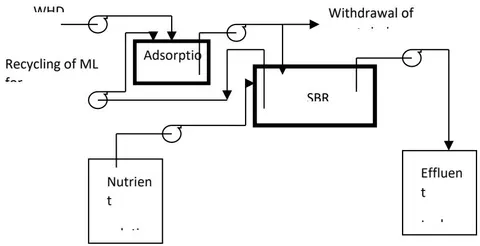
A sequencing batch reactor is used to treat WHD generated from the washing of used containers in a detergent processing factory. The WHD is fed into the SBR through an adsorption tank and the SBR has included a DESTRUCTION stage where detergent content is largely if not completely removed prior to the AERATE stage. Detergent removal is done by firstly having the detergent content largely adsorbed onto the activated sludge [6] and subjected to a prolonged and intimate mixing without aeration in the DESTRUCTION stage[7].
The SBR has therefore the following stages per cycle. FILL
DESTRUCTION
AERATE
SETTLE
DECANT
Schematic flow diagram for the SBR system is given in figure 1.
Mixed liquor is continuously recycled into the adsorption tank which is level control ie what flows in will overflow back to the aeration tank. The adsorption tank is not aerated throughout and is ONLY agitated when feeding with WHD. Hence there is deposition and cumulation of the activated sludge in the adsorption tank.
For a cycle of SBR operation, WHD is fed in the FILL stage. WHD enters the aeration tank through the adsorption tank which then has a very high activated sludge concentration through the thickening process before the FILL stage.
At the end of the FILL stage, the DESTRUCTION stage took place with agitation in both the adsorption tank and the aeration tank without aeration. With the continuous recycle of the mixed liquor, there is some degree of sludge deposition. The DESTRUCTION stage therefore prolongs the mixing of the detergent and the activated sludge prior to the AERATE stage facilitating destruction of the detergent.
With the AERATE, SETTLE and DECANT stages to complete the cycle of operation of the SBR, the WHD can then be treated with much reduction in COD and almost complete detergent removal as there is no foaming occurring in the AERATE stage. Detailed principle and operational procedures are published in our paper in 2019 [7]
b) Materials
The wastewater is produced from cleaning of the used containers returned from customers. Tap water is used and hence the wastewater is actually the washing water and is highly deficient in basic carbonaceous sources and the nutrients for cell growth. Depending on the level of Mixed Liquor Suspended Solids (MLSS), sugar or other simple food waste are added to the washings for biomass generation. Basic nutrients supplement and, in particulars, nitrogenous and phosphoric compounds are added. Urea and potassium hydrogen phosphates are used. List of nutrients and relative quantities are given in Table 1.
Most of the nutrients supplements, except the urea are being conserved and reused and needs only a small quantity of replenishment. Hence, only nitrogenous and the carbonaceous sources are frequently added.
c) Plant operation
The detergent factory generates 500L to 1000 L of washing water per day with Chemical Oxygen Demand (COD) ranging from 2000 to 4000 mg/L. The SBR is operated with a 12 hours cycles with the following stages:
FILL: 2 hours
DESTRUCTION: 10 hour
AERATE: 10 hours
SETTLE: 1.5 hours
DECANT: 0.5 hour
d) Experimental procedures
As this study is conducted to examine the detergent destruction process, ML samples were collected at end of cycle 1, the DESTRUCTION and AERATE stages of cycle2 for MLSS in mg/L determination. COD in mg/L were determined for supernatant of ML samples after 2 hours of sedimentation of the samples collected at the DESTRUCTION STAGE after 2 hours and 10 hours of operation in this stage and the effluent collected at DECANT stage at end of cycle 2.
The ML has a depth of at the end of cycle 1. After 1.5 hours of sedimentation, the SBR was decanted to a depth of .
The MLSS content is adjusted to the depth of the ML at the start of cycle 2 as given below:
Depth of ML in SBR at the start of cycle 2
Depth of ML in SBR at end of FEED cycle2 = 0.32 m
Hence MLSS in SBR:
Depth of ML x MLSS
= Depth of ML at start x adjusted MLSS (presented)
0.32 x MLSS of sample = 0.27 x MLSS adjusted (as presented in th Table2)
Therefore
MLSS presented x MLSS of sample
Volume of WHD fed to SBR
Urea:
Di-Potassium hydrogen phosphate:
Trace element solution:
| Composition of trace element Solution | Kg/m3 |
| MgSO4.7H2O | 5 |
| FeCl3.6H2O | 7 |
| Boric Acid | 0.001 |
| CuSO4.5H2O | 0.001 |
| (NH4)6Mo7O24.4H2O | 0.550 |
| NaCl | 1 |
| CaCl2.6H2O | 2 |
III. RESULTS AND DISCUSSION
Table 2 and Figure 2 present the experimental data and their variation with time of operation. An increase in the MLSS from to two hours after the SBR was filled-up to with the raw WHD while having the continuous mixing. An increase of the MLSS is possibly the adsorption and cumulation of the waste components from the WHD. This is also indicated with the sharp decrease in COD from 2032 mg/l of the raw WHD to (adjusted to the same volume of raw WHD added) of the supernatant of ML after 2 hours of mixing. Biomass from the activated sludge is well acclimated to the raw detergent wastewater and is expected to rapidly adsorb the waste components from the WHD. While the COD remained very low in the range of , the MLSS has decreased by to after 10 hours in the DESTRUCTION stage with continuous mixing but without aeration. This can be explained by the solubilization of the activated sludge [8] due to the disintegration of the sludge with mixing in the present of detergent.
With ultrasonification pretreatment Guan et al [8] reported that after an aerobic digestion time of 10.5 d sludge reduction for TSS in aerobic digestion was , compared with without pretreatment (for control). Ultrasonic pretreatment has therefore achieved an additional reduction rate of . In another study [11], anaerobic digestion of secondary sludge had an increase of in sludge reduction.
In our study the MLSS has significantly reduced by from to after 10 hours of continuous aeration. The re-building of the sludge mass did not happen and for that reason, there is always the need of adding sugar supplement to maintain the necessary MLSS level. This shows that the sludge yield in the aerobic process must be very low. This agrees with the study that sludge reduction by external ultrasonic pretreatment of the activated sludge had a decrease of 15- of sludge production yield. [14].
HyunsooKim et al [13] had reported of sludge particles reduction when the sludge disintegration was done with rotor stator type hydrodynamic cavitation reactor. The sludge breakdown rate of is therefore a remarkable effect in reducing excess sludge production as our study is only using simple and common method of mixing but with the detergent as an aid to the destruction process. It should be noted that treating WHD aerobically can achieve such prominent solids reduction comparable to the degree of destruction with sophisticated destruction methods like ultraonification, ammonia pretreatment etc. This shows that the detergent breakdown action had a very high potential in achieving sludge disintegration to improve aerobic and anaerobic digestion process. Table 3 gives a summary of sludge disintegration rate achieved by the method of detergent destruction method in treating WHD. Incidentally, the method has a double advantage of enabling aerobic treatment of WHD while preventing excessive activated sludge production even with sugar addition to facilitate the treatment method
IV. CONCLUSION
The detergent destruction method can efficiently treat WHD and other detergent wastewater by consuming the detergent to disintegrate the activated sludge to prevent severe foaming when aerated. The method has the advantage of preventing excessive generation of the activated sludge in the ASP even though sugar or other carbonaceous supplement is required to replenish the activated sludge for the detergent destruction action. This can be an economical and efficient way to achieve sludge disintegration for the improvement of wastewater treatment by the ASP. Use of detergent need to be appropriately control to prevent foaming occurring in the reactor or the digesters
ML Mixed Liquor
MLSS Mixed Liquor suspended solids
SBR Sequencing Batch Reactor
WAS Waste Activated Sludge
WHD Wastewater High in Detergent content