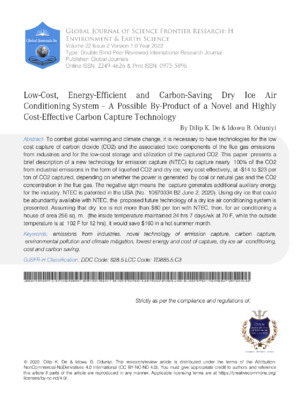
Low-Cost, Energy-Efficient and Carbon-Saving Dry Ice Air Conditioning System – A Possible by-Product of a Novel And Highly Cost-Effective Carbon Capture Technology

Article ID

II7GY

Low cost academic research publication.

Low-Cost, Energy-Efficient and Carbon-Saving Dry Ice Air Conditioning System – A Possible by-Product of a Novel And Highly Cost-Effective Carbon Capture Technology

Dilip K. De
Dilip K. De
Idowu B. Oduniyi
Idowu B. Oduniyi
Oluwatosin Obaseki
Oluwatosin Obaseki
DOI

Abstract

To combat global warming and climate change, it is necessary to have technologies for the low cost capture of carbon dioxide (CO2) and the associated toxic components of the flue gas emissions from industries and for the low-cost storage and utilization of the captured CO2. This paper presents a brief description of a new technology for emission capture (NTEC) to capture nearly 100% of the CO2 from industrial emissions in the form of liquefied CO2 and dry ice, very cost effectively, at -$14 to $23 per ton of CO2 captured, depending on whether the power is generated by coal or natural gas and the CO2 concentration in the flue gas. The negative sign means the capture generates additional auxiliary energy for the industry. NTEC is patented in the USA (No. 10670334 B2 June 2, 2020). Using dry ice that could be abundantly available with NTEC, the proposed future technology of a dry ice air conditioning system is presented. Assuming that dry ice is not more than $80 per ton with NTEC, then, for air conditioning a house of area 256 sq. m. (the inside temperature maintained 24 hrs 7 days/wk at 70 F, while the outside temperature is at 102 F for 12 hrs), it would save $160 in a hot summer month. Assuming that the sublimated CO2 is not captured back, then for air conditioning one house this would also save the emission at power plants of 992 kg or 290 kg of CO2 in a hot summer month if the power is generated by coal or natural gas respectively. The paper also discusses an efficient technique of storing dry ice and capturing back some of the CO2 that would be emitted during sublimation of the dry ice. If the sublimated CO2 is captured back, the net carbon saving would be quite substantial with the proposed dry ice air conditioning system. The paper further discusses some of the positive impacts such technology can have on climate mitigation and the future green environment.

Low-Cost, Energy-Efficient and Carbon-Saving Dry Ice Air Conditioning System – A Possible by-Product of a Novel And Highly Cost-Effective Carbon Capture Technology

To combat global warming and climate change, it is necessary to have technologies for the low cost capture of carbon dioxide (CO2) and the associated toxic components of the flue gas emissions from industries and for the low-cost storage and utilization of the captured CO2. This paper presents a brief description of a new technology for emission capture (NTEC) to capture nearly 100% of the CO2 from industrial emissions in the form of liquefied CO2 and dry ice, very cost effectively, at -$14 to $23 per ton of CO2 captured, depending on whether the power is generated by coal or natural gas and the CO2 concentration in the flue gas. The negative sign means the capture generates additional auxiliary energy for the industry. NTEC is patented in the USA (No. 10670334 B2 June 2, 2020). Using dry ice that could be abundantly available with NTEC, the proposed future technology of a dry ice air conditioning system is presented. Assuming that dry ice is not more than $80 per ton with NTEC, then, for air conditioning a house of area 256 sq. m. (the inside temperature maintained 24 hrs 7 days/wk at 70 F, while the outside temperature is at 102 F for 12 hrs), it would save $160 in a hot summer month. Assuming that the sublimated CO2 is not captured back, then for air conditioning one house this would also save the emission at power plants of 992 kg or 290 kg of CO2 in a hot summer month if the power is generated by coal or natural gas respectively. The paper also discusses an efficient technique of storing dry ice and capturing back some of the CO2 that would be emitted during sublimation of the dry ice. If the sublimated CO2 is captured back, the net carbon saving would be quite substantial with the proposed dry ice air conditioning system. The paper further discusses some of the positive impacts such technology can have on climate mitigation and the future green environment.

Dilip K. De
Dilip K. De
Idowu B. Oduniyi
Idowu B. Oduniyi
Oluwatosin Obaseki
Oluwatosin Obaseki

No Figures found in article.

Dilip K. De. 2026. “. Global Journal of Science Frontier Research – H: Environment & Environmental geology GJSFR-H Volume 22 (GJSFR Volume 22 Issue H3): .

Download Citation

Journal Specifications

Crossref Journal DOI 10.17406/GJSFR

Print ISSN 0975-5896

e-ISSN 2249-4626

Classification
GJSFR-H Classification: DDC Code: 628.5 LCC Code: TD885.5.C3
Keywords
Article Matrices
Total Views: 1557
Total Downloads: 23
2026 Trends
Research Identity (RIN)
Related Research
Our website is actively being updated, and changes may occur frequently. Please clear your browser cache if needed. For feedback or error reporting, please email [email protected]

Request Access

Please fill out the form below to request access to this research paper. Your request will be reviewed by the editorial or author team.
X

Quote and Order Details

Contact Person

Invoice Address

Notes or Comments

This is the heading

Lorem ipsum dolor sit amet, consectetur adipiscing elit. Ut elit tellus, luctus nec ullamcorper mattis, pulvinar dapibus leo.


High-quality academic research articles on global topics and journals.

Low-Cost, Energy-Efficient and Carbon-Saving Dry Ice Air Conditioning System – A Possible by-Product of a Novel And Highly Cost-Effective Carbon Capture Technology

Dilip K. De
Dilip K. De
Idowu B. Oduniyi
Idowu B. Oduniyi
Oluwatosin Obaseki
Oluwatosin Obaseki

Research Journals