In the evolution of every great empire of antiquity, the process of invasion was so inextricably interwoven that even the most powerful empire was incapable of escaping its barbarizing effect. A sudden invasion imposed major perturbation to a massive, centrallyorganised system within a relatively shorter period and became a long-lasting destabilizing factor that brought drastic changes in the productivity, economy, man-power, and social order of the system. In order to understand such a vibrant dynamics as an interplay between competition and cooperation, here we show how a simple prototype can be constructed by taking into account some of the essential sociophysical processes in their simplest settings. The simulation of the model visualizes how the outcomes depend on factors such as the strength of the invaders, defensive manoeuvre of the empire and its internal configuration.
## I. INTRODUCTION
As chronicled in a great many episodes of human history [1{7], almost every empire of antiquity, Airrespective of their sizes and strengths, endured a number of vital sociophysical processes that include the growth, assimilation, aggression, and annihilation and each of them took place at different stages of their lifespans over historical time scales [1, 8{13} Associated with every such historical process, the activity of invasion was so inextricably related that it played a key role in determining the evolutionary track of an empire. The huge Achaemenid Persian empire (550 - 330 B.C.) that was built largely through military conquest, took nearly 65 years to grow and survived for more than a century after saturation. Being aided by political instability in Persia, Alexander the Great with his exceptional military leadership abilities, embarked on the great campaign in 336 B.C. to conquest the mighty Persian Empire and by 327 B.C., the entire Persian Empire was brought under his control [1]. The Egyptian empire that nourished in the Nile Valley civilization (5500□300 B.C.), was invaded by a number of foreign powers including the Hyksos, the Libyans, the Nubians, the Assyrians, the Achaemenid Persians, and the Macedonians under the command of Alexander the Great [9,14]. The Greek Ptolemaic Kingdom, formed in the aftermath of Alexander's death, ruled Egypt until it fell to the Roman Empire in 30 B.C. and became a Roman province. The Roman empire (27 B.C.- 476 A.D.) that belonged to the Roman civilization (753 B.C.- 476 A.D.), was one of the largest empires in the ancient world. Through conquest, cultural and linguistic assimilation, at its height it controlled the North African coast, Egypt, southern and most of western Europe, much of the Middle East, and parts of Mesopotamia and Arabia [2, 3]. The Harappa empire that was culminated in the Indus Valley (3500 $\square$ 1500 B.C.), was destroyed by the Indo-European (Aryan) invaders sometime between 1800 and 1700 B.C. Repeated cycles of rising and collapse occurred in ancient India, most notably with the Mauryan and the Gupta Empires [4{7}]. The Mogul Empire that was established early in the sixteenth century, was destroyed by European invaders in the centuries following 1700 A.D.
All such historical episodes indicate that the processes of growth, expansion, and assimilation in an empire took place at different historical time scales while, an invasion was a comparatively short-time process and it happened at any evolutionary stage of the empire. Within a relatively shorter period, a sudden invasion imposed a quantifiable perturbation to a centrally-organized system and became a long-lasting destabilizing factor that brought drastic changes in the productivity, economy, manpower, and social order of the system [9]. By creating major upheavals in the economy, manpower and politics, it made a complete mess of many empire's lives and, most often, put an end to the richness and diversity of their entire evolutionary process. Being an unexpected event, it made impossible to foresee how the lifespan of such a huge centrally-organized system suddenly started shrinking and how a small empire rose all of a sudden to a powerful empire [5, 15]. The greatness of an emperor, therefore, lies in how the emperor can devise an optimal solution to resist the invaders at minimal defence costs instead of declaring a full-scale war. A great and far-ung empire thus requires to accumulate and distribute its total military strength among its powerful provinces in an optimal way so that they can resist the invaders at minimal defence costs.
(a)
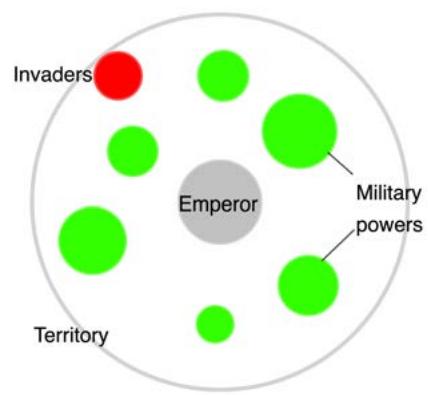
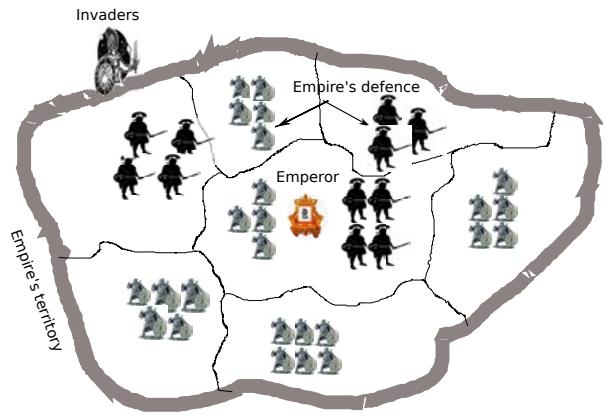
(b) Figure 1: (Color online) A replica of an empire. (a) A schematic view of an empire comprising the emperor, a territory, the internal defensive structure and the outside invaders (b) the prototype of the empire comprising a circular territory, an emperor (grey circular domain), a number of powerful provinces (PPs) or the centres of military powers of different sizes (green circular domains), and the outside invaders (red circular domain).
In order to quantify how such a strategy of defence as well as the strength of invaders impact the outcomes, we construct a simple dynamic model based on some essential sociophysical rules. We visualize the entire picture by constructing an artificial empire as a replica of a centrally-organised system, as schematically displayed in Fig. 1. As soon as the invaders pierce the territory of the empire, they proceed towards the emperor with an aim to seize the core of the empire. This engenders major perturbations that causes expansion, coalescence, and disintegration of military powers within the empire. The competition and cooperation are taken into account through the warfare strategies as well as the defensive manoeuvre of the empire. Since the invaders can pierce the territory at any arbitrary point and since the empire can distribute its military powers across the kingdom in a widely different ways, the outcomes (the victory of either the empire or the invaders) in every single invasion remains highly indeterministic. Thus, a physically meaningful quantity would be the invaders' capture probability which can only be determined by repeating the same processes for a considerably large number of random invasions on empires with random distribution of their powerful provinces (PPs) or the centres of the military powers. Such a computation would allow us to quantify the outcomes in terms of both the strength of the invaders and the defensive manoeuvre of the empire. It would also provide a way to visualize how a far-ung empire withstood the invaders of any strength, how a small empire remained irresistible over a long historical period, and how an empire could resist the invaders at minimal defence cost.
## II. THE PROTOTYPE
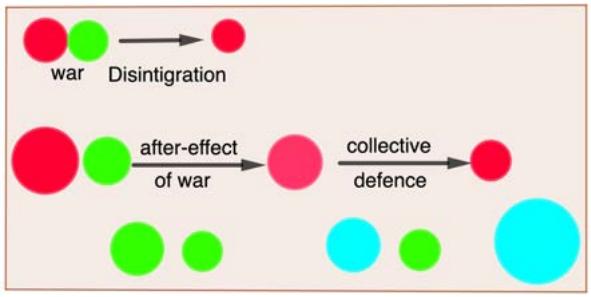
As schematically shown in Fig. 1, we construct a prototype of an empire with a circular territory and a number of powerful provinces (PPs) or the centres of military powers of different sizes that are evenly distributed across the kingdom. The core or the central state of the empire is occupied by the emperor (or the empress) who politically controls over its inhabitants, military, economy, and culture. The emperor is heavily fortified either by the strong military forces or by the seemingly impenetrable provinces so that the attacks of any strategic invasion can be evaded. It is the size of the evenly distributed PP's that determine the military strength of the empire. The invaders are also represented by a circular domain (the red circle in Fig. 1). As soon as the dynamics begins, the invaders pierce the territory at any arbitrary point. They start expanding and proceeding towards the emperor with an aim to capture the emperor by defeating the PPs through warfare. The expansion and advancement of the invaders are assumed to take place at a constant rate, which in turn determines their strength. During this process, the invading domain encounters the nearby PPs and each such interaction is considered to be a vicious war. The outcome of the war is simply assumed to depend on the sizes of the domains at the point of their interaction. If the size of the invading domain $(r_i)$ is smaller than that of the PP $(r_p)$ at the point of interaction, the invaders will be destroyed and the process stops. If $r_i > r_p$, the PP will be annihilated and the invading domain would suffer the casualty [Fig. 2(a)]. Due to the after-effect of war, the invading domain would start shrinking in size at a constant rate to an extent $r_i - \varepsilon r_p$ where the fairness parameter of warfare, $\varepsilon$, usually lies in the range $0 \leqslant \varepsilon \leqslant 1$ [16, 17]. We simply assume here each and every single war as a vicious one and, accordingly, we set $\varepsilon = 1$ throughout our simulation. The after-war effect prevails until the size of the invading domain reduces to $r_i - \varepsilon r_p$ in discrete time steps. Once the shrinking is over, the domain would again start expanding and proceeding towards the emperor at the same rate as before. The defensive strategy of the empire is such that, as soon as one of the PPs falls victim to invasion, it sends a message to its nearest PPs that lie within a certain minimum radial distance. The PPs that receive the message (represented by the color cyan in our simulation), would start expanding and coalescing among themselves for collective defence [Fig. 2(a)]. The expansion and coalescence of the PPs take place at a predefined constant rate. Relative to the expansion rate of PPs, the expansion rate of the invaders determine whether the invaders are faster or slower. If invaders approach at a faster rate, then there is a high chance to destroy the nearby PPs before the
PPs start coalescing. On the move, if the invaders are able to attack the emperor, the emperor would immediately declare a high alert in the kingdom for collective defence [Fig. 2(b)]. To enhance their military power, the remaining PPs at once will start expanding and coalescing among each other. As the expansion persists, a PP would either coalesce with other nearby PPs or engage himself in a vicious war with the invaders. The process would continue until the invaders get destroyed or all the PPs are invaded. The dynamical evolution of the empire in a single invasion following the above-mentioned rules can be visualised from the supplementary video that is generated from our simulation run.
(a)
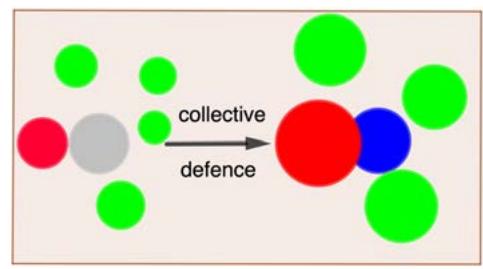
(b) Figure 2: (Color online) Sociophysical rules during the process of invasion. (a) The moment the invaders (red in color) interact with a PP (green in color), the smaller domain disintegrates and the surviving domain suffers after-effect of war. During such an interaction, the PP that falls victim to invasion, sends an alert message to its nearest PP (cyan in color) for collective defence (b) The moment the invaders attack the emperor, the emperor changes its color from grey to blue and initiates the expansion and coalescence among the remaining PPs.
## III. RESULTS AND DISCUSSIONS
For the simulation of the entire dynamics, we construct a circular territory of the empire with radius $R = 50$ units. The emperor is represented by a grey circular domain of radius $r_c = 10$ units and it lies at the centre of the empire. The PPs are assigned random sizes with their radii lying in the range $3 \leqslant r_{\mathrm{p}} \leqslant 5$. They are distributed in such a way that their centres lie in the belt $20 \leqslant r_b \leqslant 40$ that surround the emperor. At the onset of the dynamics, the invaders of size $r_i = 1$ unit appears at any arbitrary point on the empire's territory; it then pierces the territory and starts expanding (the radius increases linearly with time). At the same time, the centre of the invading domain also starts advancing towards the emperor at the same rate. To quantify the probabilistic outcomes in terms of invaders' strength, we perform the simulation with different relative strengths of the invaders. Since we assume for simplicity that the military strength is proportional to the domain size, the relative strength of the invaders is determined by their expansion and advancing rates in comparison to that of PPs. Accordingly, we choose different expansion rates of the invaders' and assume their advancing rate same as the expansion rate. By assigning the expansion rate of PPs as $f_{\mathrm{gp}} = 0.5$ units, the relative strength of the invader's are considered as slower and higher based on whether their rate of expansion $f_{\mathrm{gi}} \leqslant 0.5$ and $f_{\mathrm{gi}} \geqslant 0.5$.
(a)
(b)
(c)
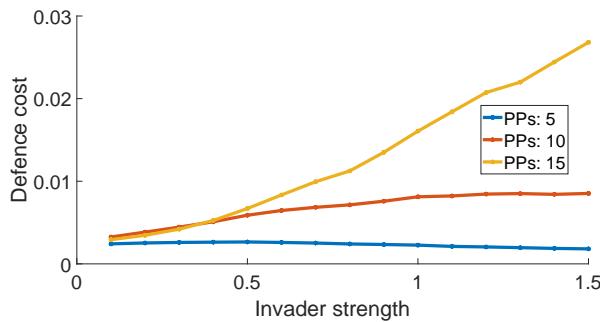
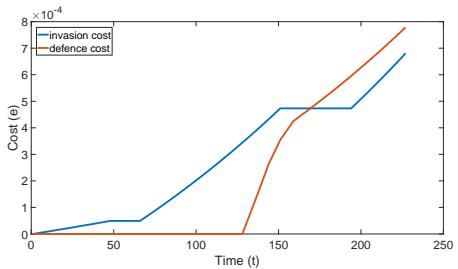
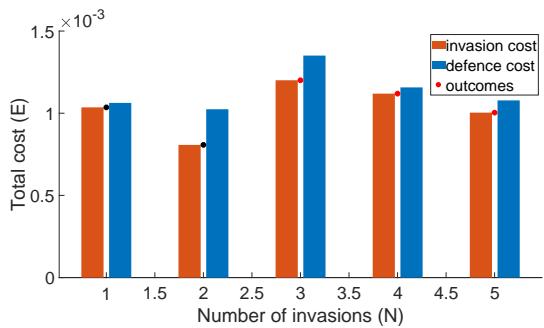
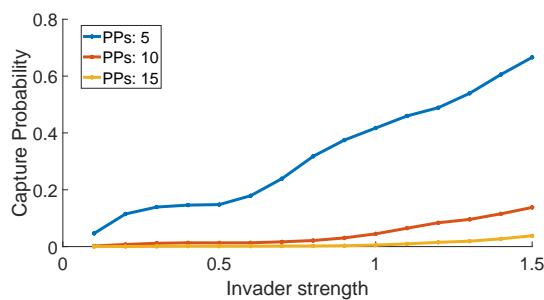
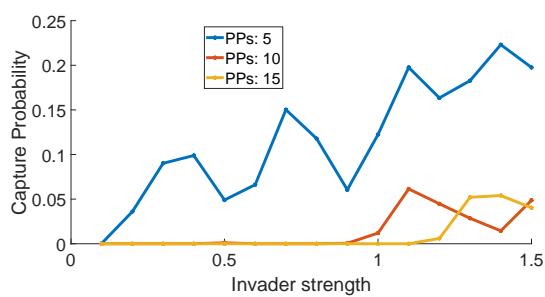
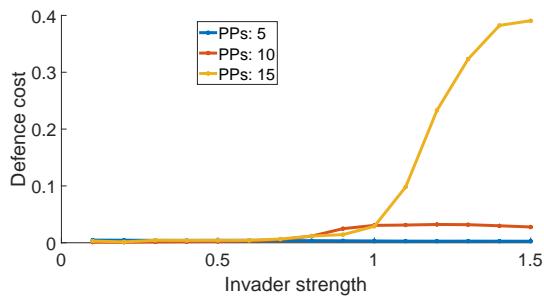
(d) Figure 3: (Color online) Simulation results for varying strength of invaders and varying configuration of the empires. (a) a typical cost profile both for the invaders and for the empire in a single invasion (b) a typical variation of total costs in five consecutive invasions. The outcomes of each invasion are shown as the victory of either the empire (indicated by the small red circles on the top right corners of the orange bars) or the invaders (small black circles) (c) the variation of capture probability with invader's strength in the empires comprising $n = 5$, 10, 15 PPs as indicated in the legend (d) the corresponding variation of the average defence costs As we are interested in the outcomes in terms of the invader's capture probability, $Pc$, we run our simulation for an exceptionally large number of invasions, namely, for $N = 50$; 000 to obtain a stable value for $Pc$. Since we assume the military strength is proportional to the domain size, the expansion of any PP incurs a defence cost while the expansion of the invaders incurs an invasion cost. Thus, we assign a cost proportional to the area covered by a domain during its expansion and, accordingly, for each run, we compute the outcome as well as the defence and invasion costs. Fig. 3(a) displays the cost profiles that are obtained in a typical event. From the defence cost incurred by the empire in a single event, we estimate the total defence cost and, similarly the total invasion cost for the invaders. Figs. 3(b) display the results for five random invasions over the empire comprising $n = 5$ PPs. The outcomes of each event are indicated by small circles at the top right corner of the orange bars; a red circle represents the victory of the empire while a black circle represents the victory of the invaders. Out of $N = 50$, 000 such simulation runs for each strength of the invaders, we compute the number of events $n_c$ in which invaders capture the empire. This allows us to calculate the capture probability $P_{c} = n_{c} / N$. The profiles of $P_{c}$ that are obtained for the empires with different number of PPs, namely $n = 5,10,15$, are displayed in Fig. 3(c). The corresponding average defence costs incurred by the empire for invaders of different strength are also shown in Fig. 3(d).
From the graphical plots of Fig. 3(c), one can see that the capture probability increases with increasing strength $(f_{\mathrm{gi}})$ of the invaders. However, an empire with increasing number density of PPs remains impregnable for slow (weak) invaders $(f_{\mathrm{gi}} < 0.5)$. Even if the invaders are moderately strong $(0.5 \leqslant f_{\mathrm{gi}} < 1.0)$, such an empire remains nearly invincible because the capture probability is negligibly small. However, if the invaders are intensely strong $(f_{\mathrm{gi}} > 1.0)$, the capture probability increases. On the other hand, an empire with a small number of PPs remains vulnerable even for weak invaders. At the small time, if we look at the economy in terms of the defence costs, we see from Fig. 3(d) that the empire with a small number of PPs always incurs a very less amount of defence cost and it remain nearly constant irrespective of the strength of the invaders. In the empire with $n = 15$ PPs, the defence costs increases with increasing strength of the invaders. All these results visualise us a rough picture as to how the increasing density of PPs affect the outcomes. It suggests that while an empire with increasing number density of PPs remains nearly invulnerable for invaders of any strength, it is difficult to withstand the extremely strong invaders with such a simple defence strategy.
To see how the invader's strength as well as the internal distribution of PPs affect the outcome, we run the simulation over a set of fixed empire whose internal maps remain constant for a fixed number of PPs. Unlike the previous case, here we do not consider a random distribution of PPs for each run; instead we construct a constant map with a particular $n$ number of PPs (say, for $n = 5$ ) and we distribute them within a circular belt of radii $20 \leqslant r_{\mathrm{b}} \leqslant 40$ around the emperor in such a way that each PP lies within the angle $\theta = 360^{\circ} / n$. For a particular $n$, we construct five different maps and then perform $N = 50,000$ number of runs on each empire and for each particular strength of the invaders. This way, we perform the simulations on different empires with different strength of invaders and compute the corresponding capture probability. The results are graphically displayed in Fig. 4.
(a)
(b)
(c)
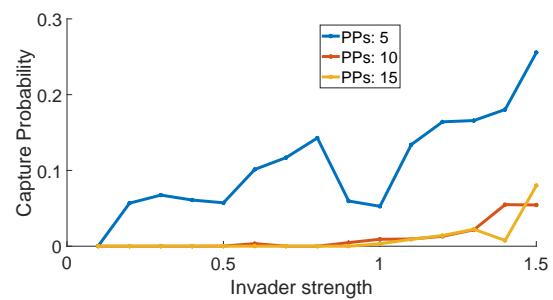
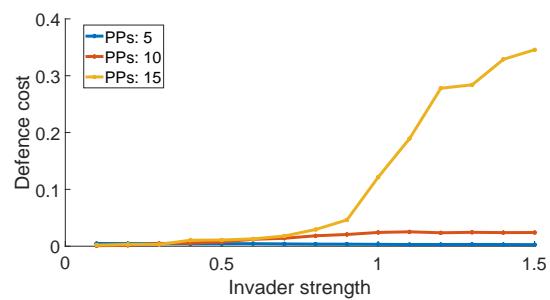
(d) Figure 4: Simulation results for the empires with constant maps. The variation of invader's capture probability and average defence costs are displayed for two different configurations: (a), (b) correspond to the empires where PPs are distributed in a narrow belt $20 \leqslant r_{\mathrm{b}} \leqslant 40$ while (c), (d) correspond to a relatively wider distribution of PPs in the belt $15 \leqslant r_{\mathrm{b}} \leqslant 45$.
As one can see from the plots of Fig. 4(a), for the empire with $n = 5$ PPs, the variation of Pc with the strength of the invaders significantly differs from that of the previous one. How the distribution of PPs affects the outcome can also be seen from a comparison of the plots given in Figs. 4(a) and (c). It indicates that a small empire with a wider distribution of its PPs remains more irresistible than that of a narrow distribution. Empires with such a configuration cannot be easily captured just by enhancing the invader's strength.
This type of anomalous behavior, in fact, signifies how the competition and cooperation conspire together in more realistic problems of similar kind and germinate indeterminism as one of the inherent characteristics of such systems. This is, however, not a surprise because, as far as war is concerned, nonlinearity and unpredictability are fundamental, enduring elements [18] and it seems that, the sociophysical rules that are embedded in our model, engender the nonlinearity and unpredictability through the distribution of PPs. Apparently, the degree of complexity lies on how enormously one can arrange the PPs within the kingdom, simply because the consequences of wars in our model depend on both the sizes and positions of PPs on the empire.
From the plots of the defence costs [Figs. 4(b) and (d)], one can visualize that the empire with $n = 15$ PPs incurs a relatively higher defence costs against stronger invaders than that of $n = 10$, but still both of the empires have nearly the same probability of winning victory against moderately strong invaders. It is true that the defence costs together with the maintenance costs in a real empire will increase with increasing number of PPs. Thus, to sustain a balance between the economy and the survivability, the empire needs to design an optimal defensive structure so that the empire can withstand the invaders at minimal defence costs. To visualize a way as to how the layout of such an optimal defensive structure can be designed, we construct two empires comprising $n = 5$ and $n = 10$ PPs having their sizes $3 \leqslant r_p \leqslant 8$ and distribute them over constant maps. Performing simulations on these two maps, we find that the empire with $n = 5$ remains more irresistible as indicated by its very low values of invader's capture probability [Fig. 5(a)] than that of the previous one [Fig. 4(a)]. Further, the variation of Pc with the invader's strength exhibits an anomalous behavior and indicates that the empire remains impregnable even for the intensely strong invaders (fgi = 1:5). The empire with $n = 10$ PPs, on the other hand, remains always impregnable irrespective of the strength of the invaders. One can also see from Fig. 5(b) that the empire with $n = 10$ incurs no defence cost for resisting the invaders. This is simply because the PPs lies more or less in the vicinity of the territory and, as they are comparatively bigger in size, they almost occupy the entire territorial region, thereby quickly destroy the invaders in a single war. In contrast to this, the empire with $n = 5$ PPs incurs a finite but nearly constant amount of defence costs. All these realise us a scenario as to how the great empires of antiquity withstood the foreign invaders of any strength. What is more is the impregnability of the small empires who, with a limited amount of military powers and with a limited amount of defence costs, could resist the invaders of any strength (the very low value of capture probability) if each PP have a considerable amount of military power (determined by their size) and if they lie close to the territory.
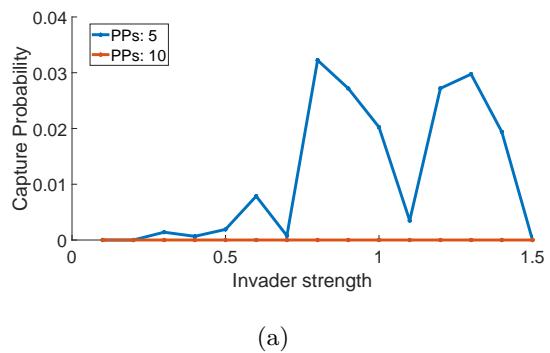
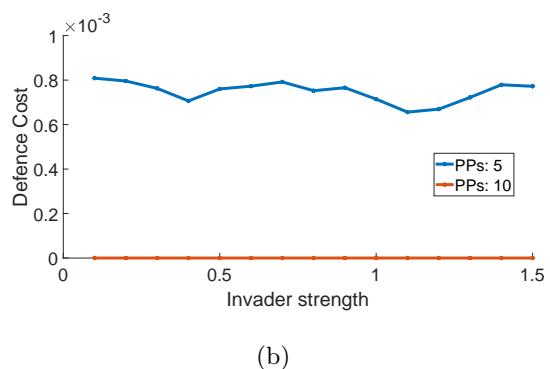 Figure 5: The results on optimal con_gurations comprising
$n = 5$ and $n = 10$ PPs. The variation of invader's capture probability and average defence costs are displayed for two different configurations: (a) and (b) correspond to the empires where PPs are distributed in a narrow belt $20 \leqslant r_{\mathrm{b}} \leqslant 40$ while (c) and (d) correspond to a relatively wider distribution of PPs in the belt $15 \leqslant r_{\mathrm{b}} \leqslant 45$.
## IV. CONCLUDING REMARKS
We have shown here how the dynamics of sudden invasion on empires can be understood by constructing a simple model that considers the centrally organised system as a playground of a handful of sociophysical processes being triggered by foreign invasion. Under the action of invasion of varying strength, we have visualized how the tangled web of all processes leads to a vibrant dynamics and gives rise to nonlinearity and unpredictability. Although we have shown through our model how the rise and fall of ancient empires could be quantified as the probabilistic outcomes of short-time invasion process, similar model practices and in-silico experiments would equally be applicable for other similar systems of our biosphere where competing interaction among different species leads to diversity and where construction of a simple theory by taking into account the relevant sociophysical processes is cumbersome. Strictly speaking, we have simply shown here how, instead of constructing a concrete theory, one could proceed and design in-silico experiments to visualize the probabilistic outcomes as an emergent of interaction and competition governed by sociophysical rules. There are, indeed, many subtleties in the construction of both the defence and the invasion strategies. The coordination among the military powers, tactics of warfare, invasion through deception, maintenance of hidden military powers are some of the important factors that needs to be considered seriously in more realistic strategies. We hope our work would inspire researchers from diverse backgrounds to apply a similar approach in exploring processes and consequences of social phenomena that are inherently unpredictable by analytical means.
Declaration of interests
The authors declare that there is no known competing financial interests or personal relationships that could have appeared to influence the work reported in this paper.
Generating HTML Viewer...
References
18 Cites in Article
Guillermo Algaze (2008). Ancient Mesopotamia at the Dawn of Civilization.
E Gibbon (1932). Edward Gibbon: The Historian of the Roman Empire.
P Heather (2006). The Fall of the Roman Empire: A New History of Rome and the Barbarians.
I Edwards (1971). The Cambridge Ancient History. Part 2: Early History of the Middle East, volume I.
I Edwards (1973). The Cambridge Ancient History. Part 1: The Middle East and the Aegean Region, volume II.
J Kenoyer (1998). Ancient Cities of the Indus Valley Civilization.
R Thapar Early India: From the Origins to AD 1300.
W Durant (1935). The Story of Civilization: Our Oriental Heritage.
C Quigley (1979). The Evolution of Civilizations.
N Yoffee (1979). The decline and rise of mesopotamian civilization: an ethno-archaeological perspective on the evolution of social complexity.
F Braudel (1987). A History of Civilizations.
J Keegan (1993). A History of Warfare.
Azar Gat (2006). War in Human Civilization.
K Bongo (2008). CHAPTER IV. THE PROTO-EGYPTIANS.
I Morris,W Scheidel (2009). The dynamics of ancient empires.
I Ispolatov,P Krapivsky,S Redner (1996). War: The dynamics of vicious civilizations.
Dhritiman Talukdar,Kishore Dutta (2019). Impact of wars on the evolution of civilizations.
Alan Beyerchen (1992). Clausewitz, Nonlinearity, and the Unpredictability of War.
No ethics committee approval was required for this article type.
Data Availability
Not applicable for this article.
How to Cite This Article
Kishore Dutta. 2026. \u201cCompetition and Cooperation in the Dynamics of Imperial Invasion: A Strategic Model\u201d. Global Journal of Science Frontier Research - A: Physics & Space Science GJSFR-A Volume 22 (GJSFR Volume 22 Issue A4): .
Explore published articles in an immersive Augmented Reality environment. Our platform converts research papers into interactive 3D books, allowing readers to view and interact with content using AR and VR compatible devices.
Your published article is automatically converted into a realistic 3D book. Flip through pages and read research papers in a more engaging and interactive format.
In the evolution of every great empire of antiquity, the process of invasion was so inextricably interwoven that even the most powerful empire was incapable of escaping its barbarizing effect. A sudden invasion imposed major perturbation to a massive, centrallyorganised system within a relatively shorter period and became a long-lasting destabilizing factor that brought drastic changes in the productivity, economy, man-power, and social order of the system. In order to understand such a vibrant dynamics as an interplay between competition and cooperation, here we show how a simple prototype can be constructed by taking into account some of the essential sociophysical processes in their simplest settings. The simulation of the model visualizes how the outcomes depend on factors such as the strength of the invaders, defensive manoeuvre of the empire and its internal configuration.
Our website is actively being updated, and changes may occur frequently. Please clear your browser cache if needed. For feedback or error reporting, please email [email protected]
Thank you for connecting with us. We will respond to you shortly.