A fast-falling chain of beads from a raised container could form a fountain-like hoisted arch in the air. This so-called chain fountain phenomenon has baffled the public and the scientific community for almost a decade since it was first demonstrated by Steve Mould in 2013 and has attracted worldwide attention through rampant media broadcasting. However, its quirky behavior has led to erroneous explanations from the researchers as attested by all the relevant publications so far, mainly owing to its sensitive dependence upon the temporal variations of key variables due to the highly nonlinear dynamic nature of the motion. In this paper, by ignoring the irregularity of the movement caused by the layout of the chain in the container, a complete set of the governing nonlinear differential equations are derived, based on which the mechanism of the chain fountain is analyzed, and the acquired knowledge is further extended to discuss more general phenomena in nature and human world.
## I. THE BRIEF BACKGROUND
In 2013, science presenter Steve Mould first demonstrated in his video the phenomenon of the so-called chain fountain (Wikipedia [1], Mould 2021a[2], b[3], c[4]), during which a long chain of metal beads with rigid links would rise above the containing jar before it rapidly falls down. The higher the jar containing the chain is placed above the ground, the higher the chain will rise. Accordingly, this phenomenon is named after its discoverer as Mould Effect. Since then, this phenomenon has attracted extensive attention around the world, especially in the scientific community, and quite a few academic papers (Anghel 2020[5], Biggins and Warner 2014[6], Cambridge 2014[7], Flekkoy et al 2018[8], Gibney 2014[9], Pantaleone 2017[10]) and multimedia documents (The Royal Society 2014[11]) have been devoted to this phenomenon, unfortunately, with some fundamental mistakes.
## II. THE DYNAMICS
Although the chain fountain is counterintuitive to our common everyday experiences, people might still be tempted to assume that the dynamic cause of it is simply intuitive, as the abovementioned researchers have claimed or indicated; nevertheless, if we delve into the minute details of the motion, we might find that the dynamics of the chain fountain is difficultly simple in the sense that there is no complicated mechanisms or unknown forces involved while the real cause for the phenomenon is obscurely hard to determine, which calls for meticulous examination of all the subtleties behind the ostensible features. So we will start our discussion in the rest of this writing with the analysis of the main characteristics of the motion based on its controlling factors (forces), and then move on to the dynamic analysis.
### a) Two Main Characteristics
There are two main characteristics of the chain fountain motion which are important for analyzing the dynamics of the motion, the first is the obvious and basic one, i.e. the rising "fountain" above the surface of the chain holder, and the second is not as obvious as the first one but also observable with careful observation, which (at least in the speed range of all the reported chain fountain experiments) is the acceleration of the motion that is much lower than the gravitational acceleration of a vertical dropping chain. Because of the second characteristics, the chain fountain has been assumed to move in a constant speed by the researchers (Anghel 2020 [5], Biggins and Warner 2014 [6], Cambridge 2014 [7], Flekkoy et al 2018 [8], Mould 2021c [4]).
These two characteristics are of crucial importance for analyzing the dynamics of chain fountain.
### b) Controlling Factors
While in multiple cases as shown in his videos, Mould (2021b,c [3,4]) uses a spooler to drive the chain fountain, in this writing, we will not consider the mechanically aided chain fountain. Nevertheless, the primary mechanism revealed in this writing would also apply to the more general cases as Mould demonstrated which will become clear at the end of this writing.
When naturally moving in an open space, the chain fountain would be impacted by multiple factors and some of them would play the controlling roles. The foremost one would undoubtedly be the gravitational pulling power that provides all the energy input after the motion is instigated. The second controlling factor is the holding force from the unmoved part of the chain in the container (we would call it the payload to the moving part of the chain). The dynamically achieved balance between these two controlling factors is the primary mechanism for creating the chain fountain.
In addition to those two primary controlling factors, there is another critically important temporary controlling factor, which is also the second energy source for the chain fountain. That is the initial boost of manpower when the human hand pulls the head of the chain into the air below the rim of the container. This initial boost, together with gravity, is important for the chain to acquire the initial momentum. The initial momentum would enable the chain to overcome all potential resistances, including the possible resistance from the rim of the container so that the chain could be bounced up into the air to form an arch over the rim (in case the initial boost itself did not create that arch), which is the critical condition for the chain fountain to form.
## i. The influence of air
Air plays a sensitive role to the chain fountain. A relevant parameter is the relative inertia of the chain over the inertia of air. Although the dynamic balance between gravity and the payload of chain in the container would control the chain fountain phenomenon, when the ratio of the chain inertia over the air inertia is low, the impact of air might dominate and thus the fountain might not be able to form, as evinced by the contrast between the falling chain of polymer beads (Spangler 2009[12], Mould 2021a [2]) and the springing chain of metal beads (e.g. Mould 2021a,b,c [2-4]). Given the resemblance of the shapes of those two different kinds of chains of beads, the contrast between their behaviors would automatically point to the ratio of the inertia of the chain over the inertia of air.
But on the other hand, once the inertia of the chain dominates over the inertia of air, the dynamically balanced effect of gravity over the payload of the unmoved part of the chain would dominate the movement of the chain that leaves the container and the fountain would form for a certain range of favored conditions.
### c) Dynamic Analysis
In the published videos, we might see that the initiations of the fountain are in general quite complicated, depending on the initial boosting speed by the human hand as well as the layout of the chain within the container. The chain might not always move at the boosting speed of the human hand. It could experience an acceleration period after the motion starts, or even a little deceleration, or pretty much stay with a constant speed from the beginning. The pattern of the growth and dying out of the fountain also varies when the initial condition and the layout condition change.
In this analysis, we will focus on the dynamic balance between the gravitational pull and the resistance of the unmoved part of the chain in the container (the payload to the moving chain), by ignoring the air drag and assuming that the chain has already formed an arch across the rim after the motion is instigated.
To further simplify our analysis, we will ignore the impact of the irregularity in the layout of the chain in the container, and thus reasonably assume that the motion would take a regular shape as shown in Fig 1, where the length of the upward moving part of the chain is $I_{u}$, of the downward part is $I_{d}$, and of the arch is $I_{a}$; the shadowed gray area symbolizes the part of the chain that has not been pulled up, i.e. the payload that the moving part needs to pick up, and $h$ is the height of the surface of the pile of chain above the bottom of the container; accordingly, $T_{p}$ symbolizes the tension between the moving part and the payload part, $T_{au}$ is the tension between the rising part and the arching part, and $T_{ad}$ is the tension between the arching part and the vertically dropping part; the whole chain is pulled down to the ground by gravity $G$ at a velocity $V$.
Since we assume that the arch has formed across the rim and ignore the air drag, the only forces acting on the moving part of the chain will be gravity and the tension (as denoted by $T_{\rho}$ in the schematic) from the unmoved payload part. While gravity is relatively simple in nature, the tension $T_{\rho}$ from the payload is most intriguing to our analysis. Although in the existing publications, same as in Fig 1, the interaction between the moving part and the unmoved part of the chain is usually conceptualized as a force acting (and counteracting) at one geometrical point, in fact, in the process of the motion, especially in the initial stage when the chain starts to move at the boost of a human hand, the transition from the moving part and the unmoved part, and accordingly the interaction between those two parts, is more complex than a single point, which would not only account for the complicated irregularities of the motion as we see in the videos but also relate to how the tension $T_{\rho}$ would dynamically affect the formation and growth of the fountain.
Philosophically speaking, the most important thing about $T_{\rho}$ is not how strong it is pulling the moving part back or how strong its counteracting force is pulling the unmoved part up, but instead, is how loose the pile of the unmoved part of the chain is and thus how easy it could be pulled up. The degree of the looseness accounts for the capacity to balance the increase of the pulling power, which is critical for the formation and growth of the fountain. If the unmoved pile is too loose, the gravitational pull on the falling part would be overwhelmingly dominating and the fountain would not occur; if the unmoved pile is too sticky, the dragging pull from the unmoved pile would take control and the fountain would not form either or would die out quickly after the initial boost; only when the looseness of the unmoved pile falls into a favorable range the fountain could be formed, maintained and growing. Considering that the chain speed stays almost unvaried as reported, the very bead that is picked up would experience a peculiar transition from a sudden acceleration to almost nil acceleration, which indicates that even during the period when this bead is still pulled to accelerate, the pulling back on this bead by the next one behind it would already start to increase; once this bead overcomes the friction from other neighboring beads as well as the pulling back of the next one behind it and picks up the upward speed $V$, the only forces acting on it would be gravity, the upward pulling tension, and the downward pulling tension. After the fountain is formed, as long as the tension $T_{p}$ from the bead that just picks up the upward speed $V$ upon the rest of the chain stays stable, the height of the fountain would constantly grow. Once $T_{p}$ starts to drop down for whatever reasons (e.g. the motion reaches to the very last layer of the beads in the container), the height of the fountain would start to decrease as shown in the videos.
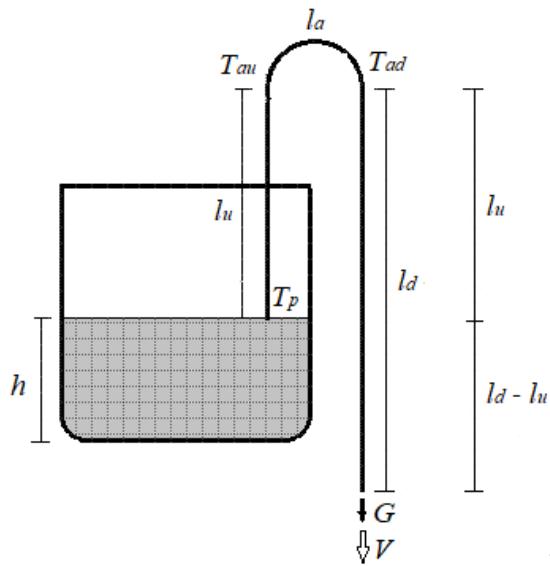 Fig. 1: Schematic of the fully developed growing fountain
## i. The mathematics behind the chain fountain
By ignoring the irregularity of the motion and assuming a regular shape of motion as illustrated in Fig 1, and ignoring air drag, from the energy conservation and Newton's laws, we might write down a set of equations to model the dynamic relationship for the chain fountain as follows:
$$
\rho\left(I_{u}+I_{d}+I_{a}\right)\frac{dV}{dt}+\rho\left(I_{u}-I_{d}\right)g+T_{\rho}=0
$$
$$
2\left(I_{u}+I_{d}+I_{a}\right)\frac{dV}{dt}+V\frac{d}{dt}\left(I_{u}+I_{d}+I_{a}\right)=2g\left(I_{d}-I_{u}\right)\quad(2)
$$
$$
\frac{d}{dt}\left(I_{d}-I_{u}\right)-\frac{dh}{dt}=V
$$
$$
\frac {d h}{d t} \approx - \frac {1}{n} \frac {d}{d t} \left(I _ {u} + I _ {d} + I _ {a}\right) \tag {4}
$$
$$
\rho I_{a} \frac{dV}{dt} + T_{au} - T_{ad} = 0
$$
$$
\rho I_{d} \frac{dV}{dt} - \rho g I_{d} + T_{ad} = 0
$$
$$
\pi\rho V^{2} - \rho g l_{a} - \pi\left(T_{au} + T_{ad}\right) = \rho\frac{d}{dt}\left(\frac{d}{dt} l_{a}\right)
$$
where $g$ is the well-known gravitational acceleration, and $n = \frac{R^2}{r}$, $R$ is the radius of the container, and $r$ is the radius of each bead.
Obviously, due to the complication of the tension between the payload and the moving chain, we might need to add one more equation by assuming the behavior of $T_{p}$. However, even if we do so, we would still face a set of highly nonlinear differential equations.
In the existing publications, researchers normally assume a so-called steady motion, i.e. omit the time dependency of certain variables, which would greatly reduce the mathematical difficulty, but in the meantime they would also miss the subtle and critical impact of those variations upon the whole dynamics as will be discussed below and thus would miss the dynamic view of how the fountain would grow.
In this writing, we use the above set of nonlinear equations only to help us to appreciate the sensitive complication of the relationship between the involved variables and assist our qualitative (metaphysical) analysis without solving the above equations.
## ii. The myth of the hidden extra kick-off force from the bottom
Mould (2021 a,b,c [2-4]) and some other researchers (Biggins and Warner 2014 [6]; Pantaleone 2017 [10]) have a strong faith in the kick-off effect by some force from the bottom of the container that would somehow lift the chain up to form the fountain, which is obviously implausible since it is in conflict to the natural law.
As we know, when being impulsively impacted the bouncing back effect would be weaker than the impacting momentum due to the damping effect (e.g. when throwing a ball into a puddle of mud, it would not be bounced); therefore, to support a momentum of $mV$, with $m$ being the mass of a bead and $V$ being the velocity of the chain, we need a momentum greater than $mV$. According to the literature, the speed $V$ would be at the order of $10m/s$ or even greater (as attested in the videos), which tells that we need a bead to hit the pile of chain or the container at that level of speed to acquire a bouncing back momentum to support the fountain, obviously we don't see that kind of impact in any of the videos.
Further, for the bouncing back force from the bottom to be transferred to the top of the fountain so that it could grow, we need to have collisions between the beads from the bottom all the way up to the top of the fountain, but even in the mathematical modeling of the proponent of the kick-off force mechanism (Biggins and Warner 2014 [6]), the internal force in the upward moving vertical part of the chain is treated as tensile instead of the colliding pressure between the beads.
The kick-off theory has been challenged by other researchers (Anghel 2020 [5], Flekkoy et al 2018 [8]) as well. Nevertheless, their treatment of the chain fountain as a steady (or even stationary) motion causes them to miss the real mechanism of the chain fountain as will be discussed in the next section.
## iii. The sensitive role of the time-dependent terms
The highly nonlinear mathematical relationship has hindered the efforts from all the previous researchers to obtain a satisfactory mathematical solution to convincingly account for the dynamics of the chain fountain so far. An obvious common defect of the reported mathematical modeling (Anghel 2020 [5], Biggins and Warner 2014 [6], Flekkoy et al 2018 [8]) is their assumption of the steady (or even stationary) state of the motion, which is equivalent to assuming both $\frac{d\boldsymbol{l}\boldsymbol{a}}{dt}$ and $\frac{dV}{dt}$ in the above set of equations to be nil. Although it seems that the variations of those physical quantities are quite mild during most part of any of the chain fountain demonstrations, the complete omission of the time dependency of those quantities could create logical conflict. The reason is as follows.
When the chain fountain is in a steady state, assume $n$ is large, from the above set of equations we would have the following:
$$
T_{\rho} = \rho g (l_{d} - l_{u})
$$
$$
2\left(\frac{d}{dt}I_{d}\right)=V+2g\left(I_{d}-I_{u}\right)/V\quad\left(2^{ ext{'}},3^{ ext{'}},4^{ ext{'}}\right)
$$
$$
T_{au}=T_{ad}=\rho g l_{d}
$$
$$
\pi \rho V ^ {2} - \rho g I _ {a} = \pi \left(T _ {a u} + T _ {a d}\right) \tag {7'}
$$
Here the biggest trouble is (1'). Since $I_{\sigma^{-}}I_{u}$ would continue to increase all the way to the end (if the chain is infinitely long, the $I_{\sigma^{-}}I_{u}$ would grow infinitely), the pulling force $T_{\rho}$ between the upward moving part of the chain and the payload will constantly increase according to (1'). This would entail a constant increase in the momentum picked up by the bead that starts to move from rest, and this would further entail an accelerating upward movement of the chain, which would conflict with the assumption of a steady motion, although it might apparently support the kick-off theory with an constant upward propagating longitudinal wave (which would violate the natural law and thus never appeared in all the videos).
In the meantime, for a constant $V$, as more of the chain drops below the container, $2g(I_d - I_u) / V$ in $(2',3',4')$ would continue to increase, and this would indicate an accelerated dropping of the chain (and thus an increased $V$ ), which does not seem to happen in the videos and thus it indicates that the growth of the fountain would also cancel out the accelerated increase of $I_d$.
Therefore, in order to correctly account for the dynamics of the chain fountain, we cannot just simply assume that the movement is in a steady state even if the acceleration might appear to be very small compared to the gravitational acceleration $g$ for a free falling. This is because the time-dependent terms, no matter how small they might be, would play a sensitively critical role in the development of the fountain.
## III. CONCLUSION AND FINAL REMARKS
The famous chain fountain that has baffled the public and the scientific community for nearly a decade is pictorially simple but dynamically obscure in a very sensitive way. Its apparently unchanging speed during most of the motion in all the reported experiments so far has been misleading the researchers to ignore the dependence of the fountain upon sensitive temporal variations. The logical fault in equations (1') to (7') resulting from the elimination of the time derivatives of the chain speed and the size of the arch as discussed above in fact points to a process of subtly sensitive adjustment of both the height of the fountain and the speed of the chain, through which (the tendency of) the increase of the tension $T_{p}$ between the upward moving part and the unmoved payload would be soon dissolved by the minute acceleration of the upward moving part itself due to the increased pull from the increased momentum of the downward part, which ends up with some minute growth of the fountain, and as an exchange, the speed returns to pretty much the same as before since the increased height (and thus weight) of fountain would cancel the added acceleration of the upward moving part and also offset the increase in the tension $T_{p}$ between the upward moving part of the chain and the unmoved payload. When the motion is near its end, i.e. the moving part of the chain touches the bottom of the container, due to the reduction in the resistance of the payload to the upward pulling force, the fountain would in fact shrink instead of intuitively supposed growing further according to (1'), due to the less effort needed for the downward moving part to bring down the height of the fountain.
In fact, the whole chain fountain phenomenon is an excellent example of how nature would automatically find the most favorable way to release its potential energy. First, without the arching across the rim of the container, the movement of the chain would dissipate more energy due to the bumpy course caused by the collision between the beads and the rim, which indeed would create more entropy with less kinetic energy transferred from the original potential energy of the beads. Accordingly, when the downward moving momentum reaches certain amount, the bumpy interaction of the beads with the rim would bounce the chain up into the air to form the arch;
Second, after the arching appears (which would cause the resistance to drop down suddenly), the chain would not fall back to the bumpy course of movement and the arch would grow, which tells that the bounce-up triggered by the bumpy collision is not the only cause to push the chain up into the air, there is more profound dynamic reason behind the formation of the arch; Third, if the chain is not initially placed in a container but rather on a smooth table, and the chain is not very long, then there would be no fountain, as shown by Mould (2021b [3]), although when the roughness of the table and the length of the chain reach certain values, another type of arching would appear as discussed by Hanna & Santangelo (2012 $\left[{ }^{13}\right]$ ). On the other hand, if the chain is nailed to the bottom of the container somewhere in its middle, then even after the arching is formed it will die out quickly once the uprising point moves close to that fixed point. Therefore, only when the resistance to the movement of the chain is mildly great would the arching stay and grow.
Fourth, as mentioned earlier, the growth of the fountain provides a mechanism to avoid an overwhelmed increase of the pulling tension between the upward moving beads and the unmoved payload. In fact, the upward pulling tension on the payload could also be alleviated by an acceleration of the chain, which would have indeed quickly happened from time to time at the very beginning and during the motion when there is still some space for the beads to relax in the neighborhood of the pile of the chain, as long as the tension in the chain has not yet reached its tolerable maximum. But those moments would be very short if the chain is solidly piled.
As a conclusion, the chain fountain appears and grows as the consequence of the sensitive dynamic balance between the gravitational pulling power on the downward moving part of the chain (boosted by the initial human pull) and the mild resistance of the unmoved pile of the chain in the container, and thus not driven by any other kind of mythical hidden forces. If the resistance in the container is either too high or too small, the fountain would not appear or would die out quickly; besides, if the inertia of the falling chain is too small compared to the inertia of air, the fountain would not appear.
Metaphysically, the chain fountain phenomenon manifests a profound approach of nature to manage energy and entropy to achieve certain principles. The presentations of both Mould and Hanna & Santangelo for two different types of movements of chains on a flat surface, together with the chain fountain phenomenon, reveal an important reason for the arching (and thus the fountain) to occur: when the movement is hindered for some reason, nature could manage to make sensitive dynamic adjustment so that the conflict between the driving cause and the hindering cause might be alleviated so that the movement would continue more smoothly.
In the case of the chain fountain as discussed in this writing, the driving cause is the difference between the lengths of the dropping part and rising part of the chain, which is counteracted by the resistance of the payload in the container; accordingly, nature raises the chain into the air to reduce the magnitude of the driving cause so that the driving cause and the hindrance would be relatively more balanced. Obviously, with the same dropping speed $V$, as the result of the struggle between the gravitational pulling force and the resistance of the payload, the formation and growth of the fountain help to maximize the amount of the chain running out of the container before the whole chain drops onto the ground, compared with the scenario when there would not have been the fountain. This mechanism could be conveniently extended to more complicated fountain cases as demonstrated by Mould (2021b,c [3,4]).
In the case of the arching on the table investigated by Hanna & Santangelo, the arching in the middle could reduce the total friction and slightly increase the speed of the chain. Even with the same total speed, the formation of that arch could speed up the reduction of the size of the original cluster a bit.
### a) A More General Law
Further from the above-discussed arching phenomena in the natural domain, we might even find patterns similar to the chain fountain in the social domain. With different social resistances or social inertias, the social effect of a political or economic drive initiated by the influential agents upon the society might well be beyond the expectations of the initiators. Although the initiating agents might still manage to drive the (human or material) energy to their targeted destinations, it might spawn some severe or even violent side movement (similar to the chain fountain). On the other hand, sometimes, we might wish the chain-fountain-like induced side movement to occur in order to speed up the flow out of a troubled area.
Similar to the mechanism of chain fountain, the side movement in the social domain might not happen if the resistance is too strong (so that the original drive would be completely ignored) or the resistance is too weak, or there is some other colossal restrictive power in the environment (similar to the case when the air drag is overwhelming). The difference is that with the natural chain fountain, the whole chain would finally end up on the ground in general, while in the social domain, the side movement might have a big chance to turn into a game changer and replace the original movement to become the main course. Nevertheless, a good understanding of the mechanism of the chain fountain in the natural domain could assist us to better understand or predict the chain-fountain-like occurrence in the social domain.
With the realistic generality of the mechanism behind the chain-fountain-like phenomena in both the natural and social domains, we actually see a general law which could be stated as: the consequence of the struggle for a dynamic balance between the driving cause of a movement and its resistance could spawn a (violent) side movement, in case the driving cause is neither too weak nor overwhelmingly strong compared with the resistance, plus there is no other dominating environmental factors.
Generating HTML Viewer...
References
13 Cites in Article
Renée Fountain (2007). Conceptual enhancement via textual plurality:.
Steve Mould (2021). World Record Chain Fountain? The Mould Effect Explained.
Steve Mould (2021). This Drill Powered Spool Proves Me Right.
Steve Mould (2021). Coogan, Steve, (born 14 Oct. 1965), actor, writer and producer.
Dragos- Anghel,Victor (2020). Fountain chain or spontaneous pulley -finding the reason behind the chain siphoning.
J Biggins,M Warner (2014). Understanding the chain fountain.
(2014). New explanation proposed for viral chain-of-beads video.
Eirik Flekkøy,Marcel Moura,Knut Måløy (2018). Mechanisms of the Flying Chain Fountain.
Elizabeth Gibney (2014). Physicists explain 'gravity-defying' chain trick.
J Pantaleone (2017). A quantitative analysis of the chain fountain.
(2014). Understanding the chain fountain.
Steve Spangler (2009). Newton's Beads -Cool Science Experiment.
J Hanna,C Santangelo (2012). Slack Dynamics on an Unfurling String.
No ethics committee approval was required for this article type.
Data Availability
Not applicable for this article.
How to Cite This Article
Rongqing Dai. 2026. \u201cThe Dynamics of the Chain Fountain\u201d. Global Journal of Science Frontier Research - A: Physics & Space Science GJSFR-A Volume 22 (GJSFR Volume 22 Issue A8).
Explore published articles in an immersive Augmented Reality environment. Our platform converts research papers into interactive 3D books, allowing readers to view and interact with content using AR and VR compatible devices.
Your published article is automatically converted into a realistic 3D book. Flip through pages and read research papers in a more engaging and interactive format.
Our website is actively being updated, and changes may occur frequently. Please clear your browser cache if needed. For feedback or error reporting, please email [email protected]
Thank you for connecting with us. We will respond to you shortly.