## I. INTRODUCTION
Rice is one of the main contributors to the consumption of inorganic As in humans. That is important in the communities that include a high amount of rice in their diet. As has been classified as a carcinogen class 1 and its toxicity depends on its chemical form. Inorganic As is highly toxic, and the specie pentavalent (V) is more harmful than trivalent (III). The Codex Alimentarius established maximum values of total As and inorganic As in polished rice of $0.3\mathrm{mgkg}^{-1}$ and $0.2\mathrm{mgkg}^{-1}$, respectively (WHO, 2012; WHO, 2019).
On the other hand, current analytical techniques permit quantifying accurately and quickly the concentration of As in rice grain for a more precise diagnosis.
Globally, depending on the constitution of the original material, the contents of total As in uncontaminated soils vary from 0.1 to $40\mathrm{mgkg^{-1}}$ with an average value of 3-4 mg $\mathrm{kg}^{-1}$. Considering the toxic effects, in agricultural soils has been established a maximum guideline values of total As between 10 and $50\mathrm{mgkg^{-1}}$. In soils contaminated with As, have been documented concentrations of this element in rice grain that exceed the limit established by the Codex Alimentarius (Khan, et al., 2010) but there are also situations of non-contaminated soil, where levels of As in grain may exceed the maximum allowed (Norton, et al., 2012).
Although in rice production areas of Argentina values of total As in soils are in the range of 1.4 to 5.6 mg kg $^{-1}$, has been detected levels of total As in polished rice grains that exceed 0.3 mg kg $^{-1}$. A favorable aspect is that rice grown in Entre Rios dominates by organic species (dimethylarsinic acid) and inorganic form is in a low ratio without exceeding the limit value of 0.2 mg kg $^{-1}$ (Quintero, et al., 2014; Oteiza, et al. 2020).
Possible agronomic management practices to reduce absorption and accumulation of As in rice grain are: 1) selection of varieties with reduced absorption and translocation of As to grain (Norton, et al., 2012);2) irrigation management that allowing oxidation of soil in some period of cultive to reduce elution of As, 3) facilitate the formation of poorly soluble compounds by adding Fe or Zn (Das., 2007), 4) inhibit or reduce the absorption of As by roots adding silicates (Si) that compete with the transporters cell wall and 5) minimise phosphate fertilization. The P would favor the release of chemisorbed arsenate and also this element is remobilized from the stems to grains with the same transporters that are used for As. When there is low availability of P, the plant gives priority to the transport of P to the grain over As (Zao, et al 2009).
Considering this background, two field trials were performed in order to establish agronomic practices to reduce concentration of As in the rice grain. The aim of this study was to evaluate the effect of irrigation management and fertilization on the yield of rice and grains As accumulation.
## II. MATERIALS AND METHODS
### a) Experiment 1
During the 2012/13 and 2013/14 seasons, in the localities of Santa María and San Ramon, province of Entre Ríos, Argentina, three field studies was conducted in a split-plot design within the farm field, with three replications. Soils in the sites studied are classified as Vertisols. The main plot was divided by water management in: i) continuous flood irrigation (RC) from the state of 4-leaf crop to maturity, and; ii) continuous flood irrigation interrupted (RI) during the growing season (paddy soil was drained 15 days before panicle differentiation, and was again flooded until maturity). Each subplot was subdivided with the following fertilization treatments at the moment of planting: a) control, without of P and Zn (T); b) fertilization with 200 kg ha $^{-1}$ of calcium triple superphosphate (20% P), equivalent to 40 kg P ha $^{-1}$ (+ P); c) fertilization with Zn, at a rate of 25 kg ha $^{-1}$ ZnSO $_{4}$.7H $_{2}$ O (22% Zn) (+ Zn) and d) fertilization with P and Zn, combining the treatments (+ P) and (+ Zn) (+ P + Zn).
### b) Experiment 2
During the 2011/12 and 2012/13 in the localities of La Paz, San Salvador and Los Conquistadores, province of Entre Rios, Argentina, three field studies were developed in a split plot design in the farm field, with three replications. In the locality of La Paz soil was classified as Mollisol and in the other two sites as Vertisols. The main plot was divided by the addition of As at moment of planting: i) no addition; and ii) addition of As (As +) at a rate of 10 kg ha $^{-1}$ of $\mathrm{NaAsO}_3.7\mathrm{H}_2\mathrm{O}$. Each subplot was subdivided with the following fertilization treatments at moment of planting: a) control, without addition of P or Zn (T); b) fertilization with 200 kg ha $^{-1}$ of calcium triple superphosphate (20% P), equivalent to 40 kg P ha $^{-1}$ (+ P); c) fertilization with Zn, at rate of 25 kg ha $^{-1}$ ZnSO $_4$.7H $_2$ O (22% Zn) (+ Zn) and d) fertilization with P and Zn, combining the treatments (+ P) and (+ Zn) (+ P + Zn). All sites were managed in continuous flood irrigation (RC) from the state 4-leaf crop to maturity and plague control.
The six sites were managed using local farmer practices of nitrogen fertilization, and weeds/pests control. In all cases, the variety of rice sown was long thin indica tipe. The rice seed was sown directly on dry soil. Surface water accumulated in reservoirs was used for irrigation. Flood irrigation was managed with levees, with a water table of $5 - 10\mathrm{cm}$. The main characteristics of the soils that are relevant for these field trips can be seen in table 1.
Table 1: Soi characteristic in the experimental sities
<table><tr><td></td><td>San Ramón 2012</td><td>Santa María 2012</td><td>Santa María 2013</td><td>San Salvador 2011</td><td>La Paz 2012</td><td>Los Conquistadores 2012</td></tr><tr><td>Organic Mater (%)</td><td>3.13</td><td>3.66</td><td>2.38</td><td>2.7</td><td>3.5</td><td>4.7</td></tr><tr><td>pH</td><td>6.66</td><td>6.11</td><td>5.38</td><td>6.8</td><td>5,8</td><td>5.1</td></tr><tr><td>P - Bray(mg kg-1)</td><td>8.3</td><td>17.9</td><td>5.4</td><td>4.4</td><td>7,8</td><td>4.1</td></tr><tr><td>Zn - EDTA(mg kg-1)</td><td>0.85</td><td>0.63</td><td>0.74</td><td>0.76</td><td>1.3</td><td>0.75</td></tr><tr><td>Total As (mgkg-1)</td><td>2.9</td><td>3.3</td><td>3.2</td><td>2,3</td><td>1,6</td><td>3.4</td></tr><tr><td>Available As (mg kg-1)</td><td>0.57</td><td>0.38</td><td>0.76</td><td>0.92</td><td>0.46</td><td>0.61</td></tr><tr><td>Clay (%)</td><td>37.2</td><td>34.4</td><td>33.8</td><td>41.2</td><td>27.3</td><td>35.1</td></tr><tr><td>Silt (%)</td><td>59.2</td><td>60.8</td><td>61.1</td><td>53.3</td><td>49.4</td><td>63.2</td></tr><tr><td>Sand (%)</td><td>3.6</td><td>4.8</td><td>5.1</td><td>3.9</td><td>22.7</td><td>2.5</td></tr></table>
### c) Yield components
The variables evaluated were: yield at $14\%$ moisture content $(\mathrm{kg} \, \mathrm{ha}^{-1})$, the biomass of straw $(\mathrm{kg} \, \mathrm{ha}^{-1})$, the number of panicles per $\mathrm{m}^{-2}$, the numbers of total and filled grains per panicle, the empty grains, and the 1000 grain weight (g).
### d) Analysis in plant tissues
The concentration of total elements, K, P, and Zn, in whole-grain paddy rice and straw was evaluated. The material was dried at an oven at $60^{\circ}\mathrm{C}$ for 48 hours and ground to a size below $1\mathrm{mm}$. One gram of plant material was digested with an acid mixture of $\mathrm{HNO}_3$ and $\mathrm{HCIO}_4$, the residue was filtered by washing with distilled water to a volume of $100\mathrm{ml}$, and the concentration of the elements was determined. P was colorimetrically quantified by the Murphy-Rileymethod; K by flame photometry, and Zn by atomic absorption spectrophotometry. Total nitrogen was quantitated by distillation of ammonium after acid digestion by the Kjeldahl method. The arsenic content in the grains was analyzed by microwave digestion and quantified by mass spectrometry inductively coupled plasma.
### e) Statistical analysis
Analysis of variance and mean comparison test was performed using "Infostat©" software.
## III. RESULTS
### a) Experiment 1
The effect of irrigation management was not significant in the productivity of rice straw, and grain (Table 2), in agree with the results obtained by Xu et al.
2008\. However, had a very significant effect on the
concentration of total As in grain, which was reduced from $0.60 \, \text{mg kg}^{-1}$ in continuous irrigation to $0.35 \, \text{mg kg}^{-1}$ in interrupted irrigation (Figure 1). In the same direction, it was observed that the percentage of empty grains decreased from 16 to $13\%$ (Table 2).
By reducing the irrigation input, the N in grain dropped from 1.09 to $1.02\%$ and P from 0.24 to $0.21\%$.
There were no significant changes in the concentration of the other elements analyzed in grain and stubble by the effect of irrigation management (Table 3).
Although the effect of the experiment site was very significant, there was no interaction site by the treatments.
Table 2: Effect of irrigation management and fertilization on yield components (mean values for the three sites tested)
<table><tr><td>Treatment</td><td>Straw biomass (t ha-1)</td><td>Grain yield (t ha-1)</td><td>Panicles (N° m-2)</td><td>Total grains panicle-1</td><td>Filled grains panicle-1</td><td>Empty grains (%)</td><td>1000 grain weight (g)</td></tr><tr><td>RC</td><td>8.5 ab</td><td>10.3 bc</td><td>541 c</td><td>78</td><td>63</td><td>16.3 ab</td><td>28.4 bc</td></tr><tr><td>RC+P</td><td>8.1 ab</td><td>10.4 c</td><td>537 bc</td><td>81</td><td>68</td><td>15.5 ab</td><td>28.0 bc</td></tr><tr><td>RC+Zn</td><td>7.6 a</td><td>9.2 a</td><td>501 ab</td><td>76</td><td>64</td><td>15.4 ab</td><td>27.9 bc</td></tr><tr><td>RC+P+Zn</td><td>7.6 a</td><td>9.3 ab</td><td>505 abc</td><td>79</td><td>65</td><td>16.8 b</td><td>25.8 a</td></tr><tr><td>RI</td><td>8.5 ab</td><td>10.3 c</td><td>526 abc</td><td>76</td><td>66</td><td>13.1 a</td><td>27.7 b</td></tr><tr><td>RI+P</td><td>7.9 ab</td><td>9.9 abc</td><td>498 a</td><td>79</td><td>68</td><td>13.4 ab</td><td>27.6 b</td></tr><tr><td>RI+Zn</td><td>7.7 ab</td><td>9.7 abc</td><td>511 abc</td><td>82</td><td>71</td><td>13.5 ab</td><td>28.7 c</td></tr><tr><td>RI+P+Zn</td><td>8.7 b</td><td>10.3 bc</td><td>496 a</td><td>76</td><td>66</td><td>12.7 a</td><td>26.3 a</td></tr></table>
The fertilization treatments had little effect on yield, low interaction with irrigation management, and did not affect the concentration of As or other nutrients evaluated in the grain. This was manifest in the control treatment (no addition of P or Zn), which showed the highest number of panicles $\mathrm{m}^{-2}$ and increased yields (Figure 1).
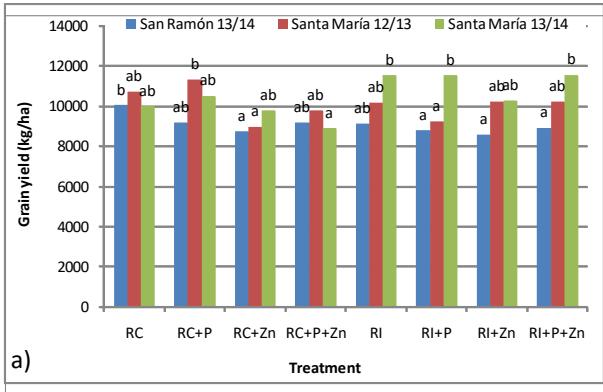
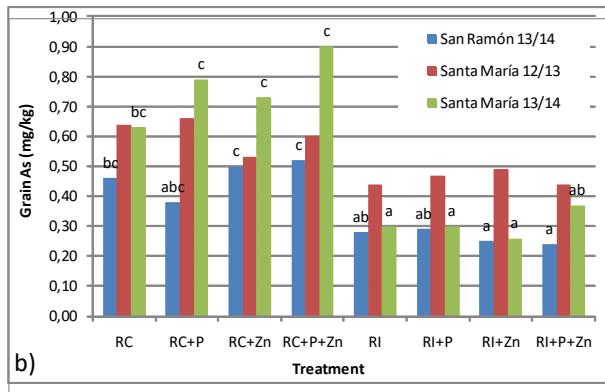 Figure 1: Yield (a) and concentration of total As in grain (b) according to treatment and tested site
Table 3: Concentration of total elements in grain and straw by treatment (mean values for the three sites tested)
<table><tr><td rowspan="2">Treatment</td><td colspan="5">Grain</td><td colspan="4">Straw</td></tr><tr><td>As (mg kg-1)</td><td>N (%)</td><td>P (%)</td><td>K (%)</td><td>Zn (mgkg-1)</td><td>N (%)</td><td>P (%)</td><td>K (%)</td><td>Zn (mg kg-1)</td></tr><tr><td>RC</td><td>0.56 b</td><td>1.07 cd</td><td>0.23 bc</td><td>0.14</td><td>23.2</td><td>0.66 b</td><td>0.10</td><td>1.35 a</td><td>34.4 a</td></tr><tr><td>RC +P</td><td>0.59 b</td><td>1.09 d</td><td>0.22 abc</td><td>0.15</td><td>23.5</td><td>0.65 b</td><td>0.11</td><td>1.60 ab</td><td>40.8 ab</td></tr><tr><td>RC +Zn</td><td>0.67 b</td><td>1.07 cd</td><td>0.24 c</td><td>0.16</td><td>23.9</td><td>0.62 ab</td><td>0.11</td><td>1.76 b</td><td>44.1 b</td></tr><tr><td>RC +P+Zn</td><td>0.65 b</td><td>1.06 bcd</td><td>0.24 c</td><td>0.16</td><td>24.3</td><td>0.63 ab</td><td>0.11</td><td>1.59 ab</td><td>39.9 ab</td></tr><tr><td>RI-</td><td>0.34 a</td><td>1.03 abc</td><td>0.22 ab</td><td>0.14</td><td>25.5</td><td>0.65 b</td><td>0.11</td><td>1.62 ab</td><td>45.0 b</td></tr><tr><td>RI-+P</td><td>0.35 a</td><td>1.01 a</td><td>0.23 ab</td><td>0.16</td><td>25.8</td><td>0.64 b</td><td>0.11</td><td>1.51 ab</td><td>45.8 b</td></tr><tr><td>RI-+Zn</td><td>0.33 a</td><td>1.03 abc</td><td>0.21 a</td><td>0.15</td><td>25.9</td><td>0.62 ab</td><td>0.11</td><td>1.60 ab</td><td>47.9 b</td></tr><tr><td>RI-+P+Zn</td><td>0.35 a</td><td>1.02 ab</td><td>0.21 a</td><td>0.15</td><td>27.0</td><td>0.59 a</td><td>0.11</td><td>1.71 b</td><td>43.3 ab</td></tr></table>
### b) Experiment 2
The effect of treatments and site was very significant on most variables evaluated. There was a considerable interaction between the treatments and the sites on yield and As concentration in grain (Figure 2).
Yield components showed no significant interaction and are summarized in Table 4. The yield was severely reduced by the application of As, especially in La Paz and to a lesser extent in San Salvador and Los Conquistadores. The decreased yield was related to a reduction in the number of panicles per square meter and the number of filled grains per panicle, and the increasing number of empty grains. The weight of grains was little affected (Table 4).
Table 4: Effect of adding As, P, and Zn on yield components (mean values for the three sites tested)
<table><tr><td>Treatment</td><td>Straw biomass (t ha-1)</td><td>Grain yield (tha-1)</td><td>Panicles (N° m2)</td><td>Total grains panicle-1</td><td>Filled grains panicle-1</td><td>Empty grains (%)</td><td>1000 grain weight (g)</td></tr><tr><td>T</td><td>6.4 ab</td><td>7.2 c</td><td>522 d</td><td>106 c</td><td>83 c</td><td>21.3 a</td><td>22.8 ab</td></tr><tr><td>+Zn</td><td>6.9 ab</td><td>6.3 c</td><td>475 bc</td><td>97 abc</td><td>75 bc</td><td>23.3 a</td><td>23.5 b</td></tr><tr><td>+P</td><td>6.5 ab</td><td>6.7 c</td><td>465 abc</td><td>105 c</td><td>82 c</td><td>21.1 a</td><td>23.6 b</td></tr><tr><td>+P+Zn</td><td>7.3 a</td><td>6.9 c</td><td>474 bc</td><td>101 bc</td><td>78 bc</td><td>22.1 a</td><td>23.7 b</td></tr><tr><td>+As</td><td>6.5 ab</td><td>2.8 a</td><td>433 a</td><td>91 abc</td><td>51 a</td><td>44.8 b</td><td>22.7 ab</td></tr><tr><td>+As+Zn</td><td>6.3 ab</td><td>3.7 a</td><td>450 ab</td><td>89 abc</td><td>59 ab</td><td>36.8 b</td><td>23.1 ab</td></tr><tr><td>+As+P</td><td>6.4 ab</td><td>3.6 a</td><td>453 ab</td><td>84 ab</td><td>47 a</td><td>46.2 b</td><td>22.4 a</td></tr><tr><td>+As+P+Zn</td><td>6.1 b</td><td>4.8 b</td><td>487 c</td><td>82 a</td><td>50 a</td><td>41.4 b</td><td>23.4 ab</td></tr></table>
In treatments without the addition of As, applications of P and Zn had no significant effect on yield and on the absorption of nutrients (Figure 2).
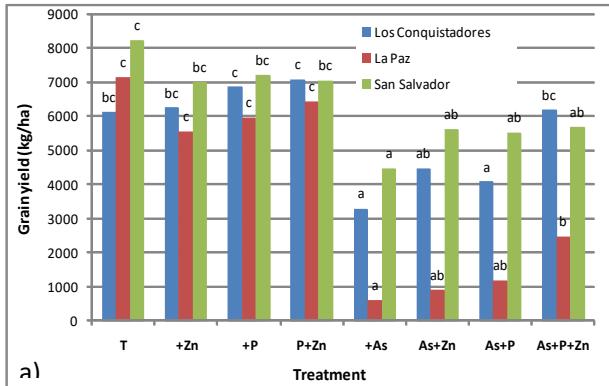
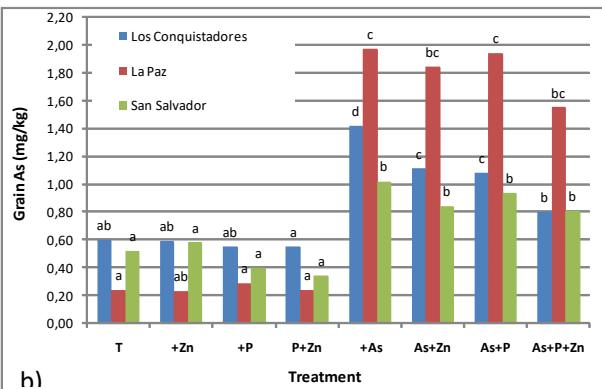 Figure 2: Yield (a) and concentration of total As in grain (b) according to treatment and tested site.
It was observed a close relationship between the As concentration in grains and rice yields (Figure 3), related to the reduction in the number of panicles $\mathfrak{m}^{-2}$ and the number of filled grains per panicle with increasing the number of empty grains (Table 4).
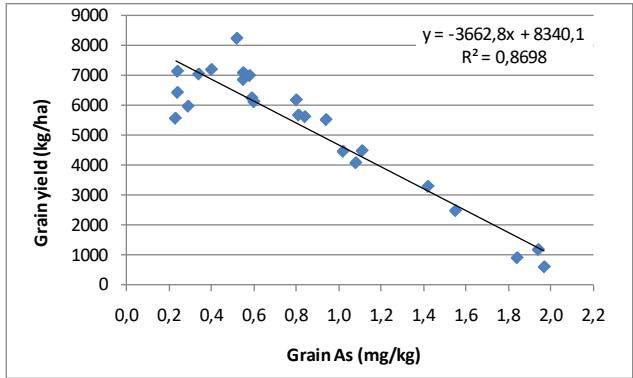 Figure 3: Correlation between as grain of rice and grain yield.
In the plots with As addition, the yield was severely reduced. However, the treatment with As plus $\mathrm{P} + \mathrm{Zn}$ had a significant effect in lowering of total As in grain from 1.41 to $1.05\mathrm{mgkg^{-1}}$ (Table 5), accompanied by an increase in yield of $2.8\ \mathrm{t}\ \mathrm{ha}^{-1}$ to $4.8\ \mathrm{t}\ \mathrm{ha}^{-1}$ (Figure 2), whereas the application of $\mathrm{As} + \mathrm{P}$ or $\mathrm{As} + \mathrm{Zn}$ had no significant effect.
Table 5: Concentration of total elements in grain and straw by treatment (mean values for the three sites tested).
<table><tr><td rowspan="2">Treatment</td><td colspan="5">Grain</td><td colspan="4">Straw</td></tr><tr><td>As (mg kg-1)</td><td>N (%)</td><td>P (%)</td><td>K (%)</td><td>Zn (mg kg-1)</td><td>N (%)</td><td>P (%)</td><td>K (%)</td><td>Zn (mg kg-1)</td></tr><tr><td>T</td><td>0.45 a</td><td>1.01 a</td><td>0.26</td><td>0.18 ab</td><td>26.9</td><td>0.62 abc</td><td>0.09 a</td><td>1.79 b</td><td>27.5 abc</td></tr><tr><td>+Zn</td><td>0.47 a</td><td>1.02 ab</td><td>0.26</td><td>0.19 b</td><td>29.7</td><td>0.64 abcd</td><td>0.10 a</td><td>1.79 b</td><td>31.6 c</td></tr><tr><td>+P</td><td>0.41 a</td><td>1.01 a</td><td>0.27</td><td>0.19 b</td><td>28.2</td><td>0.58 a</td><td>0.10 a</td><td>1.74 b</td><td>25.8 abc</td></tr><tr><td>P+Zn</td><td>0.38 a</td><td>1.01 a</td><td>0.25</td><td>0.18 ab</td><td>29.8</td><td>0.59 ab</td><td>0.10 a</td><td>1.73 b</td><td>28.3 bc</td></tr><tr><td>+As</td><td>1.41 c</td><td>1.09 c</td><td>0.26</td><td>0.16 a</td><td>27.2</td><td>0.72 d</td><td>0.15 c</td><td>1.47 a</td><td>26.6 abc</td></tr><tr><td>As+Zn</td><td>1.26 bc</td><td>1.07 bc</td><td>0.25</td><td>0.18 ab</td><td>32.0</td><td>0.69 cd</td><td>0.13 bc</td><td>1.47 a</td><td>24.4 ab</td></tr><tr><td>As+P</td><td>1.43 bc</td><td>1.10 c</td><td>0.26</td><td>0.19 b</td><td>25.8</td><td>0.71 cd</td><td>0.14 bc</td><td>1.69 ab</td><td>22.6 ab</td></tr><tr><td>As+P+Zn</td><td>1.05 b</td><td>1.06 abc</td><td>0.26</td><td>0.19 b</td><td>29.6</td><td>0.67 bcd</td><td>0.12 c</td><td>1.68 ab</td><td>22.0 a</td></tr></table>
The concentration of P and Zn in grain was not affected by treatments. Addition of As only produced a lower concentration of K in grain and straw. Khan et al. (2010) observed a decrease in the concentration of P and K in grain with the application of As, indicating that As toxicity affects the absorption of these nutrients.
The As addition produced a reduction in the number of grains per plant and a greater concentration of N and P in the straw; these elements are possibly not translocated due to lack of destinations.
## IV. DISCUSSION
### a) Effect of Irrigation
Alternative wetting-drying (AWD) Irrigation system is promoted as a way to save water. It is allowed to dry the soil surface for a few days between food irrigation events, depending on the stages of plant development. Differences in saving water whith respect to permanent floods can vary between $20 - 40\%$. A dry period would also promote the benefits of supply of some nutrients, better root development, and reduced bioavailability of As.
The soil-reducing conditions during the flood promote a release of AsV sorbed in Fe oxi-hidroxides (reductive dissolution), which is subsequently reduced to AsIII. In soils with a flood-aeration cycles, after draining, quick and simultaneous sorption and precipitation of As with Fe and Mn occurs, which reduces its bioavailability.
In the present study, as a result of the drying of soil, the concentration of total As in rice grain was significantly reduced compared to continuous flood irrigation. One aspect to note is that the As content of whole paddy grain (i.e., $0.35\mathrm{mgkg}^{-1}$ of total As in interrupted flood treatments) is a value that ensures its use for human consumption because it is close to the maximum allowed value for polished rice and still lacks industrial process that removes husk and pericarp, which are components with more total As. Xu, et al. (2008) compared As contents in rice grain and soil in an aerobic system and another with permanent flooding; they observed a decrease of 10 to 15 times in the range of total As in unpolished rice grain, associated with a reduction of 7-16 times in the concentration of As in soil solution in the aerobic system.
Grain yields obtained were higher than average in the area and were not affected by water management, ranging from 9.2 to $10.4\mathrm{tha^{-1}}$ (Table 2). This lack of significant differences gives advantages to the method of irrigation interrupted because with similar yields, a greater efficiency in water use is obtained and reduces the availability of As for growing rice.
The drying of soil or interruption of an aerobiosis during the vegetative growing season of the crop, can reduce the availability of some nutrient elements that often are more available in flooded soils. This was evident in the lower P content observed in grain in interrupted flood treatmen (Table 3). As soils dry after draining the plot, compounds of Fe and Al react with P to form insoluble phosphates, reducing their availability. This fixation of P is stronger and less reversible under flood and drying alternating conditions than under conditions of continuous moisture or flooding (Snyder and Slaton, 2003).
### b) Arsenic
The studied soils have an average total As content of $3.3\mathrm{mgkg}^{-1}$, and water used for irrigation does not exceed $35\mu \mathrm{g}$ $\mathsf{l}^{-1}$. With these environmental conditions, the average total As in white rice grain in the Noth Entre Ríos region is $0.45 \, \text{mg kg}^{-1}$ (Oteiza, et al., 2020). When a ratearound $1 \, \text{mg kg}^{-1}$ of As was applied to the soil, there was a notable increase in the content of total As grains, tripling its natural value (Table 5).
A strong negative correlation was observed between rice yield and concentration of total As in grain $(R2 = 0.87$, Figure 3), matching results with those obtained by Xu et al. (2008). The highest bioavailability of As caused a reduction in the number of panicles $\mathrm{m}^{-2}$ in the number of filled grains per panicle, and increased the grain sterility, which explained the reduction in yield (Table 4). Similar results were presented by Khan et al. (2010), showing significant reductions in the rice yields related to fewer tillers and grains per panicle produced by maximum addition of $20\mathrm{mgkg^{-1}}$ As.
The predominance of DMA species in Argentinian rice (Oteiza, et al., 2020) would be responsible for the grain sterility. Under the local conditions of soil and microbial flora, the continuous irrigation promotes a high availability of organic species of As and observation of a physiological disorder known as "Straight head", which produces a high percentage of empty and deformed grains (Panozzo et al., 2014). This increased availability of organic and inorganic As in soil, can be decreased with the oxygenation of paddy soil. Which was evidenced in our study, coinciding with results presented by Xu et al. (2008) where the soil addition of $10\mathrm{mgkg^{-1}}$ of As produces asignificant yield decreased in flood conditions, but did not effect on aerobic conditions.
### c) Phosphorus
Phosphate added to the soil can compete with arseniate (AsV) and arsenite (AsIII) for the soil adsorption sites, decreasing the amount of As adsorbed, giving as a result, a greater availability of As. For this reason, in flooded soils environments where AsIII is the dominant species, the application of phosphate could increase As toxicity. However, in both experiments, the plots that received an addition of P did not show an increase of As in grain.
Only when the availability of As was artificially higher, the combined addition of P and Zn was able to reduce the concentration of total As in grain, even though that value continued above the permissible level for human consumption (Table 5). Application of P in As-contaminated rice felds also led to Fe-plaque formation, leading to increased adsorption of As species of Fe-plaque and reduced As content in rice (Yang, et al. 2020). Some studies have shown the mitigating effect of P on Asuptake for rice, because arsenate enters the plant through the same transporters as phosphate. An example of this is noted by Sahoo et al. (2013), with a significant and negative relationship between As absorption for rice and the concentration of exchangeable soil P. Thus, the P application in alleviating As induced toxicity and reducing its level in rice grain is a suitable alternative Mishra, et al. 2022).
In Entre Rios, it has been recorded that the addition of P as fertilizer in rice crops, often depresses yield despite being soils with low availability of P. We hypothesize that the lack of response to P fertilization could be explained by release of soil native As with addition of phosphates, but ours results do reject this hypothesis because neither yield or concentration of total As in grain was affected.
### d) Zinc
When zinc was added to soils with high As availability due to its application, a $26\%$ decrease in total As content in the grain was observed; but only when Zn was combined with P fertilization. According to Das et al. (2007), this could be because Zn can react to form insoluble compounds with As and is not available to plants according to the reaction \[arsenate + $\mathrm{ZnSO_4} \rightarrow \mathrm{Zn}$ -arsenate + $\mathrm{SO}_4^{\ominus}$ \]. Studying the effect of fertilization with Zn on the mobilization of As in soil cultivated with rice using different management of water, they found that application of 25 kg $\mathrm{ha^{-1}}$ $\mathrm{ZnSO_4}$ combined with interrupted irrigation decreased by $21\%$ the concentration of As total grain rice without yield loss. In an incubation experiment, Das et al. (2016) used soil with low $(3\mathrm{mgkg}^{-1})$ to medium $(18\mathrm{mgkg}^{-1})$ total As content and recorded a decrease of $25 - 35\%$ in available soil As by adding Zn doses between 2.5 to $5\mathrm{mgkg}^{-1}$. Under field conditions, in soils with medium contents of total As and applying $20\mathrm{kgha^{-1}}$ of $\mathrm{SO}_4\mathrm{Zn}$, they recorded a reduction of total As in all parts of the plant and especially in grain, which was reduced by $12 - 14\%$ compared to control. This decrease would be attributed to the electrostatic interaction between As and Zn, which facilitates the formation of compounds of lower solubility.
## V. CONCLUSIONS
This study has demonstrated a marked effect of irrigation management on As concentration in rice grains. Irrigation system with a drying in the vegetative period is a good practice that leads to a decreaced As soil availability with the consequent reduction of As in grains, without affecting yield.
Under natural conditions of low As soil availability, and permanent flooding, P and Zn fertilization did not improve yield or affect absorption As for rice cultivation. While, with external high As availability, yield was severely affected. But, the P plus Zn addition allowed to mitigation the toxic effect in some degree. A significant negative correlation between rice yield and concentration of total As in grain was explained by the increase in the percentage of empty grains.
These preliminary results in the study of the dynamics of As in soil-plant under field conditions are essential to better understand As absorption by rice. In this way, it could develop effective management strategies to reduce As concentrations in rice grain. For the moment and under these conditions, drainage and drying of rice fields, along with a selection of varieties of lower absorption of As, are the best alternatives to reduce concentration of As in rice grains.
## ACKNOWLEDGEMENTS
We acknowledge to Project PICT-2011, $N^{\circ}$ 1955, PROARROZ Foundation, and National University of Entre Rios, who contributed to the research.
Generating HTML Viewer...