An outline of NOMA principles is provided in this article. Furthermore, this page discusses cooperative NOMA and its variations, explains power allocation in detail as a technique of resource allocation for NOMA, and gives an overview of the research challenges related to NOMA. We then, use a two-case scenario, to suggest a dynamic power allocation (DPA) plan for the downlink NOMA users, albeit it can also be expanded to many use cases. The DPA relies on channel state information (CSI) to guarantee the quality of service (QOS) for cell center customers (user c). The Outage probability (OP) as a critical performance criterion simulation data is also provided, and they demonstrate a notable performance improvement when DPA is employed compared to fixed power allocation.
## I. THE INTRODUCTION
The newest member of the multiple access family, non-orthogonal multiple access (NOMA), has received praise as a viable way to increase spectral efficiency in fifth-generation (5G) cellular communication networks [1], [2]. A low latency, excellent dependability, enormous connection, superior fairness, and high throughput are among the properties of NOMA, a suggested multiple-access solution for 5G and beyond networks [2] [2]. The multiple access strategies listed below, including FDMA, TDMA, CDMA, and OFDMA, have been implemented in cellular networks of the first through fourth generations [3]. The term "traditional orthogonal multiple access (OMA) technologies" refers to all of these multiple access schemes [4]. The number of users served in OMA is usually tiny, as the number of resources allocated is generally limited. The allocation of resources does not result in intra-cell interference in OMA, making it simple to retrieve data on many users. A new technology known as NOMA is being developed for 5G, which is expected to contribute to the development of novel radio access systems. In a NOMA system, a base station uses a superposition coding algorithm to transmit the users' signals. It also uses interference cancellation techniques to prevent a disturbance at the reception side [5]. The downlink NOMA enables several users to share a single medium at the same time, frequency, or code while using varying power levels [6], [7], which enhances the performance of the channel in several ways, including energy efficiency, fairness, and spectrum efficiency [8]. NOMA allows many users to share the same time, frequency, and code resources at varied power levels, in contrast to traditional orthogonal multiple access (OMA) techniques. The traditional OMA technology struggles to meet the expectations of a growing user base due to orthogonal resource limitations. Strong users benefit from better channel conditions than weak users, who do not [1]. The allocation of a higher power to users with more vulnerable channels is moved by supporting a certain quality of service (QOS) or improving user fairness, and this QOS is usually quantified by $R_{i} \geq r_{i}$ where $r_{i}$ is the minimum required rate for user i [3]. For signal decoding to be accomplished at the reception side, strong users implement the SIC technique while weak users decode their messages by treating the strong users' messages as noise [1]. The received signals are ranked according to the signal-to-interference-noise ratio or the power from the largest to the most minor [9]. In general, user fairness is increased by giving users with good channel circumstances low power and giving users with lousy channel conditions high power [10]. The users served to achieve imbalanced rates, which could be crucial in cases with tight fairness limitations, given that NOMA is based on the SIC order [7]. Power efficiency is vital for ultra-Reliable low latency communications (URLLC) since the NOMA system has a power delay tradeoff, especially when many devices are battery-powered. As a result, we recommend using dynamic power allocation.
Fig. 1. is an example of a two-user downlink NOMA system in the power domain with SIC being implemented at user 1 (user c) and superposition coding at the transmission side where the transmitter transmits multiple users signals at the same time [11], in this case, signals of user c and user e. The transmitted signal is given by:
$$
S _ {t} = \sum_ {i = 1} ^ {n} \sqrt {P \alpha_ {i}} x _ {i} \tag {1}
$$
Where: $P =$ total transmitted power, $\alpha_{i} =$ power allocation coefficient, and $x_{i} =$ modulated information of users.
The significant contribution of this paper is to theoretically analyze the outage performance of dynamic power allocation strategy that can be applied to a downlink scenario with two users. This PA ensures the quality of service for the cell center user. This power allocation is then used for performance analysis. Mainly, outage probability is used as a criterion to analyze the system performance under two conditions:
1. Considering only the path loss.
2. Taking into consideration both path loss and shadowing.
The rest of the paper is organized as follows: the next section highlights some of the NOMA research challenges, and related works on improving the performance of users in non-orthogonal multiple access, and section III discuss performance improvement of users in NOMA by further breaking it down into two parts, i.e., power allocation and cooperative NOMA, in section IV the performance analysis and outage probability is used as the performance metric, in section V we present the simulation results and discussion, and finally section VI gives the conclusion.
## II. RELATED TO WORKS
When compared to OMA systems, one of the major drawbacks of NOMA is the receiver's complexity brought on by the use of SIC, as well as the added implementation complexity for signal decoding. The complexity of receiving also grows with the number of users in the cell. Therefore, a high-performance nonlinear detection algorithm is required at each stage of SIC, for error-free propagation [12]. Another difficulty unique to the NOMA method is that once a SIC error occurs, all user information is decrypted with errors. This is a flawed SIC and a study topic that NOMA hasn't fully covered yet [13].
In cooperative NOMA, the combined effect of multiple copies of user messages increases the complexity on the user's side and degrades the overall performance. It also increases the system complexity of user cooperation [14].
Due to the many advantages that NOMA offers, recently, the secrecy issue of NOMA has been studied [15]. Since relays re-transmit a copy of the information symbols that are summed up via SC and transmitted over the same frequency band, which means that once the carrier frequency is successfully located by the eavesdropper, all users' messages may be intercepted, the challenge of realizing secure communications with NOMA remains. This is especially true in NOMA cooperative relay networks [16].
Further research and development are required in NOMA to make the 5G goal a reality.
The improved performance of users in NOMA has been studied actively in recent years, and the most common one is the study of fixed power allocation to address the issue. Still, in this power allocation the concentration is on the cell edge user neglecting the cell center user as its quality of service gets compromised. A reversed relay-assisted NOMA network is introduced considering user fairness. The model has been analyzed in terms of all KPIs (e.g., EC, OP, BER) with a more accurate imperfect SIC model and imperfect CSI [17]. As a result, the authors of [18] developed a novel power allocation strategy called a dynamic power allocation scheme that aims to balance service quality for consumers with varying data rates.
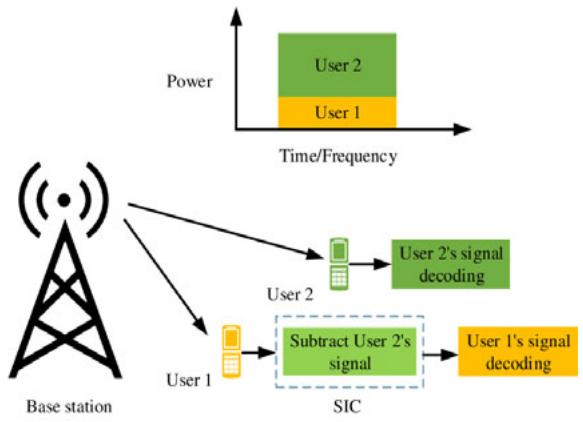 Fig. 1: Power Domain Downlink NOMA System with Two users
The power allocation for NOMA based on proportional fairness scheduling is studied for both max-sum-rate and max-min-rate problems [19].
The performance of different NOMA schemes including two-user MU-NOMA and multichannel NOMA (MC-NOMA), is investigated using optimal power allocation, and the performance measures used are max-min fairness, sum rate, and energy efficiency for downlink NOMA for performance factors such as sum rate and energy efficiency [5]. A dynamic power distribution approach for the downlink NOMA scheme that ensures user equity by improving the quality of service (QOS) of both users has been looked at in [20]. A downlink NOMA system with cooperative full-duplex relaying is being studied. This technique allows the close user to act as a full-duplex relay for the far-off user. To reduce the likelihood of an outage, they first fix the power allocation (PA) for the base station and nearby users before calculating PA analytically at the BS and relay using closed-form equations [21]. Two scenarios, immediate channel state information at the transmitter and average CSI, have been used to examine power allocation (PA) algorithms that ensure fairness for downstream users [7]. They developed algorithms that produce the best result in both cases. To increase performance for a cell-edge user of two-user NOMA systems in downlink circumstances, two cooperative relaying strategies, namely on/off full-duplex relaying (on/off-FDR) and on/off-half-duplex relaying (on/off-HDR), have been studied [22]. A new definition of fairness based on information theoretic grounds addressed the user fairness issue in power-domain NOMA [10]. The performance of the NOMA scheme in terms of outage probability and achievable sum rate for a fixed power allocation was analyzed [6]. Several major NOMA schemes for 5G have been discussed and compared from the aspects of fundamental principles, key features, receiver complexity, engineering feasibility, etc. Compared to conventional OMA, NOMA allows controllable interferences to realize overloading at the cost of a modest increase in receiver complexity [23]. A method was proposed to adjust the user rate according to the instantaneous channel state information (CSI). First, the optimization problem is transformed into an equivalence problem. By setting some parameters to represent a set of user sum rate allocation problems, constructing a penalty function by the interior point method, and gradually adjusting the penalty factor to solve the extreme point and get the optimal solution [9].
Through this literature review, it could be seen that researchers have tried to improve the fairness of users in NOMA by using cooperative relaying, dynamic power allocation, etc. However, there still exists a research gap in NOMA that ensures the quality of service. To this end, we'll investigate the impact of power allocation on the performance of users in NOMA systems.
## III. PERFORMANCE IMPROVEMENT OF USERS IN NOMA
There are several ways in which the performance of a NOMA system can be improved for users. In this section, we outline two essential features that will enhance the performance of a NOMA system, and these are; power allocation and cooperative relaying.
### a) Power Allocation (PA) in NOMA
PA plays an important role in NOMA, as users are multiplexed in the power domain [11]. It directly impacts system performance, like interference management, rate distribution, and user admission. An inappropriate PA could lead to an unfair rate distribution among users and system outage due to successive interference cancellation (SIC) failure. When PA schemes are being designed, it is cardinal to scrutinize several things like users' channel conditions, availability of channel state information (CSI), quality of service (QoS) requirements, etc. Some of the PA performance metrics that are widely adopted include the number of admitted users, sum rate, energy efficiency, user fairness, outage probability, and total power consumption [24]. Thus, the goal of PA in NOMA is to achieve either more admitted users, a higher sum rate and energy efficiency (EE), or balanced fairness under minimum power consumption.
There are different types of power allocation, each trying to accomplish a specific goal, such as maximizing the sum rate, the ergodic capacity, energy efficiency, etc [25]. To improve user fairness generally, low power is distributed to users with good channel gain, and high strength is allocated to those with poor channel gain [26]. Recently, in some NOMA systems series, user fairness issues have received attention [6].
As discussed in [27], [28], some fixed power allocation methods are adopted. This plan uses a recursive iteration technique to perform power allocation, where a recursive attribution is a number larger than zero but less than one. More power will be given to the user who has fewer channel conditions. The recursive attribution size, which is determined by the system and is fixed, also affects how much power there is between the two users. It can ensure that users with lower channel gains are given more power, but these users may experience unfairness and may not satisfy different QOS criteria from other users.
The inspiration for us to develop our proposed power allocation scheme that ensures the quality of service for the cell center user was obtained from [18]. The mathematical model of the proposed system is illustrated using equations (2) to (4) and taking the basics of fixed power assignment as the reference.
$$
\alpha_ {e} > \alpha_ {c}, \alpha_ {e} + \alpha_ {c} = 1 \tag {2}
$$
$$
R _ {e} ^ {N} = \log_ {2} \left(1 + \frac{\alpha_ {e} | h _ {e} | ^ {2}}{\alpha_ {c} | h _ {e} | ^ {2} + \frac{1}{\rho}}\right) \qquad (3)
$$
$$
R _ {c} ^ {N} = \log_ {2} \left(1 + \rho \alpha_ {c} \left| h _ {c} \right| ^ {2}\right) \tag{4}
$$
Where:
$$
\alpha_ {e} = \text{powerallocationforusere}
$$
$$
\alpha_ {c} = \text{Powerallocationforuserc}
$$
$$
h _ {e} \& h _ {c} = \text{Channelcoefficientforuserse and c}
$$
$$
R _ {e} ^ {N} \& R _ {c} ^ {N} = \text{Datareatofuserse and c}
$$
$$
\rho = \text{TransmitSNR}
$$
### b) Cooperative NOMA (C-NOMA)
Cooperative NOMA is another important concept that, when combined with NOMA, improves the system performance for users in downlink transmission, and further improves system efficiency in terms of capacity and reliability [13]. In downlink transmission, channel conditions may vary due to the near-far problem and self-interference. The users in various channel conditions can be categorized as strong or weak. In C-NOMA, the strong users can serve as relays for the weak users, which has the potential to utilize the spatial degree of freedom (DoF) even for users with a single antenna [29]. Furthermore, users in strong channel conditions employ SIC at the receiver in NOMA by decoding messages of users who belong to weak channel conditions is the main advantage in C-NOMA [14]. We will consider a four-node system network, i.e., BS, Users A, B, and C, as shown in Fig. 2 [30]. The BS transmits the message for user A, which is superimposed with symbols of both A and C. Therefore, user A should subtract the messages of users B and C before decoding its message using SIC. Similarly, user C decodes its message C. In this approach, users A and C are considered as relays and forward their messages. As a result, three copies of messages are received via different channels (two copies through the cooperative phase and one from the direct phase).
- Coordination phase: Users exchange their source data and control messages with each other and, or the destination. The source user broadcasts its data to both the relay and the destination.
- Cooperation phase: Users retransmit their messages to the destination cooperatively. The relay forwards the source's data either by itself or cooperating with the source to enhance reception at the destination [31].
To ensure cooperation among users, different relaying protocols and techniques could be employed, and this depends on the relative user location, channel conditions, and transceiver complexity. The cooperative communication protocols which would be outlined include Amplify and Forward (AAF) and Decode and Forward (DAF) protocols [32]. AAF: was proposed and analyzed in [32], where each user receives a noisy version of the signal transmitted by its partner, then amplifies it and retransmits it to the base station. The base station receives two independently faded versions of the signal and combines them to make better decisions on information detection. The main drawback of this method lies in the fact that noise contained in the signal is amplified as well and is often used when the time delay, caused by the relay to decode and encode the message has to be minimized or when there is limited computing time/power available to the relay.
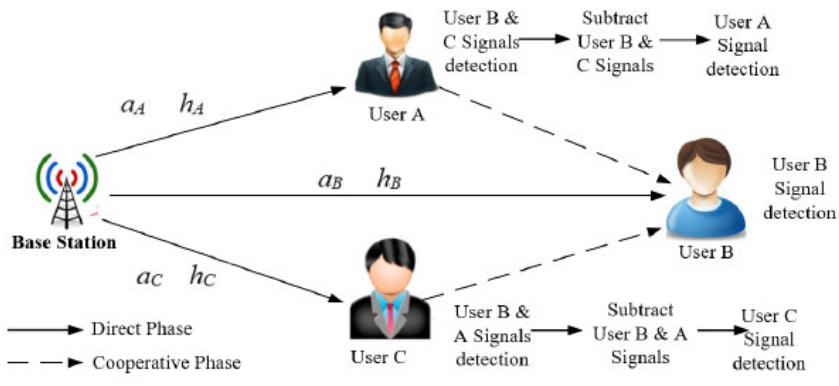 Fig. 2: An Example of Three User Cooperative Relay Network with NOMA
DAF: An example of this can be found in [33]. This strategy follows that the relay station decodes the received signal from the source node, re-encodes it, and forwards it to the destination station. It is the most often preferred method to process data in the relay since there is no amplified noise in the signal sent [31].
## IV. PERFORMANCE ANALYSIS
In this section, we analyze the proposed power allocation in terms of outage probability to evaluate its performance and also give an overview of outage probability under two conditions, i.e., path loss only and pass loss and shadowing.
### a) Outage Probability (OP)
Outage probability is defined as the point at which the received power (Pr) falls below a given threshold (Pmin) [22]. Fig. 3 shows outage probability under two conditions, i.e., a) considering path loss only, which gives a deterministic model, and b) considering path loss and shadowing which gives a continuous system. In Fig. 3a), the power decay as the users move further away from the transmitter is the same power as received in the circle. When a specific threshold is met, there is no outage, and there is no chance that there will be one. Once the boundary is exceeded probability of being in an outage is one. Fig. 3 b) It can be observed from the shadowing that some parts of the cell are also experiencing an outage, and the received power there is below the threshold.
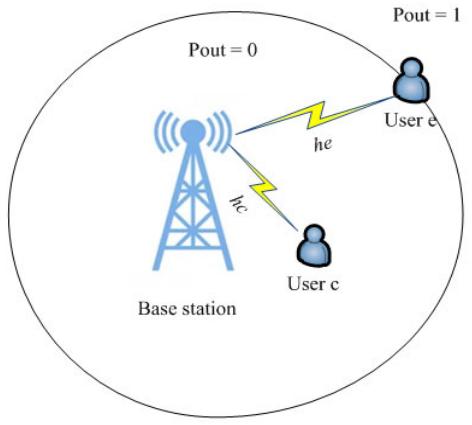
a) Outage Probability with Path Loss only
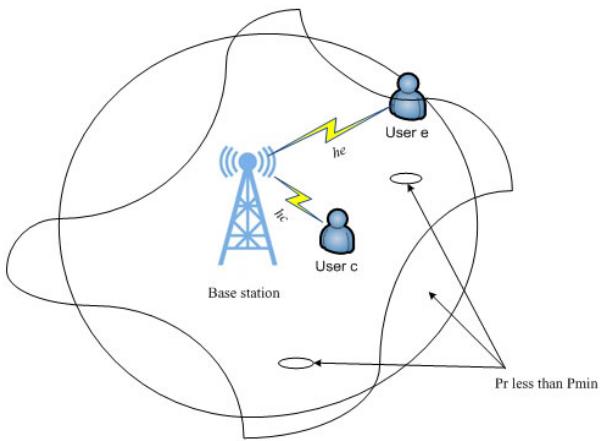
b) Outage Probability– Pathloss and Shadowing Fig. 3: a) & b) Outage Probability
Since NOMA enables users to share a single bandwidth, each user's data rate must not exceed the channel capacity. To offset the latency brought on by SIC, users should decode data at a rapid pace. An outage occurs and data loss results when a user's data rate surpasses Shannon's rate[34]. The generalized expression for the probability of an outage is given below:
$$
P _ {t o t a l} = 1 - P _ {r} \left\{R _ {e} ^ {N} > R _ {e} ^ {T}, R _ {c} ^ {N} > R _ {c} ^ {T} \right\} \tag {4}
$$
Where; $R_e^T$ & $R_c^T$ are target rates for users e and c
## V. SIMULATION RESULTS AND DISCUSSION
Through simulation, we assess the effectiveness of the suggested resource allocation strategies in this section. Fig. 4 shows the outage probability achieved by the scheme and is shown as a function of the minimum data rate for the cell edge user when fixed power allocation (FPA) is used and $\alpha_{\mathrm{e}} = 0.95, \alpha_{\mathrm{c}} = 0.05$. The distances from the BS to the users are set at $d_{\mathrm{e}} = 500\mathrm{m}$, $d_{\mathrm{c}} = 100\mathrm{m}$ for Figs. 4 and 5 and the path loss exponent $\epsilon = 4$. It can be seen from Fig. 4 that FPA is performing very poorly, despite having user c close to the BS, and the probability of the system failing is relatively high all the time when the target rate is more significant than 4.5 bps. This is because FPA does not take into consideration the channel state information
and also does not take the target rate requirements into account.
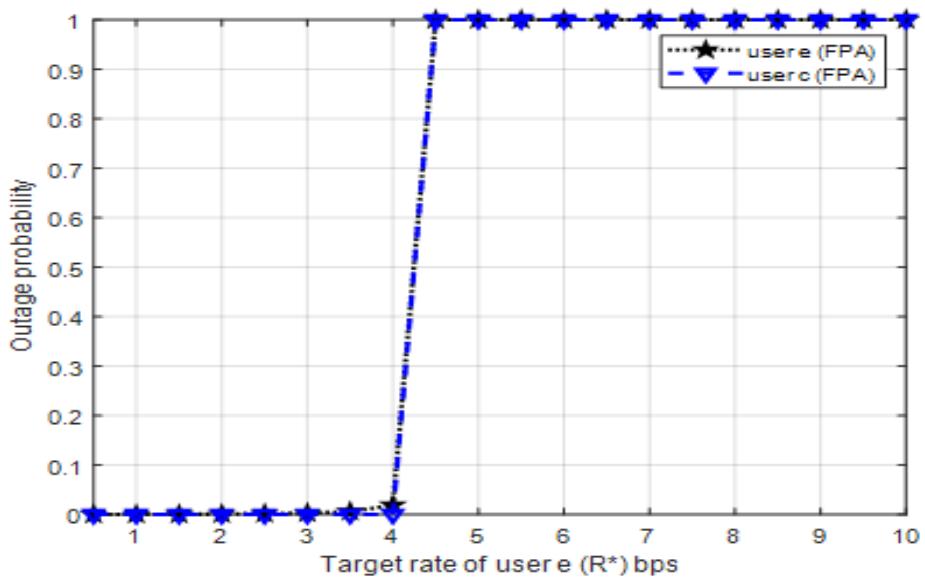 Fig. 4: Relationship between OP and Target rate for user e in DPA for
$d_{e} = 500m$, $d_{c} = 100m$ from the BS with SNR = 30dBm For the proposed dynamic power allocation (DPA) in Figs. 5 and 6, it can be seen that there's a lower outage probability because $\alpha_{\mathrm{e}} \& \alpha_{\mathrm{c}}$ are dynamically adjusted based on target rate requirements and channel state information (CSI). For DPA in Fig. 5, it is shown that the outage of user ecompared to Fig. 4 has gradual increase as its target rate requirements increase. As the target rate increases, this is the expectation, and the chances of the user e achieving that target rate become lower and lower. This would thus lead to an increase in its outage probability. At 10 bps we see the same failure rate results for both users.
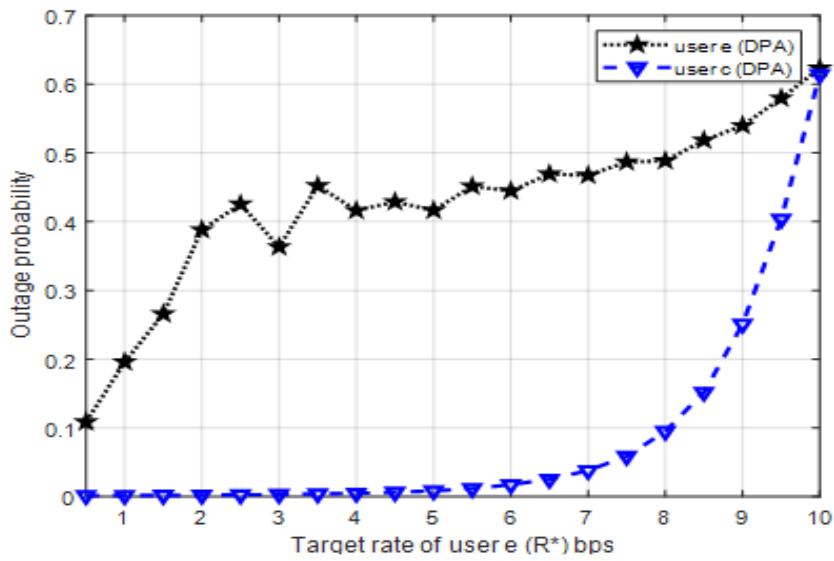 Fig. 5: Relationship between OP and target rate for user e in DPA for
$d_{e} = 500m$, $d_{c} = 100m$ from the BS with SNR = 30 dBm In Figure 6, at a data rate of 1 bps we don't expect any failure for the likelihood of being in an outage for user c is at 0, but at 10 bps the probability of being in an outage is at $20\%$ for user c.
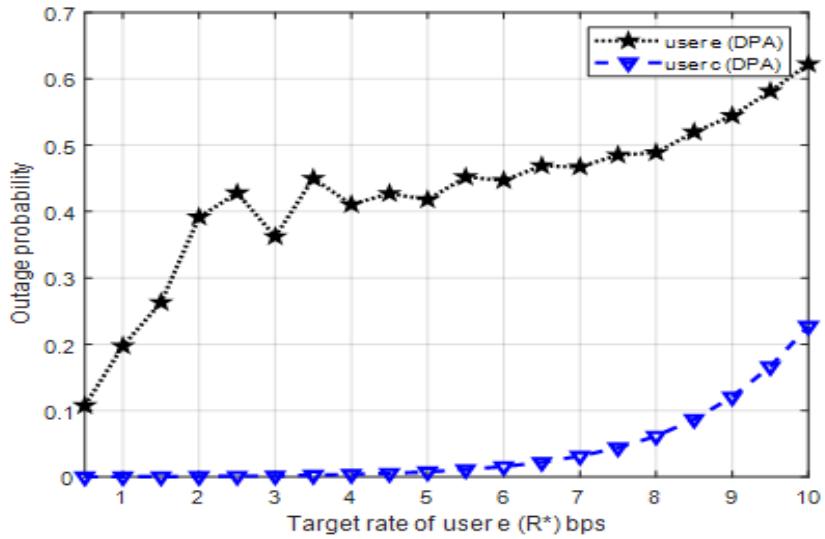 Fig. 6: Relationship between OP and Target Rate for user e in DPA for
$d_{e} = 500m$, $d_{c} = 10m$ from the BS with SNR = 30 dBm
Meanwhile, at the same speed of 10 bps user e's probability of failure is $62\%$. Also, it can be seen that at 10 bps user's c's performance improves compared to Fig. 5 as the user is closer to the BS and the probability of failure is at $20\%$.
The behavior of FPA for varying distances is the same as in Fig. 4 and this is because FPA, as earlier alluded, does not take the CSI into account. From Fig. 5 and 6, it can be seen that as the distance keeps on varying, the performance of user c keeps improving, and we are rest assured that the quality of service for user c is not compromised.
## VI. CONCLUSION
This research study provides a summary of the NOMA principle and goes into further detail about the power allocation resource allocation technique as a means of enhancing NOMA users' performance. It can be seen from the results that the proposed DPA enhances the system performance as compared to FPA. Additionally, we describe the cooperative relaying scheme, which is another technique for enhancing user performance through the employment of relays. Typically, users that have better channel conditions serve as relays. Additionally, we emphasize the research problems that NOMA may face in the future.
Generating HTML Viewer...
References
35 Cites in Article
Yuya Saito,Yoshihisa Kishiyama,Anass Benjebbour,Takehiro Nakamura,Anxin Li,Kenichi Higuchi (2013). Non-Orthogonal Multiple Access (NOMA) for Cellular Future Radio Access.
T Shimojo,A Umesh,D Fujishima,A Minokuchi (2016). Special articles on 5G technologies toward 2020 deployment.
M Vaezi,R Schober,Z Ding,H Poor (2019). Nonorthogonal multiple access: Common myths and Critical Questions.
Z Ding,C Zhong,D Ng,M Peng,H Suraweera,R Schober,H Poor (2015). Application of smart antenna technologies in simultaneous wireless information and power transfer.
Yongming Huang,Jiaheng Wang,Jianyue Zhu (2019). Optimal Power Allocation for Downlink NOMA Systems.
Z Ding,Z Yang,P Fan,H Poor (2014). On the performance of non-orthogonal multiple access in 5G systems with randomly deployed users.
Stelios Timotheou,Ioannis Krikidis (2015). Fairness for Non-Orthogonal Multiple Access in 5G Systems.
J Choi (2014). Non-orthogonal multiple access in coordinated two point systems.
J Li,Q Wang (2021). Power allocation method of downlink non-orthogonal multiple access system based on alpha fair utility function.
Guan Gui,Hikmet Sari,Ezio Biglieri (2019). A New Definition of Fairness for Non-Orthogonal Multiple Access.
S Islam,Ming Zeng,Octavia Dobre,Kyung‐sup Kwak (2017). Nonorthogonal Multiple Access (NOMA): How It Meets 5G and Beyond.
M Hussain,H Rasheed (2020). Unknown Title.
S Islam,N Avazov,O Dobre,K Kwak Power domain Non-orthogonal multiple access (NOMA) in 5G Systems: Potentials and Challenges.
Yuanwei Liu,Zhijin Qin,Maged Elkashlan,Yue Gao,Lajos Hanzo (2017). Enhancing the Physical Layer Security of Non-Orthogonal Multiple Access in Large-Scale Networks.
Dehuan Wan,Miaowen Wen,Fei Ji,Hua Yu,Fangjiong Chen (2018). Non-Orthogonal Multiple Access for Cooperative Communications: Challenges, Opportunities, and Trends.
F Kaya,H Kaya (2020). Improved user fairness in decode -forward relaying non-orthogonal multiple access schemes with imperfect SIC and CSI.
Zheng Yang,Zhiguo Ding,Pingzhi Fan,Naofal Al-Dhahir (2016). A General Power Allocation Scheme to Guarantee Quality of Service in Downlink and Uplink NOMA Systems.
J Choi (2016). Power allocation for max-sum-rate and max-min-rate proportional fairness in NOMA.
M Mabumba,S Tembo (2023). Dynamic Power Allocation as a way of Improving the Performance of Users in Non-orthogonal Multiple Access for 5G Communications.
L Zhang,M Xiao,J Liu (2017). Outage probability analysis and optimization in downlink NOMA systems with cooperative full-duplex relaying.
T Do,D Da Costa,T Duong,B An (2017). Improving the performance of Cell-edge users in NOMA using Cooperative Relaying.
Linglong Dai,Bichai Wang,Yifei Yuan,Shuangfeng Han,I Chih-Lin,Zhaocheng Wang (2015). Non-orthogonal multiple access for 5G: solutions, challenges, opportunities, and future research trends.
S Islam,Ming Zeng,Octavia Dobre,Kyung-Sup Kwak (2017). Resource Allocation for Downlink NOMA Systems: Key Techniques and Open Issues.
Mabrouk Atrouche,Soulef Ayad,Belattar Mounir (2022). Comparative Study of Fairness and Fixed Power allocation Algorithms : In Non-Orthogonal Multiple Access system.
No ethics committee approval was required for this article type.
Data Availability
Not applicable for this article.
How to Cite This Article
Mwewa Mabumba. 2026. \u201cPerformance Study of Downlink Users in Non- Orthogonal Multiple Access (NOMA) for 5G Communications\u201d. Global Journal of Computer Science and Technology - E: Network, Web & Security GJCST-E Volume 23 (GJCST Volume 23 Issue E1).
Explore published articles in an immersive Augmented Reality environment. Our platform converts research papers into interactive 3D books, allowing readers to view and interact with content using AR and VR compatible devices.
Your published article is automatically converted into a realistic 3D book. Flip through pages and read research papers in a more engaging and interactive format.
Our website is actively being updated, and changes may occur frequently. Please clear your browser cache if needed. For feedback or error reporting, please email [email protected]
Thank you for connecting with us. We will respond to you shortly.