The aim of this study is to create and incorporate signature character for a mass market organic apparel brand in the collection of Spring summer 2021 for the age group of 0-2 years and to implement this character in all other trims, packages, name tags and carton boxes, promotion posters, flyers / banners or other products used for the brand. This study focusses mainly on sustainable fashion and the need of comfort for infants’ wear. Detailed research was executed to know the preference of the parents towards the new character developed and their application onto various mediums. Samples were developed for eccentric silhouettes and new designs as per the theme chosen and designs are shown in the methodology.
## I. INTRODUCTION
Manufacturing of infants' wear clothing requires various specially treated materials like antimicrobial finish, ergonomically fit for wear and tear since children's skin is more delicate and often prone to rashes. Most of the children are playful and thus the garments should be durable to all their activities. Development of signature cartoon character calls in for various attributes which could be applied in all forms of apparel items right from garments to packaging. Fabric choices, dyes, trims and packages to meet the sustainable goals and the application of signature character is the main focus of the journal. Organic cotton and azo free dyes are being implemented to every style of the collection. Preferences of parents are taken into consideration in the further development process.
## II. LITERATURE REVIEW
In the world of fashion, every new product or style begins with an idea. Fashion designing involves a set of skills that range from market research and creativity to sketching and fabric selection. The fashion designers guide the process from inception to production. Fashion design requires professionals to constantly be in tune with the marketplace, what's trending currently and what economic indicators may influence buying decisions in the future. Market research includes following competitors as well as consumer demands. During early $20^{\text{th}}$ century clothing worn by infants all shared a common feature leading to lack of sex differentiation. They all wore same type of gown, robe or wrap around tunics with no print and colors in it. In late $18^{\text{th}}$ century the theory of swaddling-immobilizing the babies with linen wrap around has been quite popular. Though they believed that by swaddling, babies limbs could be straightened or they may grow bent. Medical theories in late $18^{\text{th}}$ century suggested that swaddling led to weakening of limbs rather than making them strong. Supporting this they arrived at lightweight and garments and 'Long dress' which consisted of tight fitted bodice and long skirt below their feet. Then when they started walking they shifted to 'short clothes' pertaining to petticoats and back opening bodice. Materials used were white cotton since it was easy to bleach, wash and paired with yoke frock or fitted bodice. In late $19^{\text{th}}$ century considering crawling as important aspect for child's growth people came with the idea of 'one-piece Romper suit' and full bloomer like pants called 'Creeping Aprons'. Fabrics for infant wear apparels include light weight cotton knitted fabrics, giving stain resistant, anti-shrink finishes. Linen fabric though could shrink butgives well breathability properties and does not cause any allergies to babies. Climatic conditions also influence the infants' garment selection process. Hand feel of the fabrics and garments with prints or few embellishments should be made sure that it does not affect or cause injuries to babies in any form. The designs and prints or silhouette used for infants should be gender neutral and the colours to play a major role in the selection of garments. Trims and accessories like sharp buttons or poking draw strings have to avoided which may pose a major threat to infants. Animal and character prints continue to dominate infants wear market. Gender neutral prints like stripes polka, checks, abstract prints, geometric prints are still the choices many parents according to Indian market. Mild florals and other summer prints are selected by fashion conscious parents purchasing according to season. Interactive prints and conversational prints also tops the children's wear market. Millennial parents prefer their children to dress fashionably right from their birth. The most prominent
Style of garment for infants include onesies/ romper, pajama set and mostly with minimal or small motifs. Few parents find mass market for infants being boring to creative spirited kids and prints being less or least interactive. People show huge affinity towards interactive garment styles with kids being able to interact in order to develop creativity and attraction. With interactive message being words kids can learn how to read and express their personal styles through these garments. This will be significant for babies from 1-2 years and not for new born. Brands contribute to environment by developing sustainable practices in all types of the activities carried out. Most of kids' apparel have incorporated sustainable fashion by using organic cotton, recycled packages, chemical free prints and using no harmful dyes. Sustainability considers 'triple bottom line' which are environmental, social and economic impacts. Dyeing and fabric processing cause more damage to environment thus shift in technology like using low liquor-to-material ratio dyeing, urea and salt-free continuous dyeing. Eco friendly labels to create better awareness differentiation retail marketers from 'go green consumers'. Use of knitted fabrics to larger extent gives the scope for easy breathability for kids since the knitting loops could help in pumping air inside the body removing excess heat from the body during day time and night time. Requirements for infants' wear clothing includes nonflammable, light weight, non-irritable, easy access for changing diapers, organic fabrics. Textiles have gained a huge awareness about anti-microbial finish for enhancing the brand's quality of products. Kids wear market mainly focuses on giving antimicrobial finish to almost all of its products. Unique natural agents like Basil, turmeric, neem, Aloe Vera, orange and pomegranate have microbial properties and thus majorly used for eco-friendly finishing treatments.
## III. METHODOLOGY
Methodologies used to carry out this study are
1. Stratified Sampling: Here homogenous groups of parents are selected and questionnaire is sent to parents with the kids of 0-2 years. Questions related to sizing and placement of characters were included and their responses were condensed to dual-axis bar chart. Questions regarding package designs, cutout label, types of prints and wash care labels were circulated among parents and their preferences are considered for further design rectifications.
2. Non Participant Observational Method: Frequent visits to competitors' brands was made to understand the parents' choices for their infants. Focus group parents tend to show affinity towards organic cotton brands and more of mild character prints in them. Parents were highly aware about the package design and it plays a major role in marketing.
3. Collection of Primary Data: Direct interviews with the parents having kids in the age group 0-2 years were carried out to explain about the fabrics, trims, and designs to be used, and their suggestions were taken into account. Questionnaires were circulated to the same group of parents about their preferences for the placement of characters on garments, packages, name labels, and types of prints.
## IV. SEQUENCE OF CHARACTER DEVELOPMENT
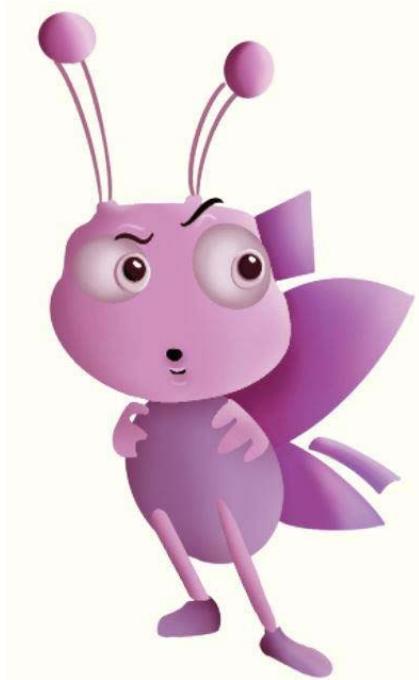
Developing the signature character for the brand and its application in all possible garments and trims is the main aim of the project. Initially the various cartoon characters in the market both domestic and international is studied. Character modifications based on colours or poses or the animation done to them is analyzed which could play a major role in the development of our own character. Next is the technique which was used to achieve or print these characters on to various garments and other related products like size label, packaging, etc. Majority of the characters were done screen printing over the garments or when there were lots of colors used the characters were printed digitally using reactive and discharge dyes. Few of the less complicated characters were achieved through embroidery and various other 3d techniques like glitter, pom pom, lace, puff or high density (HD) prints and stickers were used. Placement of the characters were in the middle or right side of the chest as a small coverage or in the middle of the garment over a big area and as discontinuous placement print. Based on all the gathered rough sketches of characters was made. Desired colour palette as per the requirements and uniqueness was experimented. 2D flat images with various combinations of shades was developed. From these combinations, highlights and shadows were given considering the effects to be achieved.
These characters were internally examined by group of management people and upon the common grounds final character was decided and given a name. Characters were placed upon different silhouette like onesies, sleeper, Pajama set, Bib and other trims like price label, polybag etc. Various dimensions of characters were experimented and by changing the positions according to the silhouette. Since its difficult and cost effective to achieve more number of colors in screen printing, digital is most preferred.
## V. DATA ANALYSIS AND FINDINGS
### a) Character Developed
### b) Application of Characters
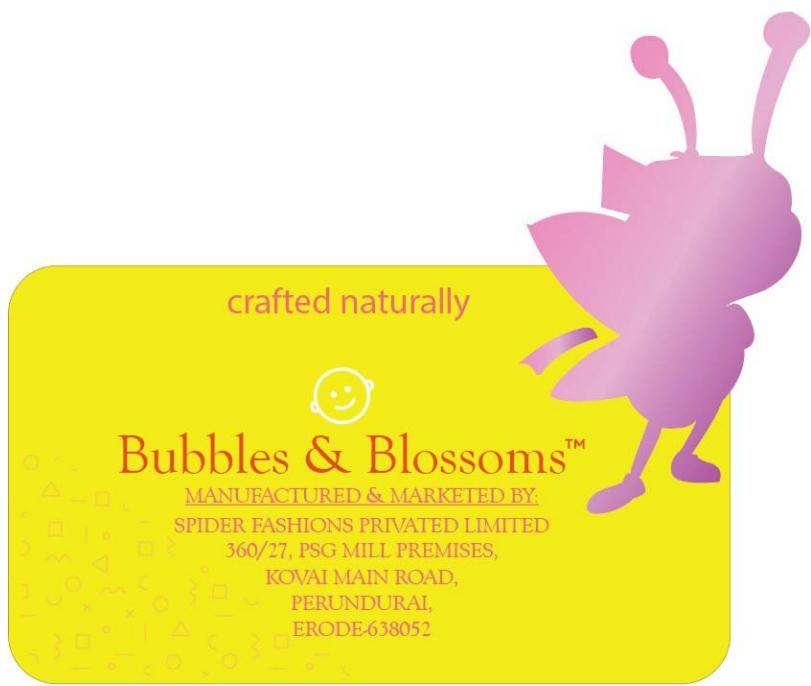
As the signature character was developed, basic product categories like onesies, polybag, wash care labels, price and hand tags has witnessed the application of this character and was being printed on various mediums.
Preference of the parents which was derived from the questionnaire was combined into bar chart and their feedback was noted for further developments.
### c) Results of the Questionnaire
Dual-axis bar chart is used for analysis the questionnaire survey analysis.Three charts are made.
1. Garment Preference -Type of fabric, colours, prints, size of prints.
2. Package Preference -Type of material, type of package, details in package.
3. Label preference -Size of label, placement of labels.
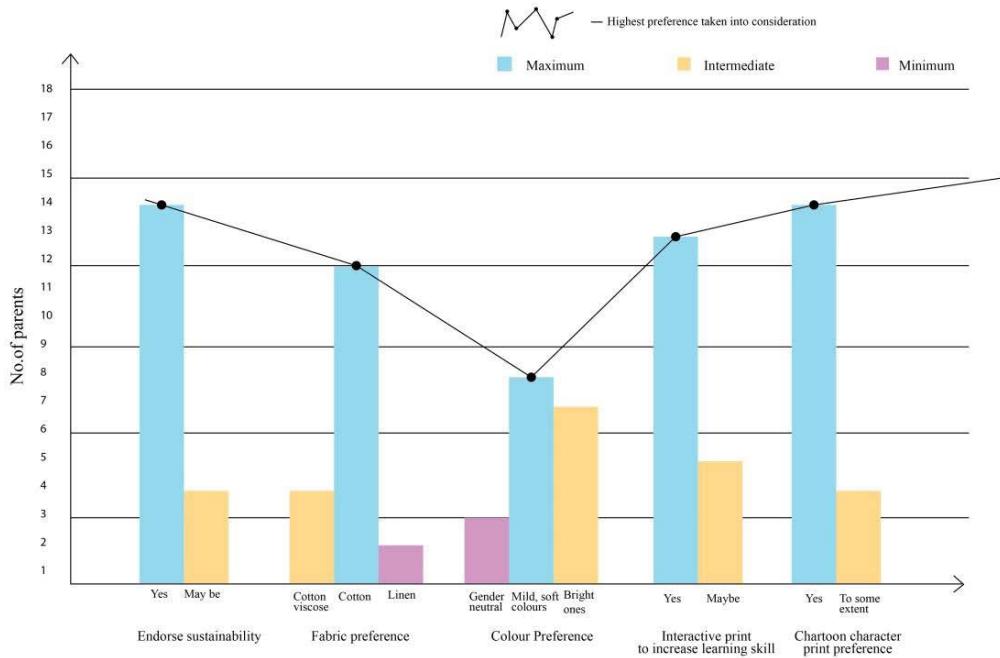 Garment Preference
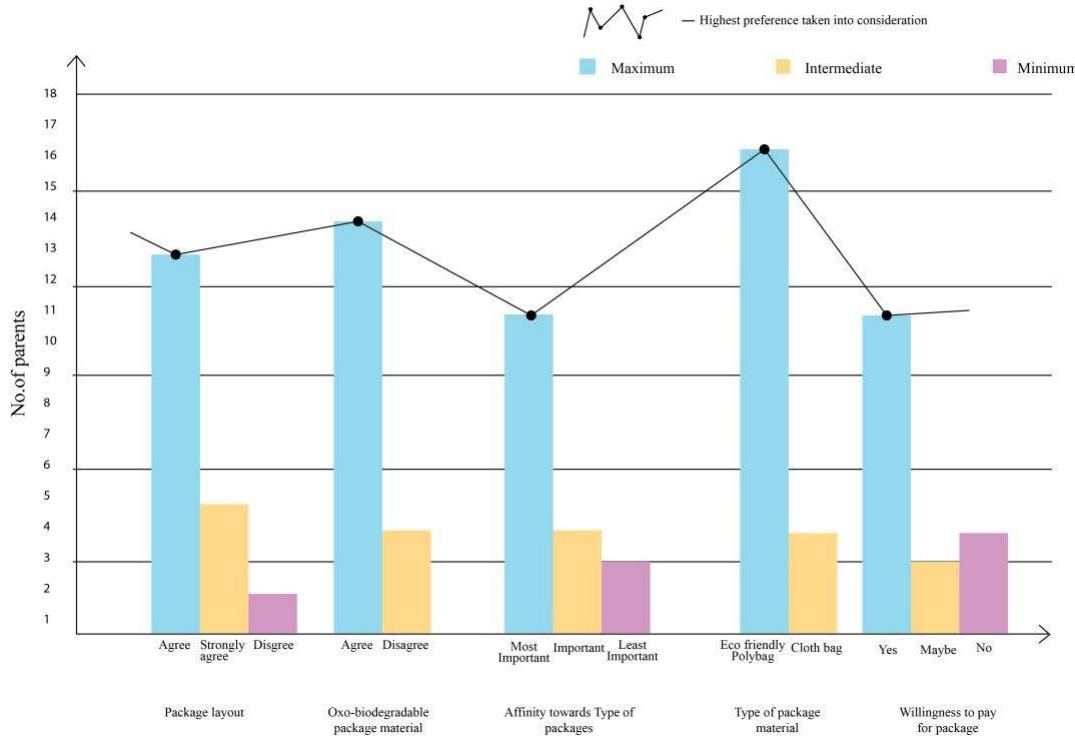
Package Layout Care label Preference
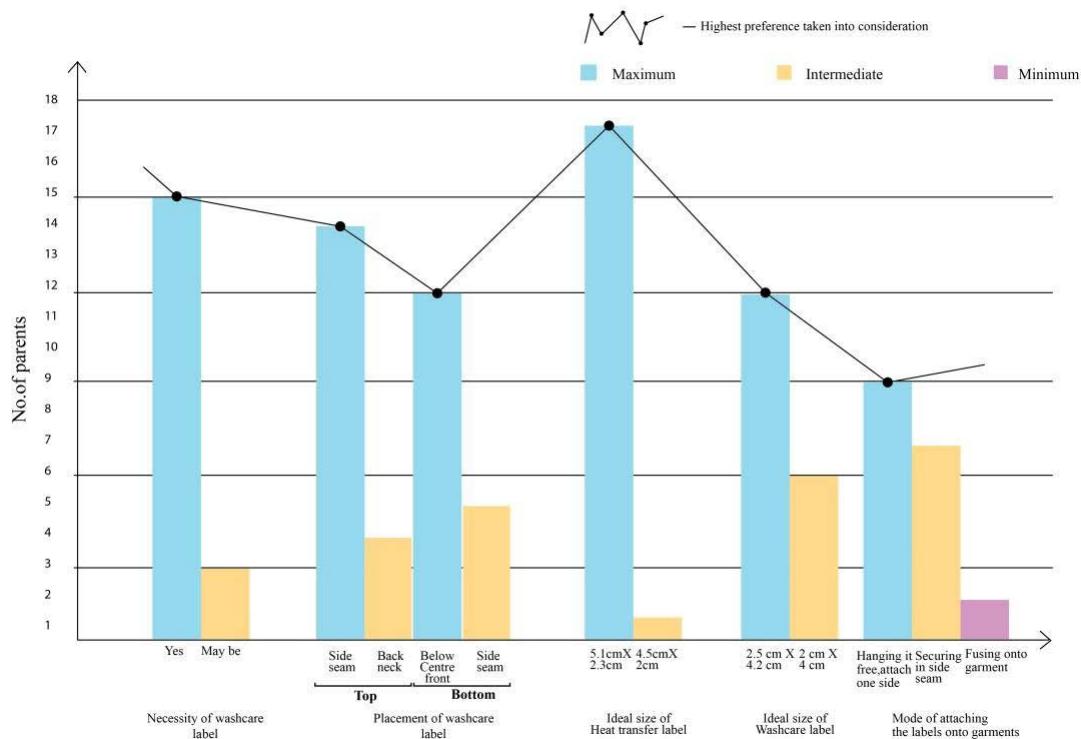
Thus it is noticed that most of the parents seemed to like the new cartoon character which was developed and their application on garment as chest print. They mostly preferred Digital printed character on garment, polybag and hand tags. Most of the parents were aware about the Oxo-biodegradable package which was to be used for sustainability and they were willing to pay for it. Organic cotton and cotton viscose blends were their choice of fabric and azo free dyes were used in the process of printing. Also, wash care labels and size label was felt extremely necessary by the parents and the position mentioned by them is either on side seam hanging it free securing one side or fusing it onto garments. Majority of parents are attracted towards sustainable packages and were willing to pay for the same which could help the brand create a unique brand
identity. Irrespective of season the parents seemed to be more affirmative towards mild colours rather than dark ones in their infants clothing.
## VI. COST SHEET FOR EACH GARMENT
which is used as trademark or signature to denote the brand. As the sizeof the print and design involved is less it is categorized into basic category symbolizing the price point from Rs. 149-199.
### a) Basic Category
Basic collection includes three garments with placement of character and the logo in the graphics
<table><tr><td>S.No.</td><td>GARMENT</td><td>FABRICS USED</td><td>GSM</td><td>PRINT</td><td>PRICE/PIECE</td></tr><tr><td>1.</td><td></td><td>Organic cotton</td><td>Body fabric: 210 Rib: 180</td><td>Placement: 4 x 4.9 cm (chest print)</td><td>Rs. 149</td></tr><tr><td>2.</td><td></td><td>Organic cotton</td><td>Body fabric: 210 Rib: 180</td><td>Placement: 10 x 11.5 cm (Mid bodice)</td><td>Rs. 180</td></tr><tr><td>3.</td><td></td><td>Organic cotton</td><td>Body fabric: 210 Rib: 180 (Contrast colour)</td><td>Placement: 9.7 x 8.3 cm (Continuous front to back)</td><td>Rs. 199</td></tr></table>
### b) Fashion Category
Fashion collection containing all over print according to season's theme with the logo being incorporated into all designs. As the coverage involved is all over the printing cost incurred is comparatively increased and thus the range is from Rs. 269 – 599.
<table><tr><td>S.No.</td><td>GARMENT</td><td>FABRICS USED</td><td>GSM</td><td>PRINT</td><td>PRICE/PIECE</td></tr><tr><td>1.</td><td></td><td>Organic cotton</td><td>Body fabric: 210Rib: 180</td><td>All over print</td><td>Rs. 399</td></tr><tr><td>2.</td><td></td><td>Organic cotton</td><td>Body fabric: 210Rib: 180(Contrast colour)</td><td>All over print</td><td>Rs. 399</td></tr><tr><td>3.</td><td></td><td>Organic cotton</td><td>Body fabric: 210Rib: 180(Contrast colour)</td><td>All over print</td><td>Rs. 450</td></tr><tr><td>1.</td><td></td><td>Organic cotton</td><td>Body fabric: 210Rib: 180</td><td>All over print</td><td>Rs. 269</td></tr><tr><td>2.</td><td></td><td>Organic cotton</td><td>Body fabric: 210</td><td>All over print</td><td>Rs. 329</td></tr><tr><td>3.</td><td></td><td>Organic cotton</td><td>Body fabric: 210Rib: 180(Contrast colour)</td><td>All over print</td><td>Rs. 479</td></tr></table>

<table><tr><td>S.No.</td><td>GARMENT</td><td>FABRICS USED</td><td>GSM</td><td>PRINT</td><td>PRICE/PIECE</td></tr><tr><td>1.</td><td></td><td>Organic cotton</td><td>Body fabric: 230</td><td>All over print</td><td>Rs. 599</td></tr></table>
### c) Cost Comparison for Signature Character
Comparison of Cost for Printing the Signature Character of Size Preferred by Parents is Done.
<table><tr><td>S.No</td><td>Type of Print</td><td>Dimensions</td><td>Cost Per Piece</td></tr><tr><td>1.</td><td>Pigment Print</td><td>4 cm × 4.9 cm</td><td>Screen 2500, Printing-Rs.7</td></tr><tr><td>2.</td><td>Reactive Print</td><td>4 cm × 4.9 cm</td><td>Rs.13</td></tr><tr><td>3.</td><td>Digital Print (Reactive Pigment)</td><td>4 cm × 4.9 cm</td><td>Rs.7</td></tr><tr><td>4.</td><td>Embroidery</td><td>4 cm × 4.9 cm</td><td>Rs.10</td></tr></table>
According to GSM of 230, 210 and type of print onesies price is compared for printing the signature character. GSM- 210, onesies garment, Garment price: 147
<table><tr><td>S.No</td><td>Type of Print</td><td>Price Per Kg</td><td>Print Price Per Garment</td></tr><tr><td>1</td><td>Pigment Print</td><td>Rs. 195</td><td>Rs. 32</td></tr><tr><td>2</td><td>Discharge Print</td><td>Rs. 260</td><td>Rs.47</td></tr><tr><td>3</td><td>Reactive Print</td><td>Rs. 325</td><td>Rs.55</td></tr></table>
GSM- 230, Onesies garment, Garment price:169
<table><tr><td>S.No</td><td>Type of Print</td><td>Price Per Kg</td><td>Print Price Per Garment</td></tr><tr><td>1</td><td>Pigment Print</td><td>Rs. 195</td><td>Rs. 48</td></tr><tr><td>2</td><td>Discharge Print</td><td>Rs. 260</td><td>Rs.65</td></tr><tr><td>3</td><td>Reactive Print</td><td>Rs. 325</td><td>Rs.81</td></tr></table>
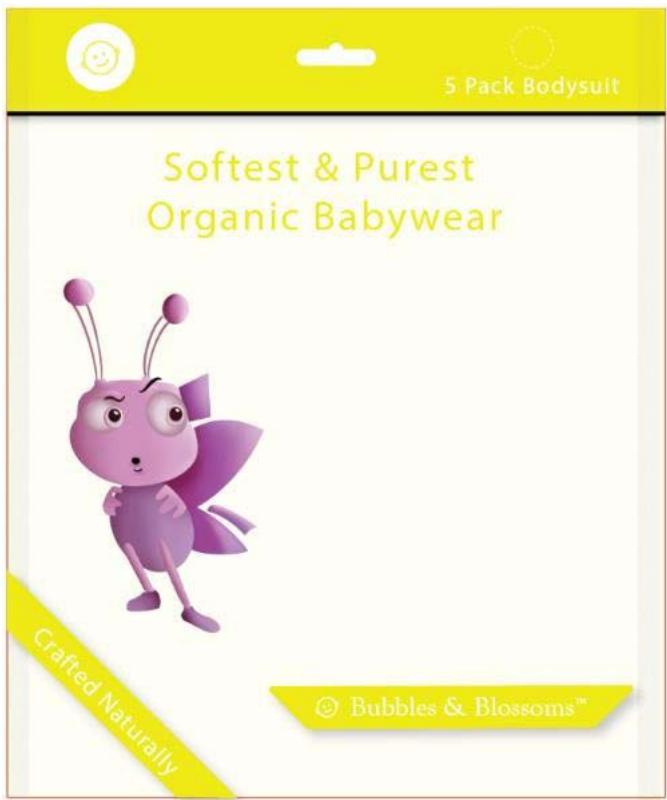
d) Package
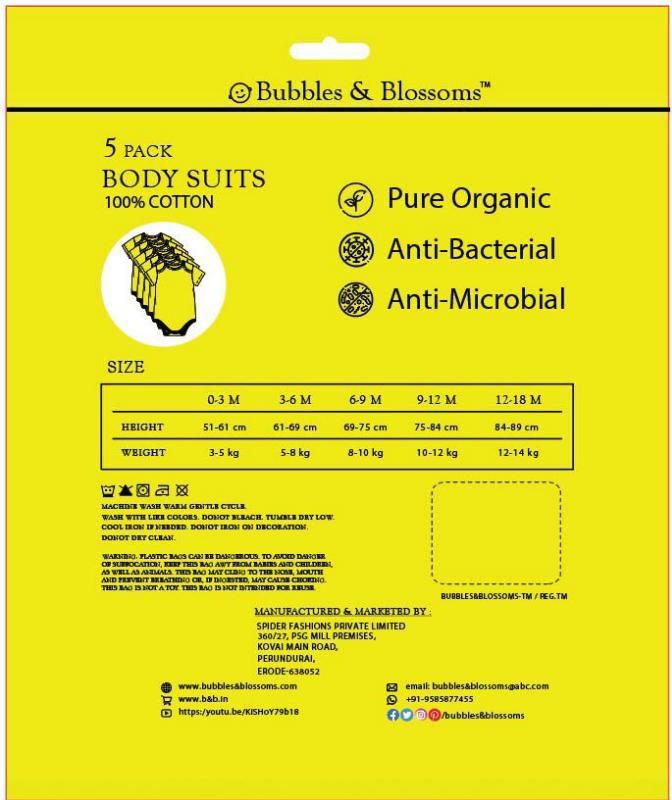
Dimension of polybag package: Length -30 cm; Width -25 cm
### e) Hand Tag
Labels attached to clothing containing brand name, significant logo, tag line and address. Designed in the form of cut out label to incorporate the signature character of the brand. White hardpaper (recycled paper) is used for the process. Dimension ofthe hand tag is: Length -7 cm; Width -8.25 cm
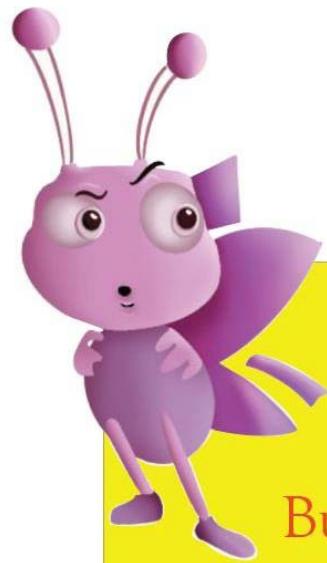 Front

Bubbles & Blossoms
Softest & Purest Organic Baby wear
Back
### f) Heat Transfer Label
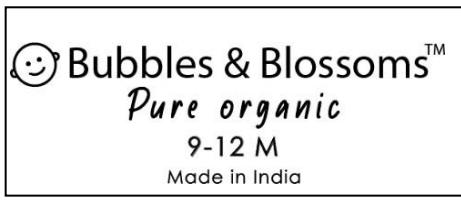
As per the preference of parent's heat transfer label is attached to back neck and centre back in bottom containing brand name, size and logo with trade mark.
Dimensions of heat transfer label is Length -2.3 cm; Width -5.1 cm.
### g) Washcare Label
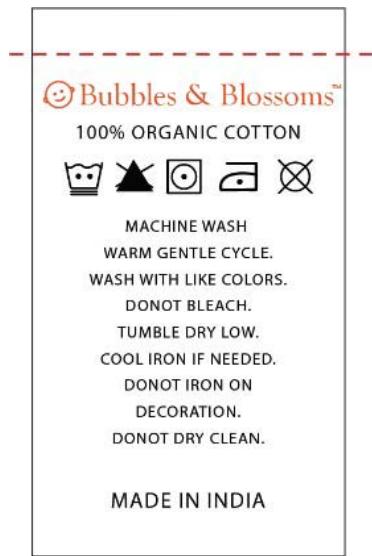
Type of washes and drying time, type of drying, type of ironing as per organic cotton is specified and is achieved onto cotton fabric using jacquard weaving. Dimensions of wash care label include Length -4.2 cm; Width-2.5 cm.
## VII. CONCLUSION
Therefore, a signature character was developed for a sustainable infants' wear brand through researches of existing characters, initial sketches of various options and thus arriving at a unique one. Their application onto various mediums like packages, garments, hand tags, price labels, social media promotions, etc., was made and their significant preferences from parents were considered onto further developmental process. Samples were developed for each of the applications of which stayed within brand identities. The ultimate goal was to meet sustainability in the application process and the choice of sustainable fabric like organic cotton and azo free dyes was being imperative. Consequently, the comfortability for the babies is achieved through silhouettes used. Further in-depth study could be conducted to develop various design options based on the signature characters and their placements on to the garments. This could also expand the possibilities of the brand to stand out in the competitive market.
Generating HTML Viewer...
References
12 Cites in Article
Richard Sorger,Jenny Udale (2017). The Fundamentals of Fashion design.
Jane Ashelford (2015). The art of dress, Clothes and society.
Yuldasheva Bahodirjon Qizi,Egamova Abduhalim Qizi (2015). ASSORTMENT OF SEWING KNITTED FABRICS AND CLOTHES MADE FROM THEM.
Afroza Rita,Akter (2018). Specific requirement for development in children's clothing: customer's preference and satisfaction for buying.
Archana (2020). Designing Kids Wear: Summary of Research & Recommendation for Kids Wear Designers.
Ashley Saeli (2018). A day in park: Developing children's wear collection.
David Sanchez (2016). Interactive message garment.
Rajkishore Nayak,Amanpreet Singh,Tarun Panwar,Rajiv Padhye (2019). Recent Trends in Sustainable Fashion and Textile Production.
A.Reshma,V.Brindha Priyadarisini,K. Amutha (2018). SUSTAINABLE ANTIMICROBIAL FINISHING OF FABRICS USING NATURAL BIOACTIVE AGENTS - A REVIEW.
Maarit Aakko,Ritva Koskennurmi-Sivonen (2013). Designing Sustainable Fashion: Possibilities and Challenges.
R Dogbey (2015). Symmetry in designs clothing fabrics.
Mehal Pandya (2016). Consumer buying behavior for chiildren apparel.
No ethics committee approval was required for this article type.
Data Availability
Not applicable for this article.
How to Cite This Article
Ragamalya M. 2026. \u201cImplementation of Developed Signature Character for An Eco-Friendly Infantswear Collection\u201d. Global Journal of Computer Science and Technology - F: Graphics & Vision GJCST-F Volume 23 (GJCST Volume 23 Issue F1).
Explore published articles in an immersive Augmented Reality environment. Our platform converts research papers into interactive 3D books, allowing readers to view and interact with content using AR and VR compatible devices.
Your published article is automatically converted into a realistic 3D book. Flip through pages and read research papers in a more engaging and interactive format.
Our website is actively being updated, and changes may occur frequently. Please clear your browser cache if needed. For feedback or error reporting, please email [email protected]
Thank you for connecting with us. We will respond to you shortly.