Inter-cultural approaches in literary pedagogy aim to enlighten the learners, researchers, and literary practitioners on social justice concerns, for instance, human rights, gender roles, and power relations, in their course objectives. Culturally responsible pedagogy theorists state that the inclusive litculture teaching method evades borders and boundaries of biases. However, the eco-centric approach argues that most pedagogical perspectives are human-centric in literary discourse. As a result, the powerrelation between ‘voices’: human and non-human, heard and unheard, exists as a binary non-symbiotic relation even in academic practices. This article investigates how an eco-centric approach can be implied in literary pedagogy by revisiting the undergraduate literature curriculum through qualitative and quantitative inductive methods. Firstly, undergraduate literature course objectives are diagnosed from an interdisciplinary lens that aims at developing symbiotic relationships among living beings.
## I. INTRODUCTION
Teaching social justice is prioritized in today's diverse academic classrooms to provide a holistic active learning environment where learners are expected to be fit as future social leaders. For this purpose, the literature curriculum is designed as a medium for establishing a sense of justice and equality among the learners. The objectives of literature courses taught in some Bangladeshi universities focus mainly on cultural and socio-political aspects. For example, Notre Dame University Bangladesh's (NDUB) undergraduate course syllabus of Nineteenth-Century Fiction shows that the main focus of the teaching of this course is to enable students to become observant of the paradigm shift in the socio-political and cultural history of that century in England. The students were also conscious of political concepts like the feminist movement interconnected with the selected novels of that period. Similarly, in another university, the University of Liberal Arts Bangladesh (ULAB), the reading of Victorian literature aims to explore the extraordinary cultural and social changes occurring during the Victorian Crisis and Compromise age. Hence, it is comprehensible that literary pedagogy is mainly focused on developing students' critical and analytical skills to build their consciousness of the cultural and socio-political aspects of that period.
However, such course objectives or goals are anthropocentric, and the teaching approaches reflected in those objectives can be identified as, according to Glen A Love, an "ego-conscious approach" (Glotfelty and Fromm 230) as teaching social justice pedagogy excludes "eco-consciousness" (ibid) or environmental voices from critical discussion. Non-human voices are not included in "Equity Talk" (McNair et al. 3), through which the issues of historical, social, cultural, and political perspectives that serve the purpose of adding multiple human narratives are examined and addressed. The primary objective of equity or inclusivity might fail if pedagogy marginalizes non-human voices. Therefore, it can be asserted that such anthropocentrism in literary pedagogy might not be a complete practice of empathy. The history of the anthropocentric approach initiated critical discussion of all forms of domination. The classroom concerns, therefore, revolve around race, hierarchy, gender discrimination, socio-economic condition, class oppression, cultural implications, etc. Hence, 'equity talk' and 'equity walk' in teaching social justice suggest that different socio-cultural backgrounds of human beings necessarily be encouraged to be discussed in the classroom so that social justice can be sustained. The syllabus is designed to be inclusive by incorporating texts written for representing various races, religions, and cultural backgrounds. In this regard, 'Nature' is 'Otherized' as it is not considered a literary 'genre' like race, language, or gender, according to Glen A. Love (Glotfelty and Fromm 233).
Consequently, these anthropocentric actions may result in causing a catastrophe in the future as many scientific inventions and business ideas brought immediate harm or potential long-term threats to the ecological system. Thereby generating "eco-consciousness" (Glotfelty and Fromm 230), a term coined by Glen A. Love, is vital in academia to encourage students toward creating a better space for both human and non-human entities. Whether in science, humanities, or business, the narrative of the non-human voice is seldom considered. The notion of human supremacy, a discussion made by David Ehrenfeld and quoted by Glotfelty, reflects how the growing threats to biological survival are subsided by the dominating idea of humanism to "celebrate the self-aggrandizing ego and to place self-interest above public interest" (Glotfelty and Fromm 226).
For this reason, this paper proposes that the inclusive teaching system could mitigate the threat to non-human and human species in general by reconsidering literary pedagogical approaches from an eco-centric lens to promote "symbiosis" (Glotfelty and Fromm 120); it implies William Ruekert's notion of a "cooperative arrangement that permits an increase in the levels of order" (ibid). Therefore, the paper revisits the undergraduate literary curriculum of a few Bangladeshi universities: Notre Dame University of Bangladesh, University of Liberal Arts Bangladesh, and North South University. This research thoroughly examines the course objectives of these universities to decide whether literary pedagogy involves an eco-centric approach in the classroom or not. In the second phase of data collection, 200 students were surveyed from various universities, including Notre Dame University Bangladesh, University of Liberal Arts Bangladesh, University of Dhaka, and Bangladesh University of Professionals. The findings suggest that students know critical discourses like class hierarchy, gender discrimination, and colonial and post-colonial impacts, which they learn from literature courses. However, for the same courses, like nineteenth-century and twentieth-century fictions: Tess of the d'Urbervilles, Pride and Prejudice, Wuthering Heights, Great Expectation, Sons and Lovers, and The God of Small Things, most learners are not aware of ecritical readings of texts and how symbiosis pitches for coexistence without binaries and prejudices. The paper concludes that an ecritical dimension, such as the inclusion of non-human narratives in the teaching-learning methods, could bring a complete description of justice, equality, and equity into the academic sphere.
## II. LITERATURE REVIEW
Most theorists defined social justice pedagogy from anthropocentric perspectives. For instance, Addy et al., in the book What Inclusive Instructors Do, say that most of the learners trained by an inclusive teaching method exhibit diversity regarding their social concerns and political viewpoints (14). Therefore, key terms such as diversity, equality, equity, and inclusion are operationalized in the classroom to familiarize the learners with inclusiveness. Inclusive teaching thus emphasizes that the voice of all humans must be heard and appreciated (Addy et al. 6).
Moreover, Eberly Center for Teaching Excellence Intercultural Communication Center, Carnegie Mellon University, recommended in "A Guide for Faculty: Teaching in an Increasingly Multi-cultural Setting, Recognizing and Addressing Cultural Variations in the Classroom" that the roles of the teachers are not limited to being a preacher of textbook knowledge only but also can portray the roles of guides or leaders. In literary pedagogy, the role of a teacher is explicitly interdisciplinary as cultural consciousness is aimed to develop among the learners along with their critical and analytical abilities. However, the learners' ability to build empathy toward the environment and ecology is hardly mentioned in any of those theories or learning goals in the curriculum. The idea of adding non-human narratives in pedagogy could be a successful turning point in response to "entire ecosystems are collapsing," as Greta Thunberg proposes in many of her lectures and seminars. ("Transcript: Greta Thunberg's Speech at the U.N. Climate Action Summit")
Similarly, the concept of 'Equity Talk' and 'Equity Walk' is addressed in the book *From Equity Talk to Equity Walk*. Still, the idea of equity remains incomplete as literary pedagogy tries to exercise human narratives. This book states that "the paradox of equality requires a critical examination of the historical, social, cultural, and political perspectives that make the concept of equality a misnomer for many in our society, especially minoritized students" (McNair et al. 8). The term 'marginalized' has been widely used in academic discourses but only targeting at racial and gender marginalization. Hardly, the discourse on how human actions marginalize non-human beings in a text is a concern.
remarks that academicians should recognize and preach Barry Commoner's first law of ecology, "Everything is connected to everything else" (ibid); that indicates inclusion is possible if it is perceived how human beings can delve into the world of ecology and see it as a web to reconnect with other species; and thus, growing a sense of compassion for them. If such notions are infused through literary pedagogy, empathy can be practiced in its truest sense, according to ecopatriots.
In another essay, "Some Principles of Ecocriticism," William Howarth explains what it means to be an eco-critic. The educator who can also be identified as an eco-critic might be able to judge "the merits and faults of writings that depict the effects of culture upon nature, to celebrate nature, berate its despoilers, and reversing their harm through political action." (Glotfelty and Fromm 69). Howarth also addresses the eco-critics by stating that "classic disciplines are suspicious of new approaches and will dismiss them as flimsy" (Glotfelty and Fromm 77), implying that "Literary theorists will regard eco-critics as insufficiently problematic...An ethical politics is welcome, yet not if it focuses on such non-human topics as scenery, animals, or landfill dumps." (ibid) In this essay, he shows the possibility of merging pedagogical structure and ecological concepts by intersecting the spheres of ecology and ethics and thus, pointing out ecocriticism's interdisciplinary qualities.
Therefore, to include the suppressed voice of natural entities, eco-critics try to redirect the humanistic ideology and critique prevalent in today's literary and scientific studies. From this perspective, Howarth also criticizes the cultural critics who "share an attachment to ideology and a distrust of physical experience" (Glotfelty and Fromm 79). For example, he notes that "Marxist theory has influenced environmental history, often by ignoring natural science" (ibid). Thus, he points out how literature reading is shaped by cultural aspects such as race, gender, class, money, and other factors, while the influence of landscape or environment remains out of the discussion.
In "Literature and Ecology," William Rueckert considers how teaching, reading, and writing about literature can benefit humans in perceiving their relation to the biosphere to understand the reason behind their anthropocentric actions. Rueckert takes the basic principle of ecology: 'everything is connected to everything'—referring to the interdisciplinary study of literature and ecology, which might assist in connecting eco-social aspects and adding a new perspective to teaching and learning in the classroom. He claims, "As readers, teachers, and critics of literature, we are used to asking selves questions-often very complex and sophisticated ones—about the nature of literature, critical discourse, language, curriculum, liberal arts, literature and society, literature and history" (Glotfelty and Fromm 114).
Moreover, Rueckert's essay can work as a symbiotic proposal to design classrooms with an "ecological purpose" (121) where "creative energy" flows out of the poet into the poem, into the reader, out of the reader, and into the classroom, and then back into the readers and out of the classroom with them, and finally back into the other larger community in a never-ending circuit of life." (ibid)
Similarly, in "Revaluing Nature: Toward an Ecological Criticism," Glen A. Love makes a distinction between "eco-consciousness" and "ego-consciousness" (Glotfelty and Fromm 230), where the former indicates writing about and responding toward Nature and the latter is associated with human-centric actions and its implications by exploiting Nature. He also asserts that critical interpretation centers around problems are related to humans, emerging from "ego-consciousness" (ibid) and causing a binary effect discriminating between Nature and humans. That is why the practice of literary criticism in the classroom is mainly human culture oriented. Hence, Glen A. Love explains that "Race, class, and gender are the words which we see and hear everywhere at our professional meetings and in our current publications." (Glotfelty and Fromm 226)
According to Cheryl Burges, as Glen A. Love points out, "the English profession is not addressing the issue of the environment and has failed to perceive the relation between Nature and culture to emphasize the need to live in the natural world without causing any destruction and extinction" (ibid). He also highlights her remark about the supremacy of cultural crises: civil rights, women's liberation, and war. Hence, Love conveys that Nature-oriented literature may offer "a needed corrective, for one very important aspect of this literature is its regard- either implicit or stated- for the non-human." (Glotfelty and Fromm 237). The job of those who profess English would be not to obscure and alienate the notion of ecocritical studies of literature and language from the mainstream critical studies of literature.
In the same manner, Michael J. McDowell, in his essay "The Bakhtinian Road to Ecological Insight" connects the philosophy of Mikhail Bakhtin, who proposed the idea of considering the relation between non-human and human voices by creating a condition called "heteroglossia" (Glotfelty and Fromm 380) where different and multiple voices collide and co-relate with each other. Thus, decentralization occurs in such spheres where there is no supremacy of human voice over non-human voice—suggesting that Bakhtinian dialogism emphasizes both natural and humanistic phenomena. McDowell points out the problem with Nature writing because "Much writing today continues to view nature solely as a backdrop to the significant things, which are human matters divorced from a nature that remains "out there." (Glotfelty and Fromm 379). According to McDowell, Bakhtin's idea of "Dialogic" (Glotfelty and Fromm 372) is opposed to the monologic reading of a text that only promotes a single voice—the voice of humans emerging from egoism. This idea can be incorporated into the classrooms by promoting the concept that the voices of all entities need to be recognized through studying landscape literature. Thus, such an approach can help subside the anthropocentric notion of studying literature only from human-centric cultural perspectives.
The literary pedagogy and curriculum need to be revised to make the classroom space for inclusive interdisciplinary studies to promote symbiosis: coexistence. The literature reviewed in this paper bridges the gaps in existing literary pedagogy and explicates how the ecocritical approach works toward establishing an inclusive curriculum.
## III. METHODOLOGY
This paper performs qualitative analysis in scrutinizing the course objectives and learning goals in Bangladeshi universities with reference to three renowned private institutions: Notre Dame University Bangladesh, University of Liberal Arts Bangladesh, and North South University. As a quantitative approach, this research surveys 200 undergraduates studying B.A. in English in Bangladesh with a questionnaire to extract the learning goals. Students, mainly from Notre Dame University Bangladesh, University of Liberal Arts Bangladesh, University of Dhaka, and Bangladesh University of Professionals, responded to questionnaires relevant to their course objectives and learning outcomes of studying literary texts like Tess of the d'Urbervilles, Pride and Prejudice, Wuthering Heights, Great Expectation, Sons and Lovers, and The God of Small Things. Finally, classroom observation from 2018-2021, consisting of approximately 600 students at Notre Dame University Bangladesh, is also used as comparative data to understand the learning outcome of the eco-centric approach.
A survey questionnaire was prepared to collect data on the journey of literary reading and its bridge with socio-political awareness or social justice pedagogy. The data were analyzed by recognizing the patterns of answers given by the responders, i.e., social justice pedagogical practices are prioritized in those courses. The empirical studies on social justice pedagogical theories are diagnosed for the literature course curriculum. This paper, thereby, prescribes whether ecocritical awareness can contribute to the concern of equity in syllabus designing and classroom environment while discussing being culturally responsive. Moreover, related essays from The Ecocriticism Reader are used to support the argument of this paper. The suggestions of the ecocritical reading impact were connected with the findings from quantitative analysis.
However, for this research, the quantitative data are collected from a few universities in Bangladesh. Therefore, the research outcomes might address only a limited number of academic situations. So, there is immense scope for conducting this research in the broader context, even outside Bangladesh. Moreover, the pedagogical structure of other courses, especially those of the humanities and arts disciplines, can also be considered to observe different data analysis outcomes.
## IV. RESULTS
This section focuses on four data sets. Firstly, the academic priorities as learning goals in literary pedagogy are collected by surveying 200 undergraduate students in the Department of English of several universities in Bangladesh, mainly students from Notre Dame University (NDUB), University of Liberal Arts Bangladesh (ULAB), University of Dhaka, and Bangladesh University of Professionals (BUP). This data is collected through online questionnaires and in-person question forms, proving that themes, analytical and writing skills, and literary movements are the most prioritized topics in literary pedagogy, as shown in Figure 1.
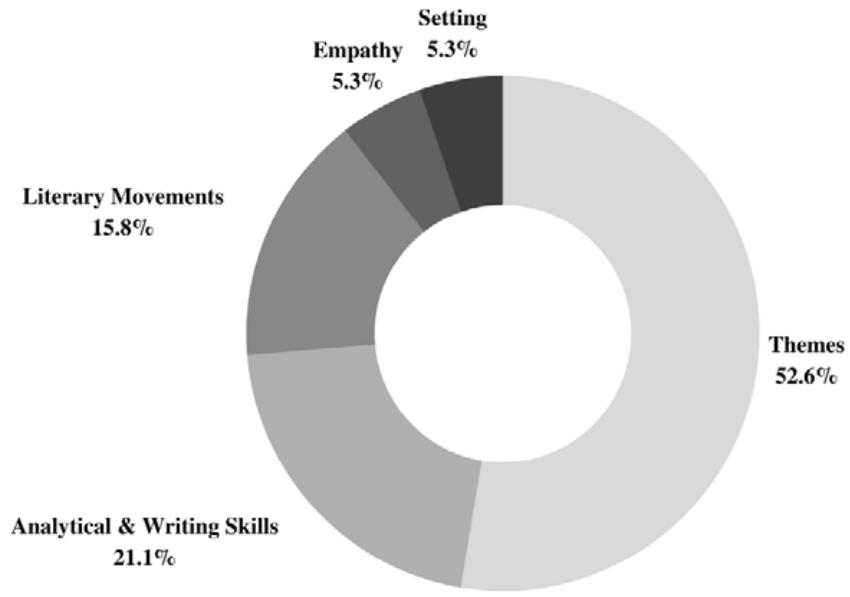 Academic focus while studying fiction Figure 1 As seen in Figure 1, learning 'Setting' and developing 'Empathy' are also prioritized; however, compared to other learning goals, the course objective primarily focuses on anthropocentric learning outcomes. Indeed, not a single student of those 200 respondents commented on different learning outcomes like Nature, ecology, eco-consciousness, and environmentalism from the following literary texts of 19th and 20th-century fiction: Tess of the d'Urbervilles, Pride and Prejudice, Great Expectations, Sons and Lovers, Lord of the Flies, and The God of Small Things.
To be precise on the learning goals, the second data, which includes the same subjects and locations, highlights that the most preferred learning outcomes were teaching themes and literary movements, as highlighted in Figure 2. Almost all the 200 students circled the grids of themes, history, psychoanalysis, Marxist analysis, and feminist approaches in the aforementioned texts with multiple checkboxes. They are well oriented with these while learning. As no one mentioned eco-centric reading or analysis of those texts, it can be interpreted that the English departments in Bangladesh generally exclude eco-consciousness from social justice pedagogy.
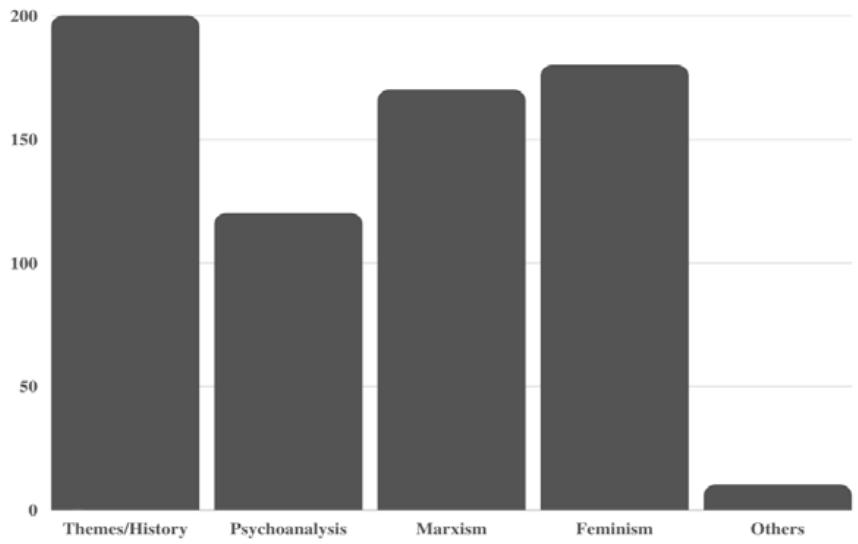 Figure 2
Another notable result of the impact of anthropocentric approaches is significant and robust, possibly because of the long-term effect of its exercise on the departments of English. The third data set reveals how themes and literary movements make students socially responsible as they understand gender roles, class hierarchies, socio-political prejudices, and boundaries. The same 200 undergraduate students of the exact location were surveyed with these five questions, as seen in Figure 3. On the contrary, these learners might be least aware of how Nature can portray the role of a social player.
Anthropocentric Learning Impact
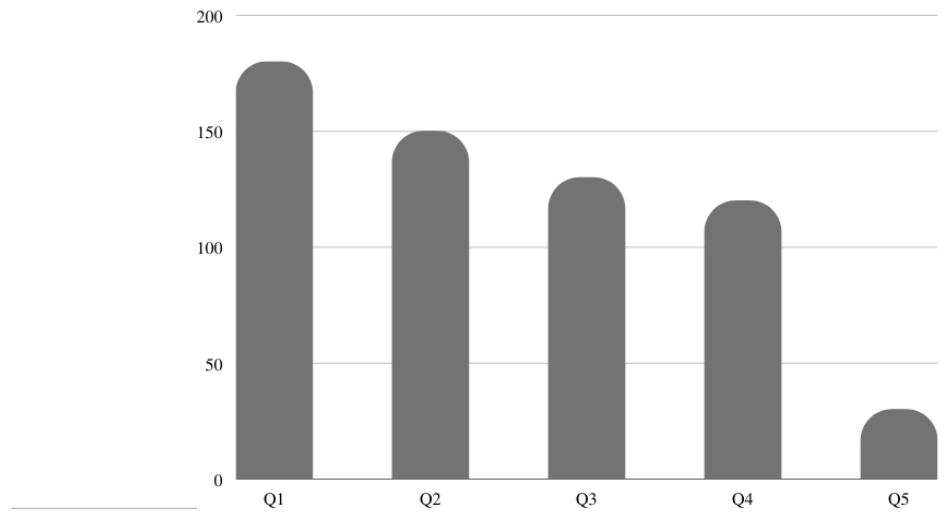 Figure 3
### I'm aware of
- Q1: class hierarchies
- Q2: gender-roles
- Q3: colonialism
- Q4: cultural prejudices
- Q5: nature as a social player
The fourth data set is performed in closed room observation on participants at Notre Dame University Bangladesh, from 2018 to 2021, where students were familiarized with the eco-centric pedagogical approach, and its impact on students was tested.
For example, while teaching Tess of the d'Urbervilles by Thomas Hardy, one of the assessments was on its ecofeminist reading of the novel: 'How does landscape is also gazed & gendered?' Similarly, while teaching Wuthering Heights by Emily Brontë, boundaries formed by social class associated with ambiance and environment was one of the assignment topics. In Great Expectations by Charles Dickens, students were assessed with this question: 'How is the theme entwined in ambiance where non-human voices are narrating the mode and tone of the novel?'
Likewise, in the course objectives of Sons and Lovers by D. H Lawrence, Lord of the Flies by William Golding, and The God of Small Things by Arundhati Roy, the primary focus of teaching was eco-centric in various ways: How landscape shapes its characters in Sons and Lovers, how landscape imageries' dissent against the government in The God of Small Things, how does
Nature play the role of a doer rather than a mere victim or how human id and eco-consciousness are in a war in the Lord of the Flies, and similar ecocritical perspectives were included. Even for plays like Doll's House by Henrik Ibsen, students were assigned to write a term paper on 'Ecofeminism: Marginalization through Sugar-coated Words.'
Gradually, the number of students being environmentally conscious grew higher, according to Figure 4. Learners started understanding the three goals of this approach: a) the environment as an active doer, not a passive background only, and b) the coexistence of humans and other living beings in the cosmos versus the global climate crises due to the human nature of colonizing the Nature, and thirdly, c) cognitive learning on the notion of 'earth matters.'
## Ecocentric Approach: Classroom Observation

earth as an active doer rather than a passive background

symbiosis/co-existence versus colonizing Nature
 earth matters
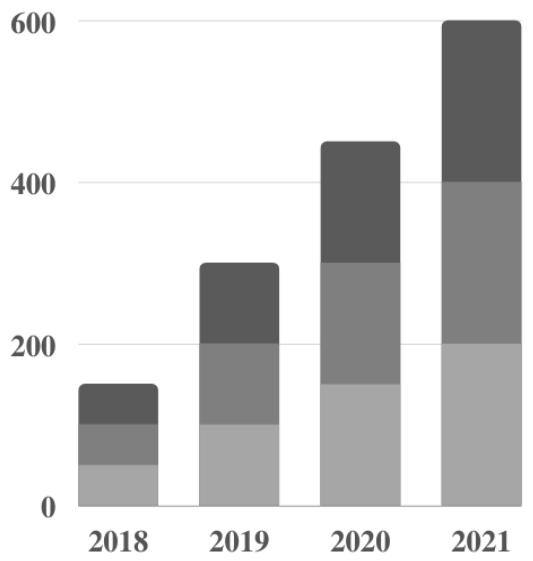 Figure 4
Among these 600 learners, 100 students organized a daylong festival as one of the cumulative course projects funded by Notre Dame University Bangladesh's English Club, 'Environmental Vanguard Award 2019', at Notre Dame University Bangladesh premises. It was an "inter-college-university competition where participants around the country competed in three categories: Photo-Story, Visual Poetry, and Short Film." According to newspaper articles and program flyers, sessions were the followings, as seen in Figure 5: 1) a workshop on photo-art narrative, b) dance recital mixed media live art performance on Greta Thunberg's speeches, c) audience activity to interact with the non-human voices entitled 'Pottery-Play,' d) lecture on 'Eco-conscious versus Ego-conscious approach in Liberal Arts' e) screening and exhibiting all the nominated photos story, visual poetry, and short films themed on environment or ecology. Some of the titles of the Photo Stories were: 'For Next Generation' by Alex Romario, 'Threats on the Rise' by Morad Ahammad Khan, and 'Stars without Names' by Tomal Samad, who obtained USD 3000 from the United Nations Development Program (UNDP) Bangladesh during that event as a fund to complete a photo story project in the coastal belt of Bangladesh on the effect of climate change upon the inhabitants. In the Short Film Category, some of the titles are 'Salvation of Oxygen' by Fuaduzzaman Fuad, who received the same grant for filming the same project, says the press release published in Dhaka Tribune. According to the news article, many literature students also won cash prizes in the Visual Arts
Installation and Visual Poetry sections themed on eco-consciousness and ecocriticism. Thus, the competition encouraged the participants to integrate environmental concepts into their project, thereby developing a perception of eco-consciousness.
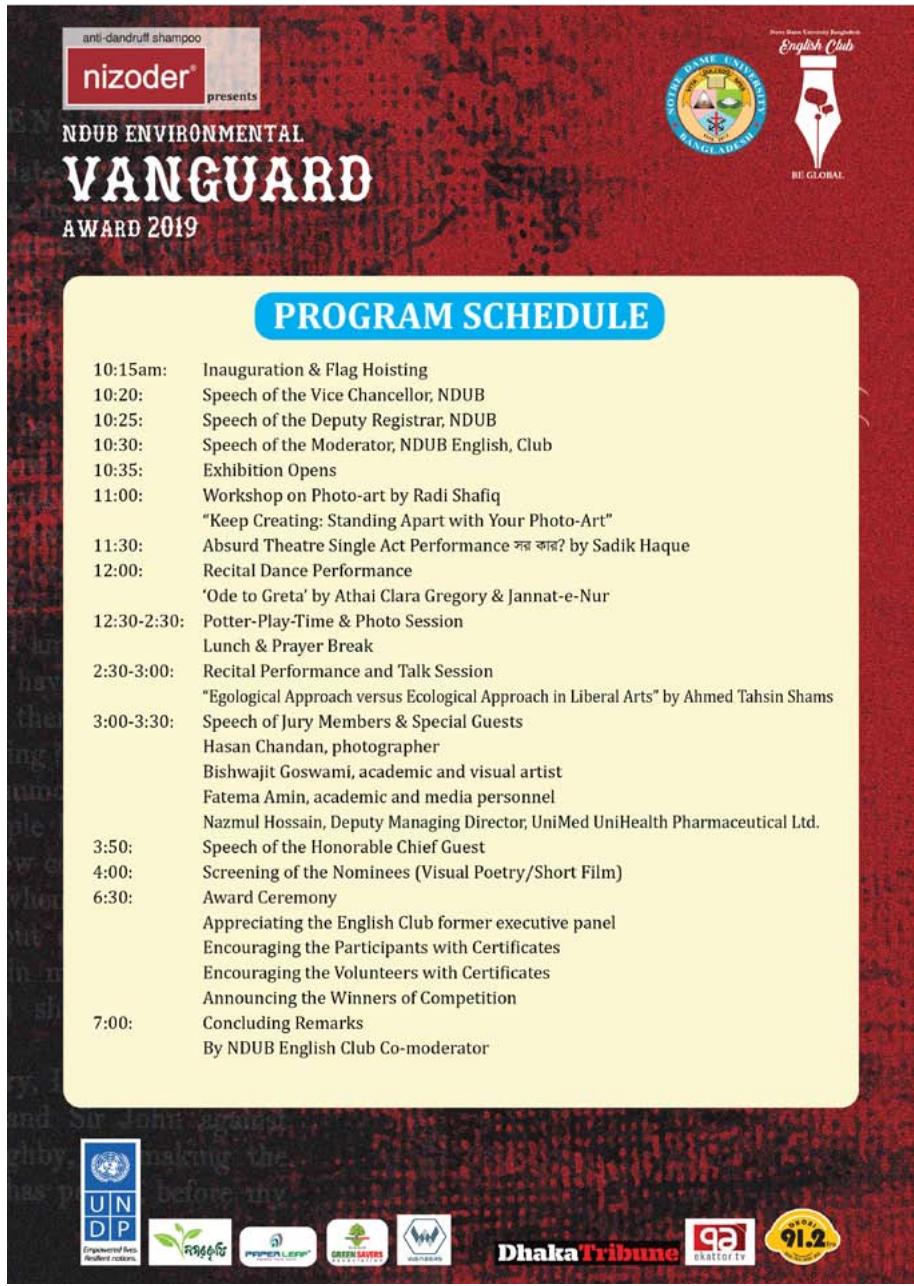 Figure 5
## V. DISCUSSION
The purpose of this research is to propose ecocriticism to be included in the social justice pedagogical narrative that eventually processes the human mind to get rid of hubris and consider human beings as a part of the ecosystem rather than at the hierarchical top level of the ecosystem. Such a mindset of hierarchy, this paper claims, might not wholly serve the purpose of eliminating prejudices and promoting empathy through the literary curriculum.
Scrutinizing the course objectives of Notre Dame University Bangladesh (NDUB), University of Liberal Arts Bangladesh (ULAB), and North South University (NSU), it is found that, for instance, courses like Victorian Literature "aims to develop student's analytical and critical skills through an engagement with a range of issues and methodologies in literary studies," says the syllabus of ULAB and focuses on "the evolution of novels and poetry amidst the progress, and prosperity of the Victorian Age." Also, the course objective claims to make students "able to interpret and analyze Victorian ideals and their impact on society and literature" to "value literature as it relates to life" and "empathize with others in need" by developing "tolerance." On the other hand, the 19th century Prose and Fiction course at NSU similarly focuses on the "underlying social themes of empire and industrialization... in an attempt to plot the course of the American search for an establishment of national identity."
The results clearly demonstrate the progress of incorporating ecocriticism in literary pedagogy. From course objectives to learning goals, anthropocentrism doesn't include ecocentrism, whereas ecocentrism includes anthropocentrism. The way anthropocentrism had a successful journey through academic discourses to lessen patriarchal prejudices, class conflicts, and cultural hegemonic power relations, eco-centrism is expected to have a similar victory if included in social justice pedagogy.
The limitation of this study is confined to its subjects and location, and researchers can further explore other social contexts of eco-consciousness in their regions, countries, languages, and disciplines. However, shreds of evidence and experiences from this research pave the way for a reconsideration of rereading literary texts to create an inclusive curriculum by which this paper firmly claims not only a voice for racial or cultural discrepancies but also for non-human voices to be heard.
Generating HTML Viewer...
References
10 Cites in Article
(2014). Works Cited.
Tracie Addy,Marcella (2021). A Guide for Faculty: Teaching in an Increasingly Multi-Cultural Setting, Recognizing and Addressing Cultural Variations in the Classroom.
Cheryll Glotfelty (1996). Introduction: Literary Studies in an Age of Environmental Crisis.
William Howarth (1996). The Ecocriticism Reader: Landmarks in Literary Ecology, Cheryll Glotfelty, 1996. The University of Georgia Press, Athens. 415 pages. ISBN; 0-8203- 1780-2 hardcover; 0-8203-1781-0 paperback. $45.00 hardcover; $19.95 paperback..
Glen Love (1996). Revaluing Nature: Toward An Ecological Criticism.
Michael Mcdowell (1996). The Bakhtinian Road to Ecological Insight.
Tia Mcnair,Brown (2020). From Equity Talk to Equity Walk.
(2019). Anthropology Award Winners.
William Rueckert (1996). Literature and Ecology: An Experiment in Ecocriticism.
Nurul Aini,Lisetyo Ariyanti (2019). PRESUPPOSITION AND ENTAILMENT USED IN GRETA THUNBERG’S SPEECH AT UN CLIMATE ACTION SUMMIT 2019.
No ethics committee approval was required for this article type.
Data Availability
Not applicable for this article.
How to Cite This Article
Ahmed Tahsin Shams. 2026. \u201cEco-centric Versus Anthropocentric Approach in Literary Pedagogy Inclusion of Non human Narratives as Teaching Social Justice\u201d. Global Journal of Human-Social Science - A: Arts & Humanities GJHSS-A Volume 22 (GJHSS Volume 22 Issue A9).
Explore published articles in an immersive Augmented Reality environment. Our platform converts research papers into interactive 3D books, allowing readers to view and interact with content using AR and VR compatible devices.
Your published article is automatically converted into a realistic 3D book. Flip through pages and read research papers in a more engaging and interactive format.
Our website is actively being updated, and changes may occur frequently. Please clear your browser cache if needed. For feedback or error reporting, please email [email protected]
Thank you for connecting with us. We will respond to you shortly.