Improving Trucks Management at Dumpsites through the Application of Queue Theory- The Case of Solous Iii Dumpsite, Igando, Lagos State

Article ID

T0Z0V

Optimizing truck queues in dumpsites.

Improving Trucks Management at Dumpsites through the Application of Queue Theory- The Case of Solous Iii Dumpsite, Igando, Lagos State

Christopher Gbenga
Christopher Gbenga
Akande
Akande
DOI

Abstract

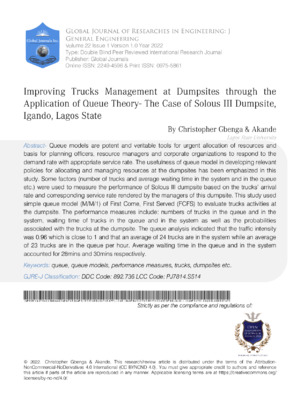
Queue models are potent and veritable tools for urgent allocation of resources and basis for planning officers, resource managers and corporate organizations to respond to the demand rate with appropriate service rate. The usefulness of queue model in developing relevant policies for allocating and managing resources at the dumpsites has been emphasized in this study. Some factors (number of trucks and average waiting time in the system and in the queue etc.) were used to measure the performance of Solous III dumpsite based on the trucks’ arrival rate and corresponding service rate rendered by the managers of this dumpsite. This study used simple queue model (M/M/1) of First Come, First Served (FCFS) to evaluate trucks activities at the dumpsite. The performance measures include: numbers of trucks in the queue and in the system, waiting time of trucks in the queue and in the system as well as the probabilities associated with the trucks at the dumpsite. The queue analysis indicated that the traffic intensity was 0.96 which is close to 1 and that an average of 24 trucks are in the system while an average of 23 trucks are in the queue per hour. Average waiting time in the queue and in the system accounted for 28mins and 30mins respectively. The study’s results also showed 96% probability that a truck will queue on arrival before being served while the probability that a truck will not queue on arrival is just 4%. The result of the study was validated through the use of Chi-square test. The outcome of the test was not significant as P-value was less than the critical value. It was observed based on the findings of the study that the problem of long queue will persist if no drastic measure is put in place by the dumpsite’s managers. Hence, the study recommended that another service channel be created to enhance the service rate; creation of slip roads of at least 500meters on both sides of the major road to serve as waiting area for the trucks to reduce traffic congestion at the dumpsite’s area and consequently improve the level of trucks’ turn-around from the dumpsite.

Improving Trucks Management at Dumpsites through the Application of Queue Theory- The Case of Solous Iii Dumpsite, Igando, Lagos State

Queue models are potent and veritable tools for urgent allocation of resources and basis for planning officers, resource managers and corporate organizations to respond to the demand rate with appropriate service rate. The usefulness of queue model in developing relevant policies for allocating and managing resources at the dumpsites has been emphasized in this study. Some factors (number of trucks and average waiting time in the system and in the queue etc.) were used to measure the performance of Solous III dumpsite based on the trucks’ arrival rate and corresponding service rate rendered by the managers of this dumpsite. This study used simple queue model (M/M/1) of First Come, First Served (FCFS) to evaluate trucks activities at the dumpsite. The performance measures include: numbers of trucks in the queue and in the system, waiting time of trucks in the queue and in the system as well as the probabilities associated with the trucks at the dumpsite. The queue analysis indicated that the traffic intensity was 0.96 which is close to 1 and that an average of 24 trucks are in the system while an average of 23 trucks are in the queue per hour. Average waiting time in the queue and in the system accounted for 28mins and 30mins respectively. The study’s results also showed 96% probability that a truck will queue on arrival before being served while the probability that a truck will not queue on arrival is just 4%. The result of the study was validated through the use of Chi-square test. The outcome of the test was not significant as P-value was less than the critical value. It was observed based on the findings of the study that the problem of long queue will persist if no drastic measure is put in place by the dumpsite’s managers. Hence, the study recommended that another service channel be created to enhance the service rate; creation of slip roads of at least 500meters on both sides of the major road to serve as waiting area for the trucks to reduce traffic congestion at the dumpsite’s area and consequently improve the level of trucks’ turn-around from the dumpsite.

Christopher Gbenga
Christopher Gbenga
Akande
Akande

No Figures found in article.

Christopher Gbenga, Akande. 2026. “. Global Journal of Research in Engineering – J: General Engineering GJRE-J Volume 22 (GJRE Volume 22 Issue J1): .

Download Citation

Journal Specifications

Crossref Journal DOI 10.17406/gjre

Print ISSN 0975-5861

e-ISSN 2249-4596

Classification
GJRE-J Classification: DDC Code: 892.736 LCC Code: PJ7814.S514
Keywords
Article Matrices
Total Views: 1821
Total Downloads: 22
2026 Trends
Research Identity (RIN)
Related Research
Our website is actively being updated, and changes may occur frequently. Please clear your browser cache if needed. For feedback or error reporting, please email [email protected]

Request Access

Please fill out the form below to request access to this research paper. Your request will be reviewed by the editorial or author team.
X

Quote and Order Details

Contact Person

Invoice Address

Notes or Comments

This is the heading

Lorem ipsum dolor sit amet, consectetur adipiscing elit. Ut elit tellus, luctus nec ullamcorper mattis, pulvinar dapibus leo.

High-quality academic research articles on global topics and journals.

Improving Trucks Management at Dumpsites through the Application of Queue Theory- The Case of Solous Iii Dumpsite, Igando, Lagos State

Christopher Gbenga
Christopher Gbenga
Akande
Akande

Research Journals