## I. INTRODUCTION
The Semantic Web's ability to organize information, ensuring more accurate searches by meaning and not by textual content, is one of the advantages of the Semantic Web. [1], this strength can be used to create a knowledge base of the traditional genres and groups of the city of Bogota from an Ontology, however, one of the biggest challenges in building it is the informal nature of this economic activity, since there is no website where the musical groups are registered, neither is there an official census by government entities of the groups, Although there are approximate data from 2006 [2] and 2012 [3] and a Colombian Popular and Artistic Movement (MOPAC) which attempted to bring together these artists, there are no exact information, considering that it is easy for a group of artists to create a new group just by inviting colleagues to be part of it, as it is also true that, as a result of discussions among their members, musical groups may disappear.
As a result of the informality previously described and that in the city of Bogota, citizens frequently contact musical groups to celebrate special dates and events, it is in certain circumstances a complex task to contact them, given that most of these musical groups at the time of offering their services do so through traditional channels such as: business cards, advertising on billboards, posters in the streets, few have their own website, do not make efficient use of social networks and often have outdated contact information, these shortcomings were the ones that motivated the development of a semantic web model which creates a knowledge base on the genres and traditional musical groups in the city of Bogota, such information is displayed on a website, so that both users and musical groups can offer or take the service.
This paper is divided into the following parts: section 2 presents the theoretical framework where the main concepts of the research are presented, the methodology for the construction of the semantic model is presented in section 3, section 4 shows the results obtained, and finally, the conclusions of the research are shown in section 5.
## II. THEORETICAL FRAMEWORK
For the development of the Semantic Web model, it is relevant to show that it uses a set of protocols and components which make its implementation and use possible [4]. Figure 1 shows how these technologies work together, which is commonly called a Stack of protocols.
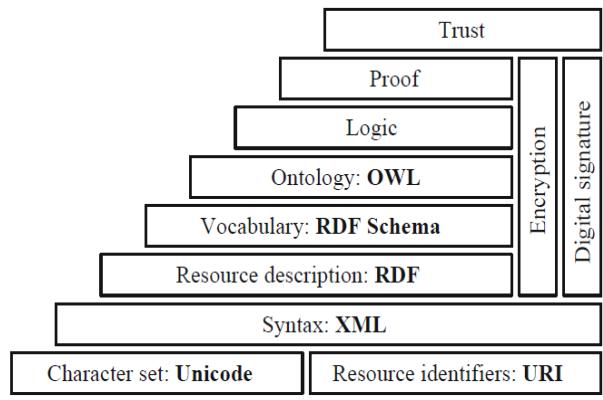 Fig. 1: Stack of Semantic Web protocols, taken from [4]
The main part in the construction of this model is the creation of the ontology, which is a fundamental piece in the construction of the Semantic Web, since it allows to add semantics to concepts of a knowledge domain and to create a hierarchy of concepts. Ontologies are defined as extensions of the RDF (Resource Description Framework) branch, but mainly the OWL language (Ontology Web Language) is used. [4], in turn an ontology has five types of components which are: classes, relations, formal axioms, instances and concepts. [5]
Several methodologies exist to design, develop and manage ontologies, some of the most widely used are SENSUS, which is a Top-Down approach to derive domain-specific ontologies from large ontologies; in this methodology, a set of seed terms that are relevant in a particular domain are identified. Such terms are manually linked to a broad coverage ontology, users automatically select the relevant terms to describe the domain and narrow down the ontology, this algorithm returns the set of hierarchically structured terms to describe a domain, which can be used as a skeleton for the knowledge base [6].
The ACO methodology, is a methodology for automatic ontology construction supported by natural language processing and machine learning techniques, which was inspired by existing manual methodologies for ontology construction. [6]
The Methontology methodology was developed by the Polytechnic University of Madrid and is one of the most complete ontology methodologies, because it has its roots in the activities identified by the software development process proposed by the IEEE [7]. it also allows creating new ontologies or reusing others.
**Methodology** is composed of activities for project planning, result quality, documentation, a life cycle based on evolved prototypes and the methodology itself, which specifies the steps to be executed in each activity, the techniques used, the results to be obtained and their form of evaluation, [8], this methodology proposes the following stages: specification, conceptualization, formalization, implementation and maintenance.
There are many other existing methodologies for the design and construction of Ontologies, however, in the present research it is decided to use Methontology given the large existing bibliographic material, in addition it has been recommended as a methodology for the construction of ontologies by the Foundation of Intelligent Physical Agents. [7]
## III. METHODOLOGY
Figure two shows the activities used in the development of the ontology.
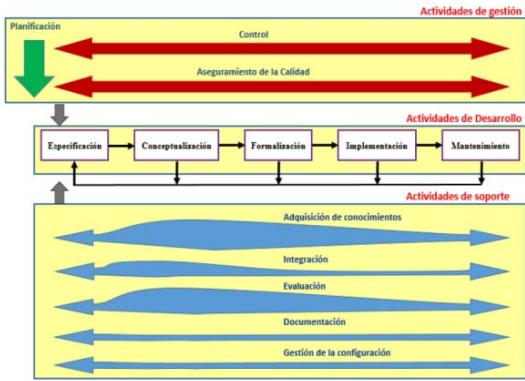 Fig. 1: Ontology development activities proposed by Methontology, taken from [7]
### a) Specification
In This first activity aims to find out why the ontology is being built, what its use will be and who will be the end users. In response to these questions, we propose an ontology to create a knowledge base of the traditional musical genres of the city of Bogota, in order to present them on a Web portal, so that the members of these groups can offer their services and update their contact information constantly.
### b) Conceptualization
This activity seeks to organize and build the informal perception of the domain in a semi-informal specification, for this purpose the methodology proposes a series of 11 tasks, in a non-sequential order [7], the present research shows the development of the most important tasks.
### c) Formalization
This activity aims to transform the conceptual model previously developed to the formal model, to achieve this goal we used the ontology editor Protégé version 5.2, this is an open source editor, it was developed by Stanford University, it provides the necessary tools for the development of ontologies on the web [10], the first step in the construction of the ontology was the creation of hierarchical classes, as shown in figure 5. For example, it is observed that mariachi is a subclass of a musical genre of Mexican origin, which is disjunct with its counterpart of nortenatype and in turn with those of Colombian origin, this means that if a musical group belongs to the mariachi genre, it cannot belong to a vallenato group or any other.
Task 1 and 4, Glossary and dictionary of terms, are built by the terms of interest of the present research. Table 1 shows the elements, concepts and essential attributes that are used as a basis for the construction of the ontology and constitute the terms of interest of the domain.
Table 1: Glossary and dictionary of terms
<table><tr><td>Name</td><td>Description</td></tr><tr><td>Music</td><td>Represents the concept and completion of the art.</td></tr><tr><td>Musical genres</td><td>It is the way in which the different kinds of music can be classified, according to their country of origins, instruments used, rhythm, melody or lyrics.</td></tr><tr><td>Mariachi</td><td>It is a Mexican musical genre, whose origin dates back to the XVII century, its main instruments are the trumpet, vihuela and guitarron.</td></tr><tr><td>Norteña</td><td>It is a Mexican musical genre, whose origin dates back to the 20th century, its main instruments are the bass and the accordion.</td></tr><tr><td>Vallenato</td><td>It is a Colombian musical genre; its main instrument is the accordion.</td></tr><tr><td>Trio</td><td>It is an unknown origin musical genre, its main instruments are the guitar and the voice, in the present investigation it will be assumed that it is originally from Colombia.</td></tr><tr><td>Llanera</td><td>It is a Colombian and Venezuelan musical genre, whose origin dates back to the 19th century, its main instruments are the harp and maracas.</td></tr></table>
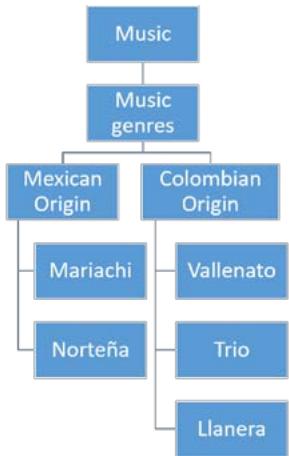 Source the author Fig. 2: Taxonomy of concepts Task 3, Diagram of binary relationships, Figure 4 shows the types of relationships that exist between the previously defined concepts.
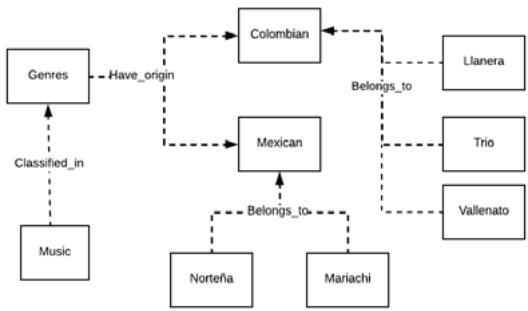 Source: the author Fig. 4: Diagram of binary relationships
Task 6, attributes of the instances, in Table 2 will describe how each of the instances of the ontology will be defined and what their predefined values will be.
Table 2: Attributes of instances
<table><tr><td></td><td>Attribute</td><td>Value</td></tr><tr><td>Musical genre</td><td>Description Origin</td><td>String
String</td></tr><tr><td>Musical group</td><td>Geographic zone
Description
Manager
Price
Contact number</td><td>Integer
String
String
Integer
String</td></tr></table>
Task 9, formal axioms, a musical genre has a unique origin, moreover this origin is unique, this is to simplify the model and make the relationships simpler.
### d) Implementation
This activity aims to transform the conceptual model. This activity illustrates the final result of the formal model developed. Fig. 5, shows the summary of the Ontology developed thanks to the OntoGraf tool, which is included in the Protégé editor, version 5.2.
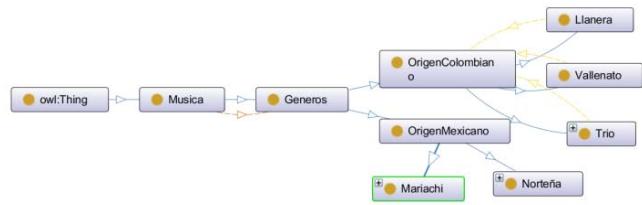 Fig. 5: Ontology Overview in OntoGraf
Once the ontology was developed, it was exported in OWL format, and deployed in the Apache Jena ontology server, which allows the entry of instances to the ontology created, the advantages of using this server is that it serves as an inference engine to reason about ontologies, provides compatibility of queries with different SPARQL specification and allows to persist the data in a relational base [9], this server will be responsible for storing the information of each musical group that is registered in the web portal, which will be known as a new instance, it stores information of the group such as: genre to which it belongs, description of the band, contact number, price of the service, geographic location and a manager.
After creating the class hierarchy, the properties of the objects were created, which describe relationships between individuals, the next step was to describe the data properties, for fields such as price, contact number, description, manager and other data described in table 2.
Finally, we validated that the Ontology created does not contain syntax or logic errors, for which we used a tool that is included in the Protégé editor called Reasoner.
## IV. RESULTS
In order to allow the members of the different traditional musical groups of the city of Bogota to offer their services, a Web portal was developed, using the framework developed by Google Angular, version 6, a registration form was designed requesting a description of the musical group, genre to which it belongs, years of career in the market, contact number and name of the manager of the band, the geographic location is taken using GPS either from the Web browser or the cell phone.
When the grouping finishes the registration in the Web Portal, the form data is sent using the HTTP protocol in the PUT operation, this information is inserted in the ontology previously created that is in the Apache Jena server, each band that is registered in the portal is a new instance in the ontology, this information is stored, in the same way when a user wants to perform a search a GET request is made which is processed by the server who performs a SPARQL query that returns the data which is displayed in the Web portal, Fig 6, shows the architecture of the server which is always listening to requests via HTTP and depending on the operation a SPARQL CRUD is performed.
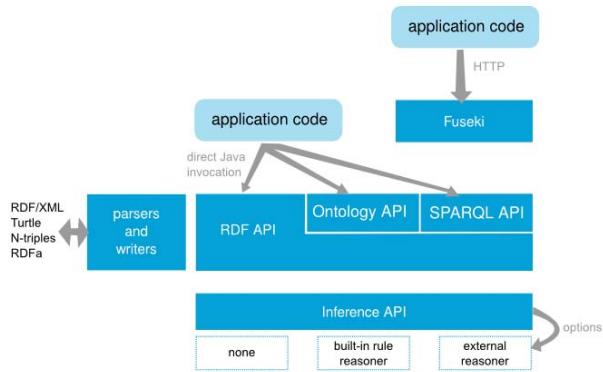 Fig. 6: Server architecture from [9]
When a user wants to search for a group according to the musical genre, a tab was created in the Web Portal called search in which the different genres are shown and the user clicking on any of these genres makes a GET type request to the server with the parameter of the musical genre as shown in Fig 7, the server makes a SPARQL type SELECT to all the instances present in the Ontology and this returns the result of the query, this information is shown in the view and the user can contact the musical group.
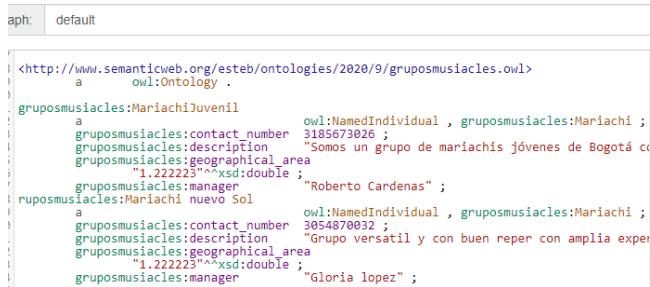 Fig. 7: SPARQL query result
## V. CONCLUSION
The use of an ontology instead of a traditional relational database allows the creation of inference rules in the portal, since the creation of concept relations and a hierarchy of classes generates explicit knowledge that can be processed by computers.
When using Protégé as a tool in the construction of the Ontology and apache Jena as a server, it is recommended to use Java technology to insert, update and read data since they are written in this language and could generate compatibility errors or make the software development even more complex.
The use of the ontology allows enriching and adding metadata which adds information that is presented in the portal, allows the information to be extensible, in the future new musical genres can be added, to enrich the information shown in the Web Portal.
The ontology created contains the existing relationships between the groups and the musical genres to which they belong; therefore, a musical group cannot belong to two different musical genres and each musical genre can only belong to one origin, thus simplifying the ontological model, although a musical genre may have one or several shared origins.
It is planned to develop a version of the portal in a productive environment so that it can be used by more users and musical groups in the city of Bogotá, since in the present research a functional prototype was developed in a local server.
The present research intends to use technology at the service of the population to improve their quality of life and thus make digital contact allows them to attract, capture and retain new customers.
Generating HTML Viewer...
References
10 Cites in Article
H Mora,J Azorín-López,A Jimeno-Morenilla,J Sánchez-Romero,F Pujol,J García-Rodríguez,J Pérez,V Morell,M Pérez,M Saval-Calvo,A Garcia-Garcia,S Orts-Escolano (2015). La Web Semántica Como Herramienta para el Apoyo a la Docencia.
Martinez Ante (2006). Bogotá, una ciudad mariachi y charra: hay aproximadamente 220 grupos.
Thomas Gruber (1995). Toward principles for the design of ontologies used for knowledge sharing?.
Fabrizio López,José Pérez Castillo (2013). Esquema metodológico para la construcción automática de ontologías.
Ó Corcho,M Fernández-López,A Gómez-Pérez,A López-Cima (2005). Construcción de ontologías legales con la metodología METHONTOLOGY y la herramienta WebODE.
J Luna,M Bonilla,I Torres (2012). Metodologías y métodos para la construcción de ontologías.
No ethics committee approval was required for this article type.
Data Availability
Not applicable for this article.
How to Cite This Article
Juan Esteban Katz Delgado. 2026. \u201cSemantic Web Model to Contact Music Bands in Bogota, Colombia\u201d. Global Journal of Research in Engineering - J: General Engineering GJRE-J Volume 22 (GJRE Volume 22 Issue J3).
Explore published articles in an immersive Augmented Reality environment. Our platform converts research papers into interactive 3D books, allowing readers to view and interact with content using AR and VR compatible devices.
Your published article is automatically converted into a realistic 3D book. Flip through pages and read research papers in a more engaging and interactive format.
Our website is actively being updated, and changes may occur frequently. Please clear your browser cache if needed. For feedback or error reporting, please email [email protected]
Thank you for connecting with us. We will respond to you shortly.