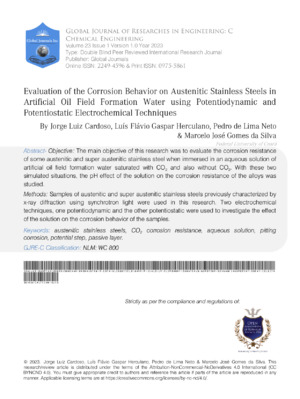
Evaluation of the Corrosion Behavior on Austenitic Stainless Steels in Artificial Oil Field Formation Water using Potentiodynamic and Potentiostatic Electrochemical Techniques

Article ID

XSWI5

Stainless steel corrosion assessment using electrochemical techniques on various stainless steel types.

Evaluation of the Corrosion Behavior on Austenitic Stainless Steels in Artificial Oil Field Formation Water using Potentiodynamic and Potentiostatic Electrochemical Techniques

Jorge Luiz Cardoso
Jorge Luiz Cardoso
Luís Flávio Gaspar Herculano
Pedro de Lima Neto
Pedro de Lima Neto
Marcelo José Gomes da Silva
DOI

Abstract

Objective: The main objective of this research was to evaluate the corrosion resistance of some austenitic and super austenitic stainless steel when immersed in an aqueous solution of artificial oil field formation water saturated with CO2 and also without CO2. With these two simulated situations, the pH effect of the solution on the corrosion resistance of the alloys was studied. Methods: Samples of austenitic and super austenitic stainless steels previously characterized by x-ray diffraction using synchrotron light were used in this research. Two electrochemical techniques, one potentiodynamic and the other potentiostatic were used to investigate the effect of the solution on the corrosion behavior of the samples. The linear polarization test was used to evaluate the CO2 corrosion resistance of the alloys in artificial oil field formation water. The potentiostatic technique (potential step) was used to assess the influence of the solution without CO2 on the corrosion resistance of the alloys, thus, varying the pH of the electrolyte. Scanning Electron Microscopy (SEM) was used to observe the type of corrosion on the surface of the samples. Results: The results indicated that the type of corrosion found on the surface of the alloys was pitting corrosion. The pH effect of the solution (artificial oil field formation water) influenced the pits’ shape. The conventional austenitic steels showed to have low corrosion resistance in chloride-containing environment. The super austenitic stainless steels presented a high corrosion resistance in the solution with and without CO2. No pits or micro pits were observed on their surfaces by SEM. Conclusion: From the results obtained, it was evident that the conventional austenitic stainless steels are not a good choice in severe environments like those found in the pre-salt region. The super austenitic stainless steels showed to be a good option in CO2-containing environments, mainly in aqueous solution with a high content of chloride.

Evaluation of the Corrosion Behavior on Austenitic Stainless Steels in Artificial Oil Field Formation Water using Potentiodynamic and Potentiostatic Electrochemical Techniques

Objective: The main objective of this research was to evaluate the corrosion resistance of some austenitic and super austenitic stainless steel when immersed in an aqueous solution of artificial oil field formation water saturated with CO2 and also without CO2. With these two simulated situations, the pH effect of the solution on the corrosion resistance of the alloys was studied. Methods: Samples of austenitic and super austenitic stainless steels previously characterized by x-ray diffraction using synchrotron light were used in this research. Two electrochemical techniques, one potentiodynamic and the other potentiostatic were used to investigate the effect of the solution on the corrosion behavior of the samples. The linear polarization test was used to evaluate the CO2 corrosion resistance of the alloys in artificial oil field formation water. The potentiostatic technique (potential step) was used to assess the influence of the solution without CO2 on the corrosion resistance of the alloys, thus, varying the pH of the electrolyte. Scanning Electron Microscopy (SEM) was used to observe the type of corrosion on the surface of the samples. Results: The results indicated that the type of corrosion found on the surface of the alloys was pitting corrosion. The pH effect of the solution (artificial oil field formation water) influenced the pits’ shape. The conventional austenitic steels showed to have low corrosion resistance in chloride-containing environment. The super austenitic stainless steels presented a high corrosion resistance in the solution with and without CO2. No pits or micro pits were observed on their surfaces by SEM. Conclusion: From the results obtained, it was evident that the conventional austenitic stainless steels are not a good choice in severe environments like those found in the pre-salt region. The super austenitic stainless steels showed to be a good option in CO2-containing environments, mainly in aqueous solution with a high content of chloride.

Jorge Luiz Cardoso
Jorge Luiz Cardoso
Luís Flávio Gaspar Herculano
Pedro de Lima Neto
Pedro de Lima Neto
Marcelo José Gomes da Silva

No Figures found in article.

Jorge Luiz Cardoso. 2026. “. Global Journal of Research in Engineering – C: Chemical Engineering GJRE-C Volume 23 (GJRE Volume 23 Issue C1): .

Download Citation

Journal Specifications

Crossref Journal DOI 10.17406/gjre

Print ISSN 0975-5861

e-ISSN 2249-4596

Classification
GJRE-C Classification: NLM: WC 800
Keywords
Article Matrices
Total Views: 1207
Total Downloads: 14
2026 Trends
Research Identity (RIN)
Related Research
Our website is actively being updated, and changes may occur frequently. Please clear your browser cache if needed. For feedback or error reporting, please email [email protected]

Request Access

Please fill out the form below to request access to this research paper. Your request will be reviewed by the editorial or author team.
X

Quote and Order Details

Contact Person

Invoice Address

Notes or Comments

This is the heading

Lorem ipsum dolor sit amet, consectetur adipiscing elit. Ut elit tellus, luctus nec ullamcorper mattis, pulvinar dapibus leo.

High-quality academic research articles on global topics and journals.

Evaluation of the Corrosion Behavior on Austenitic Stainless Steels in Artificial Oil Field Formation Water using Potentiodynamic and Potentiostatic Electrochemical Techniques

Jorge Luiz Cardoso
Jorge Luiz Cardoso
Luís Flávio Gaspar Herculano
Pedro de Lima Neto
Pedro de Lima Neto
Marcelo José Gomes da Silva

Research Journals