Investigating the Effects of Physical Parameters on First and Second Reflected Waves in Air-Saturated Porous Media Under Low-Frequency Ultrasound Excitation
This simulation study investigates the impact of a 20% variation in physical parameters, including porosity, tortuosity, viscous and thermal characteristic lengths, and two newly introduced viscous and thermal shape factor parameters, on reflected waves at the first and second interfaces in air-saturated porous media under low-frequency ultrasound excitation. The acoustic behavior of air-saturated porous media is modeled using the equivalent fluid theory and the Johnson-Allard model, refined by Sadouki [Phys. Fluids 33, (2021)]. Our results demonstrate that a 20% variation in certain physical parameters significantly affects the reflected waves at the first and second interfaces in the low-frequency domain of ultrasound. This study enhances our understanding of the underlying mechanisms governing acoustic wave propagation in airsaturated porous media, which is valuable for optimizing ultrasound-based techniques in a range of applications, such as nondestructive testing, medical imaging, and noise pollution control in buildings, aircraft, automobile industry, and civil engineering sectors.
## I. INTRODUCTION
Porous materials have a rich history that dates back to ancient times, and they continue to be of great importance in modern chemistry and materials science [1]. These materials exhibit unique properties that make them valuable across a wide range of applications, including biomedical, building and construction, aerospace, and environmental domains. Their diverse classifications, such as fibrous, granular agglomerates, polymeric, and construction materials, contribute to their widespread use in our daily lives.
In recent years, there has been a growing interest in the use of porous materials due to their versatility and unique properties. For example, in the biomedical field [2], porous materials have shown tremendous potential for drug delivery and tissue engineering. The porous structure of these materials allows for controlled drug release and promotes cell growth, making them ideal candidates for advanced medical applications. In the building and construction industry [3], porous materials are commonly used for insulation and soundproofing. Their ability to absorb sound waves through viscous friction and thermal exchanges makes them an excellent choice for reducing noise pollution. Similarly, in the aerospace industry[4], porous materials are used for thermal insulation and noise reduction.
The physical and mechanical parameters used to characterize the properties of porous materials include geometric tortuosity, viscous and thermal characteristic lengths [5-8], Young's modulus of elasticity, and Poisson's ratio. In the field of acoustics, porous materials are widely used to reduce noise pollution by absorbing a part of the sound waves through viscous friction and thermal exchanges [4]. Previous studies have been conducted to investigate the influence of physical parameters describing porous media on the transmitted signal in the low-frequency ultrasound regime [9-11]. However, there is a need for a more comprehensive numerical simulation study to determine the effect of physical parameters on the low-frequency ultrasonic signal reflected by the first and second interfaces of the medium.
In this study, we address this gap by investigating the impact of a $20\%$ variation in physical parameters, including porosity, tortuosity, viscous and thermal characteristic lengths, and two newly introduced viscous and thermal shape factor parameters, on the reflected waves at the first and second interfaces in air-saturated porous media in the low-frequency domain of ultrasound. The acoustic behavior of air-saturated porous media is modeled using the equivalent fluid theory and the Johnson-Allard model refined by Sadouki [12]. This study enhances our understanding of the underlying mechanisms governing acoustic wave propagation in porous media, providing valuable insights for optimizing ultrasound-based techniques in a range of applications, such as nondestructive testing, medical imaging, and noise pollution control in buildings, aircraft, automobile industries, and civil engineering.
## II. MODEL
Acoustic propagation in porous materials is a complex phenomenon that involves the interaction of sound waves with fluid and solid components of the porous medium. When considering air-saturated porous materials with immobile solid skeletons, wave propagation is confined to the fluid, and this behavior is typically modeled using the equivalent fluid model [5,6], which is a particular case of Biot theory [13-15]. The two frequency response factors, the dynamic tortuosity of the medium $\alpha (\omega)$ and the dynamic compressibility of air in the porous material $\beta (\omega)$, are used to account for structure-fluid interactions. The dynamic tortuosity is provided by Johnson et al [5,6], while the dynamic compressibility is given by Allard [7]. In the frequency domain, these factors are multiplied by the density and compressibility of the fluid.
At extremely low and high frequencies, the equations governing the acoustic behavior of the fluid simplify and the parameters involved are different. In the high-frequency range [7], this simplification occurs when the viscous and thermal skin thicknesses $\delta (\omega) = \sqrt{\frac{2\eta}{\rho_0\omega}}$ and $\delta^{\prime}(\omega) = \sqrt{\frac{2\eta}{P_r\rho_0\omega}}$ are smaller than the pore radius r. (Here, the density of the saturating fluid is represented by $\rho 0$, the viscosity by $\eta$, the pulse frequency by $\omega$, and the Prandtl number by $\mathrm{Pr}$ ). In the low-frequency range of the ultrasonic domain, the dynamic tortuosity and compressibility are given by \[12\]:
$$
\alpha (\omega) = \alpha_ {\infty} \left(1 + \frac {\delta (\omega)}{\Lambda} \left(\frac {2}{j}\right) ^ {\frac {1}{2}} + \xi \left(\frac {\delta (\omega)}{\Lambda}\right) ^ {2} \left(\frac {2}{j}\right) + \dots\right) \tag {1}
$$
$$
\beta (\omega) = 1 + (\gamma - 1) \left(\frac{\delta^ {\prime} (\omega)}{\Lambda^ {\prime}} \left(\frac{2}{j}\right) ^ {1 / 2} + \left(\xi^ {\prime} - 1\right) \left(\frac{\delta^ {\prime} (\omega)}{\Lambda^ {\prime}}\right) ^ {2} \left(\frac{2}{j}\right) + \dots\right) \tag{2}
$$
where, $j = \sqrt{-1}$ and $\gamma$ is the adiabatic constant.
The relevant physical parameters of the models are the high-frequency limit of the tortuosity $\alpha_{\infty}$, the viscous and thermal characteristic lengths $\Lambda$ and $\Lambda'$, respectively, and the dimensionless parameter $\xi$ introduced by Sadouki [12], which is a shape factor related to the correction of the viscous skin depth of the air layer near the tube surface where the velocity distribution is significantly perturbed by the viscous forces generated by the stationary frame in the low-frequency ultrasonic regime. $\xi'$ is the associated thermal counterpart.
Consider a homogeneous porous material that occupies the region $0 \leq x \leq L$. A sound pulse normally strikes the medium, generating an acoustic pressure field $p(x,t)$ and an acoustic velocity field $v(x,\omega)$ within the material (Fig. 1). These fields satisfy the Euler equation and the constitutive equation along the $x$ -axis:
$$
\rho_ {0} \alpha (\omega) j \omega v (x, \omega) = \frac {\partial p (x , \omega)}{\partial x}, \quad \frac {\beta (\omega)}{K _ {a}} j \omega p (x, \omega) = \frac {\partial v (x , \omega)}{\partial x}, \tag {3}
$$
Here, $K_{a}$ is the compressibility modulus of the fluid.
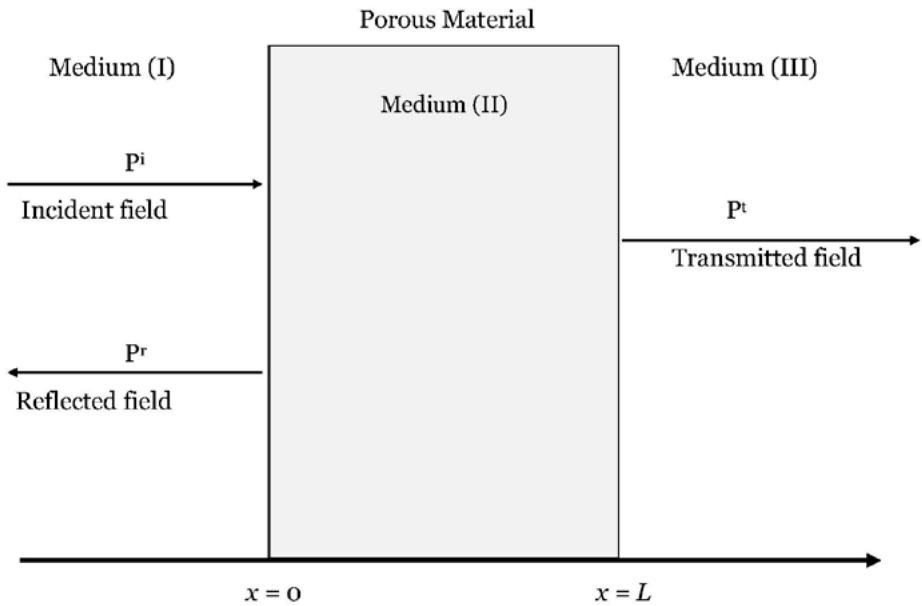 Figure 1: Problem geometry
The continuity of the pressure and velocity fields at the medium boundary gives the reflection coefficient of the porous material \[17\]:
$$
R = \frac {\left(1 - Z ^ {2}\right) \sinh (j \bar {k} L)}{2 \bar {Z} \cos h (j \bar {k} L) + (1 + \bar {Z} ^ {2}) \sinh (j \bar {k} L)} \tag {4}
$$
Where $\tilde{Z} = \frac{1}{\phi}\sqrt{\frac{\alpha(\omega)}{\beta(\omega)}}$ is the normalized characteristic impedance of the material, $\phi$ is the porosity, and $\tilde{k} = \omega \sqrt{\frac{\rho_0\alpha(\omega)\beta(\omega)}{K_a}}$ is the wave number of the acoustic wave in the porous medium. The incident and reflected fields $p^i$ and $p_{sim}^r$ are related in the frequency domain by the reflection coefficient $R$:
$$
p _ {s i m} ^ {r} (x, \omega) = R p ^ {i} (x, \omega) \tag {5}
$$
In the time domain, the reflected signal $p_{sim}^{r}(x,t)$ is obtained by taking the inverse Fourier transform of Eq. (5):
$$
P ^ {t} (x, t) = \mathcal {F} ^ {- 1} \left(R P ^ {i} (x, \omega)\right) \tag {6}
$$
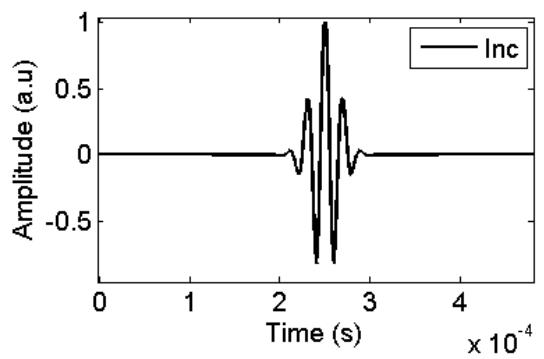
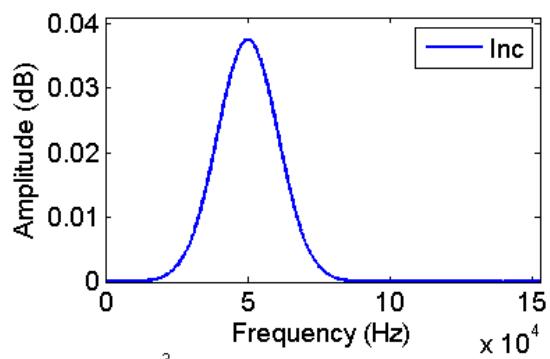
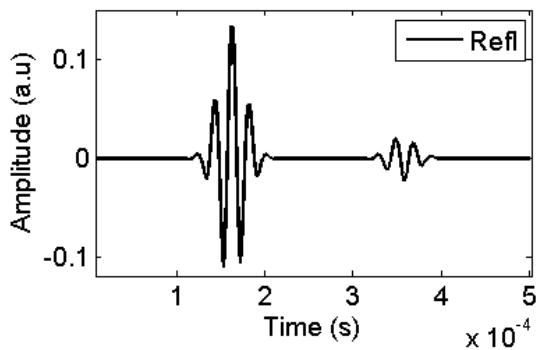
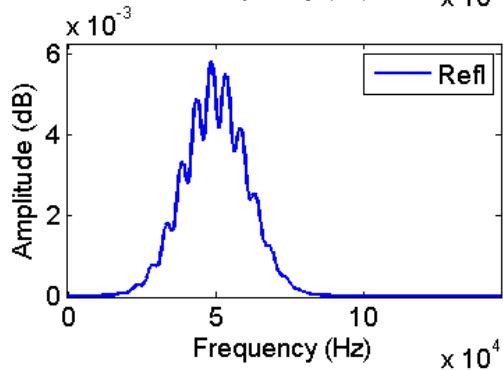 Figure 2: The incident and reflected signals of a monolayer porous medium constructed in frequency via expression (5) and in time via Eq. (6)
The simulated incident and reflected signals of a single-layer porous medium are shown in Fig. 2, and were obtained by expression (5) in the frequency domain and equation (6) in the time domain. The characteristic parameters of the porous medium are as follows: $L = 3.0 \, \text{cm}$, $\phi = 0.85$, $\alpha_{\infty} = 1.2$, $\Lambda = 300 \, \mu \text{m}$, $\Lambda' / \Lambda = 3$, $\xi = 10$, and $\xi' / \xi' = 2$. These signals were generated using the Gauss function in Matlab with center frequencies of $50 \, \text{kHz}$ and $120 \, \text{kHz}$. In the time domain, two successive reflections on the first and second interface can be clearly observed, as shown in black color below in Figure 2.
## III. SIMULATION STUDY
To investigate the influence of physical parameters, such as porosity, tortuosity, viscous and thermal characteristic lengths, and newly introduced shape factors on the reflected waves, a parameter analysis was performed. Specifically, each parameter was varied while holding the others constant, and the impact on the first and second reflected waves in the time domain, as indicated by equation (6), was observed. By systematically varying each parameter and analyzing its effect on the reflected waves, we can better understand the individual contributions of these physical factors to the overall acoustic behavior of the porous material.
### a) Effect of Porosity $\pmb{\phi}$ on the Reflected Signal
Figure 3 shows the impact of varying the porosity $(\phi)$ on the amplitude of the first and second reflected waves through a rigid porous medium, while keeping the other parameters fixed at $\alpha_{\infty} = 1.2$, $\Lambda = 300 \mu \mathrm{m}$, $\Lambda' / \Lambda = 3$, $\xi = 10$, and $\xi' / \xi' = 2$. The porosity $\phi$ varies from $+20\%$ to $-20\%$ of its initial value ( $\phi = 0.85$ ). Table 1 presents the variation ratio of the reflection coefficient compared to a $\pm 20\%$ variation of each parameter.
According to Table 1, a significant influence of porosity on the reflected signal is observed at frequencies of $50\mathrm{kHz}$ and $120\mathrm{kHz}$. When the porosity increases by $+20\%$, the modulus of the first and second reflected signals decreases by $-66.84\%$ and $-65.06\%$, respectively. Conversely, when the porosity decreases by $-20\%$, the amplitude of the 1st and 2nd reflected signals increases by $+80.26\%$ and $+71.32\%$ respectively. Moreover, the sensitivity of the porosity $\phi$ increases with frequency, as also shown in Table 1.
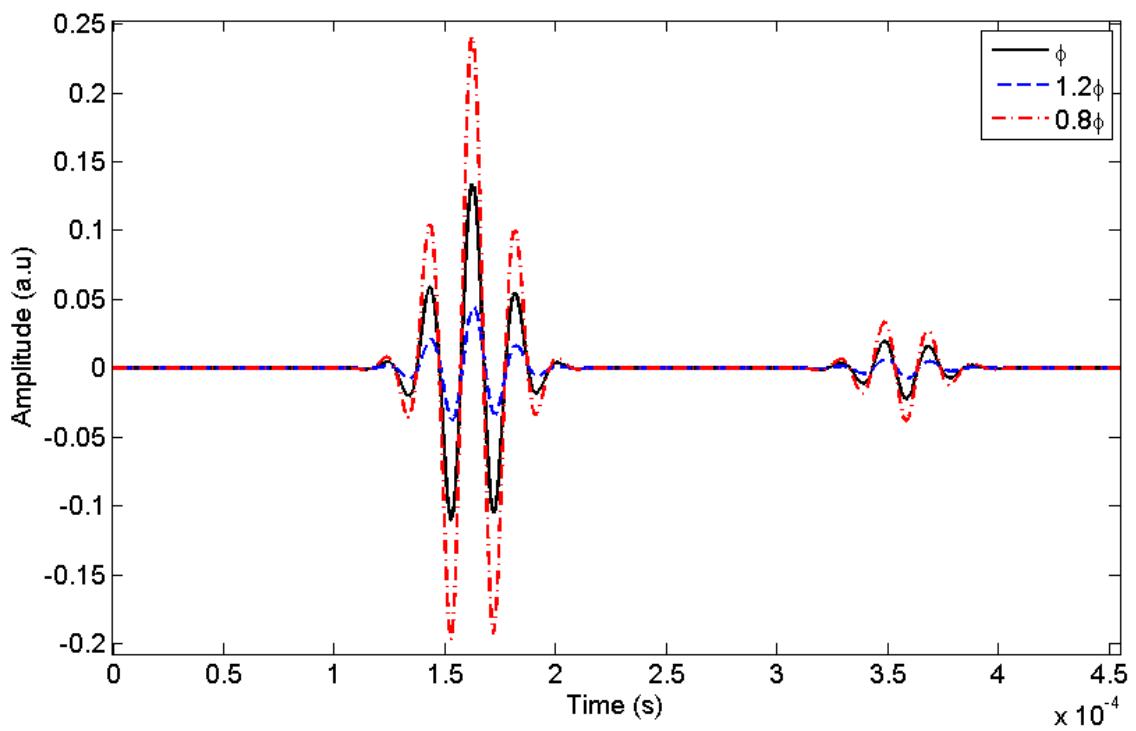 Figure 3: Sensitivity of porosity $\phi$ on the 1st and 2nd reflected signals at $50\mathrm{kHz}$
### b) Effect of Tortuosity $\pmb{\alpha}_{\infty}$ on the Reflected Signal
Figure 4 illustrates the sensitivity of tortuosity $\alpha_{\infty}$ on the 1st and 2nd reflected waves, for an excitation pulse of frequency $50~\mathrm{kHz}$. When the initial tortuosity value is increased by $+20\%$, the amplitude of the 1st and 2nd reflected waves increases by $+33.16\%$ and $10.82\%$, respectively. Conversely, a decrease of $-20\%$ in tortuosity results in a decrease in the amplitude of the 1st and 2nd reflected waves by $-40.98\%$ and $-27.47\%$, respectively. Notably, the impact of tortuosity is more pronounced on the 1st reflected signal than on the 2nd. Additionally, the sensitivity of tortuosity to the reflected signal increases with frequency, as detailed in Table 1.
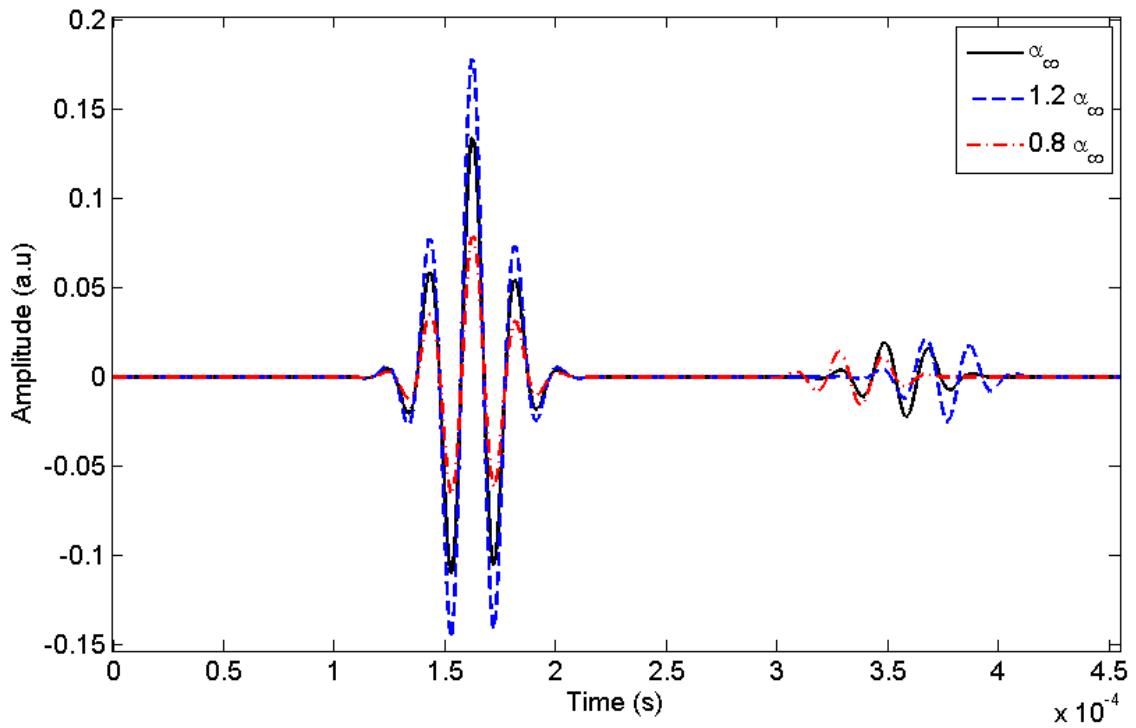 Figure 4: Sensitivity of Tortuosity $\alpha_{\infty}$ on the 1st and 2nd Reflected Waves
### c) Effect of Viscous Characteristic Length $\pmb{A}$ on the Reflected Waves
The impact of varying the viscous characteristic length on the 1st and 2nd reflected waves at high frequency is shown in Figure 5. With an excitation frequency of $50\mathrm{kHz}$, a $+20\%$ change in $\pmb{\Lambda}$ results in a $-1.07\%$ decrease in the amplitude of the first reflected wave and a $42.76\%$ increase in the amplitude of the second reflected signal. Furthermore, as the frequency increases, the sensitivity of the viscous characteristic length decreases for the 1st reflected wave and increases for the 2nd reflected wave. Therefore, we can conclude that the viscous characteristic length has a relatively small influence on the 1st reflected wave at high frequency but a high sensitivity on the 2nd reflected wave.
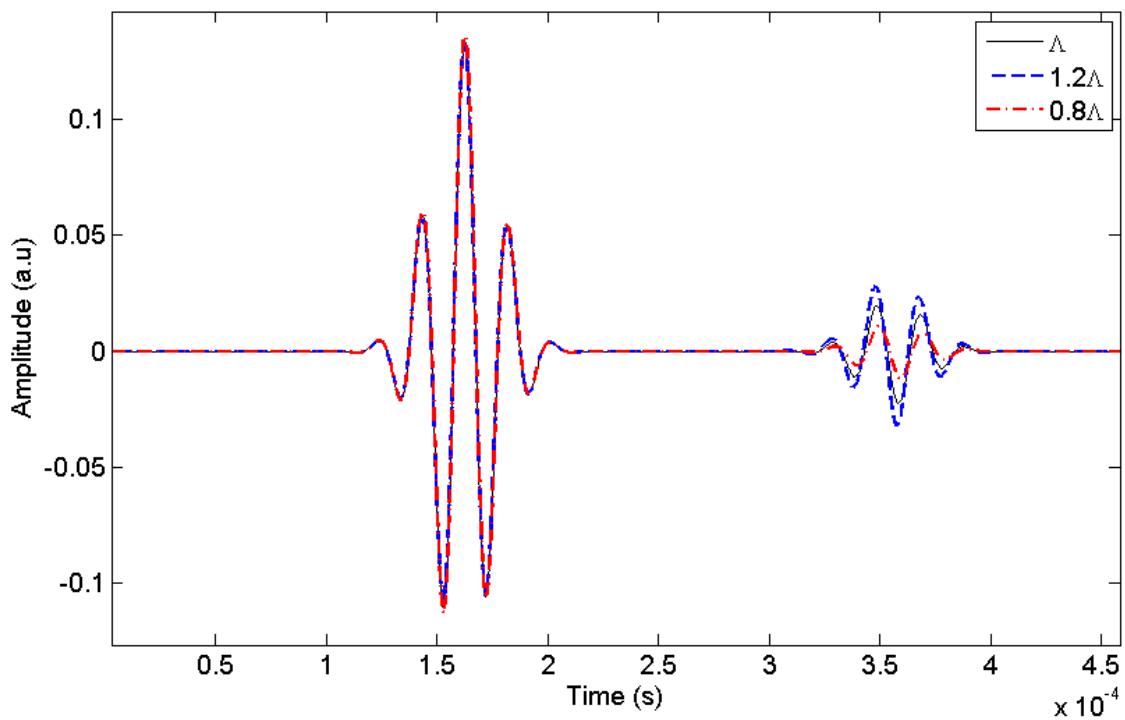 Figure 5: The sensitivity of the viscous characteristic length on the 1st and 2nd reflected waves at a frequency of 50 kHz
### d) Effect of Thermal Characteristic Length $\pmb{\Lambda}^{\prime}$ on the 1st and 2nd Reflected Waves
The sensitivity of the thermal characteristic length $\Lambda^{\prime}$ on the two reflected waves at low ultrasonic frequency is shown in Figure 5 for a variation from $+20\%$ to $-20\%$ of its initial value. From Figure 6, we can see that for a frequency of $50~\mathrm{kHz}$, there is very little influence of the thermal characteristic length on the 1st reflected signal. An increase of $+20\%$ in $\Lambda^{\prime}$ results in a $0.17\%$ increase in the modulus of the 1st reflected signal, while a variation of $-20\%$ results in a $-0.26\%$ decrease in the amplitude of the 1st reflected signal. However, the second reflected wave is more sensitive than the first. For a variation of $+20\%$ of $\Lambda^{\prime}$, the amplitude of the 2nd reflected wave increases by $3.29\%$. Moreover, according to Table 1, we observe that the sensitivity of the thermal characteristic length slightly decreases with frequency for the first reflection, while it increases for the second reflected wave.
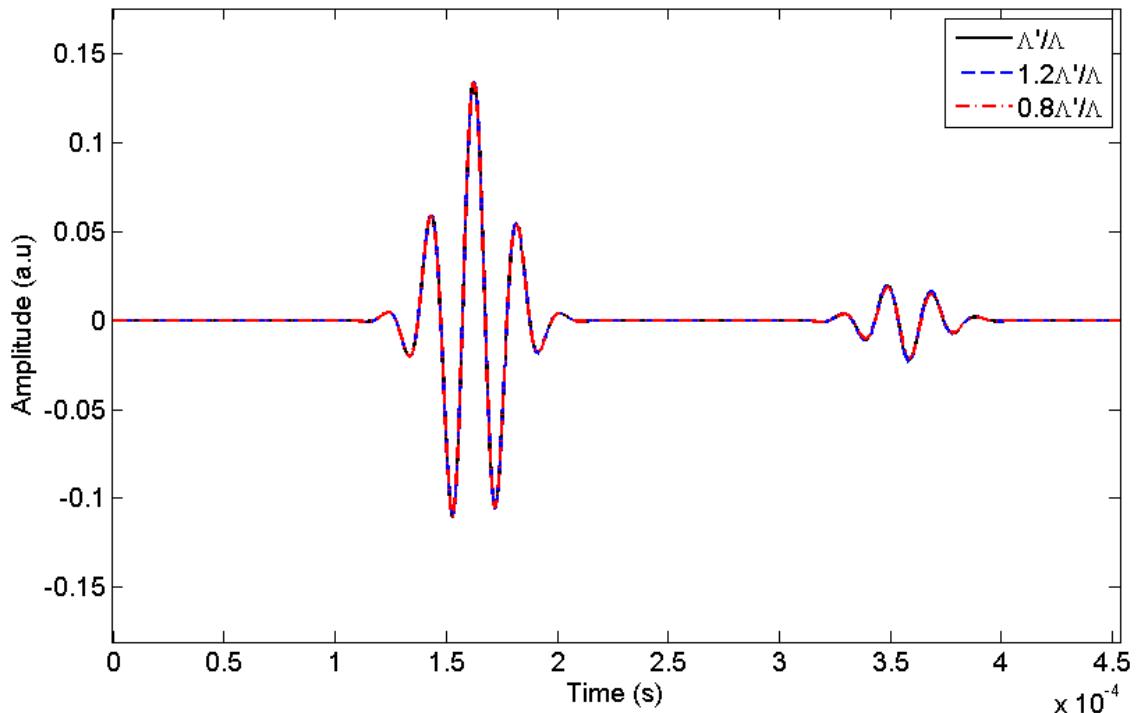 Figure 6: The sensitivity of the thermal characteristic length on the 1st and 2nd reflected waves for a frequency of 50 kHz
### e) Effect of Viscous Shape Factor $\pmb{\xi}$ on the Reflected Signal
The sensitivity of the shape factor $\xi$ on the 1st and 2nd reflected waves in the Low-Frequency Ultrasound regime is presented in Figure 7. According to this figure, a $-20\%$ variation of $\xi$ results in a regression of $-0.26\%$ and $-4.89\%$ in the amplitude of the 1st and 2nd reflected waves, respectively. For a variation of $+20\%$ of $\xi$, we observe a growth of $+0.17\%$ and $3.29\%$ in the amplitude of the 1st and 2nd reflected waves. It can be concluded that the shape factor $\xi$ has a weak influence on the first reflected wave but a strong sensitivity on the second wave in the low-frequency range of ultrasound. Moreover, the variation decreases for the first reflected wave and increases for the second wave as the frequency increases.
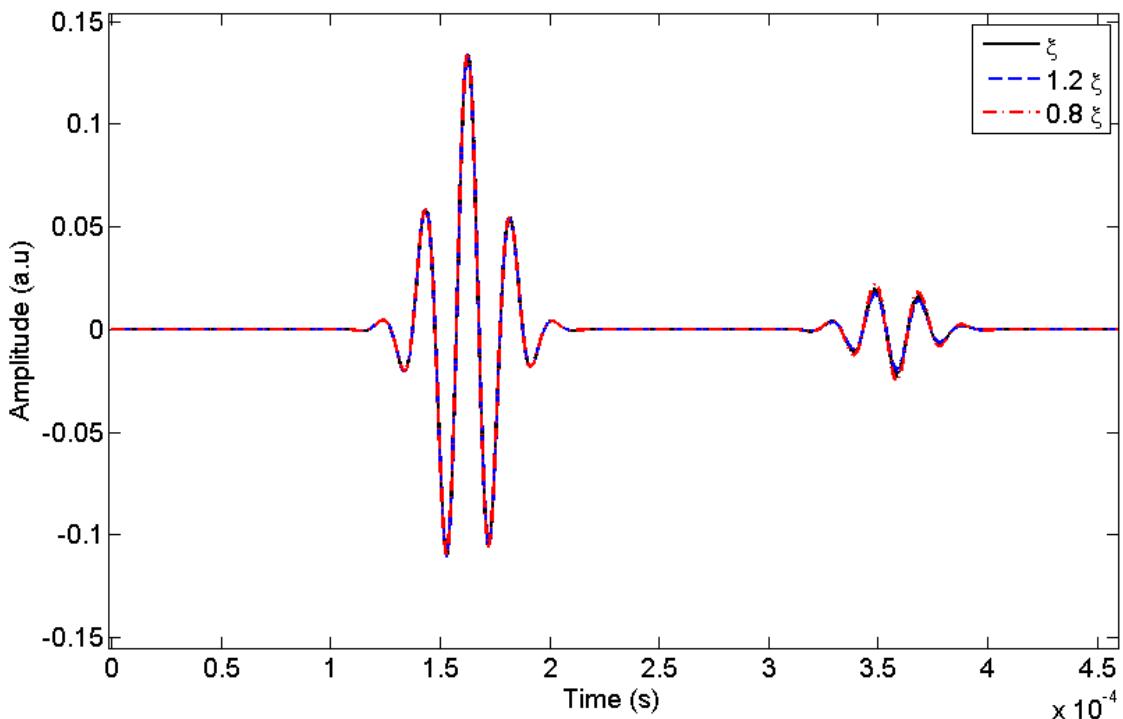 Figure 7: Sensitivity of the shape factor $\xi$ on the 1st and 2nd reflected waves in the low-frequency ultrasound regime
### f) Effect of Thermal Shape Factor $\pmb{\xi}$ on the Reflected Signal To investigate the impact of varying the thermal shape factor $\xi^{\prime}$ on the 1st and 2nd high-frequency reflected waves, Figure 8 is presented. At an excitation frequency of $50\mathrm{kHz}$, a $+20\%$ variation in $\xi/\xi^{\prime}$ results in a $+0.10\%$ increase and a $-1.91\%$ attenuation in the amplitude of the 1st and 2nd reflected waves, respectively. This parameter exhibits a weak influence on the 1st reflected wave but a more significant effect on the 2nd reflected wave in the low-frequency ultrasound regime. Table 1 summarizes the effects of porosity, tortuosity, viscous and thermal characteristic lengths, as well as the two shape factors on the 1st and 2nd reflected waves in the low-frequency regime of ultrasound (50-120 kHz).
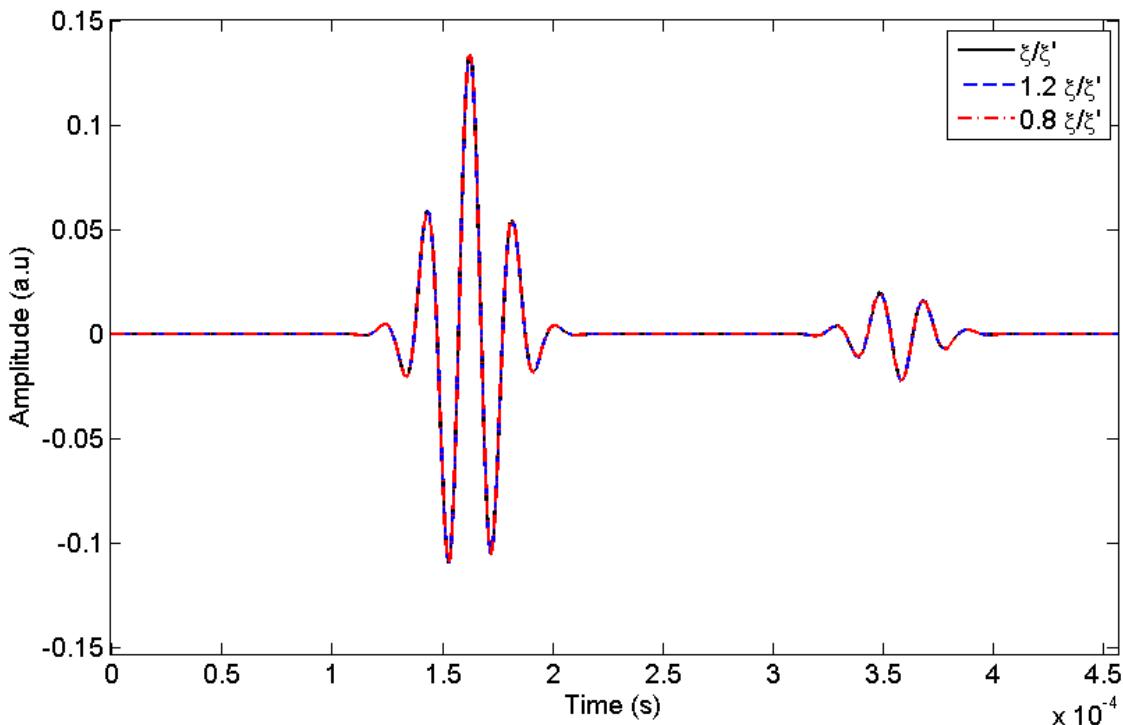 Figure 8: Sensitivity of thermal shape factor $\xi^{*}$ on the 1st and 2nd high-frequency reflected waves at an excitation frequency of $50\mathrm{kHz}$
Based on the results presented in Table 1 and Figures 3-8, we can classify the sensitivity of each parameter on the reflected signal in the order of decreasing influence as presented in Table 2.
Table 1: Relative variation of the reflection coefficient $\frac{\Delta R}{R}\%$ corresponding to a variation of $\pm 20\%$ of each physical parameter
<table><tr><td rowspan="2" colspan="2"></td><td colspan="4">\(\frac{\Delta R}{R}\% \)</td></tr><tr><td colspan="2">1st reflected wave</td><td colspan="2">2nd reflected wave</td></tr><tr><td>Parameters</td><td>Variations</td><td>50 kHz</td><td>120 kHz</td><td>50 kHz</td><td>120 kHz</td></tr><tr><td rowspan="2">Porosity \(\varphi \)</td><td>+20%</td><td>-66.84</td><td>-68.88</td><td>-65.06</td><td>-67.66</td></tr><tr><td>-20%</td><td>80.26</td><td>82.30</td><td>71.32</td><td>74.12</td></tr><tr><td rowspan="2">Tortuosity \(\alpha_{\infty} \)</td><td>+20%</td><td>33.16</td><td>34.02</td><td>10.82</td><td>5.82</td></tr><tr><td>-20%</td><td>-40.98</td><td>-42.10</td><td>-27.47</td><td>-24.77</td></tr><tr><td rowspan="2">Viscous characteristic length Λ (μm)</td><td>+20%</td><td>-1.07</td><td>-0.61</td><td>42.76</td><td>58.54</td></tr><tr><td>-20%</td><td>1.77</td><td>0.93</td><td>-44.86</td><td>-52.95</td></tr><tr><td rowspan="2">Ratio thermal-viscous characteristic lengths (Λ'/Λ)</td><td>+20%</td><td>0.17</td><td>0.11</td><td>3.29</td><td>4.63</td></tr><tr><td>-20%</td><td>-0.26</td><td>-0.16</td><td>-4.89</td><td>-6.57</td></tr><tr><td rowspan="2">Viscous shape factor \(\xi \)</td><td>+20%</td><td>0.10</td><td>0.19</td><td>-11.91</td><td>-12.16</td></tr><tr><td>-20%</td><td>-0.97</td><td>-0.18</td><td>13.56</td><td>13.88</td></tr><tr><td rowspan="2">Ratio viscous-thermal shape factors \(\xi/\xi' \)</td><td>+20%</td><td>0.16</td><td>0.25</td><td>0.35</td><td>0.34</td></tr><tr><td>-20%</td><td>-0.25</td><td>-0.38</td><td>-0.52</td><td>-0.51</td></tr></table>
Table 2: Classification of the sensitivity of each parameter on the 1st and 2nd reflected signal
<table><tr><td>Parameters</td><td>\phi</td><td>\alpha_\infty</td><td>\Lambda</td><td>\xi</td><td>\Lambda'\prime</td><td>\xi'\prime</td></tr><tr><td>Influence on the 1st reflected signal</td><td>+++</td><td>++</td><td>+</td><td>~</td><td>~~~</td><td>~~~</td></tr><tr><td>Influence on the 2nd reflected signal</td><td>+++</td><td>+</td><td>++</td><td>+</td><td>~</td><td>~~</td></tr></table>
## IV. CONCLUSION
In conclusion, this study investigated the influence of physical parameters on the reflected wave at the 1st and 2nd interface of rigid porous media in the low-frequency ultrasound regime. The results show that porosity and tortuosity are the most influential parameters affecting the two reflected signals. This influence varies proportionally with the frequency and inversely with the porosity for both the 1st and 2nd reflected waves. For the 1st reflected wave, the influence varies proportionally with the tortuosity and frequency, while for the 2nd reflected wave; it varies proportionally with the tortuosity and inversely with the frequency. However, the impact of porosity and tortuosity on the 1st reflected wave is greater than on the 2nd reflected wave. Moreover, the viscous characteristic length has a small effect on the 1st reflected wave but a substantial influence on the 2nd reflected wave, exceeding the impact of tortuosity. On the other hand, the shape factor has a minor impact on the 1st reflected wave and a significant sensitivity on the 2nd reflection. Concerning the thermal parameters, the thermal characteristic length and the thermal shape factor have a negligible impact on the 1st reflected wave, while the sensitivity of the thermal characteristic length on the 2nd reflected wave is considerable.
The study's strength is that it analyzed the two reflected waves separately and independently, which allows us to treat each wave individually. These results could have important implications for the design and optimization of ultrasound-based techniques in various applications such as medical imaging, non-destructive testing, and materials characterization. However, further research may be necessary to investigate the effect of these parameters in other frequency ranges and porous medium structures.
### ACKNOWLEDGMENT
This work was funded by The General Directorate of Scientific Research and Technological Development (DGRSDT) under grant number PRFU: B00L02UN440120200001, Algeria.
Generating HTML Viewer...
References
11 Cites in Article
Gregory Day,Hannah Drake,Hong-Cai Zhou,Matthew Ryder (2021). Evolution of porous materials from ancient remedies to modern frameworks.
K Khanafer,K Vafai (2006). The role of porous media in biomedical engineering as related to magnetic resonance imaging and drug delivery.
S Rashidi,J Abolfazli Esfahani,N Karimi (2018). Porous materials in building energy technologies-A review of the applications, modeling, and experiments.
Christopher Teruna,Leandro Rego,Francesco Avallone,Daniele Ragni,Damiano Casalino (2021). Applications of the Multilayer Porous Medium Modeling Approach for Noise Mitigation.
David Johnson,Joel Koplik,Roger Dashen (1987). Theory of dynamic permeability and tortuosity in fluid-saturated porous media.
Manuel Melon,Denis Lafarge,Bernard Castagnède,Niven Brown (1995). Measurement of tortuosity of anisotropic acoustic materials.
J Allard (1993). Propagation of Sound in Porous Media.
Denis Lafarge,Pavel Lemarinier,Jean Allard,Viggo Tarnow (1997). Dynamic compressibility of air in porous structures at audible frequencies.
Abdelmadjid Mahiou,Ilhem Sellami,Mustapha Sadouki (2021). Sensitivity of transmitted low-frequency ultrasound physical parameters describing a rigid porous material.
M Sadouki,A Mahiou,N Souna (2022). Effect of acoustic low-frequency ultrasound parameters on the reflected signal from a rigid porous medium.
Mustapha Sadouki (2018). Experimental measurement of tortuosity, viscous and thermal characteristic lengths of rigid porous material via ultrasonic transmitted waves.
No ethics committee approval was required for this article type.
Data Availability
Not applicable for this article.
How to Cite This Article
Mustapha Sadouki. 2026. \u201cInvestigating the Effects of Physical Parameters on First and Second Reflected Waves in Air-Saturated Porous Media Under Low-Frequency Ultrasound Excitation\u201d. Global Journal of Research in Engineering - I: Numerical Methods GJRE-I Volume 23 (GJRE Volume 23 Issue I1).
Explore published articles in an immersive Augmented Reality environment. Our platform converts research papers into interactive 3D books, allowing readers to view and interact with content using AR and VR compatible devices.
Your published article is automatically converted into a realistic 3D book. Flip through pages and read research papers in a more engaging and interactive format.
Our website is actively being updated, and changes may occur frequently. Please clear your browser cache if needed. For feedback or error reporting, please email [email protected]
Thank you for connecting with us. We will respond to you shortly.
Lorem ipsum dolor sit amet, consectetur adipiscing elit. Ut elit tellus, luctus nec ullamcorper mattis, pulvinar dapibus leo.
Investigating the Effects of Physical Parameters on First and Second Reflected Waves in Air-Saturated Porous Media Under Low-Frequency Ultrasound Excitation