
I. INTRODUCTION
Optical techniques are becoming increasingly important in medical diagnosis and treatment, there is an urgent need to develop and refine materials platforms for bio-photonic applications.
To enable therapeutically useful bio-photonic devices for transferring in vitro optical techniques into in situ and in vivo application, it is especially necessary to design biocompatible and biodegradable materials with appropriate optical, mechanical, chemical, and biological properties. This technological trend is driving the development of natural and synthetic polymeric biomaterials to replace brittle, non degradable silica glass-based optical materials.
We offer an overview of breakthroughs in polymeric optical material development, optical device design and fabrication techniques, and the associated applications to imaging, sensing, and phototherapy in this study.
II. METHODOLOGY & RESULTS
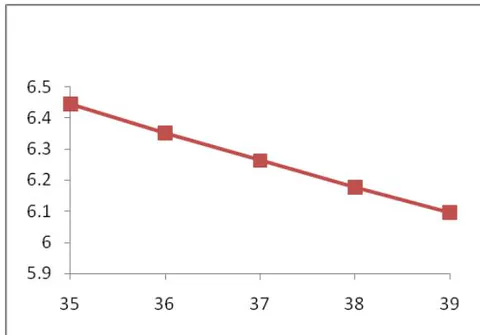
| Sl. No. | Acceleration Voltage (KV) | Wavelength (nm) 10-3 |
| 1 | 35 | 6.446 |
| 2 | 36 | 6.352 |
| 3 | 37 | 6.263 |
| 4 | 38 | 6.177 |
| 5 | 39 | 6.095 |
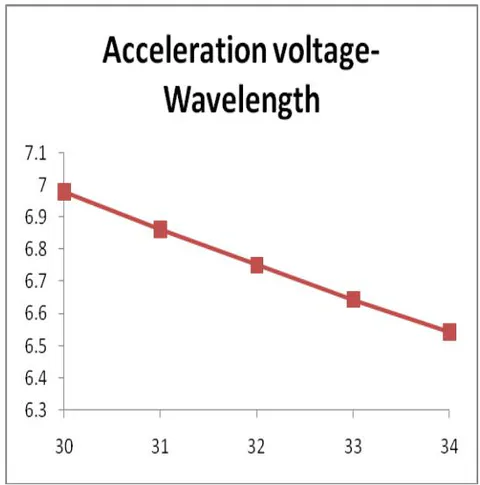
| SI. No. | Acceleration Voltage (KV) | Wavelength (nm) 10-3 |
| 1 | 30 | 6.979 |
| 2 | 31 | 6.862 |
| 3 | 32 | 6.751 |
| 4 | 33 | 6.644 |
| 5 | 34 | 6.543 |
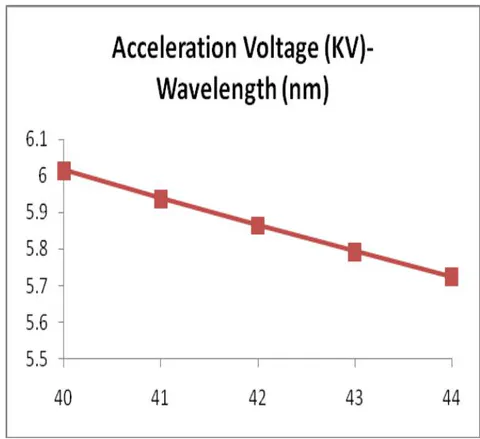
| Sl. No. | Acceleration Voltage (KV) | Wavelength (nm) 10-3 |
| 1 | 40 | 6.015 |
| 2 | 41 | 5.938 |
| 3 | 42 | 5.865 |
| 4 | 43 | 5.793 |
| 5 | 44 | 5.724 |
Optical materials are required to fabricate optical elements such as waveguides for bio-Photonic.
Photonics applications must have specified optical, mechanical, chemical, and biological qualities. The degree of transparency and the refractive index, as well as their Photonics applications must have specified optical, mechanical properties. Current synthetic biodegradable optical waveguide materials have restricted processability and designability, resulting in low-efficiency in vivo light delivery and limited functionality. A versatile material platform that can meet the diverse needs of optical (tunable refractive indices, low optical loss), mechanical (tunable mechanical flexibility for tissue compliance), and biological (biocompatibility, biodegradability, and bioactivity) functions is urgently needed. A citrate-based biomaterial platform has been investigated to overcome this issue. Citrate-based biomaterials are a class of polymers made by reacting citric acid with various diols and/or amino acids in a ne-pot poly condensation reaction. Flexible chemical and design properties have enabled citrate-based biomaterials with tunable degradation rates (from a few days to over one year), adjustable mechanical strengths (tens applications such as optical imaging, optical sensing, and light activated infrared (IR) spectral areas have Materials for bio- The degree of transparency and the refractive index, as well as their spectral dependence, are frequently the most significant qualities to consider when selecting an optical material. High-transparency materials have chemical, and biological qualities. Ultraviolet (UV), visible, and Optical materials are materials that have the capability of controlling altering.
III. CONCLUSION
Biomaterials are a broad category of natural and synthetic materials that can be used alone or in combination. It is, by definition, a chemical that has been created to interact with biological systems, primarily for medical and clinical purposes. The Increased understanding of biological systems and their interfaces with materials is opening up new avenues for the use of biomaterials, which have a diverse set of uses and requirements.
Millions of patients throughout the world have profited from biomaterials' technological advancement. Nonetheless, even as life expectancy rises, organ failure and catastrophic damage continue to crowd hospitals and degrade quality of life. Advances in disease understanding and tissue regeneration, together with increasing accessibility of modern technologies, have given unprecedented prospects for the use of biomaterials. Materials may now be swiftly generated and selecte.
This collection showcases biomaterials research that has been published in Advanced Materials technologies, with an emphasis on targeted drug delivery vehicles, high-throughput material synthesis, minimally invasive biodegradable shape-memory materials, and the development of techniques to promote tissue regeneration through the introduction of instructional. http://orcid.org/0000-0002-5091-3663.