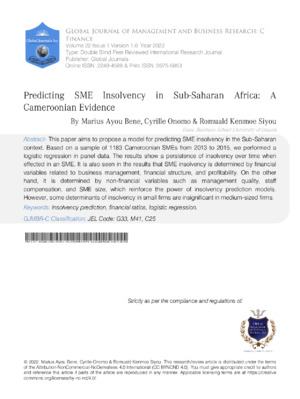
Predicting SME Insolvency in Sub-Saharan Africa: A Cameroonian Evidence

Romuald Kenmoe Siyou
Marius Ayou Bene

Marius Ayou Bene
Cyrille Onomo
Cyrille Onomo
to University of Douala University of Douala

Send Message

To: Author

Predicting SME Insolvency in Sub-Saharan Africa: A Cameroonian Evidence

Article Fingerprint

ReserarchID

C: FINANCEX0I8C

Predicting SME Insolvency in Sub-Saharan Africa: A Cameroonian Evidence Banner

AI TAKEAWAY

Connecting with the Eternal Ground
  • English
  • Afrikaans
  • Albanian
  • Amharic
  • Arabic
  • Armenian
  • Azerbaijani
  • Basque
  • Belarusian
  • Bengali
  • Bosnian
  • Bulgarian
  • Catalan
  • Cebuano
  • Chichewa
  • Chinese (Simplified)
  • Chinese (Traditional)
  • Corsican
  • Croatian
  • Czech
  • Danish
  • Dutch
  • Esperanto
  • Estonian
  • Filipino
  • Finnish
  • French
  • Frisian
  • Galician
  • Georgian
  • German
  • Greek
  • Gujarati
  • Haitian Creole
  • Hausa
  • Hawaiian
  • Hebrew
  • Hindi
  • Hmong
  • Hungarian
  • Icelandic
  • Igbo
  • Indonesian
  • Irish
  • Italian
  • Japanese
  • Javanese
  • Kannada
  • Kazakh
  • Khmer
  • Korean
  • Kurdish (Kurmanji)
  • Kyrgyz
  • Lao
  • Latin
  • Latvian
  • Lithuanian
  • Luxembourgish
  • Macedonian
  • Malagasy
  • Malay
  • Malayalam
  • Maltese
  • Maori
  • Marathi
  • Mongolian
  • Myanmar (Burmese)
  • Nepali
  • Norwegian
  • Pashto
  • Persian
  • Polish
  • Portuguese
  • Punjabi
  • Romanian
  • Russian
  • Samoan
  • Scots Gaelic
  • Serbian
  • Sesotho
  • Shona
  • Sindhi
  • Sinhala
  • Slovak
  • Slovenian
  • Somali
  • Spanish
  • Sundanese
  • Swahili
  • Swedish
  • Tajik
  • Tamil
  • Telugu
  • Thai
  • Turkish
  • Ukrainian
  • Urdu
  • Uzbek
  • Vietnamese
  • Welsh
  • Xhosa
  • Yiddish
  • Yoruba
  • Zulu
Font Type
Font Size
Font Size
Bedground

Abstract

This paper aims to propose a model for predicting SME insolvency in the Sub-Saharan context. Based on a sample of 1183 Cameroonian SMEs from 2013 to 2015, we performed a logistic regression in panel data. The results show a persistence of insolvency over time when effected in an SME. It is also seen in the results that SME insolvency is determined by financial variables related to business management, financial structure, and profitability. On the other hand, it is determined by non-financial variables such as management quality, staff compensation, and SME size, which reinforce the power of insolvency prediction models. However, some determinants of insolvency in small firms are insignificant in medium-sized firms.

References

62 Cites in Article
  1. K Adalessossi (2015). Prediction of corporate bankruptcy: Evidence from West African SME's.
  2. Nnenne Lekwauwa,Anita Bans-Akutey (2012). Commercial banks’ profitability and portfolio management in Ghana.
  3. David Alaminos,Agustín Del Castillo,Manuel Fernández (2016). A Global Model for Bankruptcy Prediction.
  4. Franklin Allen,Isaac Otchere,Lemma Senbet (2011). African financial systems: A review.
  5. Edward Altman (1968). FINANCIAL RATIOS, DISCRIMINANT ANALYSIS AND THE PREDICTION OF CORPORATE BANKRUPTCY.
  6. E Altman,G Sabato (2007). Modelling credit risk for SMEs: Evidence from the US market.
  7. Edward Altman,Gabriele Sabato,Nicholas Wilson (2010). The value of non-financial information in SME risk management.
  8. K Appiah (2011). Business failure Prediction Models: A Review and Analysis of Literature of Listed Firms in Ghana.
  9. John Armour,Simon Deakin (2001). Norms in Private Insolvency: The “London Approach” to the Resolution of Financial Distress.
  10. A Aziz,H Dar (2006). Predicting corporate bankruptcy: Where we stand?.
  11. William Beaver (1966). Financial Ratios As Predictors of Failure.
  12. T Beck,R Cull (2014). SME finance in Africa.
  13. Helmut Bester (1985). The role of collateral in credit markets with imperfect information.
  14. A Blanco,A Irimia,M Oliver (2012). The prediction of bankruptcy of Small firms in the UK using logistic regression Analisis Financiero.
  15. Howard Bodenhorn (2003). Short-Term Loans and Long-Term Relationships: Relationship Lending in Early America.
  16. J Boritz,D Kennedy,Augusto Albuquerque (1995). Predicting Corporate Failure Using a Neural Network Approach.
  17. Bernard Bushe (2019). The causes and impact of business failure among small to micro and medium enterprises in South Africa.
  18. P Calice,V Chando,S Sekioua (2012). Supporting Womens Agro-Enterprises in Africa with ICT: A Feasibility Study in Zambia and Kenya.
  19. Maria-Del-Mar Camacho-Miñano,Maria-Jesus Segovia-Vargas,David Pascual-Ezama (2013). Which Characteristics Predict the Survival of Insolvent Firms? An SME Reorganization Prediction Model.
  20. R Charan,J Useem (2002). Why Companies Fail-CEOs offer Every Excuse but the Right One: Their own Errors. Here are Ten Mistakes to Avoid.
  21. Andreas Charitou,Evi Neophytou,Chris Charalambous (2004). Predicting corporate failure: empirical evidence for the UK.
  22. F Ciampi,N Gordini (2009). Default prediction modeling for small enterprises: Evidence from small manufacturing firms in Northern and Central Italy.
  23. E Cohen (1998). Gestion financière de l'entreprise et développement financier.
  24. Loredana Cultrera,Xavier Brédart (2016). Bankruptcy prediction: the case of Belgian SMEs.
  25. M Dohnal (2008). Basel II implementation -retail credit risk mitigation.
  26. Izidin El Kalak,Robert Hudson (2016). The effect of size on the failure probabilities of SMEs: An empirical study on the US market using discrete hazard model.
  27. Olawale Fatoki (2014). The Causes of the Failure of New Small and Medium Enterprises in South Africa.
  28. D Sabba (1976). Annual Site Environmental Report: 2008 (ASER) for the SLAC National Accelerator Laboratory.
  29. R Feldman (1997). Small Business Loans, Small Banks and a Big Change in Technology Called Credit Scoring.
  30. S Ghosh,E Collins,L Scofield (1990). Prediction of mortgage loan performance with a multiple neural network learning system.
  31. M Gizaw,M Kebede,S Selvaraj (2015). The impact of credit risk on profitability performance of commercial banks in Ethiopia.
  32. N Gordini (2014). A genetic algorithm approach for SMEs bankruptcy prediction: Empirical evidence from Italy.
  33. Jairaj Gupta,Mariachiara Barzotto,Amir Khorasgani (2018). Does size matter in predicting SMEs failure?.
  34. M Gweyi (2013). Credit risk mitigation strategies adopted by commercial banks in Kenya.
  35. Patrick Honohan,Thorsten Beck (2007). Making Finance Work for Africa.
  36. C Kauffmann (2005). Financing SMEs in Africa.
  37. T Kolapo,R Ayeni,M Oke (2012). Credit risk and commercial banks performance in Nigeria: A panel model approach.
  38. Nadine Levratto (2013). From failure to corporate bankruptcy: a review.
  39. S-M Lin,J Ansell,G Andreeva (2012). Predicting default of a small business using different definitions of financial distress.
  40. Lyudmila Lugovskaya (2010). Predicting default of Russian SMEs on the basis of financial and non-financial variables.
  41. O Masetti,A Mihr (2013). Capital markets in Sub-Saharan Africa.
  42. L Mester (1997). What's the point of credit scoring?.
  43. I Mihajlovic (2015). The Reasons for SME's Failure, Comparative Analysis and Research.
  44. Pablo Monelos,Carlos Sánchez,Manuel López (2014). DEA as a business failure prediction tool Application to the case of galician SMEs.
  45. T Ncube (2014). http://www.innspub.net/wp-content/uploads/2013/12/IJB-V4No1-p158-166.pdf.
  46. (2015). New Approaches to SME and Entrepreneurship Financing.
  47. James Ohlson (1980). Financial Ratios and the Probabilistic Prediction of Bankruptcy.
  48. H Ooghe,C Van Wymmersch (1996). Traité d'analyse financière, 6 e édition.
  49. Hubert Ooghe,Sofie De Prijcker (2006). Failure processes and causes of company bankruptcy: a typology.
  50. L Pacheco (2015). SMEs probability of default: The case of hospitality sector.
  51. Aneta Ptak-Chmielewska (2019). Predicting Micro-Enterprise Failures Using Data Mining Techniques.
  52. Gabriele Sabato (2000). Credit Risk Scoring Models.
  53. P Seca Assaba (2002). Information et communication financière dans les entreprises en Afrique subsaharienne : contraintes et perspectives.
  54. Steven Sharpe (1990). Asymmetric Information, Bank Lending, and Implicit Contracts: A Stylized Model of Customer Relationships.
  55. P Simak (1997). DEA Based Analysis of Corporate Failure.
  56. Joseph Stiglitz,Andrew Weiss (1981). Macro-Economic Equilibrium and Credit Rationing.
  57. Ellen Tobback,Tony Bellotti,Julie Moeyersoms,Marija Stankova,David Martens (2017). Bankruptcy prediction for SMEs using relational data.
  58. Francois Van Der Colff,Frans Vermaak (2015). Predicting financial distress using financial and non-financial variables.
  59. Henri Wamba,Louise Tchamanbé-Djiné (2002). Information financière et politique d’offre de crédit bancaire aux PME : cas du Cameroun.
  60. A Wood (2012). The performance of insolvency prediction and credit risk models in UK: A comparative study, development and wider application.
  61. (2013). Doing Business 2013.
  62. (2014). Doing Business 2015: Going Beyond Efficiency.

Funding

No external funding was declared for this work.

Conflict of Interest

The authors declare no conflict of interest.

Ethical Approval

No ethics committee approval was required for this article type.

Data Availability

Not applicable for this article.

How to Cite This Article

Romuald Kenmoe Siyou. 2026. \u201cPredicting SME Insolvency in Sub-Saharan Africa: A Cameroonian Evidence\u201d. Global Journal of Management and Business Research - C: Finance GJMBR-C Volume 22 (GJMBR Volume 22 Issue C1).

Download Citation

High-resolution image of a research journal page on SME insolvency in Sub-Saharan Africa from Global Journals focused on business research.
Journal Specifications

Crossref Journal DOI 10.17406/GJMBR

Print ISSN 0975-5853

e-ISSN 2249-4588

Keywords
Classification
GJMBR-C Classification JEL Code: G33
M41
C25
Version of record

v1.2

Issue date
February 18, 2022

Language
en
Experiance in AR

Explore published articles in an immersive Augmented Reality environment. Our platform converts research papers into interactive 3D books, allowing readers to view and interact with content using AR and VR compatible devices.

Read in 3D

Your published article is automatically converted into a realistic 3D book. Flip through pages and read research papers in a more engaging and interactive format.

Article Matrices
Total Views: 1573
Total Downloads: 48
2026 Trends
Related Research
Our website is actively being updated, and changes may occur frequently. Please clear your browser cache if needed. For feedback or error reporting, please email [email protected]

Request Access

Please fill out the form below to request access to this research paper. Your request will be reviewed by the editorial or author team.
X

Quote and Order Details

Contact Person

Invoice Address

Notes or Comments

This is the heading

Lorem ipsum dolor sit amet, consectetur adipiscing elit. Ut elit tellus, luctus nec ullamcorper mattis, pulvinar dapibus leo.

High-quality academic research articles on global topics and journals.

Predicting SME Insolvency in Sub-Saharan Africa: A Cameroonian Evidence

Romuald Kenmoe Siyou
Romuald Kenmoe Siyou <p>University of Douala</p>
Marius Ayou Bene
Marius Ayou Bene <p>University of Douala</p>
Cyrille Onomo
Cyrille Onomo

Research Journals