
I. INTRODUCTION
Strategic intelligence was named one of the forms of intelligence which anchors leadership traits Specialists in the field of management and strategic management believe that successful management is the one that constantly seeks to innovate modern administrative tools and various techniques that would contribute to achieving leadership, creativity, and institutional excellence by working on managing all the resources of the institution in various circumstances and crises, in a way that achieves the survival of organizations Continuity and growth (AlTaweel & AlHawary, 2021; Al- Quran et al., 2020; Al-Lozi et al., 2017; Alhalalmeh et al., 2020; Al-Nady et al., 2013; Al-Nady et al., 2016; Allahow et al., 2018). Peter Darker pointed out the need for managers to learn to manage the organization in a creative way. Strategic intelligence is considered a protective shield for the organization, as it plays a vital role in every stage of the organization's strategies and operations. The role of this type of intelligence in managing crises facing the organization, as it helps managers in defining the organization's programs and policies, and the ability to address future challenge of the organization (Hijjawi & Mohammad, 2019).
Strategic intelligence was named one of the forms of intelligence which anchors leadership traits, then finding creative leaders, particularly in light of the growing importance of leadership in institutions and reliance on traits (intelligence, mind, and personality) in trying to judge the efficiency of leaders (Al-Hawary & Hadad, 2016). The challenges, problems and crises faced by public institutions in the current era are growing as a result of the rapid changes and developments that occur in their business environments, which have become an obstacle and a challenge to them, or limit their ability to keep pace with development or respond to changes, therefore, institutions need to activate strategic intelligence practices in order to develop effective crisis management strategies. Organizations required improving their products and enhancing indicators of their competitiveness, especially during the challenges the world is witnessing. In general, the success of the organizations requires keeping pace with strategic management developments. Strategic intelligence is also considered an advanced field; it is considered one of the important tools that enable these institutions to deal with the environmental uncertainty they face, and it is an important factor in supporting and coordinating all efforts to unify them in order to achieve the strategic goals efficiently and effectively. The study mainly aimed to determine the role that strategic intelligence plays in enhancing crisis management strategies.
II. THEORETICAL FRAMEWORK AND HYPOTHESES DEVELOPMENT
a) Crisis management
The concept of crisis has several meanings, including a sudden change for the worse and the risks and opportunities it entails to restore conditions to their normal state and find constructive solutions, or in other words, it is a turning point in unstable conditions, or a series of events that have a negative impact on the institution (Al-Zubaidi and Al-Mamouri, 2015). It is also a critical moment related to the fate of the administrative entity that has been affected by it. The concept of crisis management refers to how to overcome the crisis by using scientific administrative methods in order to avoid its negative aspects as much as possible and maximize its answers. Crisis management is a purposeful activity based on research and obtaining the necessary information that enables the administration to predict the locations and trends of the expected crisis, and create the appropriate climate to deal with it by taking measures to control the expected crisis. Every crisis has premises, evidence indicating its occurrence, and initial, intermediate, and final manifestations. The causes of the emergence of crises vary according to their different types, fields, and types, some of them are outside the capabilities of the institution, some are due to external causes, and some are related to the internal environment. In order to get rid of or limit the negative effects of crises when they occur, institutions may follow a number of strategies or one of them according to the stages of the crisis, and these strategies include: Early warning strategy: It is the stage of discovering the danger signs of the crisis, and these signs appear early, because the crisis usually sends a series of early warning signals long before it occurs, or symptoms that predict the possibility of the crisis. Preparedness and prevention strategy: in which a set of required prevention methods are taken at the stage of risk discovery, including: Prevention includes discovering weaknesses and strengths in order to address them. Damage containment strategy: It is summarized in preparing means to limit the damage and prevent it from spreading to other parts that are not yet affected in the organization. This strategy depends on the nature of the accident that occurred. Recovery strategy: This strategy includes preparing and implementing short and long-term programs, and this stage includes restoring lost morale. This strategy also includes trying to compensate for what was lost in the previous stage. Learning and growth strategy: It is a stage of continuous learning and reassessment to improve what has been achieved in the past. Learning is vital, but it is very painful, as it evokes painful memories left by the crisis, and that drawing lessons learned from a disaster or crisis depends on the availability of a sensitive sense in the human being that makes him appreciate the suffering the change.
b) Strategic intelligence
Intelligence has been and is still the subject of discussion for many years by researchers, psychologists, sociologists and genetics, as there is no complete agreement on its concept and meaning due to the difference being something that is not tangible and is not directly measured, although it is the basis for the greatest and best human achievements and is one of the causes of progress and creativity. Some scholars have characterized intelligence as a genuine phenomenon with a presence that can be measured, and others have described intelligence as the ability to cognitively adjust to life and its new conditions, in other words, the opportunity to benefit from prior experiences in addressing difficulties (Ghubari, Abu Shaira, 2010). Intelligence is the mental ability that individuals have, which is affected by the factors of the dynamic environment surrounding it, and among the contents of this ability is to collect and store information and refer to it to support his actions in different situations, to achieve certain goals (Qasim, 2011).
Strategic intelligence can also be defined as a systematic and continuous process to produce intelligence effectively to facilitate long-term decision-making and include improving performance of workers participating in decision-making (Al-Hawary & Hadad, 2016). Strategic intelligence has also been defined as an important tool in achieving success and leadership for enterprise leaders, and that strategic intelligence refines the qualities of leaders and transforms them into strategic leaders capable of achieving the goals of their organizations (Maccoby, 2011). Many organizations today are building and developing their strategic intelligence by attracting consultants and specialists who provide the necessary analyzes and final outputs that will help in making important and sensitive decisions in the organization such as merging and opening new production lines (Xue, 2017).
Strategic intelligence is measured through several dimensions: Foresight: It expresses the ability of the leader to think in the form of invisible forces, but they create the future and show the importance of the element in employing intelligence for leaders of organizations in several areas. Systems thinking: It expresses the ability to synthesize the integration of elements more than separating them into parts and then analyze them with each other and then evaluate them in terms of their relationship to the whole, and focus on the method of their interaction with each other in terms of their success in serving the goals of the system (Muslim, 2015). Strategic vision: A clear and enterprising strategic vision is a necessary component of strategic leadership without taking a future conception of the business, i.e. what it will need to satisfy customers, as well as what business activities to pursue and the types of long-term market situations to build compared to competitors (Bridge and O'Neill, 2012). Motivation: It expresses the action that pushes the individual to adopt an appropriate viewpoint to accomplish the task assigned to him in a satisfactory manner, as well as stimulating the emotions and desires of the individual to urge him to do a specific action (Ansoff, 2019). Intuition: The inner voice that generates feelings against our decisions or with them in general, especially if the data is conflicting or insufficient. We rely on it to reach a conclusion on the sixth sense (Mahmood, 2019). Partnership: It reflects the organization's ability to establish a set of strategic alliances with organizations that work together in order to gain sufficient support to succeed in its work, the higher the strategic intelligence of the organization, the higher its ability to build strategic alliances with others, and thus increase its ability to continue, grow and survive in the industry.
c) Strategic intelligence and crisis management strategies
Building the future of organizations is not easy. Success becomes difficult in a changing work environment, characterized by instability and uncertainty. Success and excellence in performance require a combination of different elements, such as technology, people, and resources; to create a fully functional building, here emerges the importance of the organization's interaction with crisis management strategies, considering it a basic fact and an important part of the organizations' work, and their interaction with their environment. Crisis management strategies are not random, this process follows specific patterns that lead to expected results, and one of its most common processes and results is the exploration and investment of opportunities; to achieve the objectives of the organization, and make improvements to obtain more competitive advantages to distinguish from others. The areas of crisis management have received many studies and research due to their importance. Crisis management deals with many areas in the organization, and may include more than one field at the same time.
According to Al-Abbasi and Hamad's (2020) study, there is a significant correlation between the strategic mindset and briefing in the external environment in a way that allows the institution to shape visions for ongoing activities, predict, and styling strategies for improving crisis management, while excellence, sustainable development, and continuous improvement will undeniably be for the companies that implement the most strategic intelligence, as strategic intelligence is a key component of strategic intelligence; through the development and development of intangible assets, which are among the most important resources of the organization at all. The fields of intelligence have also received a lot of studies and research from those interested in the field of strategic intelligence. Given its importance; Some previous studies found a statistically significant impact relationship between the practices of strategic intelligence and organizational ambidexterity (Saleh, Suleiman, 2020), as well as a relationship between the strategic intelligence of senior leaders in promoting organizational excellence among academic leaders at Hamdania University (Youssef, 2020). Through the foregoing in explaining the importance of the concepts of crisis management strategies and strategic intelligence, it is possible to formulate the hypothesis of the study as follows:
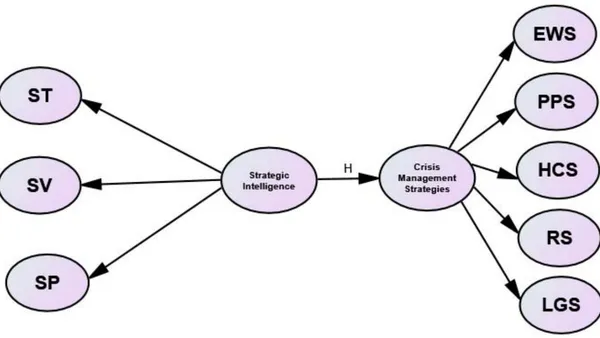
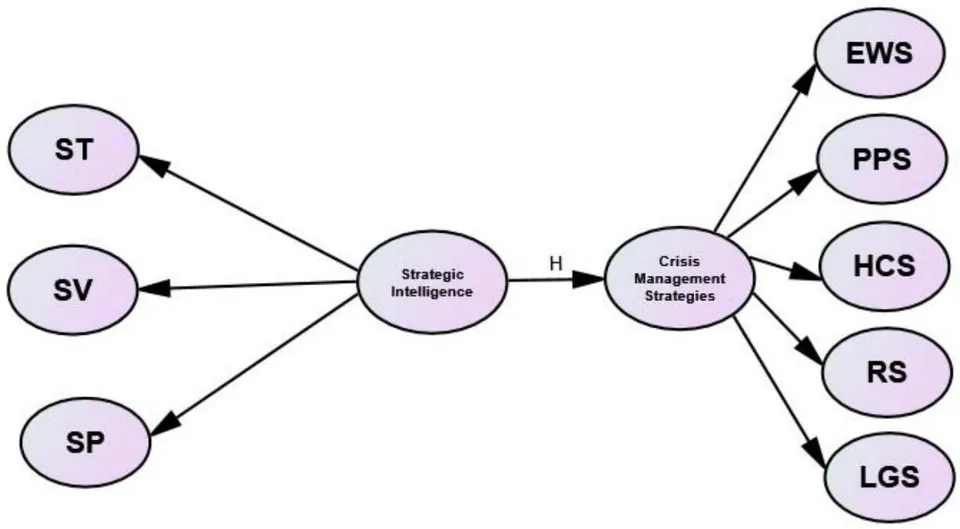
Strategic intelligence has a statistically significant impact on crisis management in Jordanian telecommunications companies.
III. STUDY MODEL
a) Methodology
i. Population and sample selection
By means of a quantitative method so as to achieve the goals of the present study, data were harvested from a sample made up of (126) subjects, who were randomly picked from telecommunication firms in Jordan. Exactly, (116) surveys were admitted; four responses were invalid due to incomplete answers were excluded, whence, data statistical analysis was carried out using (112) surveys. Such a number meets the assumption that the collected data should be saturated (Sekaran & Bougie, 2016).
ii. Measurement instrument
Research instrument entails two key sections as well as a third one for control variables. Control variables, i.e., gender, age, educational level, and experience were deemed as considered as categorical variables. The instrument was anchored adopting a five-point Likert scale; (1) refers to strongly disagree and (5) stands for strongly agree. Section1 enclosed (9) items to measure strategic intelligence based on (Pherson & Pherson, 2020; Ahmadi, Baei, Hosseini-Amiri, Moarefi,
Suifan & Sweis, 2020). The items of strategic intelligence(9 items) were scattered onthree dimensions; i.e., strategic partnership, systems thinking, and strategic partnership, equally. On the other hand, the items of the crisis management strategies (15 items) were also equally allocated to five dimensions; i.e., warning strategy, preparedness and prevention strategy, harm containment strategy, recovery strategy, and learning and growth strategy (Eliadis, 2019; Harcek, 2018; Kapucu & Ustun, 2018).
b) Findings
i. Measurement model evaluation
Hypotheses were tested applying structural equation modeling (SEM), which is anup-to-date statistical technique used to estimate the relationship between constructs (Wang & Rhemtulla, 2021). Convergent validity, discriminant validity, and internal consistency were used to assess validity and reliability, as shown in Table 1, based on constructs factor loading, average variance extracted (AVE), the square root of AVE values, and Cronbach's alpha coefficients.
| Constructs | 1 | 2 | 3 | 4 | 5 | 6 | 7 | 8 |
| 1. ST | - | |||||||
| 2. SV | 0.61 | - | ||||||
| 3. SP | 0.74 | 0.65 | - | |||||
| 4. EWS | 0.65 | 0.69 | 0.65 | - | ||||
| 5. PPS | 0.69 | 0.64 | 0.63 | 0.57 | - | |||
| 6. HCS | 0.75 | 0.63 | 0.55 | 0.65 | 0.74 | - | ||
| 7.RS | 0.72 | 0.77 | 0.59 | 0.52 | 0.74 | 0.55 | - | |
| 8.LGS | 0.76 | 0.71 | 0.62 | 0.69 | 0.69 | 0.53 | 0.65 | - |
| VIF | 2.511 | 2.019 | 1.987 | --- | --- | --- | --- | --- |
| Loadings range | 0.741- | 0.594- | 0.725- | 0.514- | 0.692- | 0.541- | 0.577- | 0.785- |
| 0.842 | 0.780 | 0.829 | 0.839 | 0.752 | 0.744 | 0.729 | 0.842 | |
| AVE | 0.644 | 0.654 | 0.624 | 0.635 | 0.622 | 0.688 | 0.654 | 0.712 |
| MSV | 0.544 | 0.562 | 0.529 | 0.533 | 0.587 | 0.601 | 0.522 | 0.534 |
| Internal consistency | 0.789 | 0.854 | 0.869 | 0.872 | 0.869 | 0.844 | 0.891 | 0.905 |
| Composite reliability | 0.887 | 0.864 | 0.849 | 0.853 | 0.816 | 0.882 | 0.798 | 0.799 |
The results in Table 1 pointed out that both validity and validity indices showed acceptable thresholds. Factor loadings, ranged between (0.514) and (0.839), were greater than 0.50 (Al-Lozi et al., 2018; Sung et al., 2019). Convergent validity was assured as AVE values were higher than 0.50 (Howard, 2018). Discriminant validity was tested based on comparing maximum-shared variance (MSV) values with AVE values and comparing the square roots of AVE values to correlations between constructs (Rimkeviciene et al., 2017). It was acknowledged that MSV values were sl tighter than AVE values, which were higher than Pearson correlation coefficients between constructs. Furthermore, Cronbach's alpha coefficient and composite reliabilities were above 0.70 (de Leeuw et al., 2019).
ii. Structural model
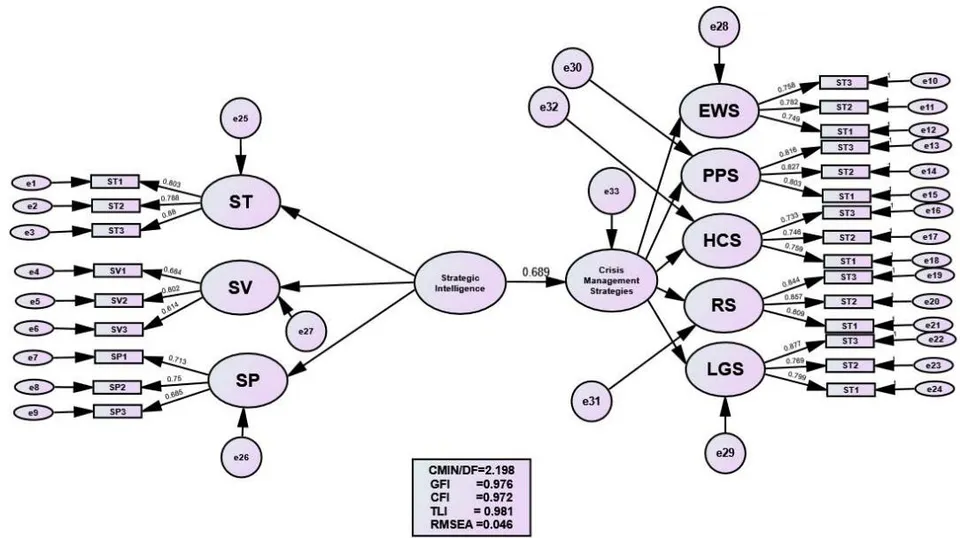
Research structural model as traced in Figure 1 displays that the collected data met the required cut-off values of goodness-of-fit indices. Chi-square to degrees of freedom (CMIN/DF = 2.198 < 3), the goodness of fit index (GFI = 0.976 > 0.90), the comparative fit index
, and the Tucker-Lewis index (TLI ). Likewise, the root mean square error of approximation (RMSEA ) (Ahmad et al., 2016; Shi et al., 2019). In terms of multicollinearity, the values of the variance inflation factor (VIF) were less than 5, which mean that the current data is free of multicollinearity among independent variables (Hair et al., 2017). The findings of hypotheses testing are outlined in Table 2.
| Hypothesis | Relation | Standard Beta | tvalue | pvalue |
| H1 | Systems Thinking→Crisis Management Strategies | 0.406 | 8.169 | 0.000 |
| H2 | Strategic Vision→Crisis Management Strategies | 0.252 | 4.937 | 0.000 |
| H3 | Strategic Partnership→Crisis Management Strategies | 0.126 | 2.598 | 0.000 |
The results exhibited in Table 2 indicate that all strategic intelligence dimensions have a positive impact relationship on crisis management strategies. However, the results indicated that systems thinking had the maximum effect, followed by strategic vision , strategic partnership had the minimum effect.
IV. DISCUSSION
The results indicated that the telecommunication companies in Jordan are working to pay attention to the perception of the companyin the form of a coherent and harmonious system, with reliance on studying ideas collectively instead of studying them individually to feel their value in the long run, and analyzing any problem by looking at its combined causes instead of separating its factors from each other, this helps to see the events that surround the institution in a clearer picture, and enhances the ability to integrate the various elements in the institution for the purpose of analytical and understanding how they interact. The hypothesis test revealed that strategic intelligence has an impact on crisis management, with the highest dimension being related to systems thinking, followed by strategic vision, and finally strategic partnership.
The researchers conclude from this result that strategic intelligence in the telecommunication companies in Jordanis reflected in many dimensions related to crisis management strategies, and given this result and the fact that systems thinking represents the first step towards the process of thinking in neutralizing the negative effects of crises, hence the preparation and prevention for it. The vision must be the independent mirror of these institutions in terms of a long-term view and an attempt to enhance organizational effectiveness in line with thinking as an institution in avoiding independent dangers to individuals, the institution and society. Therefore, cooperation and competition by maintaining the positive effects of what companies produce it is inevitable, hence the role of strategic partnerships as a regular process in the companies operating in Jordan, the result of the study is consistent with Al-Quwaz study (2012).
V. RECOMMENDATIONS
According to the results reached by the analysis, the researchers present a number of recommendations to decision-makers to adopt to enhance the desired results through strategic intelligence in adopting crisis management strategies in the telecommunication companies in Jordan, due to the value and benefit telecommunication companies in Jordan will achieve in order to persuade them to enter into a partnership A strategy by promoting practices related to the activity of containing crises through the establishment of telecommunication companies in Jordan because of their impact on restoring life to institutions and the continuity of the wheel of production in them. The researchers also recommend the need to restore activity as a crisis strategy with conscious, pre-planned and official efforts, so that the matter is under control, and to achieve the hopes of rebuilding, the need for telecommunication companies in Jordan to pay attention to learning and growth as a strategy for crises and get out of them with conscious and planned efforts, stimulating learning and training: by providing incentives the material and moral to attend training programs and meetings to study the crisis, so that the benefit from them can be confirmed.