Academically, in the context of the Lebanese market, customer-centricity has not been addressed earlier; the factors that drive the success of a customer-centric strategy for an organization are to be recognized. An organization needs to identify and define the benefit and critical success factors (CSFs) of having the customer as the driver for its operations. A customer-centric organization capitalizes on an operating model based on a deep understanding of its customers, what they value, and what contribution they make to the company’s profitability. This paper aims to assess and analyze the critical success factors of organizational customer-centricity within the context of the Lebanese market. It follows a quantitative approach with data collected from survey questionnaires administered to different employees of different organizations in various Lebanese regions.
## I. INTRODUCTION
The concept of the "Customer-centric Organizations" was investigated thoroughly in the literature (Bailey, 2005; Sadorf, 2011; Ernst & Young, 2013; Khan, 2022), and the salient question remains, "What distinguishes customer-centric organizations from other organizations claiming customer-focus?" According to Egol, Hyde, Ribeiro, & Tipping (2004), "these organizations have moved beyond lip service and re-oriented their entire operating model around the customer while increasing customer satisfaction and their profitability in the process" (p. 4). Customer-centric companies "align their operating models with a carefully defined and quantified customer segmentation strategy, and tailor business streams-product development, demand generation, production and scheduling, supply chain, customer care, etc... to delivering the greatest value to the best customers for the least cost" (p. 4). In addition, Trochil (2004) asserts that customer-centric organizations succeed because they ensure that the customers' needs and expectations are met and exceeded. A customer-centric organization practices the following steps: "Provides customer value as its primary motivation; perceives staff as customer service agents; makes the buying experience the best it can be; operates on a budget-driven by member needs, and personalizes all communication" (Para 3).
Moreover, according to Rai (2013), "The two most important elements in establishing a customer-centric organization are an enterprise database and a workforce that can willingly share information and ensure a commitment to the customers, instead of the products or organizational fiefdoms. It is a long, hard slog to become - and maintain - being a customer-centric organization, but the result is a much more profitable brand" (p. 374). The aforementioned is ensured by achieving customer satisfaction and enriching an organization's wealth tangibly and intangibly.
Concerning the context of the Lebanese market, as far as the researchers' knowledge, some references address the experience in Lebanese organizations (Hejase, 2001, 2007, 2008; Telecomreview.com, 2016; Soubra, 2021). Hence, this research aims to formulate a general proposition on the components of a successful customer-centric organization capitalizing on customer-centric strategy implementation by aligning different internal and external aspects of the organization. These include culture, structure, human resources, economic strategies, and marketing strategies. Moreover, this study intends to define the extant factors that determine the success of a customer-centric strategy adopted by an organization. The researchers adopted a quantitative approach covering a sample of companies from the Lebanese market. The findings will present a general proposition on the components of a successful customer-centric organization in this market.
## II. PROBLEM DEFINITION
Organizations now a day apply customer-centric strategies worldwide to present an offering that targets the diverse needs of all customers. They aim to satisfy the customers' needs and provide value-added and exceed consumer expectations (Deloitte & Touche, 2014). An organization should adopt several sub-strategies that concern the internal and external operations by developing a clear, successful, and effective customer-centric strategy (Yohn, 2018). In addition, Morgan (2019) stresses the importance of customer-centricity by addressing the best hundred companies in the world. The author contends that "Customer-centric companies live and breathe their customers and are highly focused on providing amazing experiences. These companies are innovative, do good in the world, disrupt their industries, and are rewarded with growth and increased revenue. Brands that have superior customer experience bring in 5.7 times more revenue than their competitors" (Para 1). "Customercentricity comes in many forms, ranging from adopting new technology to getting feedback to building relationships" (Morgan, 2019, para 3). All sectors of the economy apply customer-centricity including retail, healthcare, manufacturing, services, information and communications technology, agriculture, etc. Moreover, many firms from all countries worldwide seek to achieve the benefits of customer-centricity. Nevertheless, these firms are committed to introducing disruptive changes internally and externally. Lebanon is no exception since there is a lack of studies and knowledge in the Lebanese market. The Lebanese market is rich having many organizations competing for leadership in all different sectors. As a result, consumers have a wide choice of organizations and competing products to choose from them. Hence, there is of utmost importance to provide a unique service and value-added products to the consumers that adhere to the current era of consumer-focused and consumer-centric organizations. Developing a consumer-centric strategy is essential in the process of communicating the values of the services provided by different organizations. Determining the appropriate consumers' needs is essential for an organization to attract the right customers and exceed their expectations. Horn, Sloan, & Benjamin (2017) assert that "Consumers don't want products designed for people in other markets. They want products and services that fit their lifestyles, incomes, and cultural traditions" In short, "customers want companies to anticipate their needs through a maze of purchasing channels and technologies. When companies get it right, they can reap rich rewards through greater customer spending and loyalty" (p. 3). Hence, a continuously demanding and competitive market requires the adoption of an innovative consumer-centric strategy that capitalizes on different internal and external factors. Research covering customer-centricity in the Lebanese market is scarce. This study intends to assess and analyze the Critical Success Factors (CSFs) of a customer-centric strategy in the Lebanese market.
## III. SCOPE OF THE STUDY
This study, as stated before, covers the customer-centric strategies adopted in Lebanese organizations. The researchers will assess the importance of human resources (HR), employee behavior, and other internal and external factors in determining the success of such strategies. The research objectives are as below:
- Defining the standard internal and external CSFs of customer-centric organizations.
- Analyzing the importance of HR strategies and policies in determining the success of customer-centric organizations.
- Determining the best-practice economic model for a customer-centric organization.
- Assessing the customer-centricity of Lebanese organizations.
- Presenting the CSFs deemed important to determine customer-centric strategy outcomes in Lebanese organizations.
The paper constitutes several sections: Section 1 contains the introduction and background. Section 2 discusses the relevant review of the literature. Section 3 elucidates the methodology, the description of the variables, and the data sources while section 4 is devoted to the empirical results. Finally, section 5 offers conclusions and remarks.
## IV. LITERATURE REVIEW
### a) Customer Centricity and Customer-Centric Organizations
Gartner Inc. (2022) defines customer-centricity as "The ability of people in an organization to understand customers' situations, perceptions, and expectations. Customer centricity demands that the customer is the focal point of all decisions related to delivering products, services, and experiences to create customer satisfaction, loyalty, and advocacy" (Para 1). Van den Hemel, & Rademakers (2016) provide a broad definition, "A business approach that places the customer's value-perception at the center of attention and takes it as the starting point for all organizational activities. Developing a strategy starts at the customer and flows back to the organization (as opposed to inside-out thinking; that is, from the organization to the customer). The aim is to create an optimal and distinctive fit between the value perception of the customer and the products/services offered. In this way, superior value is created for the customer, and captured by the organization" (p. 4). Alida (n.d.) stresses the fact that "it's a key part of aligning your organization around the customer, which means creating an open, centralized and secure space so every touchpoint with a customer reflects your brand values and fosters transparency" (p. 6). According to Kretz (2021), "Customer centricity can't simply be a marketing ploy. It needs to be a company mindset. It must become embedded in a business leader's core way of thinking about everything from product to strategy" (Para 3). Finally, a report published by Ernst and Young (2013) provides another definition: "A customer-centric organization builds an operating model around a deep understanding of its customers, what they value, and the contribution each makes to the profitability of the company" (Burns, Delany, Clark, & Sterner, 2013, p. 7). In addition, the report stresses that the aforementioned is achieved "by designing business processes that target diverse customer needs, delivering a positive customer experience at every touchpoint across the customer life cycle, maintaining an active communication channel with customers, and fostering a culture that places the customer at the heart of the organizational strategy and decision-making process" (ibid).
## V. BEST PRACTICES
### a) Core Principles for Redefining Customer Relationships
The report by Ernst and Young (2013) states five core principles for redefining customer relations. Starting with protecting the organization or business against intermediation by third parties, Organizations have to ensure a direct contact relationship with their consumers to have a strong influence on how consumers view their products and services; next, organizations have to ensure the correct understanding of customers' needs to develop and provide product offerings that target those needs. Thirdly, organizations should increase productivity to gain a competitive advantage by increasing their productivity through streamlined business processes and technological improvements that will enhance the quality of the service they provide to their customers. The fourth principle is related to the diversity of sources of revenue to attain sustainability. This affects customer-centricity recognizing that product performance and consumer needs shift with market conditions and life events. Finally, organizations should embrace collaboration with new partners across the value chain. By doing so, organizations are successful in opening new opportunities by identifying and managing strategic business partnerships. Adopting those principles, organizations "can build a strong foundation for the future while improving top-line growth and profitability over the near term. To truly succeed, they must embrace and embed the concept of innovation within their organizations" (ibid).
### b) The Three-component Model for Customer-Centric Performance Requirements
Schiele and Sadorf (2009) present a three-component model for customer-centric performance requirements. This model consists of three pillars, internal organizational, external customer, and industry views. The first step of building a customer-centric organization is defining key-performance requirements including key skills and behaviors that make both employees and customers loyal. The second step describes the pillars individually. Pillar one, or the internal organizational view, deals with management identifying high-performance employees who can develop and sustain outstanding customer relationships. Employees can provide an internal benchmark for the organization. A quantitative approach to recognizing key result measures by an individual is preferred to avoid subjectivity. The second pillar, the external customer's view deals with gathering customers' input and feedback on their expectations. Organizations can identify, from consumers' perspectives, the activities and drivers they value the most through customer workshops and focus groups. The third pillar, the industry's view identifies specific practices and benchmarks to compare the organization's performance and customer relationships (Schiele & Sadorf, 2009).
### c) SMART Customer Relationship Management
Sadorf (2011) presents another model for customer relationship management. This model consists of five sections depicting the word "SMART" standing for S: Start with the survey, M: Meet with customers, A: Act, R: Rate the progress, and T: Target improvement.
### d) Customer-Centric Organizational Factors
A customer-centric organization has equally been "one which orients its whole being around customers and their requirements. It ensures an alignment of its strategy, people, and processes with customers' needs. This will affect the organization's systems, its structures, the working environment, and the skills and behaviors of its employees" (Macaulay, 2011, p. 4 cited in Osakwe, 2020, p. 457). Macaulay (2011, cited in Osakwe, 2020) mentions different success factors in dealing with an organizational customer-centric strategy. These factors include 'Customer-oriented leadership' and enthusiastic leaders driven by customer relationships. 'Supportive culture' adopts a wide customer-centric culture that includes internal and external customers. Based on this culture, an organization should reward and celebrate customer-focused success. Moreover, the 'Human Resource department plays a great role in determining the customer-centricity of an organization through recruitment policies and training and development programs. As for the importance of the HR function, Fox (2013) contends that "Customer-centric HR is the next level of human resource management that will revolutionize the way companies operate" (para 2). Dave Ulrich (a Ross School of Business professor at the University of Michigan-Ann Arbor) cited in Fox (2013) recommends "partnering with customers. i.e., organizations strive to be an employer of employees whom customers would choose instead of being an employer of choice — and, in some cases, do choose. Customers filter almost every HR practice" (para 5). The second recommendation is soliciting customers to partner with the organization, "professional HR executives must seek external customers, listen to them and involve them. Therefore, needing strong two-way communication channels and using collected information to inform HR decisions. Thirdly, selecting, training, and developing employees. Fourthly, rewarding employees' good behavior" (Fox, 2013).
Furthermore, along the same lines as above, MacDonald (2022) recommends four best practices to support business success: "(1) Hiring for customer success. Regardless of the role, the focus must be on hiring talent aligned with customer-centric thinking and the importance of customer experience in the business. (2) Putting relationships first. Customers are people who benefit to a great extent when partnering with them. (3) Democratizing customer data. A customer relationship management (CRM) database can help facilitate a personalized relationship with customers to provide the business with a unified front (internal integration) that delivers better customer experiences. (4) Connecting company culture to customer outcomes. Indeed, employees' motivation is boosted by customer-centricity strategy when linking actions to results" (para 25-28).
### e) Customer-centric characteristics
Embedding customer-centricity in the organization's 'DNA' is based on several characteristics of organizations. According to Macaulay (2011) and Deloitte & Touche (2014), these factors are listening to customers, leading by example, creating service standards, customer service training, internal customer cooperation, continuous improvement, and employee empowerment and responsibility.
# f) The Path to Customer Centricity
Shah and Staelin (2006) mention several factors that an organization should consider while evaluating and developing its customer-centric strategy. (1) Organizational culture that engulfs values, norms, and beliefs. Values represent the essence of a culture driven by a central value to which each decision is focused primarily on customer needs and satisfaction. Norms represent the customer advocacy as adopted by employees. A familiar norm of customer-centric organizations is knowledge sharing between employees who become capable of best serving the customers. Finally, two beliefs; customers' understanding that comes from living with the customer and 'customers' loyalty' is considered the key to long-term success and profit (Shah & Staelin, 2006). (2) Organizational structure implying the complete integration of all functional activities to deliver superior customer value. Integrating functions and/or key account managers or segment task forces may be ways an organization can adopt to coordinate all customer value-creation activities. (3) Processes, whereby Payne and Frow (2005, cited in Shah & Staelin, 2006), identified five essential processes for an organization to be customer-centric. Strategy-development process; Dual value creation (core of exchange) process; Multichannel integration (all customer front-end points) process; Information-management process; and Performance-assessment process. (4) Financial metrics are significant to motivate individual employees to be more customer-centric and help marketing managers measure the financial implications of their decision-making. However, the challenge lies in quantifying the financial results and impact of a customer-centric strategy where the main metrics are intangible such as customer satisfaction (Shah & Staelin, 2006).
### g) Becoming Customer-Centric
Bailey (2005) asserts that there are many steps to becoming customer-centric with three top-level primary imperatives: (1) Knowing the customer includes customer segmentation based on common characteristics whereby each customer deserves an appropriate and customized level of attention. The abovementioned help organizations leverage and allocate limited resources maximizing customers' acquisition, retention, and profitability. To be effective, "customer segmentation requires that the entire organization aligns all of its resources with the model" (p. 100). (2) Aligning resources include people, the organization's system, and products and services with the customer. "Once an organization has aligned its resources with the customer via segments, the next step is to listen to and respond to the customer on a continuous basis" (Bailey, 2005, pp. 100-102). (3) Listening and responding (also known as the voice of the customer strategy). Simply administering an organizational survey alone is not listening. Listening requires that organizations internalize and respond to what customers say. A complete "voice of the customer" strategy includes continually obtaining and analyzing input from every front-end point that a customer can have with the organization. "Truly listening requires that the organization obtains customer's input from each touchpoint, then integrating this information, internalizing it, analyzing it, and responding" (Bailey, 2005, p. 102).
### h) Elements and Advantages of Customer-Centric Organizations
Torchlil (2004, para 5) defines the different elements of customer-centric organizations as follows:
- Culture: needs to be well documented and shared among all staff members defining ways of interaction with the customer and the customer's importance to the business.
- Metrics: Tracking, measuring, and responding to data labeled by the customers as significant and attractive.
- Knowledge: Embracing a wide association and integrated discipline of gathering and responding to information about the customers' challenges, needs, and expectations.
- Technology: building, developing, and managing the appropriate tools to deliver concise information to the right people at the right time.
- Segmentation: Categorizing customers into different groups, such that each group gathers people with similar characteristics to improve the services provided and gain a higher return on marketing investments.
Also, Self (2009) defines the advantages of becoming customer-centric. Starting with profits (financial perspective), these are the first advantage for organizations transforming themselves into customer-centric. "Companies that improve their ability consistently meet their customers' needs will produce positive bottom-line business results." (Mikel Harry and Richard Schroeder cited by Self, Para 2). The financial perspective is a direct benefit that starts most organizations on the journey to increased customer relevance. However, Self (2009) justifies his arguments as "first, customer-centricity produces freedom for an organization. Then, freedom empowers everyone in the organization to customize their treatment of customers, rises out of the confidence that all employees understand why and for whom they are working, and manifests itself when a company is proactively working on customer solutions. All of the above translates to fewer worries, accompanied with brand's new opportunities to achieve greater heights in terms of innovative and creative solutions" (Para 3). The second argument is employee loyalty. "Companies will enjoy stronger employee loyalty if they embrace strong customer relationship values. Much of employees' satisfaction comes from delivering strong, commonsense solutions to their customers. Customer-centric organizations rise above internal procedures, which the customer does not care about, and focus on a logical service or product that makes the customer's life easier. If employees are empowered to take care of their customers, they will like working much better. Therefore, the result is having happier, more committed employees and customers at the same time" (Para 4). Finally, Companies that outperform the competition have "customers" as a core competency (ibid).
### i) Customer-Centricity: The Construct and the Operational Antecedents
Lamberti (2013) presents four components of the customer-centricity construct:
- Customer Integration
General customization, such as mass customization, is essentially product-centric (Sheth et al., 2000, p. 55). It adapts existing products to different customer needs rather than developing products around customer needs. In a customer-centric approach, customers are active players in the marketing process by the ways products/services reach the customer and by the content's nature that derives from a participatory decision-making process involving customers (Etgar, 2008).
- Interactive CRM
Attaining firm-customer trust is required and is accomplished through adaptive learning of customers' needs and preferences, requiring interactivity. The above explains the strong linkage between customer integration and interactive customer relationship management.
External Integration
Within a customer-centric context, a prerequisite for implementing customer focus effectively is underlining supply-chain alignment, collaboration, and an alignment between the companies and the retailers (Gagnon and Chu, 2005; as cited in Lamberti, 2013).
Internal Integration
A common goal and a shared cultural view of the company's role are essential to implementing customer-centered processes (Galbraith, 2002, as cited in Lamberti, 2013). Moreover, "in customer-centric organizations, the emphasis is on the total integration of all customer-facing activities by better aligning all firm activities around customer value-adding activities" (Sheth et al., 2000).
### j) The Building Blocks of a Customer-Centric Organization
According to Booz & Company (2004, p. 5), a leading global management consultancy firm, the building blocks of a customer-centric organization are:
- Customer life-cycle view; an organization has a holistic and continuous view of each customer's evolving life-cycle needs and other transforming life experiences.
- Solution mindset; encouraging a new customer value proposition. A focused Mindset on problem-solving away from only selling.
- Advice bundling; relies on continuous dialogue engagement with customers alongside the product/service purchasing and serviceability cost-effectively.
- Can-Do customer interface; arms front-line staff with the skills and authority to tailor solutions.
- Fit-For-Purpose business processes; wisely flow the most basic and stable products and services through the most efficient, least expensive business streams. Diverting more complicated and less predictable elements of offerings to more customized streams is recommended to isolate complexity within the system and minimize costs).
- Collective, cross-functional effort; tailoring solutions to customers' ever-changing needs requires cooperation across functions, product/service lines, and company boundaries.
### k) The Seven Practices of Customer-Centric Organizations
- A provider of customer experience and engagement software 'People Metrics' (2013) identified seven practices of customer-centric organizations. These are: making customers mission-central, seeking highly loyal customers, empowering customers' feedback, enriching employees' knowledge sharing to improve customers' experience, providing all necessary resources to employees' customers' problem solving, sharing collected customers' feedback with employees, and recognizing employees when they offer good service to customers. These practices are familiar among many models discussed earlier in this paper.
I) Customer-Centricity Attributes and Behaviors
Marshak (2013) presents the attributes and behaviors that define true customer-centricity as follows:
- Organizational commitment to customer success
- Full engagement with customers
- Top-down management customer commitment
- Internalizing a culture of customer-centricity
- Recognizing the customer along the corporate business lines
- Designing customer-centric processes and policies
- Measuring customers' related transactions
- Encouraging innovation for customers
Marshak emphasizes other practices like "customer experience." A truly customer-centric organization will work to understand what its end customers are trying to do and help them get that done with ease, grace, and a positive experience.
## VI. INTERNAL ORGANIZATIONAL FACTORS AND CUSTOMER CENTRICITY
Internal organizational factors like culture and structure play an important role in shaping the customer-centricity of an organization. Researchers in this section summarizes the findings of relevant literature on the impact of organizational culture and structure in determining the success of a customer-centric organization.
### a) Organizational Culture and Customer Centricity Creating a customer-centric culture
Blacharski (2006) presents different actions an organization should take to ensure a wide-accepted customer-centric culture. (1) Organizational identity is embedded in every employee in the organization. A fact observed in the process of creation of the product/service with the customer in mind. (2) Organizational mission statement must embed the commitment, the desire to deliver the best value, and the delivery of the best customer experience. The mission statement should lead to the value proposition of the organization shared among all employees. This value statement should envisage how the organization wants its image in consumers' minds. Blacharski (2006) asserts that the main steps in creating a customer-centric culture are as follows: Knowing customers, hiring appropriate talent, training for customer service, activating standards and record metrics, practicing positive reinforcement techniques, starting from the top (top management commitment), and keeping employees happy.
b) Organizational Culture and Customer Centricity
- Jordheim (2014) discusses the development of a customer-centric culture that enables the organization to live up to customer expectations. Hiring staff that mirrors customer-centric culture is essential in determining the success of customer-centric strategies. Employees are the company's heart with all the values, norms, and beliefs that the company is trying to adopt as a cultural image.
c) Organizational Structure and Customer Centricity
Different structures adopted by the organization may lead to the success or failure of the customer-centric strategy adopted by this organization.
### d) Reinforcing customer-centricity through the structure
Reesink (2014) discusses the importance of organizational structure as a customer-centricity determinant factor. The researcher mentions that perceiving customer-centricity as an organization's goal or strategy is achieved by aligning the organizational structure to them. An organizational structure that enables a mindset that crosses different functional areas is essential to creating the highest customer value. Jones, 2010, as cited in Reesink (2014) contends that "the differentiation of subunits based on customer segments allows such a cross-functional mindset since it will align functional skills and competencies with the needs of the customer segment" (p. 14). Moreover, Reesink states that while customer-centricity implies the maximization of value creation for the customer, each employee should work on reaching this maximum value by defining the Key Performance Indicator (KPI) structure. Total integration of subunits and all front-end activities reinforce customer-centricity by aligning all value creation activities. "An integration role coordinates the activities of two or more functions or subunits, promotes information and knowledge sharing, and pursues organizational goals better by influencing what employees do and how they do it" (Jones, 2013, p. 124). Jones also mentions the importance of vertical integration of all subunits. Such structure enables various subunits to interact and exchange information causing the alignment of operational and tactical goals that lead to the maximization of value creation. Finally, the researcher concludes that a customer-centric organization should divide its subunits based on functional tasks. The subunits may be divided based on customer segments if specific subunits can identify consumer needs (Reesink, 2014).
Moreover, Gebauer and Kowalkowski (2012) discuss the importance of organizational structure in shaping the customer orientation of an organization. They highlight the importance of vertical integration structure in driving the organization towards a customer-oriented strategy. Then, to create customer orientation, an organization has to either set up and integrate customer teams in the sales organizations of product Strategic Business Units (SBUs) or establish customer-focused SBUs. Such a vertical integration structure requires sharing knowledge and resources between the different teams across all concerned SBUs. In addition, an organization should formulate a customer-oriented frame with all its business partners to ensure the delivery of a benefit to customers (Gebauer & Kowalkowski, 2012).
## VII. TECHNOLOGY AND CUSTOMER CENTRICITY
Technology includes different software for the analysis of data that is customer-centric.
### a) Customer Service Technology and Customer-Centricity
Schawbel's (2014) interview with Jim McCann, CEO of 1-800-FLOWERS, highlighted the customer experience of 1-800-FLOWERS of customer service technology. McCann highlighted the importance of adopting new technology in the customer-centric strategy of the organization. McCann stressed the impact of the customer service technology to further the organization's customer experience initiatives. He added that the company's customer service agents use the customer service technology in capturing, accessing, and sharing knowledge that improves customer interaction and accelerates customer support. Also, McCann highlights the importance of data analysis provided by technology in building customer loyalty. In addition, he stresses the impact of hardware technology, specifically mobile phones, that organizations should exploit the opportunity to reach customers everywhere and anytime through this medium. Technological interaction engagement with customers is essential for an organization to build customer loyalty, enhance customer retention, and maximize customer value (Jim McCann, as cited in Schawbel, 2014).
### b) Information Technology as a Strategic Partner for Marketing in Customer Centricity
"Forbes Insights" (2015), in association with TURN, surveyed 162 U.S.-based senior executives. Their report informs that "brand intelligence solutions, customer relationship management systems, consumer intelligence technologies, and data management platforms are enabling organizations to manage better their volumes of data and better understand customers through their behaviors" (p. 4). The research highlights the importance of formulating a strategic partnership between Information Technology (IT) and marketing practices so that a customer-centric organization succeeds. In addition, according to $72\%$ of the respondents, "companies are still focused primarily on knowledge gathering rather than making real and actionable use of their data" (p. 5). In addition, the report stresses the fact that "As data-centric tools become sophisticated and brands become appreciative of data's value, several key changes are taking place" (p. 4). In fact, "nearly half— $48\%$ —of participant senior executives answered that they plan to evangelize data discoveries to modify business and strategic objectives" (p. 4). Finally, the report recommends that "embracing the newfound power of data takes more than innovative technologies. Advanced organizations establish best practices to glean greater value from their data (p. 8) - as these increasingly recognize the relevance of data-driven marketing, they are investing more heavily in the necessary tools, talent, and technologies" (p. 13).
### c) Customer-Centricity Challenges and Information Technology
Nadkarni (2010) emphasizes that "although companies are aware of the value of customer-centric efforts, less attention has been given to its implementation - especially the key role that the information technology (IT) organization plays in its eventual success" (Para 1). The growth of the customercentricity strategy resulted in a higher emphasis on finding the organization's overall profitability due to customers and calculating customers' lifetime value. However, Nadkarni (2010) contends that "the analytics required to support such a strategy have required databases designed to enable querying of data across the various customer interactions with the company. The above deviates from the classic approach of efficiently designing databases querying account/relationship information about the customer. Such account-centric databases fall short when one has to find out about all of the customer's interactions with the company" (Para 3). Also, Galliers and Leidner (2003) contend that there should be strategic congruence between the information systems strategy and the corporate strategy. The authors suggest focusing on four areas to plan for the strategic information systems. These include "using business goals as the starting point for IT investment, looking for opportunities to leverage IT for competitive advantage, managing IT workers efficiently and effectively, and defining enterprise architectures and policies for technology clearly" (p. 182).
Furthermore, Reynolds (2002) also emphasizes that CRM technology must follow a customer-centric strategy because only customer-centricity attains the full benefits offered by CRM technology. In addition, Nadkarni (2010) argues that IT implications of implementing a customer-centric business strategy occur when understanding the organization's broader business challenges. Exhibit 1 depicts these.
Exhibit 1: Organization's broader business challenges
- Identify and understand each stakeholder's role in the execution of the strategy successfully.
- Implement effective communication between stakeholders to avoid loss or misinterpretation of messages throughout the organization's ranks and levels.
- Define a consistent data architecture strategy with a clear vision of the organization's strategy and communicated operational objectives.
Source: Nadkarni, 2010, Para 5-14.
The obstacles to overcome when implementing a customer-centric business strategy extend way beyond IT. However, "the IT organization can take the lead role in ensuring the success of such a strategy - overcoming challenges, reducing implementation times, and preventing organizational frustrations" (Nadkarni, 2010, para 14).
### d) Customer-Centric Information Systems
Liang and Tanniru (2007) present a three-generation framework for customer-centric information systems. "The first-generation systems focused on technology utilization; the second-generation systems were process-oriented built to support general-purpose processes for adaptation through configuration and reusability; while the third depicted customer-centric information systems" (pp. 10-11). Liang and Tanniru emphasize that "Customer value and business competitiveness were the drivers of those systems; making the system development a dynamic process. Moreover, the system development focus is to configure various components of the customer-driven value chain to meet the ever-changing customer value proposition" (p. 11). Capitalizing on the abovementioned, the authors present a framework of four different components for the customer-centric information system that includes customers, processes, products and services, and technologies. Customers are centric with the other three components depicted around the center.
## VIII. ECONOMICS OF CUSTOMER CENTRICITY
The economics of customer-centricity section covers mass customization, customer-centricity sustainability, and economic customer-centricity metrics.
### a) Mass Customization and Customer Integration
Piller and Moeslein (2004) discuss the concept of mass customization and present a value-creation model through mass customization. "Mass customization has emerged in the last decade as a solution for addressing the new market realities while still enabling firms to capture the efficiency advantages of mass-production" (Pine, 1993, Tseng and Jiao, 2001, Piller, 2003, as cited in Piller & Moeslein, 2004). Moreover, "Mass customization is a technology-assisted production process where customers are allowed to modify the traditional mass production process to produce their preferred design and fit. Moreover, it is a collaborative approach where the manufacturer customizes a product based on customer desires identified through a proper dialog" (Fralix, 2001; Gilmore & Pine, 1997; Dissanayake, 2019). The main difference between mass customization and mass production is the high intensity of information (Piller, 2003, cited in Piller & Moeslein, 2004). In a mass customization system, a customer is involved in the configuration or design phases of the products. However, with a variance in the degree of this involvement based on the type of the product. Mass customization is an economic strategy that enables an organization to benefit from the efficiency and deploys a customer-centric strategy to maximize customer value (Piller & Moeslein, 2004).
### b) Customer Centricity Sustainability
Sheth, Sethia, and Srinivas (2011) assert that sustainability, as a business goal, leads to economic, social, and environmental positive impacts. They dissected the economic dimension of sustainability where multiple arguments are present. They argue that the economics aspect relates to one of the known 3Ps: planet, people, and profit representing the conventional economic profit. However, through customer-centricity, organizations may also define a new concept in the economic dimension of sustainability. Adopting customer-centric sustainability (CCS) as a core element results in much greater effectiveness of the Corporate's sustainability agenda. Seth et al. (2011) propose conceptualizing CCS as a metric of performance based on sustainability outcomes that are personally consequential for customers and result from customer-directed business actions. The authors argue that there are three dimensions of CCS:
- Environmental; relates to the impact of consumption on the environment's well-being.
- Social; relates to the impact of consumption on consumers' well-being.
- Economics; relates to the impact of consumption on consumers' financial well-being.
Sheth et al. (2011) argue that a customer-centric strategy impacts the customer's well-being that needs to be measured tangibly. However, there is the difficulty in quantifying the customer-centricity economic impacts and pointing out marketing metrics as the measure of the success of customer-centricity.
### c) Customer Centricity and Customer Loyalty Metrics
A sustainable stakeholder value is best when focusing on customer loyalty. For example, Peter Drucker (1999) asserts "purpose of business is to create and keep customers." However, not all customers are equal, and in fact, loyal customers are far more profitable. According to Rioux (2020), "Loyal customers lead to growth" (para 1). Moreover, she advocates that increasing customer loyalty leads to "customers becoming brand advocates, increased spending, lower cost to serve, increased purchases of higher-margin products/services, and more customer referrals" (para 8-19). Also, Skorobogatykh & Shirotchenskay (2019) stress that several key customer behavior metrics exist to evaluate the overall financial impact of a loyalty program. Metrics include "retention; or the incremental percent of current customers who are program members and remain loyal. Lift, or the incremental increase in spending by current customers who are also program members; shift, or the incremental spending from competitors' customers who are program members and start shopping at the business" (p. 198). Furthermore, executives quantitatively evaluate the economic value of implementing a loyalty program using the loyalty math behind 'retention, lift, and shift' to drive an attractive Return on Investment (ROI) (ibid, p. 199).
Panthongpraser (2015), quoting performance improvement expert H. James Harrington contends that "measurement is the first step that leads to control and eventually to improvement" (p. 45). However, businesses realize that "not all customers are the same; so, attracting and retaining customers cannot be measured for management action purposes without understanding the differences between customers" (p. 45). Consequently, for a person to quantify the economics of customer retention, several metrics have to be defined and understood. Moreover, marketers find these metrics useful for better decision-making in marketing to understand dynamic and fast changes when necessary and detect opportunities for various customer relationships. Metrics that are very useful for measuring and assessing the value of customers include the following:
Customer Retention Rate (CRR); is recommended as the first metric that marketers and economists should keep tracking. CRR is the quotient of the number of customers retained to the number of customers at risk. The functions in the primary factors of the supply chain marketing and sales and customer care departments must share strategies and results to identify opportunities in retaining their customers. "The Pareto Principle can be of use to observe that $80\%$ of a company's revenues referred to $20\%$ of the customers" (Rivard, 2017, para 3). However, it is not easy to know the exact percentages. It is still the case that businesses concentrate on their most valuable customers. According to Info Entrepreneurs (2009), "identifying customers worth more for the business can be for many reasons ranging from the size of their purchases to the relative ease of managing their account. Successful businesses do the following: identify customers, build relationships with them, and work to bring in new customers with similar profiles" (para 2). Congruent to the aforementioned, Panthongpraser (2015) recommends that "organizations have to be aware of their focused efforts to nurture and engage current customers, improve organizational practices implemented to increase loyalty, and transform customers to ambassadors for their brands" (p. 45). In addition, Cioffi (2019) contends that "if the data-driven marketing goal is to manage churn actively, one must perform value-based marketing taking into consideration customer lifetime value, event-driven marketing, data warehousing, and analytics infrastructure" (p. 23). Next, quoting Panthongpraser (2015, pp. 45-46), some of the metrics are reviewed as shown,
#### Customer Retention Rate (CRR):
CRR = (Original no. of customers — Lost customers) / Original no. of customers
Customer Acquisition Cost (CAC) or Cost of Customer Acquisition (COCA):
CAC = (the total acquisition spending) / (the number of new customers acquired)
According to Bernazzani (2021), "Total acquisition spending refers to total sales expenses and marketing cost - adding up all the programs or advertising spending, salaries, commissions and bonuses, and overhead spent to acquire customers in a period" (para 16-23).
Customer Lifetime Value (CLV or LTV): CLV is "the present value of the future cash flows or the value of business attributed to the customer during his or her entire relationship with the company" (The Economic Times, 2022, para 1). However, one may compare it with the customer profit (CP). CP = Revenues - Costs associated with the customer relationship during a specified period. However, Panthongpraser (2015) asserts that the difference between CP and CLV is that the first measures the past, and the second looks forward.
Hence, CLV enriches the managers' decisions but is hard to quantify because it involves forecasting future activity.
CLV = (Avg. monthly Rev. per customer * Gross margin per customer)/Churn rate Where Churn rate $= 1 - \mathrm{CRR}$
According to Customer Thermometer (n.d.), "Customer Churn is the movement of customers out of your business... is also known as customer attrition, customer turnover and customer loss" (para 1, 4). The Churn Rate is the ratio of all the customers lost during a period (i.e., a month) divided by the total number of the company's customers at the beginning of the month. One does not include any new sales from that month.
$$
C L V = G C (C R R / 1 + d - C R R)
$$
Where,
GC is yearly gross contribution per customer.
CRR is the yearly retention rate (or 1 - Churn rate), and $d$ is the 'yearly discount rate.'
** "Assume that contribution margin, retention rate, and discount rate are constant, and the company uses an infinite horizon timeframe when it calculates the present value of future cash flows" (Panthongpraser, 2015, p. 45). Also, according to Caldwell (2021),
CLV = Average Transaction Size x Number of Transactions x Retention Period
The ratio of Customer Lifetime Value to CAC (CLV: CAC): In a well-balanced business, CAC should be less than customer lifetime value, or the CLV: CAC ratio should be higher than (1 time), i.e., a higher one means the company's sales and marketing have a higher ROI. Panthongpraser (2015) offers the following comparisons: "Ratio 1:1 means you lose money the more you sell; Ratio 3:1 or better is a good target, and Ratio 4:1 or higher indicates a great business model, but in a competitive market you might be under-investing in sales and marketing" (Panthongpraser, 2015, p. 46).
CAC looks at what resources the organization puts into landing new customers, while CLV examines the customers' potential value they bring to the organization.
## IX. PROPOSED RESEARCH MODEL
Figure 1 depicts the proposed research framework for this research. It also illustrates the five hypotheses to be tested.
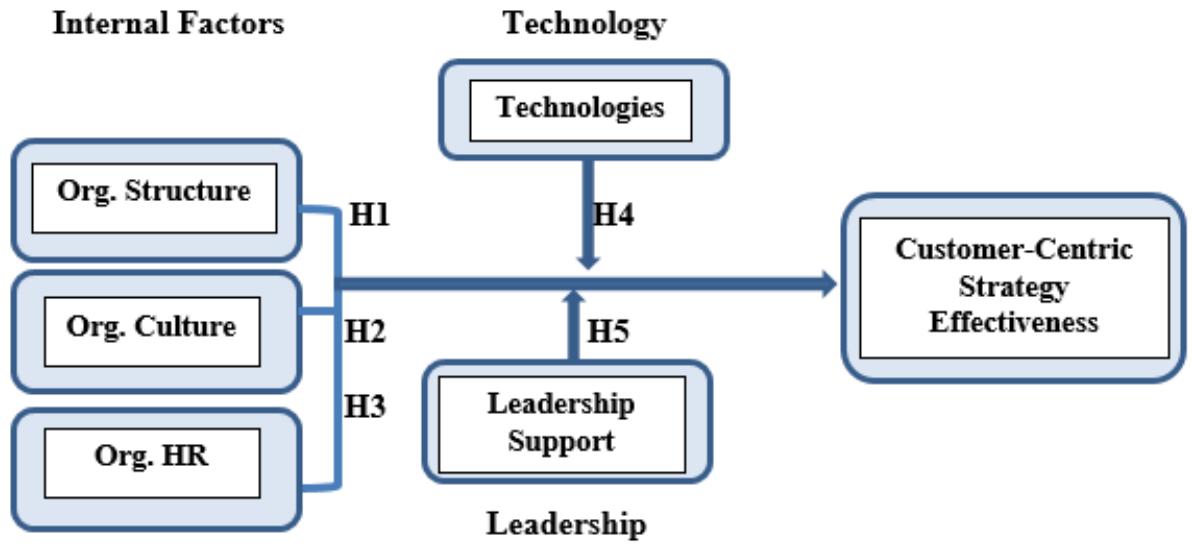 Figure 1: Proposed Research Model
## X. RESEARCH QUESTIONS AND HYPOTHESES
- RQ1: What is the impact of internal organizational factors on the customer-centric strategy adopted by the organization?
- H1: Organizational structure affects the effectiveness of the customer-centric strategy.
- H2: Organizational culture affects the effectiveness of the customer-centric strategy.
- H3: Human Resources (HR) policies affect employee behavior in being customer-centric
- RQ2: What is the impact of technology on the customer-centric strategy adopted by the organization?
- H4: Adopting the right technologies enables the success of customer-centric strategies.
- RQ3: What are the right leadership practices that enable the success of customer-centric strategies?
- H5: Applying the right leadership commitment enables the success of customer-centric strategies.
RQ4: Are Lebanese organizations following a customer-centric approach?
H6: The majority of Lebanese organizations are following a customer-centric approach.
## XI. RESEARCH METHODOLOGY
Williams (2007) contends that "Quantitative researchers seek explanations and predictions with the intent to establish, confirm, or validate relationships and to develop generalizations that contribute to the theory understudy" (p. 66). Kothari (2004) asserts that "Quantitative research quantifies attitudes, opinions, behaviors, and other defined variables and generalizes results from a larger sample population. This approach applies to phenomena expressed by quantity" (p. 3). Based on the above reasoning, the researchers adopted quantitative research aiming for a scientific approach to measure the level of customer-centricity of a selected number of Lebanese organizations and determine the critical success factors of customer-centric organizations. Indeed, the main objective of quantitative research is to test theories or hypotheses.
### a) The Philosophy
Saunders et al. (2009) and Hejase & Hejase (2013) contend that strat researcher considers the research philosophy. The current research follows the principles of positivism that "depend on quantifiable observations that lead to statistical analysis" (Collins, 2010, p. 38; cited in Dudovskiy, n.d.). Moreover, Hejase and Hejase (2013) contend that "Positivism is when the researcher assumes the role of an objective analyst, is independent, and neither affects nor is affected by the subject of the research." (Hejase & Hejase, 2013, p. 77). The positivist research paradigm assures an objective reality, valuing honesty and personal integrity that creates an environment of trust. The abovementioned entails a study trusted to correspond to reality (Saunders et al., 2009).
### b) The Approach
The researchers adopted the deductive approach to validate the hypotheses set at the beginning of the research. In fact, "A deductive approach is useful if the general aim was to test a previous theory in a different situation or to compare categories at different periods" (Elo & Helvi, 2008, p. 107).
### c) The Strategy
Research strategy is a blueprint for the research and forms the milestones needed in the research design. Research design can be exploratory, descriptive, or causal: (Hejase & Hejase 2013, p. 110). This research is exploratory and causal. "An exploratory design is conducted about a research problem when there are few or no earlier studies. The focus is on gaining insights and familiarity for later investigation or undertaken when problems are in a preliminary stage of investigation" (Labaree, 2013, p. 7). Moreover, Hejase & Hejase (2013, p. 115) find cause-effect relations between two or more variables indicated by causal research.
### d) Data Collection Techniques
Secondary data
The literature review provides a clear, timely, streamlined understanding of the subject of this research. More than 70 references were revised and analyzed using books, reviews, Internet sources, scholarly blogs, and articles. The purpose was to collect reported data, explore better the problem of investigation, and illustrate different views on customer centricity models and issues.
### e) Primary data
A survey was the research tool used to collect primary data administered at a specific period.
### f) Population
The target population of the survey questionnaire includes employees of all levels of different organizations in the Lebanese market. The authors covered various regions of Lebanon to formulate a representative view on the status of customer-centricity in Lebanese organizations.
### g) Sample selection and size
This study uses a non-probabilistic sampling method. The basis of participants' choice was their willingness, free-will involvement, and ease of reach. Researchers distributed 250 questionnaires. The number of valid returned questionnaires reached 200. Fifty questionnaires were invalid due to being half-completed (35), erroneously filled (11), and those with a missing pages (4). Therefore, the response ratio was $80\%$. The administration of the questionnaires to respondents covers different ages and backgrounds at universities, places of work, and several organizations.
### h) Survey instrument or questionnaire
The front page was composed of a brief introduction that explains the survey's purpose, the time required to complete it, the respect for confidentiality, and who is conducting it. Four sections divided the questionnaire covering the knowledge of customer-centricity, attitude towards customer centricity, implementation issues of customer-centricity, and demographics. Questions styles include multiple-choice questions and 5-level Likert scale questions for the attitude section. The questionnaire design aids in testing, validating the hypotheses, and thus answering the research questions.
The researchers' choice of close-ended questions, such as two-point, multiple-choice, scaled, matrix, and contingency questions, is reasoned that people are more likely to answer a questionnaire if it does not engage a lot of time and effort. Moreover, the researchers conducted a pilot testing on a sample with ten (10) respondents (not among the sample participants), resulting in slight improvement adjustments applied to the questionnaire.
### i) Data Analysis
Collected data were analyzed applying statistical methods and techniques that include both descriptive and inferential statistics. The Statistical Product and Service Solutions (SPSS) version 21, an IBM product since 2009, is used. Hejase et al. (2012) contend that "informed objective decisions base on facts, numbers, real, realistic and timely information" (p. 129). Furthermore, according to Hejase and Hejase (2013), "descriptive statistics deals with describing a collection of data by condensing the amounts of data into simple representative numerical quantities or plots that can provide a better understanding of the collected data" (p. 272). This paper uses calculations of the mode, median, mean, standard deviation, variance, range, skewness, correlation coefficient, cross-tabulation, or kurtosis since these provide a helpful initial view (Aldrich and Cunningham, 2015). On the other hand, inferential statistics include t-tests, Analysis of Variance (ANOVA), regression analysis, and many other multivariate methods.
### j) Research Ethics
Ethics are essential since these relate directly to the integrity of research and the disciplines involved. Ethical concerns arise in four areas: harm to participants, lack of informed consent, data management, reciprocity and trust, affiliation, and conflict of interest. In addition, the researchers undertook to abide by the ethics principles mentioned above during the whole course of the research.
### k) Reliability Analysis
The 22-item scale assessment uses the Cronbach's Alpha technique to measure Internal Reliability. The 22-item scale had a Cronbach's Alpha = 0.815, while those of the five sections are 0.798, 0.855, 0.756, 0.688 and 0.814, respectively (see Table 1). One may observe that Cronbach's alpha values fall in three ranges 0.6-0.7, 0.7-0.8, and 0.8-1.00 labeled "Moderate," "Good," and "Very Good," respectively (Burns & Burns, 2008, p. 481). Hejase & Hejase (2013) contend that "the generally agreed upon lower limit for Cronbach's alpha is 0.70, although it may decrease to 0.60 in exploratory research" (p. 570). Chehimi et al. (2019) indicate that the
## ii. Percentage of Customers tracked
outcomes assert a moderate and acceptable "strength of association and prove that the selection of the questions is suitable for the questionnaire purpose" (p. 1915).
## XII. RESULTS AND FINDINGS
### a) Demographic Statistics
Results show that $54\%$ of the respondents were females while $46\%$ were males. $71.5\%$ of the respondents belong to the age groups of 20 to 39 years (grouping 20-29 years, $29\%$ and 30-39 years, $42.5\%$ ), while $19\%$ belong to the group age of 40-49 years. Others are either less than 20 years old, $3\%$ or more than 49 years old, $6.5\%$. Also, $64\%$ of the respondents are single, $31\%$ are married, $4.5\%$ are divorced, and $0.5\%$ are widowed. In addition, $60\%$ of the respondents have achieved Master's Degrees, while $32.5\%$ have Bachelor's degrees, $6.5\%$ were high school graduates or equivalent, and $1\%$ earned their doctorate.
Results show that $35\%$ of the respondents assume managerial positions (manager $16.5\%$ and head of department $19\%$ ) while about $35\%$ are senior employees, team leaders & supervisors $23.5\%$ and $11\%$, respectively. The remaining are junior $(21.5\%)$ and trainee $(8.5\%)$ employees.
As for salary, results show that $57\%$ of the respondents earn a monthly annual salary between 1000USD and 3000USD, $31\%$ a monthly annual salary between 3001USD and 5000USD, $3\%$ have a salary less than 1000USD and $9\%$ earn more than 5000USD. In addition, respondents' years of experience are as follows: $45.5\%$ have more than (10) years of experience, $50.5\%$ have between 2 and 9 years of experience, and $4\%$ have less than (2) years of experience. Finally, $24\%$ of the respondents are in the HR department, $18\%$ are in the marketing and communications departments, $10.5\%$ are in the Accounting and Finance departments, and $23\%$ are technical (Engineering $10\%$, Information Technology $6.5\%$, and Operations $6.5\%$ ), and $8.5\%$ are in Quality Management. Furthermore, $6.5\%$ are in Corporate Socially Responsibility, and the remaining $9.5\%$ are in the corporate, executive division, and top management.
### b) Knowledge Statistics
## i. Organization practices tracking of customers
98.5% of the respondents confirmed that their organizations practice tracking customers.
Table 1: Percentage of Customers Tracked
<table><tr><td colspan="2"></td><td>Frequency</td><td>Percent</td><td>Valid Percent</td></tr><tr><td rowspan="3">Valid</td><td>Less than 25%</td><td>55</td><td>27.5</td><td>27.5</td></tr><tr><td>25%-49%</td><td>133</td><td>66.5</td><td>66.5</td></tr><tr><td>50%-74%</td><td>9</td><td>4.5</td><td>4.5</td></tr><tr><td rowspan="2"></td><td>Unspecified</td><td>3</td><td>1.5</td><td>1.5</td></tr><tr><td>Total</td><td>200</td><td>100.0</td><td>100.0</td></tr></table>
Table 1 shows that $66.5\%$ of the respondents agree that the organizations (they belong to) track $25\%$ to $49\%$ of their customers, and $27.5\%$ answered that their organizations track less than $25\%$.
## iii. Customer Tracking Tool
Figure 2 shows that the most used tool in tracking customers is telephone follow-up (67%), followed by surveys (50.5%), while the tools used least are face-to-face talk (26%), comment cards (21.5%), and financial reports (12.5%).
Tracking Tools Use
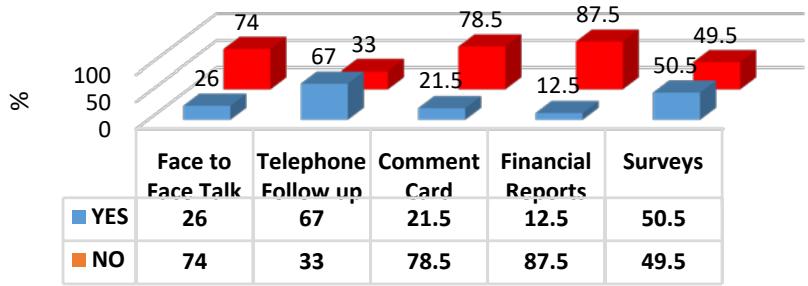 Figure 2: Customer Tracking Tool Histogram
Tracking Tools YES NO
## iv. Loyalty Program
76% of respondents claimed their organizations have a loyalty program, and 24% denied that fact.
## v. Loyalty Program Tool
Figure 3 shows that $59\%$ of the respondents' organizations use special discounts, followed by $54\%$ who asserted the use of loyalty cards.
Loyalty Program Tools
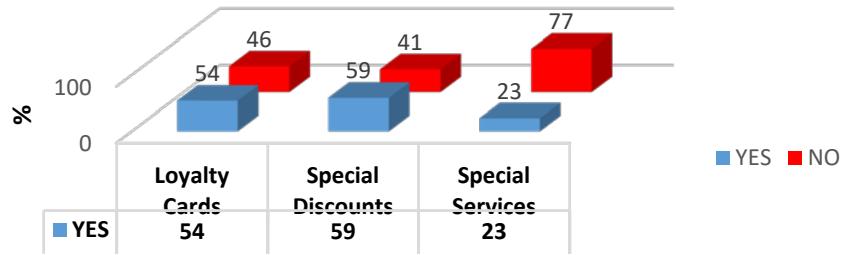 Figure 3: Loyalty Program Tool Histogram
Loyalty program tools
### c) Implementation Issues Statistics
## i. The Respondent's View on Organization's Centricity
Respondents who consider their organizations customer-centric constitute $72\%$ of the sample, while $28\%$ considered their organizations product-centric.
ii. Customers of the Organization are Involved in the Design of their Products and Services
Also, $81.5\%$ of the participants agree that their organizations allow customers' involvement in their products and services design.
## iii. Respondents' attitude towards internal customer-centric factors
Respondents were required to express their agreement with the following statements by selecting the degree of effectiveness whereby SE: Slightly Effectively, E: Effectively, HE: Highly Effectively, and EE: Extremely Effectively. Results were grouped for simplicity of interpretation to show the maximum effect of the responses.
Respondents confirmed the effective integration of the functional teams related to direct customer relationships (99%), their use of technology to analyze customer data is highly effective (94%), and their
organizational culture is suitable for supporting customer-centricity (95%) effectively.
Table 2: Respondents' attitude towards internal customer-centric factors
<table><tr><td>No.</td><td>Statement</td><td>EE</td><td>HE</td><td>E</td><td>SE</td></tr><tr><td>1</td><td>Functional Teams Related to Direct Customer Relationships are Integrated</td><td>20.5</td><td>47.0</td><td>31.5</td><td>01.0</td></tr><tr><td>2</td><td>The Use of Technology to Analyze Customer Data in the Respondent's Organization</td><td>31.5</td><td>63.0</td><td>05.5</td><td>00.0</td></tr><tr><td>3</td><td>The Organization's Culture Supports Customer Centricity</td><td>20.5</td><td>40.5</td><td>34.0</td><td>05.0</td></tr></table>
## iv. Organizational Customer Centricity is in the Mission and Vision Statements
86% of the respondents agree that the customer-centricity of their organizations is in the mission and vision statements.
v. The Organization Has a Clearly Defined Customer-Centric Strategy Communicated Across All Depart
- Moreover, $71.5\%$ of the participants state that there exists a clearly defined customer-centric strategy communicated across all departments.
vi. Inferential Statistics
Cross-tab Analysis
Six variables representing the attitude were cross-tabulated against the question of the presence of a clearly defined customer-centric strategy in the respondents' organization.
Cross Tab 1: "Our company's top executives demonstrate their commitment to our customer experience strategy" * "The Respondent's organization has a clearly defined customer-centric strategy communicated across all functional departments.
Table 3: Cross-tabulation 1
<table><tr><td rowspan="2" colspan="2">Count</td><td colspan="2">Respondents' organization has a clearly defined customer-centric strategy communicated across all functional departments.</td><td rowspan="2">Total</td></tr><tr><td>Yes</td><td>No</td></tr><tr><td rowspan="4">Our company's top executives demonstrate their commitment to our strategy on customer experience.</td><td>Disagree</td><td>0</td><td>5</td><td>5</td></tr><tr><td>Neutral</td><td>4</td><td>36</td><td>40</td></tr><tr><td>Agree</td><td>73</td><td>9</td><td>82</td></tr><tr><td>Strongly Agree</td><td>66</td><td>7</td><td>73</td></tr><tr><td colspan="2">Total</td><td>143</td><td>57</td><td>200</td></tr></table>
Table 3 shows that 139 (70%) respondents who agree and strongly agree that their companies' executives display their commitment to their strategy on customer experience also agree that their organizations have clearly defined customer-centric strategies communicated across all departments.
Table 4: Chi-Square Tests Crosstab 1
<table><tr><td></td><td>Value</td><td>df</td><td>Asymp. Sig. (2-sided)</td></tr><tr><td>Pearson Chi-Square</td><td>23.729</td><td>3</td><td>.000</td></tr><tr><td>Likelihood Ratio</td><td>27.309</td><td>3</td><td>.000</td></tr><tr><td>Linear-by-Linear Association</td><td>13.654</td><td>1</td><td>.000</td></tr><tr><td>N of Valid Cases</td><td>200</td><td></td><td></td></tr></table>
Note: df: degrees of freedom
Table 4 shows that Pearson's Chi-Square (calculated) is 23.729, df=3, and the p-value is 0.000.
Chi-Square (Tabulated, df = 3, α=5%) is 7.815. Therefore, Chi-Square (Calculated) > Chi-Square
(Tabulated) indicates the rejection of the null hypothesis of independence, and the relationship between the two variables is statistically significant.
Further analysis shows that Pearson's correlation $R = 0.265$ with Approx. Sig. of 0.000 less than 5% standard error, implying a weak positive but statistically significant between the variables.
Cross Tab 2: "At our company, the customer experience, the strategy, and the brand are inseparable" * "The Respondent's organization has a clearly defined customer-centric strategy communicated across all functional departments."
Tables 3 and 4 reported similar calculations performed on the relationships. Outcomes show that 124 (62%) of the respondents who confirm that the customer experience, the strategy, and the brand are inseparable in their organizations also agree that their organizations' strategies have a clearly defined customer-centricity communicated across all departments.
More results show that the calculated value of Pearson's Chi-Square is 8.845, df is 3, and the p-value is under Asymp. Sig is 0.006. Chi-Square (Tabulated; df =3, α=5%) is 7.815. The Chi-Square (Calculated) is greater than the tabulated, asserting the rejection of the null hypothesis of independence, and the relationship between the two variables is statistically significant.
Further analysis shows that Pearson's correlation $R(p = 0.040 < 5\%) = 0.148$, implying a very weak positive but statistically significant relationship between the variables.
Cross Tab 3: "Our HR systems support the customer experience" * "The Respondent's organization has a clearly defined customer-centric strategy communicated across all departments."
Outcomes show that 110 (55%) of the participants who confirm that their HR systems support the customers' experience agree that their organizations have a clearly defined customer-centric strategy communicated across all departments. Also, results show that the calculated value of Pearson's Chi-Square (Calculated; df =4, p=0.000) = 22.704. The Chi-Square (Tabulated, df = 4, α=5%) is 9.488. If the Chi-Square (calculated) is greater than that of the tabulated, then the null hypothesis of independence is rejected, and the relationship between the two variables is statistically significant. Moreover, Pearson's correlation R (p=0.002 <5%) = 0.219 implies a weak, positive, and statistically significant between the variables.
Cross Tab 4: "Our reward systems reinforce the behaviors we try to promote around serving customers" * "The Respondent's organization has a clearly defined customer-centric strategy communicated across all departments."
Outcomes show that 88 (44%) of the participants who confirm that the reward systems reinforce the behaviors they try to promote around serving customers also agree that their organizations have a clearly defined customer-centric strategy communicated across all departments.
Furthermore, outcomes show that Pearson's Chi-Square (calculated, df =9, p=.005) = 23.498. The Chi-Square (Tabulated, df=9, α=5%) is 16.919. Therefore, since Chi-Square (Calculated) is greater than the tabulated value, the null hypothesis of independence is rejected, and the relationship between the two variables is statistically significant. Moreover, Pearson's correlation R(p=0.000 < 5%) = 0.252, implying a very weak positive but statistically significant between the variables.
Cross Tab 5: "Our internal communications help create clarity and commitment toward delivering the customer experience" * "The Respondent's organization has a clearly defined customer-centric strategy communicated across all departments."
55% (109) of the participants who confirm that their internal communications help create clarity and commitment toward delivering the customers' experience also agree that their organizations have a clearly defined customer-centric strategy communicated across all departments. Furthermore, outcomes show that the calculated value of Pearson's Chi-Square (Calculated, df =3, p=0.000) is 38.503. Chi-Square (Tabulated, df =9, α=5%) is 7.815. Therefore, since Chi-Square (Calculated) > Chi-Square (Tabulated), the null hypothesis of independence is rejected, indicating that the relation between the two variables is statistically significant. Also, Pearson's correlation R (p=0.000 < 5%) = 0.359 implies a moderate, positive, and statistically significant relationship between the two variables.
Cross Tab 6: "Our use of CRM technology enhances customer interaction" * "The Respondent's organization has a clearly defined customer-centric strategy communicated across all departments."
Outcomes show that 68 (34%) of the participants who confirm that their use of CRM technology enhances customers' interaction also accept that their organizations have a clearly defined customer-centric strategy communicated across all departments. Also, 72 (36%) of those who agree and strongly agree that their use of CRM technology enhances customer interaction reject that their organizations have a clearly defined customer-centric strategy communicated across all departments.
Furthermore, outcomes indicate that Pearson's Chi-Square (Calculated, df =12, p=0.000) = 152.826. Chi-Square (Tabulated, df = 9, α=5%) is 21.026. Therefore, since Chi-Square (calculated) value is greater than the tabulated, the null hypothesis of independence is rejected and indicates that the two variables are statistically significant and related. Moreover, Pearson's correlation R (Approx. Sig. of 0.000 less than α=5%) =
0.430, implying a moderate positive but statistically significant between the variables.
## vii. Cross-tab analysis summary
The abovementioned analysis showed that the most related factors to the presence of a clearly defined customer-centric strategy are those factors related to culture, structure, and technology. Results are similar to those reported by Self (2009), Van den Hemel and Rademakers (2016), Morgan (2019), and Soubra (2021). Other factors on distinctive strategy and HR are related but at a lower rate. Results indicate the importance of having a culture that encourages internal customer-centric communication driven by the commitment of leadership towards the customer-centric strategy of the organization. Also, technology (CRM) is a significant factor in increasing customer interaction which fits Lamberti's (2013) recommendations.
## viii. T-Test
Data from the questionnaire's attitude section was extracted to perform a T-test analysis. The aim was to assess if there was a difference in the employees' perceptions regarding the different factors under study in the customer-centric organization. Nine questions of this section were significant with their t-test results shown in Table 5. Tables 5 and 6 illustrate the salient differences between the respondents' answers means who considered their organizations are customer-centric or product-centric.
Table 5: Levene's Test for Equality of Variances/Independent Samples Test
<table><tr><td colspan="7">Section 1 - Customer-Centric Leadership</td></tr><tr><td rowspan="2" colspan="2">Levene's Test for Equality of Variances</td><td></td><td></td><td colspan="3">t-test for Equality of Means</td></tr><tr><td>F</td><td>Sig.</td><td>T</td><td>df</td><td>Sig. (2-tailed)</td></tr><tr><td rowspan="2">7- Our company's top executives demonstrate their commitment to our customer experience strategy</td><td>Equal Variances Assumed</td><td>8.557</td><td>.004</td><td>-3.288</td><td>198</td><td>.001</td></tr><tr><td>Equal Variances are not Assumed</td><td></td><td></td><td>-3.204</td><td>177.200</td><td>.002</td></tr><tr><td rowspan="2">9- Our leaders spend significant time with customers and employees hearing first-hand about the customer experience</td><td>Equal Variances Assumed</td><td>1.802</td><td>.182</td><td>-2.606</td><td>198</td><td>.010</td></tr><tr><td>Equal Variances are not Assumed</td><td></td><td></td><td>-2.579</td><td>174.056</td><td>.011</td></tr></table>
<table><tr><td colspan="7">Section 2 – Distinctive Strategy</td></tr><tr><td></td><td></td><td>F</td><td>Sig.</td><td>T</td><td>df</td><td>Sig. (2-tailed)</td></tr><tr><td rowspan="2">13-A profound understanding of customers' needs informs our strategic direction</td><td>Equal Variances Assumed</td><td>3.041</td><td>.083</td><td>-2.888</td><td>198</td><td>.004</td></tr><tr><td>Equal Variances are not Assumed</td><td></td><td></td><td>-2.828</td><td>179.312</td><td>.005</td></tr><tr><td rowspan="2">15- At our company, the customer experience, the strategy, and the brand are inseparable</td><td>Equal Variances Assumed</td><td>11.842</td><td>.001</td><td>-2.327</td><td>198</td><td>.021</td></tr><tr><td>Equal Variances are not Assumed</td><td></td><td></td><td>-2.201</td><td>173.919</td><td>.030</td></tr></table>
<table><tr><td colspan="7">Section 3 – HR Alignment</td></tr><tr><td></td><td></td><td>F</td><td>Sig.</td><td>T</td><td>df</td><td>Sig. (2-tailed)</td></tr><tr><td rowspan="2">16- Our HR systems support the customer experience</td><td>Equal Variances Assumed</td><td>.560</td><td>.455</td><td>-2.136</td><td>198</td><td>.034</td></tr><tr><td>Equal Variances are not Assumed</td><td></td><td></td><td>-2.066</td><td>173.648</td><td>.041</td></tr><tr><td rowspan="2">17- We hire for attitude and fit with our culture</td><td>Equal Variances Assumed</td><td>1.251</td><td>.265</td><td>-1.989</td><td>198</td><td>.049</td></tr><tr><td>Equal Variances are not Assumed</td><td></td><td></td><td>-1.940</td><td>177.559</td><td>.055</td></tr><tr><td colspan="7">Section 4 – Internal Culture</td></tr><tr><td></td><td></td><td>F</td><td>Sig.</td><td>T</td><td>df</td><td>Sig. (2-tailed)</td></tr><tr><td rowspan="2">21- Our internal communications help create clarity and commitment toward delivering the customer experience</td><td>Equal Variances Assumed</td><td>4.642</td><td>.033</td><td>2.678</td><td>198</td><td>.008</td></tr><tr><td>Equal Variances are not Assumed</td><td></td><td></td><td>2.711</td><td>176.390</td><td>.008</td></tr><tr><td rowspan="2">25- Our employee experience mirrors the customer experience</td><td>Equal Variances Assumed</td><td>.067</td><td>.796</td><td>3.179</td><td>198</td><td>.002</td></tr><tr><td>Equal Variances are not Assumed</td><td></td><td></td><td>3.162</td><td>176.390</td><td>.002</td></tr></table>
<table><tr><td colspan="7">Section 5 – Customer-Centric Technology</td></tr><tr><td></td><td></td><td>F</td><td>Sig.</td><td>T</td><td>df</td><td>Sig. (2-tailed)</td></tr><tr><td rowspan="2">26- Our use of CRM technology enhances customer interaction</td><td>Equal Variances Assumed</td><td>.022</td><td>.883</td><td>6.474</td><td>198</td><td>.000</td></tr><tr><td>Equal Variances are not Assumed</td><td></td><td></td><td>6.401</td><td>173.755</td><td>.000</td></tr></table>
Table 6: Group Statistics
<table><tr><td></td><td>The respondents' organization is:</td><td>N</td><td>Mean</td><td>Std. Deviation</td><td>Std. Error Mean</td></tr><tr><td rowspan="2">Our company's top executives demonstrate their commitment to our customer experience strategy.</td><td>Customer-centric</td><td>163</td><td>3.59</td><td>.920</td><td>.118</td></tr><tr><td>Product-centric</td><td>37</td><td>2.05</td><td>.808</td><td>.085</td></tr><tr><td rowspan="2">Our leaders spend significant time with customers and employees hearing first-hand about the customer experience</td><td>Customer-centric</td><td>163</td><td>4.34</td><td>.964</td><td>.123</td></tr><tr><td>Product-centric</td><td>37</td><td>2.75</td><td>.914</td><td>.096</td></tr><tr><td rowspan="2">A profound understanding of customers' needs informs our strategic direction.</td><td>Customer-centric</td><td>163</td><td>3.46</td><td>.959</td><td>.123</td></tr><tr><td>Product-centric</td><td>37</td><td>1.89</td><td>.862</td><td>.090</td></tr><tr><td rowspan="2">At our company, the customer experience, the strategy, and the brand are inseparable</td><td>Customer-centric</td><td>163</td><td>3.69</td><td>1.041</td><td>.133</td></tr><tr><td>Product-centric</td><td>37</td><td>2.03</td><td>.781</td><td>.082</td></tr><tr><td rowspan="2">Our HR systems support the customer experience</td><td>Customer-centric</td><td>163</td><td>2.92</td><td>.802</td><td>.103</td></tr><tr><td>Product-centric</td><td>37</td><td>2.18</td><td>.676</td><td>.071</td></tr><tr><td rowspan="2">We hire for attitude and fit with our culture</td><td>Customer-centric</td><td>163</td><td>3.51</td><td>.960</td><td>.123</td></tr><tr><td>Product-centric</td><td>37</td><td>2.80</td><td>.846</td><td>.089</td></tr><tr><td rowspan="2">Our internal communications help create clarity and commitment toward delivering the customer experience.</td><td>Customer-centric</td><td>163</td><td>4.00</td><td>.931</td><td>.119</td></tr><tr><td>Product-centric</td><td>37</td><td>2.5</td><td>.990</td><td>.104</td></tr><tr><td rowspan="2">Our employee experience mirrors the customer experience</td><td>Customer-centric</td><td>163</td><td>3.75</td><td>.921</td><td>.137</td></tr><tr><td>Product-centric</td><td>37</td><td>2.1</td><td>.954</td><td>.109</td></tr><tr><td rowspan="2">Our use of CRM technology enhances customer interaction</td><td>Customer-centric</td><td>163</td><td>4.02</td><td>.991</td><td>.127</td></tr><tr><td>Product-centric</td><td>37</td><td>2.99</td><td>.937</td><td>.098</td></tr></table>
Upon evaluating the mean of each variable, results show a statistically significant difference exists between the means of some questions answered by respondents belonging to customer-centric or product-centric organizations. Tables 5 and 6 depict results explained below:
Rule: Observe the p-value reported for Levene's Test for Equality of Variance in Table 5. If p is well below the 0.05 threshold, one can say that Levene's null hypothesis fails and "equal variance is not assumed" for this sample. Then perform a t-test under the alternative assumption of Non-Equality of Variance and continue to check the significance level reported in the t-test for Equality of Means. The associated significance level of p of the t-test is well below the $5\%$ threshold. The associated significance level indicates that the probability of having no difference between the tested variables is significantly small.
Our company's top executives demonstrate their commitment to our customer experience strategy:
Levene's test significance is $0.004 < 0.05$, so equal variances are not assumed. Then, the P-value of the t-statistic (under Leven's test of Equal Variances not Assumed) is significant at (Sig. $0.002 < 0.05$ ), indicating there is a difference between the means. The mean of customer-centric = 3.59 is significantly higher than that of product-centric = 2.05, inferring that respondents from customer-centric organizations agree that their organizations' top executives demonstrate commitment to customer experience strategy more than those from product-centric organizations.
Our leaders spend significant time with customers and employees hearing first-hand about the customer experience:
Levene's test significance is $0.182 > 0.05$, so equal variances assumed. Then, the P-value of the t-statistic (under Leven's test of Equal Variances Assumed) is significant at (Sig. $0.01 < 0.05$ ), indicating there is a difference between the means. The mean of customer-centric = 4.34 is significantly higher than that of product-centric = 2.75, inferring that respondents from customer-centric organizations are more convinced that their leaders spend significant time with customers and employees to gather feedback about the customer experience.
A profound understanding of customers' needs informs our strategic direction:
Levene's test significance is $0.083 > 0.05$, so equal variances are assumed. The P-value of the t-statistic (under Leven's test of Equal Variances Assumed) is significant at (Sig. $0.004 < 0.05$ ), indicating there is a difference between the means. The mean of customer-centric = 3.46 is significantly higher than that of product-centric = 1.89, inferring that respondents from customer-centric organizations are more convinced that understanding customers' needs drives organizations' strategies.
At our company, the customer experience, the strategy, and the brand are inseparable
Levene's test significance is $0.001 < 0.05$, so equal variances are not assumed. The P-value of the t-statistic (under Leven's test of Equal Variances not Assumed) is significant at (Sig. $0.03 < 0.05$ ), indicating there is a difference between the means. The mean of customer-centric = 3.46 is significantly higher than that of product-centric = 1.89, inferring that respondents from customer-centric organizations are more convinced that the strategy and brand of the organization are supportive of and driven by the customer experience.
Our HR systems support the customer experience
Levene's test significance is $0.445 > 0.05$, so equal variances are assumed. The P-value of the t-statistic (under Leven's test of Equal Variances Assumed) is significant at (Sig. $0.034 < 0.05$ ). The mean of customer-centric = 2.92 is higher than that of product-centric = 2.18, indicating there is a difference between the means, inferring that respondents from customer-centric organizations believe that their HR supports the customer experience at their organizations but in a relatively ineffective manner.
We hire for attitude and fit with our culture
Levene's test significance is $0.265 > 0.05$, so equal variances are assumed. The P-value of the t-statistic (under Levene's test of Equal Variances Assumed) is significant at (Sig. $0.049 < 0.05$ ), indicating there is a difference between the means. The mean of customer-centric = 3.51 is higher than that of product-centric = 2.8, inferring that respondents from customer-centric organizations are slightly more convinced that the hiring policy fits the culture of their organizations.
Our internal communications help create clarity and commitment toward delivering the customers' experiences
Levene's test significance is $0.033 < 0.05$, so equal variances are not assumed. The P-value of the t-statistic (under Levene's test of Equal Variances not Assumed) is significant at (Sig. $0.008 < 0.05$ ), indicating there is a difference between the means. The mean of customer-centric = 4.00 is significantly higher than that of product-centric = 2.50. Inferring that respondents belonging to customer-centric organizations assert that their internal communication strategy is motivating their customers' experiences efficiently and effectively.
Our employee experience mirrors customers' experiences
Levene's test significance is $0.796 > 0.05$, so equal variances are assumed. The P-value of the t-statistic (under Levene's test of Equal Variances Assumed) is significant at (Sig. $0.02 < 0.05$ ), indicating there is a difference between the means. The customercentricity mean $= 3.75$ is larger than the productcentricity mean $= 2.1$, concluding that the respondents' organizations adopting customer-centricity are motivated by customers' experiences.
Our use of CRM technology enhances the interaction of customers
Levene's test significance is $0.883 > 0.05$, so equal variances are assumed. The P-value of the t-statistic (under Levene's test of Equal Variances Assumed) is significant at (Sig. $0.00 < 0.05$ ), indicating there is a difference between the means. The mean of customer-centric = 4.02 is higher than that of product-centric = 2.99, showing that respondents from customer-centric organizations are confident that their use of CRM technology enhances their interaction with the customers.
## ix. T-test summary
Following the variances and means analysis of the different attitude questions between the respondents of customer-centric organizations and product-centric organizations shows that this analysis coincides with the cross-tabulations result. The analysis shows that the main differences in means were in factors related to structure, culture, and technology depicting that respondents value the importance of leadership commitment, internal communication, and CRM applications in supporting the customer experience at their respective organizations. In some cases, the customer-centric and the product-centric means were close to 3 (a reference to the choice of 'Neutral'), indicating respondents are uncertain about the status of the specific factor in determining their organization-centricity. Moreover, the overall results and analysis are a good indicator that the structure, culture, and technology of an organization are significant determinants in the centricity of this organization. Such findings align with those of Self (2009), Van den Hemel and Rademakers (2016), Morgan (2019), and Soubra (2021). Finally, the T-test results and analysis will be the basis of the hypotheses testing and validation mentioned at the end of this paper.
## x. Regression Analysis
This section presents a regression analysis of the variables examined for the sample under study. The dependent variable is the statement "respondents' organizations have a clearly defined customer-centric strategy communicated across all departments." The researchers decided to select various independent variables from the different questionnaire sections. The variables taken are five (5) knowledge-related variables, 15 attitude-related variables (3 from every section), and five (5) implementation issues-related variables. The selected variables are as below:
Dependent variable: Customer-centric strategy communicated across all departments
Independent variables:
Knowledge
1. The Respondent's Organization Tracking of Customers
2. The Respondent's Organization Tracks Customer Satisfaction
3. Customer Tracking Tool
4. The Respondent's Organization Has a Loyalty Program
5. Loyalty Program Tool
Attitude: Customer-Centric Leadership
6. Our company's top executives demonstrate their commitment to our customer experience strategy.
7. Our leaders spend significant time with customers and employees hearing first-hand about the customer experience.
8. At our company, the customer experience, the strategy, and the brand are inseparable.
Attitude: Distinctive Strategy
9. We have a strategic vision that permeates the company
10. A profound understanding of customers' needs informs our strategic direction
11. At our company, the customer experience, the strategy, and the brand are inseparable
Attitude: HR Alignment
12. Our HR systems support the customer experience
13. We hire for attitude and fit with our culture
14. We have created training to equip our employees to deliver the customer experience.
Attitude: Internal Culture
15. Our internal communications help create clarity and commitment toward delivering the customer experience.
16. We have a distinctive culture and a brand 'DNA' that permeates our company
17. Our employee experience mirrors the customer experience
Attitude: Customer-Centric Technology
18. Our use of CRM technology enhances customer interaction
19. Customer-centric information systems enable our company to target our customers' most persisting needs
20. Our customer-centric technology increases the value we deliver to our customers
Implementation Issues
21. Customers of the Organization are Involved in the Design of their Products and Services
22. Functional Teams Related to Direct Customer Relationships are Integrated
23. The Use of Technology to Analyze Customer Data in the Respondent's Organization
### 24. The Culture of the Respondent's Organization Supports Customer Centricity
#### 25. Customer Centricity of the Respondent's Organization is in the Mission and Vision Statements
Table 8: Pearson's correlation analysis
<table><tr><td>Valid Sample (N) = 200</td><td>The respondent's organization has a clearly defined customer-centric strategy communicated across all departments.</td><td>Sig.(1-tailed)</td></tr><tr><td colspan="2">Weak strength of relationship 0.20 < R < 0.40</td><td></td></tr><tr><td>We have a strategic vision that permeates the company</td><td>.205</td><td>.035</td></tr><tr><td>Our company's top executives demonstrate their commitment to our customer experience strategy</td><td>.210</td><td>.006</td></tr><tr><td>Customer Tracking Tool</td><td>.245</td><td>.039</td></tr><tr><td>Loyalty Program Tool</td><td>.266</td><td>.025</td></tr><tr><td>The Respondent's Organization Tracking of Customers</td><td>.276</td><td>.040</td></tr><tr><td>We have a distinctive culture and a brand 'DNA' that permeates our company</td><td>.305</td><td>.035</td></tr><tr><td>Our employee experience mirrors the customer experience</td><td>.320</td><td>.000</td></tr><tr><td>Our customer-centric technology increases the value we deliver to our customers</td><td>.322</td><td>.000</td></tr><tr><td>We have created training to equip our employees to deliver the customer experience</td><td>.344</td><td>.000</td></tr><tr><td>Customer Centricity of the Respondent's Organization is in the Mission and Vision Statements</td><td>.352</td><td>.031</td></tr><tr><td>The Respondent's Organization Tracks Customer Satisfaction</td><td>.354</td><td>.000</td></tr><tr><td>Customer-centric information systems enable our company to target our customers most persisting needs</td><td>.367</td><td>.026</td></tr><tr><td colspan="2">Moderate strength of relationship 0.41 < R < 0.60</td><td></td></tr><tr><td>The Culture of the Respondent's Organization Supports Customer Centricity</td><td>.408</td><td>.005</td></tr><tr><td>The Use of Technology to Analyze Customer Data in the Respondent's Organization</td><td>.427</td><td>.000</td></tr><tr><td>Customers of the Organization are Involved in the Design of their Products and Services</td><td>.433</td><td>.000</td></tr><tr><td>Our HR systems support the customer experience</td><td>.443</td><td>.000</td></tr><tr><td>Our leaders spend significant time with customers and employees hearing first-hand about the customer experience</td><td>.523</td><td>.000</td></tr><tr><td>Functional Teams Related to Direct Customer Relationships are Integrated</td><td>.543</td><td>.007</td></tr><tr><td>We hire for attitude and fit with our culture</td><td>.548</td><td>.000</td></tr><tr><td>At our company, the customer experience, the strategy, and the brand are inseparable</td><td>.583</td><td>.000</td></tr><tr><td>Our use of CRM technology enhances customer interaction</td><td>.599</td><td>.014</td></tr><tr><td colspan="2">Strong strength of relationship 0.61 < R < 0.80</td><td></td></tr><tr><td>A profound understanding of customers' needs informs our strategic direction</td><td>.635</td><td>.000</td></tr><tr><td>Our leaders make decisions that are consistent with our customer experience strategy</td><td>.674</td><td>.000</td></tr><tr><td>The Respondent's Organization Has a Loyalty Program</td><td>.704</td><td>.000</td></tr><tr><td>Our internal communications help create clarity and commitment toward delivering the customer experience</td><td>.769</td><td>.010</td></tr></table>
Table 8 reports the values of Pearson Correlation R and P-sig between all the different variables. As shown in Table 8, the strength of the correlation is marked based on three categories: weak, moderate, and strong. All variables are statistically significant at $5\%$ significance. The dependent variable
"The Respondent's organization has a clearly defined customer-centric strategy communicated across all departments" correlates differently with all the independent variables selected.
The model summary result shows that in the resultant model number 12 [generated after twelve (12) cycles of stepwise calculations], Pearson R is $= 0.813$ $(81.3\%)$ and demonstrates a strong relationship [excellent association] between dependent and independent variables. Meaning the dependent variable "Customer-centric strategy communicated across all departments" is justified by the different explanatory terms strongly. On the other hand, R Square and Adjusted R Square are $= 0.754$ and 0.749, respectively, which support a good fit of the proposed regression model to the available data (see also Figures 4 and 5). In addition, the independent variables' total variation explains $74.9\%$ of the dependent variable's variation. Moreover, Sig F Change is 0.037 $(3.7\%)$ less than $\alpha = 5\%$ (Standard Error) is statistically significant. In addition, the Durbin-Watson statistic for this case is 1.589 value between 0 and 4. A value near 2.0 means not detecting autocorrelation in the sample (Default, 2019; cited in Younis et al., 2021b). Moreover, Analysis of Variance (ANOVA) testing indicates that the regression equation predicts better than expected by chance. The F-value $= 112.803$ with an associated probability of Sig P. $= 0.000 < \alpha = 5\%$. Consequently, this regression model is a good fit for the data on hand.
Table 9: Coefficients
<table><tr><td rowspan="2" colspan="2">Model 12</td><td colspan="2">Unstandardized Coefficients</td><td>Standardized Coefficients</td><td rowspan="2">T</td><td rowspan="2">Sig.</td></tr><tr><td>B</td><td>Std. Error</td><td>Beta</td></tr><tr><td rowspan="16">12</td><td>(Constant)</td><td>-5.005</td><td>.448</td><td></td><td>-11.178</td><td>.000</td></tr><tr><td>The Respondent's Organization Tracking of Customers (X)</td><td>.738</td><td>.050</td><td>.494</td><td>14.751</td><td>.000</td></tr><tr><td>The Respondent's Organization Has a Loyalty Program (Z)</td><td>.226</td><td>.067</td><td>.126</td><td>3.365</td><td>.001</td></tr><tr><td>Our company's top executives demonstrate their commitment to our customer experience strategy (W)</td><td>.245</td><td>.034</td><td>.264</td><td>7.202</td><td>.000</td></tr><tr><td>Our leaders spend significant time with customers and employees hearing first-hand about the customer experience (A)</td><td>.119</td><td>.066</td><td>.071</td><td>1.817</td><td>.040</td></tr><tr><td>A profound understanding of customers' needs informs our strategic direction (B)</td><td>.775</td><td>.088</td><td>.358</td><td>8.812</td><td>.000</td></tr><tr><td>At our company, the customer experience, the strategy, and the brand are inseparable (C)</td><td>.418</td><td>.135</td><td>.119</td><td>3.104</td><td>.002</td></tr><tr><td>Our HR systems support the customer experience (D)</td><td>.161</td><td>.032</td><td>.183</td><td>5.075</td><td>.000</td></tr><tr><td>We hire for attitude and fit with our culture (E)</td><td>.312</td><td>.051</td><td>.186</td><td>6.123</td><td>.000</td></tr><tr><td>Our internal communications help create clarity and commitment toward delivering the customer experience (F)</td><td>.037</td><td>.018</td><td>.068</td><td>2.087</td><td>.038</td></tr><tr><td>Our employee experience mirrors the customer experience (G)</td><td>.160</td><td>.047</td><td>.096</td><td>3.393</td><td>.001</td></tr><tr><td>Our use of CRM technology enhances customer interaction (H)</td><td>.329</td><td>.059</td><td>.194</td><td>5.611</td><td>.000</td></tr><tr><td>Customers of the Organization are Involved in the Design of their Products and Services (I)</td><td>.207</td><td>.036</td><td>.220</td><td>5.758</td><td>.000</td></tr><tr><td>Functional Teams Related to Customer Direct Relationships are Integrated (J)</td><td>.469</td><td>.106</td><td>.161</td><td>4.404</td><td>.000</td></tr><tr><td>The Use of Technology to Analyze Customer Data in the Respondent's Organization (K)</td><td>.400</td><td>.110</td><td>.146</td><td>3.641</td><td>.000</td></tr><tr><td>The Culture of the Respondent's Organization Supports Customer Centricity (L)</td><td>.505</td><td>.241</td><td>.049</td><td>2.092</td><td>.037</td></tr></table>
$$
\begin{array}{l} \mathrm {Y} = 0. 4 9 4 \mathrm {X} + 0. 1 2 6 \mathrm {Z} + 0. 2 6 4 \mathrm {W} + 0. 0 7 1 \mathrm {A} + 0. 3 5 8 \mathrm {B} + 0. 1 1 9 \mathrm {C} + 0. 1 8 3 \mathrm {D} + 0. 1 8 6 \mathrm {E} \\(0. 0 0 0) \quad (0. 0 0 0) \quad (0. 0 0 0) \quad (0. 0 4 0) \quad (0. 0 0 0) \quad (0. 0 0 2) \quad (0. 0 0 0) \quad (0. 0 4 2) \\+ 0. 0 6 8 \mathrm {F} + 0. 0 9 6 \mathrm {G} + 0. 1 9 4 \mathrm {H} + 0. 2 2 0 \mathrm {I} + 0. 1 6 1 \mathrm {J} + 0. 1 4 6 \mathrm {K} + 0. 0 4 9 \mathrm {L} \\(0. 0 3 8) \quad (0. 0 1) \quad (0. 0 0 0) \quad (0. 0 0 0) \quad (0. 0 0 0) \quad (0. 0 0 0) \quad (0. 0 3 7) \\\end{array}
$$
Clearly, the equation shows that 15 explanatory variables affect the dependent variable: "Customer-centric strategy communicated across all departments." However, the standardized Beta values representing the strength of the relationship between the dependent and the independent variables vary from weak to moderate. One must concentrate on the highest Beta values. Moreover, all the explanatory variables are positive. Increasing any of these variables by one standard deviation, the dependent variable will increase by the corresponding Beta value of a standard deviation. i.e., for every (1) standard deviation increase in X "The Respondent's Organization Tracking of Customers," the dependent variable will increase by 0.494 standard deviations. The same approach applies to all variables. Nevertheless, the highest impacts, but not ignoring other variables, are actually with the following explanatory variables:
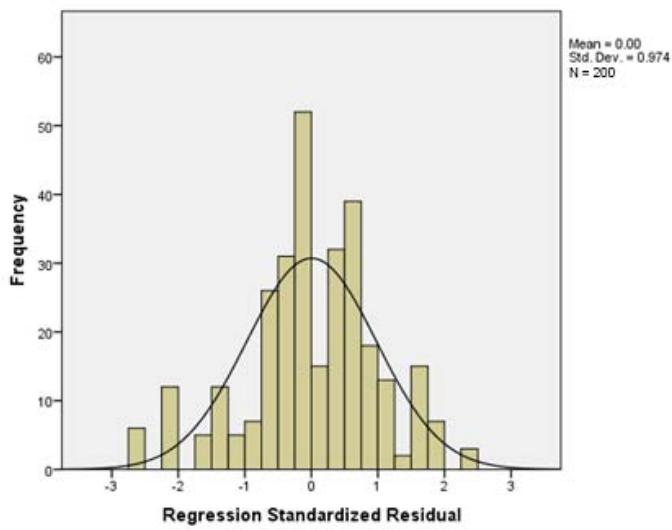 Figure 4: Normal P-Plot Histogram of Std. Residual
## xi. Regression analysis summary
An overall look at the regression analysis concludes that defining the customer-centric strategy at a specific organization is highly dependent on the culture, structure, and leadership. The technology used is also a factor upon which this strategy is dependent. The regression results show that customer tracking, loyalty programs, and economic tools exist in organizations adopting customer-centricity. The results also highlight the importance of the HR system and recruitment policy in being customer-centricity supportive factors. Moreover, results show that the tracking of customers, the profound understanding of customers' needs, the company's top executives' commitment to their customers' experiences, and the customers' involvement in the products and services design are the most significant determinants upon which a strategy for organization customer-centric.
- The respondent's organization tracking of customers (X) with Standardized Beta =.494
- A profound understanding of customers' needs informs our strategic direction (B) with Standardized Beta =.358
- Our company's top executives demonstrate their commitment to our customer experience strategy (W) with Standardized Beta =.264
- Customers of the organization are involved in the design of their products and services (I) with Standardized Beta =.220
- Our HR systems support the customer experience (D) with Standardized Beta =.183
- We hire for attitude and fit with our culture (E) with Standardized Beta =.186
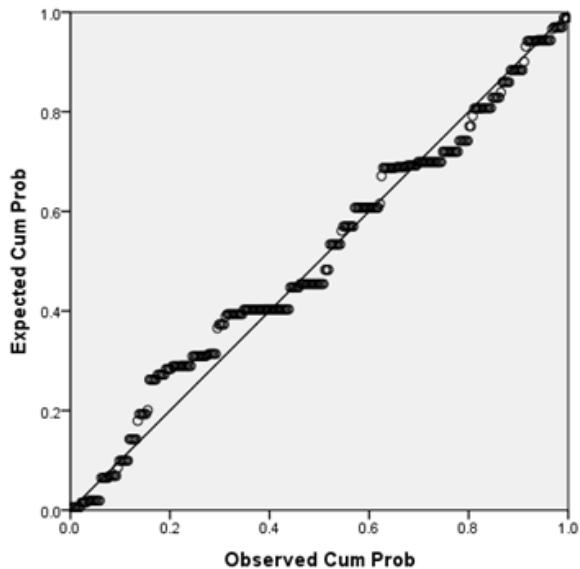 Figure 5: Regression Model
### d) Hypotheses Validation
After the discussion of results obtained from the analysis of the primary data source, i.e., the survey questionnaire, and the findings from the secondary data source, i.e., relevant literature, the validation of hypotheses are as follows:
#### H1: Organizational structure affects the effectiveness of the customer-centric strategy
The result from the regression model involving the variable "Functional Teams Related to Direct Customer Relationships are Integrated (J)" related to the structure was statistically significant. Therefore, hypothesis H1 is accepted. Different researchers like Shah and Staelin (2006), Gebauer & Kowalkowski (2012), Reesink (2014), and Yohn (2018) supported the abovementioned result and stressed the importance of structure in the effectiveness of customer-centric strategies. Researchers assert that an ideal customer- centric organization implies the complete integration of all functional activities to deliver superior customer value. Those literature findings were congruent with the results obtained from the inferential analysis of primary data.
H2: Organizational culture affects the effectiveness of the customer-centric strategy
Regression analysis showed that the variable "The Culture of the Respondent's Organization Supports Customer Centricity (L)" related to culture was statistically significant. Therefore, hypothesis H2 is accepted. Many researchers highlighted the importance of culture as the main factor and considered it a critical success factor of a customer-centric organization (Shah and Staelin, 2006; Trochlil, 2004; Lamberti, 2013; Jordheim, 2014; Yohn, 2018).
H3: Human Resources (HR) policies affect employee behavior in being customer-centric
Four statements tested hypothesis H3. These are: "our internal communications help create clarity and commitment toward delivering the customer experience (F)," "our employee experience mirrors the customer experience (G)," "our HR systems support the customer experience (D)," and "we hire for attitude and fit with our culture (E)." These were tested and resulted in being statistically significant. These supported the acceptance of hypothesis H3. The abovementioned variables are highly congruent with Macaulay (2011), Fox (2013), and MacDonald (2022) highlighted the importance of the HR function, processes, and policies in affecting employee behavior and the success of the customer-centric strategy of the organization.
H4: Adopting the right technologies enables the success of customer-centric strategies
Four statements tested hypothesis H4. These are: "the Respondent's Organization Tracking of Customers (X)," "our HR systems support the customer experience (D)," "our use of CRM technology enhances customer interaction (H)," and "the Use of Technology to Analyze Customer Data in the Respondent's Organization (K)." According to the outcomes of the regression analysis, all four statements were statistically significant. Therefore, H4 is also accepted. This result is congruent with Galliers and Leidner (2003), who highlighted the importance of aligning the information systems with the corporate customer-centric strategy. The authors state that the fit of technology with organizational strategy is essential to determine the success of a customer-centricity strategy. In addition, Reynolds (2002), Morgan (2019), and MacDonald (2022) emphasized that customer relationship management (CRM) technology follows a customer-centric strategy where applying the right solution is also critical to the success of the organization's strategy. The use of CRM technology to target customer needs and support the customer experience was a significant variable in all tests and analyses done. Moreover, Marshak (2013) stressed the measurement factor supporting the tracking of customers in organizations. The results also show the importance of this variable as compared with other strategic and internal organizational factors.
H5: Applying the right leadership commitment enables the success of customer-centric strategies
Regression analysis results show that two statements were tested and were statistically significant. Therefore, the two statements "Our Company's top executives demonstrate their commitment to our customer experience strategy (W)" and "Our leaders spend significant time with customers and employees hearing first-hand about the customer experience (A)" support the acceptance of the hypothesis 5. The first statement is fundamental since it reflects the long-term direction toward the sustainability of customer-centricity. Galliers and Leidner (2003), Nadkarni (2010), and Macaulay (2011) emphasized the strategic role that leadership commitment foster and supports a strong integration of the HR strategy, information systems strategy, marketing strategy, and customer-centricity strategy and how these should be in harmony with the corporate strategy. Moreover, Bhattacharjee, Hartvig Müller, & Roggenhofer (2016) stress the importance of the organization's leading players "to choose which customer journeys matter, which metrics to target, and which incentives to apply in energizing and motivating frontline workers to build and sustain a superior customer experience" (para 3). As for the second statement, Bailey (2005) contended that one of the three-level primary imperatives to becoming customer-centric is knowing the customer well. Fox (2013) stressed that executives must seek external customers, listen to them and involve them. In addition, MacDonald (2022) recommended putting relationships with customers first as one of four critical success factors for customer-centricity.
H6: The majority of Lebanese organizations are following a customer-centric approach
Five statements tested hypothesis H6. These are: "a profound understanding of customers' needs informs our strategic direction (B)," "at our company, the customer experience, the strategy, and the brand are inseparable (C)," "our internal communications help create clarity and commitment toward delivering the customer experience (F)," "customers of the Organization are Involved in the Design of their Products and Services (I)," and "the Respondent's Organization Has a Loyalty Program (Z)." According to the outcomes of the regression analysis, all four statements were statistically significant. Therefore, H6 is accepted.
It is worth mentioning that the descriptive analysis shows that $72\%$ of the surveyed sample considered their organization to be customer-centric, and $71.5\%$ stated that their organization has a clearly-defined customer-centric strategy communicated among all functional departments. On the other hand, the findings fit many researchers' findings; Schlesinger and Heskett (1991) stressed both employees' and customers' loyalty. Reichheld (1996) expanded the loyalty business model beyond customers and employees. Panthongpraser (2015) recommended that "organizations have to be aware of their focused efforts to nurture and engage current customers and improve organizational practices implemented to increase loyalty and to transform customers to ambassadors of their brands" (p. 45). Moreover, Galbraith (2002, as cited in Lamberti, 2013) stressed that a common goal of a shared cultural view of the company's role is essential to implementing customer-centered processes. Fralix (2001), Gilmore & Pine (1997), and Dissanayake (2019) emphasized the customer's new role of being a partner in the design process. Finally, MacDonald (2022) asserted the bonding of organizational culture to customers.
## XIII. CONCLUSION AND RECOMMENDATIONS
### a) Conclusion
This paper aims to assess and analyze the critical success factors of organizational customercentricity within the context of the Lebanese market. Overall findings support that many Lebanese companies are attempting to become customer-centric whose representative respondents have supported that among the primary critical success factors assessed are structure, culture, leadership, technology, and human resources were salient. The corresponding hypotheses were all statistically significant though many of the corresponding Pearson's correlation values ranged from 'weak to moderate' as shown in the regression analysis. Nevertheless, the results serve as a revelation for further research work and the highest involvement of Lebanese institutions.
Customer-centric companies capitalize on what customers value. And the value customers represent to the organizational bottom line. These organizations' operating models work according to carefully defined and quantified customer segmentation strategies. They tailor their business streams with product development to demand generation to production and scheduling to marketing, sales, customer care, etc., to deliver top value to their best customers for the least cost. The respondent's view on the organization's centricity was surprisingly satisfactory. Results show that $72\%$ of the respondents consider their organizations to be customer-centric versus $28\%$ who view them as product-centric; $81.5\%$ answered that their organizations allow the involvement of the customers in the design of their products and services. Also, $99\%$ of the respondents believe that the functional teams related to direct customer relationships are consolidated effectively, and $94\%$ believe that using technology to analyze customer data in their organization is highly effective. In addition, $95\%$ of the respondents believe that their organization's culture is suitable and effective in supporting customer-centricity. In addition, $86\%$ of the respondents believe that their organizations' customercentricity is in the mission and vision statements, and $71.5\%$ of the respondents state that there is a clearly defined customer-centric strategy communicated across all departments. The findings are surprising because very few use metrics to measure their customers' retention and loyalty using scientific methodologies. Most possibly, besides the classical customer surveys, managers establish direct contact with their customers and mostly their few preferred ones.
Worth mentioning that even though Lebanese organizations pay good attention to their IT support systems and their HR talent, they are more in the 'wishful thinking' stage by having them in the customer-centric context and oriented applications. It is a long, demanding, and continuous work to become - and maintain - a customer-centric organization, but the result is a much more profitable brand.
#### Tested Research Model (Figure 6)
Findings suggest the following final research model based on statistically significant hypotheses.
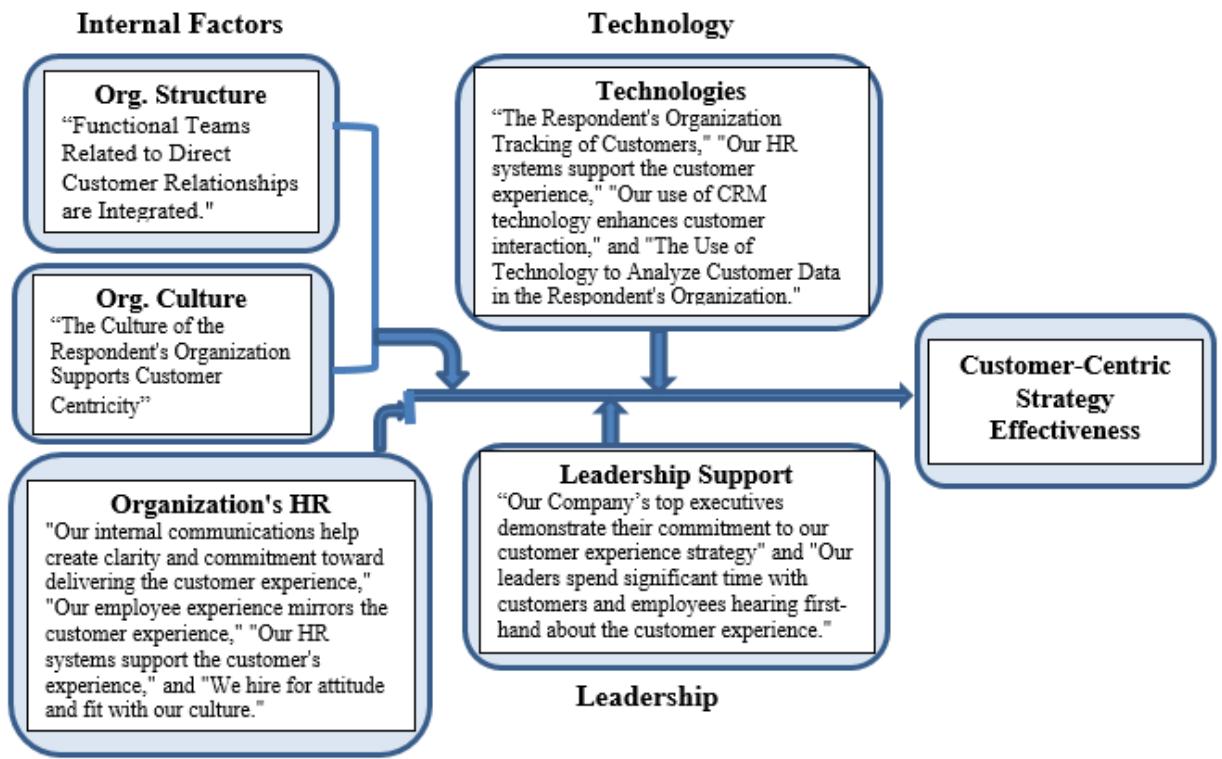 Figure 6: Validated Research Model
### b) Recommendations
Based on the conclusions mentioned above, the research suggests the following recommendations:
Regarding practitioners, to ensure the smooth and successful adoption of an effective customer-centric strategy in different organizations, there should be sufficient knowledge of theoretical frameworks. Moreover, critical success factors must be identified, understood, and applied. Gaining experience on how to develop a suitable customer-centric strategy is essential to attract and retain customers who are prospects, current, and loyal. Stakeholders and the broad-supply-chain include practitioners from different fields, including management, marketing, finance, customer service, human resources, and technology, should join their effort in determining a best practice model for a customer-centric organization. Deloitte & Touche (2014), Yohn (2018), and Morgan (2019) recommend that to develop a successful and effective customer-centric strategy, an organization should adopt selected strategies in the internal and external operations. Exploring such a model could be applicable with appropriate changes (Lamberti, 2013) to the different industries in various areas of Lebanon and possibly in the region.
As for academics, this study sheds light on a subject not researched in the context of Lebanon. Consequently, many studies may be realized in various economic sectors in Lebanon and conducting a cross-country comparison. The practitioners' experiences help improve frameworks to extract the full potential in different organizations effectively and efficiently.
Regarding future research, studies and investigations should tackle the interrelationships between the different critical success factors and the profitability of a customer-centric organization. As mentioned in the literature review, several metrics measure the effectiveness of customer tracking techniques (Panthongpraser, 2015). However, a definitive metric that enables the calculation of the profitability of each internal or external factor is not yet present. In the Lebanese context, future research can cover the relation between customer-centric strategies and the type of businesses. More than $90\%$ of business institutions in Lebanon are family-owned. Hence, this research is analyzed to explore possible correlations between the customer-centricity of an organization and its type. Studying the different factors identified in this research and how they differ between family and non-family-owned businesses is intriguing for future research.
#### Research Limitations
This research has several limitations:
- The research has a small sample of participants. Therefore based on the respondents' experiences from different organizations in the Lebanese market regarding customer-centricity. A fact that affects the ability to generalize the results and findings of the research. Nevertheless, the findings are unique, add to the already limited knowledge in Lebanon about the subject, and could serve to be a source for the future works,
- The sample size and the convenient sampling technique applied in this work may increase the error percentage in the quantitative results presented.
- Time and cost constraints hindered the ability to cover different areas in the Lebanese market.
#### Researchers' Contributions and Lessons Learned Researcher's Contributions
The results and findings of this research contribute to the present recorded knowledge regarding customer-centric organizations. In addition, having this research applied in the Lebanese industry may provide insights for other economic sectors and be considered a cornerstone for further research involving the financial performance of organizations. Moreover, this study is a new addition to the Lebanese market, stimulating mitigating the knowledge gap on the subject of customer-centricity success factors in the Lebanese market. The researchers were also able to formulate a framework based on the factors that determine the customer-centricity of Lebanese organizations. This framework's determinants are congruent with findings from relevant literature. Finally, this research's outcomes serve for the future development and implementation of customer-centric strategies in Lebanese organizations.
Generating HTML Viewer...
References
73 Cites in Article
James Aldrich,J Cunningham (2015). Using IBM® SPSS® Statistics: An Interactive Hands-On Approach.
Alida (2022). Customer Centricity: The definitive Guide for aspiring Customer-Centric Brands.
C Bailey (2005). Embarking on the Journey to Customer Centricity.
S Bernazzani (2021). The Ultimate Guide to Calculating, Understanding, and Improving CAC in 2022.
D Bhattacharjee,L Hartvig Müller,S Roggenhofer (2016). Futureproofing the Customer‐Centric Organization.
Company Mckinsey (2022). Unknown Title.
D Blacharski,D Starcher (2006). Creating A Customer-Centric Corporate Culture.
D Blacharski (2006). Superior Customer Service How to Keep Customers Racing Back To Your Business--Time Tested Examples from Leading Companies.
Ju-Yeon Lee,George Day (2004). Designing customer-centric organization structures: toward the fluid marketing organization.
Austin Caldwell (2021). What Is Customer Lifetime Value (CLV) & How to Calculate? ORACLE Net Suite.
Ghada Chehimi,Ale Hejase,Nour Hejase (2019). An Assessment of Lebanese Companies’ Motivators to Adopt CSR Strategies.
Roberto Cioffi (2019). DATA-DRIVEN MARKETING: Strategies, metrics and infrastructures to optimize the marketing performances.
Kriti (2022). Customer churn: A study of factors affecting customer churn using machine learning.
Touche Deloitte (2014). Goss, Wayne Keith, (26 Feb. 1951–10 Nov. 2014), Chair, Deloitte Touche Tohmatsu, Australia, since 2005 (Managing Partner, 1999–2003); Member, National Board, Deloitte Touche Tohmatsu, since 2003.
D Dissanayake (2019). Does Mass Customization Enable Sustainability in the Fashion Industry?.
(2022). Fashion Industry - An Itinerary Between Feelings and Technology.
P Drucker (1999). The Practice of Management.
J Dudovskiy (2022). Positivism.
M Egol,P Hyde,F Ribeiro,A Tipping (2004). The Customer-Centric Organization: From Pushing Products to Winning Customers.
Satu Elo,Helvi Kyngäs (2008). The qualitative content analysis process.
Young Ernst (2013). The Journey Toward Greater Customer Centricity.
Michael Etgar (2008). A descriptive model of the consumer co-production process.
Sandy Boucher,Curtis Forbes (2015). The pragmatic turn in the scientific realism debate.
Adrienne Fox (2013). Strategic HR: Customer-Centric HR.
M Fralix (2001). Digital printing and mass customization.
R Galliers,D Leidner (2003). Strategic Information Management: Challenges and Strategies in Managing Information Systems.
Gartner (2022). Glossary: Customer Centricity.
William Gartner,Jennifer Starr,Subodh Bhat (2022). Predicting New Venture Survival: An Analysis of "Anatomy of Start-up." Cases from INC. Magazine.
Heiko Gebauer,Christian Kowalkowski (2012). Customer‐focused and service‐focused orientation in organizational structures.
J Gilmore,J Pine (1997). The four faces of mass customisation.
H Hejase (2001). Customer Care.
(2001). Workshop: Customer Centric Organizations.
H Hejase (2007). O’Mara, Margaret, (born 10 May 1951), Director, Human Resources, National Offender Management Service, Home Office, 2006–07.
Ahmad Halawi,Mohamad Ghazal,Hassan Cherry,Pierre Abi Hanna,Mirna Chahine (2008). Knowledge, perception and precautions of the Lebanese population regarding the novel Coronavirus outbreak: A cross-sectional study between 18 and 22 March 2020.
Mohamed Hejase,Ale Hejase,Hassan Hejase,Hussin Hejase (2012). Management of Normogonadotropic males with idiopathic infertility with bilateral varicocelectomy with and without intramuscular recombinant FSH and HCG course(s): A twenty-year- experience in a prospective, controlled, and randomized clinical study.
A Hejase,H Hejase (2013). Research Methods: A Practical Approach for Business Students.
H Horn,N Sloan,B Benjamin (2017). The Business Case for a Customer-Centric Culture.
(2009). Creating Your Most Valuable Asset: Your Brand.
G Jones (2013). Organizational Theory, Design, and Change.
T Jordheim (2014). Crafting aCustomer-Centric Culture.
J Khan (2022). How to Build a Culture of Customer Centricity in Your Organization.
C Kothari (2004). Research Methodology. Methods and Technique.
Gachoucha Kretz (2021). Creating Customer Centric Leaders: How HEC Paris designs executive programs on customer centricity.
Nicharatsangthong Ph.D.,Rattasartphongphaew Ph.D.,Assoc. Ph.D.,Jureepornmakingrilas Ph.D.,Vichailamsutthi Ph.D. (2013). THE CAUSAL RELATIONSHIP BETWEEN THE COMPONENTS OF SOCIAL ENTREPRENEUR AND ECONOMIC AND SOCIAL SECURITY.
L Lamberti (2013). Customer centricity: the construct and the operational antecedents.
Ting-Peng Liang,Mohan Tanniru (2007). Special Section: Customer-Centric Information Systems.
S Macaulay (2011). The Customer-Centric Organisation.
Steven Macdonald (2022). The Blog Strategy (Everybody's Talking at Me).
R Marshak (2013). Defining the Customer-Centric Organization.
Blake Morgan (2019). 100 Of The Most Customer-Centric Companies.
Sudeep Nadkarni (2010). Starting a WordPress Blog.
Christian Osakwe (2020). Customer centricity: an empirical analysis in the micro-sized firm.
A Panthongpraser (2015). Customer Metrics for Marketers.
Ronni Marshak (2013). Defining the Customer-Centric Organization.
Frank Piller,Kathrin Moeslein,Christof Stotko (2004). Does mass customization pay? An economic approach to evaluate customer integration.
Alok Rai (2013). Customer Relationship Management: Concepts and Cases.
P Reesink (2014). Customer Centricity in Banks and Insurance Companies: the Design of Organizational Structure.
F Reichheld (1996). The Loyalty Effect.
Janice Reynolds (2002). A Practical Guide to CRM.
P Rioux (2020). FACTORS INFLUENCING TO COMPLAIN BY FIRST TIME CUSTOMERS AND LOYAL CUSTOMERS IN DTH SERVICES.
Johanna Rivard (2017). 80–20 rule.
N Sadorf (2011). Building customer-centric processes in your organization.
M Saunders,P Lewis,A Thornhill (2009). Research Methods for Business Students.
Dan Schawbel (2014). Jim McCann: How He Turned 1-800-Flowers.com Into A Household Name.
J Schiele,N Sadorf (2009). Building a customer-centric culture of performance in your organization.
Leonard Schlesinger,James Heskett (1991). Enfranchisement of Service Workers.
Bill Self (2009). The benefits of being customer centric.
Denish Shah,Roland Rust,A Parasuraman,Richard Staelin,George Day (2006). The Path to Customer Centricity.
J Sheth,R Sisodia,A Sharma (2000). The Antecedents and Consequences of Customer-Centric Marketing.
No ethics committee approval was required for this article type.
Data Availability
Not applicable for this article.
How to Cite This Article
Fatima Al Sayed. 2026. \u201cAn Assessment of Customer-Centricity Success Factors: Context of the Lebanese Market\u201d. Global Journal of Management and Business Research - E: Marketing GJMBR-E Volume 22 (GJMBR Volume 22 Issue E2).
Explore published articles in an immersive Augmented Reality environment. Our platform converts research papers into interactive 3D books, allowing readers to view and interact with content using AR and VR compatible devices.
Your published article is automatically converted into a realistic 3D book. Flip through pages and read research papers in a more engaging and interactive format.
Our website is actively being updated, and changes may occur frequently. Please clear your browser cache if needed. For feedback or error reporting, please email [email protected]
Thank you for connecting with us. We will respond to you shortly.