It is imperative to evaluate the training courses for which various procedures are practiced. Training courses were largely conducted with a set of objectives determined through Training Need Analysis (TNA). Evaluation of training (EoT) courses is carried out to elucidate the achievement of training objectives and benefit of training to trainee’s organization. The paper proposes a holistic evaluation methodology to assess the efficacy of training courses. Apart from discussing the concepts and principles of the suggested EoT method a model is put forth for its effective implementation. Data generation, processing procedures, and applicability in assessing the training functions at different levels are elaborated. The study suggests applying various formative and summative assessment tools to ensure the full achievement of the training objectives. These include pre and post-training tests, intermittent tests and independent handson tests in the simulated work environment to facilitate the transfer of learning. A numerical Trainee’s feedback pattern is suggested for impartial evaluation of the entire training activity. An assessment package designed in MS Excel is proposed for accurate and impartial assessment.
## I. INTRODUCTION
Evaluation of training is a crucial part of the training function. It is like a mirror showing the true picture of a training course, reflecting its strength, benefits, and drawbacks. A precise and fair evaluation of training will be a valuable addition to training institute, though many regard it as additional work and unnecessary expenditure. EoT will ensure the achievement of training objectives and significant improvement in on-job performance. The evaluation of training is directly linked with the organization's quality systems, as the information it provides enables training results to be identified, possible deficiencies to be analyzed and improvements to be introduced to optimize the training function as a whole (Holton, 1996; Kirkpatrick, 1998). It can be noticed that trainee's organization and training centre/institute in general give the least importance to EoT in the true sense but for collecting and compiling formal feedback. Though some training centres carry out various types of internal validation and generate a lot of information the data is neither compiled nor systematically analyzed applying the EoT tools. Pineda (2010) opined that only a few companies evaluate the results of training in a systematic and rigorous way. Training evaluation is conducted by training institutions in an unsystematic, informal, and ad hoc manner (Hashim 2001). Ineffective use of information about present level of knowledge and skill on proposed training topics among the prospective participants (Entry behavior; EB) illustrates the poor state of affairs in the training domain (William and Richard 1978). In many training courses, the EB was collected through oral interaction and is rarely used to customize the learning process in the concurrence with EB. Even if it is used subsequent evaluation mechanism is not applied to prove that the learning and development have been achieved uniformly to the mastery level. It can be found that many of the EoT tools are not applied as they are normally not engraved in the training need analysis or training design. Twitchell et. al., (2018) specified the poor compliance with training evaluation practices and lack of innovation noticeable in the domain over four decades. This situation has resulted in a data vacuum hindering the evaluation of the training in terms of its total value and benefits accrued. Any authentic and accurate evaluation process needs continuous monitoring, measurement (data/information), and benchmarks (expectation). The data could be of immense help for EoT as it provides the basis for bridging the gap between training effectiveness and efficiency. Sunita and Ajeya (2011) rightly pointed out that having a well-structured measuring system in place can help one determine where the problem lies. Urbancova et. al., (2021) also emphasized - the benefit to the individual can be assessed by a measurable degree of his knowledge, mastering a certain operation, etc. The training should provide scope for internal validation in the form of periodic assessments and external validation such as collecting information from managers about the performance of the trainees after the completion of training at the workplace to evaluate the cost-benefit ratio. On many occasions, the information collected is insufficient to substantiate the achievement of training objectives and Return on Investment (Kaye Alvarez et.
al., 2004). A workable EoT component needs to be incorporated in training design to effectively assess the training outcome. It is imperative to thoroughly evaluate the training process to prove the training objectives are achieved and the aspirations of the client organization are met by improved performance of the trainees. Contributors to effective EoT could be training designers, course directors, trainer, trainees, HR managers, top management of both training center and trainees' organization. The study by Shahrooz Farjad (2012) showed that the effectiveness of evaluation needed to be improved through the implementation of optimizing training design, redefining training roles, providing enough budget, management commitment, attention to the individual, job and organizational needs, motivation mechanism, use of ongoing and summative evaluation. The stakeholders of EoT vary for each training course based on the persons involved in the training function thus stakeholder analysis is necessary for each training course. The training function encompasses all learning activities aimed at improving performance at the workplace. The Kirkpatrick Model (2006), the most popular among the training community, is widely used to define the training function boundary and understand its dynamic nature. EoT matrix based on the Kirkpatrick Model (1976 and 1996) can be applied to identify the areas which require attention for authentic evaluation of training courses (Fig. 1). It is prudent to evaluate training courses applying different EoT tools for putting all the training functions on continuous monitoring and improvement mechanism. Sunita and Ajeya (2011) stressed that "a key to obtaining consistent success with training programs is to have a systematic approach to measurement and evaluation". The research is initiated with a premise that evaluation element is often neglected during the training process. Aim of the paper is to emphasize the importance of evaluation among training community. The prime objective of the paper is to propose an evaluation model with assessment tools for effective evaluation of training.
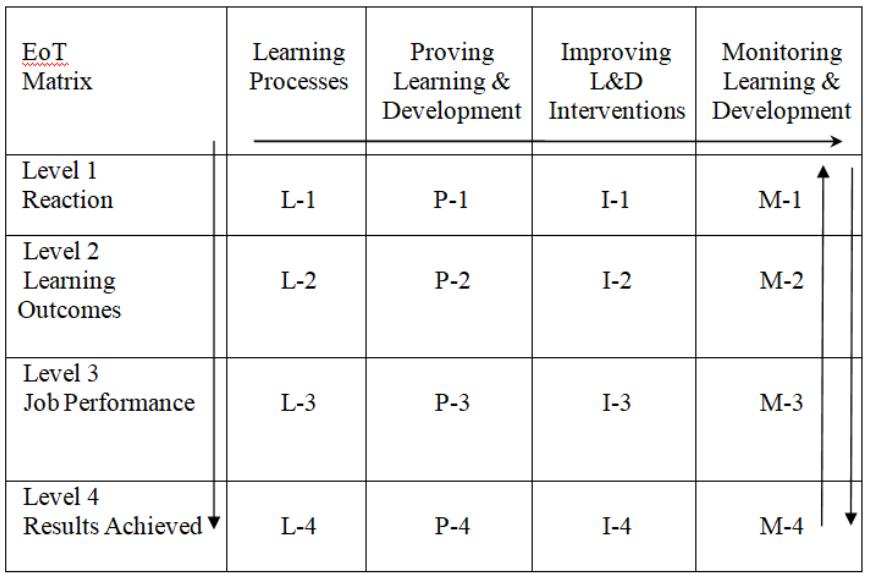 Fig. 1: Evaluation of training matrix
## II. INFORMATION REQUIRED AND SOURCE
Information or data is the key to the successful accomplishment of any assessment. Identifying, locating, and procuring useful and valid information is one of the prime tasks of the EoT. If the required data is not available or procured during the training period the total evaluation of training would not be possible. The information required along with options to obtain and suggestive format for collecting is presented in Table 1. Though many options or tools are available for gathering information, it requires support and commitment from persons engaged with the training. The tools and procedures that help in obtaining the required information are deliberated in the following paragraphs.
## III. PROCESS OF EOT
A three-pronged strategy can be applied to monitor and measure the training activity and its efficacy. They are Assessment, Validation, and Evaluation each one contains sub-strategies and is necessary for obtaining required inputs for grading various training functions. Assessment and validation tools provide data for the evaluation (Sunita and Ajeya 2011).
Table 1: Information required, source and format for evaluation of a training course
<table><tr><td>SI.
No.</td><td>Information required</td><td>Information source</td><td>Information Format</td></tr><tr><td>1</td><td>Basic details of the trainees</td><td>Registration & Self Introduction</td><td>Nomination/Registration Forms</td></tr><tr><td>2</td><td>Entry Behaviour</td><td>Interaction with trainees</td><td>do</td></tr><tr><td>3</td><td>Training Objectives, Course schedule</td><td>Course Module</td><td>Course Module</td></tr><tr><td>4</td><td>Pre-training test</td><td>Questions pattern and test results.</td><td>Format/Pattern provided</td></tr><tr><td>5</td><td>Formative Assessment</td><td>do</td><td>do</td></tr><tr><td>6</td><td>Summative Assessment</td><td>do</td><td>do</td></tr><tr><td>7</td><td>Post-training test</td><td>do</td><td>do</td></tr><tr><td>8</td><td>Feedback</td><td>Written feedback and oral feedback in valedictory function</td><td>do</td></tr><tr><td>9</td><td>Internal validation in TI</td><td>Assessments and Feedback</td><td>Summary results of Assessment and Feedback</td></tr><tr><td>10</td><td>External validation in CO</td><td>do</td><td>Summary results of Assessment and Feedback</td></tr><tr><td>11</td><td>Evaluation of training by top management of TI</td><td>Output of Validation and Discussion with CO</td><td>Brief Report by Trainer/CD</td></tr><tr><td>12</td><td>Evaluation of training by top management of CO</td><td>Output of Validation and Discussion with TI</td><td>Brief Report by Line Manager/HR Manager</td></tr></table>
### a) Assessment
Assessment is used to measure the outcome of learning. It is conducted in different forms in each learning unit through which numerical data displaying the extent of learning by each trainee can be obtained. Jennie Tokoian (2018) pointed out assessments help to gauge the strengths and weaknesses of each student, so one can adjust and guide student learning accordingly (https://edulastic.com). To gauge the cognitive skill achievement written or oral tests can be helpful whereas for soft skills or reproductive tasks demonstrative exercises can be used. An intermittent assessment pattern was adopted by Zrenjanin (2014) in the training evaluation report prepared for the EU through the Bulgaria - Serbia IPA Cross-border Programme. Wang (2006) emphasized the importance of summative evaluation at the last phase of the training program. The assessment constitutes a baseline for evaluation; it can be accomplished in different phases.
1. Diagnostic Assessment - pre-training review of trainees' aptitude and current level of knowledge and skill on the topics/tasks proposed in the training. Aliya Mohammed (2018) in his research on the evaluation of training and development of employees stressed that pre-training interventions and activities were the strongest factors contributing to expectations of the training environment, as well as to expectations of trainer performance and behaviour.
2. Formative Assessment - carried out during training, ensures learning by modifying methods.
3. Interim Assessment - undertaken at end of each learning unit (session) to ensure particular leaning objective is achieved.
4. Summative Assessment - carried out at the concluding stage of training to make sure training objective is accomplished. It can be of two types-
Normative - this is a norm-referenced test, which offers rank order to trainees, it promotes competition among trainees that may encourage active learning.
Criteria-based - it is referenced to certain set standards, expectations, or goals (e.g. qualifying score or marks).
### b) Feedback
Appraisal of each component of training functions by the trainees comprises an important input for training evaluation. Trainee's option normally gathered in the form of written feedback or in digital mode using software is compiled and overall grading of the training is obtained. The assessment points in the feedback generally are related to the execution part of the training as well as facilities. The information obtained from the feedback is seldom considered seriously but is routinely filed as a formality on the premise there would be difference of opinion. Trainees also feel feedbacks are superfluous and their suggestions are not valued. Specific and digital information about key issues/operations of the training will be valuable input for enhancing the training process (Ahire et. al., 2020). To encourage honest feedback, assessment has to be in numerical form and limited to a few very important points relevant to learning and development from the trainee's point of view. Eseryel (2002) stressed the need for expediting the performance of evaluations and expanding the range and precision of data collection using automated systems. Online feedback can be gathered on two occasions from the stakeholders as below, it would be a valuable addition for training evaluation.
1. Feedback from the trainees soon after training in training centre
2. Feedback from the HR Manager after three months of completion of training from the trainee's organization.
### c) Validation
Validation provides indicators to substantiate whether the trainees have achieved the knowledge and skills training was intended to provide, and the entire training course is designed correctly (Kenneth, https://smallbusiness.chron.com/). Validation involves inspection of assessment data/information, for its genuineness, reliability, and authenticity. The validated results are used to ensure set goals of the training are achieved. Two types of validation procedures are followed to estimate the effectiveness of the training course.
1. Internal Validation - checks to what extent the training objective is achieved. It is done by training centre.
2. External Validation - verifies level of improvement in job performance by trainees. It is done at trainee's organization.
## IV. EVALUATION MODEL
A comprehensive evaluation model encompassing all training functions is proposed for the effective appraisal of training courses. It integrates various assessment tools/components as well as facilitates the multidimensional flow of information and analysis. The model suggests a simple data generation process for all activities involved even before the beginning and after the end of the training event. Evaluation is usually not considered as part of training; many key players may not encourage or cooperate. To offset or minimize such resistances the model identifies a gray area for focused attention. It is an interactive and dynamic and action-oriented model. Its implementation would facilitate the end-to-end evaluation of the training course. The proposed evaluation model together with the action plan is presented in Table 2.
Table 2: EoT model along with action plan
<table><tr><td>SI.
No.</td><td>Key Issues</td><td>Related issues</td><td>Action</td><td>Location</td><td>Consequences/Risks</td><td>Result/Outcome</td></tr><tr><td>1</td><td>Improving RF/EB</td><td>Re-design to suite demands of EoT</td><td>Revise R F. Prepare brief questioner for EB.</td><td>In Training Hall</td><td>Trainees could be embarrassed or offended</td><td>Information on KSA of trainees. Re-orient the LP to suite the EB</td></tr><tr><td>2</td><td rowspan="4">Formative Assessment</td><td>Pr-training evaluation test</td><td>Set test paper (~20 questions) in context TO</td><td>In Training Hall</td><td>Trainees my feel discomfort.</td><td>Re-orient the LP if required.</td></tr><tr><td>3</td><td>Oral test (IRQ/OQAS)</td><td>Design questions (~5 Nos) as per LO (each day 5 min.)</td><td>In Training Hall, Lab and SWE</td><td>Additional work for Trainer</td><td>Prove extent of LO achieved/Re-orient the LP if required.</td></tr><tr><td>4</td><td>LU tests (one for each LU)</td><td>Set test paper (~20 questions) in context of LO</td><td>In Training Hall</td><td>do</td><td>do</td></tr><tr><td>5</td><td>Individual/ Group Exercises</td><td>Design viable exercises as per LOs</td><td>do</td><td>Additional work for Trainer</td><td>Prove extent of skill enhancement</td></tr><tr><td>6</td><td>Summative Assessment i. Normative</td><td>Individual Hands-on Exercises. Encourage competition</td><td>Create facility for performing tasks as per TO</td><td>SWE</td><td>Additional work for Trainer. Trainees may enjoy</td><td>Demonstrates K&S development</td></tr><tr><td>7</td><td>ii. Criteria based</td><td>Post-training evaluation test with qualifying marks of 70%</td><td>Use few pre-training evaluation test questions and as per TO</td><td>In Training Hall</td><td>Trainees may feel exhausted.</td><td>Confirm extent of K&S improvement achieved in comparison with EB and that of TNA</td></tr><tr><td>8</td><td>Feedback</td><td>Written & Oral</td><td>Emphasize on seeking fair and frank opinion of trainees on total training function.</td><td>In Training Hall at the end of training &</td><td>Trainees may try to be unbiased</td><td>Proves overall benefits received by Trainees, TI or</td></tr><tr><td></td><td></td><td></td><td></td><td>during
Valedictory
function</td><td></td><td>shows shortfall
(if any) in
training design
and execution.</td></tr><tr><td>9</td><td>Internal Validation (IV)</td><td>Analysis of data/information from different activities, assessments and feedback</td><td>Plan for improvements/standardization in line with IV output</td><td>TI</td><td>Trainer may feel offended</td><td>Director, TI may feel satisfied.</td></tr><tr><td>10</td><td>External Validation (EV)</td><td>Inputs from Line manager/Manager</td><td>Make provision for improvements/standardization ToL in collaboration with CO</td><td>CO</td><td>Trainees may feel elated</td><td>CO may feel satisfied</td></tr><tr><td>11</td><td>Evaluation</td><td>Summarized information from Trainer as well as Manager</td><td>Review the information and make judgement on quality of training and Rol</td><td>Directors of TI and CO</td><td>Expectation could be high by CO</td><td>Based on the final outcome TI and CO could be happy for successful execution of training and Rol</td></tr></table>
In the suggested evaluation model assessment is the key component that provides data inputs to prove learning or the need for improvement. Assessment and validation are required to be incorporated in training courses to ascertain the learning has occurred and training was effective. Assessment tools along with an action plan is proposed to propel the evaluation cycle. This is an indicative and demonstrative package, which can be modified to suit different training courses. It is designed using a MS Excel spreadsheet and numerical appraisal is encouraged to avoid scope for human judgment. Performance of each trainee and faculty/trainer can be continuously accessed and monitored by all the key stakeholders, which would help in improving not only the ongoing training but form basis for the betterment of all future training courses. The flow of information from this package provides an opportunity for internal and external validation. The assessments should be viewed as stepping stones for improvement of the training function rather than as progress reports of trainees. The onus is on course director, trainer, and training centre to achieve the best possible results by effectively utilizing outcomes from the package. A suggestive assessment pattern detailing types of questions, marks, duration and day for each test, etc., are provided in Supplemental Material 1. Guidelines for use of the assessment package are mentioned in Supplemental Material 2. The package contains ready-to-use Excel spreadsheet (listed below) for test evaluation, entry of marks/data, and scorecard (Supplemental Material 3). It also includes suggestive spreadsheet (forms) for the collection and analysis of feedback by trainees. A criteria-based assessment is provided to the final score to highlight the underperforming trainees. Similarly, the final output of feedback would indicate the efficiency of the training process.
> Assessment pattern (Supplemental Material 1)
<table><tr><td colspan="9">Assessment pattern with type of questions, marks, duration and day for each test</td></tr><tr><td>Type of test</td><td>Type questions</td><td>No of question s</td><td>Maximum marks for each Question</td><td>Total maximum marks for set of questions</td><td>Total maximum marks for each Test</td><td>Total marks of test</td><td>Duration of each test (min)</td><td>Time & Day of test</td></tr><tr><td rowspan="4">PrTET and PsTET</td><td>MCQ (with four choice answers)</td><td>5</td><td>5</td><td>25</td><td></td><td></td><td rowspan="5">30</td><td rowspan="5">PrTET - 11am/1; PsTET - 3pm/10</td></tr><tr><td>True/False</td><td>5</td><td>5</td><td>25</td><td></td><td></td></tr><tr><td>One word answers</td><td>5</td><td>5</td><td>25</td><td></td><td></td></tr><tr><td>One line answers</td><td>5</td><td>5</td><td>25</td><td></td><td></td></tr><tr><td>Nos Tests</td><td></td><td></td><td></td><td>2</td><td>100</td><td>200</td></tr><tr><td rowspan="2">LUT1 to LUT4</td><td>One word answers</td><td>8</td><td>2.5</td><td>20</td><td></td><td></td><td rowspan="2">20</td><td rowspan="2">10am/2; 10am/4; 10am/6:</td></tr><tr><td>Match the</td><td>4</td><td>2.5</td><td>10</td><td></td><td></td></tr><tr><td rowspan="3"></td><td>following</td><td></td><td></td><td></td><td></td><td></td><td rowspan="4"></td><td rowspan="4">10am/8</td></tr><tr><td>One line answers</td><td>4</td><td>2.5</td><td>10</td><td></td><td></td></tr><tr><td>MCQ (with four choice answers)</td><td>4</td><td>2.5</td><td>10</td><td></td><td></td></tr><tr><td>Nos Tests</td><td></td><td></td><td></td><td>4</td><td>50</td><td>200</td></tr><tr><td rowspan="4">Hands-on Lab/ClassTest (Demonstrative)</td><td>Subtask-(w r t LU1)</td><td>Activity 1</td><td>25</td><td>25</td><td></td><td></td><td rowspan="5">60</td><td rowspan="5">4pm/7</td></tr><tr><td>Subtask-(w r t LU2)</td><td>Activity 2</td><td>25</td><td>25</td><td></td><td></td></tr><tr><td>Subtask-(w r t LU3)</td><td>Activity 3</td><td>25</td><td>25</td><td></td><td></td></tr><tr><td>Subtask-(w r t LU4)</td><td>Activity 4</td><td>25</td><td>25</td><td></td><td></td></tr><tr><td>Nos Tests</td><td></td><td></td><td></td><td>1</td><td>100</td><td>100</td></tr><tr><td rowspan="5">Hands-on SWE Test (Demonstrative)</td><td>Subtask-(w r t LU1)</td><td>Activity 1</td><td>20</td><td>20</td><td></td><td></td><td rowspan="6">60</td><td rowspan="6">2pm/9</td></tr><tr><td>Subtask-(w r t LU2)</td><td>Activity 2</td><td>20</td><td>20</td><td></td><td></td></tr><tr><td>Subtask-(w r t LU3)</td><td>Activity 3</td><td>20</td><td>20</td><td></td><td></td></tr><tr><td>Subtask-(w r t LU4)</td><td>Activity 4</td><td>20</td><td>20</td><td></td><td></td></tr><tr><td>Final output (w r t TO)</td><td>Activity 5</td><td>20</td><td>20</td><td></td><td></td></tr><tr><td>Nos Tests</td><td></td><td></td><td></td><td>1</td><td>100</td><td>100</td></tr><tr><td></td><td></td><td></td><td></td><td>Grand Total</td><td></td><td>600</td><td>260</td><td></td></tr><tr><td></td><td colspan="3">Note: w r t = with reference to</td><td></td><td></td><td></td><td></td><td></td></tr></table>
2021 ISSIAANSSIXX (V) qreessnepure wneaeW Joeonof
Guidelines for use of Assessment Package (Supplemental Material 2)
<table><tr><td>Guidelines for use of Assessment Package</td></tr><tr><td>PrTET (Pre training evaluation test) and PsTET (Post training evaluation test)</td></tr><tr><td>1. Prepare Questions and Key as per the pattern mentioned in Supplemental Material 1.</td></tr><tr><td>2. Enter the Key in Cell C4 (Column C form Row 6) of Marks sheet for each test -PrTET (Supplemental Material 3) against the each question.</td></tr><tr><td>3. Enter the Trainee ID from cell D6 (Column D form Row 6, till as many trainees) of Marks sheet for each test -PrTET (Supplemental Material 3).</td></tr><tr><td>4. After conducting the PrTET test enter the Trainee's response (alphabet) against each question till row 23 or to cover all the questions of all the trainees.</td></tr><tr><td>5. As the Key is linked to trainees response cell the score will be automatically recoded in Cell M6 (Column M form Row 6) for that particular question.</td></tr><tr><td>6. After entering the response of the all the trainees for all the questions the total score for each trainee will be generated automatically in row 26 from cell E26.</td></tr><tr><td>7. If the score is less than 70% it will be highlighted in red to alert the trainer to initiate corrective measures.</td></tr><tr><td>8. Follow same procedure for PsTET by creating/using separate Marks sheet.</td></tr><tr><td>LUT 1 to LUT4 (Learning Unit Test)</td></tr><tr><td>9. Follow same procedure from step 1 to 7 for LUT1 to LUT4</td></tr><tr><td>10. Care has to be taken in entering the Key as the pattern of questions is different.</td></tr><tr><td>11. One Marks sheet for each test may be used</td></tr><tr><td>12. Please note that formative assessment can be conducted in different pattern for each LU based on the LO. They can be Group Exercises. Individual Exercises, Demonstrative Exercises etc. For which assessment can be made by awarding marks in numerical form which can be directly entered in the marks sheet.</td></tr><tr><td>13. Prepare one model marks sheet for each LUT, more can be duplicated depending on the number of tests to be conducted.</td></tr><tr><td>Field /Class and SWE Test (Skill /Work Evaluation Test)</td></tr><tr><td>14. These tests can be conducted by coining task based assignments in three to five steps as mentioned in Supplemental Material 3.</td></tr><tr><td>15. Marks can be awarded for each trainee in Row 6 to 9 of Column D, E, F of Supplemental Material 3 directly based on the performance of each trainee.</td></tr><tr><td>16. A separate marks sheet can be prepared for Hands-on Lab/Class Test (Demonstrative) and SWE Hands-on SWE Test (Demonstrative) Tests or enter score in Score card directly.</td></tr><tr><td>17. The marks sheets of PrTET, PsTET and LUT 1 to 4 and Hands-on Tests can be liked to Score card. Same can be done for other marks sheet created based on the need and number of tests conducted by making a copy of marks sheet provided using Excel Spreadsheet.</td></tr><tr><td>Score card</td></tr><tr><td>18. The marks sheets can be linked to a Score card the marks scored by each trainee will automatically filled in Score card and total score will reflected.
19. As criteria is functioned-in, the trainees who score <700/1000 will be highlighted in red.
20. Score card displays the assessment results of each trainee for each test conducted and also a cumulative score. It is an at glance score board for entire training.
21. Criteria can be also fixed for each LU test to high light the weak areas where the Trainer can focus.
22. K&S gained by trainees on particular theme/subtask can be ascertained from the numerical value of Total Score for Question (last column M; cell M6) of marks sheet of each test. Low score for a particular Question/subtask indicates Trainee is unable to understand/learn the K&S.</td></tr><tr><td>Each Trainee Feedback form</td></tr><tr><td>23. Enter the trainee ID in merged Cells 3C:L
24. Individual trainee can enter his/her response (any one numerical value between 10 and 1) asked for each point for assessment listed in Column B & Rows 7 to 31 in respective Rows of Columns C to L.
25. Overall score will be recorded in Column M and Cell M32 will reflect the trainee's assessment of entire training course.
26. Each trainee assessment sheet is linked to Feedback analysis sheet. The consolidated responses of each trainee will be recorded in it and general statistics of trainees evaluation will generated. It provides the overall score (mean of all numerical responses of all trainees) for the training course.
27. The summarised digital information of Assessments and Feedback will provide ample opportunity for improving or standardizing the training functions.
28. An unbiased statement on objectives achieved and capability of showing improvement in on on-job performance can be assessed and proved.</td></tr></table>
A model Marks sheet (Supplemental Material 3).
<table><tr><td colspan="13">Supplemental Material 3a</td></tr><tr><td colspan="13">A model marks sheet</td></tr><tr><td></td><td></td><td></td><td colspan="9">Trainee ID</td><td></td></tr><tr><td></td><td></td><td></td><td colspan="2">SE1</td><td colspan="2">SE2</td><td colspan="2">ER1</td><td colspan="2">ER2</td><td></td><td></td></tr><tr><td>Type of Questions</td><td>Question No.</td><td>Key</td><td>T C</td><td>Marks</td><td>T C</td><td>Marks</td><td>T C</td><td>Marks</td><td>T C</td><td>Marks</td><td></td><td>Total Score for Question</td></tr><tr><td rowspan="5">Muliple Choice Questions</td><td>1</td><td>B</td><td>b</td><td>1</td><td>a</td><td>0</td><td>b</td><td>1</td><td></td><td>1</td><td>0</td><td>3</td></tr><tr><td>2</td><td>A</td><td></td><td></td><td></td><td></td><td></td><td></td><td></td><td></td><td></td><td>0</td></tr><tr><td>3</td><td>C</td><td></td><td></td><td></td><td></td><td></td><td></td><td></td><td></td><td></td><td>0</td></tr><tr><td>4</td><td>A</td><td></td><td></td><td></td><td></td><td></td><td></td><td></td><td></td><td></td><td>0</td></tr><tr><td>5</td><td>D</td><td></td><td></td><td></td><td></td><td></td><td></td><td></td><td></td><td></td><td>0</td></tr><tr><td rowspan="5">True/Flase</td><td>6</td><td>T</td><td></td><td></td><td></td><td></td><td></td><td></td><td></td><td></td><td></td><td>0</td></tr><tr><td>7</td><td>F</td><td></td><td></td><td></td><td></td><td></td><td></td><td></td><td></td><td></td><td>0</td></tr><tr><td>8</td><td>F</td><td></td><td></td><td></td><td></td><td></td><td></td><td></td><td></td><td></td><td>0</td></tr><tr><td>9</td><td>T</td><td></td><td></td><td></td><td></td><td></td><td></td><td></td><td></td><td></td><td>0</td></tr><tr><td>10</td><td>F</td><td></td><td></td><td></td><td></td><td></td><td></td><td></td><td></td><td></td><td>0</td></tr><tr><td rowspan="5">One word answer</td><td>11</td><td>C</td><td></td><td></td><td></td><td></td><td></td><td></td><td></td><td></td><td></td><td>0</td></tr><tr><td>12</td><td>C</td><td></td><td></td><td></td><td></td><td></td><td></td><td></td><td></td><td></td><td>0</td></tr><tr><td>13</td><td>W</td><td></td><td></td><td></td><td></td><td></td><td></td><td></td><td></td><td></td><td>0</td></tr><tr><td>14</td><td>C</td><td></td><td></td><td></td><td></td><td></td><td></td><td></td><td></td><td></td><td>0</td></tr><tr><td>15</td><td>W</td><td></td><td></td><td></td><td></td><td></td><td></td><td></td><td></td><td></td><td>0</td></tr><tr><td rowspan="5">One line answer</td><td>16</td><td>C</td><td></td><td></td><td></td><td></td><td></td><td></td><td></td><td></td><td></td><td>0</td></tr><tr><td>17</td><td>C</td><td></td><td></td><td></td><td></td><td></td><td></td><td></td><td></td><td></td><td>0</td></tr><tr><td>18</td><td>W</td><td></td><td></td><td></td><td></td><td></td><td></td><td></td><td></td><td></td><td>0</td></tr><tr><td>19</td><td>C</td><td></td><td></td><td></td><td></td><td></td><td></td><td></td><td></td><td></td><td>0</td></tr><tr><td>20</td><td>W</td><td></td><td></td><td></td><td></td><td></td><td></td><td></td><td></td><td></td><td>0</td></tr><tr><td colspan="3">Total score of each trainee</td><td></td><td>1</td><td></td><td>0</td><td></td><td>1</td><td></td><td>1</td><td></td><td>3</td></tr><tr><td></td><td></td><td></td><td colspan="4">TC: Trainee choice</td><td></td><td></td><td></td><td></td><td></td><td></td></tr></table>
<table><tr><td colspan="13">Supplemental Material 3b</td><td></td></tr><tr><td colspan="13">Analysis of Evaluation of Training course based on Feedback by Trainees (an example)</td><td></td></tr><tr><td></td><td></td><td colspan="11">Trainee's assessment</td><td></td></tr><tr><td>SI.No.</td><td>Trainees ID</td><td>SE1</td><td>SE2</td><td>ER3</td><td>NR4</td><td>SE5</td><td>CR6</td><td>WR7</td><td>SER8</td><td>KR9</td><td>Min</td><td>Max</td><td>Mean</td></tr><tr><td></td><td>Points for assessment</td><td></td><td></td><td></td><td></td><td></td><td></td><td></td><td></td><td></td><td></td><td></td><td></td></tr><tr><td>1</td><td>Organization of Programme</td><td>9</td><td></td><td></td><td></td><td></td><td></td><td></td><td></td><td>9</td><td>9</td><td>9</td><td>9.00</td></tr><tr><td>2</td><td>Daily Lectures schedule</td><td>3</td><td></td><td></td><td></td><td></td><td></td><td></td><td></td><td>8</td><td>3</td><td>8</td><td>5.50</td></tr><tr><td>3</td><td>Frequency of Exercises/ tests/Evaluations</td><td>5</td><td></td><td></td><td></td><td></td><td></td><td></td><td></td><td>10</td><td>5</td><td>10</td><td>7.50</td></tr><tr><td>4</td><td>Contents and tasks of Exercises/Project</td><td>5</td><td></td><td></td><td></td><td></td><td></td><td></td><td></td><td>7</td><td>5</td><td>7</td><td>6.00</td></tr><tr><td>5</td><td>Opportunities for Questions/Discussions</td><td>7</td><td></td><td></td><td></td><td></td><td></td><td></td><td></td><td>9</td><td>7</td><td>9</td><td>8.00</td></tr><tr><td>6</td><td>Individual attention by faculty</td><td>2</td><td></td><td></td><td></td><td></td><td></td><td></td><td></td><td>8</td><td>2</td><td>8</td><td>5.00</td></tr><tr><td>7</td><td>Training Kit and Supplementary Material</td><td>6</td><td></td><td></td><td></td><td></td><td></td><td></td><td></td><td>8</td><td>6</td><td>8</td><td>7.00</td></tr><tr><td>8</td><td>Class Room</td><td>7</td><td></td><td></td><td></td><td></td><td></td><td></td><td></td><td>9</td><td>7</td><td>9</td><td>8.00</td></tr><tr><td>9</td><td>Accommodation</td><td>4</td><td></td><td></td><td></td><td></td><td></td><td></td><td></td><td>6</td><td>4</td><td>6</td><td>5.00</td></tr><tr><td>10</td><td>Boarding</td><td>8</td><td></td><td></td><td></td><td></td><td></td><td></td><td></td><td>8</td><td>8</td><td>8</td><td>8.00</td></tr><tr><td>11</td><td>General Assistance</td><td>6</td><td></td><td></td><td></td><td></td><td></td><td></td><td></td><td>7</td><td>6</td><td>7</td><td>6.50</td></tr><tr><td>12</td><td>Course Design</td><td>7</td><td></td><td></td><td></td><td></td><td></td><td></td><td></td><td>10</td><td>7</td><td>10</td><td>8.50</td></tr><tr><td>13</td><td>Course Content</td><td>4</td><td></td><td></td><td></td><td></td><td></td><td></td><td></td><td>9</td><td>4</td><td>9</td><td>6.50</td></tr><tr><td>14</td><td>Course Materials</td><td>6</td><td></td><td></td><td></td><td></td><td></td><td></td><td></td><td>10</td><td>6</td><td>10</td><td>8.00</td></tr><tr><td>15</td><td>Field /Site/Lab visit</td><td>5</td><td></td><td></td><td></td><td></td><td></td><td></td><td></td><td>9</td><td>5</td><td>9</td><td>7.00</td></tr><tr><td>16</td><td>Work environment (WE)</td><td>3</td><td></td><td></td><td></td><td></td><td></td><td></td><td></td><td>7</td><td>3</td><td>7</td><td>5.00</td></tr><tr><td>17</td><td>Demonstration in (WR)</td><td>4</td><td></td><td></td><td></td><td></td><td></td><td></td><td></td><td>8</td><td>4</td><td>8</td><td>6.00</td></tr><tr><td>18</td><td>Faculty/Trainer-1</td><td>8</td><td></td><td></td><td></td><td></td><td></td><td></td><td></td><td>10</td><td>8</td><td>10</td><td>9.00</td></tr><tr><td>19</td><td>Faculty/Trainer-2</td><td>7</td><td></td><td></td><td></td><td></td><td></td><td></td><td></td><td>9</td><td>7</td><td>9</td><td>8.00</td></tr><tr><td>20</td><td>Faculty/Trainer-3</td><td>3</td><td></td><td></td><td></td><td></td><td></td><td></td><td></td><td>10</td><td>3</td><td>10</td><td>6.50</td></tr><tr><td>21</td><td>Faculty/Trainer-4</td><td>7</td><td></td><td></td><td></td><td></td><td></td><td></td><td></td><td>10</td><td>7</td><td>10</td><td>8.50</td></tr><tr><td>22</td><td>LO 1 Achievement</td><td>8</td><td></td><td></td><td></td><td></td><td></td><td></td><td></td><td>9</td><td>8</td><td>9</td><td>8.50</td></tr><tr><td>23</td><td>LO 2 Achievement</td><td>7</td><td></td><td></td><td></td><td></td><td></td><td></td><td></td><td>10</td><td>7</td><td>10</td><td>8.50</td></tr><tr><td>24</td><td>LO 3 Achievement</td><td>9</td><td></td><td></td><td></td><td></td><td></td><td></td><td></td><td>9</td><td>9</td><td>9</td><td>9.00</td></tr><tr><td>25</td><td>TO Achievement</td><td>5</td><td></td><td></td><td></td><td></td><td></td><td></td><td></td><td>9</td><td>5</td><td>9</td><td>7.00</td></tr><tr><td></td><td>Average</td><td>5.80</td><td>#####</td><td>#####</td><td>#####</td><td>#####</td><td>#####</td><td>#####</td><td>#####</td><td>#####</td><td>2.00</td><td>10.00</td><td>7.26</td></tr></table>
## V. INBUILT REVIEW SYSTEM
EoT is a dynamic process, taking the inputs from it the trainer should strive to regularly improve or alter the training methods to ensure knowledge and skill among trainees is achieved to the desired level. Top management of training center (Institute), trainees' organization has to monitor/review the ongoing process of EoT. Based on the threats, consequences, risks listed in Table 2, some resistance from trainees and trainers can be anticipated due to frequent testing procedures. Enforcing tests could lead to disinterest and aversion among trainees and fatigue in trainers. To offset this negative impact and to reinforce confidence among key
stakeholders provision for changes is provided in the form of an inbuilt review system. The information and database about the training course will provide an opportunity for regular review and revision. The review process undergoes in the training institute during and after the training involving the key players associated with training. The pattern of flow of information and review process is presented in Fig. 2.
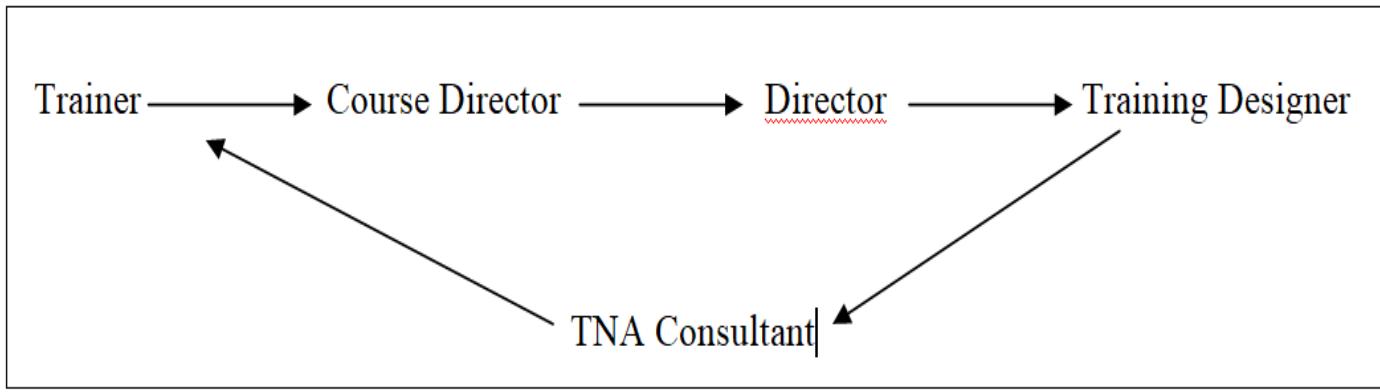 Fig. 2: Review procedure in Training Institute
## VI. CONCLUSIONS
It can be observed that the EoT component is not applied to the extent required by many training centres as it requires extra efforts and resources to generate the required information. To encourage the use of EoT a simple and viable model is proposed after considering the functional training boundaries as well as available facilities. The model ensures the multidimensional evolution of a training course from conceptualization to conclusion phase. The methodology adopted includes primary and secondary data generation through the application of various EoT tools. Data inputs could be used to ensure the achievement of the training objective and its successful on-job implementation. The tools provide data and information that is measurable and visible among key stakeholders. It establishes the level of learning and development attained at different stages.
Andragogy principles may be followed in assessing the trainees. The formative assessment results/information has to be used for altering/modifying/improving the learning process based on the indicators obtained concerning objectives. Similarly based on the outcome of summative assessment (if necessary) remedial training may be offered to the underperformers. Inferences from internal validation can be used to tune up (if required) the design and delivery components of training functions. Pointers from external validation can be applied in the precise identification of performance gaps (If any) and the causes thereof despite providing training. Evaluation of the total training process both by training centre and trainee's organisation using summarized inputs would reflect the effectiveness the training and returns on investment. The proposed model facilitates efficient evaluation of training process which results in enhanced on-job performance by trainees. It also provides ample scope for improvement and standardization of training functions.
DECLARATIONS
<table><tr><td>z-Ethical Approval</td><td>"Not applicable"</td></tr><tr><td>-Consent to Participates</td><td>"Not applicable"</td></tr><tr><td>-Consent to Publish</td><td>"Not applicable"</td></tr><tr><td>-Authors Contributions</td><td>Single Author</td></tr><tr><td>-Funding</td><td>"Not applicable"</td></tr><tr><td>-Competing Interests</td><td>The author declares - "no competing interests."</td></tr><tr><td>-Availability of data and materials</td><td>All data generated or analyzed during this study are included in this published article.</td></tr></table>
Generating HTML Viewer...
References
25 Cites in Article
Ahire (2020). Unknown Title.
Laxman Ahire,Prabhu Venkatesan Feedback Analysis of the Human Resource Training Programme.
Aliya Mohammed,Al-Mughairi (2018). The evaluation of training and development of employees: The case of a national oil and gas industry.
Eseryel (2002). Eseryel, Deniz "Approaches to Evaluation of Training: Theory & Practice.
Elwood Holton (1996). The flawed four‐level evaluation model.
Junaidah Hashim (2001). Training evaluation: clients’ roles.
Jennie Tookoian (2018). TYPES OF IN-SCHOOL ASSESSMENT: FORMATIVE AND SUMMATIVE ASSESSMENTS.
Kaye Alvarez,Eduardo Salas,Christina Garofano (2004). An Integrated Model of Training Evaluation and Effectiveness.
V Kenneth,Oster (null). Figure 7: Training and validation losses evaluation..
Evron Kirkpatrick (1976). Joseph R. Starr.
D Kirkpatrick Evaluation of training.
D Kirkpatrick (1996). Revisiting Kirkpatrick's fourlevel model.
D Kirkpatrick (1998). Evaluating Training Programs.
Jeane Kirkpatrick,Douglas Kirkpatrick (2006). In Memoriam.
D Kirkpatrick,J Kirkpatrick Evaluating training programs: The four levels.
Pilar Pineda (2010). Evaluation of training in organisations: a proposal for an integrated model.
Shahrooz Farjad (2012). The Evaluation Effectiveness of Training Courses in University by Kirkpatrick Model (Case Study: Islamshahr University).
Ajeya Sunita (2011). Sunita Dahiya1 and Ajeya Jha. Review of Training Evaluation.
Twitchell (2018). Unknown Title.
Skip Twitchell,Elwood Holton,James Trott (2000). Technical Training Evaluation Practices in the United States.
Hana Urbancová,Pavla Vrabcová,Monika Hudáková,Gabriela Petrů (2021). Effective Training Evaluation: The Role of Factors Influencing the Evaluation of Effectiveness of Employee Training and Development.
Joseph Wang (2006). Analytical Electrochemistry.
Greg Wang,Diane Wilcox (2006). Training Evaluation: Knowing More Than Is Practiced.
William Hicks,Richard Klimoski (1987). RESEARCH NOTES. ENTRY INTO TRAINING PROGRAMS AND ITS EFFECTS ON TRAINING OUTCOMES: A FIELD EXPERIMENT..
; Zrenjanin,Pergament (2014). Training Evaluation Report (Final).
No ethics committee approval was required for this article type.
Data Availability
Not applicable for this article.
How to Cite This Article
A G S Reddy. 2026. \u201cAn Integrated Approach for Effective Evaluation of Training Courses\u201d. Global Journal of Management and Business Research - A: Administration & Management GJMBR-A Volume 22 (GJMBR Volume 22 Issue A5).
Explore published articles in an immersive Augmented Reality environment. Our platform converts research papers into interactive 3D books, allowing readers to view and interact with content using AR and VR compatible devices.
Your published article is automatically converted into a realistic 3D book. Flip through pages and read research papers in a more engaging and interactive format.
Our website is actively being updated, and changes may occur frequently. Please clear your browser cache if needed. For feedback or error reporting, please email [email protected]
Thank you for connecting with us. We will respond to you shortly.