
I. INTRODUCTION
More start-ups with innovation and modernization will emerge in the next years, with the ability to transform the global economy. Start-ups can happen anywhere, and the countries with the greatest needs are often the ones with the most prospects. In impoverished countries, struggling nations, and countries that are new to the entrepreneurship environment, start-ups are at the grass root level. Such surroundings imply a plethora of issues that start-ups might exploit, not just to generate revenue, but also to effect change in the environment and make an imprint in a suffering economy. Entrepreneurship is the only option to boost a country's economic progress. A tiny business idea can grow into a major revolutionary solution. A small start-up idea can grow into a major revolutionary solution that has the potential to influence the economy's future. Small businesses, such as start-ups, play a crucial role in economic growth. This is because they create jobs, which implies lower unemployment rates, and lower unemployment indicates a more refined and developing economy. Because new entrepreneurs have innovative ideas to propose, start-ups create competition and urge individuals to be more pioneering and inventive. This encourages even greater invention and innovation.
Over time, start-ups create new industries, and if they go far enough, they can become 'money-making engines,' not only for the owners, but also for the employees and shareholders. Hundreds of Google employees have become worth more than $5 million, as we can see. Alibaba (a multinational corporation holding company with a diverse array of businesses around the world) single-handedly transformed the trading landscape for small and medium-sized firms (smes) in china, a country known for its numerous trade entry hurdles at the time. As the number of start-ups rises, so does the level of rivalry among them. Healthy competition, on the other hand, is important for start-ups and their clients to curate the startup ecosystem. Many start-ups have already adopted cutting-edge technology such as the internet of things, artificial intelligence, and robotics, among others. Nowadays, the majority of technological giant corporations outsource their duties to start-ups, which helps start-ups increase their cash flow.
It has never been easy to start a business, not now and not in the past. to attract consumers to start buying from a store, it takes a lot of effort and dedication in terms of time, money, and resources. the challenges faced by start-up enterprises in marketing their businesses a few decades ago were numerous. They had to be very careful in dividing the resources and money spent on marketing, from setting the pricing to determining distribution routes and explaining product attributes and quality. The current period and its business experts, on the other hand, place their trust in technologically improved tools. here's where social media comes in, where over 2.8 billion active users all around the world may make or ruin your business. it cannot be argued that it is a strong instrument that alters the way start-ups operate. Though a start-up must have a novel business strategy, it must also communicate the appropriate message to the right people, and this method of reaching out to the right individuals is not only original but also effective. The impact of social media on the creation of new businesses is so powerful that it has been hailed as the true source of buyer contact.
The social media platform attracts a large number of people who are looking for items and services. This becomes a powerful method of selling businesses since it allows you to generate high-quality leads that can quickly be converted into paying
consumers. Customers will associate with a brand more closely if start-ups communicate with them on social media. Social networks not only allow users to interact across social and geographical borders, but they also stimulate the easy sharing of user-generated content. As a result, the business community becomes just as vital as the customers. Having a huge number of blog and website followers puts you in a better position to establish a powerful brand. Buyers are constantly more curious to learn about the face and story behind a start-journey, up's and social media is a wonderful method to humanize a brand and allow consumers to engage with it on a more personal level. A simple logo on a brochure may not be enough to pique the consumer's attention, but offering glimpses of ongoing initiatives and behind-the-scenes on social networking platforms may be enough to pique their interest.
A startup, on the other hand, should always prioritize quality over quantity; as a result, benefits should be prioritized, i.e., giving consumers with something useful, shareable, and intriguing. "Social tools are undoubtedly useful for start-ups," says Larry Weber, co-author of The Digital Marketer. Companies must be able to wrap their products and services in well-designed experiences that people can get enthusiastic about and share with their peers for society to be effective."
Burberry, for example, has used Burberry Kisses to market their new cosmetic range to shoppers. It was a social experience that used facial recognition technology to allow users to offer kisses digitally to anyone they chose. Sending was an experience in which the one sending the kiss may choose from Burberry's latest beauty collection lipstick hues for their lip print. The sender could see their message travelling through a three-dimensional world, a landscape that included local landmarks and street views, until it arrived at its destination, thanks to location data.
The social media tool allows you to analyse and optimise your material as you go. Start-ups not only go through a learning curve, but they also learn from their errors. It is possible to learn about what their competitors are doing and what is working for them. Similar interesting phenomena of social media marketing relevance can be observed in the domain of the Indian Start-up Ecosystem, and many epoch-making efforts have been undertaken by relevant stake-holders in the country, be it the government or emerging entrepreneurs, who have put in immense effort to preserve this novel cultural manifestation. According to a survey conducted by UK-based accounting firm Sage, Indian Institute of Technology is the world's fourth highest creator of billion-dollar start-ups. alumnus of IIT Flipkart, Snapdeal, shop clues, ola, and Zomato are among the 12-billion-dollar start-ups. Start-up India creates a lot of buzz and opens up a lot of possibilities for the future. India recognized the harsh realities of
modern business, as well as its complexity. The central government attempted to solve the issues confronting young, enterprising Indians, whose propensity to take risks is unrivalled around the world. The entrepreneur encountered a number of impediments, including policy gridlock and a lack of openness. In start-ups, technology plays a predetermined role. Today, the Internet-driven industry provides 250 billion expected by 2020. During the same time span, the internet business in the United States may increase from 3.5 trillion, while China's could grow from $700 billion to 1.5 trillion. The magnitude of change that a startup may bring is enormous and exponential.
Social media is a significant public relations instrument that allows for two-way engagement with stakeholders, according to key literature., and it's a method of generating corporate value (Berthon et al., 2012). It is used to communicate with primary and secondary stakeholders, as well as internal and external stakeholders (Jurgens et al., 2016). (Reilly and Hynan, 2014). It aids businesses in communicating with stakeholders and exchanging information, selling their products, receiving customer feedback, enhancing customer relations, and developing investor ties. Internal communication can be improved with the use of social media within a corporation. To fully profit from these tools for this goal, businesses must restructure their structure, procedures, and culture in such a way that they develop an open and horizontal structure with a trust-based culture (McKinsey, 2012).
However, 2015 has proven to be a year that has served as a wake-up call to all and has significantly altered the dynamics. The year also set the tone for the following phase of the startup ecosystem's evolution. The maturity in decision-making that should ideally come in at this point would be a positive move in the right direction, propelling India's startup scene to greater heights, as it deserves. Prime Minister of India has announced that start-up is backbone of India on the occasion of national start-ups day January 16, 2022. Government of India is taking active participation in promoting the start-ups in India under the self-reliance movement. The Government of India had introduced Stand up India, Start-up India, and Make in India to encourage the young and new entrepreneurs. The Government of India solved the issues around Angel Tax. Also, the tax procedures have been simplified. Gol now allows self-certification and has removed more than 25,000 compliances. In 2013, only four thousand patents were approved. However, in 2020-21, more than 28,000 patents have been registered. In 2013-14, 70,000 trademarks were registered. However, in 2020-21 more than 2.5 lakh trademarks were registered.
India has climbed the ladder from the 46th spot in Global Innovation Index from 81st rank. Due to the ubiquity of IT and the internet, there is a distinct activity in the start-up arena in India, in addition to government initiatives. Many new businesses are forming in the service sector, such as education, legal services, retail, insurance, and health care. The popularity and feasibility of start-ups is no longer a daunting proposition for an entrepreneur, as clients become aware of the benefits and convenience. A few venture capitalists and angel investors are bullish about Indian start-ups, seeing a lot of promise and expecting a few to become unicorns (highly valued companies) with significant returns. On the other hand, there are examples of a few start-ups that failed and finally shut down owing to a variety of concerns and challenges. India, being a huge country with a population of over 130 million people, has significant demographic benefits due to its enormous youth population. According to a recent UN report, India has the biggest concentration of youth population, with 356 million 10-24 year-olds, who would be the driving force behind innovation and creation, with commensurate demand and consumption of goods and services (Mittal, 2014).
This paper aims to investigate current changes in the Indian start-up ecosystems and to shed light on the impact of start-ups and other related government initiatives on the country's innovation culture.
II. LITERATURE REVIEW
Digital business strategy: toward a next generation of insights: This study theorises and empirically investigates how the intensity, richness, and responsiveness of a company's social media initiatives influence consumer behaviour (engagement and attention) and firm performance. Researchers found that the richness and responsiveness of a firm's social media efforts are highly associated with the firm's market success, as measured by anomalous returns and Tobin's q, using detailed data collected from the Facebook pages of 63 firms over the 2010-2012 timeframe. Interestingly, the intensity of a company's social media initiatives has little bearing on its performance. They also discovered that customer involvement and attention not only have a direct impact on corporate performance, but that they also serve as a mediator between a corporation's social media initiatives and its performance. Unlike previous studies that looked at the impact of third-party or consumer-initiated social media, such as blogs and consumer ratings, our research focuses on estimating financial returns on firms' own efforts on firm-initiated social media, allowing us to directly assess the business value of social media.
Entrepreneurial Adaptation and Social Networks: Evidence from a Randomized Experiment on a MOOC Platform: Although social connection is important in the effectuation process, they are unaware of the consequences for effectuation when an entrepreneur engages through specific channels such as social media. To close this gap, our paper uses an inductive, theory-building methodology to establish hypotheses on how entrepreneurs' effectuation processes are affected when they utilise Twitter. Twitter is a microblogging service that allows for a significant increase in contact. They claim that Twitter-based engagement can lead to effectual cognitions, but that too much contact can lead to effective churn. They also claim that one element, perceived time affordability, affects how much social contact an entrepreneur engages in via Twitter. They also offer two criteria that can help to reduce the effects of social interaction on Twitter. Community orientation and conformity to community norms are two of these elements. It is examined what this means for our knowledge of effectuation, social interaction, and the impact of social media on entrepreneurial enterprises.
Does social media Enhance Firm Value? Evidence from Turkish Firms Using Three Social Media Metrics: The impact of social media on firm value in an emerging market scenario is investigated in this study. The study highlights the new phenomena of increased value to enterprises through the use of social media, which allows contact with stakeholders in terms of financial and non-financial achievements, as well as organisational difficulties, at cheap cost and in a direct and fast manner. The sample is made up of Turkish companies who are listed on the BIST 100 Index of Borsa Istanbul for the year 2014, and it is based on three social media metrics: the creation of a social media account, the breadth of social media participation, and the depth of social media involvement. The findings suggest that social media involvement depth has a substantial positive link with business value, however social media account ownership and social media engagement. breadth do not have a statistically significant relationship. These data suggest that opening social media accounts and placing symbols for numerous social media on company websites, which is currently a craze and fashion, may not always result in a benefit. Strong engagement for corporate reasons, on the other hand, will yield the desired results and rewards. As a result, the study has implications and recommendations for businesses that are already using or considering adopting social media.
The Effect of Social Media Marketing Content on Consumer Engagement: Evidence from Facebook: Using a large-scale field study on Facebook, the authors evaluate the impact of social media content on customer engagement. Using a combination of Amazon Mechanical Turk and state-of-the-art Natural Language Processing algorithms, they content-coded over 100,000 unique messages across 800 companies connecting with Facebook users. They use this enormous database of content qualities to test the impact of social media marketing material on subsequent user interaction with the messaging, as measured by Likes and comments. They create techniques to account for potential selection biases caused by Facebook's Edge Rank filtering algorithm, which assigns messages to users non-randomly. They discovered that including persuasive content, such as emotional and charitable information, boosts message engagement. They discovered that informative content, such as pricing, availability, and product features, decreases engagement when used alone in messages, but increases engagement when combined with persuasive attributes. As a result, persuasive material appears to be the key to successful engagement. The methodology they establish to content-code large-scale textual data provides a framework for future studies on unstructured natural language data such as advertising content or product reviews, and our findings guide content creation strategies in social media.
III. OBJECTIVES
In concurrence with the Project Title, the following objectives serve as the basis of the study:
- To study how funding activities in India has evolved over the years from 2010-2020 in India.
- Conceptualize the relevance of social media (Twitter, Instagram, Facebook, LinkedIn) in enabling the foundation of start-up ecosystem in India.
- To explore and perform an in-depth analysis of the performance of the start-up's ecosystem in India.
IV. RESEARCH METHODOLOGY
For the purpose of the study, relevant literature aligned with the project topic has been compiled from numerous reputable sources gathered online. The research design employed concurs with an exploratory research framework used to draw conclusions from the available literature to comprehend the recent developments within the start-up ecosystems in the country,
Also, the paper provides a unified compilation of qualitative secondary data regarding relevant efforts and policies undertaken by key stake-holding institutions be it private or public.
V. DATA ANALYSIS AND FINDINGS
a) Key plans and schemes under the start-ups India programme
Start-up India is a flagship initiative of the Indian government aimed at fostering entrepreneurship and innovation. The government intends to use this effort to empower start-up companies across India in order to stimulate entrepreneurship, economic growth, and employment.
The government's Action Plan aims to boost the growth of start-ups across India, in all critical sectors – in Tier 1, 2, and 3 cities, as well as semi-urban and rural areas - and promotes entrepreneurship among SCs/STs and women. Due to the long gestation period for start-ups, the definition of a start-up has been revised under the Start-up India initiative, with an entity being regarded a start-up for 7 years, up from 5 years previously, and a biotechnology start-up for up to 10 years from the date of incorporation.
The keypoints of the Prime Minister action plan for start-ups India program includes:
- Elf certification-based compliance regime - Self Certification Payment of gratitude, Contract labour, Employees Provident Fund, Water, and Air Pollution Acts, among other labour and environmental regulations, had been introduced. In addition, there would be no inspections for the first five years of the venture's inception to alleviate the weight of revolution on start-ups.
- Start-up India Hub- A hub for start-ups in India. A single point of contact for the whole start-up ecosystem has been established in India, allowing for knowledge sharing, the creation of a knowledge and experience pool, and access to funding.
- Streamlined start-up procedures—the procedure for starting a firm has been simplified. To be recognised as a start-up, no letter of reference from an incubator or industry group is required.
- Patent protection – for start-ups, the government has simplified the patent application and registration process. Patent applicants receive free legal services and a reimbursement of on their patent application fees. To help start-ups save money during their vital formative years, the government has changed the trademark rules in 2017 to grant a 50 percent discount on trademark feeling fees to new businesses.
- Simple exit policy - India's insolvency and bankruptcy board has been established, and insolvency resolution provisions have been enacted. Saxon 55 to 58 of the Insolvency and Bankruptcy Code, 2016 deal with the fast-track liquidation and wound up of a business within ninety days after filing an application.
- A fund of funds with a corpus of INR 10,000 crore the government has established a fund of funds with a total corpus of INR 10,000 crore, which is managed by SIDBI, to give finance support to innovation-driven firms.
- Start-up credit guarantee fund- to encourage entrepreneurship by providing credit to innovators from all walks of life, a credit guarantee fund will be established through the National Credit Guarantee Trust Company [NGTC] / SIDBI with a budgetary corpus of INR 500 crores per year for the next four years.
- Capital gain tax exemption-section 54 EE of the Financial Act of 2016 and section 54 GB of the
Income Tax Act of 1961 have been revised to offer capital gain tax exemption if the sale profits are placed in a government-recognized fund.
- 3 year text exemption for start-ups - to assist start-ups in their first year of operation, earnings of start-ups that close after April 1, 2016, are exempt from income tax for a period of 3 years in a block of 7 years.
- The investment of a venture capital fund in a startup that has a fair market value has been tax-free. To encourage creativity, The Atal Innovation Mission (AIM) has been launched, with four awards to be given out. A major innovation challenge award has been established for finding low-cost solutions to India's intractable challenges.
- Various award schemes, such as the UCCHATAR AAVISHKAR YOJNA (UAY), the MILLION MINDS AUGMENTING NATIONAL ASPIRATIONS AND KNOWLEDGE (MANAK) SCHEME, and the SMART INDIA HACKATHON, have already begun and have
attracted active participation from active minds all over the country. Around 1,00,000 INSPIRE-MANAK recipients competed at the district and state levels in 2017, while 7500 teams with over 40,000 students participated in the smart India Hackathon, a 36-hour nonstop digital programme event.
b) Launch of Start-ups India Action Plan Start-ups India's 19- Point Action Plan
Start-up India is about bringing wealth to the country. Many enterprising persons who want to establish their own business don't have the financial means to do so. As a result, their ideas, creativity, and potential go unexplored, resulting in a loss of wealth, economic progress, and jobs for the country. Start-up With initiative-taking support and incentives at several levels, India will assist enhance entrepreneurship and economic development by ensuring that people with the potential to create and start their own firm are encouraged.
START-UP INDIA'S 19-POINT ACTION PLAN ARE AS FOLLOWS:
| 1. Self-certification compliance, |
| 2. single point of contact via Start-ups India Hub |
| 3. Simplifying processes with mobile app and portal (for registration, filing compliances & obtaining information) |
| 4. Legal support, fast tracking & 80% reduction in patent registration fee |
| 5. Relaxed norms of public procurement |
| 6. Easier & faster exit |
| 7. Funding support via a fund of funds corpus of INR 10,000 crore |
| 8. Credit Guarantee Funding |
| 9. Tax exemption on capital gains |
| 10. 3-Year income tax exemption |
| 11. Tax exemption on investments above Fair Market Value (FMV) |
| 12. Annual start-ups fests (national & international) |
| 13. Launch of world-class Innovation Hubs under Atal Innovation Mission (AIM) |
| 14. Set up of country-wide incubator network |
| 15. Innovation centres to augment incubation and R&D |
| 16. Research parks to propel innovation |
| 17. Promote entrepreneurship in biotechnology |
| 18. Innovation focused programs for students |
| 19. Annual incubator grand challenge |
Prime Minister Narendra Modi announced the Start-up India Action Plan on January 16, 2016, to highlight many initiatives and plans suggested by the Indian government to foster innovation and empower start-ups across the country.
The 19-point Action Plan envisages several incubation centres, easier patent filing, tax exemptions, ease of setting-up of business, an INR 10,000 crore corpus fund, a faster exit mechanism, among others.
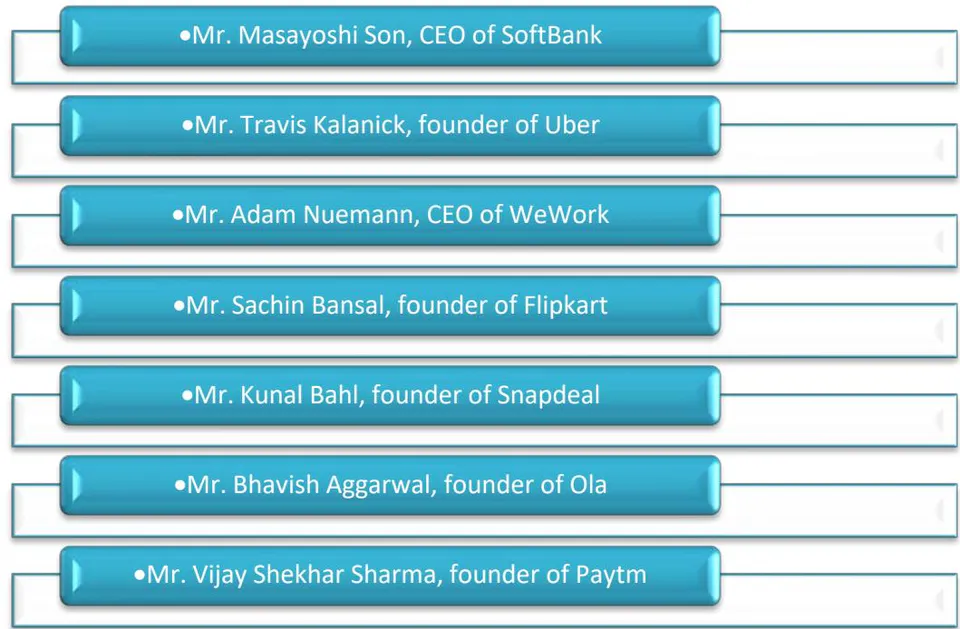
Over 1500 CEOs, Start-up founders and investors who attended the Start-up India launch included:
c) Scope of Start-Up India in promoting entrepreneurial culture in India
- Between 2016 and 2019, 15,113 start-ups were recognised under the Start-up India programme throughout 492 districts in twenty-nine states and six Union territories.
- Fifty-five percent of the recognised start-ups are from Tier 1 cities, 27 percent from Tier 2 cities, and 18 percent from Tier 3 cities.
- In the last three years, the government has implemented twenty-two regulatory adjustments and approved 1,275 patent rebates.
- Forty-five percent of recognised start-ups have at least one or more women directors
- 24 Indian states have introduced a start-ups strategy
- The Start-up India Hub has over 288.16K registered users
- The Start-up India Hub has answered 121.83K enquiries and assisted 673 start-ups.
- More than 233.27K have registered under the startup India learning programme.
The Start-up India Action Plan aims to create a robust support ecosystem that promotes the growth of start-ups and encourages the spirit of entrepreneurship in India. It placed a strong emphasis on self- compliance, making the Start-up India Hub team a vital stakeholder in the ecosystem, allowing them to work in a hub-and-spoke model and collaborate with multiple enablers.
The Indian government took the first move toward making start-ups a viable source of income, rather than just a 'jugaad', by introducing the Fund of Funds, which is worth INR 10,000 crore (a Hindi word meaning an improvised or impromptu solution to something). It also encouraged the country's youth to consider entrepreneurship as a viable career option.
Simultaneously, the government think tank NITI Aayog created the Atal Innovation Mission to encourage grassroots innovation among budding businesses. A total of 5,441 Atal Tinkering Labs have been established across the country as part of this initiative. In the 2018 Union Budget, the government set aside $480 million (INR 3414.19 crore) for new-age technologies in order to boost innovation in India's startup ecosystem.
Start-ups were defined and redefined under the Start-up India programme. For example, the age of start-ups was raised from 5 to 7 years (10 in the case of biotech). The government has taken a number of steps to support the country's expanding start-up culture, including expediting patent filings, income tax exemption, and self-certification. It also launched the Start-up India Hub to bridge the gap between various
stakeholders of the start-up's ecosystem. Since majority of the achievements have been made public by the Government through their designated websites and social media handles, this helps to incentivise the inception of further start-ups in the country because it not only provides recognition to the existing entrepreneurs but also motivates the potential entrepreneurs to start their own venture, which not only ensures self-sustainability, but also increases investor confidence in the economy.
d) Role of Social Media Marketing in Indian Start-up Ecosystem
Over the years, marketing has changed drastically with bringing in the new trends of the digital age. Since the time marketing has turned digital, it has made a revolutionary impact with making the internet a linking platform for billions of lives across the globe. The digital media is constantly in an ebb and flow of change.
On the other hand, the usage of social media sites has doubled the connectivity and the idea of digital marketing. Innovative new web services have sprouted up, creating a transcendental shift and the born of new devices has emerged as boons for the marketing world, thus allowing them to quickly adapt to the changing landscape and take full-fledged yet impressive advantages.
According to a report produced by Statista, India's internet penetration rate climbed from to between 2007 and 2020. Individuals, businesses, and markets have all benefited from the use of social media as a source of information. Social media offers a different avenue for marketing communication, allowing businesses to establish brands and interact with customers. In the context of existing enterprises and product marketplaces, the efficiency of social media for selling goods and services has been particularly well-studied (Aral, Dellarocas, & Godes, 2013; Bharadwaj, El Sawyer, Pavlou, & Venkatraman, 2013). However, there have been few studies on the usage of social media by emerging businesses or the importance of social media in capital markets.
Social media serves as a platform for information exchange, providing solutions to market participants' costly search and information shortage issues. Start-up companies can use social media to promote themselves and boost awareness of their existence among possible investors, allowing investors to find more early-stage initiatives and broaden their pool of potential investment prospects. Furthermore, investors can use start-ups' social media activities as an extra source of information when evaluating investment options.
Popularity on social media, for example, could reflect a startup's ability to attract certain client groups, create a brand identity, and incorporate customer feedback. Such favourable social media content demonstrates solid quality to investors and enhances their expected return on investment, increasing the start-prospects up's of obtaining finance.
Regulators are also paying attention to social media's expanding significance as a source of investing data. Historically, start-ups' capacity to make public offers or solicitations to sell stocks, including on social media platforms, was restricted. However, the use of social media in place of traditional information sources like press releases has created ambiguity in the concept of suitable investor communications.
There have been few studies on the usage of social media by emerging businesses or the function of social media in capital markets. Rather, present social media research focuses mostly on marketing outcomes and established businesses. Social media, according to studies (Aral et al., 2013; Chevalier & Mayzlin, 2006; Dellarocas, Zhang, & Awad, 2007; Forman, Ghose, & Wiesenfeld, 2008; Zhu & Zhang, 2010), promotes word-of-mouth information diffusion and serves as a platform for greater consumer engagement with a product or brand (Chen, De, & Hu, 2015; Ghose& Han, 2011; Goes, Lin, & Au Yeung, 2014; Li & Wu, 2014; Miller & Tucker, 2013).
Recent research has found a correlation between social media participation and corporate success via marketing effectiveness mechanisms (Chung, Animesh, Han, & Pinsonneault, 2014; Goh, Heng, & Lin, 2013; Luo, Zhang, & Duan, 2013) and social media analytics value extraction (Hitt, Jin, and Wu, 2015). However, with the notable exception of related work by Aggarwal et al. (2012), who examine social media mentions of a firm (particularly on blogs) and venture financing, there are few studies directly examining the use of social media by and its effect on early stage firms. They find that negative electronic word-of-mouth has a greater impact than positive electronic word-of-mouth, and that the effect on financing decreases as a firm progresses to later stages of financing. The impact of startup enterprises' direct use of social media for corporate promotion on the likelihood of funding is investigated in this study, with a particular focus on the function of social media in changing the costs or benefits of physical proximity.
Case Discussion of Shark-Tank India exemplifying the importance of Social-Media Marketing for promoting Start-up Ecosystem in the country:
The show 'Shark Tank India' has caught quite a frenzy among the masses in no time - thanks to the booming start-ups culture fuelled by the right policies in the country along with its wide coverage across T.V and other social media platform which has made Digital Marketing even more relevant in promoting a new venture.
In 2021, Sony Entertainment Television bought rights of the Emmy-winning ABC series 'Shark Tank' with a view to start its own version 'Shark Tank India'. The show first aired on television on December 16 and runs on weekdays from 9- 10 PM on Sony TV. The format of the show is simple – Budding start-ups firms get to pitch their ideas for funding in front of a panel of angel investors or 'Sharks.'
The Sharks who have committed total funding worth Rs. 41.68 crore to 67 qualified budding ventures happen to be the biggest names in the business scene today. The galaxy of investors ranges from Aman Gupta (co-founder boat), Asner Grover (MD and co-founder of fintech firm BharatPe), Ghazal Alagh (co-founder, Mamaearth), Vineeta Singh (CEO & Co-founder of SUGAR Cosmetics) to Anupam Mittal (founder, Shaadi.com), NamitaThapar (Executive Director of Emcure Pharmaceuticals) and PiyushBansal (Co-founder and CEO of Lens kart).
In a very short span of time since its release, Shark Tank has hit the right notes within the aspirational, hard-working masses who have a vision and stake in India's future. What is uniquely fascinating to see, are the stories from the breadth of India taking centre stage to carve out their identity through entrepreneurial zeal. New ventures ranging from gadget start-ups to businesses in the food industry have struck awe-inspiring deals from the Sharks.
Peeschute, a venture committed to improving toilet hygiene is a company producing affordable unisex disposable urine Bags. Siddhant Tawarawala, the founder who hails from Jalna, Maharashtra has struck a deal with Aman Gupta for ₹75 lakhs against 6% Equity. Similarly, it was Skippi Pops an Ice Pops brand from Hyderabad which raised the highest ₹1 crore for 15% Equity with all five sharks investing. This also underlines the power of collaborations in the business arena.
Shark Tank India has been able to mimic Badalte Bharat Ki NayiSoch in its first season, and has been successful in mainstreaming debates around entrepreneurship. Given the show's unusual format, Sony Entertainment Television (SET) and its digital partner White Rivers Media (WRM) maintained consistent engagement with the audience throughout the season with live updates, decoding business jargon, Shark anecdotes, inspiring moments from the show, and highlighting each 'deal,' making the business reality show more inclusive and relatable to the audience.
Starting with the registration phase, WRM encouraged participation in the show by reaching out to the incubator community, college graduates, and coworking spaces. In addition, to communicate with the public, the digital agency built dedicated social media accounts on Twitter and Instagram. With its viral posts, it swiftly grew to 750K followers and became the one-stop shop for anything related to the show.
WRM also ran a 100-hour countdown on social media leading up to the show's premiere, creating excitement and urgency by sharing content that described the format and gave a sneak glimpse of the
'Sharks.' WRM used social media to engage with the show's fandom in a variety of ways, including developing the sharks through LIVE sessions, showcasing the 'pitchers' and their unique ideas, and teaching the A-Z of 'entrepreneurship' through curated content.
It was just a matter of time after the programme premiered before content creators, companies, and communities found themselves immersed in viral situations through serial content. Week after week, #SharkTankIndia was trending, and everything about it, from the Sharks to their reactions, became a tangible part of popular culture. The daily average of 1 million or more views on Reel content, combined with positive feedback, resulted in a tremendous surge in followers for SET and Sony Liv's social media sites. The show has set a new standard for Social Media Marketing in the Country. Not only that, but mutual benefit was also observed when it comes to the collaboration of the show and its advertisement across numerous social media handles and others digital platforms. Not only did the show capitalise from its promotions in social media, but also the entrepreneurs struggling to secure a limelight received overnight recognition and became a public sensation.
An example of this would be the case of Kamlesh, well known as Jugaadu Kamlesh whose video of grass root innovation in the domain of agriculture became viral as he innovated a product which could remotely spray fertilizers thereby irritating the health hazard arising out of human contact with the fertilizers. After pitching the product with the sharks and its coverage across the show's social media handle, the discrete but promising innovator has become a household name and strike up as a role model for buddy entrepreneurs.
VI. CONCLUSION
The relevance as well as the scope of social media in the Business Arena has augmented over time up to the level that now it has become indispensable for the conduct as well as the buoyancy of any business. It has spurred an entrepreneurial culture, especially in an emerging economy like India by providing a face to grass-root innovation which not only provides due recognition to the innovative entrepreneurs of which they are deserving of; but also acts as a catalyst for economic growth stirred by materializing overnight success stories into a reality by incentivizing an innovative culture, as was evident from the rags to riches stories covered under the umbrella of reality shows like Shark Tank India. This way, social media has also been a pioneering force in mainstreaming debates around innovation and entrepreneurship and it serves to be a boon for a developing country like India, especially where most of the economic effort has been directed to incubate an entrepreneurial culture because if taken seriously, social media has the potential to materialize this effort by bringing innovation to the center stage within a very short span of time and allowing entrepreneurship to hit the right notes within the aspirational, hard-working masses who have a vision and stake in the country's future.