The world has been struck by the ultimate calamity of the COVID-19 pandemic, which has wreaked havoc on organisations, in particular because employees working in these organisations have been affected in terms of their emotional, cognitive, and psychological aspects, resulting in inefficiency in both their professional and personal lives, and ultimately acting as a disarray for the organization’s culture. In this rising economy with intense market pressures and stakeholders rising expectations, satrtups have been striving hard to ensure long term-viability with respect to new adaptations. The pandemic’s impact on these startups have highlighted the importance of adaptability and resilience in their workforce, expedited the transition to a new digital chevalier and emphasised the prominence of human resources in these historic times, predicting HR’s future significance and function following COVID-19. The study’s goal is to highlight the characteristics that can help these startups modify their systems before and after the epidemic, deploy remote engagement strategies while minimising risks, and increase productivity while refining their culture.
## I. INTRODUCTION
The COVID-19 crisis is still unfolding and has impacted every aspect of society which resembles a once-in-a-l lifetime event with devastating economic implications along with unawareness of its persistence and possibility of a 'New Normal'. The sudden spread of this contagion led to massive destruction of lives which has made organisations retransform their organisational policies and procedures. Since the beginning of the year 2020, the world has witnessed a series of incredible paradigm upheavals in almost every area of business, ranging from massive increases in demand in certain industries to complete lack of demand in others. Organisations are looking into whether the methods of operation that have served them well in the past will continue to serve them well in the future. Simultaneously, this epidemic ushers in a new reality of sustaining a high demand for virtual working, characterised by simple, intuitive, and "waterproof" technologies that can be accessed at any time and from any location. The current circumstances have provided HR professionals with a once-in-a-lifetime opportunity to help their companies become more robust and resilient in the face of COVID-19's economic and cultural repercussions. HR holds a very unique position to help businesses recover and prosper in the new world of work, playing a key part in determining how businesses recruit and develop individuals, manage experiences, and break free from traditional operating patterns in order to accomplish desired results.
Human Resource Management has a critical role to play in designing organisational structure and also in shaping a great culture as well as in alignment of employees' goals and objectives with that of organisational strategic intent. This crisis is acting as an unanticipated opportunity for HR professionals in exposing previously identified deficiencies and allowing for the implementation of new creative solutions to handle the future contingencies. HR plays a significant role in handling the COVID-19 reaction at the organisational level in the beginning which has been focused towards maintaining the staff and the company engaged, productive, and resilient. The situation provides HR professionals an immense opportunity to rebuild and lead the charge toward organisational stability and strength. The HR professionals can act as a strong aid by emphasising identity, agility and scalability by applying a more dynamic work structure model in the organisation through demonstrating the true worth of human resources and the need of investing in flexible and reliable HR processes and systems. With businesses on the verge of recovery, HR's function is becoming even more critical in serving a pillar of strength by aligning the organisational strategic intent with the present circumstances by navigating into its vague present and unforeseen future by critically examining on certain crucial variables like remote engagement for employees, remote working affecting day to day operations and social implications of employee centric culture in the organisations. This research is aimed at the effects of the recent unpredicted crisis on startups and the entire business community.
## II. REVIEW OF LITERATURE
Kiconco Yvonne (2021) stated that the COVID-19 pandemic has thrown people's lives into turmoil, affecting not just their finances but also their health and well-being. Both the employer and the employee are stressed as a result of psychological and bodily discomfort, as well as on and off work schedules. Competition-driven pressures to live in a failing economy have paved the way for the 'New Normal,' in which the existing condition is accepted as normal with new adjustments. Employees have had to risk their lives by leaving the so-called comfort of their homes to join the office, while others have converted their homes into offices in order to work from home. They are at increased risk of infection and are agitated as a result of the new working environment. The most difficult step for businesses is ensuring the well-being of their staff in order to maintain consistent and timely work development. During this pandemic, HR has become the most important factor. The most difficult task in a crisis is dealing with people and getting work done with minimal resources. The current article examines the three phrases 'New Normal,' 'Employee Wellbeing,' and 'Role of HR' in relation to one another and offers insight based on many studies in this sector. Employee wellbeing has been shown to be a widely discussed topic that has long been a source of concern for all HR professionals. Employee well-being ensures reciprocal benefit for both the employee and the company.
Dhrupa Bhatia (2021) studied the pros and cons of WFH initiatives. The pros of WFH have been identified as less wastage of time, support in cost cutting initiatives, updated digital workplace, help in busting hierarchy and enable effective and quick decision making. The cons of WFH initiatives are the varied sentiments of the employees, limitations for economically backward countries to implement WFH initiative, and data security threats. The concept of ROTA system, which facilitates different teams alternating between home and office, can be an initial step towards WFH. The driving forces for WFH to be part of HR policy are the updating of risk management plans, advances changes and innovations will form the worldwide economy, and easy availability of new talent due to less locational issues.
Iza Gigauri (2020) highlighted that COVID-19's extraordinary improvements have compelled businesses all around the world to speed their transition to digital business operations. Human resource management (HRM) is at the centre of these changes, assisting organisations in navigating the uncertain present and future. In order to preserve company continuity and work-life balance, HRM must manage people in firms during a crisis. Changes in rules, processes, workspaces, collaboration systems, and employee wellness are becoming increasingly important as the future brings more flexible, remote-friendly, digital working standards.
Max Reinwald (2021) found that many parts of our society and work life have been severely altered as a result of the COVID-19 epidemic. He examined how daily fluctuations in infection rates in employees' neighbourhoods affect daily variations in employee work engagement. The suggestions highlighted that rising COVID-19 cases have an impact on employee engagement, depending on the individual sensemaking processes of the workers, using the conceptual framework of event system theory. The certain variables like employee age and received leader support are important context factors for these sensemaking processes, and that, in particular, older employees and employees who receive little leader consideration react to rising local COVID-19 infections in their vicinity with lower work engagement levels.
Christina Shaji (2020) coined that the Coronavirus has provided leaders with a once-in-a-l lifetime opportunity to ponder and introspect, something that would have been difficult to do in the normal course of business. The pandemic crisis may compel many businesses to reinvent work techniques in order to stay in business and to better adapt to technology. This strategy will be employed not only during the lockdown period, but also during normal times in the future. Technology is at the heart of the new workplace reality, which also benefits from decentralisation. Digital champions have a higher chance of surviving and adapting. While this has the potential for cost savings, team diversification, and quick iterations of the organisation's progress, a strong culture is required for success. In reaction to the spread of the Covid-19 virus, many companies have decided to undertake all work remotely. The importance of business resilience and the agility to embrace virtual collaboration tools and processes has been highlighted as a result of this. HR should change to a more human-centric approach in a post-Covid-19 environment, where employees must adjust how they operate. Human Resource managers bear a significant amount of responsibility for keeping all staff motivated and making them more productive and efficient. They must learn new skills, create new expertise, and disrupt certain old processes as part of the demand to be more agile. HR experts must reaffirm employees' faith in the company and improve their perceptions of it.
Wasim Al Mala (2020) laid emphasis on the relevance of HRM in organisations and businesses, particularly in light of the new problems posed by Coronavirus. Employees require more help than ever before, especially in light of the uncertain future and the significant risk of job loss or income reduction. As a result, businesses begin to rely more on their HR departments to develop the appropriate HR strategy, which may encounter new obstacles. As a result, this article sheds light on the various issues created by COVID-19 pandemics, such as rising unemployment, wage deductions, the psychological impact of COVID-19 on employees, managing remote work, working hours, employee conflicts, and social distance.
The new normal established by the global pandemic of COVID-19 is transforming the economic landscape today. Working from home during the lockdown was difficult for most workers (Bhumika, 2020). Employers found it difficult to manage personnel remotely as well. During this difficult time, human resource managers are working tirelessly to find new, inventive, and effective ways to engage people more healthily (Chanana and Sangeeta, 2020). Employees must be engaged with their existing job and company during remote work since they are afraid of losing their jobs. As a result, managers should take proactive steps to meet their employees' expectations, which can affect individual performance and, ultimately, organisational performance (Patro, 2013; Chanana and Sangeeta, 2020).
The term engagement has gained a lot of traction in the IT sector in the last decade. It has become a vital component in developing corporate strategy in today's competitive market and has emerged as a success factor for firms. Not only does employee engagement have the potential to significantly influence employee dedication, productivity, loyalty, and retention, but it is also a critical component in increasing customer happiness, corporate repute, and, to a considerable extent, stakeholder value (Andrew and Sofian, 2012). Human resource managers are specifically involved in firms to build a plan for engaging employees and gaining a competitive advantage.
Kahn's work in 1990 was essential in the development of the idea of engagement. Personal engagement, according to Kahn (1990), is the psychological state in which each employee devotes their entire individual self to their work by committing their physical, cognitive, and emotional efforts. Employees excel their roles due to the overall synergy of cognitive, emotional, and physical aspects of involvement. Kahn also mentions the psychological circumstances of purpose, safety, and availability as jointly with which employees perform their various job tasks in his study.
The concept of work engagement was added by Schaufeli et al. (2002), who defined it as "a pleasant, rewarding, work-related frame of mind marked by energy, devotion, and immersion." Engagement, according to Schaufeli and Bakker (2002), is a positive, satisfying work-oriented mindset marked by energy, dedication, and absorption. High levels of energy and mental effort put in by employees to complete a task in an organisation are typically termed as vigour (Schaufeli et al., 2002). Dedication refers to being completely absorbed and dedicated to one's task, with a high level of interest and satisfaction (Schaufeli et al., 2002).
## III. RESEARCH OBJECTIVES &
### QUESTIONS
### a) Research Objectives
- To study the impact of organisation culture refinement towards employee centric workplace
- To examine the measures of maximising remote engagement on physical and mental well being of employees
- To identify the organisational social transformation that promote workforce flexibility and productivity.
### b) Research Questions
- What impact will COVID-19 have on the future of remote work culture in the startups?
- What impact will culture refinement have on the remote work engagement of the startups and day-to-day operations?
- What are the social ramifications of such a turnaround in employee centric culture?
## IV. METHODOLOGY
The aim of this research is to gauge out the certain modifications that are imperative as a response to the pandemic in understanding the impact of COVID-19 pandemic on organisational culture and its refinement leading to certain impact on its remote work culture and employee wellbeing. The research includes an amalgamation of both qualitative and quantitative research methods. The semi-structured interview with experts allows an expert to disclose his or her opinions, thoughts and insights that was deemed appropriate for this study. The data used for this study were obtained through primary and secondary data sources. The first section includes direct information that is obtained through the administration of questionnaires in order to acquire insight into the research issue that is included in it. The secondary data sources include some selected journals and publications which have highlighted certain aspects of the new normal in the workplaces in the organisations. The primary data were gathered through the usage of questionnaires for 25 HR professionals working across different startups in India. The questionnaire for this study is divided into two sections: the first section comprises nominal scale questions about respondents demographics information which were later converted into percentage form for a better understanding and analysis. The second section comprises 5 point Likert scale questions with options ranging from 1 to 5. The options are given to the respondents on the degree at which they agree or disagree with the questions. The options provided with these questions starts from 1-which stands for "Strongly Disagree", followed by 2-which represents "Disagree",
the next is 3-which stands for "Neutral", followed by 4-which represents "Agree", and lastly ends with 5-which stands for "Strongly Agree". The hypothesis analysis has been done by simple factor regression analysis, factor analysis and reliability tests.
The below is the illustrative for the same involving questions asked on demographic profile and certain technical aspects with dimensions pertaining to Organisational Culture Refinement, Work Engagement Organisational Structure Refinement, Roles & Work Design, Process Redesign, Change Management and Remote Employee Engagement.
<table><tr><td>S. NO.</td><td>NUMBER OF FACTORS</td><td>NUMBER OF
RESPONDENTS</td><td>PERCENTAGE</td></tr><tr><td rowspan="3">1</td><td>GENDER</td><td></td><td></td></tr><tr><td>a) MALE</td><td>16</td><td>64%</td></tr><tr><td>b) FEMALE</td><td>9</td><td>36%</td></tr><tr><td rowspan="5">2</td><td>AGE</td><td></td><td></td></tr><tr><td>a) 25-30</td><td>3</td><td>12%</td></tr><tr><td>b) 30-35</td><td>11</td><td>44%</td></tr><tr><td>c) 40-50</td><td>8</td><td>32%</td></tr><tr><td>d) 50-60</td><td>3</td><td>12%</td></tr><tr><td rowspan="6">3</td><td>LOCATION</td><td></td><td></td></tr><tr><td>a) DELHI</td><td>4</td><td>16%</td></tr><tr><td>b) MUMBAI</td><td>4</td><td>16%</td></tr><tr><td>c) BANGALORE</td><td>7</td><td>28%</td></tr><tr><td>d) CHENNAI</td><td>4</td><td>16%</td></tr><tr><td>e) KOLKATA</td><td>6</td><td>24%</td></tr></table>
<table><tr><td>S. No</td><td>Dimensions</td><td>Questions on A 5 Point Likert Scale</td><td>Percentage</td></tr><tr><td rowspan="5">1</td><td rowspan="5">Organisational Culture Refinement</td><td>A.) Designed standardised set of values and norms post covid era</td><td>Strongly Disagree- 4%
Disagree- 12%
Neutral- 20%
Agree- 44%
Strongly Agree- 20%</td></tr><tr><td>B.) Culture Refinement is aligned with strategy and processes.</td><td>Strongly Disagree- 8%
Disagree- 8%
Neutral- 24%
Agree- 48%
Strongly Agree- 12%</td></tr><tr><td>C.) Culture Refinement leads to accountability.</td><td>Strongly Disagree- 4%
Disagree- 8%
Neutral- 28%
Agree- 40%
Strongly Agree- 20%</td></tr><tr><td>D.) Culture refinement changes are being communicated strategically to employees.</td><td>Strongly Disagree- 4%
Disagree- 4%
Neutral- 28%
Agree- 36%
Strongly Agree- 28%</td></tr><tr><td>E.) Effectiveness of changes in the culture post covid times is being measured.</td><td>Strongly Disagree- 8%
Disagree- 16%
Neutral- 32%
Agree- 24%
Strongly Agree- 20%</td></tr><tr><td rowspan="5">2</td><td rowspan="5">Occupational Work Engagement</td><td>A.) Followed a set of guidelines to measure remote work productivity.</td><td>Strongly Disagree- 4%
Disagree- 12%
Neutral- 36%
Agree- 40%
Strongly Agree- 8%</td></tr><tr><td>B.) Putting in place a support system for employees as they return to work and adjust to the new realities and emotional hurdles that the COVID-19 outbreak has posed.</td><td>Strongly Disagree- 12%
Disagree- 20%
Neutral- 24%
Agree- 28%
Strongly Agree- 16%</td></tr><tr><td>C.) Employees not just focused on their routine tasks but always focus on some extra.</td><td>Strongly Disagree-
Disagree-
Neutral- 12%
Agree- 52%
Strongly Agree- 36%</td></tr><tr><td>D.) Employees are emotionally attached with their tasks.</td><td>Strongly Disagree- 8%
Disagree- 8%
Neutral- 24%
Agree- 40%
Strongly Agree- 20%</td></tr><tr><td>E.) Remote working brings better work ethos.</td><td>Strongly Disagree- 8%
Disagree-
Neutral- 28%
Agree- 40%
Strongly Agree- 24%</td></tr><tr><td rowspan="7">3</td><td rowspan="7">Refinement in Organisational Structures</td><td>A.) Remote working has emerged to be a new revolution which has enhanced employee productivity.</td><td>Strongly Disagree-
Disagree- 4%
Neutral- 8%
Agree- 48%
Strongly Agree- 40%</td></tr><tr><td>B.) Organisational structure is aligned with remote work processes.</td><td>Strongly Disagree-4%
Disagree-8%
Neutral-28%
Agree-40%
Strongly Agree-20%</td></tr><tr><td>C.) Simplification of organisational structure is needed to speed up the decision processes in remote working.</td><td>Strongly Disagree-4%
Disagree-4%
Neutral-28%
Agree-52%
Strongly Agree-12%</td></tr><tr><td>D.) Realisation of strategic goals with respect to departmental goals can be achieved in the context of remote working.</td><td>Strongly Disagree-8%
Disagree-16%
Neutral-32%
Agree-36%
Strongly Agree-8%</td></tr><tr><td>E.) Remote working brings more flexibility and agility in the working environment.</td><td>Strongly Disagree-4%
Disagree-12%
Neutral-16%
Agree-52%
Strongly Agree-16%</td></tr><tr><td>F.) Better financial performance, employee happiness, and staff satisfaction result from optimising organisational design.</td><td>Strongly Disagree-
Disagree-
Neutral-24%
Agree-48%
Strongly Agree-28%</td></tr><tr><td>G.) Sustainable competitive advantage can be obtained by optimising organisational structure.</td><td>Strongly Disagree-
Disagree-8%
Neutral-16%
Agree-52%
Strongly Agree-24%</td></tr><tr><td>S. No.</td><td>Dimensions</td><td>Dichotomous Questions</td><td>Percentage</td></tr><tr><td rowspan="4">1</td><td rowspan="4">Roles & Work Design</td><td>A.) Are key organisational roles and work designed appropriately post covid era?</td><td>Yes-72%
No-28%</td></tr><tr><td>B.) In the remote working scenario, do the team members understand their respective roles?</td><td>Yes-70%
No-30%</td></tr><tr><td>C.) Do leaders have a clear grasp of which jobs and functions are most important in achieving their objectives?</td><td>Yes-75%
No-25%</td></tr><tr><td>D.) Are there structures and processes in place to handle individual and institutional accountability effectively?</td><td>Yes-80%
No-20%</td></tr><tr><td rowspan="4">2</td><td rowspan="4">Process Redesign</td><td>A.) Is it possible for the company to identify the important processes post covid era,that it must effectively manage in order to satisfy its employees and build long-term value?</td><td>Yes-68%
No-32%</td></tr><tr><td>B.) Is the organisation's fundamental processes reviewed for effectiveness and potential for improvement on a regular basis during the post covid era?</td><td>Yes-71%
No-29%</td></tr><tr><td>C.) Is technology being used to effectively restructure important processes, starting from the ground up if necessary?</td><td>Yes-76%
No-24%</td></tr><tr><td>D.) Have you identified the organisation's significant process "bottlenecks" and capacity constraints at the time of post covid era?</td><td>Yes-68%
No-32%</td></tr><tr><td rowspan="4">3</td><td rowspan="4">Change Management</td><td>A.) Are all employees aware of the business difficulties and necessary modifications to the current model of remote working?</td><td>Yes-65%
No-35%</td></tr><tr><td>B.) Is the organisation successful in instilling the required enthusiasm, energy, and feeling of urgency for implementing critical change programmes?</td><td>Yes-64%
No-36%</td></tr><tr><td>C.) Is the organisation effective at learning from its failures and applying these "lessons learned" to new situations?</td><td>Yes-68%
No-32%</td></tr><tr><td>D.) Is the organisation successful in implementing improvement/change programmes?</td><td>Yes-66%
No-34%</td></tr><tr><td rowspan="7">4</td><td rowspan="7">Remote Employee Engagement</td><td>A.) Does remote working provide better employee engagement?</td><td>Yes-40%
No-60%</td></tr><tr><td>B.) Innovation is highly encouraged at the organisation</td><td>Yes-80%
No-20%</td></tr><tr><td>C) Do employees feel valued, heard and engaged at the times of remote working?</td><td>Yes-76%
No-24%</td></tr><tr><td>D) Does your organisation have an inspiring remote culture that engages all employees?</td><td>Yes-68%
No-32%</td></tr><tr><td>E.) Do the employees feel motivated while shifted to an effective remote working environment?</td><td>Yes-56%
No-44%</td></tr><tr><td>F.) Do you master communication in order to ensure clarity and trust among employees at the remote working times?</td><td>Yes-64%
No-36%</td></tr><tr><td>G.) Does your organisation have employee listening practices followed for a better change?</td><td>Yes-60%
No-40%</td></tr></table>
Theory and Hypothesis
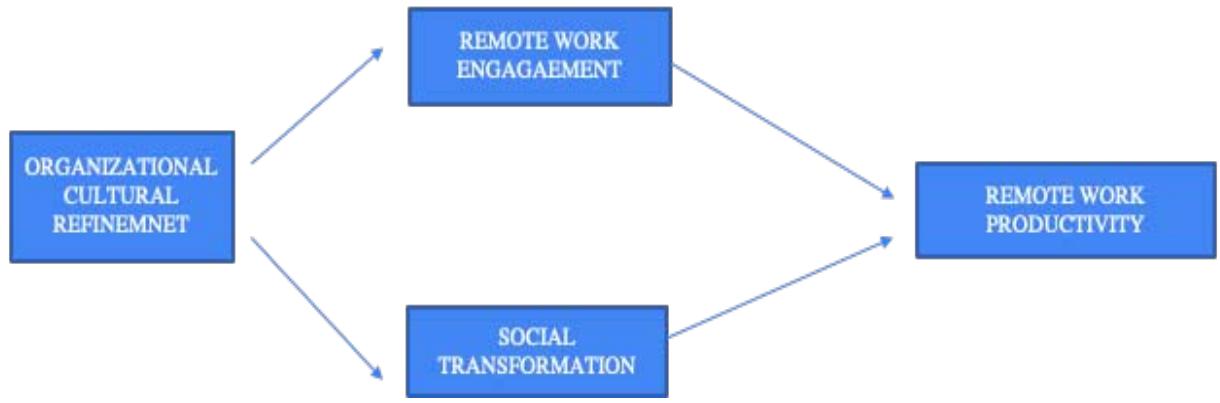
Hypothesis Model Relating Organizational Cultural Refinement Figure 1: Hypothesized Research Model
1. There is no impact of Organizational cultural refinement on employees cultural accountability.
<table><tr><td>For Hypothesis (I)</td><td>Value of R-34%
Value of R-square-27.6%</td><td>Significance value of 0.02, rejecting null hypothesis</td><td>Regression equation
Y=4.246+2.44x</td><td>There is 27.6% variation of organisational culture alignment on employees cultural accountability.</td></tr></table>
2. There is no impact of Organizational cultural refinement on remote work engagement.
<table><tr><td>For Hypothesis (II)</td><td>Value of R-43%
Value of R- square-33.4%</td><td>Significance
value of 0.03,
rejecting null
hypothesis</td><td>Regression
equation
Y=5.425+1.56
x</td><td>There is 33.4% variation
of organizational cultural
refinement on remote
work engagement.</td></tr></table>
3. There is no impact of Organizational cultural refinement on social transformation.
<table><tr><td rowspan="2">For Hypothesis (III)</td><td>Value of R-27%</td><td rowspan="2">Significance value of 0.01, rejecting null hypothesis</td><td rowspan="2">Regression equation Y=3.515+2.34 x</td><td rowspan="2">There is 18.4% variation of organizational cultural refinement on social transformation.</td></tr><tr><td>Value of R-square-18.4%</td></tr></table>
4. There is no impact of Organizational cultural refinement on employee productivity.
<table><tr><td>For Hypothesis (IV)</td><td>Value of R-23%
Value of R- square-11.4%</td><td>Significance value of 0.03, rejecting null hypothesis</td><td>Regression equation
Y=3.436+1.78 x</td><td>There is 11.4% variation of organizational cultural refinement on employee productivity.</td></tr></table>
Analysis for Reliability Test
- The value of Cronbach's Alpha is 0.803 which indicates a high level of internal consistency and hence the questions are really good for the analysis.
Analysis-For Factor Analysis
<table><tr><td>Correlation of Factors</td><td>Determinant value comes out to be 0.568 which is >0.00001 and hence data is correlated and can be used for further analysis.</td></tr><tr><td>KMO's & Bartlett's Test</td><td>KMO is 0.83 which indicates data has sufficient variance & Bartlett's test value is <0.05 which is rejecting our null hypothesis.</td></tr><tr><td>Communalities</td><td>Looking for items which has >value of 0.3 and rest all dimensions will not not be used.</td></tr><tr><td>Component Matrix</td><td>Looking for Initial Eigen values with 52% variation in cluster 3 which is good for further analysis.</td></tr><tr><td>Component Correlation</td><td>Cluster 3 has been the most appropriate because of correlation value of 0.71 and most varied cluster values involved which is Organisational culture refinement, remote engagement and social transformation.</td></tr></table>
## V. DISCUSSION AND FINDINGS
1. $44\%$ of HR professionals perceive that for the purpose of building organisational refinement focused on building an inclusive culture, there is a need to design a certain standardised set of values and norms since it is the employee values which determine what they think significant and worthwhile. Each value is linked to a set of ideas and attitudes about the world. This could have a direct impact on one's well-being. Bringing standardisation in values can have an indirect impact on well-being by influencing the activities that people with different values choose in the organisation. The pandemic era will surely bring a significant change to channelise the workforce energy and abilities in a prominent direction to effectively cope with forthcoming difficulties and normative forces in which values are likely to alter in reaction to external circumstances.
2. $48\%$ HR professionals discern about the fact that refinement of culture in post covid should be aligned with the organisational as well as inter departmental processes which portrays the organisation's culture as the result of interactions among personnel who have been working together for a long period. The culture refinement can be done by bringing a positive change in ideologies, principles, policies and beliefs of the organisation. The management style of dealing with personnel, in its own unique way, also contributes to the organisation's culture. Employees who have spent a significant period of time in a company prefer to establish specific norms and procedures for their own convenience and mutual understanding. The world of mobility has been going through some rapid shifts and the pandemic has also gained significant momentum which brings transformation in terms of automation which requires constant focus on the model of sustainability and hence organisation should bring in the policies and procedures of connectivity and sustainability in order to make the workplace a happier place, and should be a part of cultural transfiguration whereby organisation brings greater employee centricity and innovation on the board and that will embark upon renewed journey for culture rejuvenation to prepare ourselves for future uncertainties.
3. $40\%$ of HR professionals believe that the refinement in organisational culture brings accountability in the behaviour of employees. It is extremely important in these times of pandemic that in spite of remote working, the employees should bring in similar productivity in their work as earlier and hence, focus should be on bringing a culture which ensures more adaptability and reactive processes across the board so that the productivity of employee does not get hampered even if the workforce is not working from offices, and hence culture that is bringing similar accountability in the heart and soul of employees is highly desirable.
4. $36\%$ HR professionals think that the most dominant factor is that these cultural refinement changes should be communicated strategically to employees, as organisations should communicate each and every change to their employees since it will be a time taking process to adapt such a new change. A healthy and timely communication from Top leadership will not only improve the long term sustainable relationships with the employees but will also enhance productivity of the workforce since this will focus on trust and empathy in the minds of the workforce that why this change is actually imminent and is crucial for their success. It is equally important to clarify the motives behind any organisational change to the employees which will bring mutual understanding and allow everyone to work efficiently and effectively under a shared vision. In addition to conveying the initial change endeavour, it's critical to let your employees know that there are resources available to assist them in the transition.
5. $24\%$ HR professionals find that effectiveness of any change in the culture refinement post pandemic times should be measured using right metrics which will measure the three best possible impacts on individual employee performance, organisational performance and performance measures. Finding out whether the culture refinement change management actions implemented yielded favourable outcomes is what measuring effectiveness of cultural change entails. Quantifying the right set of needed skills and capabilities with new ideas and strategies will also result in behavioural and performance changes which can lead to new ways of thinking and culture shifts.
6. When it comes to developing a system that is measuring remote work enagement, $40\%$ HR professionals strongly felt that to build a system of measuring the employees work engagement as when employees allowed a set of guidelines to measure remote work productivity. This involves an emphasis on continuous measurement of their daily standardised tasks by their respective departmental managers. The process acts as an controlling factor to measure their performance to make sure that the work engagement increases even it is a remote working scenario.
7. $28\%$ HR professionals feel that there should be a support system designed in the organisation for the employees which will help them in handling their emotional hurdles and also useful in adjusting to the new realities when they return to work. This pandemic leads not only to physical harm to employees but also emotional breakdown. In these unprecedented times, there is a need for a system which gives emotional support to the employees handling their psychological stability.
8. $52\%$ of HR professionals believe in employees not just focused on their routine tasks but always focus on some extra. This extra apart from their daily standardised tasks will ensure the psychological alignment of employees for their respective jobs and act as a keen factor to decide upon that your employees are your real assets adn is sustained in your organization for a long term period of time.
9. $40\%$ of HR professionals focused on mental health for supportive environments leading to increased psychological demands which also includes our social well being and affects how employees think, feel and act. Organisations that are able to care for their employees' mental health and well-being will cultivate motivated and enthusiastic employees. These mindful and responsible businesses will eventually develop, based on a strong culture that brings all stakeholders together in times of crisis. This mental stigma promotes the culture of emotional stability and resembles that employees are emotionally attached with their tasks.
10. $24\%$ of HR professionals have found that remote working brings better work ethos which implies that menial work and dedication have a moral advantage and an intrinsic ability, virtue, or value to enhance character and individual abilities. It is a set of ideals centred on the significance of work and shown through the will to work hard.
11. $48\%$ HR professionals believe that remote working has emerged to be a new revolution which has enhanced employee productivity. The ability to work from home is determined by the mix of activities performed in each occupation, as well as the physical, geographical, and interpersonal setting. Employers also discovered during the pandemic that, while some tasks can be completed remotely in a crisis, they are significantly more productive when completed in person. Coaching, counselling, and providing advice and feedback are examples of these activities, as are building customer and colleague relationships, hiring new employees, negotiating and making critical decisions, teaching and training, and work that benefits from collaboration, such as innovation, problem-solving, and creativity. If onboarding were to be done remotely, for example, it would necessitate a considerable rethinking of the process in order to attain results comparable to those obtained in person. Over time, remote work and its associated technology will be a revolutionary force for businesses. The general consensus appears to be that firms' employee productivity has increased as a result of the new remote work model.
12. $40\%$ HR professionals have the opinion that organisational structure should be aligned with the remote work processes, this is extremely crucial to make sure that remote working follows the same organisational rules, norms, and work ethics behaviour so that there is no deviation when it comes to working from office or remote working in terms of productivity and efficiency.
13. $52\%$ HR professionals perceive that a simplification of organisational structure is needed to speed up the decision processes in remote working. Organisation Simplification aims to de-clutter the workplace by empowering employees and establishing a flat, efficient, and straightforward structure. Even in the scenario of remote working, where there could be high probability of several uncertainties, a simplified organisational structure will bring in prolificity in the complete system.
14. $36\%$ HR professionals figured out that realisation of strategic goals with respect to departmental goals can be achieved in the context of remote working. The managers need to be extremely particular that the goal setting needs to be done keeping in mind the remote working scenario whereby the organisational goals and objectives should be linked with the departmental goals and also individual targets and key performance indicators. Effective remote managers have learned to adapt to changing times and alter their procedures in order for their workers to be even more productive than they were in the office, shattering business goals while maintaining a flexible lifestyle. They've realised that communication must be deliberate, and that they can no longer rely on a "check-in" at an employee's actual workspace. Setting explicit goals with specific indicators, sticking to established check-in and evaluation schedules, and establishing expectations and cultural norms ahead of time can help managers of remote teams envisage and accomplish success.
15. $52\%$ of HR professionals have the opinion that remote working brings more flexibility and agility in the working environment. This ability to operate rapidly, seamlessly, and cohesively in the workplace leads to workplace agility. The productivity of the organisation should not decrease when more employees work from home or on the road. Employees should be allowed to work from anywhere, at any time, and in whatever way they want. From collaboration suites to virtualized desktop environments, provide employees with the tools they require. Creating a flexible workplace that is enabled and supported by technology and information technology will help in achieving organisational efficiency. Organisational transformation, such as modifications to the current procedures, department structures, and culture, will be required to facilitate an agile and flexible workplace.
16. $48\%$ HR professionals highlighted creating a better organisational design will bring in better financial performance, employee happiness, and staff satisfaction. Managers need to make sure that establishing effective structures, governance, and roles that are guided by a set of design principles that are linked with the company's strategic intent. Also supporting informal networks and cultivating a culture of continuous improvement to ensure that the necessary talent and skills flourish in a future-ready workforce. Managers should also focus on establishing rigour in performance management goals and encourage efficient decision-making, as well as ensuring that processes and technology support their teams rather than hinder achievement.
17. $52\%$ HR professionals have the opinion that sustainable competitive advantage can be obtained by optimising organisational structure and the complete focus should be on ensuring that corporate strategy and organisational design are firmly aligned is one of the most difficult tasks facing modern organisations. According to conventional thinking, deciding the enterprise strategy first and then re-aligning the organisation to deliver on it is vital. Organisations that arrange themselves around functions are more likely to create fixed and functional strategies. Similarly, businesses that organise themselves around geographies are more likely to create fixed geographic strategies. Aside from the lack of flexibility, both are easy to duplicate by competitors and will likely limit the long-term execution of unique strategies and performance. Hence, optimisation of organisational structure becomes really prominent to sustain a competitive advantage in the long run.
18. When it comes to roles and work design, $72\%$ HR professionals strongly think that organisational roles and work have been designed in an apt and appropriate manner because they feel that in order get the most out of such advancements, managers need to make sure that the structure of jobs or roles, as well as the demands they place on job or role holders, boost motivation, engagement, and dedication. Job or position contents, procedures, and relationships must fit technological and organisational criteria, but they must also meet the human needs of the employees involved. These two objectives may not always be simple to reconcile, but they must be attempted if the greatest possible gains from technological and organisational transformation are to be realised.
19. $70\%$ HR professionals feel that in case of remote working also, if the structure is well organised, then also team members will be able understand their respective roles in the remote working scenarios. Looking ahead to the future of work, on the other hand, necessitates more than a quick response. A big-picture approach is also required for a prosperous post- pandemic future. Business standards must be optimised to assist team members succeed no matter where they work in the next evolution of leading remote teams and hybrid workforces.
20. $75\%$ HR professionals believe that leaders have a clear grasp of which jobs and functions are most important in achieving their objectives. According to the competencies of the employees and analysing the remote working uncertainties, leaders know very well about the job evaluation and its functions and segregating the key performance indicators to their team members.
21. $80\%$ HR professionals highlighted that there are structures and processes in place to handle individual and institutional accountability effectively. Managers need to maintain the balance between achieving the accountability levels of the employees as well as the for the organisation, which will ensure long run productivity even at the most uncertain zone.
22. $68\%$ of HR professionals feel that there is a possibility for the company to identify the important processes post pandemic era, that it must effectively manage in order to satisfy its employees and build long- term value. It becomes vital for the organisation to make certain processes for a long term aspect which is also helpful in fostering growth and development for the employees as well as organisation.
23. $71\%$ of HR professionals believe that organisation's fundamental processes should be reviewed for effectiveness and potential for improvement on a regular basis and must be checked during the post pandemic era. Constant efforts should be made and reviewed by the managers to measure the effectiveness of the change.
24. $76\%$ of HR professionals state that technology is being used to effectively restructure important processes, starting from the ground up if necessary. In this revolutionised world, where organisations have been highly capital intensive it comes important post Covid times to indulge every single processes down the line equipped with technology.
25. $68\%$ HR professionals feel that they have identified the organisation's significant process "bottlenecks" and capacity constraints at the time of post covid era, improving the efficiency of any process, whether for production, distribution, or another commercial goal, is a critical step in increasing a company's bottom line. Improvements in efficiency also allow organisations to consistently offer high-quality items to their customers.
26. $65\%$ of HR professionals highlighted that employees are aware of the business difficulties and necessary modifications to the current model of remote working and also have prepared for a transformational change from physical working to remote working.
27. $64\%$ HR professionals feel that the organisations have been successful in instilling the required enthusiasm, energy, and feeling of urgency for implementing critical change programmes. They have been constantly looking for workers with zeal and a strong sense of belonging to their firm and who inspire innovation and propel the organisation ahead.
28. $68\%$ HR professionals believed that the organisation is being effective at learning from its failures and applying these "lessons learned" to new situations. The near future will be highly uncertain and hence learning from present failures and adopting the ways to tackle these uncertainties in the future is highly recommended.
29. $66\%$ of HR professionals sense that the organisation is successful in implementing improvement/change programmes because these changes and transformations must be introduced deliberately, cooperatively, and respectfully within businesses. It gives the managers and leaders the critical skills to create change inside an organisation if you manage people through effective change training courses for their constant training and development.
30. $40\%$ of HR professionals highlighted that remote working provides employee engagement to the employees and hence it becomes very important for the managers to make sure that even at the time of remote working employees should be emotionally, cognitively and psychologically involved with their respective tasks.
31. $80\%$ of HR professionals perceive that innovation is highly encouraged at times of remote working.
32. $76\%$ of HR professionals feel that employees are valued and heard at the remote working scenario which is helping them in building up long term relationships with their colleagues and supervisors and also enhancing their work productivity.
33. $68\%$ of HR professionals believe that organisations have created a remote culture that engages all employees and coworkers who share comparable priorities, interests, and attitudes, they enjoy an unconditional sensation of connection. When employees don't see each other on a regular basis, they still feel connected. Employees with strong work cultures have an unshakeable sense of belonging.
34. $56\%$ of HR professionals stated that the employees feel motivated while shifted to an effective remote working environment.
35. $64\%$ of HR professionals have the perception that there is a significant and continuous master communication in order to ensure clarity and trust among employees at the remote working times.
36. $60\%$ of HR professionals believed that organisations have employee listening practices followed for a better change.
## VI. RECOMMENDATIONS
1. The Indian startup sector had gone through a period of fast growth, with large increases in workforce both organically and through acquisitions. Previously, startups had made employment selections based on current business needs of switching from physical working mode to remote working mode which has impacted the overall work culture, priorities have been switched towards employees mental and physical wellness and also on remote work engagement with individual managers and departments making their own decisions. This study will help the startup sector companies to refine their organisational structure and culture with reference to transformation in remote working environments surmounted by unforeseen uncertainties in the post covid era. However, with this study HR professionals would be able to make certain key strategic decisions, which would increasingly result in individual and organisational underperformance.
2. This study will also help the employees in understanding the new strategic intent of the organisations engrossed with their vision, mission goals and objectives and meeting their expectations without hampering the individual productivity in remote work and maintaining a perfect blend of their work life balance.
## VII. LIMITATIONS AND FUTURE SCOPE OF STUDY
### a) Limitations of Study
The study conducted has certain limitations involved in it. The first limitation is choosing a very small sample size which is caused because of limited time. The study could have improved by choosing a large sample size of different HR professionals as well as other stakeholders which has much scope in analysing from the holistic perspective. Second limitation could be of convergent scope of choosing only startups industries of India and not international startups. The involvement of startups in this study will bring a different perspective altogether with better understanding and results. A superior statistical analysis in comparison to the study conducted from a holistic perception and comparative standpoint of analysis could be the third constraint which requires capacious research in order to gain more detailed insights in order to bridle the problems and the challenges faced by HR professionals working in the startups.
### b) Future Scope of Study
1. This research will act as a base in transforming organisations in setting a remote work culture.
2. This research will help in establishing the significance of remote engagement.
3. This research will help the organisations in understanding the prominence of social transformation in increasing productivity.
4. This will act as a catalyst for sustaining organizations in the world of uncertainties through its culture and structure.
#### ACKNOWLEDGEMENT
The FORE School of Management's financial and infrastructural support throughout this research is widely recognised and highly acknowledged.
Generating HTML Viewer...
References
14 Cites in Article
Dhrupa Bhatia,Anjali Mote (2021). Work from Home (WFH): The New Normal?.
Max Reinwald,Sophia Zimmermann,Florian Kunze (2021). Working in the Eye of the Pandemic: Local COVID-19 Infections and Daily Employee Engagement.
B Chandramana,Sudeep,Christina Shaji (2020). Re-thinking HR Strategies for the Post-Covid Workplace.
J Staples (2006). A new type of threat.
Chandramana Sudeep,B (2020). Sustainable Business Practices for the Post-Covid Age, Socio-Economic Repercussions of Covid-19 Pandemic.
Iza Gigauri (2020). EFFECTS OF COVID-19 ON HUMAN RESOURCE MANAGEMENT FROM THE PERSPECTIVE OF DIGITALIZATION AND WORK-LIFE-BALANCE.
Kiconco Yvonne,Shimei Jiang (2021). A Review on the New Normal, Employee Wellbeing and the Role of HRM: A Tale of HR among the New Normal for the Employee Wellbeing.
Morshidul Islam (2025). The Future of HR: How AI is Shaping Recruitment and Employee Management.
Bhumika Bhumika (2020). Challenges for work–life balance during COVID-19 induced nationwide lockdown: exploring gender difference in emotional exhaustion in the Indian setting.
M Barrick,G Thurgood,T Smith,S Courtright (2015). Collective organizational engagement: Linking motivational antecedents, strategic implementation, and firm performance.
Simon Albrecht,Arnold Bakker,Jamie Gruman,William Macey,Alan Saks (2015). Employee engagement, human resource management practices and competitive advantage.
Alan Saks (2019). Antecedents and consequences of employee engagement revisited.
Li Sun,Chanchai Bunchapattanasakda (2019). Employee Engagement: A Literature Review.
A Saks (2006). Antecedents and consequences of employee engagement.
No ethics committee approval was required for this article type.
Data Availability
Not applicable for this article.
How to Cite This Article
Aman Maheshwari. 2026. \u201cUnderstanding Organizational Remote Engagement and Employee Social Transformation in Post-Covid Times with Special Reference to Startups in India\u201d. Global Journal of Management and Business Research - A: Administration & Management GJMBR-A Volume 22 (GJMBR Volume 22 Issue A6).
Explore published articles in an immersive Augmented Reality environment. Our platform converts research papers into interactive 3D books, allowing readers to view and interact with content using AR and VR compatible devices.
Your published article is automatically converted into a realistic 3D book. Flip through pages and read research papers in a more engaging and interactive format.
Our website is actively being updated, and changes may occur frequently. Please clear your browser cache if needed. For feedback or error reporting, please email [email protected]
Thank you for connecting with us. We will respond to you shortly.