Network-enabled enterprise systems called interorganizational systems use (IOS) go beyond the walls of an organization, allowing partners in the supply chain to collaborate better by exchanging business information in real time. As a result, the study (Case Study: Sudan Food Industry) examined the Mediating Role of Supply Chain Management Capabilities on the Relationship between Inter-Organizational System Use on Firm Performance, with the purposeful participation of (450) participants, to whom the questionnaire was addressed. The information was then gathered from the supply chain and production management at the Sudanese food processing industry. The data was then coded using SPSS and AMOS 26. After ensuring normality, validity, and reliability, a descriptive analysis was conducted and variable correlation was examined. Path analysis was formerly used to test hypotheses. The findings of the study reveal IOS have a positive and significant impact on SCM capabilities. also, SCM capabilities mediating the relationship between IOS and Performance.
## I. INTRODUCTION
Network-enabled enterprise systems called inter-organizational systems (IOS) go beyond the confines of an organization, allowing partners in the supply chain to interact more successfully and share business information in real time (Bakos, 1991; Chatterjee & Ravichandran, 2004; Hartono, Li, Na, & Simpson, 2010).
Businesses have implemented a variety of IOS uses, such as vendor managed inventory, electronic data interchange, and collaborative planning, forecasting, and replenishment, to enable supply chain partners to communicate in real time and make informed decisions. To gain a competitive edge, interorganizational systems enable efficient management of activities in a coordinated and integrated manner.
According to the resource-based view (RBV) hypothesis, a corporation acquires a competitive edge when it manages and successfully combines resources that are uncommon, valued, heterogeneous, and unique (Barney, 1991; Peteraf & Barney, 2003). Consequently, research in logistics and resource-based theory both demonstrate for the mutual advantage of the supply chain network's participants, inter-organizational systems enable an organization to supplement its internal resources and capabilities with external resources made available to the partners.
The entire supply chain greatly benefits from the usage of IOS (Asamoah, Agyei-Owusu, Andoh-Baidoo, &Ayaburi, 2019; Hartono et al., 2010). However, there are calls for deeper research into the methods by which IOS use improves firm performance and for the supply chain Blackbox to be opened. (Agbenyo, Asamoah, &Agyei-Owusu, 2018; Aydiner, Tatoglu, Bayraktar, & Zaim, 2019; Yu, Chavez, Jacobs, & Feng, 2018). Therefore, through the following research gaps, the study attempts to cover the food industry in Sudan in order to get the benefit of IOS and SCC in Sudanese food processing industry.
The current study thus concentrates on 1) external IOS usage in SCC and 2) the impact of inter-organizational system uses on firm performance. Management's comprehension of the operational dynamics of IOS in the organization is enriched by insights from the investigation of the interaction between IOS use and SCC in improving Firm performance. In this work, we investigate the complex interactions between SCC, Firm performance, and IOS usage.
The remaining sections of this essay are organized as follows. Introduction in Section 1, evaluation of pertinent literature in Section 2, and formulation of hypotheses in Section 3. Section 4 presents the research methodology, while Section 5 summarizes the findings. Finally, our analysis and conclusions in Section 6.
## II. LITERATURE REVIEW
### a) Inter-organizational information systems (IOS)
following three objectives: facilitate communication, facilitate integration, and facilitate business intelligence (Zhang and Cao 2018; Subramani 2004).
Deploying IOS for business intelligence is more crucial in the present big data era, where large amounts of corporate data are produced every day. Exploring and understanding corporate data can help organizations gain new insights into their processes, customers, and markets, which can pave the way for enhanced performance.
IOS-enabled business intelligence refers to how effectively IOS is used to support learning and business intelligence. IFIP 2021, International Federation for Information Processing A. Kumi et al., "Knowledge Sharing in a Supply Chain Network," Springer Nature Switzerland AG, 2021 (Zhang and Cao 2018). Cooperative knowledge acquisition, shared databases and decision support systems, and artificial intelligence are examples of applications for IOS-enabled business intelligence (Mandal and Dubey 2021).
Implementing IOS enhances a number of outcomes, including firm performance, according to past studies (Hartono et al. 2010, Rajaguru and Matanda 2013, and Firm performance (Cho et al. 2017; Asamoah et al. 2021a).While concentrating primarily on IOS use at the second order level, the present literature on IOS outcomes usually blends a variety of IOS use factors and neglects to examine how certain IOS use dimensions may enhance firm performance. Therefore, it is currently unknown whether and how IOS-enabled business information affects the performance of businesses. Researchers have often encouraged to look into how different IOS use aspects affect performance (Asamoah et al. 2021a; Agbenyo et al. 2018).
Additionally, nothing is known about how IOS-enabled business intelligence enhances company performance. This study closes these research gaps by analyzing the significance of information interchange, coordination, integration, and supply chain responsiveness abilities in explaining the outcomes of IOS-enabled business intelligence. Therefore, we conclude the following hypothesis
$H_{1}$ inter-organizational system use IOS with sub-dimension (C-I) has positive impact on Firm performance SCP with sub-dimension (R.E.F).
$H_{2}$ inter-organizational system use IOS with sub-dimension (C-I) has positive impact on supply chain capabilities with sub-dimension (I.C.R)
### b) Dynamic Supply Chain Capabilities (SCC)
Due to uncertainties and ongoing market and business environment changes, the idea of dynamic capacities has evolved. Teece et al (2017). created the dynamic capabilities hypothesis. In order to adapt to the quick changes in the business environment, firms must be able to develop, integrate, and reconfigure their internal and external resources and competencies.
According to Zahra and George (2002), dynamic capabilities allow businesses to update and reorganize their resource base in response to shifting consumer demands and rival strategies. The importance of using dynamic capabilities in the supply chain is rising (Witcher et al., 2008 & Allred et al., 2018).
The establishment of dynamic supply chain capabilities is a result of shifting long- and short-term supply and demand, market dynamics, and consumer demands (Ju et al., 2016). In order to handle these changes, businesses need dynamic supply chain capabilities. Dynamic supply chain skills enable businesses to foresee market demands precisely, forge collaborative relationships with consumers and suppliers, and improve the supply chain's response to those needs (Sanders, 2014). From a supply chain perspective, the dynamic capabilities have been studied by numerous academics.
According to Mathivathanan et al. (2017), the supply chain's ability to build dynamic capabilities is crucial for meeting future demands. Dynamic supply chain capabilities are defined by Oh et al. (2019) as a firm's capacity to recognize and utilize internal and external resources in order to improve supply chain processes effectively and efficiently. They add that information exchange, coordination, integration, and supply chain responsiveness are examples of dynamic supply chain capabilities. According to Ju et al. (2016), in order to meet customer expectations and keep competitiveness in a dynamic environment, dynamic supply chain capabilities are procedures of information sharing, supply chain alignment, and information technology. According to Aslam et al. (2018), dynamic supply chain capabilities include cohesive elements of supply chain agility and flexibility which should be integrated to support supply chain ambidexterity.
A company's capacity to adapt its internal and external resources to market changes depends on its supply chain agility. This skill aids an organization's efforts to seize opportunities or fend off dangers posed by unstable environments (Van Hoek et al., 2001), which may result in the acquisition or preservation of a competitive advantage (Eisenhardt and Martin 2000). According to numerous studies, enhancing supply chain agility capability—that is, becoming more responsive to changes at low costs—has a favorable effect on the performance and competitiveness of businesses (Blome et al., 2013; Chakravarty et al., 2013; Oh, 2018).
Supply chain responsiveness is a company's capacity to react swiftly to fluctuations in consumer demands, production and delivery volumes, and product mix, volume, and delivery. Most likely, these modifications will result in improved performance results, such as lower manufacturing costs, higher customer satisfaction, and quicker delivery (Yu et al., 2016). Additionally, studies by Prago and
Olhager (2016) and Mandal et al. (2016) demonstrate that supply chain responsiveness has a favorable effect on operational performance.
- Collaboration capability refers to a company's capacity to establish a long-term relationship in terms of supply chain operations and the exchange of knowledge, resources, and risk in order to meet shared goals (Bowersox et al., 2002). According to Cao and Zhang (2011), an organization's capacity for information sharing determines its capacity for supply chain collaboration, knowledge and resource, goal consistency. Customer cooperation, supplier collaboration, and internal collaboration are crucial components that make up the collaborative supply chain, according to Yunus (2018). Integrability reflects a company's aptitude to forge strategic alliances and work in tandem with its supply chain partners (Flynn et al., 2010).
- Supply chain integration emphasizes the availability of the appropriate items to the appropriate consumers at the appropriate time and at a reasonable cost (Angeles, 2009). According to Rajaguru and Matanda (2019), supply chain integration entails integrating financial, physical, and informational flows. The ability of a business to adapt quickly to market changes and turbulence in order to better serve its suppliers and consumers is referred to as agility capability (Aslam et al., 2018).
Additionally, supply chain agility is a dynamic process that modifies or reconfigures the current business process to deal with market hiccups and other uncertainties. According to Li et al. (2009), strategic readiness and reaction capability, operational readiness and response capability, and episodic readiness and response capability are key components of supply chain agility. The ability of supply chain partners to react to changes and alterations in the environment is referred to as responsiveness capability (Williams et al., 2013). According to Singh and Sharma (2015), supply chain responsiveness places an emphasis on cutting down on lead times, enhancing service quality, responding quickly to client needs, and optimizing transportation. Shekarian and others,(2020) contend that there are three essential components to supply chain responsiveness: agility to respond to customer requests, flexibility to facilitate the development of new products and entry into new markets, and a reduction in the likelihood of supply chain bottlenecks and interruptions. So, we conclude the following hypothesis
H3 supply chain management capabilities SCMC with sub-dimension (I.S.R) has positive impact on Firm performance SCP with sub-dimension (R.E.F)
### c) Firm Performance
Firm performance in a changing environment, with businesses aiming for superior organizational performance and competitive advantages (Rajaguru and Matanda, 2019). pertaining to the effectiveness of the company's internal operations, which may allow the company to increase its profitability and competitiveness in the market (Hong et al., 2019). Operational performance is a multifaceted concept that encompasses the successful conversion of operational capabilities into organizational competitive advantages. Productivity, quality, cost, delivery, flexibility, and customer happiness can all be used to evaluate it (Gambi, 2018). Businesses aim to gain competitive advantages and achieve good organizational performance in a dynamic environment (Rajaguru and Matanda, 2019).
Firm performance is related to the effectiveness of the company's internal operations, which may allow the company to increase its profitability and competitiveness in the market (Hong., 2019). Firm performance is a multifaceted concept that encompasses the successful conversion of operational capabilities into organizational competitive advantages. Productivity, quality, cost, delivery, flexibility, and customer happiness can all be used to evaluate it (Saleh, 2018). Therefore, after reviewing previous studies that confirmed the existence of a relationship between them, we can conclude the following hypothesis
H4 supply chain management capabilities SCMC multi-dimension mediated the positive impact of inter-organizational system use IOS use with multi-dimension on SCP.
## III. RESEARCH METHODS
### a) Sampling and data collection
The current study is categorized as both a cause-and-effect and descriptive study. Its goal to testing (ISO, FP, SCCM). The approach begins with a review of the literature in order to compile a profile for assessing supply chain management capabilities SCMC multi-dimension mediated the positive impact of interorganizational system use IOS use with multi-dimension on SCP. Following that, the information gathered used non-probability sample (Convenience) The data was then coded using SPSS, SMART PLS. After ensuring normality, validity, and reliability, a descriptive analysis and variable correlation checks were conducted.
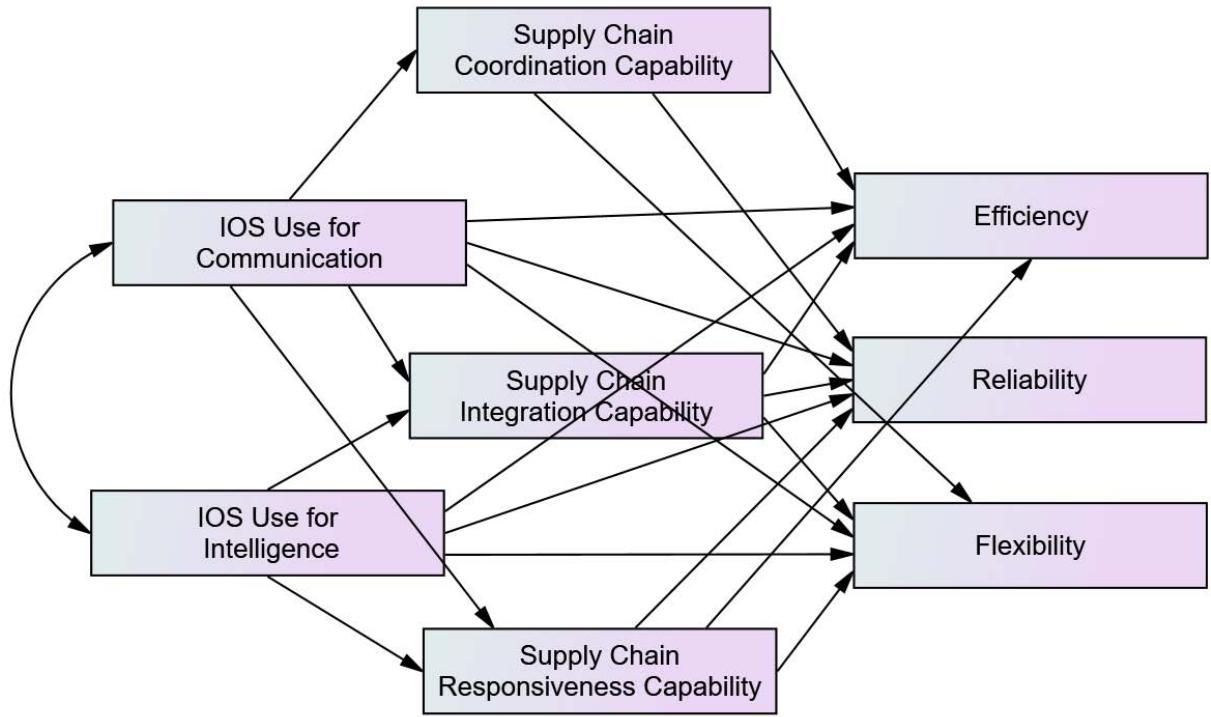 Fig. 1: Conceptual framework
### b) Measurement
Measurement instruments for the constructs were obtained from previous studies and adapted to suit the context of this study. IOS Use was adopted from Zhang and Cao (2018), Supply Chain Capabilities was adopted from Wu et al. (2006), and Firm performance was adopted from Kocoglu et al. (2011) and Lee et al. (2007).
### c) Empirical strategy
In this work, the proposed model was examined using SPSS and AMOS. The theoretical framework was examined using SEM in order to examine the suggested model. Additionally, it provides accurate estimations of the pathways between constructions by simultaneously analyzing the structural and size models (Chin, 1998). Sarstedt, Ringle, and Hair (2017) argue that SEM is a suitable method for testing mediation and moderation outcomes and examining complex relationships as a result. Last but not least, CB-SEM is often utilized in fields involving number lookups (e.g., Ferraris, Devalle, Ciampi, and Couturier, 2019; Rezvani, Dong, and Khosravi, 2017).
### d) Non-response bias and common method bias countermeasures
Countermeasures for non-response bias and common method bias inclination we compared $25\%$ of repplies from the first fourteen days of the review period with $25\%$ of responses from the most recent two weeks, as recommended by Armstrong and Overton (1977), and performed a t-test to determine whether our review was free of the NRB problem. Additionally, it was confirmed that there were no disparities in the respondents' responses in the two states using the ANOVA analysis, which revealed that there were no significant differences. We conducted many tests to mitigate the negative effects of normal technique predisposition (CMB). In addition to the programming stacking test by Muthen and Muthen (2007), Harman's single element test (Gomez-Conde et al., 2019), and Podsakoff et al.'s. (2003) NRB test. These tests showed that our review was liberated from CMB. Besides, we directed pre-testing for the questionnaire to guarantee the understandability of the assertions introduced in that.
## IV. DATA ANALYSIS AND RESULTS
We used SPSS and AMOS v 26 to assess the measurement model and structural model, and a bootstrapping estimation procedure was adopted to investigate the significance of mediation effects.
Table 1: Company profile
<table><tr><td colspan="2"></td><td>Frequency</td><td>Percent</td></tr><tr><td rowspan="3">Gender</td><td>Male</td><td>260</td><td>59.1</td></tr><tr><td>Female</td><td>170</td><td>38.6</td></tr><tr><td>Total</td><td>440</td><td>100.0</td></tr><tr><td rowspan="5">Age</td><td>18 to 24</td><td>180</td><td>40.9</td></tr><tr><td>25 to 30</td><td>210</td><td>47.7</td></tr><tr><td>31 to 35</td><td>30</td><td>6.8</td></tr><tr><td>More than 36</td><td>10</td><td>2.3</td></tr><tr><td>Total</td><td>430</td><td>97.7</td></tr><tr><td rowspan="4">Academic qualification</td><td>B.sc</td><td>10</td><td>2.3</td></tr><tr><td>M.sc</td><td>380</td><td>86.4</td></tr><tr><td>PhD</td><td>40</td><td>9.1</td></tr><tr><td>Total</td><td>430</td><td>97.7</td></tr><tr><td rowspan="6">Specialization</td><td>Business</td><td>150</td><td>34.1</td></tr><tr><td>Management (MIS)</td><td>70</td><td>15.9</td></tr><tr><td>Supply chain Management</td><td>180</td><td>40.9</td></tr><tr><td>IT</td><td>20</td><td>4.5</td></tr><tr><td>Others</td><td>10</td><td>2.3</td></tr><tr><td>Total</td><td>430</td><td>97.7</td></tr><tr><td rowspan="4">Income</td><td>Less than 100000</td><td>30</td><td>6.8</td></tr><tr><td>In range 100000 to 500000</td><td>380</td><td>86.4</td></tr><tr><td>Above 500000</td><td>10</td><td>2.3</td></tr><tr><td>Total</td><td>420</td><td>95.5</td></tr><tr><td>Missing</td><td>System</td><td>20</td><td>4.5</td></tr><tr><td colspan="2">Total</td><td>440</td><td>100.0</td></tr></table>
### a) Factor analysis
## i. Exploratory factor analysis
EFA used to be done in an organized order and was viewed as such. First, the significance of the issue evaluation, which was evaluated by looking at the correlation matrix of the accumulated statistics, was verified using the Bartlett sphericity test (Hair et al., 2005). Kaiser-Meyer-Olkin (KMO) statistics were employed to calculate sample adequacy at the same time. Sphericity and the KMO value are considered in the Bartlett's grading. Maximum Likelihood Approach to
Habits (EFA). The twelve elements that were originally utilized to gauge the dimensions Impact of exchange and communications technology on firm performance: the mediation effect of supply chain Capabilities underwent factor examination. Table 5.6 confirmed the precis of consequences all the gadgets it is above then 0.5. So, the KMO and Bartlett's take a look at equal 0.869 which is full-size (0.00). This end result indicates that the pattern dimension is ample for structural equation modelling (Gaskin, 2012, Kenny and McCoach, 2003).
Table 2: (Pattern Matrix $^{a}$ ) The pattern matrix to establish convergent and discriminant validity
<table><tr><td rowspan="2"></td><td colspan="8">Component</td></tr><tr><td>1</td><td>2</td><td>3</td><td>4</td><td>5</td><td>6</td><td>7</td><td>8</td></tr><tr><td>Communication 1</td><td>-.028</td><td>.385</td><td>-.388</td><td>.019</td><td>.456</td><td>.082</td><td>.083</td><td>.150</td></tr><tr><td>Communication 3</td><td>-.060</td><td>.285</td><td>-.087</td><td></td><td>-.315</td><td>-.034</td><td>.260</td><td>.947</td></tr><tr><td>Exchange 1</td><td>.068</td><td>.850</td><td>.176</td><td>-.119</td><td>.210</td><td>-.104</td><td>-.196</td><td>.144</td></tr><tr><td>Exchange 2</td><td>-.271</td><td>.125</td><td>-.085</td><td>.478</td><td>.182</td><td>.295</td><td>.222</td><td>.322</td></tr><tr><td>Exchange 3</td><td>.158</td><td>.011</td><td>-.124</td><td>.047</td><td>.348</td><td>.645</td><td>.161</td><td>-.215</td></tr><tr><td>Exchange 4</td><td>-.182</td><td>.077</td><td>.733</td><td>-.105</td><td>.221</td><td>-.025</td><td>.237</td><td>-.244</td></tr><tr><td>Coordination 1</td><td>-.164</td><td>.074</td><td>.838</td><td>.072</td><td>-.093</td><td>.155</td><td>-.152</td><td>.047</td></tr><tr><td>Coordination 2</td><td>.571</td><td>-.173</td><td>.375</td><td>.102</td><td>.312</td><td>.286</td><td>-.094</td><td>.028</td></tr><tr><td>Coordination 3</td><td>-.256</td><td>.161</td><td></td><td>.071</td><td>.736</td><td>-.306</td><td>-.253</td><td>-.212</td></tr><tr><td>Coordination 4</td><td>.523</td><td>.553</td><td>-.151</td><td>-.514</td><td>-.067</td><td>-.018</td><td>.110</td><td>.221</td></tr><tr><td>Integration 1</td><td>-.027</td><td>-.006</td><td>-.025</td><td>.198</td><td>-.122</td><td>-.181</td><td>.848</td><td>.250</td></tr><tr><td>Integration 3</td><td>-.056</td><td>.232</td><td>.139</td><td>.745</td><td>-.330</td><td>.243</td><td>-.135</td><td>.087</td></tr><tr><td>Integration 4</td><td>.490</td><td>.162</td><td>.138</td><td>.065</td><td>.175</td><td>.264</td><td>-.256</td><td>.277</td></tr><tr><td>Responsiveness 1</td><td>.141</td><td>-.100</td><td>-.049</td><td>-.183</td><td>.887</td><td>.142</td><td>.040</td><td>-.209</td></tr><tr><td>Responsiveness 2</td><td>-.543</td><td>.646</td><td>.206</td><td>.184</td><td>.104</td><td>.080</td><td>.257</td><td>.037</td></tr><tr><td>Responsiveness 4</td><td>.604</td><td>-.072</td><td>-.450</td><td>.103</td><td>.076</td><td>.052</td><td>-.122</td><td>.235</td></tr><tr><td>Efficiency 1</td><td>.171</td><td>-.133</td><td>.473</td><td>.116</td><td>.267</td><td>-.352</td><td>-.045</td><td>.300</td></tr><tr><td>Efficiency 2</td><td>.081</td><td>.688</td><td>-.043</td><td>.014</td><td>-.044</td><td>.095</td><td>.114</td><td>.173</td></tr><tr><td>Efficiency 3</td><td>.145</td><td>-.066</td><td>.619</td><td>-.265</td><td>-.027</td><td>-.133</td><td>.683</td><td>.214</td></tr><tr><td>Efficiency 4</td><td>-.101</td><td>.386</td><td>.261</td><td>-.080</td><td>.713</td><td>.021</td><td>-.074</td><td>-.116</td></tr><tr><td>Reliability 1</td><td>.157</td><td>-.010</td><td>.130</td><td>-.076</td><td>-.166</td><td>.922</td><td>-.219</td><td>.064</td></tr><tr><td>Reliability 2</td><td>.291</td><td>.262</td><td>.089</td><td>.115</td><td>-.037</td><td>.207</td><td>.595</td><td>-.045</td></tr><tr><td>Reliability 3</td><td>.431</td><td>.385</td><td>-.130</td><td>.167</td><td>.197</td><td>-.420</td><td>.063</td><td>.101</td></tr><tr><td>Reliability 4</td><td>.326</td><td>-.025</td><td>.035</td><td>.892</td><td>-.122</td><td>-.359</td><td>.137</td><td>-.124</td></tr><tr><td>Flexibility 1</td><td>.256</td><td>-.279</td><td>-.098</td><td>.755</td><td>.151</td><td>.029</td><td>.251</td><td>-.012</td></tr><tr><td>Flexibility 2</td><td>.412</td><td>.079</td><td>.616</td><td>.265</td><td>-.183</td><td>.094</td><td>.060</td><td>-.099</td></tr><tr><td>Flexibility 3</td><td>.861</td><td>-.029</td><td>-.088</td><td>.051</td><td>-.030</td><td>.086</td><td>.092</td><td>-.073</td></tr><tr><td>Flexibility 4</td><td>.388</td><td>.573</td><td>-.067</td><td>.086</td><td>.076</td><td>-.086</td><td>-.100</td><td>-.598</td></tr><tr><td>Flexibility 5</td><td>.875</td><td>.172</td><td>.091</td><td>.039</td><td>-.192</td><td>.159</td><td>-.084</td><td>-.174</td></tr></table>
## ii. Confirmatory factor analysis (CFA)
Confirmatory factor analysis (CFA) was used to examine the validity and reliability of the records measuring tool, respectively. A multi-dimensional CFA model in (Figure 1) has been hypothesized and tested for its psychometric qualities in order to confirm the degree of correspondence between the apparent variables and latent aggregate of the trlmpact of exchange and communications technology on firm performance.
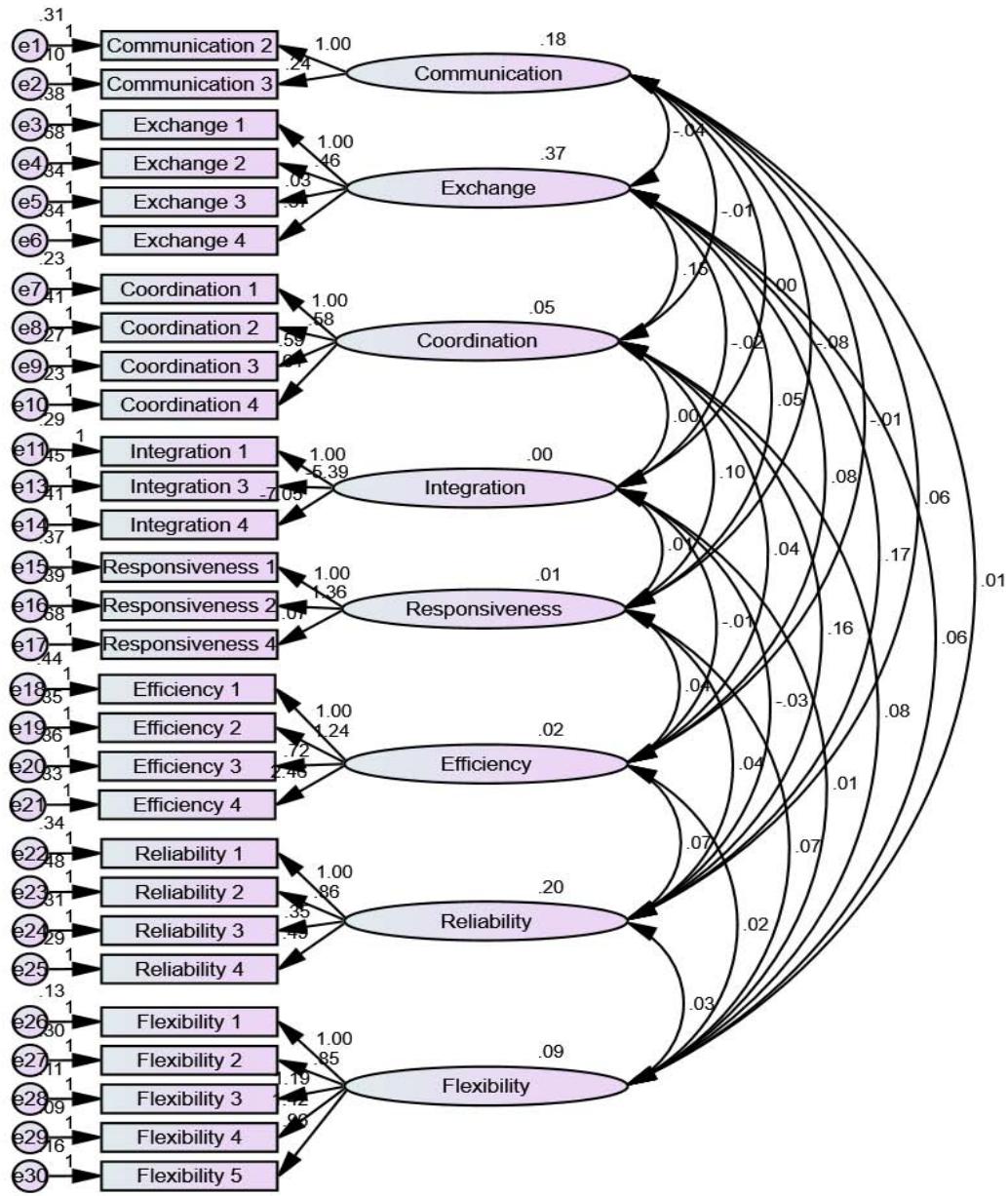
Following Fornell and Larcker (1981), we performed a confirmatory component evaluation (CFA) to determine the constructs in phrases of convergent validity, discriminant validity, and reliability. The effects of the CFA confirmed pretty desirable
Table 3: Fornell and Larcker (discriminant validity)
<table><tr><td>Exchange</td><td>Communication</td><td>Coordination</td><td>Integration</td><td>Responsiveness</td><td>Efficiency</td><td>Reliability</td><td>Flexibility</td></tr><tr><td>0.426</td><td></td><td></td><td></td><td></td><td></td><td></td><td></td></tr><tr><td>-0.162</td><td>0.485</td><td></td><td></td><td></td><td></td><td></td><td></td></tr><tr><td>1.157*</td><td>-0.115</td><td>0.288</td><td></td><td></td><td></td><td></td><td></td></tr><tr><td>-0.649</td><td>-0.15</td><td>0.152</td><td>0.374</td><td></td><td></td><td></td><td></td></tr><tr><td>0.83</td><td>-1.718†</td><td>4.360*</td><td>1.048</td><td>0.158</td><td></td><td></td><td></td></tr><tr><td>0.875</td><td>-0.194</td><td>1.113</td><td>-1.449</td><td>2.423</td><td>0.347</td><td></td><td></td></tr><tr><td>0.642*</td><td>0.316</td><td>1.634**</td><td>-1.137</td><td>0.787</td><td>0.962</td><td>0.453</td><td></td></tr><tr><td>0.331</td><td>0.105</td><td>1.216**</td><td>0.388</td><td>2.141*</td><td>0.46</td><td>0.251</td><td>0.651</td></tr></table>
The fit statistics: $\chi^2(59) = 112.329$, RMSEA=0.067, NFI=0.90, CFI=0.95, IFI=0.95, GFI=0.92, and SRMR=0.052. We used composite reliability (CR) and Cronbach's alpha to determine the reliability of all constructs. As proven in Table 3, all values of CR (ranging from 0.695 to 0.814) are greater than 0.7, suggesting sufficient reliability (Fornell and Larcker, 1981)
Table 4: Reliability and validity
<table><tr><td></td><td>CR</td><td>AVE</td><td>MSV</td><td>MaxR(H)</td></tr><tr><td>Exchange</td><td>0.780</td><td>0.181</td><td>1.34</td><td>0.551</td></tr><tr><td>Communication</td><td>0.757</td><td>0.235</td><td>2.951</td><td>0.413</td></tr><tr><td>Coordination</td><td>0.651</td><td>0.083</td><td>19.012</td><td>0.274</td></tr><tr><td>Integration</td><td>0.699</td><td>0.14</td><td>2.099</td><td>0.349</td></tr><tr><td>Responsiveness</td><td>0.685</td><td>0.025</td><td>19.012</td><td>0.073</td></tr><tr><td>Efficiency</td><td>0.713</td><td>0.12</td><td>5.872</td><td>0.385</td></tr><tr><td>Reliability</td><td>0.688</td><td>0.205</td><td>2.67</td><td>0.532</td></tr><tr><td>Flexibility</td><td>0.779</td><td>0.423</td><td>4.584</td><td>0.818</td></tr></table>
iii. Structural models and hypotheses test results In the current study, the hypotheses have been tested through constructing structural model using SEM.
Structural model provides a direct effect on the output file as unstandardised and standardised
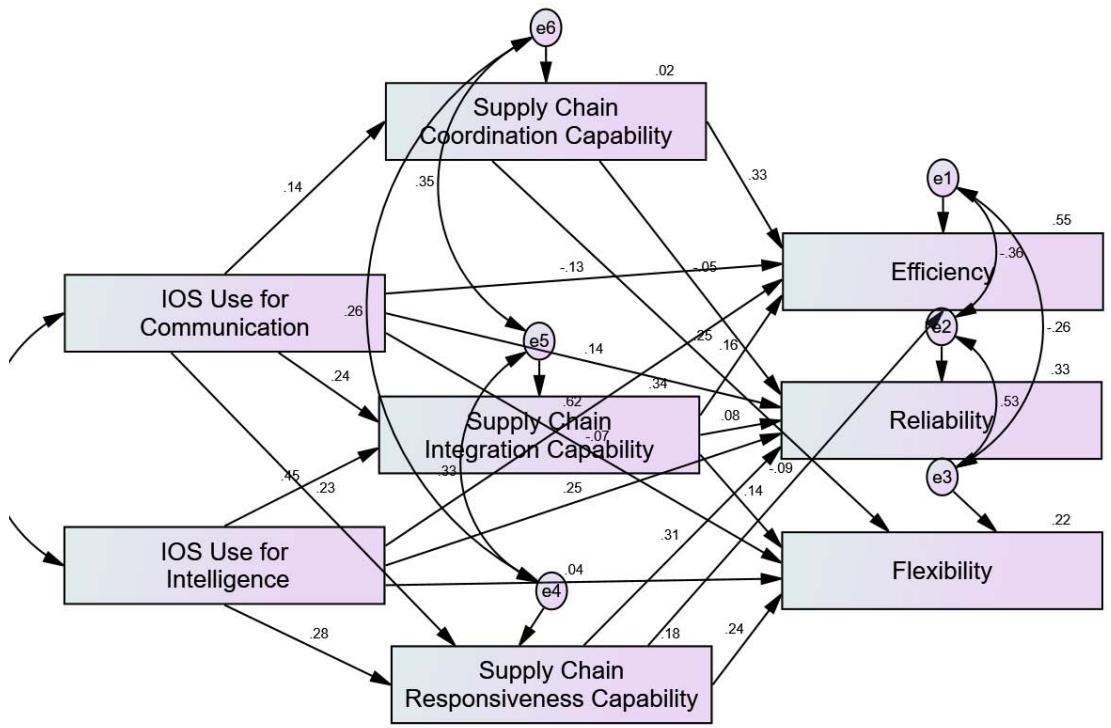 Figure 3: Shows the estimation results of the structural model. The goodness of fit indices were $\chi^2 = (2.277)$, DF=2, CMIN/DF= 1.138 with RMSEA=0.026, NFI=0.92,CFI=0.96, IFI=0.96, GFI=0.94, and SRMR=0.041, suggesting an acceptable fit.
Table 5: Direct Hypotheses Testing
<table><tr><td></td><td></td><td></td><td>Estimate</td><td>S.E.</td><td>C.R.</td><td>P</td><td>Result</td></tr><tr><td>Coordination</td><td><---</td><td>Communication</td><td>0.128</td><td>0.135</td><td>0.947</td><td>0.344</td><td>Not Supported</td></tr><tr><td>Integration</td><td><---</td><td>Communication</td><td>0.222</td><td>0.128</td><td>1.735</td><td>0.083</td><td>Not Supported</td></tr><tr><td>Responsiveness</td><td><---</td><td>Communication</td><td>0.18</td><td>0.118</td><td>1.529</td><td>0.126</td><td>Not Supported</td></tr><tr><td>Integration</td><td><---</td><td>Exchange</td><td>0.484</td><td>0.154</td><td>3.149</td><td>0.002</td><td>Supported</td></tr><tr><td>Responsiveness</td><td><---</td><td>Exchange</td><td>0.245</td><td>0.146</td><td>1.681</td><td>0.093</td><td>Not Supported</td></tr><tr><td>Efficiency</td><td><---</td><td>Communication</td><td>-0.126</td><td>0.114</td><td>-1.103</td><td>0.27</td><td>Not Supported</td></tr><tr><td>Reliability</td><td><---</td><td>Communication</td><td>0.13</td><td>0.134</td><td>0.965</td><td>0.334</td><td>Not Supported</td></tr><tr><td>Flexibility</td><td><---</td><td>Communication</td><td>-0.084</td><td>0.175</td><td>-0.481</td><td>0.631</td><td>Not Supported</td></tr><tr><td>Efficiency</td><td><---</td><td>Exchange</td><td>0.7</td><td>0.16</td><td>4.389</td><td>***</td><td>Supported</td></tr><tr><td>Reliability</td><td><---</td><td>Exchange</td><td>0.272</td><td>0.188</td><td>1.452</td><td>0.146</td><td>Not Supported</td></tr><tr><td>Flexibility</td><td><---</td><td>Exchange</td><td>0.053</td><td>0.244</td><td>0.217</td><td>0.828</td><td>Not Supported</td></tr><tr><td>Efficiency</td><td><---</td><td>Coordination</td><td>0.362</td><td>0.139</td><td>2.61</td><td>0.009</td><td>Supported</td></tr><tr><td>Reliability</td><td><---</td><td>Coordination</td><td>-0.054</td><td>0.163</td><td>-0.332</td><td>0.74</td><td>Not Supported</td></tr><tr><td>Flexibility</td><td><---</td><td>Coordination</td><td>0.316</td><td>0.212</td><td>1.494</td><td>0.135</td><td>Not Supported</td></tr><tr><td>Efficiency</td><td><---</td><td>Integration</td><td>0.162</td><td>0.148</td><td>1.097</td><td>0.273</td><td>Not Supported</td></tr><tr><td>Reliability</td><td><---</td><td>Integration</td><td>0.078</td><td>0.174</td><td>0.448</td><td>0.654</td><td>Not Supported</td></tr><tr><td>Flexibility</td><td><---</td><td>Integration</td><td>0.175</td><td>0.226</td><td>0.775</td><td>0.439</td><td>Not Supported</td></tr><tr><td>Efficiency</td><td><---</td><td>Responsiveness</td><td>-0.12</td><td>0.156</td><td>-0.769</td><td>0.442</td><td>Not Supported</td></tr><tr><td>Reliability</td><td><---</td><td>Responsiveness</td><td>0.377</td><td>0.184</td><td>2.05</td><td>0.04</td><td>Supported</td></tr><tr><td>Flexibility</td><td><---</td><td>Responsiveness</td><td>0.352</td><td>0.239</td><td>1.471</td><td>0.141</td><td>Not Supported</td></tr></table>
After doing a statistical study on the hypothesis, it was determined that the findings were statistically significant (95% confidence interval, 5,000 bootstrapping). The key details about the potential relationship routes are presented in Table 5. Some hypotheses were supported when the P value for statistical significance was used (P value 0.05), which supports the corresponding hypothesis. The other pathways showed statistically insignificant impacts, therefore their predicted linkages were unsupported.
From the data in the above table, we can derive the following results
- Communication do not have a positive influence on Coordination
- Communication do not have a positive influence on Integration
- Responsiveness do not have a positive influence on Communication
- Exchange has a positive influence on Responsiveness
- Exchange has a positive influence on Integration
- Communication does not have a positive influence on Efficiency
- Communication does not have a positive influence on Reliability
- Communication does not have a positive influence on Flexibility
- Exchange has a positive influence on Efficiency
- Exchange does not have a positive influence on Reliability
- Exchange does not have a positive influence on Flexibility
- Coordination has a positive influence on Efficiency
- Coordination does not have a positive influence on Reliability
- Coordination does not have a positive influence on Flexibility
- Integration does not have a positive influence on Efficiency
- Integration does not have a positive influence on Reliability
- Integration does not have a positive influence on Flexibility
- Responsiveness does not have a positive influence on Efficiency
- Responsiveness does not have a positive influence on Reliability
- Responsiveness does not have a positive influence on Flexibility
## iv. The mediation tests: indirect effects using the bootstrap approach
The indirect effects using the bootstrap approach (Bollen and Stine, 1990, Preacher and Hayes, 2004, Shrout and Bolger, 2002) it's different from Baron-
Kenny (1986) approach. the evidence are shows in the next Table.
Table 6: The Regression Path Coefficient for Indirect Effects
<table><tr><td></td><td>Exchange</td><td>Result</td><td>Communication</td><td>Result</td></tr><tr><td>Coordination</td><td>...</td><td></td><td>...</td><td></td></tr><tr><td>Flexibility</td><td>.250</td><td>No mediation</td><td>.356</td><td>No mediation</td></tr><tr><td>Reliability</td><td>.770</td><td>No mediation</td><td>.608</td><td>No mediation</td></tr><tr><td>Efficiency</td><td>.015</td><td>Full mediation</td><td>.551</td><td>No mediation</td></tr></table>
Table 7: Indirect Effects - Two Tailed Significance (BC) (Group number 1 - Default model)
<table><tr><td></td><td>Exchange</td><td>Result</td><td>Communication</td><td>Result</td></tr><tr><td>Integration</td><td>...</td><td></td><td>...</td><td></td></tr><tr><td>Flexibility</td><td>.032</td><td>Full mediation</td><td>.048</td><td>Full mediation</td></tr><tr><td>Reliability</td><td>.264</td><td>No mediation</td><td>.213</td><td>No mediation</td></tr><tr><td>Efficiency</td><td>.052</td><td>No mediation</td><td>.100</td><td>No mediation</td></tr></table>
Table 8: Indirect Effects - Two Tailed Significance (BC) (Group number 1 - Default model)
<table><tr><td></td><td>Exchange</td><td>Result</td><td>Communication</td><td>Result</td></tr><tr><td>Responsiveness</td><td>...</td><td></td><td>...</td><td></td></tr><tr><td>Flexibility</td><td>.024</td><td>Full mediation</td><td>.087</td><td>No mediation</td></tr><tr><td>Reliability</td><td>.020</td><td>Full mediation</td><td>.087</td><td>No mediation</td></tr><tr><td>Efficiency</td><td>.878</td><td>No mediation</td><td>.753</td><td>No mediation</td></tr></table>
- Coordination did not mediate the relationship between Exchange on Flexibility
- Coordination did not mediate the relationship between Communication on Flexibility
- Coordination did not mediate the relationship between Exchange on Reliability
- Coordination did not mediate the relationship between Communication on Reliability
- Coordination mediates the relationship between Exchange on Efficiency
- Coordination did not mediate the relationship between Communication on Efficiency
- Integration mediates the relationship between Exchange on Flexibility
- Integration mediates the relationship between Communication on Flexibility
- Integration did not mediate the relationship between Exchange on Reliability
- Integration did not mediate the relationship between Communication on Reliability
- Integration did not mediate the relationship between Exchange on Efficiency
- Integration did not mediate the relationship between Communication on Efficiency
- Responsiveness mediates the relationship between Exchange on Flexibility
- Responsiveness did not mediate the relationship between Communication on Flexibility
- Responsiveness mediates the relationship between Exchange on Reliability
- Responsiveness did not mediate the relationship between Communication on Reliability
- Responsiveness did not mediate the relationship between Exchange on Efficiency Responsiveness did not mediate the relationship between Communication on Efficiency
Table 9: Global Test
<table><tr><td></td><td>X2</td><td>DF</td></tr><tr><td>Unconstrained</td><td>15.089</td><td>2</td></tr><tr><td>Constrained</td><td>53.396</td><td>22</td></tr><tr><td>Difference</td><td>38.307</td><td>20</td></tr><tr><td>P-Value</td><td colspan="2">0.008</td></tr></table>
Interpretation: The p-value of the chi-square difference test is significant; the model differs across groups.
Table 10: Local Tests
<table><tr><td>Path Name</td><td>Male Beta</td><td>Female Beta</td><td>Difference in Betas</td><td>P-Value for Difference</td><td>Interpretation</td></tr><tr><td>Communication → Coordination.</td><td>0.218</td><td>0.096</td><td>0.123</td><td>0.841</td><td>NO</td></tr><tr><td>Communication → Integration.</td><td>0.159</td><td>0.301</td><td>-0.142</td><td>0.558</td><td>NO</td></tr><tr><td>Communication → Responsiveness.</td><td>0.091</td><td>0.415*</td><td>-0.323</td><td>0.193</td><td>YES</td></tr><tr><td>Exchange → Integration.</td><td>0.431†</td><td>0.493**</td><td>-0.062</td><td>1.000</td><td>NO</td></tr><tr><td>Exchange → Responsiveness.</td><td>0.101</td><td>0.380*</td><td>-0.279</td><td>0.365</td><td>YES</td></tr><tr><td>Communication → Efficiency.</td><td>-0.147</td><td>-0.085</td><td>-0.062</td><td>1.000</td><td>NO</td></tr><tr><td>Communication → Reliability.</td><td>0.054</td><td>0.118</td><td>-0.064</td><td>0.764</td><td>NO</td></tr><tr><td>Communication → Flexibility.</td><td>-0.370*</td><td>0.188</td><td>-0.558</td><td>0.112</td><td>YES</td></tr><tr><td>Exchange → Efficiency.</td><td>0.748***</td><td>0.553**</td><td>0.195</td><td>0.913</td><td>NO</td></tr><tr><td>Exchange → Reliability.</td><td>0.241</td><td>0.100</td><td>0.141</td><td>0.760</td><td>NO</td></tr><tr><td>Exchange → Flexibility.</td><td>-0.296</td><td>0.115</td><td>-0.410</td><td>0.286</td><td>NO</td></tr><tr><td>Coordination → Efficiency.</td><td>0.258</td><td>0.294†</td><td>-0.036</td><td>0.722</td><td>YES</td></tr><tr><td>Coordination → Reliability.</td><td>0.239</td><td>-0.226</td><td>0.466</td><td>0.192</td><td>NO</td></tr><tr><td>Coordination → Flexibility.</td><td>0.441*</td><td>0.187</td><td>0.254</td><td>0.453</td><td>YES</td></tr><tr><td>Integration → Efficiency.</td><td>-0.161</td><td>0.592**</td><td>-0.753</td><td>0.010</td><td>YES</td></tr><tr><td>Integration → Reliability.</td><td>0.037</td><td>0.106</td><td>-0.069</td><td>0.825</td><td>NO</td></tr><tr><td>Integration → Flexibility.</td><td>0.116</td><td>0.185</td><td>-0.070</td><td>0.786</td><td>NO</td></tr><tr><td>Responsiveness → Efficiency.</td><td>0.045</td><td>-0.418†</td><td>0.464</td><td>0.073</td><td>YES</td></tr><tr><td>Responsiveness → Reliability.</td><td>0.047</td><td>0.532†</td><td>-0.485</td><td>0.166</td><td>YES</td></tr><tr><td>Responsiveness → Flexibility.</td><td>0.171</td><td>0.172</td><td>-0.001</td><td>0.956</td><td>NO</td></tr></table>
- The positive relationship between Responsiveness and Communication is only significant for Female.
- The positive relationship between Responsiveness and Exchange is only significant for Female.
- The negative relationship between Flexibility and Communication is only significant for Male.
- The positive relationship between Efficiency and Coordination is only significant for Female.
- The positive relationship between Flexibility and Coordination is only significant for Male.
- The positive relationship between Efficiency and Integration is stronger for Female.
- The negative relationship between Efficiency and Responsiveness is stronger for Female.
- The positive relationship between Reliability and Responsiveness is only significant for Female.
## V. DISCUSSION
The results of the study provide initial verification of the effectiveness of the IT artefact in explaining the level of Firm performance of firms.
First: the relationship between IOS Use for Intelligence (exchange) has positively and significant influence on firm Performance (Efficiency, Reliability and
Flexibility)so, the rationale is to allow company to obtain information and then use it and exchange to get the benefit from the coordination and integration capabilities as it is supposed. In addition, companies are working to enhance the capabilities of information that helps business to became strong in their performance, which is directly reflected in the supply chain of companies. Therefore, this result is consistent with the results of previous studies that noted that the use of IOS in general enhances the ISO of supply chain management in general (Agbenyo et al. 2018; Asamoah et al. 2019; Asamoah et al. 2021a).
On the contrary, we find that IOS Use for Communication has not positively and significant influence on firm Performance (Efficiency, Reliability and Flexibility). consequently, this indicates that refer to Dal Foods industry is not leading to a staggering improvement in supply chain management capabilities specifically in IOS Use for (Communication). However, Communication were not correlated with higher supply chain response.
The results provide empirical support for prior studies on the IOS (exchange) in predicting the level of Firm performance of firms (Asamoah et al., 2019;
Hartono et al., 2010; Lee et al., 2014). The findings of the study revealed that the effect of IOS use on SCM performance was partially positive and significant. Accordingly, we find that the availability of integrated supply chain management systems for the company works to take advantage of opportunities to obtain insights from inside and outside the organization.
Second: the relationship between SCC (Responsiveness, Integration and Coordination) have not positively and significant influence on firm Performance (Efficiency, Reliability and Flexibility) Where confirmed (Williamson, Harrison, & Jordan, 2004). higher SCC can be leveraged to propel attainment of higher levels of Firm performance. on the complex interrelationship of IOS use and SCM cap- abilities in driving Firm performance, it is important for managers and business practitioners to aim at concurrently managing and deploying their IOS implementations and SCM capabilities, as this should create highest possible benefits in terms of Firm performance.
This result is confirmed by the results of the analysis of the mediator variable. Supply Chain Capabilities mediate the Inter-Organizational System use on firm Performance
### a) Implications
We have proposed and confirmed the construction by relying on structural equation modeling. Building the model consists of eight dimensions, and we found a positive relationship between inter-organizational system use (ISO) on the firm performance through the mediation of the supply chains capabilities. Therefore, company managers need to rely on such models because they have a positive impact on the performance of companies, and also the need to rely on the capabilities of supply chains because they positively affect performance. Finally, since SCMc mediates the relationship between ISO and firm performance, company managers must pay attention to these capabilities and for the purpose of learning about the value of ISO implementation.
### b) Limitations and future research
There were some limitations to the work. IOS use, SCC, onfirm performance. The complementary effect may not be linear and further examination of a potential non-linear relationship would provide additional insights. Also, as the study utilized data from only one context naduS in Africa, specifically Dall group future research may explore the phenomenon examined over multiple contexts.
Generating HTML Viewer...
References
20 Cites in Article
M Ali,E Abou (2020). Determinants of entrepreneurial intention among Sudanese university students.
Mohamed Ali,Emad Abou (2021). The effects of internal and external resource management on logistics performance.
M Ali,A Ibrahim,Rejal,E Abou (2021). The mediating role of technology perception in the relationship between customer experience and the adoption of e-payment cards during the COVID-19 pandemic.
D Asamoah,B Agyei-Owusu,F Andoh-Baidoo,E Ayaburi (2021). Inter-organizational systems use and supply chain performance: Mediating role of supply chain management capabilities.
C Defee,Brian Fugate (2010). Changing perspective of capabilities in the dynamic supply chain era.
Chuleeporn Changchit,Timothy Klaus,Alicha Treerotchananon (2021). Using Customer Review Systems to Support Purchase Decisions.
Chunyan Zhu,Xu Guo,Shaohui Zou (2022). Impact of information and communications technology alignment on supply chain performance in the Industry 4.0 era: mediation effect of supply chain integration.
Constantin Blome,Tobias Schoenherr,Daniel Rexhausen (2013). Antecedents and enablers of supply chain agility and its effect on performance: a dynamic capabilities perspective.
Haris Aslam,Constantin Blome,Samuel Roscoe,Tashfeen Azhar (2018). Dynamic supplychain capabilities.
Jun Han,Hun‐tong Tan (2010). Investors' Reactions to Management Earnings Guidance: The Joint Effect of Investment Position, News Valence, and Guidance Form.
Mei Cao,Qingyu Zhang (2013). Supply Chain Collaboration.
Muhammad Fawad Afraz,Sabeen Bhatti,Alberto Ferraris,Jerome Couturier (2021). The impact of supply chain innovation on competitive advantage in the construction industry: Evidence from a moderated multimediation model.
Paul Blaise Issockissock,Mercy Mpinganjira,Mornay Roberts-Lombard (2021). Unknown Title.
S Rahul,Arvind Mor,Sarbjit Bhardwaj,Singh,Kumar Vinkel,Arora (2020). Exploring the factors affecting supply chain performance in dairy industry using exploratory factor analysis technique.
(2021). Responsible AI and Analytics for an Ethical and Inclusive Digitized Society.
Unknown Title.
Teng Teng,Christos Tsinopoulos (2021). Understanding the link between IS capabilities and cost performance in services: the mediating role of supplier integration.
Wantao Yu,Roberto Chavez,Mark Jacobs,Mengying Feng (2018). Data-driven supply chain capabilities and performance: A resource-based view.
Yang Shuhui,Yu Zhang,Muhammad Umar,Adeel Shah (2021). Empirical Investigation to assess the impact of ICT deployment in Supply Chain Management.
Yang Yuan,Zhaofang Chu,Fujun Lai,Hao Wu (2020). The impact of transaction attributes on logistics outsourcing success: A moderated mediation model.
No ethics committee approval was required for this article type.
Data Availability
Not applicable for this article.
How to Cite This Article
Mohammed Idris Osman. 2026. \u201cImpact of Exchange and Communications Technology on Firm Performance: The Mediation Effect of Supply Chain Capabilities\u201d. Global Journal of Management and Business Research - A: Administration & Management GJMBR-A Volume 22 (GJMBR Volume 22 Issue A8).
Explore published articles in an immersive Augmented Reality environment. Our platform converts research papers into interactive 3D books, allowing readers to view and interact with content using AR and VR compatible devices.
Your published article is automatically converted into a realistic 3D book. Flip through pages and read research papers in a more engaging and interactive format.
Our website is actively being updated, and changes may occur frequently. Please clear your browser cache if needed. For feedback or error reporting, please email [email protected]
Thank you for connecting with us. We will respond to you shortly.