Understanding Tax Compliance in the Informal Sector in a Developing or Emergent Economy a Case Study of Nyarugenge District Rwanda

Article ID

5H1E7

Comprehensive study on tax laws in Nyarugenge district.

Understanding Tax Compliance in the Informal Sector in a Developing or Emergent Economy a Case Study of Nyarugenge District Rwanda

Dr Sazir Nsubuga Mayanja
Dr Sazir Nsubuga Mayanja University of Kigali
Akumuntu Joseph
Akumuntu Joseph
Shakira Namutebi Mayanja
DOI

Abstract

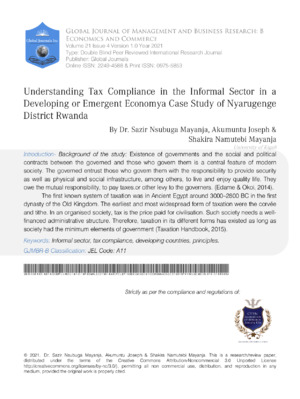
Background of the study: Existence of governments and the social and political contracts between the governed and those who govern them is a central feature of modern society. The governed entrust those who govern them with the responsibility to provide security as well as physical and social infrastructure, among others, to live and enjoy quality life. They owe the mutual responsibility, to pay taxes.or other levy to the governers. (Edame & Okoi, 2014). The first known system of taxation was in Ancient Egypt around 3000–2800 BC in the first dynasty of the Old Kingdom. The earliest and most widespread form of taxation were the corvée and tithe. In an organised society, tax is the price paid for civilisation. Such society needs a wellfinanced administrative structure. Therefore, taxation in its different forms has existed as long as society had the minimum elements of government (Taxation Handbook, 2015).

Understanding Tax Compliance in the Informal Sector in a Developing or Emergent Economy a Case Study of Nyarugenge District Rwanda

Background of the study: Existence of governments and the social and political contracts between the governed and those who govern them is a central feature of modern society. The governed entrust those who govern them with the responsibility to provide security as well as physical and social infrastructure, among others, to live and enjoy quality life. They owe the mutual responsibility, to pay taxes.or other levy to the governers. (Edame & Okoi, 2014). The first known system of taxation was in Ancient Egypt around 3000–2800 BC in the first dynasty of the Old Kingdom. The earliest and most widespread form of taxation were the corvée and tithe. In an organised society, tax is the price paid for civilisation. Such society needs a wellfinanced administrative structure. Therefore, taxation in its different forms has existed as long as society had the minimum elements of government (Taxation Handbook, 2015).

Dr Sazir Nsubuga Mayanja
Dr Sazir Nsubuga Mayanja University of Kigali
Akumuntu Joseph
Akumuntu Joseph
Shakira Namutebi Mayanja

No Figures found in article.

Dr Sazir Nsubuga Mayanja. 2021. “. Global Journal of Management and Business Research – B: Economic & Commerce GJMBR-B Volume 21 (GJMBR Volume 21 Issue B4): .

Download Citation

Journal Specifications

Crossref Journal DOI 10.17406/GJMBR

Print ISSN 0975-5853

e-ISSN 2249-4588

Issue Cover
GJMBR Volume 21 Issue B4
Pg. 13- 28
Classification
GJMBR-B Classification: JEL Code: A11
Keywords
Article Matrices
Total Views: 1911
Total Downloads: 893
2026 Trends
Research Identity (RIN)
Related Research
Our website is actively being updated, and changes may occur frequently. Please clear your browser cache if needed. For feedback or error reporting, please email [email protected]

Request Access

Please fill out the form below to request access to this research paper. Your request will be reviewed by the editorial or author team.
X

Quote and Order Details

Contact Person

Invoice Address

Notes or Comments

This is the heading

Lorem ipsum dolor sit amet, consectetur adipiscing elit. Ut elit tellus, luctus nec ullamcorper mattis, pulvinar dapibus leo.

High-quality academic research articles on global topics and journals.

Understanding Tax Compliance in the Informal Sector in a Developing or Emergent Economy a Case Study of Nyarugenge District Rwanda

Dr Sazir Nsubuga Mayanja
Dr Sazir Nsubuga Mayanja University of Kigali
Akumuntu Joseph
Akumuntu Joseph
Shakira Namutebi Mayanja

Research Journals