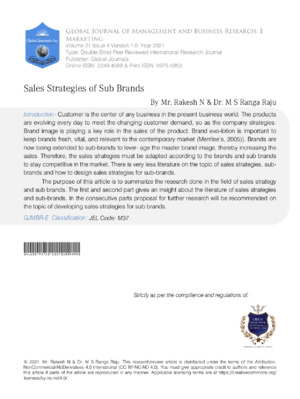
Sales Strategies of Sub Brands

Mr. Rakesh N
Mr. Rakesh N
Dr. M S Ranga Raju
Dr. M S Ranga Raju
Visvesvaraya Technological University

Send Message

To: Author

Sales Strategies of Sub Brands

Article Fingerprint

ReserarchID

NE120

Sales Strategies of Sub Brands Banner

AI TAKEAWAY

Connecting with the Eternal Ground
  • English
  • Afrikaans
  • Albanian
  • Amharic
  • Arabic
  • Armenian
  • Azerbaijani
  • Basque
  • Belarusian
  • Bengali
  • Bosnian
  • Bulgarian
  • Catalan
  • Cebuano
  • Chichewa
  • Chinese (Simplified)
  • Chinese (Traditional)
  • Corsican
  • Croatian
  • Czech
  • Danish
  • Dutch
  • Esperanto
  • Estonian
  • Filipino
  • Finnish
  • French
  • Frisian
  • Galician
  • Georgian
  • German
  • Greek
  • Gujarati
  • Haitian Creole
  • Hausa
  • Hawaiian
  • Hebrew
  • Hindi
  • Hmong
  • Hungarian
  • Icelandic
  • Igbo
  • Indonesian
  • Irish
  • Italian
  • Japanese
  • Javanese
  • Kannada
  • Kazakh
  • Khmer
  • Korean
  • Kurdish (Kurmanji)
  • Kyrgyz
  • Lao
  • Latin
  • Latvian
  • Lithuanian
  • Luxembourgish
  • Macedonian
  • Malagasy
  • Malay
  • Malayalam
  • Maltese
  • Maori
  • Marathi
  • Mongolian
  • Myanmar (Burmese)
  • Nepali
  • Norwegian
  • Pashto
  • Persian
  • Polish
  • Portuguese
  • Punjabi
  • Romanian
  • Russian
  • Samoan
  • Scots Gaelic
  • Serbian
  • Sesotho
  • Shona
  • Sindhi
  • Sinhala
  • Slovak
  • Slovenian
  • Somali
  • Spanish
  • Sundanese
  • Swahili
  • Swedish
  • Tajik
  • Tamil
  • Telugu
  • Thai
  • Turkish
  • Ukrainian
  • Urdu
  • Uzbek
  • Vietnamese
  • Welsh
  • Xhosa
  • Yiddish
  • Yoruba
  • Zulu
Font Type
Font Size
Font Size
Bedground

Abstract

Introduction-Customer is the center of any business in the present business world. The products are evolving every day to meet the changing customer demand, so as the company strategies. Brand image is playing a key role in the sales of the product. Brand evo-lotion is important to keep brands fresh, vital, and relevant to the contemporary market (Merrilee’s, 2005)). Brands are now being extended to sub-brands to lever-age the master brand image, thereby increasing the sales. Therefore, the sales strategies must be adapted according to the brands and sub brands to stay competitive in the market. There is very less literature on the topic of sales strategies, subbrands and how to design sales strategies for sub-brands.

References

69 Cites in Article
  1. L Chernatony (2001). A model for strategically building brands.
  2. Frederick Webster,Kevin Keller (2004). A roadmap for branding in industrial markets.
  3. F Schaefers (2015). Do Price Promotions Help or Hurt Premium-Product Brands.
  4. M Sawhney (1998). Leveraged High-Variety Strategies: From Portfolio Thinking to Platform Thinking.
  5. Bill Merrilees (2005). Radical Brand Evolution: A Case-Based Framework.
  6. A Krishnatray (2008). Rethinking Branding: The Need for a New Conceptual Framework to Analyze Customer-Based Brand Equity.
  7. P Cheng (2008). Sales Warriors: What Makes Brand Sales Performers Successful.
  8. H Peter,J Farquhar (1992). Strategies for Leveraging Master Brands.
  9. M Berk Ataman,Harald Van Heerde,A (2010). The Long-term Effect of Marketing Strategy on Brand Sales.
  10. Barbara Deleersnyder,Marnik Dekimpe,Miklos Sarvary,Philip Parker (2004). Weathering Tight Economic Times: The Sales Evolution of Consumer Durables Over the Business Cycle.
  11. H Peter,P Farquhar (1990). A Relational Model for Category Extensions of Brands.
  12. Artemisia Apostolopoulou (2002). Brand Extensions by U.S. Professional Sport Teams: Motivations and Keys to Success.
  13. D Aaker (1990). Brand Extensions: The Good, the Bad, and the Ugly.
  14. Helena Allman,Anton Fenik,Kelly Hewett,Felicia Morgan (2016). Brand Image Evaluations: The Interactive Roles of Country of Manufacture, Brand Concept, and Vertical Line Extension Type.
  15. C Thakor (1997). Branding Consumer Goods: Insights from Theory and Practice.
  16. P Doyle (1990). Building Successful Brands: Strategic Options.
  17. A Dengfeng Yan (2007). Can Incongruent Brand Extensions Be Superior Over Congruent Ones? The Influence of Preceding Extensions.
  18. Tom Buday (1989). Capitalizing on Brand Extensions.
  19. Carolyn Celebucki,Geoffrey Wayne,Gregory Connolly,James Pankow,Elsa Chang (2005). Characterization of measured menthol in 48 U.S. cigarette sub‐brands.
  20. D Keller (1990). Consumer Evaluations of Brand Extensions.
  21. B John (1993). Diluting Brand Beliefs: When Do Brand Extensions Have a Negative Impact.
  22. K Rahman (2013). Series Introduction: Meaning of Research and Research on (Brand) Meaning.
  23. K Zaveri (2013). Discovering Meaning: Deriving The Components of a Sub-brand.
  24. A Paul,B (2001). Do We Really Know How Consumers Evaluate Brand Extensions? Empirical Generalizations Based on Secondary Analysis of Eight Studies.
  25. S Siew Meng Leong (1997). Dominance and dilution: the effects of extending master brands.
  26. C Park,Sandra Milberg,Robert Lawson (1991). Evaluation of Brand Extensions: The Role of Product Feature Similarity and Brand Concept Consistency.
  27. Scott Davis (2002). Implementing your BAM<sup>2</sup> strategy: 11 steps to making your brand a more valuable business asset.
  28. Byron Sharp (1993). Managing brand extension.
  29. Q Yi He (2016). Managing sub-branding affect transfer: The Role of Consideration Set Size and Brand Loyalty.
  30. K Areni (2014). Marketing Strategies for Services: Is Brand Architecture a Viable Way Forward.
  31. M.-S Jo (2007). Should a quality sub-brand be located before or after the parent brand? An application of composite concept theory.
  32. B.-H Chan-Olmsted (2010). Success Factors of Cable Network Brand Extension: Focusing on the Parent Network, Composition, Fit, Consumer Characteristics, and Viewing Habits.
  33. A Keel (2015). The effects of adjacent competitors and promotion on brand sales.
  34. S Keller (2012). The Effects of Brand Name Structure on Brand Extension Evaluations and Parent Brand Dilution.
  35. D Katsanis (1995). Understanding brand equity for successful brand extension.
  36. Shannon Cummins,James Peltier,Robert Erffmeyer,Joel Whalen (2013). A Critical Review of the Literature for Sales Educators.
  37. F Jr (2005). A Perspective on the Evolution of Marketing Management.
  38. Jeff Johnson (2015). Broadening the application of mixed methods in sales research.
  39. V Zanina Kirovska BTL Activity as a tool in sales strategy and sustainability of competition in the Banking Sector.
  40. F Dwyer,Paul Schurr,Sejo Oh (1987). Developing Buyer-Seller Relationships.
  41. G Nikolaos,C Panagopoulos (2015). Does choice of sales control conceptualization matter? An empirical comparison of existing conceptualizations and directions for future research.
  42. Christian Homburg,Wayne Hoyer,Ruth Stock (2007). How to get lost customers back?.
  43. G Nikolaos,N Pangopoulos,-Y (2011). Internationalizing Sales Research: Current Status, Opportunities, and Challenges.
  44. M Hutt (1983). Leaders in Sales and Sales and Management.
  45. Paolo Guenzi,Luigi De Luca,Gabriele Troilo (2011). Organizational Drivers of Salespeople’s Customer Orientation and Selling Orientation.
  46. Jeff Johnson (2015). Qualitative sales research: an exposition of grounded theory.
  47. A Rinn (2016). Reinventing Advanced Sales: Focus on the Five Laws.
  48. S Kelly (2014). Sales-as-practice: an introduction and methodological outline.
  49. Géraldine Michel,Michaela Merk,Sevgin Eroglu (2015). Salesperson–brand relationship: main dimensions and impact within the context of private brand retailing.
  50. Cindy Rippé (2015). Show and Sell: Teaching Sales Through Hands-on Selling.
  51. Chui-Hua Liu,Gwo-Hshiung Tzeng,Ming-Huei Lee (2013). Strategies for improving cruise product sales using hybrid ‘multiple criteria decision making’ models.
  52. Ana Babic,Rosario,F (2016). The Effect of Electronic Word of Mouth on Sales: A Meta-Analytic Review of Platform, Product, and Metric Factors.
  53. Thomas Wotruba (1991). The Evolution of Personal Selling.
  54. Nicholas Mcclaren (2015). The Methodology in Empirical Sales Ethics Research: 1980–2010.
  55. M Friedrich (2015). The right pricing strategy for offline retailers when expanding into the online sales channel.
  56. Anthony Asare,Jing Yang,Thomas Brashear Alejandro (2012). The State of Research Methods in Personal Selling and Sales Management Literature.
  57. L William,A Cron (2014). The strategic role of the sales force: perceptions of senior sales executives.
  58. Mahmoud Darrat,Gary Wilcox,Venessa Funches,Mohamad Darrat (2016). Toward an Understanding of Causality Between Advertising and Sales: New Evidence from a Multivariate Cointegrated System.
  59. C William,G Moncrief (2000). Tracking Academic Research in Selling and Sales Management: Authors, Authorship, Academic Institutions and Journals.
  60. A Jr (2012). Transforming Selling: Why it is Time to Think Differently about Sales Research.
  61. George Franke,Adam Rapp,James “mick” Andzulis (2013). Using Shortened Scales in Sales Research: Risks, Benefits, and Strategies.
  62. K Aaker (1992). The Effects of Sequential Introduction of Brand Extensions.
  63. A Harleen Kaur (2015). Modelling Consumer Evaluation of Brand Extensions: Empirical Evidence from India.
  64. R Harish (2008). Association between Brand Architecture and Brand Concept-An Exploration Based on Primary Survey.
  65. H Pandit (2013). Consumer Evaluation of Brand Extension: Empirical Generalization and Comparitive Analysis.
  66. Y Xie (2007). Consumer Innovativeness and Acceptance of Brand Extensions.
  67. Kevin Keller,A (1992). The Effects of Corporate Images and Branding Strategies on New Product Evaluations.
  68. P Kotler (1996). Marketing management: An Asian perspective.
  69. J Tanner (2010). Marketing to power.

Funding

No external funding was declared for this work.

Conflict of Interest

The authors declare no conflict of interest.

Ethical Approval

No ethics committee approval was required for this article type.

Data Availability

Not applicable for this article.

How to Cite This Article

Mr. Rakesh N. 2021. \u201cSales Strategies of Sub Brands\u201d. Global Journal of Management and Business Research - E: Marketing GJMBR-E Volume 21 (GJMBR Volume 21 Issue E4).

Download Citation

Effective sales strategies for sub brands in market research. Enhance brand growth and customer engagement through targeted techniques.
Journal Specifications

Crossref Journal DOI 10.17406/GJMBR

Print ISSN 0975-5853

e-ISSN 2249-4588

Keywords
Classification
GJMBR-E Classification JEL Code: M37
Version of record

v1.2

Issue date
October 16, 2021

Language
en
Experiance in AR

Explore published articles in an immersive Augmented Reality environment. Our platform converts research papers into interactive 3D books, allowing readers to view and interact with content using AR and VR compatible devices.

Read in 3D

Your published article is automatically converted into a realistic 3D book. Flip through pages and read research papers in a more engaging and interactive format.

Article Matrices
Total Views: 1959
Total Downloads: 887
2026 Trends
Related Research
Our website is actively being updated, and changes may occur frequently. Please clear your browser cache if needed. For feedback or error reporting, please email [email protected]

Request Access

Please fill out the form below to request access to this research paper. Your request will be reviewed by the editorial or author team.
X

Quote and Order Details

Contact Person

Invoice Address

Notes or Comments

This is the heading

Lorem ipsum dolor sit amet, consectetur adipiscing elit. Ut elit tellus, luctus nec ullamcorper mattis, pulvinar dapibus leo.

High-quality academic research articles on global topics and journals.

Sales Strategies of Sub Brands

Mr. Rakesh N
Mr. Rakesh N <p>Visvesvaraya Technological University</p>
Dr. M S Ranga Raju
Dr. M S Ranga Raju

Research Journals